ESP VOLVO C70 2013 Owner´s Manual
[x] Cancel search | Manufacturer: VOLVO, Model Year: 2013, Model line: C70, Model: VOLVO C70 2013Pages: 296, PDF Size: 7.18 MB
Page 149 of 296
06 Starting and driving
Starting the vehicle
06
147 To start the engine
WARNING
Before starting, check that the seat, steering
wheel and mirrors are adjusted properly.
Make sure the brake pedal can be
depressed completely. Adjust the seat if
necessary.
1. Fasten the seat belt.
2. Apply the parking brake if not already set.
The gear selector should be locked in the
Park (P) position (Shiftlock). See also page
153.
NOTE
After a cold start, idle speed may be notice-
ably higher than normal for a short period.
This is done to help bring components in the
emission control system to their normal
operating temperature as quickly as possi-
ble, which enables them to control emis-
sions and help reduce the vehicle's impact
on the environment.
3. The vehicle is equipped with an autostart
feature. Without touching the throttle
pedal, turn the key to position III andrelease it. The starter motor will then oper-
ate automatically (for up to ten seconds)
until the engine starts. If the engine fails to
start, repeat this step.
CAUTION
If the engine does not start after the third try,
wait for approximately 3 minutes before try-
ing to start it again to give the battery time
to recover its starting capacity.
4. To release the gear selector from the Park
(P) position, the engine must be running (or
the ignition key must be in position II) and
the brake pedal must be depressed.
5. Select the desired gear. The gear engages
after a very slight delay, which is especially
noticeable when selecting R.
WARNING
•Never use more than one floor mat at a
time on the driver's floor. An extra mat
on the driver's floor can cause the
accelerator and/or brake pedal to
catch. Check that the movement of
these pedals is not impeded.
•Volvo's floor mats are specially manu-
factured for your car. They must be
firmly secured in the clips on the floor so
that they cannot slide and become trap-
ped under the pedals on the driver's
side.
Page 161 of 296
06 Starting and driving
Stability system
06
159
WARNING
The car's handling and stability characteris-
tics will be altered if the DSTC system func-
tions have been disabled.
DSTC-related messages in the text
window
•"TRACTION CONTROL TEMPORARILY
OFF" – The system has been temporarily
switched off due to high brake temperature
and will automatically switch on again
when the brakes have cooled.
•"ANTI-SKID SERVICE REQUIRED" – the
system has been automatically disen-
gaged due to a fault. A trained and qualified
Volvo service technician retailer should
check the system.
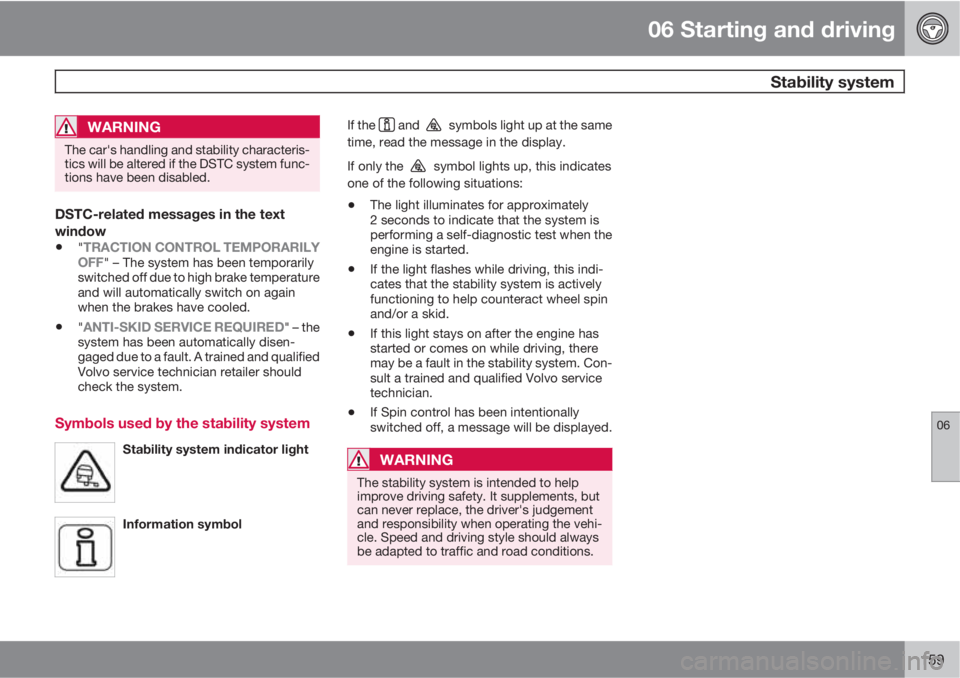
Symbols used by the stability system
Stability system indicator light
Information symbol
If the and symbols light up at the same
time, read the message in the display.
If only the
symbol lights up, this indicates
one of the following situations:
•The light illuminates for approximately
2 seconds to indicate that the system is
performing a self-diagnostic test when the
engine is started.
•If the light flashes while driving, this indi-
cates that the stability system is actively
functioning to help counteract wheel spin
and/or a skid.
•If this light stays on after the engine has
started or comes on while driving, there
may be a fault in the stability system. Con-
sult a trained and qualified Volvo service
technician.
•If Spin control has been intentionally
switched off, a message will be displayed.
WARNING
The stability system is intended to help
improve driving safety. It supplements, but
can never replace, the driver's judgement
and responsibility when operating the vehi-
cle. Speed and driving style should always
be adapted to traffic and road conditions.
Page 170 of 296
06 Starting and driving
Blind Spot Information System (BLIS)*
06
168* Option/accessory, for more information, see Introduction.
Introduction
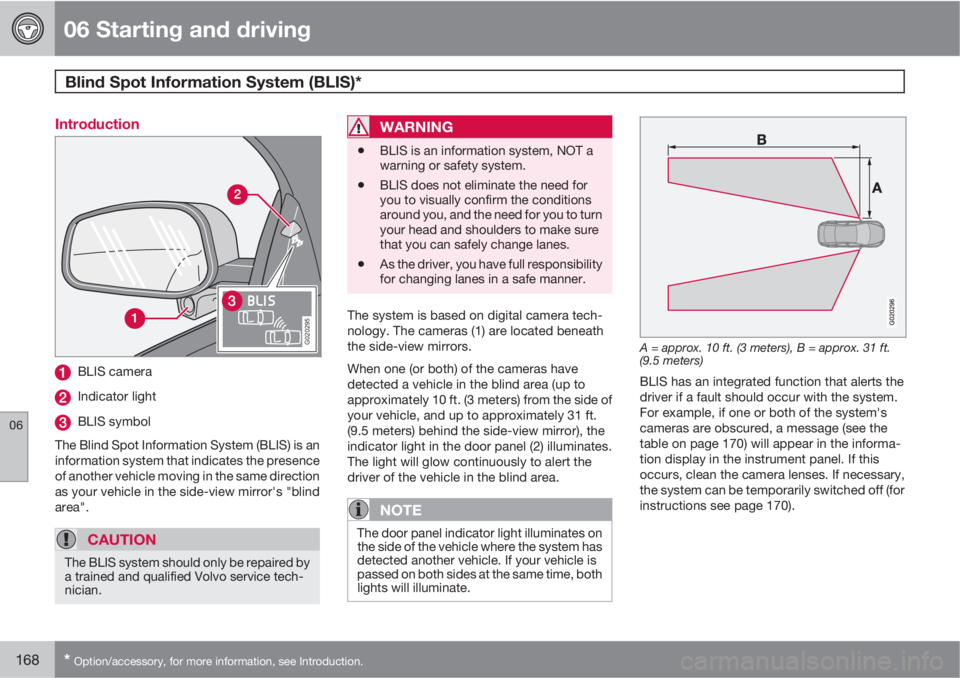
G020295
BLIS camera
Indicator light
BLIS symbol
The Blind Spot Information System (BLIS) is an
information system that indicates the presence
of another vehicle moving in the same direction
as your vehicle in the side-view mirror's "blind
area".
CAUTION
The BLIS system should only be repaired by
a trained and qualified Volvo service tech-
nician.
WARNING
•BLIS is an information system, NOT a
warning or safety system.
•BLIS does not eliminate the need for
you to visually confirm the conditions
around you, and the need for you to turn
your head and shoulders to make sure
that you can safely change lanes.
•As the driver, you have full responsibility
for changing lanes in a safe manner.
The system is based on digital camera tech-
nology. The cameras (1) are located beneath
the side-view mirrors.
When one (or both) of the cameras have
detected a vehicle in the blind area (up to
approximately 10 ft. (3 meters) from the side of
your vehicle, and up to approximately 31 ft.
(9.5 meters) behind the side-view mirror), the
indicator light in the door panel (2) illuminates.
The light will glow continuously to alert the
driver of the vehicle in the blind area.
NOTE
The door panel indicator light illuminates on
the side of the vehicle where the system has
detected another vehicle. If your vehicle is
passed on both sides at the same time, both
lights will illuminate.
A = approx. 10 ft. (3 meters), B = approx. 31 ft.
(9.5 meters)
BLIS has an integrated function that alerts the
driver if a fault should occur with the system.
For example, if one or both of the system's
cameras are obscured, a message (see the
table on page 170) will appear in the informa-
tion display in the instrument panel. If this
occurs, clean the camera lenses. If necessary,
the system can be temporarily switched off (for
instructions see page 170).
Page 180 of 296
07 Wheels and tires
General information
07
178
•The tires with the most tread should always
be at the rear (to reduce the risk of skid-
ding).
•Contact a Volvo workshop if you are
unsure about the tread depth.
Storing wheels and tiresWhen storing complete wheels (tires mounted
on rims), they should be suspended off the
floor or placed on their sides on the floor.
Tires not mounted on rims should be stored on
their sides or standing upright, but should not
be suspended.
CAUTION
Tires should preferably be stored in a cool,
dry, dark place, and should never be stored
in close proximity to solvents, gasoline, oils,
etc.
WARNING
•The wheel and tire sizes for your Volvo
are specified to meet stringent stability
and handling requirements. Unap-
proved wheel/tire size combinations
can negatively affect your vehicle's sta-
bility and handling.
•Any damage caused by installation of
unapproved wheel/tire size combina-
tions will not be covered by your new
vehicle warranty. Volvo assumes no
responsibility for death, injury, or
expenses that may result from such
installations.
Page 181 of 296
07 Wheels and tires
Tire inflation
07
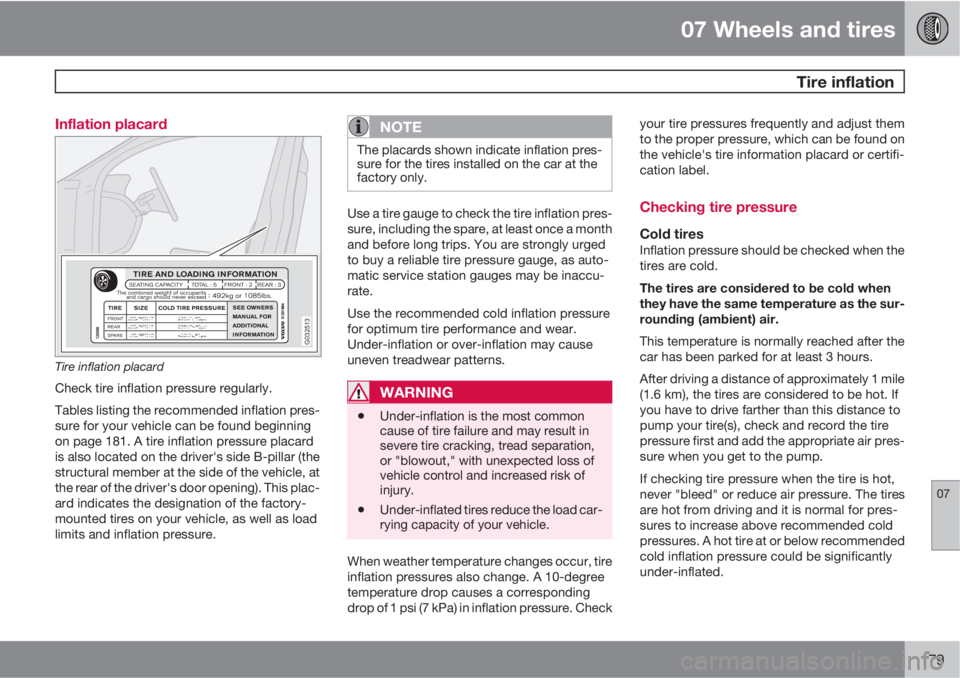
179 Inflation placard
G032513
Tire inflation placard
Check tire inflation pressure regularly.
Tables listing the recommended inflation pres-
sure for your vehicle can be found beginning
on page 181. A tire inflation pressure placard
is also located on the driver's side B-pillar (the
structural member at the side of the vehicle, at
the rear of the driver's door opening). This plac-
ard indicates the designation of the factory-
mounted tires on your vehicle, as well as load
limits and inflation pressure.
NOTE
The placards shown indicate inflation pres-
sure for the tires installed on the car at the
factory only.
Use a tire gauge to check the tire inflation pres-
sure, including the spare, at least once a month
and before long trips. You are strongly urged
to buy a reliable tire pressure gauge, as auto-
matic service station gauges may be inaccu-
rate.
Use the recommended cold inflation pressure
for optimum tire performance and wear.
Under-inflation or over-inflation may cause
uneven treadwear patterns.
WARNING
•Under-inflation is the most common
cause of tire failure and may result in
severe tire cracking, tread separation,
or "blowout," with unexpected loss of
vehicle control and increased risk of
injury.
•Under-inflated tires reduce the load car-
rying capacity of your vehicle.
When weather temperature changes occur, tire
inflation pressures also change. A 10-degree
temperature drop causes a corresponding
drop of 1 psi (7 kPa) in inflation pressure. Checkyour tire pressures frequently and adjust them
to the proper pressure, which can be found on
the vehicle's tire information placard or certifi-
cation label.
Checking tire pressure
Cold tiresInflation pressure should be checked when the
tires are cold.
The tires are considered to be cold when
they have the same temperature as the sur-
rounding (ambient) air.
This temperature is normally reached after the
car has been parked for at least 3 hours.
After driving a distance of approximately 1 mile
(1.6 km), the tires are considered to be hot. If
you have to drive farther than this distance to
pump your tire(s), check and record the tire
pressure first and add the appropriate air pres-
sure when you get to the pump.
If checking tire pressure when the tire is hot,
never "bleed" or reduce air pressure. The tires
are hot from driving and it is normal for pres-
sures to increase above recommended cold
pressures. A hot tire at or below recommended
cold inflation pressure could be significantly
under-inflated.
Page 189 of 296
07 Wheels and tires
Uniform tire quality gradings
07
187 Uniform tire quality gradings
ALL PASSENGER VEHICLE TIRES MUST
CONFORM TO FEDERAL SAFETY
REQUIREMENTS IN ADDITION TO THESE
GRADES
Quality grades can be found, where appli-
cable, on the tire sidewall between the tread
shoulder and maximum section width. For
example:
Treadwear 200 Traction AA
Temperature A
TREADWEARThe treadwear grade is a comparative rating
based on the wear rate of the tire when tested
under controlled conditions on a specified gov-
ernment test course. For example, a tire gra-
ded 150 would wear one and one half (1 1/2)
times as well on the government course as a
tire graded 100. The relative performance of
tires depends upon the actual conditions of
their use, however, and many depart signifi-
cantly from the norm due to variation in driving
habits, maintenance practices and differences
in road characteristics and climate.
TRACTIONThe traction grades, from highest to lowest, are
AA, A, B, and C, as measured under controlled
conditions on specified government test sur-faces of asphalt and concrete. A tire marked C
may have poor traction performance. The trac-
tion grade assigned to this tire is based on
braking (straight-ahead) traction tests and is
not a measure of cornering (turning) traction.
WARNING
The traction grade assigned to this tire is
based on braking (straight-ahead) traction
tests and is not a measure of cornering
(turning) traction.
TEMPERATUREThe temperature grades are A (the highest), B,
and C, representing the tire's resistance to the
generation of heat and its ability to dissipate
heat when tested under controlled conditions
on a specified indoor laboratory test wheel.
Sustained high temperature can cause the
material of the tire to degenerate and reduce
tire life, and excessive temperature can lead to
sudden tire failure. The grade C corresponds
to a minimum level of performance that all pas-
senger vehicle tires must meet under the Fed-
eral Motor Safety Standard No. 109. Grades B
and A represent higher levels of performance
on the laboratory test wheel than the minimum
required by law.
WARNING
The temperature grade for this tire is estab-
lished for a tire that is properly inflated and
not overloaded. Excessive speed, under-
inflation, or excessive loading, either sepa-
rately or in combination, can cause heat
buildup and tire failure.
Page 192 of 296
07 Wheels and tires
Tire Sealing System*
07
190* Option/accessory, for more information, see Introduction.
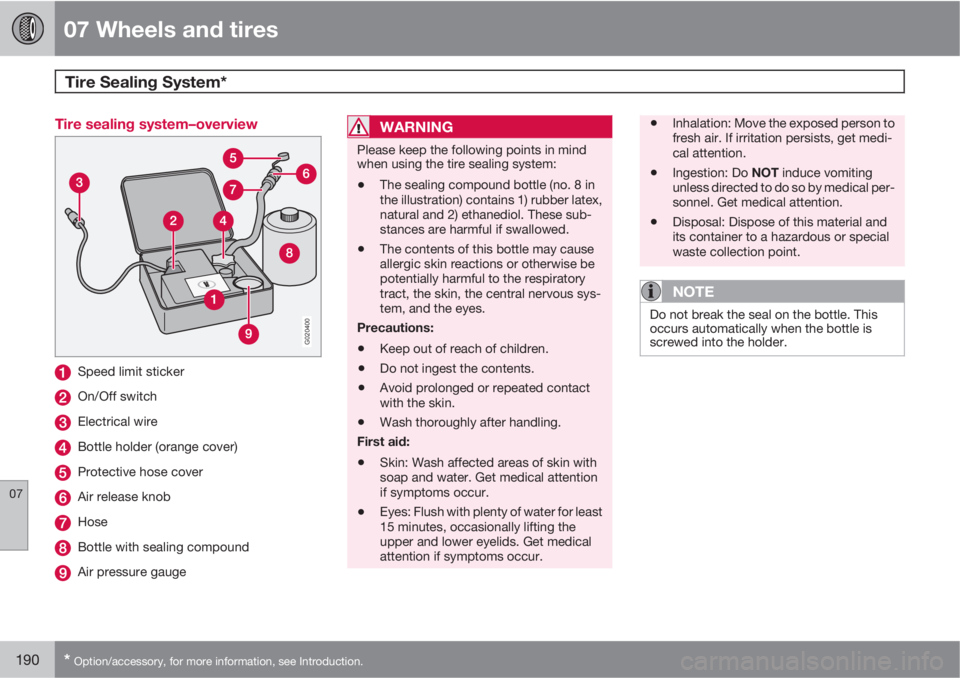
Tire sealing system–overview
G020400
Speed limit sticker
On/Off switch
Electrical wire
Bottle holder (orange cover)
Protective hose cover
Air release knob
Hose
Bottle with sealing compound
Air pressure gauge
WARNING
Please keep the following points in mind
when using the tire sealing system:
•The sealing compound bottle (no. 8 in
the illustration) contains 1) rubber latex,
natural and 2) ethanediol. These sub-
stances are harmful if swallowed.
•The contents of this bottle may cause
allergic skin reactions or otherwise be
potentially harmful to the respiratory
tract, the skin, the central nervous sys-
tem, and the eyes.
Precautions:
•Keep out of reach of children.
•Do not ingest the contents.
•Avoid prolonged or repeated contact
with the skin.
•Wash thoroughly after handling.
First aid:
•Skin: Wash affected areas of skin with
soap and water. Get medical attention
if symptoms occur.
•Eyes: Flush with plenty of water for least
15 minutes, occasionally lifting the
upper and lower eyelids. Get medical
attention if symptoms occur.
•Inhalation: Move the exposed person to
fresh air. If irritation persists, get medi-
cal attention.
•Ingestion: Do NOT induce vomiting
unless directed to do so by medical per-
sonnel. Get medical attention.
•Disposal: Dispose of this material and
its container to a hazardous or special
waste collection point.
NOTE
Do not break the seal on the bottle. This
occurs automatically when the bottle is
screwed into the holder.
Page 197 of 296
07 Wheels and tires
Temporary spare
07
195 Temporary spare
The spare tire in your vehicle1 is called a "Tem-
porary Spare".
Recommended tire pressure (see the placard
on the B-pillar or on the fuel filler door) should
be maintained irrespective of which position on
the car the temporary spare tire is used.
In the event of damage to this tire, a new one
can be purchased from your Volvo retailer.
WARNING
Current legislation prohibits the use of the
"Temporary Spare" tire other than as a tem-
porary replacement for a punctured tire. It
must be replaced as soon as possible by a
standard tire. Road holding and handling
may be affected with the "Temporary
Spare" in use. Do not exceed a speed of
50 mph (80 km/h) with the "Temporary
Spare" in use.
CAUTION
The car must not be driven with wheels of
different dimensions or with a spare tire
other than the one that came with the car.
The use of different size wheels can seri-
ously damage your car's transmission.
1Not on models equipped with the Tire sealing system.
Page 203 of 296
07 Wheels and tires
Tire Pressure Monitoring System (TPMS)
07
201 Introduction
The tire pressure monitoring system1 uses sen-
sors mounted in the tire valves to check infla-
tion pressure levels. When the vehicle is mov-
ing at a speed of approximately 20 mph
(30 km/h) or faster, these sensors transmit
inflation pressure data to a receiver located in
the vehicle.
NOTE
USA – FCC ID: KR5S122780002
This device complies with part 15 of the
FCC rules. Operation is subject to the fol-
lowing conditions: (1) This device may not
cause harmful interference, and (2) this
device must accept any interference
received, including interference that may
cause undesired operation.
When low inflation pressure is detected, TPMS
will light up the tire pressure warning light
(also referred to as a telltale) in the instrument
panel and will display one of the following mes-
sages in the text window:
LOW TIRE PRESS.
CHECK TIRES or TIRE PRESSURE LOW.
NOTE
If a fault occurs in TPMS, the tire pressure
warning light will flash for approximately
1 minute and
TIRE PRESS SYST
SERVICE REQUIRED will be displayed.
Each tire, including the spare (if provided),
should be checked monthly when cold and
inflated to the inflation pressure recommended
by the vehicle manufacturer on the vehicle
placard or tire inflation pressure label. (If your
vehicle has tires of a different size than the size
indicated on the vehicle placard or tire inflation
pressure label, you should determine the
proper tire inflation pressure for those tires.)
As an added safety feature, your vehicle has
been equipped with a tire pressure monitoring
system (TPMS) that illuminates a low tire pres-
sure telltale when one or more of your tires is
significantly under-inflated. Accordingly, when
the low tire pressure telltale illuminates, you
should stop and check your tires as soon as
possible, and inflate them to the proper pres-
sure. Driving on a significantly under-inflated
tire causes the tire to overheat and can lead to
tire failure. Under-inflation also reduces fuel
efficiency and tire tread life, and may affect the
vehicle's handling and stopping ability.Please note that the TPMS is not a substitute
for proper tire maintenance, and it is the driv-
er's responsibility to maintain correct tire pres-
sure, even if under-inflation has not reached
the level to trigger illumination of the TPMS low
tire pressure telltale.
Your vehicle has also been equipped with a
TPMS malfunction indicator to indicate when
the system is not operating properly. The
TPMS malfunction indicator is combined with
the low tire pressure telltale . When the system
detects a malfunction, the telltale will flash for
approximately one minute and then remain
continuously illuminated. This sequence will
continue upon subsequent vehicle start-ups as
long as the malfunction exists. When the mal-
function indicator is illuminated, the system
may not be able to detect or signal low tire
pressure as intended. TPMS malfunctions may
occur for a variety of reasons, including the
installation of replacement or alternate tires or
wheels on the vehicle that prevent the TPMS
from functioning properly. Always check the
TPMS malfunction telltale after replacing one
or more tires or wheels on your vehicle to
ensure that the replacement or alternate tires
and wheels allow the TPMS to continue to
function properly.
1U.S. models only
Page 209 of 296
08 Car care
Washing and cleaning the car
08
207
tant, especially in the winter. Some automatic
washers do not have facilities for washing the
underbody.
CAUTION
•Remove the antenna on the right rear
fender. This antenna should never be
bent in any way. Doing so could result
in damage or malfunction. When the
antenna is put back in position, turn it
carefully to help avoid damaging the
threads on the antenna's mount.
•Before driving into an automatic car
wash, turn off the optional rain sensor to
avoid damaging the windshield wipers.
•Make sure that side view mirrors, auxil-
iary lamps, etc, are secure.
•Chromed wheels: Clean chrome-
plated wheels using the same deter-
gents used for the body of the vehicle.
Aggressive wheel-cleaning agents can
permanently stain chrome-plated
wheels.
WARNING
•When the car is driven immediately after
being washed, apply the brakes several
times in order to remove any moisture
from the brake linings.
•Engine cleaning agents should not be
used when the engine is warm. This
constitutes a fire risk.
Exterior lightingCondensation may form temporarily on the
inside of the lenses of exterior lights such as
headlights, fog lights, or taillights. This is nor-
mal and the lights are designed to withstand
moisture. Normally, condensation will dissi-
pate after the lights have been on for a short
time.
Polishing and Waxing
•Normally, polishing is not required during
the first year after delivery, however, wax-
ing may be beneficial.
•Before applying polish or wax the vehicle
must be washed and dried. Tar spots can
be removed with kerosene or tar remover.
Difficult spots may require a fine rubbing
compound.
•After polishing use liquid or paste wax.
•Several commercially available products
contain both polish and wax.
•Waxing alone does not substitute for pol-
ishing a dull surface.
•A wide range of polymer-based waxes can
be purchased today. These waxes are easy
to use and produce a long-lasting, high-
gloss finish that protects the bodywork
against oxidation, road dirt and fading.
•Do not polish or wax your vehicle in direct
sunlight (the surface of the vehicle should
not be warmer than 113 °F (45 °C).
CAUTION
Volvo does not recommend the use of long-
life or durable paint protection coatings,
some of which may claim to prevent pitting,
fading, oxidation, etc. These coatings have
not been tested by Volvo for compatibility
with your vehicle's clear coat. Some of them
may cause the clear coat to soften, crack,
or cloud. Damage caused by application of
paint protection coatings may not be cov-
ered under your vehicle's paint warranty.