towing VOLVO C70 2013 Owner´s Manual
[x] Cancel search | Manufacturer: VOLVO, Model Year: 2013, Model line: C70, Model: VOLVO C70 2013Pages: 296, PDF Size: 7.18 MB
Page 171 of 296
06 Starting and driving
Blind Spot Information System (BLIS)*
06
* Option/accessory, for more information, see Introduction.169 When does BLIS function
The system functions when your vehicle is
moving at speeds above 6 mph (10 km/h).
When you pass another vehicle:
The system reacts when you pass another
vehicle at a speed of up to 6 mph (10 km/h)
faster than that vehicle.
When you are passed by another vehicle:
The system reacts if your vehicle is passed by
another vehicle at a speed of up to 43 mph
(70 km/h) faster than your vehicle.
WARNING
•BLIS does not function in sharp curves.
•BLIS does not function when your vehi-
cle is backing up.
•If you are towing a wide trailer, this may
prevent the BLIS cameras from detect-
ing other vehicles in adjacent lanes.
How BLIS functions in daylight and
darkness
Daylight
BLIS reacts to the shape of surrounding vehi-
cles. The system is designed to help detect
motor vehicles such as cars, trucks, buses,
motorcycles, etc.
DarknessBLIS reacts to the headlights of surrounding
vehicles. In order to be detected by BLIS, a
vehicle in the blind area must have its head-
lights on. This means, for example, that the
system will not detect a trailer without head-
lights that is being towed behind a car or truck.
WARNING
•BLIS does not react to cyclists or
mopeds.
•BLIS does not react to vehicles that are
standing still.
•The BLIS cameras have the same limi-
tation as the human eye. In other words,
their "vision is impaired" by adverse
weather conditions such as heavy
snowfall, intense light directly into the
camera, dense fog, etc.
LimitationsIn certain situations, the BLIS indicator light(s)
may illuminate even when there are no other
vehicles in the area monitored by the system.
NOTE
If the BLIS indicator lights illuminate occa-
sionally even when there are no other vehi-
cles in the blind area, this does not indicate
a fault in the system.
In the event of a fault,
Blind spot syst.
Service required will be displayed.
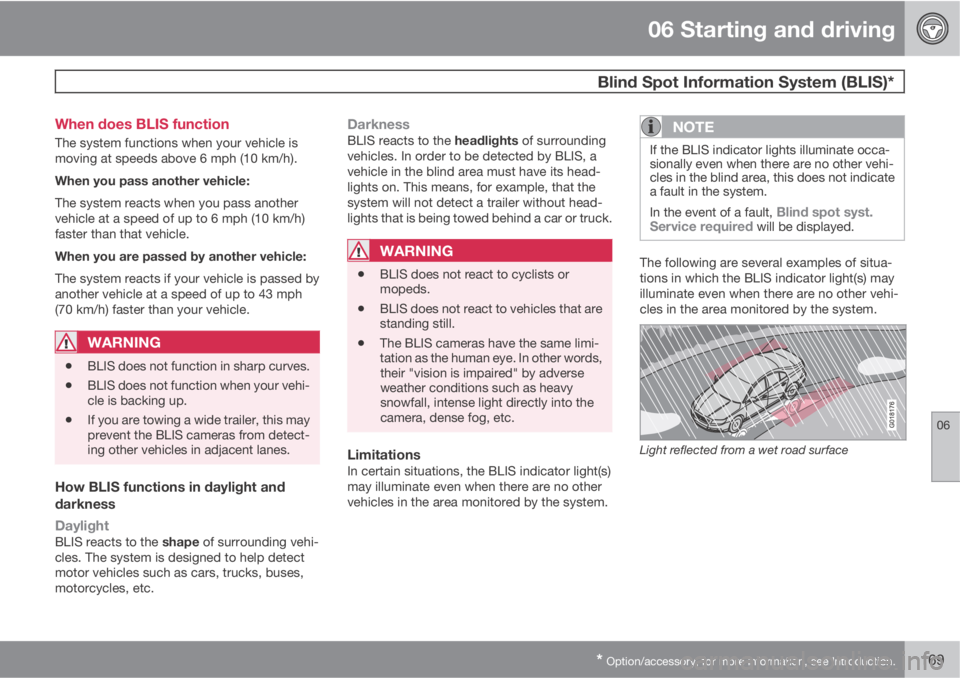
The following are several examples of situa-
tions in which the BLIS indicator light(s) may
illuminate even when there are no other vehi-
cles in the area monitored by the system.
Light reflected from a wet road surface
Page 174 of 296
06 Starting and driving
Rear park assist*
06
172* Option/accessory, for more information, see Introduction.
Introduction
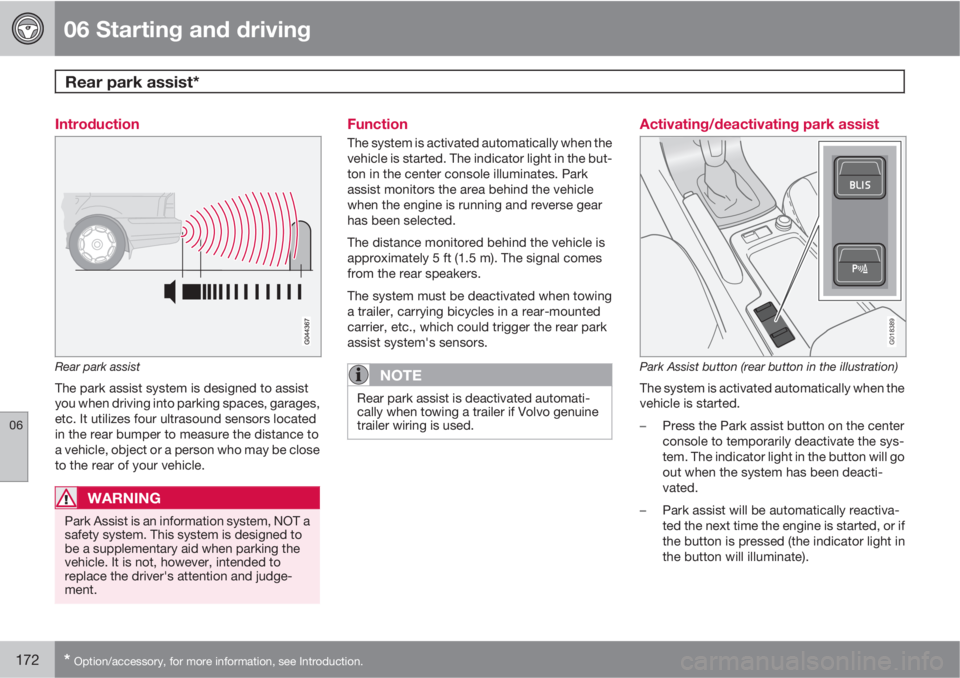
Rear park assist
The park assist system is designed to assist
you when driving into parking spaces, garages,
etc. It utilizes four ultrasound sensors located
in the rear bumper to measure the distance to
a vehicle, object or a person who may be close
to the rear of your vehicle.
WARNING
Park Assist is an information system, NOT a
safety system. This system is designed to
be a supplementary aid when parking the
vehicle. It is not, however, intended to
replace the driver's attention and judge-
ment.
Function
The system is activated automatically when the
vehicle is started. The indicator light in the but-
ton in the center console illuminates. Park
assist monitors the area behind the vehicle
when the engine is running and reverse gear
has been selected.
The distance monitored behind the vehicle is
approximately 5 ft (1.5 m). The signal comes
from the rear speakers.
The system must be deactivated when towing
a trailer, carrying bicycles in a rear-mounted
carrier, etc., which could trigger the rear park
assist system's sensors.
NOTE
Rear park assist is deactivated automati-
cally when towing a trailer if Volvo genuine
trailer wiring is used.
Activating/deactivating park assist
G018389
Park Assist button (rear button in the illustration)
The system is activated automatically when the
vehicle is started.
–Press the Park assist button on the center
console to temporarily deactivate the sys-
tem. The indicator light in the button will go
out when the system has been deacti-
vated.
–Park assist will be automatically reactiva-
ted the next time the engine is started, or if
the button is pressed (the indicator light in
the button will illuminate).
Page 187 of 296
07 Wheels and tires
Vehicle loading
07
185 Loading the vehicle
Before loading your vehicle, familiarize yourself
with the following terms for determining your
vehicle's weight ratings, with or without a
trailer, from the vehicle's Federal/Canadian
Motor Vehicle Safety Standards (FMVSS/
CMVSS) label, and the vehicle's tire informa-
tion placard:
Curb weightThe weight of the vehicle including a full tank
of fuel and all standard equipment. It does not
include passengers, cargo, or optional equip-
ment.
Capacity weightAll weight added to the curb weight, including
cargo and optional equipment. When towing,
trailer hitch tongue load is also part of cargo
weight.
NOTE
For trailer towing information, please refer to
the section "Towing a trailer", see
page 164.
Permissible axle weightThe maximum allowable weight that can be
carried by a single axle (front or rear). These
numbers are shown on the Federal/CanadianMotor Vehicle Safety Standards (FMVSS/
CMVSS) label. The total load on each axle must
never exceed its maximum permissible weight.
Gross vehicle weight (GVW)The vehicle's curb weight + cargo + passen-
gers.
NOTE
•The location of the various labels in your
vehicle can be found on page 270.
•A table listing important weight limits for
your vehicle can be found on page
273.
Steps for Determining Correct Load
Limit
1. Locate the statement "the combined
weight of occupants and cargo should
never exceed XXX pounds" on your vehi-
cle's placard.
2. Determine the combined weight of the
driver and passengers that will be riding in
your vehicle.3. Subtract the combined weight of the driver
and passengers from XXX kilograms or
XXX pounds.
4. The resulting figure equals the available
amount of cargo and luggage load
capacity. For example, if the "XXX" amount
equals 1400 lbs. and there will be five
150 lbs. passengers in your vehicle, the
amount of available cargo and luggage
load capacity is 650 lbs. (1400–750 (5×150)
= 650 lbs.)
5. Determine the combined weight of luggage
and cargo being loaded on the vehicle.
That weight may not safely exceed the
available cargo and luggage load capacity
calculated in Step 4.
6. If your vehicle will be towing a trailer, load
from your trailer will be transferred to your
vehicle. Consult this manual1 to determine
how this reduces the available cargo and
luggage load capacity of your vehicle.
1See "Towing a trailer"
Page 194 of 296
07 Wheels and tires
Tire Sealing System*
07
192* Option/accessory, for more information, see Introduction.
NOTE
Be sure that none of the other 12-volt sock-
ets is being used while the compressor is in
operation.
9. Start the vehicle’s engine.
10. Start the tire sealing system’s compressor
by pressing the on/off switch to position I.
WARNING
•Never stand next to the tire being inflated
when the compressor is in operation.
•If cracks, bubbles, etc. form on the tire,
switch off the compressor immediately.
•If there is visible damage to the sidewall
or the rim, the tire cannot be repaired.
The vehicle should not be driven if this
occurs. Contact a towing service or
Volvo On Call Roadside Assistance if
applicable.
NOTE
The air pressure gauge will temporarily
show an increase in pressure to approxi-
mately 88 psi (6 bar) while the sealing com-
pound is being pumped into the tire. The
pressure should return to a normal level
after approximately 30 seconds.
11. Within seven minutes, inflate the tire to
between 22—44 psi (1.8—3.0 bar). Switch
off the compressor briefly to get a clear
reading from the pressure gauge.
CAUTION
The compressor should not be used for
more than 10 minutes at a time to avoid
overheating.
WARNING
If the pressure remains below 22 psi
(1.8 bar) after approximately seven minutes,
turn off the compressor. In this case, the
hole is too large to be sealed and the vehicle
should not be driven.
12. Switch off the compressor and disconnect
the electrical wire from the 12-volt socket.13. Unscrew the hose from the tire’s inflation
valve and reinstall the valve cap.
14. Immediately drive the vehicle for approxi-
mately 2 miles (3 km) at a maximum speed
of 50 mph (80 km/h) to distribute the seal-
ing compound in the tire.
CAUTION
If your vehicle is equipped with the Tire
Pressure Monitoring System (TPMS), the
use of the sealing compound may lead to
incorrect tire pressure readings or in rare
cases, damage to the tire pressure sensor.
Use the tire sealing system to check and
adjust the damaged tire's inflation pressure.
NOTE
•Safely stow the tire sealing system in a
convenient place as it will soon be used
again to check the tire’s inflation pres-
sure.
•The empty bottle of sealing compound
cannot be removed from the bottle
holder. Consult a trained and qualified
Volvo service technician to have the
bottle removed and properly disposed
of.
Page 278 of 296
11 Specifications
Fuel, oils, and fluids
11
276
NOTE
The transmission oil does not normally need
to be changed during the service life of the
vehicle. However, it may be necessary to
replace the oil if the vehicle is often driven
in areas of sustained temperature extremes
(hot or cold), when towing a trailer over long
distances, for prolonged driving in moun-
tainous areas, or if the vehicle is often driven
short distances in temperatures under 40 °F
(5 °C).
Page 290 of 296
12 Index
12
288
Electronic Brake Force Distribution (EBD) 155
Electronic Climate Control......................... 89
air distribution table.............................. 95
Electronic Climate Control (ECC)............... 91
Emergency brake..................................... 157
Emergency locking retractor...................... 40
Emergency starting.................................. 163
Emergency towing................................... 160
Emission inspection readiness................ 215
Engine
specifications...................................... 278
starting................................................ 147
starting with keyless drive.................. 149
Engine compartment overview................218
Engine oil.........................................219, 277
changing............................................. 219
checking............................................. 219
volumes.............................................. 275
Environment............................................... 13
Equalizer, audio system........................... 249
Eyelets for anchoring loads..................... 117F
Federal Clean Air Act............................... 214
Flat tires
changing..................................... 196, 199
repairing with tire sealing system....... 189
Floor mats
cleaning.............................................. 209
placing correctly.........................147, 149
Fluids and oils.......................................... 275
FM1/FM2 menu....................................... 251
Fog lights
front...................................................... 66
rear........................................................ 66
Front airbags.............................................. 25
disconnecting passenger’s side airbag 29
Front fog lights........................................... 66
Front seats................................................. 98
accessing the rear seat........................ 98
adjusting the head restraints.............. 103
manually operated................................ 98
power.................................................. 101
Fuel filler door
opening manually................................. 67
unlocking.............................................. 67
Fuel gauge................................................. 54Fuel requirements.................................... 143
Fuel tank volume.....................................275
Fuses, replacing......................................234
G
Garage door opener
HomeLink® Wireless Control System. . . 83
Gasoline requirements............................. 143
Geartronic................................................ 152
Glossary of tire terminology..................... 184
Glove compartment................................. 113
locking................................................ 134
Gross vehicle weight (GVW)............185, 273
H
Hand brake (parking brake)..................... 157
Hazard warning flashers............................ 76
HD digital radio........................................ 253
Headlights.................................................. 64
Active Bending Lights........................... 64
changing bulbs................................... 226
Page 294 of 296
12 Index
12
292
tire pressure monitoring system......... 201
tire sealing system.............................. 189
tread wear indicator............................ 177
uniform tire quality grading................. 187
winter driving...................................... 188
Tire sealing system.................................. 189
Towing a trailer........................................ 164
trailer hitch.......................................... 166
Towing the vehicle................................... 160
Trailer hitch - detachable......................... 166
Trailer towing........................................... 164
Transmission
Geartronic........................................... 152
shiftlock override................................ 153
Tread wear indicator................................ 177
Treble....................................................... 248
Trip computer............................................ 70
Trips, long distance................................. 142
Trunk
loading................................................116
opening from the inside...................... 133
opening mechanically......................... 133
Trunk divider (Power retractable hard top) 106
Turn signals............................................... 68
indicator lights...................................... 54U
Uniform Tire Quality Grading...................187
V
Valet locking............................................ 126
Vehicle dimensions.................................. 272
Vehicle loading........................................ 185
Vehicle maintenance................................ 214
performed by the owner.....................215
Vehicle towing.........................................160
Vehicle weights........................................ 273
VIN (Vehicle Identification Number)......... 271
Volvo and the environment........................ 13
Volvo maintenance.................................. 214
Volvo On Call Roadside Assistance........ 284
W
Warning flashers, hazard........................... 76
Warning symbol......................................... 56
Warranties................................................ 214Washer fluid..................................... 221, 275
Washer fluid reservoir......................218, 221
Water, driving through............................. 140
Weights.................................................... 273
Wheel nuts............................................... 198
Wheels.....................................................176
changing............................................. 199
storing................................................. 178
Whiplash Protection System (WHIPS)....... 35
Wind blocker (power retractable hard top)
(Power retractable hard top).................... 109
Windows
power.................................................... 77
Windshield washer fluid reservoir............218
Windshield wiper blades.......................... 223
Windshield wipers...................................... 74
rain sensor............................................ 75
Winter tires............................................... 188
Wiper blades
replacing............................................. 223