weight VOLVO C70 2013 Owner´s Manual
[x] Cancel search | Manufacturer: VOLVO, Model Year: 2013, Model line: C70, Model: VOLVO C70 2013Pages: 296, PDF Size: 7.18 MB
Page 43 of 296
01 Safety
Child restraint systems01
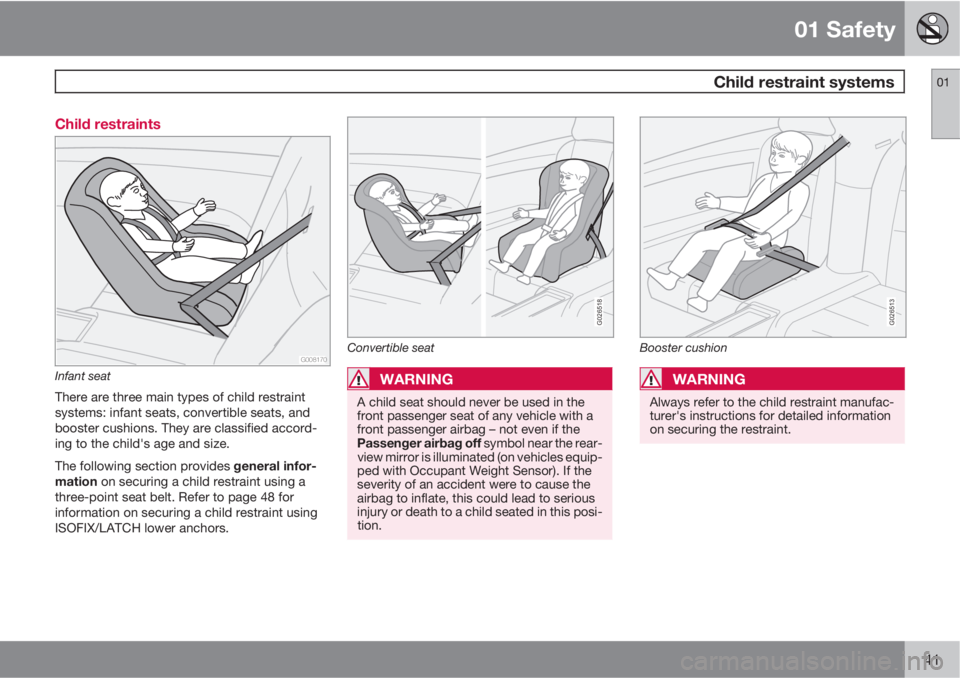
41 Child restraints
G008170
Infant seat
There are three main types of child restraint
systems: infant seats, convertible seats, and
booster cushions. They are classified accord-
ing to the child's age and size.
The following section provides general infor-
mation on securing a child restraint using a
three-point seat belt. Refer to page 48 for
information on securing a child restraint using
ISOFIX/LATCH lower anchors.
G026518
Convertible seat
WARNING
A child seat should never be used in the
front passenger seat of any vehicle with a
front passenger airbag – not even if the
Passenger airbag off symbol near the rear-
view mirror is illuminated (on vehicles equip-
ped with Occupant Weight Sensor). If the
severity of an accident were to cause the
airbag to inflate, this could lead to serious
injury or death to a child seated in this posi-
tion.
G026513
Booster cushion
WARNING
Always refer to the child restraint manufac-
turer's instructions for detailed information
on securing the restraint.
Page 44 of 296
01 Safety
Child restraint systems 01
42
WARNING
•When not in use, keep the child restraint
system secured or remove it from the
passenger compartment to help pre-
vent it from injuring passengers in the
event of a sudden stop or collision.
•A small child's head represents a con-
siderable part of its total weight and its
neck is still very weak. Volvo recom-
mends that children up to age 4 travel,
properly restrained, facing rearward. In
addition, Volvo recommends that chil-
dren should ride rearward facing, prop-
erly restrained, as long as possible.
•The following text is mandated by
Canadian legislation: The Volvo C70 is
not equipped with top tether anchors.
Child restraints or booster cushions
requiring anchors of this kind cannot be
properly fastened and should not be
used in this vehicle.
Page 45 of 296
01 Safety
Infant seats01
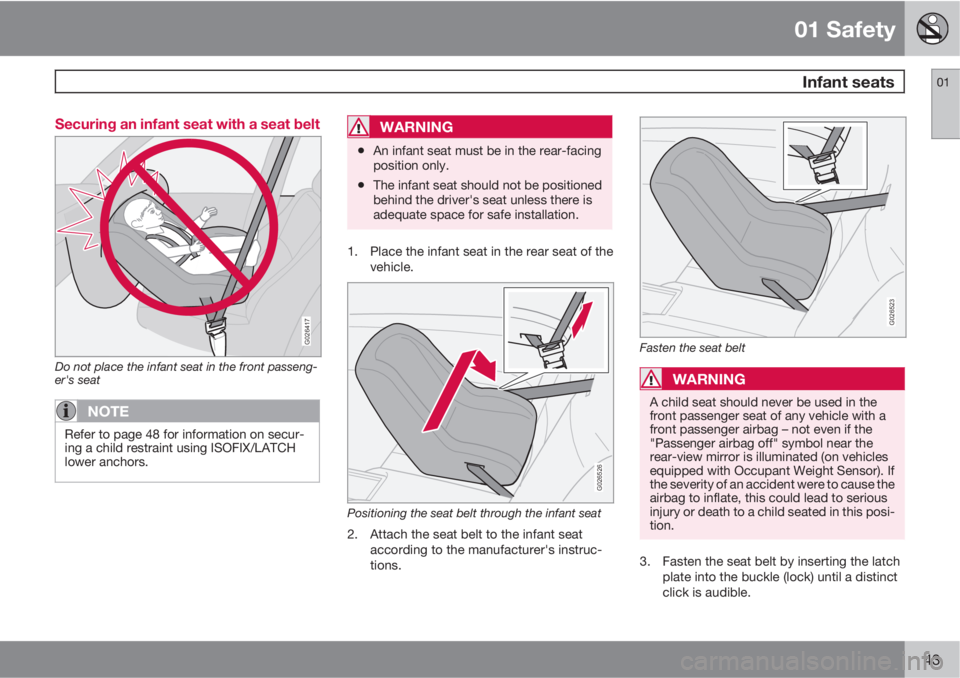
43 Securing an infant seat with a seat belt
G026417
Do not place the infant seat in the front passeng-
er's seat
NOTE
Refer to page 48 for information on secur-
ing a child restraint using ISOFIX/LATCH
lower anchors.
WARNING
•An infant seat must be in the rear-facing
position only.
•The infant seat should not be positioned
behind the driver's seat unless there is
adequate space for safe installation.
1. Place the infant seat in the rear seat of the
vehicle.
G026526
Positioning the seat belt through the infant seat
2. Attach the seat belt to the infant seat
according to the manufacturer's instruc-
tions.
G026523
Fasten the seat belt
WARNING
A child seat should never be used in the
front passenger seat of any vehicle with a
front passenger airbag – not even if the
"Passenger airbag off" symbol near the
rear-view mirror is illuminated (on vehicles
equipped with Occupant Weight Sensor). If
the severity of an accident were to cause the
airbag to inflate, this could lead to serious
injury or death to a child seated in this posi-
tion.
3. Fasten the seat belt by inserting the latch
plate into the buckle (lock) until a distinct
click is audible.
Page 47 of 296
01 Safety
Convertible seats01
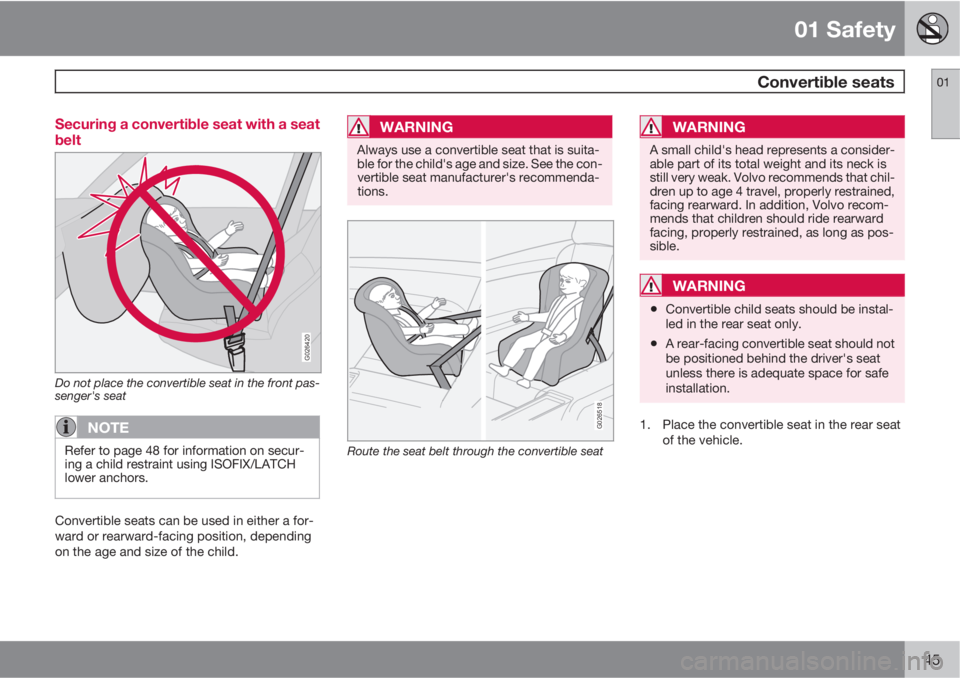
45 Securing a convertible seat with a seat
belt
G026420
Do not place the convertible seat in the front pas-
senger's seat
NOTE
Refer to page 48 for information on secur-
ing a child restraint using ISOFIX/LATCH
lower anchors.
Convertible seats can be used in either a for-
ward or rearward-facing position, depending
on the age and size of the child.
WARNING
Always use a convertible seat that is suita-
ble for the child's age and size. See the con-
vertible seat manufacturer's recommenda-
tions.
G026518
Route the seat belt through the convertible seat
WARNING
A small child's head represents a consider-
able part of its total weight and its neck is
still very weak. Volvo recommends that chil-
dren up to age 4 travel, properly restrained,
facing rearward. In addition, Volvo recom-
mends that children should ride rearward
facing, properly restrained, as long as pos-
sible.
WARNING
•Convertible child seats should be instal-
led in the rear seat only.
•A rear-facing convertible seat should not
be positioned behind the driver's seat
unless there is adequate space for safe
installation.
1. Place the convertible seat in the rear seat
of the vehicle.
Page 49 of 296
01 Safety
Booster cushions01
47 Securing a booster cushion
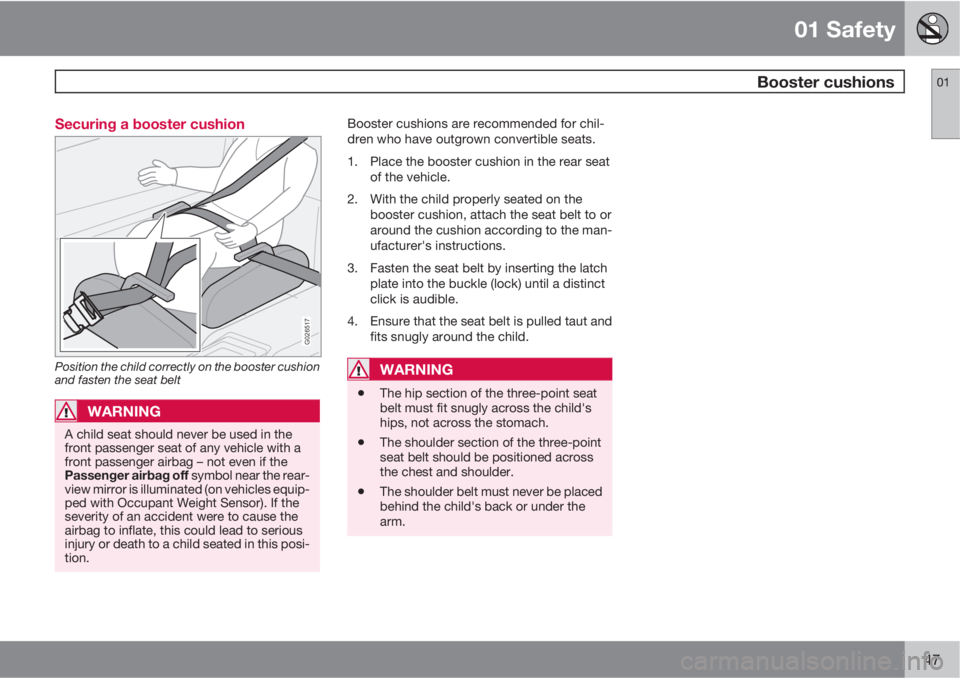
G026517
Position the child correctly on the booster cushion
and fasten the seat belt
WARNING
A child seat should never be used in the
front passenger seat of any vehicle with a
front passenger airbag – not even if the
Passenger airbag off symbol near the rear-
view mirror is illuminated (on vehicles equip-
ped with Occupant Weight Sensor). If the
severity of an accident were to cause the
airbag to inflate, this could lead to serious
injury or death to a child seated in this posi-
tion.
Booster cushions are recommended for chil-
dren who have outgrown convertible seats.
1. Place the booster cushion in the rear seat
of the vehicle.
2. With the child properly seated on the
booster cushion, attach the seat belt to or
around the cushion according to the man-
ufacturer's instructions.
3. Fasten the seat belt by inserting the latch
plate into the buckle (lock) until a distinct
click is audible.
4. Ensure that the seat belt is pulled taut and
fits snugly around the child.
WARNING
•The hip section of the three-point seat
belt must fit snugly across the child's
hips, not across the stomach.
•The shoulder section of the three-point
seat belt should be positioned across
the chest and shoulder.
•The shoulder belt must never be placed
behind the child's back or under the
arm.
Page 50 of 296
01 Safety
ISOFIX/LATCH lower anchors 01
48
Using the ISOFIX/LATCH lower child
seat anchors
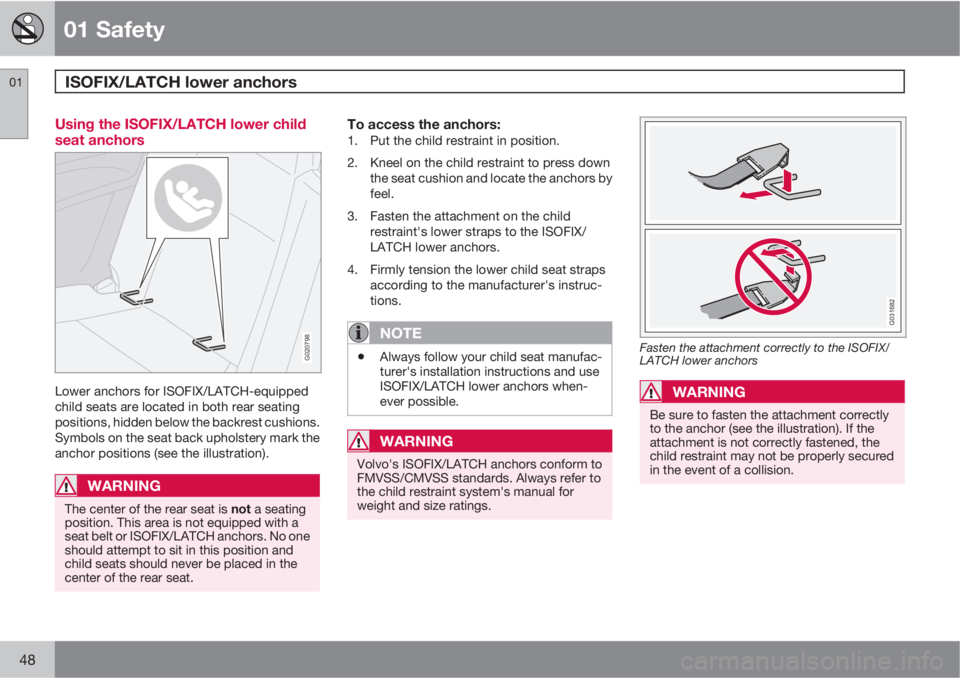
G020798
Lower anchors for ISOFIX/LATCH-equipped
child seats are located in both rear seating
positions, hidden below the backrest cushions.
Symbols on the seat back upholstery mark the
anchor positions (see the illustration).
WARNING
The center of the rear seat is not a seating
position. This area is not equipped with a
seat belt or ISOFIX/LATCH anchors. No one
should attempt to sit in this position and
child seats should never be placed in the
center of the rear seat.
To access the anchors:1. Put the child restraint in position.
2. Kneel on the child restraint to press down
the seat cushion and locate the anchors by
feel.
3. Fasten the attachment on the child
restraint's lower straps to the ISOFIX/
LATCH lower anchors.
4. Firmly tension the lower child seat straps
according to the manufacturer's instruc-
tions.
NOTE
•Always follow your child seat manufac-
turer's installation instructions and use
ISOFIX/LATCH lower anchors when-
ever possible.
WARNING
Volvo's ISOFIX/LATCH anchors conform to
FMVSS/CMVSS standards. Always refer to
the child restraint system's manual for
weight and size ratings.
G031682
Fasten the attachment correctly to the ISOFIX/
LATCH lower anchors
WARNING
Be sure to fasten the attachment correctly
to the anchor (see the illustration). If the
attachment is not correctly fastened, the
child restraint may not be properly secured
in the event of a collision.
Page 55 of 296
02 Instruments and controls
Instrument overview
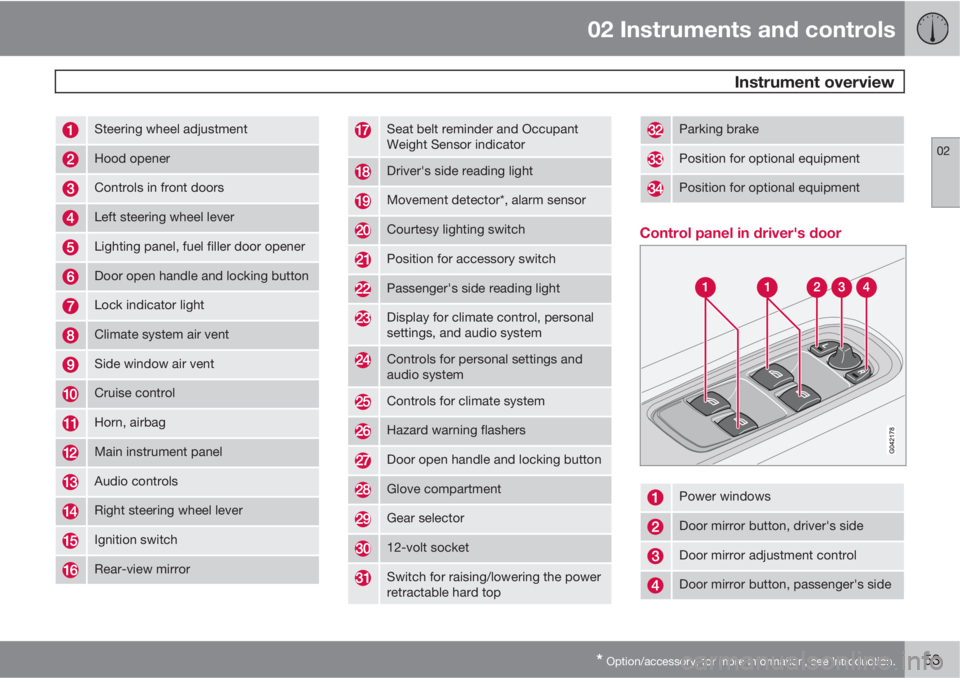
02
* Option/accessory, for more information, see Introduction.53
Steering wheel adjustment
Hood opener
Controls in front doors
Left steering wheel lever
Lighting panel, fuel filler door opener
Door open handle and locking button
Lock indicator light
Climate system air vent
Side window air vent
Cruise control
Horn, airbag
Main instrument panel
Audio controls
Right steering wheel lever
Ignition switch
Rear-view mirror
Seat belt reminder and Occupant
Weight Sensor indicator
Driver's side reading light
Movement detector*, alarm sensor
Courtesy lighting switch
Position for accessory switch
Passenger's side reading light
Display for climate control, personal
settings, and audio system
Controls for personal settings and
audio system
Controls for climate system
Hazard warning flashers
Door open handle and locking button
Glove compartment
Gear selector
12-volt socket
Switch for raising/lowering the power
retractable hard top
Parking brake
Position for optional equipment
Position for optional equipment
Control panel in driver's door
Power windows
Door mirror button, driver's side
Door mirror adjustment control
Door mirror button, passenger's side
Page 120 of 296
04 Interior
Trunk
04
118
Carrying long loads (ski hatch)
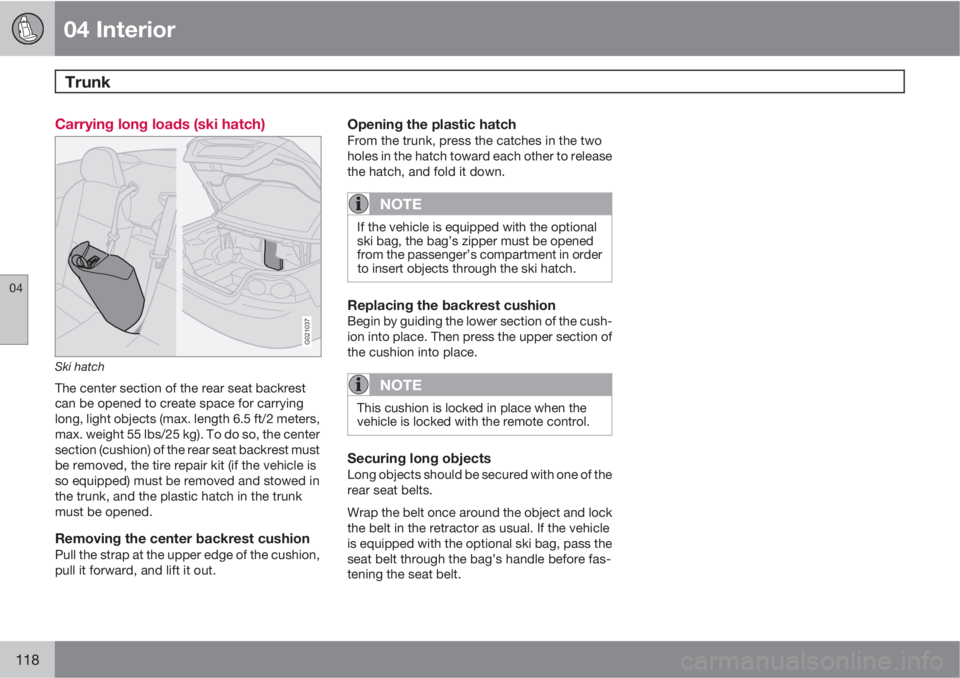
G021037
Ski hatch
The center section of the rear seat backrest
can be opened to create space for carrying
long, light objects (max. length 6.5 ft/2 meters,
max. weight 55 lbs/25 kg). To do so, the center
section (cushion) of the rear seat backrest must
be removed, the tire repair kit (if the vehicle is
so equipped) must be removed and stowed in
the trunk, and the plastic hatch in the trunk
must be opened.
Removing the center backrest cushionPull the strap at the upper edge of the cushion,
pull it forward, and lift it out.
Opening the plastic hatchFrom the trunk, press the catches in the two
holes in the hatch toward each other to release
the hatch, and fold it down.
NOTE
If the vehicle is equipped with the optional
ski bag, the bag’s zipper must be opened
from the passenger’s compartment in order
to insert objects through the ski hatch.
Replacing the backrest cushionBegin by guiding the lower section of the cush-
ion into place. Then press the upper section of
the cushion into place.
NOTE
This cushion is locked in place when the
vehicle is locked with the remote control.
Securing long objectsLong objects should be secured with one of the
rear seat belts.
Wrap the belt once around the object and lock
the belt in the retractor as usual. If the vehicle
is equipped with the optional ski bag, pass the
seat belt through the bag’s handle before fas-
tening the seat belt.
Page 142 of 296
06 Starting and driving
General information
06
140
Economical driving conserves natural
resources
Better driving economy may be obtained by
thinking ahead, avoiding rapid starts and stops
and adjusting the speed of your vehicle to
immediate traffic conditions.
Observe the following rules:
•Bring the engine to normal operating tem-
perature as soon as possible by driving
with a light foot on the accelerator pedal for
the first few minutes of operation. A cold
engine uses more fuel and is subject to
increased wear.
•Whenever possible, avoid using the vehicle
for driving short distances. This does not
allow the engine to reach normal operating
temperature.
•Drive carefully and avoid rapid acceleration
and hard braking.
•Use the transmission's Drive (D) position
as often as possible and avoid using kick-
down.
•Do not exceed posted speed limits.
•Avoid carrying unnecessary items (extra
load) in the vehicle.
•Maintain correct tire pressure. Check tire
pressure regularly (when tires are cold).
•Remove snow tires when threat of snow or
ice has ended.
•At highway driving speeds, fuel consump-
tion will be lower with the air conditioning
on and the windows closed than with the
air conditioning off and the windows open.
•Using the onboard trip computer's fuel
consumption modes can help you learn
how to drive more economically.
Other factors that decrease gas mileage
are:
•Dirty air cleaner
•Dirty engine oil and clogged oil filter
•Dragging brakes
•Incorrect front end alignment
Some of the above mentioned items and others
are checked at the standard maintenance
intervals.
WARNING
Driving with the trunk open: Driving with
the trunk open could lead to poisonous
exhaust gases entering the passenger com-
partment. If the trunk must be kept open for
any reason, proceed as follows:
1. Close the windows.
2. Set the ventilation system control to air
flow to floor, windshield and side win-
dows and the blower control to its high-
est setting.
Weight distribution affects handling
At the specified curb weight your vehicle has a
tendency to understeer, which means that the
steering wheel has to be turned more than
might seem appropriate for the curvature of a
bend. This ensures good stability and reduces
the risk of rear wheel skid. Remember that
these properties can alter with the vehicle load.
The heavier the load in the cargo area, the less
the tendency to understeer.
Handling, roadholding
Vehicle load, tire design and inflation pressure
all affect vehicle handling. Therefore, check
that the tires are inflated to the recommended
pressure according to the vehicle load. See the
"Tire pressure" section. Loads should be dis-
tributed so that capacity weight or maximum
permissible axle loads are not exceeded.
Driving through water
The vehicle can be driven through water up to
a depth of approximately 9 in. (25 cm), at a
maximum speed of 6 mph (10 km/h).
•Take particular care when driving through
flowing water.
•Clean the electrical connections for trailer
wiring after driving in mud or water
•When driving through water, maintain low
speed and do not stop in the water.
Page 166 of 296
06 Starting and driving
Towing a trailer
06
164
General information
•Volvo recommends the use of Volvo trailer
hitches that are specially designed for the
vehicle.
Maximum trailer weights recommended by
Volvo are:
•Trailers without brakes: 1,540 lbs
(700 kg).
•Trailers with brakes: 2,000 lbs (900 kg)
Observe the legal requirements of the
state/province in which the vehicles are
registered.
•The maximum recommended hitch
tongue load is 165 lbs (75 kg).
•All Volvo models are equipped with
energy-absorbing shock-mounted bump-
ers. Trailer hitch installation should not
interfere with the proper operation of this
bumper system.
Trailer towing does not normally present any
particular problems, but take into considera-
tion:
•Increase tire pressure to recommended
full. See the chapter "Wheels and tires."
•When your vehicle is new, avoid towing
heavy trailers during the first 620 miles
(1,000 km).
•Maximum speed when towing a trailer:
50 mph (80 km/h).
•Engine and transmission are subject to
increased loads. Therefore, engine coolant
temperature should be closely watched
when driving in hot climates or hilly terrain.
Use a lower gear and turn off the air con-
ditioner if the temperature gauge needle
enters the red range.
•If the automatic transmission begins to
overheat, a message will be displayed in
the information display.
•Avoid overload and other abusive opera-
tion.
•Hauling a trailer affects handling, durabil-
ity, and economy.
•It is necessary to balance trailer brakes
with the towing vehicle brakes to provide a
safe stop (check and observe state/local
regulations).
•Do not connect the trailer's brake system
directly to the vehicle's brake system.
•More frequent vehicle maintenance is
required.
•Remove the ball and drawbar assembly
when the hitch is not being used.
•Volvo recommends the use of synthetic
engine oil when towing a trailer over long
distances or in mountainous areas.
WARNING
•Bumper-attached trailer hitches must
not be used on Volvos, nor should
safety chains be attached to the
bumper.
•Trailer hitches attaching to the vehicle's
rear axle must not be used.
•Never connect a trailer's hydraulic
brake system directly to the vehicle
brake system, nor a trailer's lighting
system directly to the vehicle lighting
system. Consult your nearest trained
and qualified Volvo service technician
for correct installation.
•When towing a trailer, the trailer's safety
wire must be correctly fastened to the
hole or hook provided in the trailer hitch
on the vehicle. The safety wire should
never be fastened to or wound around
the drawbar ball.