ECU VOLVO C70 2013 Owner´s Manual
[x] Cancel search | Manufacturer: VOLVO, Model Year: 2013, Model line: C70, Model: VOLVO C70 2013Pages: 296, PDF Size: 7.18 MB
Page 163 of 296
06 Starting and driving
Towing
06
161
2. Insert the key into the ignition to unlock the
steering wheel. With the engine off and the
vehicle at a standstill, great effort will be
required to turn the steering wheel.
3.
Turn the ignition key to position II.
4. Place the gear selector in neutral. For vehi-
cles with automatic transmissions, follow
instruction on page 153, "Shiftlock over-
ride" to allow the gear selector to be moved
from the Park position.
5. Keep firm pressure on the brake pedal
while releasing the parking brake.
6. When towing has been completed, return
the gear selector to Park and apply the
parking brake.
The following points should also be
observed:
•Never exceed 50 mph (80 km/h). Never
exceed local towing speed limits and heed
all local towing restrictions.
•Never tow farther than 50 miles (80 km).
•Keep the tow rope taut at all times while the
vehicle is in motion.
•The disabled vehicle should be towed in
the forward direction only.
WARNING
•Never allow a vehicle to be towed with-
out a driver behind the wheel of the dis-
abled vehicle.
•When the engine is not running, steering
resistance and the effort needed to
apply the brakes will be great.
•Never attempt to tow a vehicle with a
dead battery at night.
CAUTION
•Check with state and local authorities
before attempting this type of towing,
as vehicles being towed are subject to
regulations regarding maximum towing
speed, length and type of towing
device, lighting, marker flags, etc.
•Never attempt to push- or tow-start a
vehicle with a dead battery. This would
inject unburned fuel into the three-way
catalytic converter(s), causing over-
heating, backfiring, and damage, see
page 163 for instructions on jump star-
ting the vehicle.
Towing vehicles with front wheel drive
Volvo recommends the use of flat bed equip-
ment for towing vehicles with front wheel drive.
If wheel lift equipment must be used, please
use extreme caution to help avoid damage to
the vehicle.
In this case, the vehicle should be towed with
the rear wheels on the ground if at all possible.
If it is absolutely necessary to tow the vehicle
with the front wheels on the ground, please
refer to the towing information on the previous
page.
•Sling-type equipment applied at the front
will damage radiator and air conditioning
lines.
•It is equally important not to use sling-type
equipment at the rear or apply lifting equip-
ment inside the rear wheels; serious dam-
age to the rear axle may result.
•If the vehicle is being towed on a flat bed
truck, the towing eyelets must not be used
to secure the vehicle on the flat bed. Con-
sult the tow truck operator.
Page 169 of 296
06 Starting and driving
Transporting loads
06
167 Loading the vehicle
Your vehicle's load-carrying capacity is affec-
ted by factors such as:
•the number of passengers
•tire inflation
•the amount of optional or accessory equip-
ment installed
•the amount of cargo.
See the chapter "Wheels and tires" for more
detailed information.
Before loading the car, turn off the engine, and
apply the parking brake when loading or
unloading long objects. The gear selector can
be inadvertently knocked out of position by
long cargo, causing the car to move.
Keep the following in mind when
loading the vehicle:
•Load objects in the trunk against the rear
seat backrest.
•Load heavy cargo as low as possible.
•Center wide loads.
•Secure all cargo with restraining straps
anchored to the load securing eyelets.
•Cover sharp edges on the load.
WARNING
•Remember that an object weighing
44 lbs (20 kg) produces a force of
2,200 lbs (1,000 kg) in a head-on colli-
sion at 30 mph (50 km/h)!
•When the rear backrest(s) are folded
down, the vehicle should not be loaded
to a level higher than 2 in. (5 cm) below
the upper edge of the rear side win-
dows. Objects placed higher than this
level could impede the function of the
Inflatable Curtain.
Page 193 of 296
07 Wheels and tires
Tire Sealing System*
07
* Option/accessory, for more information, see Introduction.191 Tire sealing system–temporarily
repairing a flat tire
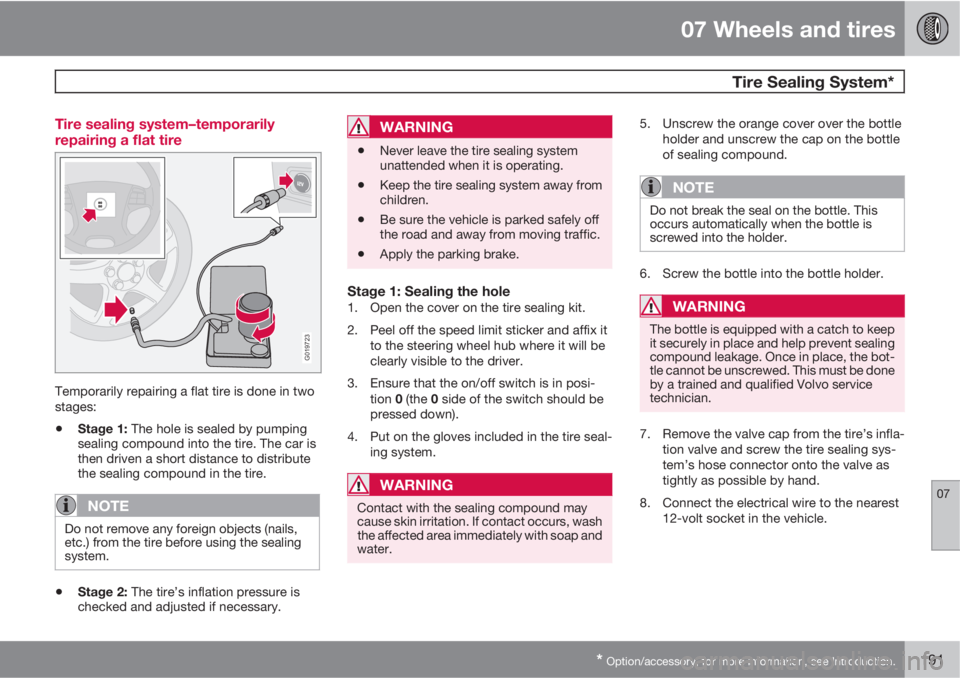
G019723
Temporarily repairing a flat tire is done in two
stages:
•Stage 1: The hole is sealed by pumping
sealing compound into the tire. The car is
then driven a short distance to distribute
the sealing compound in the tire.
NOTE
Do not remove any foreign objects (nails,
etc.) from the tire before using the sealing
system.
•Stage 2: The tire’s inflation pressure is
checked and adjusted if necessary.
WARNING
•Never leave the tire sealing system
unattended when it is operating.
•Keep the tire sealing system away from
children.
•Be sure the vehicle is parked safely off
the road and away from moving traffic.
•Apply the parking brake.
Stage 1: Sealing the hole1. Open the cover on the tire sealing kit.
2. Peel off the speed limit sticker and affix it
to the steering wheel hub where it will be
clearly visible to the driver.
3. Ensure that the on/off switch is in posi-
tion 0 (the 0 side of the switch should be
pressed down).
4. Put on the gloves included in the tire seal-
ing system.
WARNING
Contact with the sealing compound may
cause skin irritation. If contact occurs, wash
the affected area immediately with soap and
water.
5. Unscrew the orange cover over the bottle
holder and unscrew the cap on the bottle
of sealing compound.
NOTE
Do not break the seal on the bottle. This
occurs automatically when the bottle is
screwed into the holder.
6. Screw the bottle into the bottle holder.
WARNING
The bottle is equipped with a catch to keep
it securely in place and help prevent sealing
compound leakage. Once in place, the bot-
tle cannot be unscrewed. This must be done
by a trained and qualified Volvo service
technician.
7. Remove the valve cap from the tire’s infla-
tion valve and screw the tire sealing sys-
tem’s hose connector onto the valve as
tightly as possible by hand.
8. Connect the electrical wire to the nearest
12-volt socket in the vehicle.
Page 196 of 296
07 Wheels and tires
Tire Sealing System*
07
194* Option/accessory, for more information, see Introduction.
WARNING
•The vehicle’s engine should be running
when the tire sealing system is used to
avoid battery drain. Therefore, be sure
the vehicle is parked in a well ventilated
place, or outdoors, before using the sys-
tem. The parking brake should be
securely applied and the gear selector
should be in the P (park) position.
•Children should never be left unattended
in the vehicle when the engine is running.
7. Check the tire’s inflation pressure on the
gauge. Switch off the compressor briefly to
get a clear reading from the pressure
gauge.
8. Refer to the tire inflation table for the cor-
rect inflation pressure. If the tire needs to
be inflated, start the tire sealing system’s
compressor (press the on/off switch to
position I). If necessary, release air from the
tire by turning the air release knob coun-
terclockwise.
CAUTION
The compressor should not be used for
more than 10 minutes at a time to avoid
overheating.
9. Turn off the compressor (press the on/off
switch to position 0) when the correct infla-
tion pressure has been reached.
10. Unscrew the hose from the tire’s inflation
valve and reinstall the valve cap.
11. Disconnect the electrical wire from the
12-volt socket.
Page 199 of 296
07 Wheels and tires
Spare tire and jack
07
197
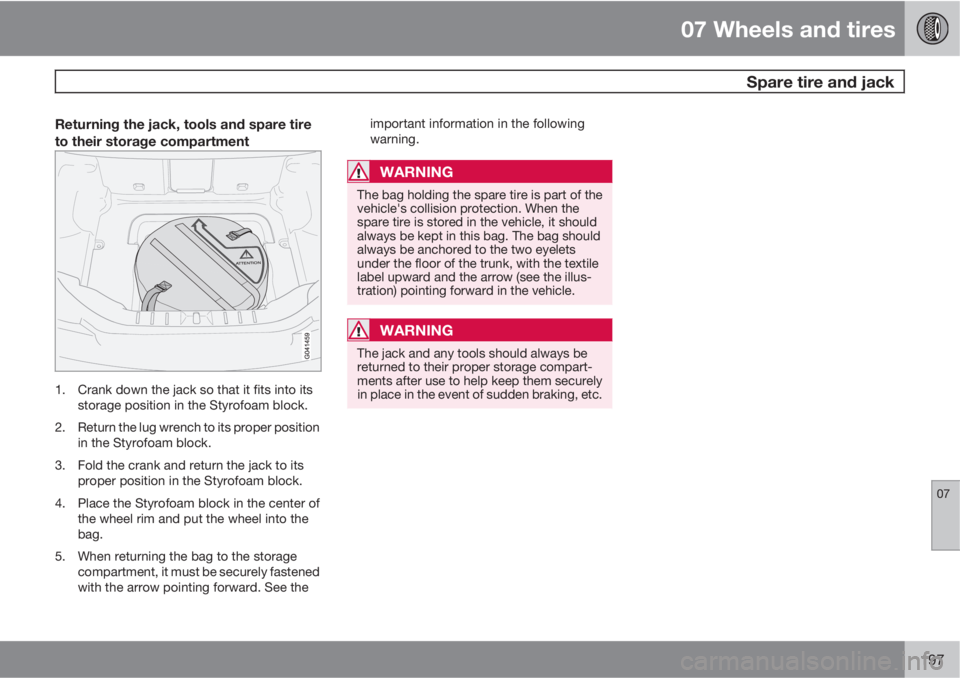
Returning the jack, tools and spare tire
to their storage compartment
1. Crank down the jack so that it fits into its
storage position in the Styrofoam block.
2. Return the lug wrench to its proper position
in the Styrofoam block.
3. Fold the crank and return the jack to its
proper position in the Styrofoam block.
4. Place the Styrofoam block in the center of
the wheel rim and put the wheel into the
bag.
5. When returning the bag to the storage
compartment, it must be securely fastened
with the arrow pointing forward. See theimportant information in the following
warning.
WARNING
The bag holding the spare tire is part of the
vehicle's collision protection. When the
spare tire is stored in the vehicle, it should
always be kept in this bag. The bag should
always be anchored to the two eyelets
under the floor of the trunk, with the textile
label upward and the arrow (see the illus-
tration) pointing forward in the vehicle.
WARNING
The jack and any tools should always be
returned to their proper storage compart-
ments after use to help keep them securely
in place in the event of sudden braking, etc.
Page 200 of 296
07 Wheels and tires
Wheel nuts
07
198
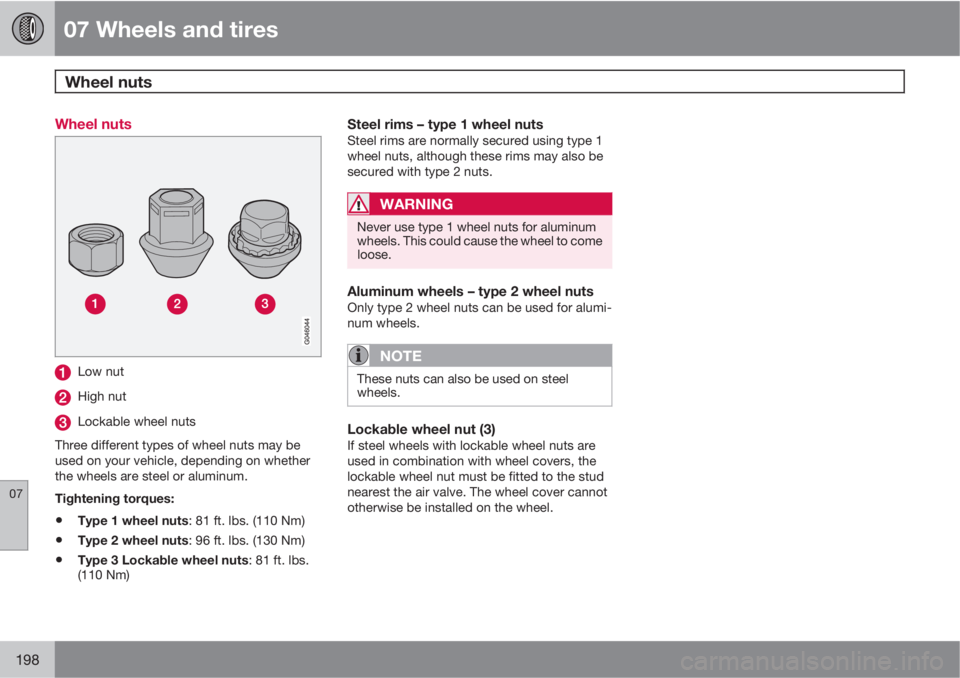
Wheel nuts
Low nut
High nut
Lockable wheel nuts
Three different types of wheel nuts may be
used on your vehicle, depending on whether
the wheels are steel or aluminum.
Tightening torques:
•Type 1 wheel nuts: 81 ft. lbs. (110 Nm)
•Type 2 wheel nuts: 96 ft. lbs. (130 Nm)
•Type 3 Lockable wheel nuts: 81 ft. lbs.
(110 Nm)
Steel rims – type 1 wheel nutsSteel rims are normally secured using type 1
wheel nuts, although these rims may also be
secured with type 2 nuts.
WARNING
Never use type 1 wheel nuts for aluminum
wheels. This could cause the wheel to come
loose.
Aluminum wheels – type 2 wheel nutsOnly type 2 wheel nuts can be used for alumi-
num wheels.
NOTE
These nuts can also be used on steel
wheels.
Lockable wheel nut (3)If steel wheels with lockable wheel nuts are
used in combination with wheel covers, the
lockable wheel nut must be fitted to the stud
nearest the air valve. The wheel cover cannot
otherwise be installed on the wheel.
Page 202 of 296
07 Wheels and tires
Changing a wheel
07
200
NOTE
The jack provided with your vehicle is
intended to be used only in temporary sit-
uations such as changing wheels in the
event of a flat tire. Only the jack that came
with your particular model should be used
to lift the vehicle. If the vehicle needs to be
lifted more frequently or for a prolonged
period, using a garage jack or hoist is rec-
ommended. Always follow this device’s
instructions for use.
Installing the wheel
1. Clean the contact surfaces between the
wheel and hub.
2. Lift the wheel and place it on the hub.
3. Install the wheel nuts and hand-tighten
them. Using the lug wrench, tighten cross-
wise until all nuts are snug.
4. Lower the vehicle to the ground and alter-
nately tighten the bolts crosswise to
81 ft. lbs. (110 Nm) or 96 ft. lbs. (130 Nm),
depending on the type of wheel/wheel nuts
used on your vehicle. See also 198 for
additional information.
5. Install the wheel cover (where applicable).
See page 196 for information on returning the
jack and tools to their proper storage positions.On vehicles equipped with the tire sealing sys-
tem, the jack should be cranked down as far as
possible and returned to its storage position in
the foam block.
WARNING
The jack and any tools should always be
returned to their proper storage compart-
ments after use to help keep them securely
in place in the event of sudden braking, etc.
Page 209 of 296
08 Car care
Washing and cleaning the car
08
207
tant, especially in the winter. Some automatic
washers do not have facilities for washing the
underbody.
CAUTION
•Remove the antenna on the right rear
fender. This antenna should never be
bent in any way. Doing so could result
in damage or malfunction. When the
antenna is put back in position, turn it
carefully to help avoid damaging the
threads on the antenna's mount.
•Before driving into an automatic car
wash, turn off the optional rain sensor to
avoid damaging the windshield wipers.
•Make sure that side view mirrors, auxil-
iary lamps, etc, are secure.
•Chromed wheels: Clean chrome-
plated wheels using the same deter-
gents used for the body of the vehicle.
Aggressive wheel-cleaning agents can
permanently stain chrome-plated
wheels.
WARNING
•When the car is driven immediately after
being washed, apply the brakes several
times in order to remove any moisture
from the brake linings.
•Engine cleaning agents should not be
used when the engine is warm. This
constitutes a fire risk.
Exterior lightingCondensation may form temporarily on the
inside of the lenses of exterior lights such as
headlights, fog lights, or taillights. This is nor-
mal and the lights are designed to withstand
moisture. Normally, condensation will dissi-
pate after the lights have been on for a short
time.
Polishing and Waxing
•Normally, polishing is not required during
the first year after delivery, however, wax-
ing may be beneficial.
•Before applying polish or wax the vehicle
must be washed and dried. Tar spots can
be removed with kerosene or tar remover.
Difficult spots may require a fine rubbing
compound.
•After polishing use liquid or paste wax.
•Several commercially available products
contain both polish and wax.
•Waxing alone does not substitute for pol-
ishing a dull surface.
•A wide range of polymer-based waxes can
be purchased today. These waxes are easy
to use and produce a long-lasting, high-
gloss finish that protects the bodywork
against oxidation, road dirt and fading.
•Do not polish or wax your vehicle in direct
sunlight (the surface of the vehicle should
not be warmer than 113 °F (45 °C).
CAUTION
Volvo does not recommend the use of long-
life or durable paint protection coatings,
some of which may claim to prevent pitting,
fading, oxidation, etc. These coatings have
not been tested by Volvo for compatibility
with your vehicle's clear coat. Some of them
may cause the clear coat to soften, crack,
or cloud. Damage caused by application of
paint protection coatings may not be cov-
ered under your vehicle's paint warranty.
Page 225 of 296
09 Maintenance and servicing
Wiper blades09
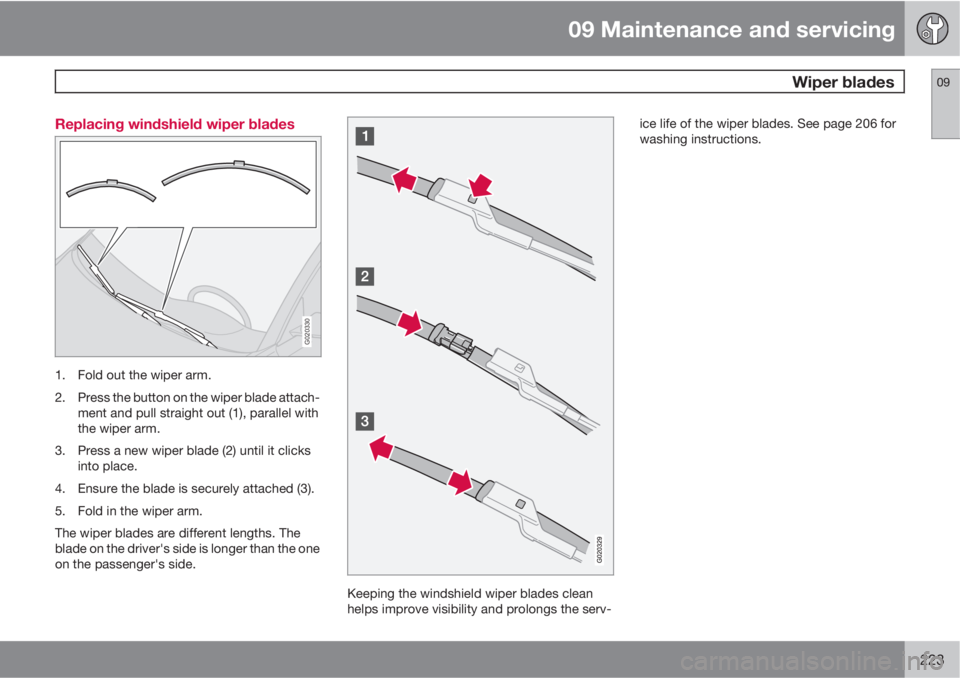
223 Replacing windshield wiper blades
G020330
1. Fold out the wiper arm.
2. Press the button on the wiper blade attach-
ment and pull straight out (1), parallel with
the wiper arm.
3. Press a new wiper blade (2) until it clicks
into place.
4. Ensure the blade is securely attached (3).
5. Fold in the wiper arm.
The wiper blades are different lengths. The
blade on the driver's side is longer than the one
on the passenger's side.
Keeping the windshield wiper blades clean
helps improve visibility and prolongs the serv-ice life of the wiper blades. See page 206 for
washing instructions.
Page 226 of 296
09 Maintenance and servicing
Battery 09
224
Battery maintenance
Driving habits and conditions, climate, the
number of starts, etc., all affect the service life
and function of the battery. In order for your
battery to perform satisfactorily, keep the fol-
lowing in mind:
Check the fluid level in each cell in the battery
every 24 months or every 15,000
1 miles
(24,000 km), whichever is sooner.
•Use a screw driver to open the caps or
cover and a flashlight to inspect the level.
•If necessary, add distilled water. The level
should never be above the indicator.
•The fluid level should be checked if the
battery has been recharged.
•After inspection, be sure the cap over each
battery cell or the cover is securely in
place.
•Check that the battery cables are correctly
connected and properly tightened.
•Never disconnect the battery when the
engine is running, or when the key is in the
ignition. This could damage the vehicle's
electrical system.
•The battery should be disconnected from
the vehicle when a battery charger is used
directly on the battery.
•To help keep the battery in good condition,
the vehicle should be driven for at least 15
minutes a week or connected to a charger
with an automatic charging function.
•If the battery is fully discharged a number
of times, this may shorten its service life.
Keeping the battery fully charged helps
prolong its service life.
•The service life of a battery is affected by
factors such as driving conditions and cli-
mate. Extreme cold may also further
decrease the battery’s starting capacity.
•Because the battery’s starting capacity
decreases with time, it may be necessary
to recharge it if the vehicle is not driven for
an extended period of time or if the vehicle
is usually only driven short distances.
•
WARNING
PROPOSITION 65 WARNING!
Battery posts, terminals, and related acces-
sories contain lead and lead compounds,
chemicals known to the state of California
to cause cancer and reproductive harm.
Wash hands after handling.
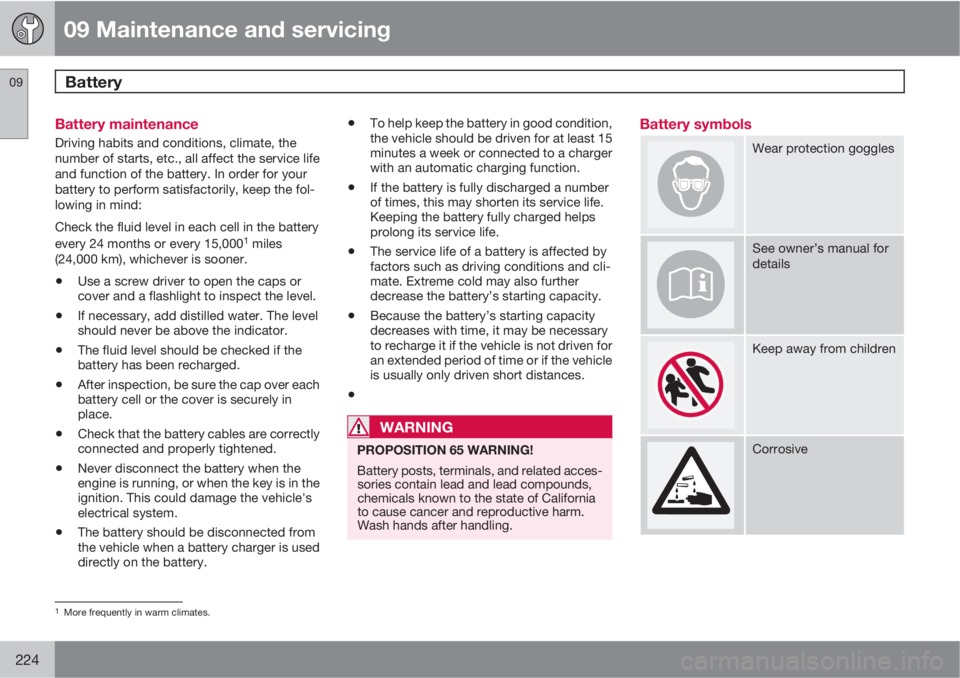
Battery symbols
Wear protection goggles
See owner’s manual for
details
Keep away from children
Corrosive
1More frequently in warm climates.