brake VOLVO C70 2013 Owner´s Manual
[x] Cancel search | Manufacturer: VOLVO, Model Year: 2013, Model line: C70, Model: VOLVO C70 2013Pages: 296, PDF Size: 7.18 MB
Page 161 of 296
06 Starting and driving
Stability system
06
159
WARNING
The car's handling and stability characteris-
tics will be altered if the DSTC system func-
tions have been disabled.
DSTC-related messages in the text
window
•"TRACTION CONTROL TEMPORARILY
OFF" – The system has been temporarily
switched off due to high brake temperature
and will automatically switch on again
when the brakes have cooled.
•"ANTI-SKID SERVICE REQUIRED" – the
system has been automatically disen-
gaged due to a fault. A trained and qualified
Volvo service technician retailer should
check the system.
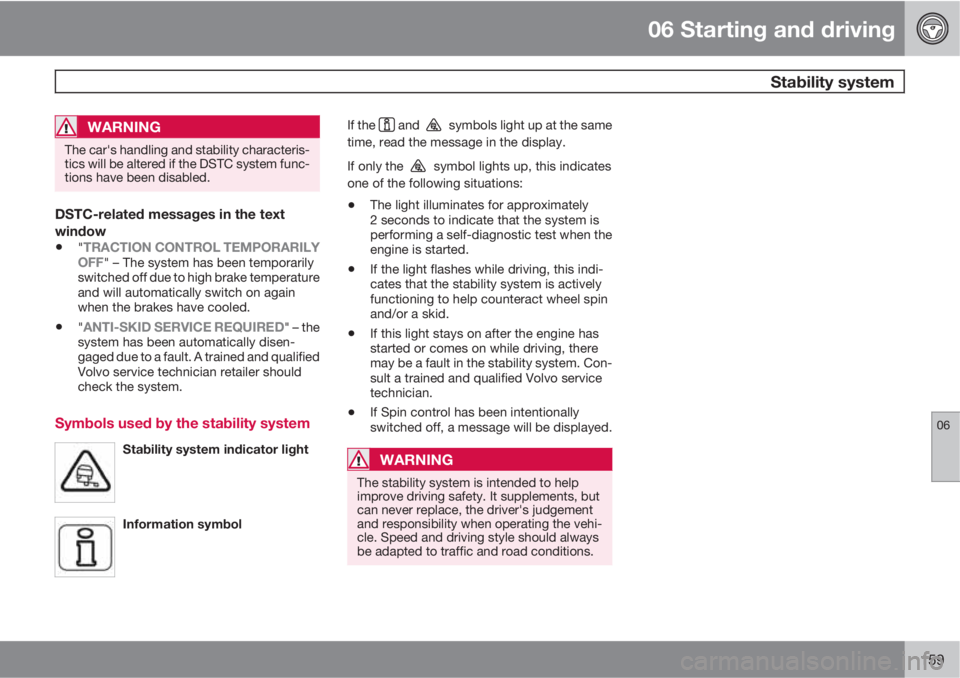
Symbols used by the stability system
Stability system indicator light
Information symbol
If the and symbols light up at the same
time, read the message in the display.
If only the
symbol lights up, this indicates
one of the following situations:
•The light illuminates for approximately
2 seconds to indicate that the system is
performing a self-diagnostic test when the
engine is started.
•If the light flashes while driving, this indi-
cates that the stability system is actively
functioning to help counteract wheel spin
and/or a skid.
•If this light stays on after the engine has
started or comes on while driving, there
may be a fault in the stability system. Con-
sult a trained and qualified Volvo service
technician.
•If Spin control has been intentionally
switched off, a message will be displayed.
WARNING
The stability system is intended to help
improve driving safety. It supplements, but
can never replace, the driver's judgement
and responsibility when operating the vehi-
cle. Speed and driving style should always
be adapted to traffic and road conditions.
Page 162 of 296
06 Starting and driving
Towing
06
160
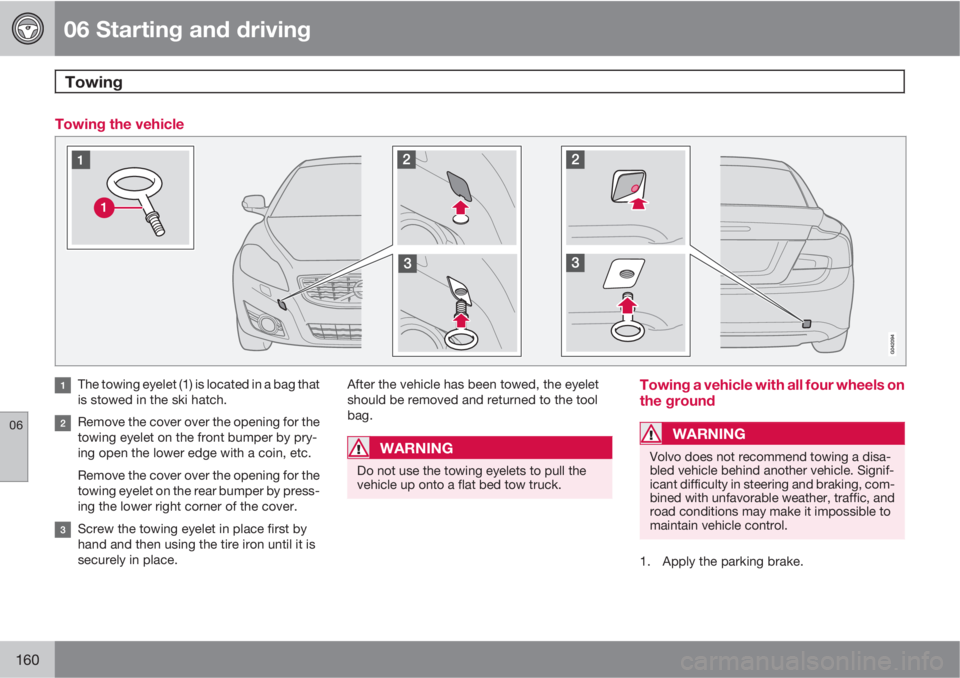
Towing the vehicle
The towing eyelet (1) is located in a bag that
is stowed in the ski hatch.
Remove the cover over the opening for the
towing eyelet on the front bumper by pry-
ing open the lower edge with a coin, etc.
Remove the cover over the opening for the
towing eyelet on the rear bumper by press-
ing the lower right corner of the cover.
Screw the towing eyelet in place first by
hand and then using the tire iron until it is
securely in place.After the vehicle has been towed, the eyelet
should be removed and returned to the tool
bag.
WARNING
Do not use the towing eyelets to pull the
vehicle up onto a flat bed tow truck.
Towing a vehicle with all four wheels on
the ground
WARNING
Volvo does not recommend towing a disa-
bled vehicle behind another vehicle. Signif-
icant difficulty in steering and braking, com-
bined with unfavorable weather, traffic, and
road conditions may make it impossible to
maintain vehicle control.
1. Apply the parking brake.
Page 163 of 296
06 Starting and driving
Towing
06
161
2. Insert the key into the ignition to unlock the
steering wheel. With the engine off and the
vehicle at a standstill, great effort will be
required to turn the steering wheel.
3.
Turn the ignition key to position II.
4. Place the gear selector in neutral. For vehi-
cles with automatic transmissions, follow
instruction on page 153, "Shiftlock over-
ride" to allow the gear selector to be moved
from the Park position.
5. Keep firm pressure on the brake pedal
while releasing the parking brake.
6. When towing has been completed, return
the gear selector to Park and apply the
parking brake.
The following points should also be
observed:
•Never exceed 50 mph (80 km/h). Never
exceed local towing speed limits and heed
all local towing restrictions.
•Never tow farther than 50 miles (80 km).
•Keep the tow rope taut at all times while the
vehicle is in motion.
•The disabled vehicle should be towed in
the forward direction only.
WARNING
•Never allow a vehicle to be towed with-
out a driver behind the wheel of the dis-
abled vehicle.
•When the engine is not running, steering
resistance and the effort needed to
apply the brakes will be great.
•Never attempt to tow a vehicle with a
dead battery at night.
CAUTION
•Check with state and local authorities
before attempting this type of towing,
as vehicles being towed are subject to
regulations regarding maximum towing
speed, length and type of towing
device, lighting, marker flags, etc.
•Never attempt to push- or tow-start a
vehicle with a dead battery. This would
inject unburned fuel into the three-way
catalytic converter(s), causing over-
heating, backfiring, and damage, see
page 163 for instructions on jump star-
ting the vehicle.
Towing vehicles with front wheel drive
Volvo recommends the use of flat bed equip-
ment for towing vehicles with front wheel drive.
If wheel lift equipment must be used, please
use extreme caution to help avoid damage to
the vehicle.
In this case, the vehicle should be towed with
the rear wheels on the ground if at all possible.
If it is absolutely necessary to tow the vehicle
with the front wheels on the ground, please
refer to the towing information on the previous
page.
•Sling-type equipment applied at the front
will damage radiator and air conditioning
lines.
•It is equally important not to use sling-type
equipment at the rear or apply lifting equip-
ment inside the rear wheels; serious dam-
age to the rear axle may result.
•If the vehicle is being towed on a flat bed
truck, the towing eyelets must not be used
to secure the vehicle on the flat bed. Con-
sult the tow truck operator.
Page 164 of 296
06 Starting and driving
Towing
06
162
WARNING
•The power brakes and power steering
will not function when the engine is not
running. Approximately 5 times more
pressure will be required on the brake
pedal and the steering wheel will be
considerably harder to turn.
•The towing eyelets must not be used for
pulling the vehicle out of a ditch or for
any similar purpose involving severe
strain. Do not use the towing eyelets to
pull the vehicle up onto a flat bed tow
truck.
Page 166 of 296
06 Starting and driving
Towing a trailer
06
164
General information
•Volvo recommends the use of Volvo trailer
hitches that are specially designed for the
vehicle.
Maximum trailer weights recommended by
Volvo are:
•Trailers without brakes: 1,540 lbs
(700 kg).
•Trailers with brakes: 2,000 lbs (900 kg)
Observe the legal requirements of the
state/province in which the vehicles are
registered.
•The maximum recommended hitch
tongue load is 165 lbs (75 kg).
•All Volvo models are equipped with
energy-absorbing shock-mounted bump-
ers. Trailer hitch installation should not
interfere with the proper operation of this
bumper system.
Trailer towing does not normally present any
particular problems, but take into considera-
tion:
•Increase tire pressure to recommended
full. See the chapter "Wheels and tires."
•When your vehicle is new, avoid towing
heavy trailers during the first 620 miles
(1,000 km).
•Maximum speed when towing a trailer:
50 mph (80 km/h).
•Engine and transmission are subject to
increased loads. Therefore, engine coolant
temperature should be closely watched
when driving in hot climates or hilly terrain.
Use a lower gear and turn off the air con-
ditioner if the temperature gauge needle
enters the red range.
•If the automatic transmission begins to
overheat, a message will be displayed in
the information display.
•Avoid overload and other abusive opera-
tion.
•Hauling a trailer affects handling, durabil-
ity, and economy.
•It is necessary to balance trailer brakes
with the towing vehicle brakes to provide a
safe stop (check and observe state/local
regulations).
•Do not connect the trailer's brake system
directly to the vehicle's brake system.
•More frequent vehicle maintenance is
required.
•Remove the ball and drawbar assembly
when the hitch is not being used.
•Volvo recommends the use of synthetic
engine oil when towing a trailer over long
distances or in mountainous areas.
WARNING
•Bumper-attached trailer hitches must
not be used on Volvos, nor should
safety chains be attached to the
bumper.
•Trailer hitches attaching to the vehicle's
rear axle must not be used.
•Never connect a trailer's hydraulic
brake system directly to the vehicle
brake system, nor a trailer's lighting
system directly to the vehicle lighting
system. Consult your nearest trained
and qualified Volvo service technician
for correct installation.
•When towing a trailer, the trailer's safety
wire must be correctly fastened to the
hole or hook provided in the trailer hitch
on the vehicle. The safety wire should
never be fastened to or wound around
the drawbar ball.
Page 167 of 296
06 Starting and driving
Towing a trailer
06
165
NOTE
•When parking the vehicle with a trailer
on a hill, apply the parking brake before
putting the gear selector in Park (P).
Always follow the trailer manufacturer's
recommendations for wheel chocking.
•If you use the manual (Geartronic) shift
positions while towing a trailer, or if the
vehicle is equipped with a manual trans-
mission, make sure the gear you select
does not put too much strain on the
engine (using too high a gear).
•The drawbar assembly/trailer hitch may
be rated for trailers heavier than the
vehicle is designed to tow. Please
adhere to Volvo's recommended trailer
weights.
•Avoid driving with a trailer on inclines
exceeding 15%.
Page 169 of 296
06 Starting and driving
Transporting loads
06
167 Loading the vehicle
Your vehicle's load-carrying capacity is affec-
ted by factors such as:
•the number of passengers
•tire inflation
•the amount of optional or accessory equip-
ment installed
•the amount of cargo.
See the chapter "Wheels and tires" for more
detailed information.
Before loading the car, turn off the engine, and
apply the parking brake when loading or
unloading long objects. The gear selector can
be inadvertently knocked out of position by
long cargo, causing the car to move.
Keep the following in mind when
loading the vehicle:
•Load objects in the trunk against the rear
seat backrest.
•Load heavy cargo as low as possible.
•Center wide loads.
•Secure all cargo with restraining straps
anchored to the load securing eyelets.
•Cover sharp edges on the load.
WARNING
•Remember that an object weighing
44 lbs (20 kg) produces a force of
2,200 lbs (1,000 kg) in a head-on colli-
sion at 30 mph (50 km/h)!
•When the rear backrest(s) are folded
down, the vehicle should not be loaded
to a level higher than 2 in. (5 cm) below
the upper edge of the rear side win-
dows. Objects placed higher than this
level could impede the function of the
Inflatable Curtain.
Page 175 of 296
06 Starting and driving
Rear park assist*
06
* Option/accessory, for more information, see Introduction.173 Audible signals from the park assist
system
The Park Assist system uses an intermittent
tone that pulses faster as you come close to an
object, and becomes constant when you are
within approximately 1 ft (30 cm) of an object
behind the vehicle. If the volume of another
source from the audio system is high, this will
be automatically lowered.
Faults in the system
If the information symbol illumi-
nates and PARK ASSIST
SERVICE REQUIRED is shown
on the information display, this
indicates that the system is not
functioning properly and has been disengaged.
Consult a Volvo retailer or authorized Volvo
service technician.
CAUTION
In certain circumstances, the park assist
system may give unexpected warning sig-
nals that can be caused by external sound
sources that use the same ultrasound fre-
quencies as the system. This may include
such things as the horns of other vehicles,
wet tires on asphalt, pneumatic brakes,
motorcycle exhaust pipes, etc. This does
not indicate a fault in the system.
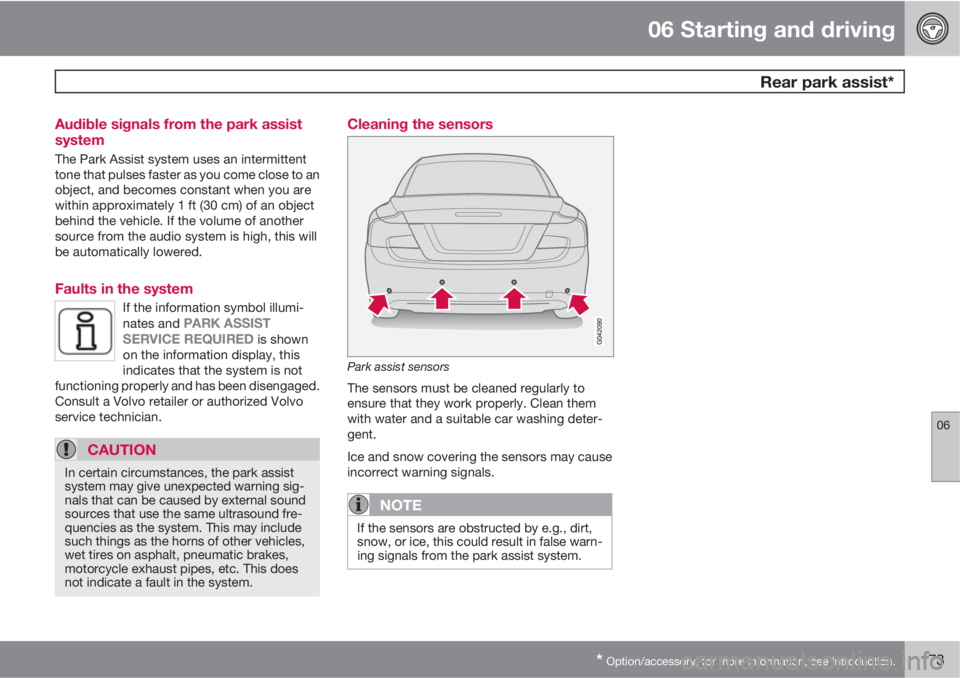
Cleaning the sensors
Park assist sensors
The sensors must be cleaned regularly to
ensure that they work properly. Clean them
with water and a suitable car washing deter-
gent.
Ice and snow covering the sensors may cause
incorrect warning signals.
NOTE
If the sensors are obstructed by e.g., dirt,
snow, or ice, this could result in false warn-
ing signals from the park assist system.
Page 190 of 296
07 Wheels and tires
Snow chains, snow tires, studded tires
07
188
Snow chains
Snow chains can be used on your Volvo with
the following restrictions:
•Snow chains should be installed on front
wheels only. Use only Volvo approved
snow chains.
•If accessory, aftermarket or "custom" tires
and wheels are installed and are of a size
different than the original tires and wheels,
chains in some cases CANNOT be used.
Sufficient clearances between chains and
brakes, suspension and body components
must be maintained.
•Some strap-on type chains will interfere
with brake components and therefore
CANNOT be used.
•Certain size tires may not allow the assem-
bly of snow chains/traction devices.
Consult your Volvo retailer for additional snow
chain information.
CAUTION
•Check local regulations regarding the
use of snow chains before installing.
•Always follow the chain manufacturer's
installation instructions carefully. Install
chains as tightly as possible and
retighten periodically.
•Never exceed the chain manufacturer's
specified maximum speed limit. (Under
no circumstances should you exceed
31 mph (50 km/h).
•Avoid bumps, holes or sharp turns
when driving with snow chains.
•The handling of the vehicle can be
adversely affected when driving with
chains. Avoid fast or sharp turns as well
as locked wheel braking.
Snow tires, studded tires
Tires for winter use:
•Owners who live in or regularly commute
through areas with sustained periods of
snow or icy driving conditions are strongly
advised to fit suitable winter tires to help
retain the highest degree of traction.
•It is important to install winter tires on all
four wheels to help retain traction during
cornering, braking, and accelerating. Fail-ure to do so could reduce traction to an
unsafe level or adversely affect handling.
•Do not mix tires of different design as this
could also negatively affect overall tire road
grip.
•Winter tires wear more quickly on dry roads
in warm weather. They should be removed
when the winter driving season has ended.
•Studded tires should be run-in
300–600 miles (500–1000 km) during
which the car should be driven as smoothly
as possible to give the studs the opportu-
nity to seat properly in the tires. The tires
should have the same rotational direction
throughout their entire lifetime.
NOTE
Please consult state or provincial regula-
tions restricting the use of studded winter
tires before installing such tires.
Page 193 of 296
07 Wheels and tires
Tire Sealing System*
07
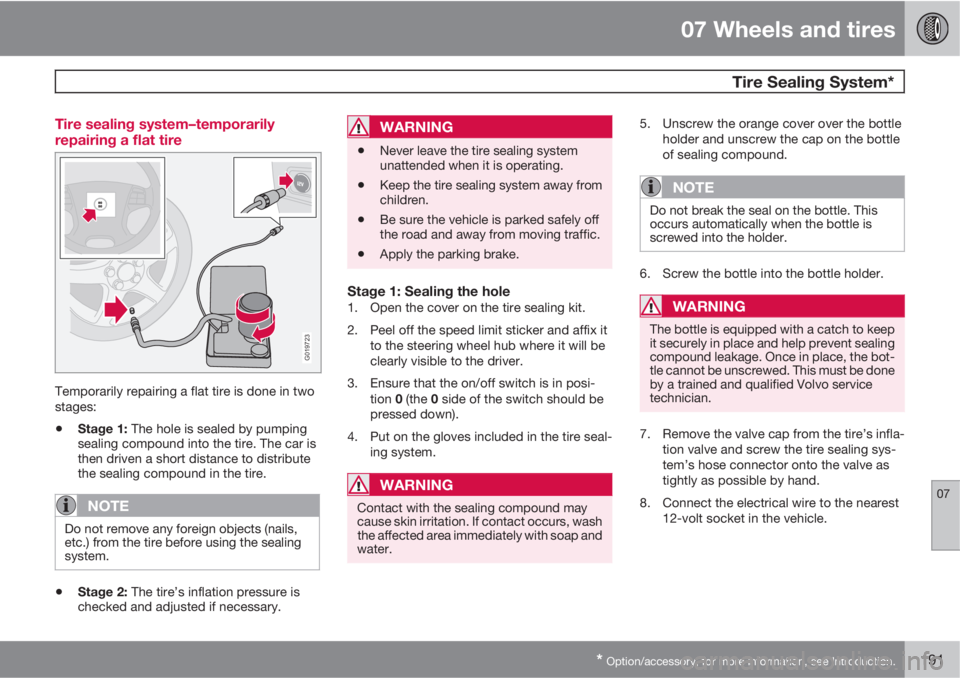
* Option/accessory, for more information, see Introduction.191 Tire sealing system–temporarily
repairing a flat tire
G019723
Temporarily repairing a flat tire is done in two
stages:
•Stage 1: The hole is sealed by pumping
sealing compound into the tire. The car is
then driven a short distance to distribute
the sealing compound in the tire.
NOTE
Do not remove any foreign objects (nails,
etc.) from the tire before using the sealing
system.
•Stage 2: The tire’s inflation pressure is
checked and adjusted if necessary.
WARNING
•Never leave the tire sealing system
unattended when it is operating.
•Keep the tire sealing system away from
children.
•Be sure the vehicle is parked safely off
the road and away from moving traffic.
•Apply the parking brake.
Stage 1: Sealing the hole1. Open the cover on the tire sealing kit.
2. Peel off the speed limit sticker and affix it
to the steering wheel hub where it will be
clearly visible to the driver.
3. Ensure that the on/off switch is in posi-
tion 0 (the 0 side of the switch should be
pressed down).
4. Put on the gloves included in the tire seal-
ing system.
WARNING
Contact with the sealing compound may
cause skin irritation. If contact occurs, wash
the affected area immediately with soap and
water.
5. Unscrew the orange cover over the bottle
holder and unscrew the cap on the bottle
of sealing compound.
NOTE
Do not break the seal on the bottle. This
occurs automatically when the bottle is
screwed into the holder.
6. Screw the bottle into the bottle holder.
WARNING
The bottle is equipped with a catch to keep
it securely in place and help prevent sealing
compound leakage. Once in place, the bot-
tle cannot be unscrewed. This must be done
by a trained and qualified Volvo service
technician.
7. Remove the valve cap from the tire’s infla-
tion valve and screw the tire sealing sys-
tem’s hose connector onto the valve as
tightly as possible by hand.
8. Connect the electrical wire to the nearest
12-volt socket in the vehicle.