fuel pressure VOLVO C70 2013 Owner´s Manual
[x] Cancel search | Manufacturer: VOLVO, Model Year: 2013, Model line: C70, Model: VOLVO C70 2013Pages: 296, PDF Size: 7.18 MB
Page 6 of 296
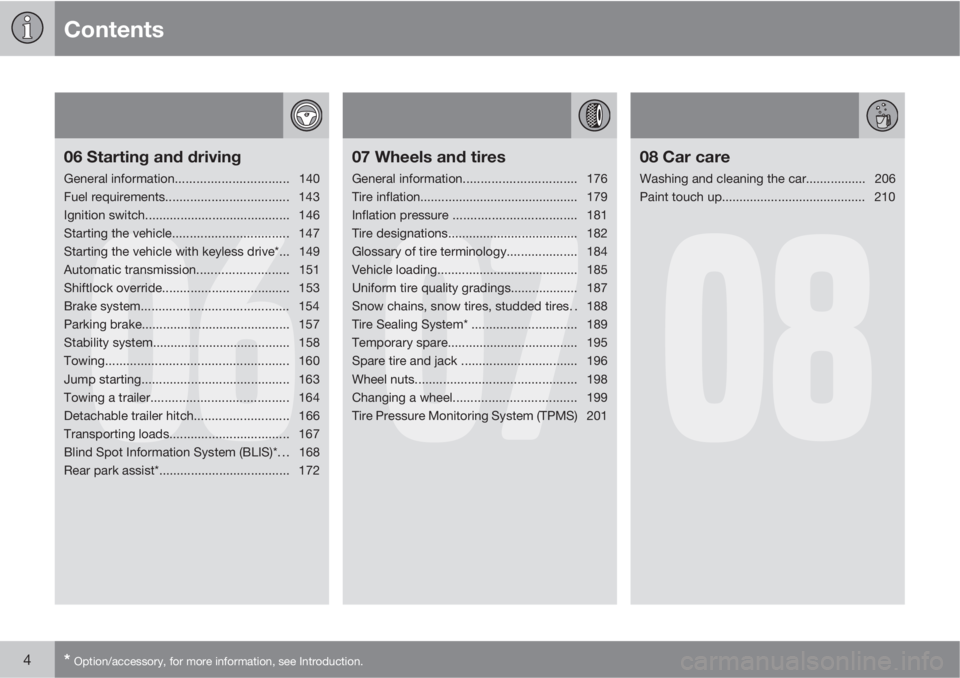
Contents
4* Option/accessory, for more information, see Introduction.
06
06 Starting and driving
General information................................140
Fuel requirements................................... 143
Ignition switch......................................... 146
Starting the vehicle................................. 147
Starting the vehicle with keyless drive*... 149
Automatic transmission..........................151
Shiftlock override.................................... 153
Brake system.......................................... 154
Parking brake.......................................... 157
Stability system....................................... 158
Towing.................................................... 160
Jump starting.......................................... 163
Towing a trailer....................................... 164
Detachable trailer hitch........................... 166
Transporting loads.................................. 167
Blind Spot Information System (BLIS)*. . . 168
Rear park assist*..................................... 172
07
07 Wheels and tires
General information................................176
Tire inflation............................................. 179
Inflation pressure ...................................181
Tire designations..................................... 182
Glossary of tire terminology.................... 184
Vehicle loading........................................ 185
Uniform tire quality gradings................... 187
Snow chains, snow tires, studded tires. . 188
Tire Sealing System* .............................. 189
Temporary spare..................................... 195
Spare tire and jack .................................196
Wheel nuts.............................................. 198
Changing a wheel................................... 199
Tire Pressure Monitoring System (TPMS) 201
08
08 Car care
Washing and cleaning the car................. 206
Paint touch up......................................... 210
Page 15 of 296
Introduction
Environment
13 Volvo and the environment
Volvo is committed to the well being of its cus-
tomers. As a natural part of this commitment,
we care about the environment in which we all
live. Caring for the environment means an
everyday involvement in reducing our environ-
mental impact. Volvo's environmental activities
are based on a holistic view, which means we
consider the overall environmental impact of a
product throughout its complete life cycle. In
this context, design, production, product use,
and recycling are all important considerations.
In production, Volvo has partly or completely
phased out several chemicals including CFCs,
lead chromates, asbestos, and cadmium; and
reduced the number of chemicals used in our
plants 50% since 1991.
Volvo was the first in the world to introduce into
production a three-way catalytic converter with
a Lambda sond, now called the heated oxygen
sensor, in 1976. The current version of this
highly efficient system reduces emissions of
harmful substances (CO, HC, NOx) from the
exhaust pipe by approximately 95 – 99% and
the search to eliminate the remaining emis-
sions continues. Volvo is the only automobile
manufacturer to offer CFC-free retrofit kits for
the air conditioning system of all models as far
back as the 1975 model 240. Advanced elec-
tronic engine controls and cleaner fuels are
bringing us closer to our goal. In addition tocontinuous environmental refinement of con-
ventional gasoline-powered internal combus-
tion engines, Volvo is actively looking at
advanced technology alternative-fuel vehicles.
When you drive a Volvo, you become our part-
ner in the work to lessen the car's impact on
the environment. To reduce your vehicle's
environmental impact, you can:
•Maintain proper air pressure in your tires.
Tests have shown decreased fuel econ-
omy with improperly inflated tires.
•Follow the recommended maintenance
schedule in your Warranty and Service
Records Information booklet.
•Drive at a constant speed whenever pos-
sible.
•See a trained and qualified Volvo service
technician as soon as possible for inspec-
tion if the check engine (malfunction indi-
cator) light illuminates, or stays on after the
vehicle has started.
•Properly dispose of any vehicle-related
waste such as used motor oil, used batter-
ies, brake pads, etc.
•When cleaning your vehicle, please use
genuine Volvo car care products. All Volvo
car care products are formulated to be
environmentally friendly.
RecyclingAs part of Volvo’s commitment to the environ-
ment, it is essential for the vehicle to be recy-
cled in an environmentally sound way. Almost
the entire vehicle can be recycled and for that
reason, the vehicle’s final owner is requested
to contact a Volvo retailer for information about
approved and certified recycling facilities.
FSCŸŸ
The FSCŸ (Forest Stewardship CouncilŸ) sym-
bol indicates that the wood pulp used in this
publication comes from FSC
Ÿ certified forests
and other responsible sources.
Page 60 of 296
02 Instruments and controls
Symbols – instrument panel
02
58
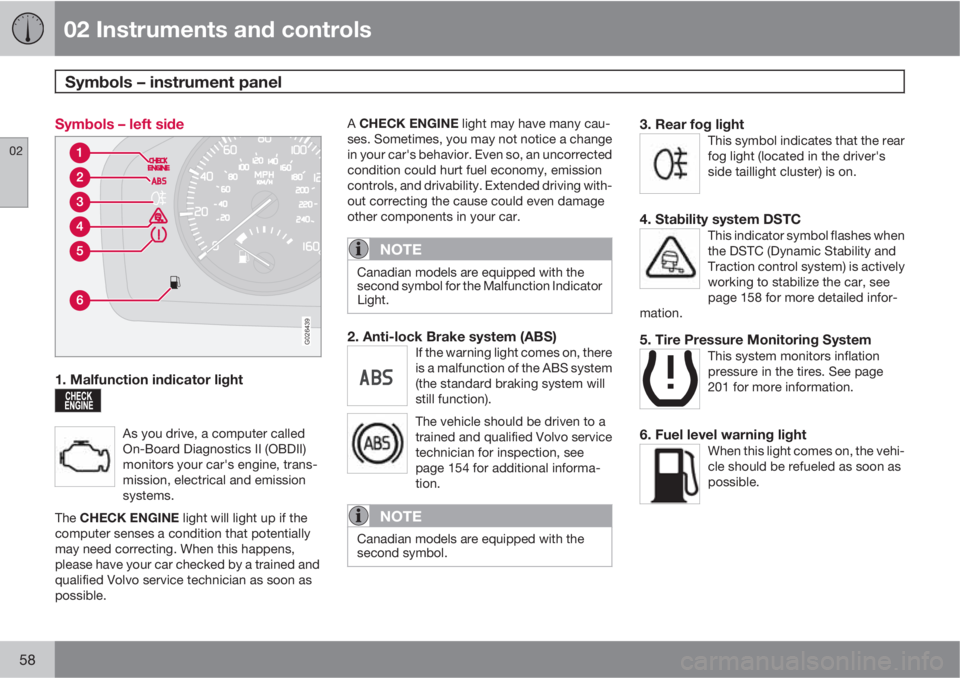
Symbols – left side
G026439
1. Malfunction indicator light
As you drive, a computer called
On-Board Diagnostics II (OBDII)
monitors your car's engine, trans-
mission, electrical and emission
systems.
The CHECK ENGINE light will light up if the
computer senses a condition that potentially
may need correcting. When this happens,
please have your car checked by a trained and
qualified Volvo service technician as soon as
possible.
A CHECK ENGINE light may have many cau-
ses. Sometimes, you may not notice a change
in your car's behavior. Even so, an uncorrected
condition could hurt fuel economy, emission
controls, and drivability. Extended driving with-
out correcting the cause could even damage
other components in your car.
NOTE
Canadian models are equipped with the
second symbol for the Malfunction Indicator
Light.
2. Anti-lock Brake system (ABS)If the warning light comes on, there
is a malfunction of the ABS system
(the standard braking system will
still function).
The vehicle should be driven to a
trained and qualified Volvo service
technician for inspection, see
page 154 for additional informa-
tion.
NOTE
Canadian models are equipped with the
second symbol.
3. Rear fog lightThis symbol indicates that the rear
fog light (located in the driver's
side taillight cluster) is on.
4. Stability system DSTCThis indicator symbol flashes when
the DSTC (Dynamic Stability and
Traction control system) is actively
working to stabilize the car, see
page 158 for more detailed infor-
mation.
5. Tire Pressure Monitoring SystemThis system monitors inflation
pressure in the tires. See page
201 for more information.
6. Fuel level warning lightWhen this light comes on, the vehi-
cle should be refueled as soon as
possible.
Page 142 of 296
06 Starting and driving
General information
06
140
Economical driving conserves natural
resources
Better driving economy may be obtained by
thinking ahead, avoiding rapid starts and stops
and adjusting the speed of your vehicle to
immediate traffic conditions.
Observe the following rules:
•Bring the engine to normal operating tem-
perature as soon as possible by driving
with a light foot on the accelerator pedal for
the first few minutes of operation. A cold
engine uses more fuel and is subject to
increased wear.
•Whenever possible, avoid using the vehicle
for driving short distances. This does not
allow the engine to reach normal operating
temperature.
•Drive carefully and avoid rapid acceleration
and hard braking.
•Use the transmission's Drive (D) position
as often as possible and avoid using kick-
down.
•Do not exceed posted speed limits.
•Avoid carrying unnecessary items (extra
load) in the vehicle.
•Maintain correct tire pressure. Check tire
pressure regularly (when tires are cold).
•Remove snow tires when threat of snow or
ice has ended.
•At highway driving speeds, fuel consump-
tion will be lower with the air conditioning
on and the windows closed than with the
air conditioning off and the windows open.
•Using the onboard trip computer's fuel
consumption modes can help you learn
how to drive more economically.
Other factors that decrease gas mileage
are:
•Dirty air cleaner
•Dirty engine oil and clogged oil filter
•Dragging brakes
•Incorrect front end alignment
Some of the above mentioned items and others
are checked at the standard maintenance
intervals.
WARNING
Driving with the trunk open: Driving with
the trunk open could lead to poisonous
exhaust gases entering the passenger com-
partment. If the trunk must be kept open for
any reason, proceed as follows:
1. Close the windows.
2. Set the ventilation system control to air
flow to floor, windshield and side win-
dows and the blower control to its high-
est setting.
Weight distribution affects handling
At the specified curb weight your vehicle has a
tendency to understeer, which means that the
steering wheel has to be turned more than
might seem appropriate for the curvature of a
bend. This ensures good stability and reduces
the risk of rear wheel skid. Remember that
these properties can alter with the vehicle load.
The heavier the load in the cargo area, the less
the tendency to understeer.
Handling, roadholding
Vehicle load, tire design and inflation pressure
all affect vehicle handling. Therefore, check
that the tires are inflated to the recommended
pressure according to the vehicle load. See the
"Tire pressure" section. Loads should be dis-
tributed so that capacity weight or maximum
permissible axle loads are not exceeded.
Driving through water
The vehicle can be driven through water up to
a depth of approximately 9 in. (25 cm), at a
maximum speed of 6 mph (10 km/h).
•Take particular care when driving through
flowing water.
•Clean the electrical connections for trailer
wiring after driving in mud or water
•When driving through water, maintain low
speed and do not stop in the water.
Page 144 of 296
06 Starting and driving
General information
06
142
Conserving electrical current
Keep the following in mind to help minimize
battery drain:
•When the engine is not running, avoid turn-
ing the ignition key to position II. Many
electrical systems (the audio system, the
optional navigation system, power win-
dows, etc) will function with the ignition key
in position I. This position reduces drain on
the battery.
•Please keep in mind that using systems,
accessories, etc that consume a great deal
of current when the engine is not running
could result in the battery being completely
drained. Driving or having the engine run-
ning for approximately 15 minutes will help
keep the battery charged.
•The optional 12 volt socket in the trunk
(certain models only) provides electrical
current even with the ignition switched off,
which drains the battery.
NOTE
•If the ignition is switched on, a warning
message will be displayed in the text
window in the instrument panel when
the battery charge is low.
•An energy conserving function
designed into the vehicle's electrical
system will switch off certain functions
or reduce the load on the battery by,
e.g., reducing the audio system's vol-
ume.
Before a long distance trip
It is always worthwhile to have your vehicle
checked at a trained and qualified Volvo serv-
ice technician before driving long distances.
Your trained and qualified Volvo service tech-
nician will also be able to supply you with
bulbs, fuses, spark plugs and wiper blades for
your use in the event that problems occur.
As a minimum, the following items should be
checked before any long trip:
•Check that engine runs smoothly and that
fuel consumption is normal.
•Check for fuel, oil, and fluid leakage.
•Have the transmission oil level checked1.
•Check condition of drive belts.
•Check state of the battery's charge.
•Examine tires carefully (the spare tire as
well), and replace those that are worn.
Check tire pressures.
•The brakes, front wheel alignment, and
steering gear should be checked by your
Volvo retailer only.
•Check all lights, including high beams.
•Reflective warning triangles are legally
required in some states/provinces.
•Have a word with your Volvo retailer if you
intend to drive in countries where it may be
difficult to obtain the correct fuel.
•Consider your destination. If you will be
driving through an area where snow or ice
are likely to occur, consider snow tires.
1To prevent injury from contact with hot surfaces, do not inspect your vehicle's transmission fluid yourself. Have your vehicle's transmission fluid level inspected by a qualified Volvo service technician.
Page 147 of 296
06 Starting and driving
Fuel requirements
06
145
You can also keep the vehicle locked if you
remain inside it during refueling. The central
locking button does not lock the fuel filler door.
Be sure the fuel filler door is not obstructed and
is completely closed after refueling. Open the
fuel filler cap slowly during hot weather.
Refueling
The fuel tank is designed to accommodate
possible expansion of the fuel in hot weather,
see page 275 for fuel tank volume. Be aware
that the "usable" tank capacity will be some-
what less than the specified maximum. When
the fuel level is low, such factors as ambient
temperature, the fuel's "Reid vapor pressure"
characteristics, and terrain can affect the fuel
pump's ability to supply the engine with an
adequate supply of fuel. Therefore, it is advis-
able to refuel as soon as possible when the
needle nears the red zone, or when the fuel
warning light comes on.
CAUTION
•Do not refuel with the engine running2.
Turn the ignition off or to position I. If the
ignition is on, an incorrect reading could
occur in the fuel gauge
•After refueling, close the fuel filler cap
by turning it clockwise until it clicks into
place.
•Avoid overfilling the fuel tank. Do not
press the handle on the filler nozzle
more than one extra time. Too much fuel
in the tank in hot weather conditions can
cause the fuel to overflow. Overfilling
could also cause damage to the emis-
sion control systems.
•Avoid spilling gasoline during refueling.
In addition to causing damage to the
environment, gasolines containing
alcohol can cause damage to painted
surfaces, which may not be covered
under the New Vehicle Limited War-
ranty.
•Do not use gasolines containing meth-
anol (methyl alcohol, wood alcohol).
This practice can result in vehicle per-
formance deterioration and can dam-
age critical parts in the fuel system.
Such damage may not be covered
under the New Vehicle Limited War-
ranty.
2If the fuel filler cap is not closed tightly or if the engine is running when the vehicle is refueled, the Check Engine Light (malfunction indicator lamp) may indicate a fault. However, your vehicle’s
performance will not be affected. Use only Volvo original or approved fuel filler caps.
Page 163 of 296
06 Starting and driving
Towing
06
161
2. Insert the key into the ignition to unlock the
steering wheel. With the engine off and the
vehicle at a standstill, great effort will be
required to turn the steering wheel.
3.
Turn the ignition key to position II.
4. Place the gear selector in neutral. For vehi-
cles with automatic transmissions, follow
instruction on page 153, "Shiftlock over-
ride" to allow the gear selector to be moved
from the Park position.
5. Keep firm pressure on the brake pedal
while releasing the parking brake.
6. When towing has been completed, return
the gear selector to Park and apply the
parking brake.
The following points should also be
observed:
•Never exceed 50 mph (80 km/h). Never
exceed local towing speed limits and heed
all local towing restrictions.
•Never tow farther than 50 miles (80 km).
•Keep the tow rope taut at all times while the
vehicle is in motion.
•The disabled vehicle should be towed in
the forward direction only.
WARNING
•Never allow a vehicle to be towed with-
out a driver behind the wheel of the dis-
abled vehicle.
•When the engine is not running, steering
resistance and the effort needed to
apply the brakes will be great.
•Never attempt to tow a vehicle with a
dead battery at night.
CAUTION
•Check with state and local authorities
before attempting this type of towing,
as vehicles being towed are subject to
regulations regarding maximum towing
speed, length and type of towing
device, lighting, marker flags, etc.
•Never attempt to push- or tow-start a
vehicle with a dead battery. This would
inject unburned fuel into the three-way
catalytic converter(s), causing over-
heating, backfiring, and damage, see
page 163 for instructions on jump star-
ting the vehicle.
Towing vehicles with front wheel drive
Volvo recommends the use of flat bed equip-
ment for towing vehicles with front wheel drive.
If wheel lift equipment must be used, please
use extreme caution to help avoid damage to
the vehicle.
In this case, the vehicle should be towed with
the rear wheels on the ground if at all possible.
If it is absolutely necessary to tow the vehicle
with the front wheels on the ground, please
refer to the towing information on the previous
page.
•Sling-type equipment applied at the front
will damage radiator and air conditioning
lines.
•It is equally important not to use sling-type
equipment at the rear or apply lifting equip-
ment inside the rear wheels; serious dam-
age to the rear axle may result.
•If the vehicle is being towed on a flat bed
truck, the towing eyelets must not be used
to secure the vehicle on the flat bed. Con-
sult the tow truck operator.
Page 197 of 296
07 Wheels and tires
Temporary spare
07
195 Temporary spare
The spare tire in your vehicle1 is called a "Tem-
porary Spare".
Recommended tire pressure (see the placard
on the B-pillar or on the fuel filler door) should
be maintained irrespective of which position on
the car the temporary spare tire is used.
In the event of damage to this tire, a new one
can be purchased from your Volvo retailer.
WARNING
Current legislation prohibits the use of the
"Temporary Spare" tire other than as a tem-
porary replacement for a punctured tire. It
must be replaced as soon as possible by a
standard tire. Road holding and handling
may be affected with the "Temporary
Spare" in use. Do not exceed a speed of
50 mph (80 km/h) with the "Temporary
Spare" in use.
CAUTION
The car must not be driven with wheels of
different dimensions or with a spare tire
other than the one that came with the car.
The use of different size wheels can seri-
ously damage your car's transmission.
1Not on models equipped with the Tire sealing system.
Page 203 of 296
07 Wheels and tires
Tire Pressure Monitoring System (TPMS)
07
201 Introduction
The tire pressure monitoring system1 uses sen-
sors mounted in the tire valves to check infla-
tion pressure levels. When the vehicle is mov-
ing at a speed of approximately 20 mph
(30 km/h) or faster, these sensors transmit
inflation pressure data to a receiver located in
the vehicle.
NOTE
USA – FCC ID: KR5S122780002
This device complies with part 15 of the
FCC rules. Operation is subject to the fol-
lowing conditions: (1) This device may not
cause harmful interference, and (2) this
device must accept any interference
received, including interference that may
cause undesired operation.
When low inflation pressure is detected, TPMS
will light up the tire pressure warning light
(also referred to as a telltale) in the instrument
panel and will display one of the following mes-
sages in the text window:
LOW TIRE PRESS.
CHECK TIRES or TIRE PRESSURE LOW.
NOTE
If a fault occurs in TPMS, the tire pressure
warning light will flash for approximately
1 minute and
TIRE PRESS SYST
SERVICE REQUIRED will be displayed.
Each tire, including the spare (if provided),
should be checked monthly when cold and
inflated to the inflation pressure recommended
by the vehicle manufacturer on the vehicle
placard or tire inflation pressure label. (If your
vehicle has tires of a different size than the size
indicated on the vehicle placard or tire inflation
pressure label, you should determine the
proper tire inflation pressure for those tires.)
As an added safety feature, your vehicle has
been equipped with a tire pressure monitoring
system (TPMS) that illuminates a low tire pres-
sure telltale when one or more of your tires is
significantly under-inflated. Accordingly, when
the low tire pressure telltale illuminates, you
should stop and check your tires as soon as
possible, and inflate them to the proper pres-
sure. Driving on a significantly under-inflated
tire causes the tire to overheat and can lead to
tire failure. Under-inflation also reduces fuel
efficiency and tire tread life, and may affect the
vehicle's handling and stopping ability.Please note that the TPMS is not a substitute
for proper tire maintenance, and it is the driv-
er's responsibility to maintain correct tire pres-
sure, even if under-inflation has not reached
the level to trigger illumination of the TPMS low
tire pressure telltale.
Your vehicle has also been equipped with a
TPMS malfunction indicator to indicate when
the system is not operating properly. The
TPMS malfunction indicator is combined with
the low tire pressure telltale . When the system
detects a malfunction, the telltale will flash for
approximately one minute and then remain
continuously illuminated. This sequence will
continue upon subsequent vehicle start-ups as
long as the malfunction exists. When the mal-
function indicator is illuminated, the system
may not be able to detect or signal low tire
pressure as intended. TPMS malfunctions may
occur for a variety of reasons, including the
installation of replacement or alternate tires or
wheels on the vehicle that prevent the TPMS
from functioning properly. Always check the
TPMS malfunction telltale after replacing one
or more tires or wheels on your vehicle to
ensure that the replacement or alternate tires
and wheels allow the TPMS to continue to
function properly.
1U.S. models only
Page 208 of 296
08 Car care
Washing and cleaning the car
08
206
Washing the car
The following points should be kept in mind
when washing and cleaning the car:
•The car should be washed at regular inter-
vals since dirt, dust, insects and tar spots
adhere to the paint and may cause dam-
age. To help prevent corrosion, it is partic-
ularly important to wash the car frequently
in the wintertime when salt has been used
on the roads.
•Avoid washing your car in direct sunlight.
Doing so may cause detergents and wax
to dry out and become abrasive. To avoid
scratching, use lukewarm water to soften
the dirt before you wash with a soft
sponge, and plenty of sudsy water.
•Bird droppings: Remove from paintwork
as soon as possible. Otherwise the finish
may be permanently damaged.
•A detergent can be used to facilitate the
softening of dirt and oil.
•Dry the car with a clean chamois and
remember to clean the drain holes in the
doors and rocker panels.
•Tar spots can be removed with tar remover
after the car has been washed.
•A stiff-bristle brush and lukewarm soapy
water can be used to clean the wiper
blades. Frequent cleaning of the wind-
shield and wiper blades improves visibilityconsiderably and also helps prolong the
service life of the wiper blades.
•Wash off the dirt from the underside (wheel
housings, fenders, etc).
•In areas of high industrial fallout, more fre-
quent washing is recommended.
NOTE
When washing the car, remember to remove
dirt from the drain holes in the doors and
sills.
Exterior componentsVolvo recommends the use of special cleaning
products, available at your Volvo retailer, for
cleaning colored plastic, rubber, or ornamental
components such as chromed strips on the
exterior of your vehicle. The instructions for
using these products should be followed care-
fully. Solvents or stain removers should not be
used.
CAUTION
•Avoid waxing or polishing plastic or rub-
ber components
•Polishing chromed strips can wear
away or damage the surface
•Polishes containing abrasive sub-
stances should not be used
CAUTION
•During high pressure washing, the
spray mouthpiece must never be closer
to the vehicle than 13" (30 cm). Do not
spray into the locks.
•Dirt, snow, etc., on the headlights can
reduce lighting capacity considerably.
Clean the headlights regularly, for
example when refueling.
Automatic washing – simple and quickWe do NOT recommend washing your car in an
automatic wash during the first few months
(because the paint will not have hardened suf-
ficiently).
An automatic wash is a simple and quick way
to clean your car, but it is worth remembering
that it may not be as thorough as when you
yourself go over the car with sponge and water.
Keeping the underbody clean is most impor-