ignition VOLVO S40 2000 User Guide
[x] Cancel search | Manufacturer: VOLVO, Model Year: 2000, Model line: S40, Model: VOLVO S40 2000Pages: 84, PDF Size: 2.28 MB
Page 25 of 84

If the doors are locked while driving, this may hinder rapid access to the occupants of the car in the event of an
accident. (Also see information on "Child safety locks").
Central locking button
Central locking button
The central locking button (1) can be used to lock or unlock all doors and trunk/tailgate.
Lock: Press the lower side of the button.
Unlock: Press the upper side of the button.
Note: As long as ignition is on, you can always lock or unlock with the central locking button.
With ignition off and 25 seconds after having locked all doors and trunk/tailgate with the key or with the remote
control, the central locking button will not lock or unlock the car any more.
Note: If the key is in the ignition switch and you close the driver's door, the driver's door will be immediately
unlocked again in order to prevent accidentally locking the car with the keys left inside the car.
pg. 40 Remote keyless entry system
Remote keyless entry system
Your car is equipped with a remote control transmitter. This transmitter uses a radio frequency which will allow
"keyless" entry into the passenger compartment or the trunk. You will be supplied with two coded key ring
transmitters, which will enable you to lock/unlock all doors and the trunk/tailgate and fuel filler door from a distance
of 10-15 feet (3-5 meters).
The Remote also activates/deactivates the alarm system that comes standard with this car.
The car can also be locked/unlocked with the key.
Using the remote control
· Press the LOCK button once to lock all doors and trunk/tailgate.
· Press the UNLOCK button once to unlock the driver's door and the fuel filler door only. Press this button again
(within 10 seconds) to unlock other doors, trunk/tailgate.
· Press the OPEN trunk/tailgate button to unlock the tailgate/trunk.
ProCarManuals.com
Page 26 of 84

This device complies with FCC rules Part 15. Operation is subject to the following two conditions: (1) This device
may not cause harmful interference and (2) this device must accept any interference that may be received, including
interference that may cause undesired operation.
NOTE: If only the driver's door is unlocked, the lock will automatically reengage (re-lock) and the alarm will be set
after 2 minutes unless the door has been opened (see page 42
).
The lock/unlock and alarm features can also be utilized by using the keys. See section: Doors and Locks on page 39.
WARNING!
Volvo does not recommend using the transmitter to lock the doors from inside the car. The alarm would be activated
and would sound when one of the doors is opened. The doors must not be locked using the remote transmitter while
the vehicle is occupied. In case of an accident, this may hinder rapid access to the occupants of the vehicle.
Remote control not functioning.
If the remote control is not functioning the car can be started as follows:
Open the driver's door with the key. The alarm and alarm siren will activate.
Turn the ignition on. The alarm will deactivate.
Note: The remote control will not function if a key is left in the ignition switch.
pg. 41 Alarm
Alarm
The radio signal emitted from the transmitter, which is used to set/unset the alarm, is a "rolling code" signal. This
means that the signal is changed randomly for each transmission and is intended to help prevent unauthorized
recording of the code.
When armed (set), the alarm continuously monitors a number of points on the car. The following conditions will set off
the alarm:
· The hood is opened
· The trunk/tailgate is opened
· A door is opened
· The ignition switch is tampered with
ProCarManuals.com
Page 28 of 84

· LED off - the alarm is not armed (set)
· LED flashes once per second - the alarm is armed (set)
· LED flashes rapidly before the ignition is switched on - the alarm has been triggered
· LED flashes rapidly for 15 seconds after the ignition has been switched on - a fault has been detected in the alarm
system. Contact a Volvo retailer.
Automatic relock
If only the driver's door is unlocked with the remote control, the lock will automatically reengage (re-lock) and the
alarm will be set after 2 minutes unless the door has been opened.
Batteries
Each remote transmitter is powered by two three-volt batteries, type CR 2016. If the range of the transmitter is
noticeably reduced, this indicates that the battery is weak and should be replaced.
Replacement: Open the remote control by twisting a coin in the ring between front and back (leave the ring in place).
Replace the batteries. Reinstall the cover, making sure it is secured tightly to help protect the transmitter.
CAUTION: Do not attempt to service or repair any components of the alarm system yourself. This should only be
done by an authorized Volvo retailer.
pg. 43 Trunk/Tailgate, Glove compartment
Opening/unlocking the trunk/tailgate
The trunk/tailgate locks are incorporated in the central locking system and are locked or unlocked when the driver's
door is locked/unlocked.
ProCarManuals.com
Page 32 of 84
Refueling
The fuel tank is designed to hold approximately: 16 US gallons (60 liters) with sufficient volume left over to
accommodate possible expansion of the fuel in hot weather.
Fuel filler door
The fuel filler door (on the left rear fender) is unlocked along with the car's central locking system.
Open fuel filler cap slowly during hot weather conditions.
See page 95
in case the fuel filler door does not unlock along with the central locking system
CAUTION:
· Do not refuel with the engine running *. Turn the ignition off or to position I. If the ignition is on, an incorrect
reading could occur in the fuel gauge.
· After refueling, close the fuel filler cap by turning it clockwise until it clicks into place *.
· Avoid spilling gasoline during refueling. Gasolines containing alcohol can cause damage to painted surfaces, which
may not be covered under the New Vehicle Limited Warranty.
· Do not use gasolines containing methanol (methyl alcohol, wood alcohol). This practice can result in vehicle
performance deterioration and can damage critical parts in the fuel system. Such damage may not be covered under the
New Vehicle Limited Warranty.
· Do not overfill the fuel tank. Overfilling could damage the emission control system.
* If the fuel filler cap is not closed tightly or if the engine is running when the car is refueled, the Check Engine
Lamp may indicate a fault. However, your vehicle's performance will not be affected. Use only Volvo original or
approved fuel filler caps.
pg. 60 Driving economy
Economical driving conserves natural resources
Better driving economy may be obtained by thinking ahead, avoiding rapid starts and stops and adjusting the speed of
your vehicle to immediate traffic conditions. Observe the following rules:
· Bring the engine to normal operating temperature as soon as possible by driving with a light foot on the accelerator
pedal for the first few minutes of operation. A cold engine uses more fuel and is subject to increased wear.
· Whenever possible, avoid using the car for driving short distances. This does not allow the engine to reach normal
operating temperature.
· Drive carefully and avoid rapid acceleration and hard braking.
· Do not exceed posted speed limits.
· Avoid carrying unnecessary items (extra load) in the car.
· Maintain correct tire pressure. Check tire pressure regularly (check when tires are cold).
· Remove snow tires when threat of snow or ice has ended.
· Note that roof racks, ski racks, etc., increase air resistance and thereby fuel consumption.
· Avoid using automatic transmission kickdown feature unless necessary.
ProCarManuals.com
Page 33 of 84
· Avoid using the air conditioning when it is not required. When engaged, the air conditioner's compressor places an
additional load on the engine. However, please note that fuel consumption is lower with the air conditioning on than it
is when driving with the air conditioning switched off and the windows down.
· Utilizing the fuel consumption modes in the Trip Computer can help you "learn" how to drive more economically.
Other factors which decrease gas mileage are:
· Worn or dirty spark plugs
· Incorrect spark plug gap
· Dirty air cleaner
· Dirty engine oil and clogged oil filter
· Dragging brakes
· Incorrect front end alignment
Some of the above mentioned items and others are checked at the standard Maintenance Service intervals.
NOTE : The automatic transmission's ( D)rive position should be used as often as possible to help improve fuel
economy.
WARNING!
It is recommended that tires of the same make and dimensions be used on all four wheels (including the use of snow
tires). Do not use bias ply tires as this will adversely alter vehicle handling characteristics. Maintain correct tire
pressure.
pg. 61 Starting the engine
Starting and stopping
1. Fasten the seat belt.WARNING!
Before starting, check that the seat, steering wheel and mirrors are adjusted properly. Make sure the brake pedal can
be depressed completely. Move the seat closer if necessary. Refer to section "front seats".
2. Apply the parking brake, if not already set. The gear selector is locked in the (P)ark position (SHIFT LOCK).
3. Without touching the accelerator pedal, turn the ignition key to the starting position. Allow the starter to operate
for up to 5 seconds. Release the key as soon as the engine starts. If the engine fails to start, repeat step 3.
For cold starts at altitudes above 6000 ft (1800 meters), depress the accelerator pedal halfway and turn the key to the
starting position. Release the pedal slowly when the engine starts.
4. To release the gear selector from the (P)ark position, the ignition key must be in position II and the brake pedal
must be depressed.
See page 95
for instructions on manually releasing the SHIFTLOCK system.
NOTE: Your car is equipped with a KEYLOCK system. When the engine is switched off, the gear selector must be
in the ( P)ark position before the starting key can be removed from the ignition switch.
5. Select the desired gear. The gear engages after a slight delay which is especially noticeable when selecting R.
ProCarManuals.com
Page 36 of 84
The indicator lamp in the instrument panel lights up when this gear is selected. No upshift can occur when L is
engaged. Select position L for driving in first and second gears. Use this position to select low gear with no upshift,
e.g. when ascending and descending steep grades. The transmission will make a very noticeable downshift from 2nd to
1st gear if road speed drops to below 30 mph (45 km/h) in E mode or 6 mph (10 km/h) in S mode.
Kick-down
Automatic shift to a lower gear (kick-down) is achieved by depressing the accelerator pedal fully and briskly. An
upshift will be achieved when approaching the top speed for a particular gear or by releasing the accelerator pedal
slightly. Kick -down can be used for maximum acceleration or when passing at highway speeds. Avoid using the kick-
down function during the break-in period (first 1,200 miles of vehicle operation).
"Lock-up"
The automatic transmission has a "lock -up" function which reduces engine speed and saves fuel. The "lock -up"
function can sometimes be felt as an additional gear change.
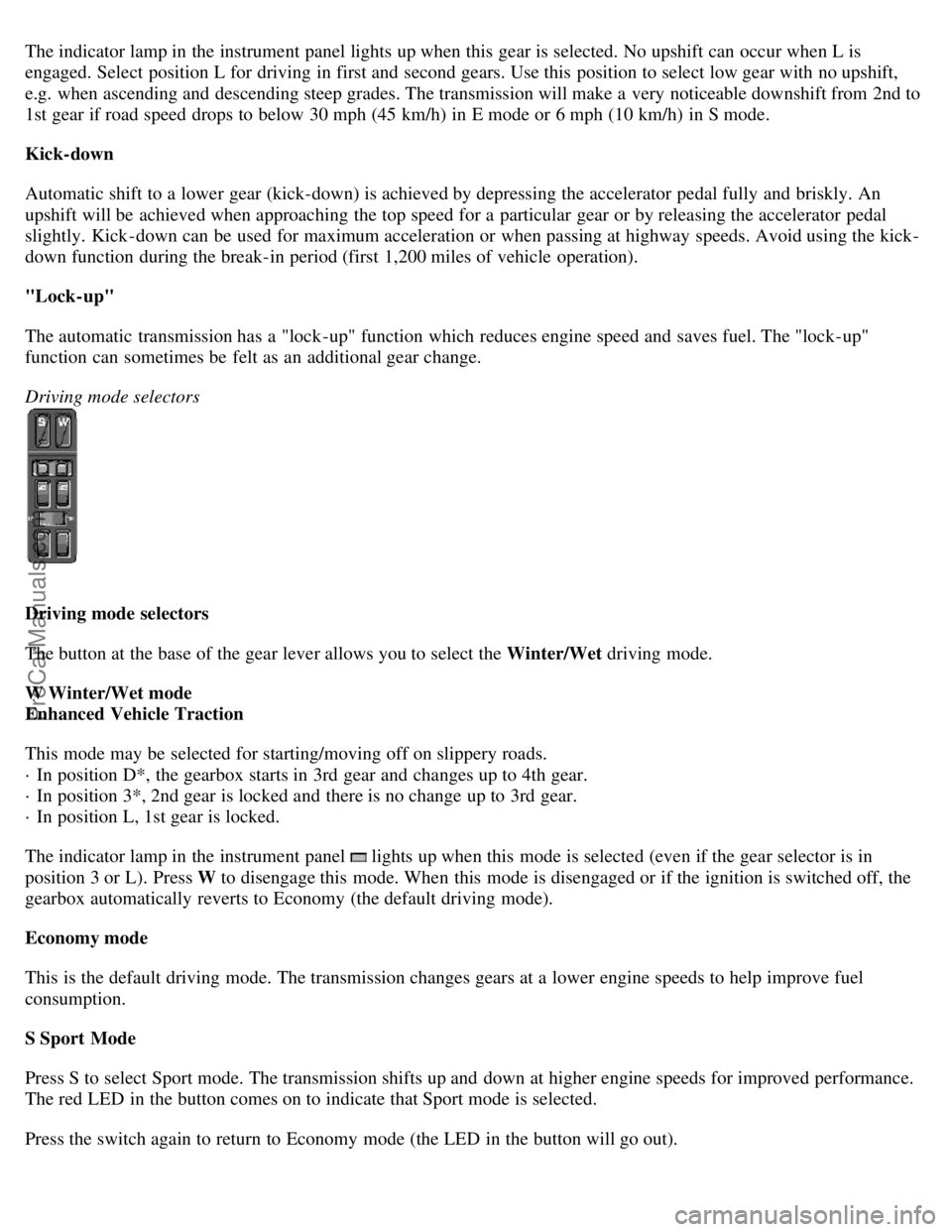
Driving mode selectors
Driving mode selectors
The button at the base of the gear lever allows you to select the Winter/Wet driving mode.
W Winter/Wet mode
Enhanced Vehicle Traction
This mode may be selected for starting/moving off on slippery roads.
· In position D*, the gearbox starts in 3rd gear and changes up to 4th gear.
· In position 3*, 2nd gear is locked and there is no change up to 3rd gear.
· In position L, 1st gear is locked.
The indicator lamp in the instrument panel
lights up when this mode is selected (even if the gear selector is in
position 3 or L). Press W to disengage this mode. When this mode is disengaged or if the ignition is switched off, the
gearbox automatically reverts to Economy (the default driving mode).
Economy mode
This is the default driving mode. The transmission changes gears at a lower engine speeds to help improve fuel
consumption.
S Sport Mode
Press S to select Sport mode. The transmission shifts up and down at higher engine speeds for improved performance.
The red LED in the button comes on to indicate that Sport mode is selected.
Press the switch again to return to Economy mode (the LED in the button will go out).
ProCarManuals.com
Page 47 of 84
· Attach the crank to the jack (C).
· Attach the lug wrench (D) to the crank.
· Raise the jack by cranking it clockwise. Be sure the jack engages the attachment point correctly.
The base of the jack must be flat on a level, firm, non-slippery surface. Before raising the car, check that the
jack is still correctly positioned in the attachment point.
· Raise the car until the wheel to be changed is lifted off the ground.
· Unscrew the wheel bolts completely and carefully remove the wheel so as not to damage the thread on the studs.WARNING!
The jack must be correctly placed in the jack attachment.
Installing the wheel
Clean the contact surfaces on the wheel and
hub. Lift the wheel and place it on the hub. Install the wheel bolts crosswise and tighten by turning lightly clockwise.
Lower the vehicle to the ground and alternately tighten the bolts to 81 ft. lbs. (110 Nm). Install the wheel cap (where
applicable).
pg. 85 Replacing bulbs
Remove cover
Removing high/low beam headlight bulbs
· Switch off the ignition
· Turn the light switch off and open the hood.
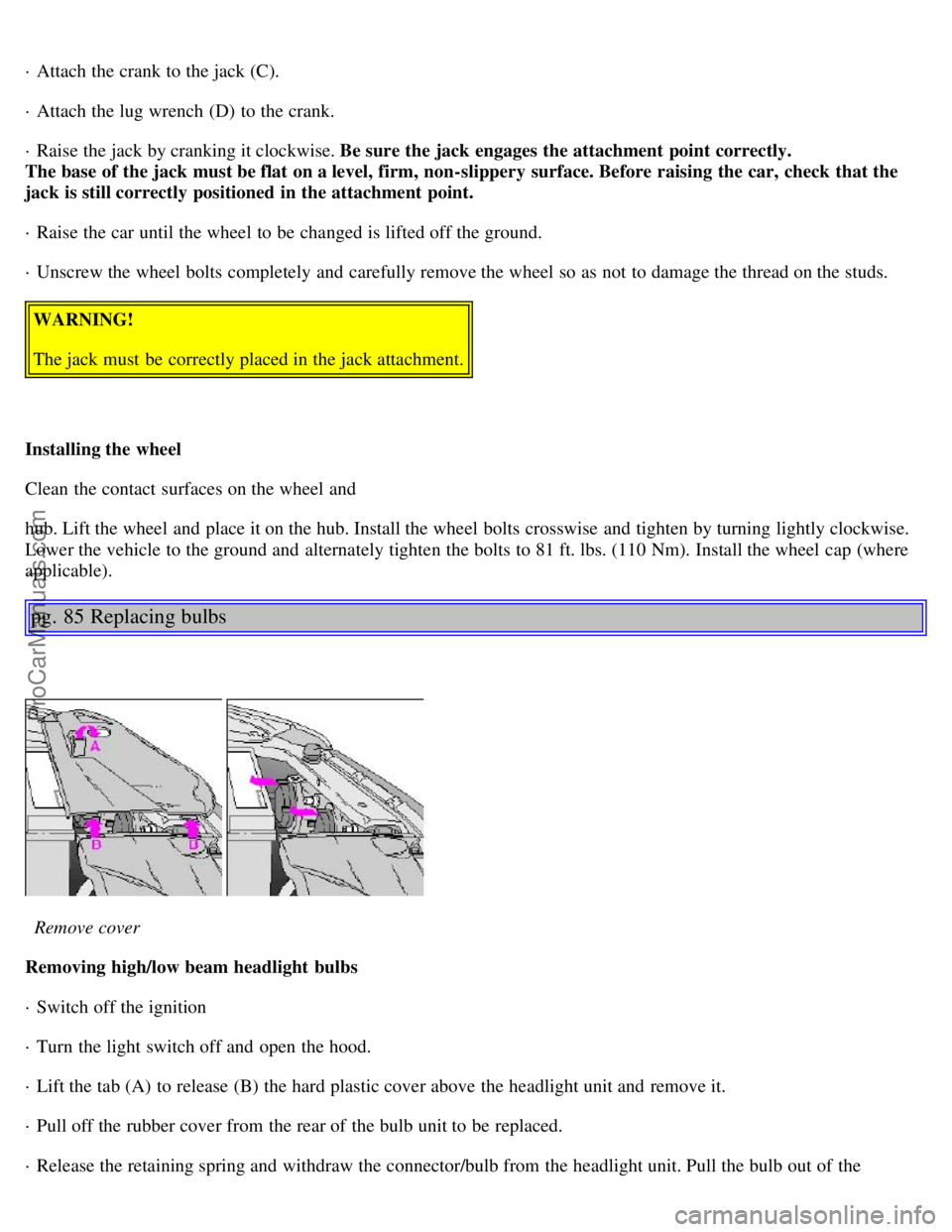
· Lift the tab (A) to release (B) the hard plastic cover above the headlight unit and remove it.
· Pull off the rubber cover from the rear of the bulb unit to be replaced.
· Release the retaining spring and withdraw the connector/bulb from the headlight unit. Pull the bulb out of the
ProCarManuals.com
Page 50 of 84
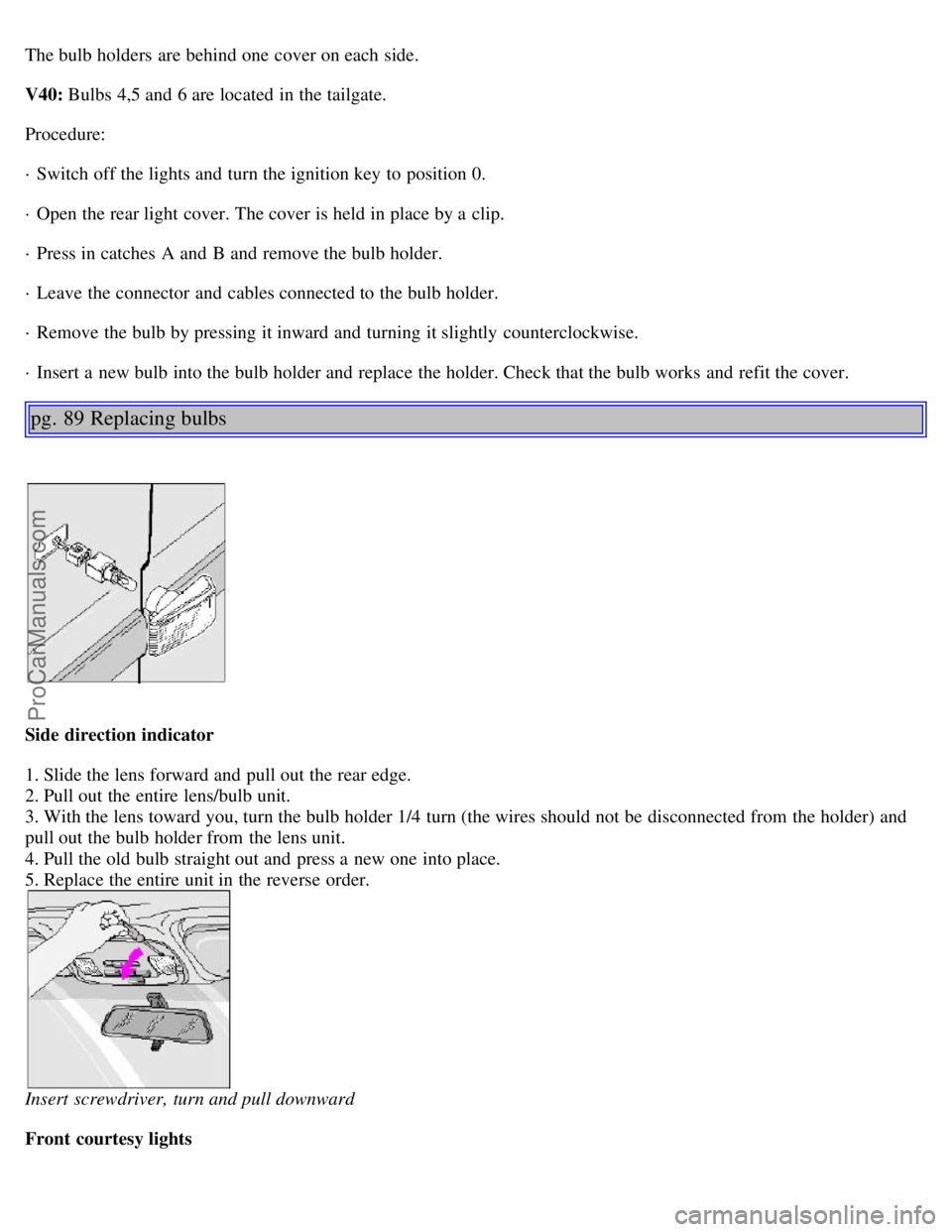
The bulb holders are behind one cover on each side.
V40: Bulbs 4,5 and 6 are located in the tailgate.
Procedure:
· Switch off the lights and turn the ignition key to position 0.
· Open the rear light cover. The cover is held in place by a clip.
· Press in catches A and B and remove the bulb holder.
· Leave the connector and cables connected to the bulb holder.
· Remove the bulb by pressing it inward and turning it slightly counterclockwise.
· Insert a new bulb into the bulb holder and replace the holder. Check that the bulb works and refit the cover.
pg. 89 Replacing bulbs
Side direction indicator
1. Slide the lens forward and pull out the rear edge.
2. Pull out the entire lens/bulb unit.
3. With the lens toward you, turn the bulb holder 1/4 turn (the wires should not be disconnected from the holder) and
pull out the bulb holder from the lens unit.
4. Pull the old bulb straight out and press a new one into place.
5. Replace the entire unit in the reverse order.
Insert screwdriver, turn and pull downward
Front courtesy lights
ProCarManuals.com
Page 51 of 84
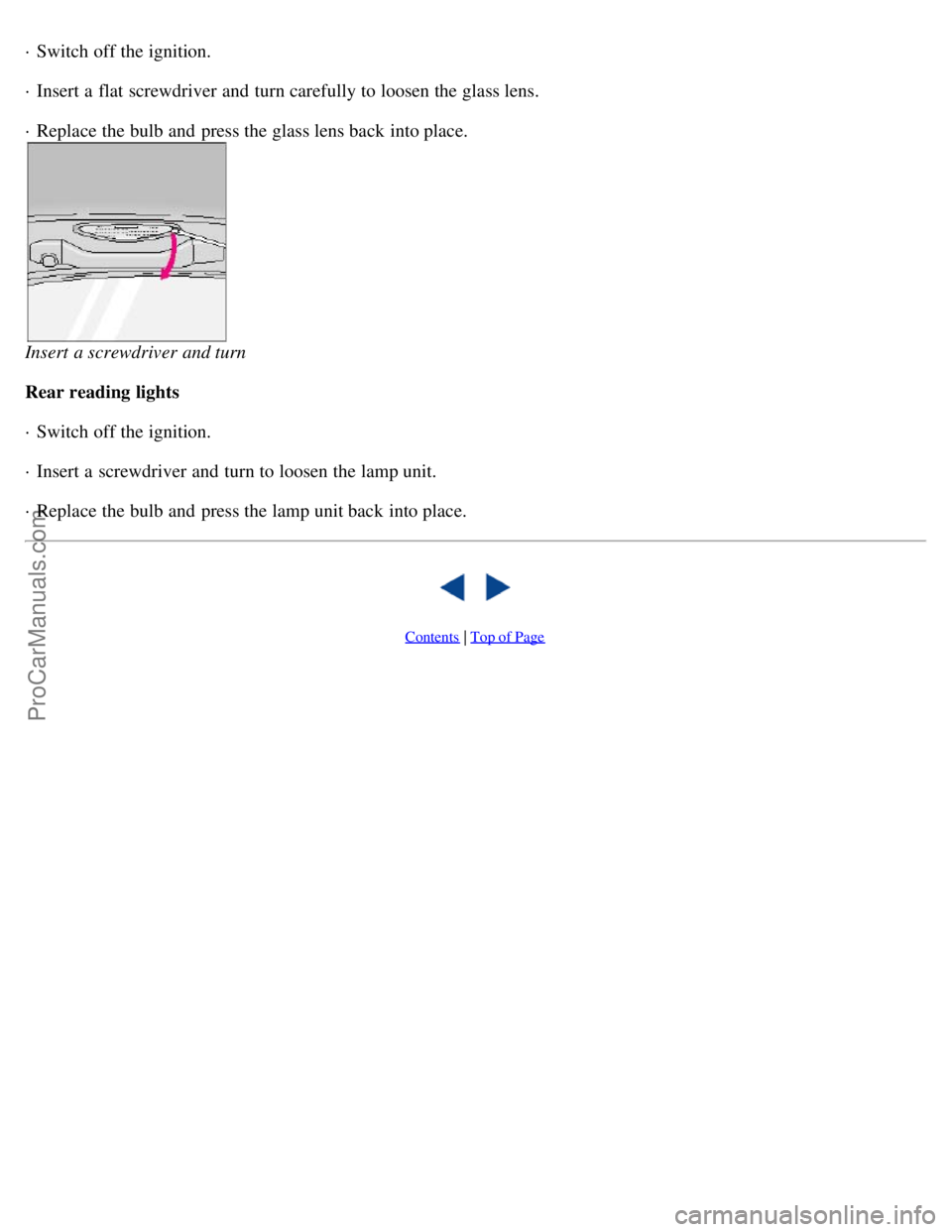
· Switch off the ignition.
· Insert a flat screwdriver and turn carefully to loosen the glass lens.
· Replace the bulb and press the glass lens back into place.
Insert a screwdriver and turn
Rear reading lights
· Switch off the ignition.
· Insert a screwdriver and turn to loosen the lamp unit.
· Replace the bulb and press the lamp unit back into place.
Contents | Top of Page
ProCarManuals.com
Page 65 of 84
2 0 0 0
VOLVO
S & V 40
Chapter 9 - Specifications
pg. 119 Specifications
Specifications
This chapter contains facts and figures pertaining to the technical specifications of your car. Oil/fluids specifications
120
Engine specifications121
Cooling/fuel/distributor ignition systems122
Front/rear suspensions122
Transmission, Capacities, Vehicle loading123
Electrical system/bulbs124
Weights125
Road assistance126
pg. 120 Oil/fluid specifications
Oil quality
Meeting API specification SJ, SJ/CF, or SJ/Energy Conserving.
For best fuel economy and engine protection, consult with your authorized Volvo retailer for recommended oils. Oil
with a different quality rating may not provide adequate engine protection.
Synthetic oils complying with oil quality requirements are recommended for: driving in areas of sustained temperature
extremes (hot or cold), when towing a trailer over long distances or for prolonged driving in mountainous areas.
Extra oil additives must not be used unless advised by an authorized Volvo retailer.
Viscosity (stable ambient temperatures):
ProCarManuals.com