light VOLVO S40 2000 User Guide
[x] Cancel search | Manufacturer: VOLVO, Model Year: 2000, Model line: S40, Model: VOLVO S40 2000Pages: 84, PDF Size: 2.28 MB
Page 21 of 84

3 High beam/low beam switch (headlights on).
Move the lever towards the steering wheel and release it.
4 Headlight flasher (headlights off).
Move the lever towards the steering wheel. The headlight high beam will be on until the lever is released.
NOTE: A defective turn signal bulb will cause the turn signal indicator and remaining signal lights to flash
more rapidly than normal.
Home Safe lighting
When you leave your car at night, you can make use of the exterior courtesy lighting function:
· Remove the key from the ignition switch.
· Pull the turn signal lever towards the steering wheel (as when using the headlight flasher function).
The low beam headlights will now remain on for 30 seconds to light your way.
Repeat the above measures if you want to switch off the Home Safe Lighting.
Wipers/washers
1 "Single sweep" position:
The switch returns automatically when released.
2 Intermittent wiper
The wipers will sweep approximately every 5 seconds (car speed depending).
3 Wipers, normal speed
4 Wipers, high speed
5 Windshield wiper/washer, headlight wiper/washer.
The wipers will make 23 sweeps across the windshield and headlights and 1 sweep after 3 seconds.
6 Tailgate window wiper (V40)
The tailgate wiper switch has two positions:
OFF
ON : intermittent and synchronized with windshield wiper
Tip function
When pressing switch 7 briefly the wiper will make one sweep, independent of the interval
Backing up
When the gearlever is moved towards rear and the windshield wipers are on, the rear window wiper will come
on for two sweeps.
ProCarManuals.com
Page 23 of 84

2 0 0 0
VOLVO
S & V 40
Chapter 3 - Body and interior
pg. 37 Body and interior
Body and interior
The seats, sun roof, mirrors, etc. are described on the following pages. Keys
38
Doors and locks39
Alarm41
Trunk/tailgate43
Child safety locks44
Front seats45
Rear/side view mirrors47
Interior lights, Vanity mirror48
Sun roof49
Hood50
Storage compartments51
Trunk light, Spare tire, Jack52
Folding rear seat53
Folding front seat, Luggage strap54
Side cargo net, Luggage net55
Weight distribution, Handling, Roadholding, Roofrack56
pg. 38 Keys
ProCarManuals.com
Page 27 of 84

The alarm will sound for 30 second intervals, with a 10 second pause between intervals. This function cannot be
interrupted.
· If the battery or the siren are disconnected, the alarm will sound for five minutes
Arming (setting) the alarm
Press the LOCK button on the remote control, lock the car using the key in the driver's door . One long flash of the
turn signals will confirm that the alarm is set.
Disarming the alarm
Press the UNLOCK button on the remote control or unlock the driver's door with the key.
Turning off (stopping) the alarm
If the alarm is sounding, it can be stopped by pressing the UNLOCK button on the remote control or by unlocking the
driver's door with the key.
Visual alarm signal
The visual alarm signal is given by flashing all turn signals and turning on the interior lighting for approximately 5
minutes.
Audible alarm signal
An audible alarm signal is given by the backup siren. One alarm cycle lasts for 30 seconds.
"Panic" function
In an emergency situation, this feature can be used to attract attention, if you are within 10-15 feet (3-5) meters of the
car. .
Activate the "panic" function by pressing the red panic button on the remote control for at least 3 seconds or by
pressing this button twice within 3 seconds. The turn signals will flash, the interior lights will go on and the alarm will
sound.
The "panic" alarm can be turned off after 5 seconds by pressing any of the buttons on the remote control or it
will stop automatically after 25 seconds.
NOTE: This button will NOT unlock the car.
pg. 42 Alarm
LED alarm status signals
The status of the alarm system is indicated by the red LED at the right side of the dash:
ProCarManuals.com
Page 31 of 84
Volvo recommends the use of gasoline containing deposit control additives. These additives have shown to be efficient
in keeping injectors and intake valves clean. Consistent use of deposit control gasolines will help ensure good
driveability and fuel economy. If you are not sure whether the gasoline contains deposit control additives, check with
the service station operator.
Unleaded fuel
Each Volvo has a three-way catalytic converter and must use only unleaded gasoline. U.S. and Canadian regulations
require that pumps delivering unleaded gasoline be labelled "UNLEADED". Only these pumps have nozzles which fit
your car's filler inlet. It is unlawful to dispense leaded fuel into a vehicle labelled "unleaded gasoline only". Leaded
gasoline damages the three-way catalytic converter and the heated oxygen sensor system. Repeated use of leaded
gasoline will lessen the effectiveness of the emission control system and could result in loss of emission warranty
coverage. State and local vehicle inspection programs will make detection of misfueling easier, possibly resulting in
emission test failure for misfueled vehicles.
NOTE: Some U.S. and Canadian gasolines contain an octane enhancing additive called methly-cyclopentadienyl
manganese tricarbonyl (MMT). If such fuels are used, your Emission Control System performance may be affected,
and the Check Engine Lamp located on your instrument panel may light. If this occurs, please return your vehicle to
an authorized Volvo retailer for service.
pg. 59 Fuel requirements, Refueling
Octane rating
Volvo engines are designed for optimum performance on unleaded premium gasoline with an octane rating. AKI of 91,
or above. AKI (ANTI KNOCK INDEX) is an average of the Research Octane Number, RON, and the Motor Octane
Number, MON. (RON + MON/2).
The minimum octane requirement is AKI 87 (RON 91).
Gasoline containing alcohol and ethers
"Oxygenated fuels"
Some fuel suppliers sell gasoline containing "oxygenates" which are usually alcohols or ethers. In some areas, state or
local laws require that the service pump be marked indicating use of alcohols or ethers. However, there are areas in
which the pumps are unmarked. If you are not sure whether there is alcohol or ethers in the gasoline you buy, check
with the service station operator. To meet seasonal air quality standards, some areas require the use of "oxygenated"
fuel.
Volvo allows the use of the following "oxygenated fuels; however, the octane ratings listed on this page must still be
met.
Alcohol — Ethanol
Fuels containing up to 10% ethanol by volume may be used.
Ethanol may also be referred to as Ethyl alcohol, or "Gasohol".
Ethers — MTBE
Fuels containing up to 15% MTBE may be used.
ProCarManuals.com
Page 32 of 84
Refueling
The fuel tank is designed to hold approximately: 16 US gallons (60 liters) with sufficient volume left over to
accommodate possible expansion of the fuel in hot weather.
Fuel filler door
The fuel filler door (on the left rear fender) is unlocked along with the car's central locking system.
Open fuel filler cap slowly during hot weather conditions.
See page 95
in case the fuel filler door does not unlock along with the central locking system
CAUTION:
· Do not refuel with the engine running *. Turn the ignition off or to position I. If the ignition is on, an incorrect
reading could occur in the fuel gauge.
· After refueling, close the fuel filler cap by turning it clockwise until it clicks into place *.
· Avoid spilling gasoline during refueling. Gasolines containing alcohol can cause damage to painted surfaces, which
may not be covered under the New Vehicle Limited Warranty.
· Do not use gasolines containing methanol (methyl alcohol, wood alcohol). This practice can result in vehicle
performance deterioration and can damage critical parts in the fuel system. Such damage may not be covered under the
New Vehicle Limited Warranty.
· Do not overfill the fuel tank. Overfilling could damage the emission control system.
* If the fuel filler cap is not closed tightly or if the engine is running when the car is refueled, the Check Engine
Lamp may indicate a fault. However, your vehicle's performance will not be affected. Use only Volvo original or
approved fuel filler caps.
pg. 60 Driving economy
Economical driving conserves natural resources
Better driving economy may be obtained by thinking ahead, avoiding rapid starts and stops and adjusting the speed of
your vehicle to immediate traffic conditions. Observe the following rules:
· Bring the engine to normal operating temperature as soon as possible by driving with a light foot on the accelerator
pedal for the first few minutes of operation. A cold engine uses more fuel and is subject to increased wear.
· Whenever possible, avoid using the car for driving short distances. This does not allow the engine to reach normal
operating temperature.
· Drive carefully and avoid rapid acceleration and hard braking.
· Do not exceed posted speed limits.
· Avoid carrying unnecessary items (extra load) in the car.
· Maintain correct tire pressure. Check tire pressure regularly (check when tires are cold).
· Remove snow tires when threat of snow or ice has ended.
· Note that roof racks, ski racks, etc., increase air resistance and thereby fuel consumption.
· Avoid using automatic transmission kickdown feature unless necessary.
ProCarManuals.com
Page 33 of 84
· Avoid using the air conditioning when it is not required. When engaged, the air conditioner's compressor places an
additional load on the engine. However, please note that fuel consumption is lower with the air conditioning on than it
is when driving with the air conditioning switched off and the windows down.
· Utilizing the fuel consumption modes in the Trip Computer can help you "learn" how to drive more economically.
Other factors which decrease gas mileage are:
· Worn or dirty spark plugs
· Incorrect spark plug gap
· Dirty air cleaner
· Dirty engine oil and clogged oil filter
· Dragging brakes
· Incorrect front end alignment
Some of the above mentioned items and others are checked at the standard Maintenance Service intervals.
NOTE : The automatic transmission's ( D)rive position should be used as often as possible to help improve fuel
economy.
WARNING!
It is recommended that tires of the same make and dimensions be used on all four wheels (including the use of snow
tires). Do not use bias ply tires as this will adversely alter vehicle handling characteristics. Maintain correct tire
pressure.
pg. 61 Starting the engine
Starting and stopping
1. Fasten the seat belt.WARNING!
Before starting, check that the seat, steering wheel and mirrors are adjusted properly. Make sure the brake pedal can
be depressed completely. Move the seat closer if necessary. Refer to section "front seats".
2. Apply the parking brake, if not already set. The gear selector is locked in the (P)ark position (SHIFT LOCK).
3. Without touching the accelerator pedal, turn the ignition key to the starting position. Allow the starter to operate
for up to 5 seconds. Release the key as soon as the engine starts. If the engine fails to start, repeat step 3.
For cold starts at altitudes above 6000 ft (1800 meters), depress the accelerator pedal halfway and turn the key to the
starting position. Release the pedal slowly when the engine starts.
4. To release the gear selector from the (P)ark position, the ignition key must be in position II and the brake pedal
must be depressed.
See page 95
for instructions on manually releasing the SHIFTLOCK system.
NOTE: Your car is equipped with a KEYLOCK system. When the engine is switched off, the gear selector must be
in the ( P)ark position before the starting key can be removed from the ignition switch.
5. Select the desired gear. The gear engages after a slight delay which is especially noticeable when selecting R.
ProCarManuals.com
Page 34 of 84
CAUTION:
The engine should be idling; never accelerate until after you feel the gear engage! Toorapid acceleration immediately
after selecting a gear will cause harsh engagement and premature transmission wear.
NOTE : Selecting P or N when idling at a standstill for prolonged periods of time will help prevent overheating of
transmission oil.
WARNING!
Always place the gear selector in Park and apply the parking brake before leaving the vehicle. Never leave the car
unattended with the engine running.
Always open the garage doors fully before starting the engine inside a garage to ensure adequate ventilation. The
exhaust gases contain carbon monoxide, which is invisible and odorless but very poisonous.
CAUTION:
Never race the engine immediately after starting. Oil flow may not reach some lubricating points fast enough to
prevent engine damage.
Do not race the engine just prior to switching off!
pg. 62 Automatic transmission
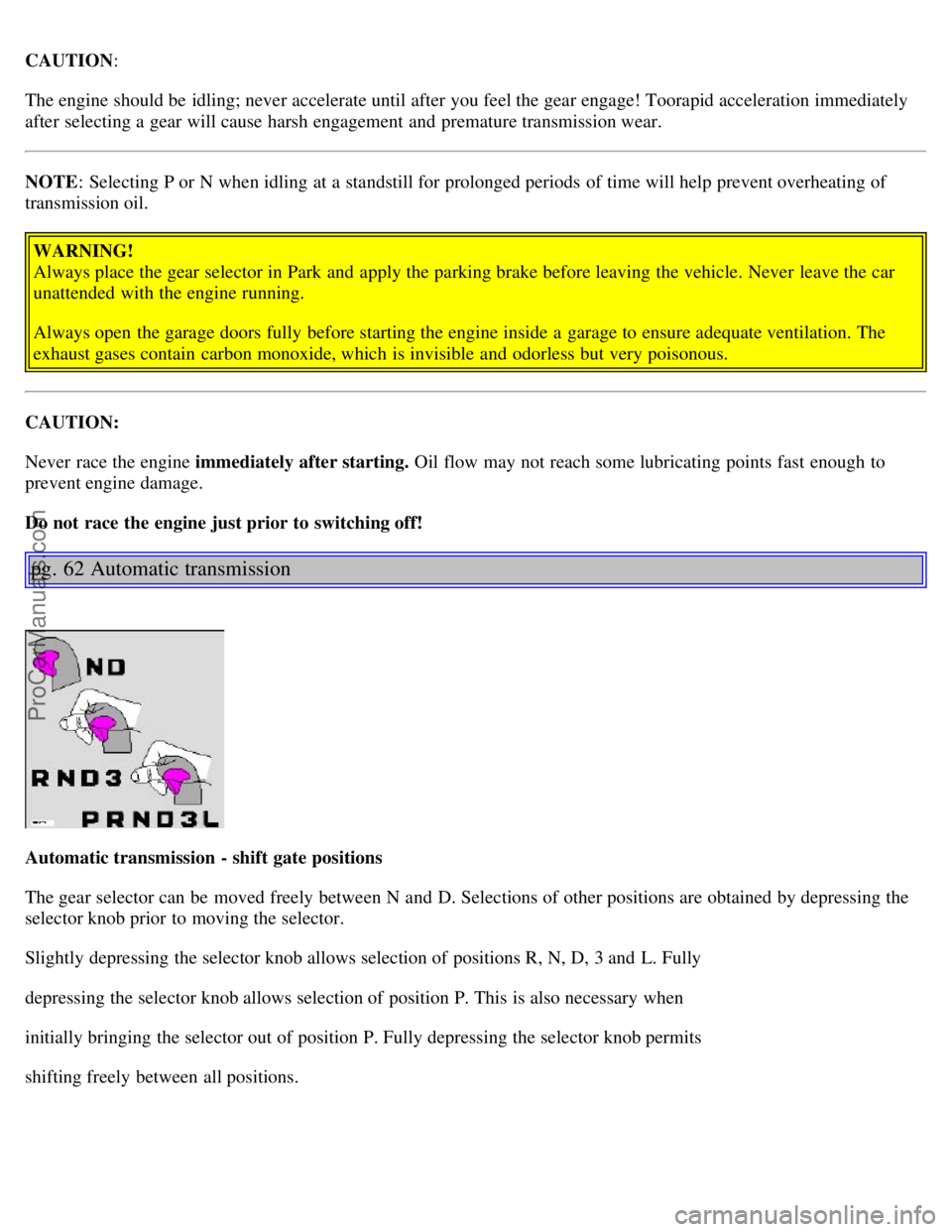
Automatic transmission - shift gate positions
The gear selector can be moved freely between N and D. Selections of other positions are obtained by depressing the
selector knob prior to moving the selector.
Slightly depressing the selector knob allows selection of positions R, N, D, 3 and L. Fully
depressing the selector knob allows selection of position P. This is also necessary when
initially bringing the selector out of position P. Fully depressing the selector knob permits
shifting freely between all positions.
ProCarManuals.com
Page 35 of 84
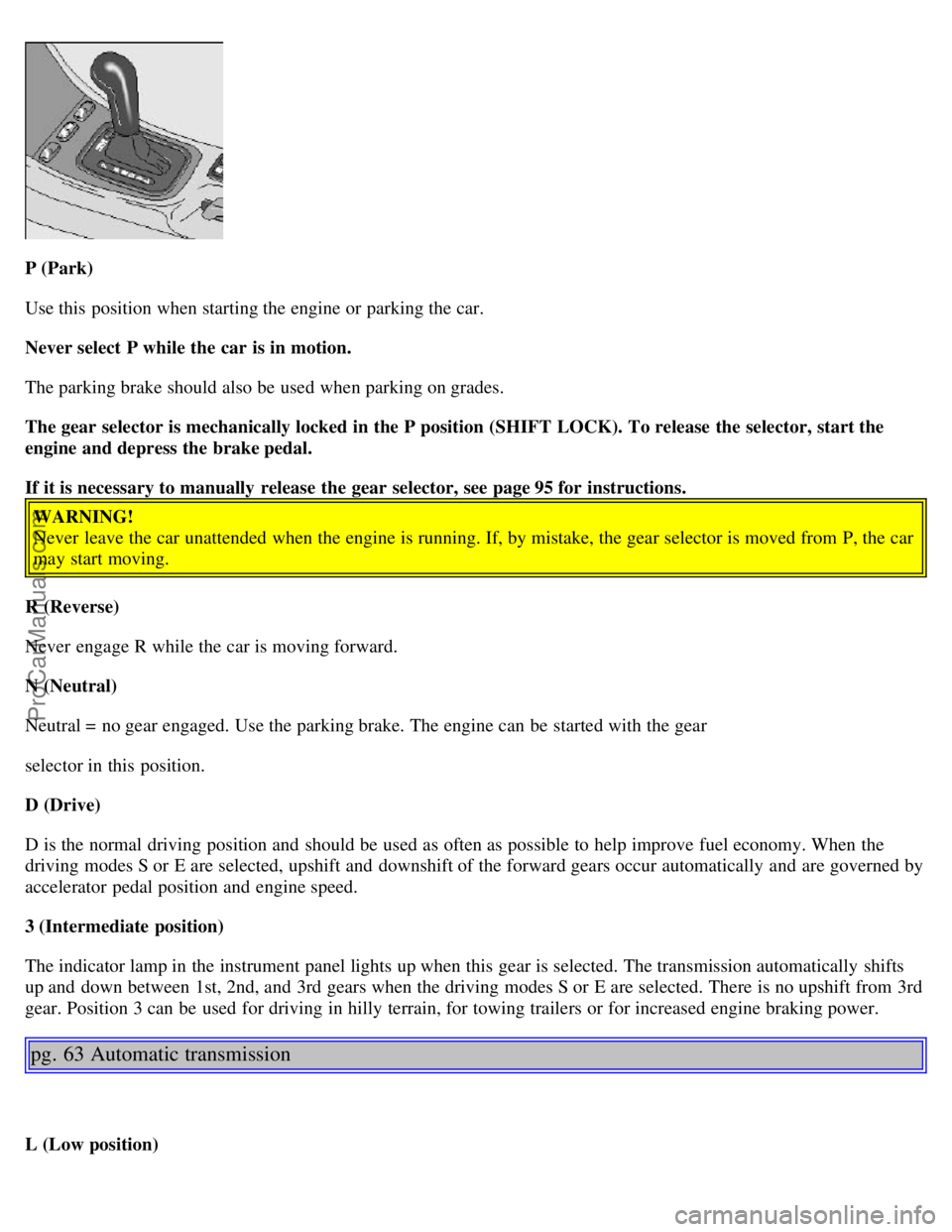
P (Park)
Use this position when starting the engine or parking the car.
Never select P while the car is in motion.
The parking brake should also be used when parking on grades.
The gear selector is mechanically locked in the P position (SHIFT LOCK). To release the selector, start the
engine and depress the brake pedal.
If it is necessary to manually release the gear selector, see page 95 for instructions.
WARNING!
Never leave the car unattended when the engine is running. If, by mistake, the gear selector is moved from P, the car
may start moving.
R (Reverse)
Never engage R while the car is moving forward.
N (Neutral)
Neutral = no gear engaged. Use the parking brake. The engine can be started with the gear
selector in this position.
D (Drive)
D is the normal driving position and should be used as often as possible to help improve fuel economy. When the
driving modes S or E are selected, upshift and downshift of the forward gears occur automatically and are governed by
accelerator pedal position and engine speed.
3 (Intermediate position)
The indicator lamp in the instrument panel lights up when this gear is selected. The transmission automatically shifts
up and down between 1st, 2nd, and 3rd gears when the driving modes S or E are selected. There is no upshift from 3rd
gear. Position 3 can be used for driving in hilly terrain, for towing trailers or for increased engine braking power.
pg. 63 Automatic transmission
L (Low position)
ProCarManuals.com
Page 36 of 84
The indicator lamp in the instrument panel lights up when this gear is selected. No upshift can occur when L is
engaged. Select position L for driving in first and second gears. Use this position to select low gear with no upshift,
e.g. when ascending and descending steep grades. The transmission will make a very noticeable downshift from 2nd to
1st gear if road speed drops to below 30 mph (45 km/h) in E mode or 6 mph (10 km/h) in S mode.
Kick-down
Automatic shift to a lower gear (kick-down) is achieved by depressing the accelerator pedal fully and briskly. An
upshift will be achieved when approaching the top speed for a particular gear or by releasing the accelerator pedal
slightly. Kick -down can be used for maximum acceleration or when passing at highway speeds. Avoid using the kick-
down function during the break-in period (first 1,200 miles of vehicle operation).
"Lock-up"
The automatic transmission has a "lock -up" function which reduces engine speed and saves fuel. The "lock -up"
function can sometimes be felt as an additional gear change.
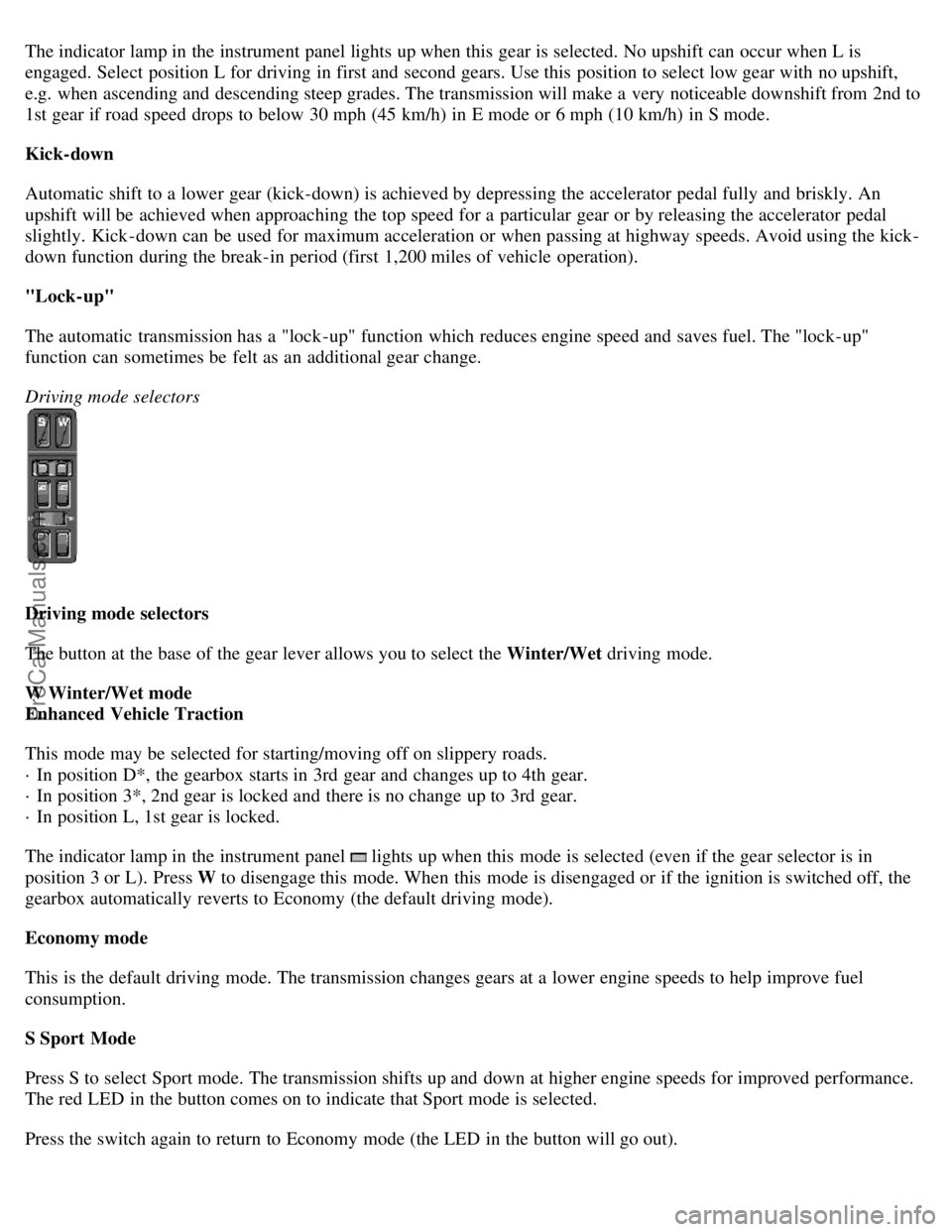
Driving mode selectors
Driving mode selectors
The button at the base of the gear lever allows you to select the Winter/Wet driving mode.
W Winter/Wet mode
Enhanced Vehicle Traction
This mode may be selected for starting/moving off on slippery roads.
· In position D*, the gearbox starts in 3rd gear and changes up to 4th gear.
· In position 3*, 2nd gear is locked and there is no change up to 3rd gear.
· In position L, 1st gear is locked.
The indicator lamp in the instrument panel
lights up when this mode is selected (even if the gear selector is in
position 3 or L). Press W to disengage this mode. When this mode is disengaged or if the ignition is switched off, the
gearbox automatically reverts to Economy (the default driving mode).
Economy mode
This is the default driving mode. The transmission changes gears at a lower engine speeds to help improve fuel
consumption.
S Sport Mode
Press S to select Sport mode. The transmission shifts up and down at higher engine speeds for improved performance.
The red LED in the button comes on to indicate that Sport mode is selected.
Press the switch again to return to Economy mode (the LED in the button will go out).
ProCarManuals.com
Page 37 of 84
Check Engine Lamp
If the indicator lamp begins to flash, this is an indication of a fault in the automatic gearbox. The Check Engine
Lamp will also light up if a fault is detected. If the transmission does not shift properly, place the gear selector in
position L. Please contact your Volvo retailer if this occurs.
* These positions always offer the kick-down function.
Contents | Top of Page
ProCarManuals.com