height VOLVO S40 2000 Owners Manual
[x] Cancel search | Manufacturer: VOLVO, Model Year: 2000, Model line: S40, Model: VOLVO S40 2000Pages: 84, PDF Size: 2.28 MB
Page 5 of 84
2 0 0 0
VOLVO
S & V 40
Chapter 1 - Occupant safety
pg. 1 Occupant safety
Occupant safety
Not wearing a seat belt is like believing "It'll never happen to me!" Volvo, the inventor of the three-point seat belt,
urges you and all adult occupants of your car to wear seat belts and ensure that children are properly restrained, using
an infant, car or booster seat determined by age, weight and height. Volvo also believes no child should sit in the
front seat of a car and that no one under 4 feet 7 inches should ride as a passenger in the front seat of any
vehicle equipped with a passenger side airbag.
Fact: In every state and province, some type of child-restraint legislation has been passed. Additionally, most states
and provinces have already made it mandatory for occupants of a car to use seat belts.
So, urging you to "buckle up" is not just our recommendation - legislation in your state or province may mandate seat
belt usage. The few seconds it takes to buckle up may one day allow you to say, "It's a good thing I was wearing my
seat belt".
Seat belts2
Volvo SRS4
Side Impact Protection System - (SIPS) air bag8
Child safety9
Occupant safety14
Reporting Safety Defects14
pg. 2 Seat belts
Seat belts
ProCarManuals.com
Page 6 of 84
Always fasten the seat belts before you drive or ride.
Two lights above the rear view mirror will be illuminated for 4-8 seconds after the starting
(ignition) key is turned to the driving position. A chime will sound at the same time if the
driver has not fastened his seat belt. The rear seats are provided with self - retracting inertial
reel belts. The front seats are provided with single roller belts with tensioners.
To buckle:
Pull the belt out far enough to insert the latch plate into the receptacle (buckle for rear seats)
until a distinct snapping sound is heard. The seat belt retractor is normally "unlocked" and
you can move freely, provided that the shoulder belt is not pulled out too far. The retractor will lock up as follows:
· if the belt is pulled out rapidly
· during braking and acceleration
· if the vehicle is leaning excessively
· when driving in turns
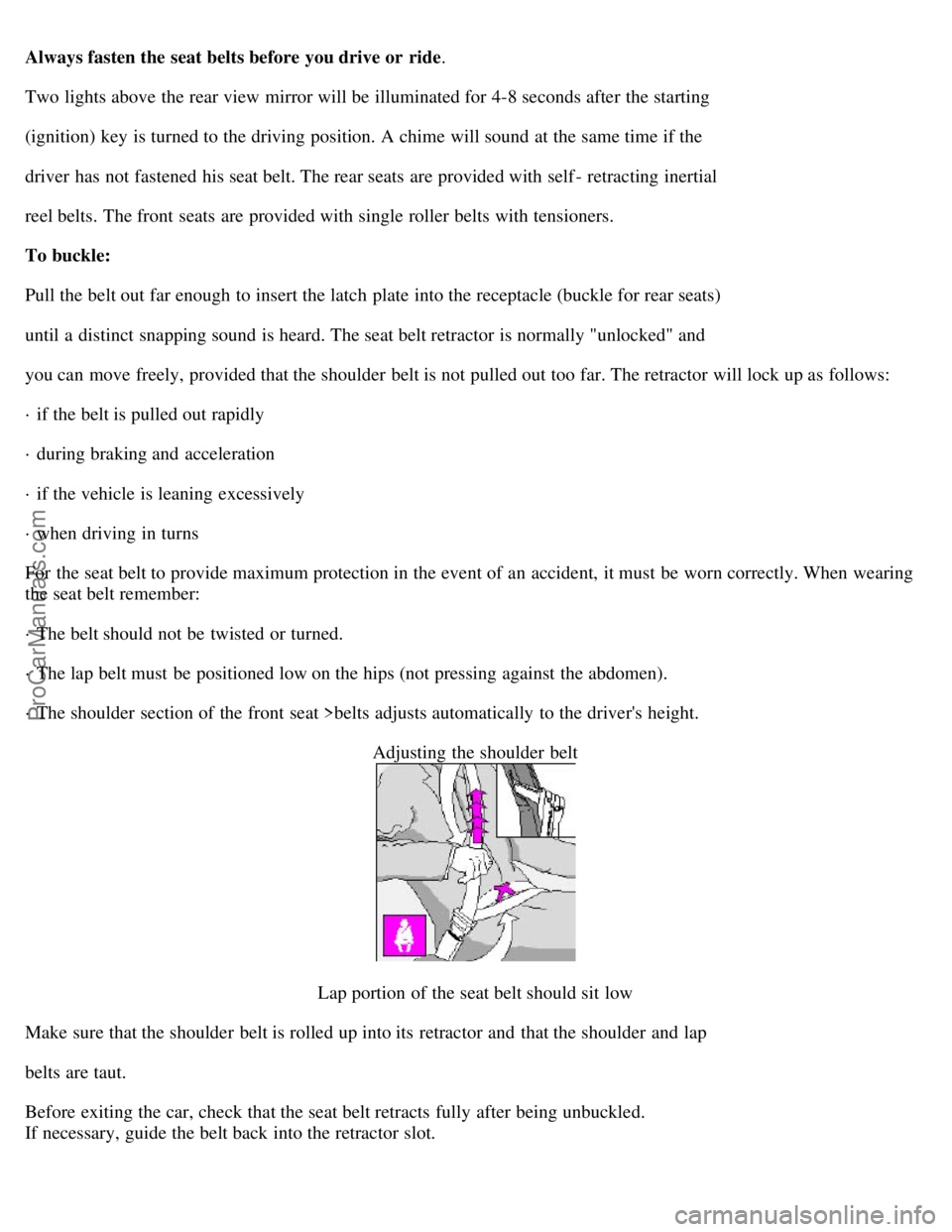
For the seat belt to provide maximum protection in the event of an accident, it must be worn correctly. When wearing
the seat belt remember:
· The belt should not be twisted or turned.
· The lap belt must be positioned low on the hips (not pressing against the abdomen).
· The shoulder section of the front seat >belts adjusts automatically to the driver's height. Adjusting the shoulder belt
Lap portion of the seat belt should sit low
Make sure that the shoulder belt is rolled up into its retractor and that the shoulder and lap
belts are taut.
Before exiting the car, check that the seat belt retracts fully after being unbuckled.
If necessary, guide the belt back into the retractor slot.
ProCarManuals.com
Page 8 of 84
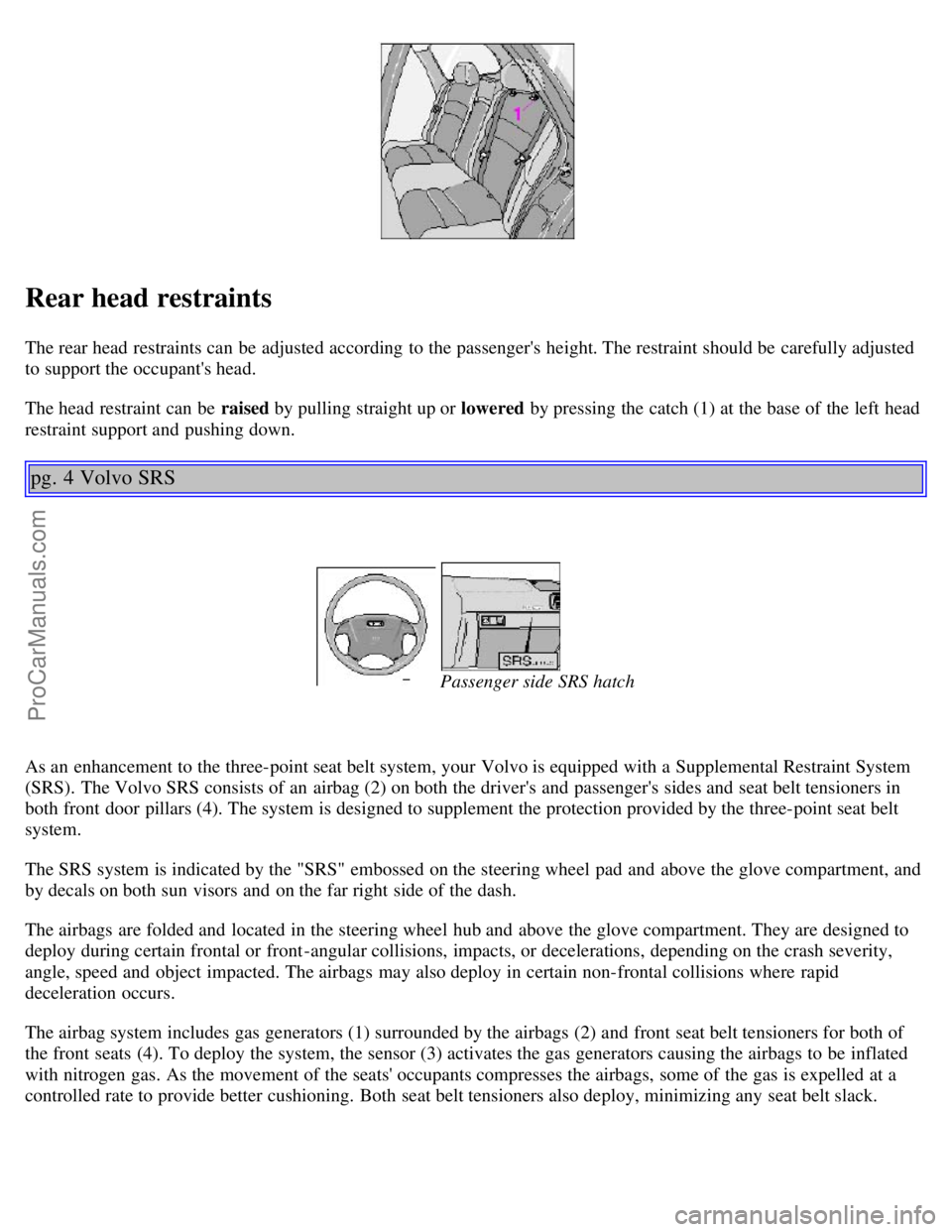
Rear head restraints
The rear head restraints can be adjusted according to the passenger's height. The restraint should be carefully adjusted
to support the occupant's head.
The head restraint can be raised by pulling straight up or lowered by pressing the catch (1) at the base of the left head
restraint support and pushing down.
pg. 4 Volvo SRS
Passenger side SRS hatch
As an enhancement to the three-point seat belt system, your Volvo is equipped with a Supplemental Restraint System
(SRS). The Volvo SRS consists of an airbag (2) on both the driver's and passenger's sides and seat belt tensioners in
both front door pillars (4). The system is designed to supplement the protection provided by the three-point seat belt
system.
The SRS system is indicated by the "SRS" embossed on the steering wheel pad and above the glove compartment, and
by decals on both sun visors and on the far right side of the dash.
The airbags are folded and located in the steering wheel hub and above the glove compartment. They are designed to
deploy during certain frontal or front -angular collisions, impacts, or decelerations, depending on the crash severity,
angle, speed and object impacted. The airbags may also deploy in certain non-frontal collisions where rapid
deceleration occurs.
The airbag system includes gas generators (1) surrounded by the airbags (2) and front seat belt tensioners for both of
the front seats (4). To deploy the system, the sensor (3) activates the gas generators causing the airbags to be inflated
with nitrogen gas. As the movement of the seats' occupants compresses the airbags, some of the gas is expelled at a
controlled rate to provide better cushioning. Both seat belt tensioners also deploy, minimizing any seat belt slack.
ProCarManuals.com
Page 15 of 84
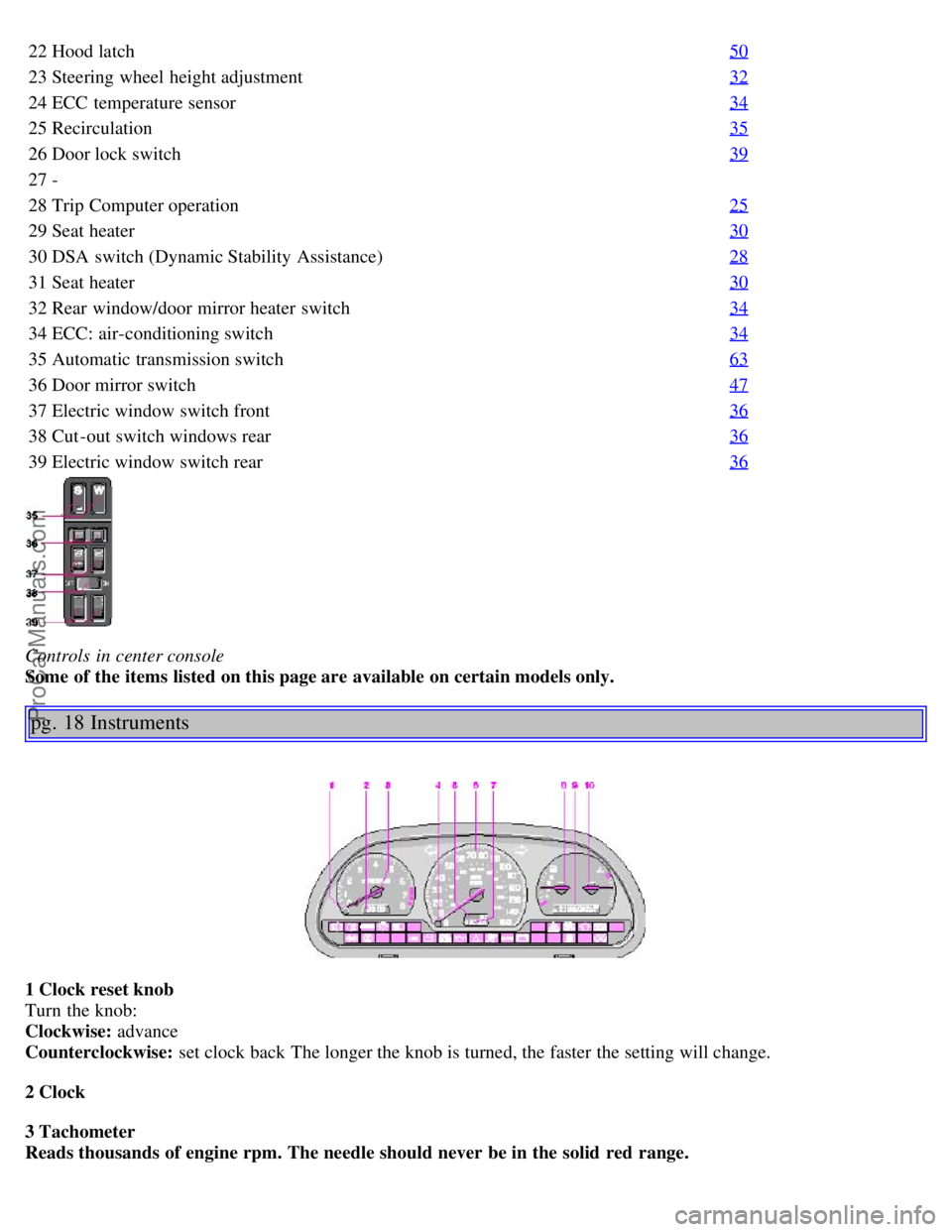
22Hood latch 50
23Steering wheel height adjustment 32
24ECC temperature sensor 34
25Recirculation 35
26Door lock switch 39
27-
28 Trip Computer operation 25
29Seat heater 30
30DSA switch (Dynamic Stability Assistance) 28
31Seat heater 30
32Rear window/door mirror heater switch 34
34ECC: air-conditioning switch 34
35Automatic transmission switch 63
36Door mirror switch 47
37Electric window switch front 36
38Cut -out switch windows rear 36
39Electric window switch rear 36
Controls in center console
Some of the items listed on this page are available on certain models only.
pg. 18 Instruments
1 Clock reset knob
Turn the knob:
Clockwise: advance
Counterclockwise: set clock back The longer the knob is turned, the faster the setting will change.
2 Clock
3 Tachometer
Reads thousands of engine rpm. The needle should never be in the solid red range.
ProCarManuals.com
Page 38 of 84
2 0 0 0
VOLVO
S & V 40
Chapter 5 - Wheels and tires
pg. 75 Wheels and tires
Wheels and tires
The handling and riding comfort of the vehicle is dependent on the inflation pressure and the type of tires fitted. Read
the following pages carefully. General information, Wear indicator, Tire economy, Flat spots
76
Snow chains, Winter tires77
Inflation pressure78
Uniform tire quality grading79
"Special spare" tire80
pg. 76 Wheels and tires
General information
Your vehicle is equipped with tires according to the tire information label located on the inside of the fuel filler
door
The following is an example of a tire designation code 195/60R15:
195 = tire width in mm.
60 = tire profile. This is the relationship (in percent) between the section height and width of the tire.
R = radial tires.
15 = diameter in inches.
The tires have good road holding characteristics and offer good handling on dry and wet surfaces. It should be noted
however that the tires have been developed to give these features on snow/icefree surfaces. However, for optimum road
holding on icy or snow covered roads we recommend suitable winter tires on all four wheels. When replacing tires,
be sure that the new tires are the same size designation, type (radial) and from the same manufacturer, on all four
wheels. Otherwise there is a risk of altering the car's roadholding and handling characteristics.
NOTE: When storing wheel/tire assemblies (e.g. winter tires and wheels), either stand the assemblies upright, or
suspend them off the ground. Laying wheel/tire assemblies on their sides for prolonged periods can cause wheel and/or
ProCarManuals.com
Page 70 of 84

DimensionsLength S40/V40 176.4 in. (448 cm)
Width S40/V40 67.7 in. (172 cm)
Height S40/V40 55.5 in. (141 cm)
Wheel base S40/V40 100.4 in. (255 cm)
Track, front S40/V40 57.1 in. (145 cm)
Track, rear S40/V40 57.9 in. (147 cm)
Turning circle: S40/V40 34.1 ft. (11.2 m)
Cargo capacity: S40 (rear seat up) 39.8 in. (101 cm)
S40 (rear seat down) 68.5 in. (174 cm)
V40 (rear seat up) 40.2 in. (102 cm)
V40 (rear seat down) 68.9 in. (175 cm)
Max width of load opening 27.6 in. (67 cm)
Max height of load opening 20.1 in. (51 cm)
Weights Gross Vehicle Weight (GVW):
S40 4180 lbs (1896 kg)
V40 4340 lbs (1969 kg)
Capacity Weight:
S40 841 lbs (382 kg)
V40 837 lbs (380 kg)
Permissible axle weight, front:
S40 2093 lbs (950 kg)
V40 2093 lbs (950 kg)
Permissible axle weight, rear:
S40 1885 lbs (856 kg)
V40 1916 lbs (870 kg)
Permissible axle weight total:
S40 3921 lbs (1780 kg)
V40 3964 lbs (1800 kg)
Curb weight:
S40 2996 lbs (1360 kg)
V40 3040 lbs (1380 kg)
The max permissible axle loads or the gross vehicle weight must not be exceeded.
Max roof load * 220 lbs (100 kg)
Max trailer weight
(w/o brakes) 1100 lbs (500 kg)
(with brakes) 2000 lbs (908 kg)
Max tongue weight ** 110 lbs (50 kg)
ProCarManuals.com