page 21 VOLVO S40 2003 Owner's Manual
[x] Cancel search | Manufacturer: VOLVO, Model Year: 2003, Model line: S40, Model: VOLVO S40 2003Pages: 85, PDF Size: 1.75 MB
Page 33 of 85
Shift lock
In order to move the gear selector from P position to the other gear positions the key must be in driving position
(position II) and the brake pedal must be depressed. See page 99
for information on how to move the gear selector
manually in case of a dead battery.
R Reverse
The car must be at a standstill before you select Reverse gear.
N Neutral position
The N position is the neutral position. The engine can be started, but no gear is selected. Apply the parking brake when
the car is stationary with the gear selector in position N.
D Driving position
D is the normal driving position. The gear se-lector automatically shifts up and down between the transmission gears,
based on the level of acceleration and the speed. The car should be stationary when you select D from position R.
4 Low gear position
Shifting up and down between the 1st, 2nd, 3rd, and 4th occurs automatically.
Shifting up to Drive does not occur.
Position 4 can be used:
for mountain driving
for driving with trailer
to increase the engine braking
3 Low gear position
Shifting up and down between the 1st, 2nd, and 3rd occurs automatically.
The 4th and Drive gears will not be engaged.
Position 3 can be used:
for mountain driving
for driving with trailer
to increase the engine braking
L Low gear position
Choose position L if you want to drive with the 1st or 2nd gear engaged. Position L gives the best possible engine
braking effect when, for example, mountain driving.
Shifting up to 5th does not occur.
Position 4 can be used:
for mountain driving
for driving with trailer
to increase the engine braking
Downshifting protection
There is a built in protection in the transmission which prevents over revving in the engine when you select one of the
low gear positions.
pg. 67 Automatic transmission
ProCarManuals.com
Page 34 of 85
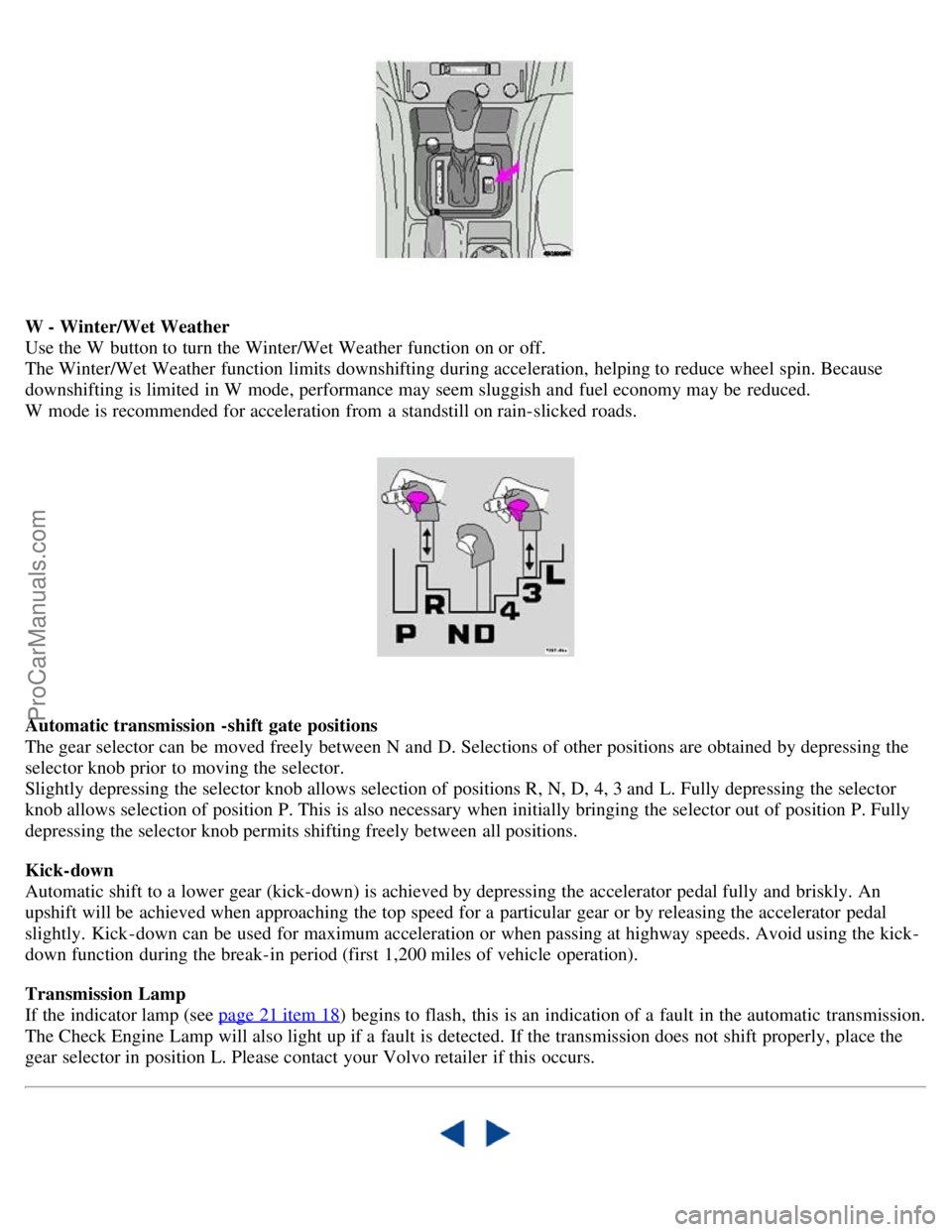
W - Winter/Wet Weather
Use the W button to turn the Winter/Wet Weather function on or off.
The Winter/Wet Weather function limits downshifting during acceleration, helping to reduce wheel spin. Because
downshifting is limited in W mode, performance may seem sluggish and fuel economy may be reduced.
W mode is recommended for acceleration from a standstill on rain-slicked roads.
Automatic transmission -shift gate positions
The gear selector can be moved freely between N and D. Selections of other positions are obtained by depressing the
selector knob prior to moving the selector.
Slightly depressing the selector knob allows selection of positions R, N, D, 4, 3 and L. Fully depressing the selector
knob allows selection of position P. This is also necessary when initially bringing the selector out of position P. Fully
depressing the selector knob permits shifting freely between all positions.
Kick-down
Automatic shift to a lower gear (kick-down) is achieved by depressing the accelerator pedal fully and briskly. An
upshift will be achieved when approaching the top speed for a particular gear or by releasing the accelerator pedal
slightly. Kick -down can be used for maximum acceleration or when passing at highway speeds. Avoid using the kick-
down function during the break-in period (first 1,200 miles of vehicle operation).
Transmission Lamp
If the indicator lamp (see page 21 item 18
) begins to flash, this is an indication of a fault in the automatic transmission.
The Check Engine Lamp will also light up if a fault is detected. If the transmission does not shift properly, place the
gear selector in position L. Please contact your Volvo retailer if this occurs.
ProCarManuals.com
Page 35 of 85

Contents | Top of Page
ProCarManuals.com
Page 36 of 85
2 0 0 3
VOLVO
S40 & V40
Chapter 5 - Wheels and tires
pg. 79 Wheels and tires
Wheels and tires
The handling and riding comfort of the vehicle is dependent on the inflation pressure and the type of tires fitted. Read
the following pages carefully. General information, Wear indicator, Tire economy, Flat spots
80
Snow chains, Snow tires, Studded tires81
Inflation pressure, Tire rotation82
Uniform tire quality grading83
"Special spare" tire84
pg. 80 Wheels and tires
General information
Your vehicle is equipped with tires according to the tire information label located on the inside of the fuel filler
door.
The following is an example of a tire designation code 195/60R15:
195 = tire width in mm.
60 = tire profile. This is the relationship (in percent) between the section height and width of the tire.
R = radial tires.
15 = diameter in inches.
The tires have good road holding characteristics and offer good handling on dry and wet surfaces. It should be noted
however that the tires have been developed to give these features on snow/icefree surfaces. However, for optimum road
holding on icy or snow covered roads we recommend suitable winter tires on all four wheels. When replacing tires,
be sure that the new tires are the same size designation, type (radial) and from the same manufacturer, on all four
wheels. Otherwise there is a risk of altering the car's roadholding and handling characteristics.
NOTE: When storing wheel/tire assemblies (e.g. winter tires and wheels), either stand the assemblies upright, or
suspend them off the ground. Laying wheel/tire assemblies on their sides for prolonged periods can cause wheel and/or
ProCarManuals.com
Page 40 of 85
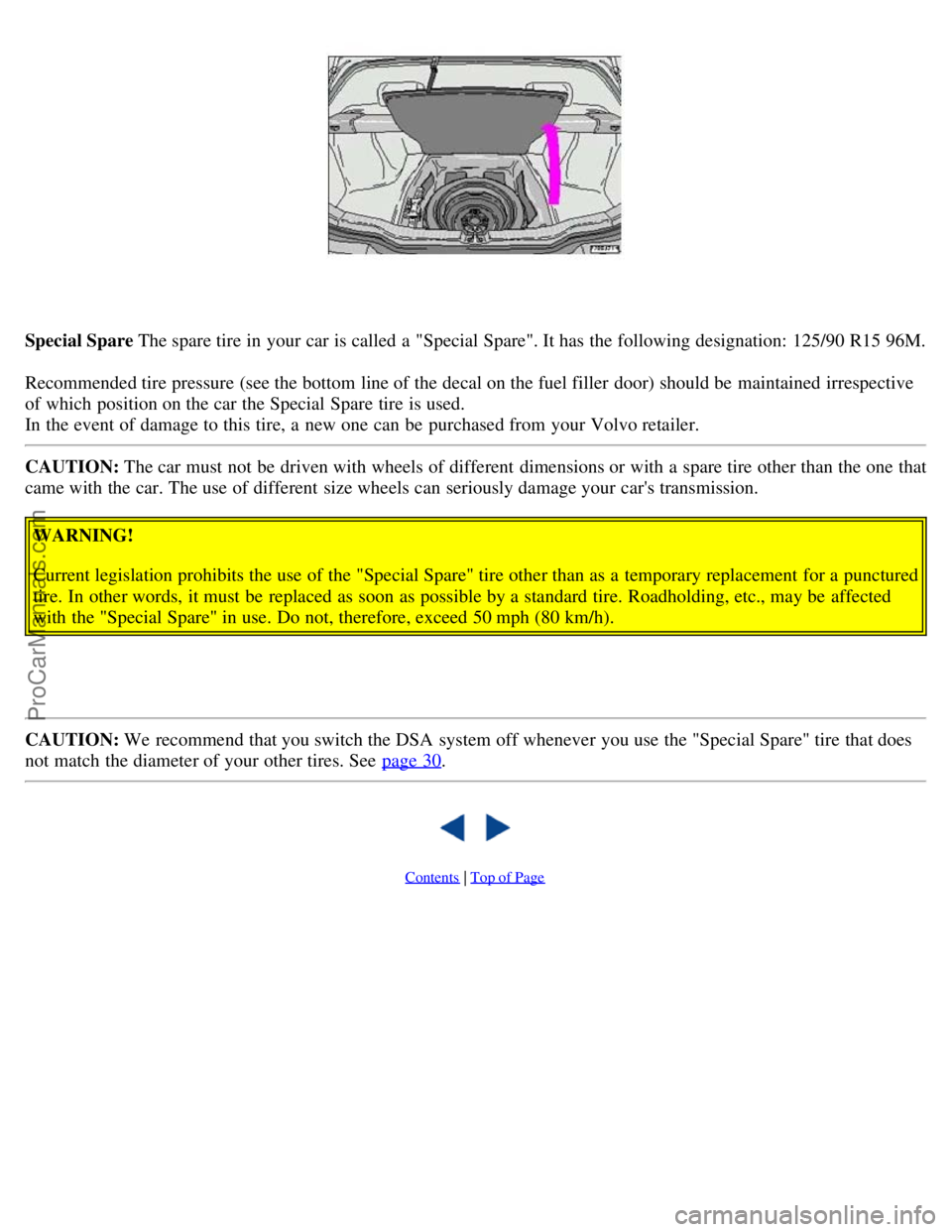
Special Spare The spare tire in your car is called a "Special Spare". It has the following designation: 125/90 R15 96M.
Recommended tire pressure (see the bottom line of the decal on the fuel filler door) should be maintained irrespective
of which position on the car the Special Spare tire is used.
In the event of damage to this tire, a new one can be purchased from your Volvo retailer.
CAUTION: The car must not be driven with wheels of different dimensions or with a spare tire other than the one that
came with the car. The use of different size wheels can seriously damage your car's transmission.
WARNING!
Current legislation prohibits the use of the "Special Spare" tire other than as a temporary replacement for a punctured
tire. In other words, it must be replaced as soon as possible by a standard tire. Roadholding, etc., may be affected
with the "Special Spare" in use. Do not, therefore, exceed 50 mph (80 km/h).
CAUTION: We recommend that you switch the DSA system off whenever you use the "Special Spare" tire that does
not match the diameter of your other tires. See page 30
.
Contents | Top of Page
ProCarManuals.com
Page 42 of 85
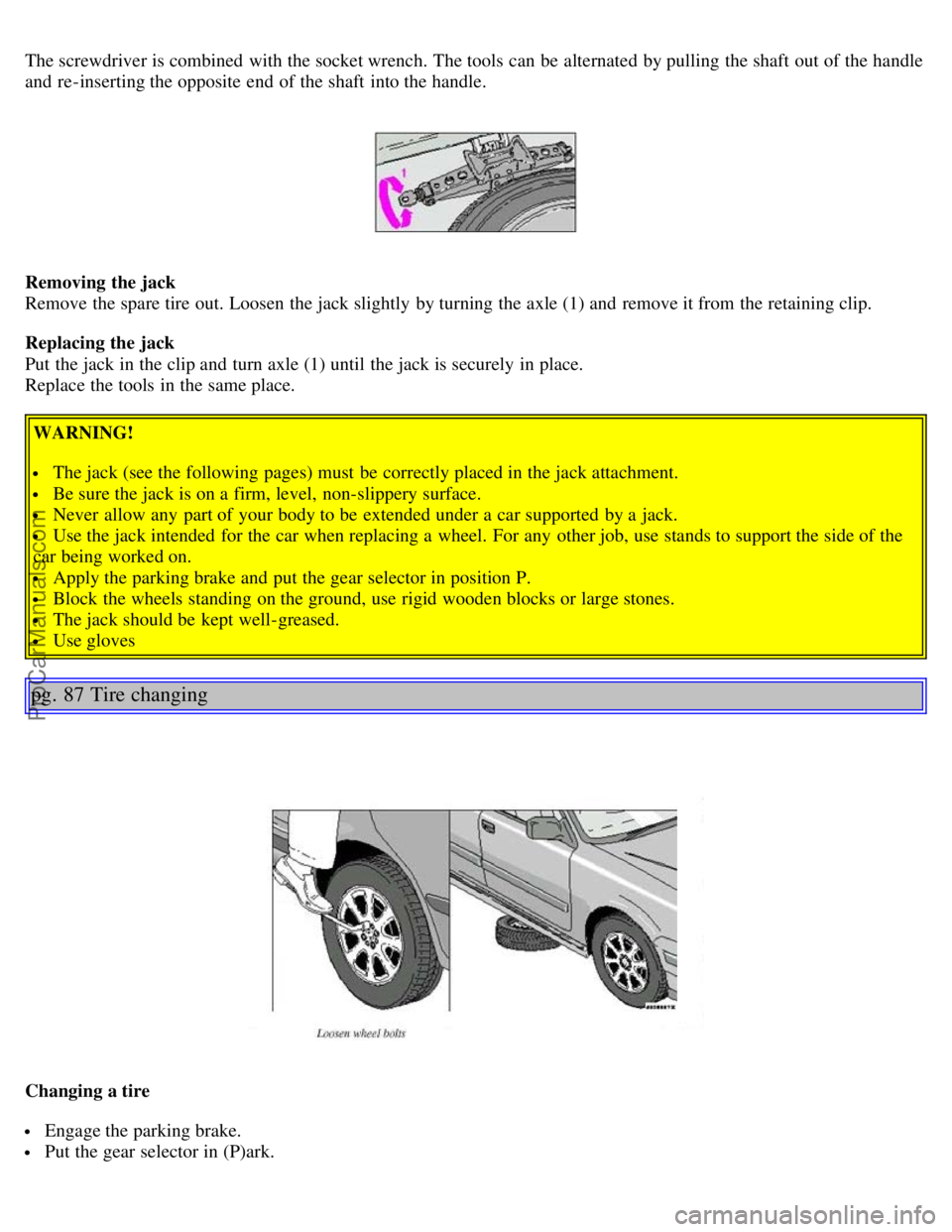
The screwdriver is combined with the socket wrench. The tools can be alternated by pulling the shaft out of the handle
and re-inserting the opposite end of the shaft into the handle.
Removing the jack
Remove the spare tire out. Loosen the jack slightly by turning the axle (1) and remove it from the retaining clip.
Replacing the jack
Put the jack in the clip and turn axle (1) until the jack is securely in place.
Replace the tools in the same place.
WARNING!
The jack (see the following pages) must be correctly placed in the jack attachment.
Be sure the jack is on a firm, level, non-slippery surface.
Never allow any part of your body to be extended under a car supported by a jack.
Use the jack intended for the car when replacing a wheel. For any other job, use stands to support the side of the
car being worked on.
Apply the parking brake and put the gear selector in position P.
Block the wheels standing on the ground, use rigid wooden blocks or large stones.
The jack should be kept well-greased.
Use gloves
pg. 87 Tire changing
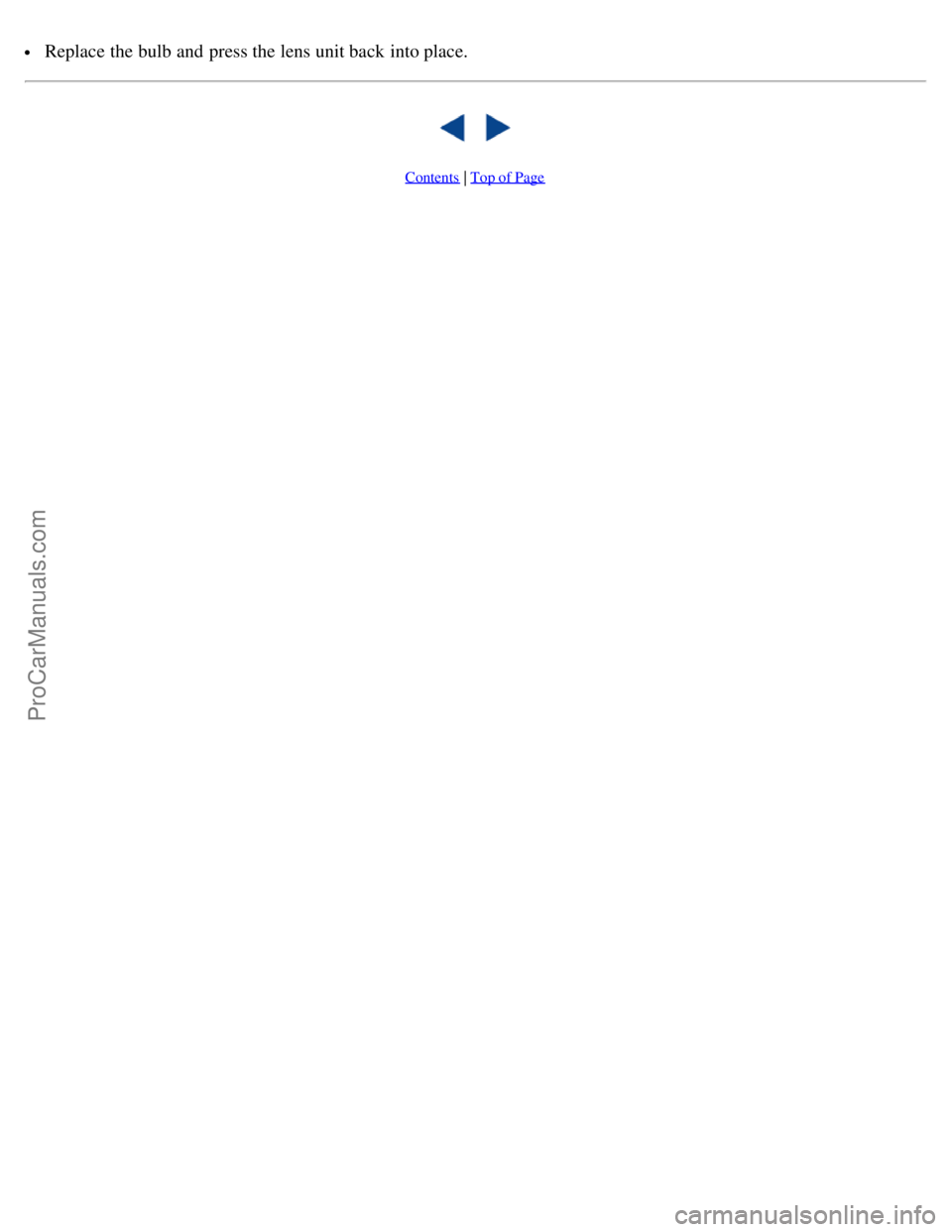
Changing a tire
Engage the parking brake.
Put the gear selector in (P)ark.
ProCarManuals.com
Page 49 of 85
Replace the bulb and press the lens unit back into place.
Contents | Top of Page
ProCarManuals.com
Page 53 of 85
pg. 105 Cleaning the upholstery
Cleaning the upholstery
The fabric can be cleaned with soapy water or a detergent. For more difficult spots caused by oil, ice cream, shoe
polish, grease, etc., use a clothing/fabric stain remover.
The plastic in the upholstery can be cleaned with a soft cloth and mild soap solution.
Leather upholstery/suede-like upholstery (Alcantera™) can be cleaned with a soft cloth and mild soap solution.
For more difficult spots, Volvo offers a leather care kit.
Under no circumstances should gasoline, naphtha or similar cleaning agents be used on the plastic or the leather
since these can cause damage.
Cleaning the seat belt
Clean only with lukewarm water and mild soap solution.
Cleaning floor mats
The floor mats should be vacuumed or brushed clean regularly, especially during winter when they should be taken out
for drying. Spots on textile mats can be removed with a mild detergent. Make sure the carpets are properly secured in
the fixation points on the floor.
Bear in mind
Take extra care when removing stains such as ink or lipstick since the coloring can spread.
Use solvents sparingly. Too much solvent can damage the seat padding.
Start from the outside of the stain and work toward the center.
pg. 106
Contents | Top of Page
ProCarManuals.com
Page 56 of 85
"Warranty and Service Records Information booklet," are not covered by the warranty. You will be required to pay for
labor and material used.
Maintenance services
Your Volvo has passed several major inspections before it was delivered to you, accordance with Volvo specifications.
The maintenance services outlined in the Warranty and Service Records Information booklet, many of which will
positively affect your vehicle's emissions, should be performed as indicated. It is recommended that receipts for
vehicle emission services be retained in case questions arise concerning maintenance.
Inspection and service should also be performed anytime a malfunction is observed or suspected.
Page 110
provides more information about maintenance of emission-related components.
Applicable warranties
In accordance with U.S. Federal Regulations, the following list of applicable U.S. warranties is provided. For Canadian
specification vehicles, see your separate warranty booklet.
New Car Limited Warranty
Parts and Accessories Limited Warranty
Corrosion Protection Limited Warranty
Seat belt and Supplemental Restraint Systems Limited Warranty
Emission Design and Defect Warranty
Emission Performance Warranty
These are the Federal warranties; other warranties are provided as required by state law. Refer to your separate
"Warranty and Service Records Information booklet" for detailed information concerning each of the warranties.
pg. 110 Emission maintenance
Periodic maintenance helps minimize emissions
Periodic maintenance will help keep your vehicle running well. Your Warranty and Service Records Information
booklet provides a comprehensive periodic maintenance schedule up to 150,000 miles (240,000 km) of vehicle service.
The schedule includes components that affect vehicle emissions. This page describes some of the emission-related
components.
Engine air filter
The engine air filter cleans particles from air entering the engine. Replace the engine air filter cartridge with a new one
every 37,500 miles (60,000 km) under normal driving conditions. Replace the cartridge more often when the vehicle is
driven under dirty and dusty conditions. The cartridge cannot be cleaned, and should always be replaced with a new
one.
Fuel filter
The fuel filter should be replaced at 105,000 miles (168,000 km). The filter is replaced as a complete unit. Replace
more frequently if contaminated fuel is introduced into the tank, or if there is reason to suspect that this has occurred.
Fuel system, including filler cap, tank, lines and connections
The ability of the fuel system to contain hydrocarbons depends upon a leak-free system. Inspect fuel lines every
30,000 miles (48,000 km). Check for proper sealing of the fuel filler cap which contains "O" ring seals.
NOTE: If the fuel filler cap is not closed tightly or if the engine is running when the car is refueled, the Check Engine
light (Malfunction indicator) may indicate a fault. However, your vehicle's performance will not be affected. Use only
Volvo original or approved fuel filler caps.
ProCarManuals.com
Page 59 of 85
may illuminate.
During a transitional period, a small number of service stations may still have fuel nozzles that are not compatible
with the fuel filler neck on cars equipped with the evaporative emission control system mandated by the U.S.
Environmental Protection Agency and the California Air Resources Board. If you experience difficulties in refueling
your vehicle, please ask the gas station attendant for assistance.
CAUTION:
Fuel must not be siphoned from the fuel tank. This will damage the evaporative emission control system.
Contents | Top of Page
ProCarManuals.com