Fuel tank VOLVO S40 2003 Owners Manual
[x] Cancel search | Manufacturer: VOLVO, Model Year: 2003, Model line: S40, Model: VOLVO S40 2003Pages: 85, PDF Size: 1.75 MB
Page 16 of 85
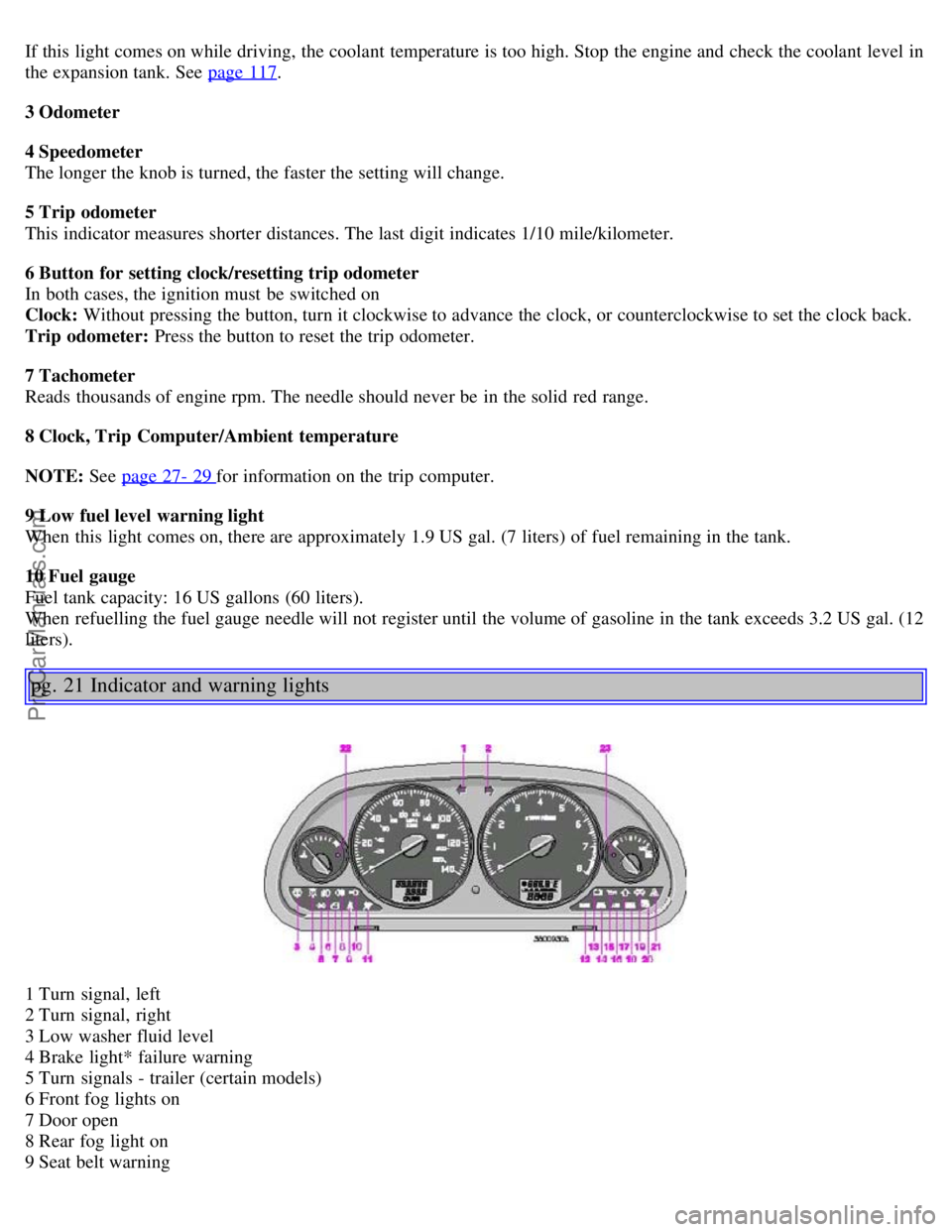
If this light comes on while driving, the coolant temperature is too high. Stop the engine and check the coolant level in
the expansion tank. See page 117.
3 Odometer
4 Speedometer
The longer the knob is turned, the faster the setting will change.
5 Trip odometer
This indicator measures shorter distances. The last digit indicates 1/10 mile/kilometer.
6 Button for setting clock/resetting trip odometer
In both cases, the ignition must be switched on
Clock: Without pressing the button, turn it clockwise to advance the clock, or counterclockwise to set the clock back.
Trip odometer: Press the button to reset the trip odometer.
7 Tachometer
Reads thousands of engine rpm. The needle should never be in the solid red range.
8 Clock, Trip Computer/Ambient temperature
NOTE: See page 27- 29
for information on the trip computer.
9 Low fuel level warning light
When this light comes on, there are approximately 1.9 US gal. (7 liters) of fuel remaining in the tank.
10 Fuel gauge
Fuel tank capacity: 16 US gallons (60 liters).
When refuelling the fuel gauge needle will not register until the volume of gasoline in the tank exceeds 3.2 US gal. (12
liters).
pg. 21 Indicator and warning lights
1 Turn signal, left
2 Turn signal, right
3 Low washer fluid level
4 Brake light* failure warning
5 Turn signals - trailer (certain models)
6 Front fog lights on
7 Door open
8 Rear fog light on
9 Seat belt warning
ProCarManuals.com
Page 29 of 85
Each Volvo has a three-way catalytic converter and must use only unleaded gasoline. U.S. and Canadian regulations
require that pumps delivering unleaded gasoline be labeled "UNLEADED". Only these pumps have nozzles which fit
your car's filler inlet. It is unlawful to dispense leaded fuel into a vehicle labeled "unleaded gasoline only". Leaded
gasoline damages the three-way catalytic converter and the heated oxygen sensor system. Repeated use of leaded
gasoline will lessen the effectiveness of the emission control system and could result in loss of emission warranty
coverage. State and local vehicle inspection programs will make detection of misfueling easier, possibly resulting in
emission test failure for misfueled vehicles.
NOTE: Some U.S. and Canadian gasolines contain an octane enhancing additive called methly-cyclopentadienyl
manganese tricarbonyl (MMT). If such fuels are used, your Emission Control System performance may be affected,
and the Check Engine Lamp located on your instrument panel may light. If this occurs, please return your vehicle to
an authorized Volvo retailer for service.
Carbon Monoxide - Important Warning
Carbon monoxide is a poisonous, colorless, and odorless gas. It is present in all exhaust gases. If you ever smell
exhaust fumes inside the vehicle, make sure the passenger compartment is ventilated, and immediately return the
vehicle to your retailer for correction.
Fuel Formulations
Do not use gasoline that contains lead as a knock inhibitor, and do not use lead additives. Besides damaging the
exhaust emission control systems on your car, lead has been strongly linked to certain forms of cancer.
Many fuels contain benzene as a solvent. Unburned benzene has been strongly linked to certain forms of cancer. If you
live in an area where you must fill your own gas tank, take precautions. These may include:
standing upwind away from the filler nozzle while refueling
refueling only at gas stations with vapor recovery systems that fully seal the mouth of the filler neck during refueling
wear neoprene gloves while handling a fuel filler nozzle.
Use of Additives
With the exception of gas line antifreeze during winter months, do not add solvents, thickeners, or other store -bought
additives to your car's fuel, cooling, or lubricating systems. Overuse may damage your engine, and some of these
additives contain organically volatile chemicals. Do not needlessly expose yourself to these chemicals.
ENGINE OIL
Although some oil consumption occurs during normal engine operation, more oil is consumed when the engine is new
as the internal parts generate higher friction while wearing in to each other. From the time the engine is new until
the first service is performed, the oil consumption could be higher than normal. For this reason, it is especially
important to check the oil every time you refuel your car during this period. See page 114
.
pg. 63 Fuel requirements, Refueling
Octane rating
Volvo engines are designed for optimum performance on unleaded premium gasoline with an octane rating. AKI of 91,
or above. AKI (ANTI KNOCK INDEX) is an average of the Research Octane Number, RON, and the Motor Octane
Number, MON. (RON + MON/2).
The minimum octane requirement is AKI 87 (RON 91).
Gasoline containing alcohol and ethers
"Oxygenated fuels"
Some fuel suppliers sell gasoline containing "oxygenates" which are usually alcohols or ethers. In some areas, state or
local laws require that the service pump be marked indicating use of alcohols or ethers.
However, there are areas in which the pumps are unmarked. If you are not sure whether there is alcohol or ethers in the
ProCarManuals.com
Page 30 of 85
gasoline you buy, check with the service station operator. To meet seasonal air quality standards, some areas require
the use of "oxygenated" fuel.
Volvo allows the use of the following "oxygenated fuels; however, the octane ratings listed on this page must still be
met.
Alcohol — Ethanol
Fuels containing up to 10% ethanol by volume may be used.
Ethanol may also be referred to as Ethyl alcohol, or "Gasohol".
Ethers — MTBE
Fuels containing up to 15% MTBE may be used.
Refueling
The fuel tank is designed to hold approximately: 16 US gallons (60 liters) with sufficient volume left over to
accommodate possible expansion of the fuel in hot weather.
Fuel filler door
The fuel filler door (on the left rear fender) is unlocked along with the car's central locking system.
Open fuel filler cap slowly during hot weather.
CAUTION:
Do not refuel with the engine running *. Turn the ignition off or to position I. If the ignition is on, an incorrect
reading could occur in the fuel gauge.
After refueling, close the fuel filler cap by turning it clockwise until it clicks into place *.
Avoid spilling gasoline during refueling. Gasoline containing alcohol can cause paint damage that may not be
covered under the New Vehicle Limited Warranty.
Do not use gasolines containing methanol (methyl alcohol, wood alcohol). This practice can result in vehicle
performance deterioration and can damage critical parts in the fuel system. Such damage may not be covered under the
New Vehicle Limited Warranty.
Do not overfill the fuel tank. Overfilling could damage the emission control system.
* If the fuel filler cap is not closed tightly or if the engine is running when the car is refueled, the Check Engine
Lamp may indicate a fault. However, your vehicle's performance will not be affected. Use only Volvo original or
approved fuel filler caps.
pg. 64 Driving economy
Economical driving conserves natural resources
Better driving economy may be obtained by thinking ahead, avoiding rapid starts and stops and adjusting the speed of
your vehicle to immediate traffic conditions. Observe the following rules:
Bring the engine to normal operating temperature as soon as possible by driving with a light foot on the accelerator
pedal for the first few minutes of operation. A cold engine uses more fuel and is subject to increased wear.
Whenever possible, avoid using the car for short trips. Short trips do not allow the engine to reach normal operating
temperature.
Drive carefully and avoid rapid acceleration and hard braking.
Do not exceed posted speed limits.
Avoid carrying unnecessary items (extra load) in the car.
Maintain correct tire pressure. Check tire pressure regularly (check when tires are cold).
Remove snow tires when threat of snow or ice has ended.
ProCarManuals.com
Page 56 of 85
"Warranty and Service Records Information booklet," are not covered by the warranty. You will be required to pay for
labor and material used.
Maintenance services
Your Volvo has passed several major inspections before it was delivered to you, accordance with Volvo specifications.
The maintenance services outlined in the Warranty and Service Records Information booklet, many of which will
positively affect your vehicle's emissions, should be performed as indicated. It is recommended that receipts for
vehicle emission services be retained in case questions arise concerning maintenance.
Inspection and service should also be performed anytime a malfunction is observed or suspected.
Page 110
provides more information about maintenance of emission-related components.
Applicable warranties
In accordance with U.S. Federal Regulations, the following list of applicable U.S. warranties is provided. For Canadian
specification vehicles, see your separate warranty booklet.
New Car Limited Warranty
Parts and Accessories Limited Warranty
Corrosion Protection Limited Warranty
Seat belt and Supplemental Restraint Systems Limited Warranty
Emission Design and Defect Warranty
Emission Performance Warranty
These are the Federal warranties; other warranties are provided as required by state law. Refer to your separate
"Warranty and Service Records Information booklet" for detailed information concerning each of the warranties.
pg. 110 Emission maintenance
Periodic maintenance helps minimize emissions
Periodic maintenance will help keep your vehicle running well. Your Warranty and Service Records Information
booklet provides a comprehensive periodic maintenance schedule up to 150,000 miles (240,000 km) of vehicle service.
The schedule includes components that affect vehicle emissions. This page describes some of the emission-related
components.
Engine air filter
The engine air filter cleans particles from air entering the engine. Replace the engine air filter cartridge with a new one
every 37,500 miles (60,000 km) under normal driving conditions. Replace the cartridge more often when the vehicle is
driven under dirty and dusty conditions. The cartridge cannot be cleaned, and should always be replaced with a new
one.
Fuel filter
The fuel filter should be replaced at 105,000 miles (168,000 km). The filter is replaced as a complete unit. Replace
more frequently if contaminated fuel is introduced into the tank, or if there is reason to suspect that this has occurred.
Fuel system, including filler cap, tank, lines and connections
The ability of the fuel system to contain hydrocarbons depends upon a leak-free system. Inspect fuel lines every
30,000 miles (48,000 km). Check for proper sealing of the fuel filler cap which contains "O" ring seals.
NOTE: If the fuel filler cap is not closed tightly or if the engine is running when the car is refueled, the Check Engine
light (Malfunction indicator) may indicate a fault. However, your vehicle's performance will not be affected. Use only
Volvo original or approved fuel filler caps.
ProCarManuals.com
Page 58 of 85
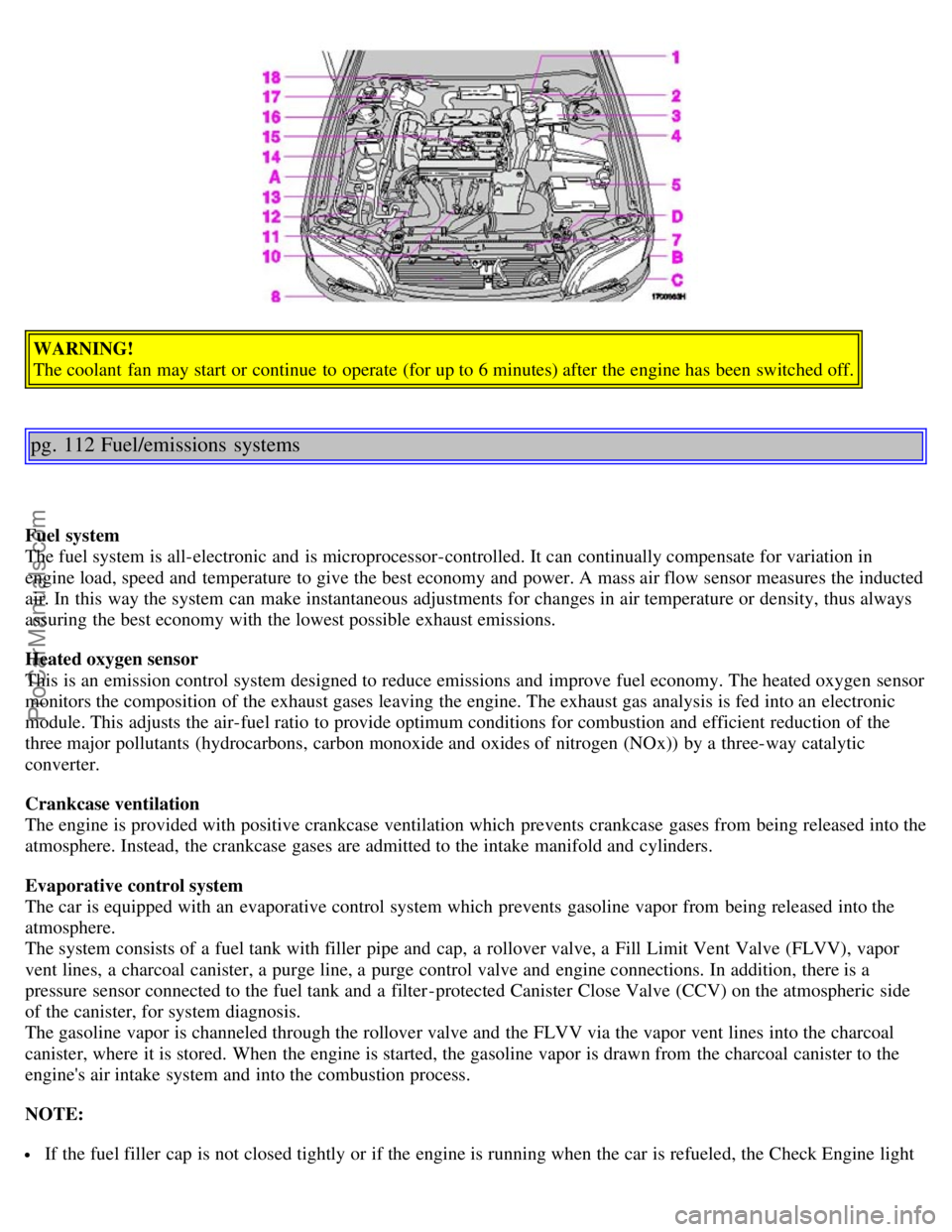
WARNING!
The coolant fan may start or continue to operate (for up to 6 minutes) after the engine has been switched off.
pg. 112 Fuel/emissions systems
Fuel system
The fuel system is all-electronic and is microprocessor-controlled. It can continually compensate for variation in
engine load, speed and temperature to give the best economy and power. A mass air flow sensor measures the inducted
air. In this way the system can make instantaneous adjustments for changes in air temperature or density, thus always
assuring the best economy with the lowest possible exhaust emissions.
Heated oxygen sensor
This is an emission control system designed to reduce emissions and improve fuel economy. The heated oxygen sensor
monitors the composition of the exhaust gases leaving the engine. The exhaust gas analysis is fed into an electronic
module. This adjusts the air-fuel ratio to provide optimum conditions for combustion and efficient reduction of the
three major pollutants (hydrocarbons, carbon monoxide and oxides of nitrogen (NOx)) by a three-way catalytic
converter.
Crankcase ventilation
The engine is provided with positive crankcase ventilation which prevents crankcase gases from being released into the
atmosphere. Instead, the crankcase gases are admitted to the intake manifold and cylinders.
Evaporative control system
The car is equipped with an evaporative control system which prevents gasoline vapor from being released into the
atmosphere.
The system consists of a fuel tank with filler pipe and cap, a rollover valve, a Fill Limit Vent Valve (FLVV), vapor
vent lines, a charcoal canister, a purge line, a purge control valve and engine connections. In addition, there is a
pressure sensor connected to the fuel tank and a filter -protected Canister Close Valve (CCV) on the atmospheric side
of the canister, for system diagnosis.
The gasoline vapor is channeled through the rollover valve and the FLVV via the vapor vent lines into the charcoal
canister, where it is stored. When the engine is started, the gasoline vapor is drawn from the charcoal canister to the
engine's air intake system and into the combustion process.
NOTE:
If the fuel filler cap is not closed tightly or if the engine is running when the car is refueled, the Check Engine light
ProCarManuals.com
Page 59 of 85
may illuminate.
During a transitional period, a small number of service stations may still have fuel nozzles that are not compatible
with the fuel filler neck on cars equipped with the evaporative emission control system mandated by the U.S.
Environmental Protection Agency and the California Air Resources Board. If you experience difficulties in refueling
your vehicle, please ask the gas station attendant for assistance.
CAUTION:
Fuel must not be siphoned from the fuel tank. This will damage the evaporative emission control system.
Contents | Top of Page
ProCarManuals.com
Page 63 of 85
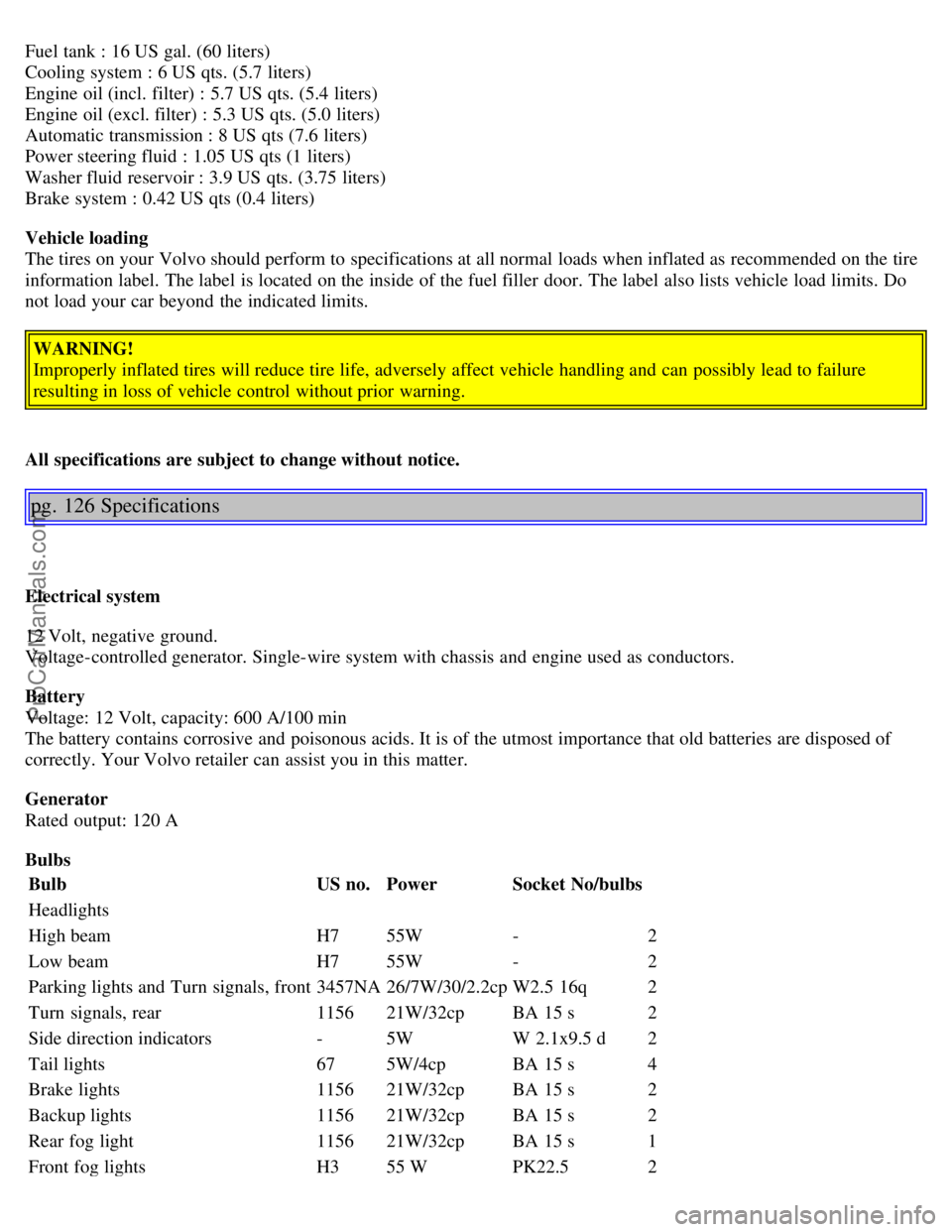
Fuel tank : 16 US gal. (60 liters)
Cooling system : 6 US qts. (5.7 liters)
Engine oil (incl. filter) : 5.7 US qts. (5.4 liters)
Engine oil (excl. filter) : 5.3 US qts. (5.0 liters)
Automatic transmission : 8 US qts (7.6 liters)
Power steering fluid : 1.05 US qts (1 liters)
Washer fluid reservoir : 3.9 US qts. (3.75 liters)
Brake system : 0.42 US qts (0.4 liters)
Vehicle loading
The tires on your Volvo should perform to specifications at all normal loads when inflated as recommended on the tire
information label. The label is located on the inside of the fuel filler door. The label also lists vehicle load limits. Do
not load your car beyond the indicated limits.
WARNING!
Improperly inflated tires will reduce tire life, adversely affect vehicle handling and can possibly lead to failure
resulting in loss of vehicle control without prior warning.
All specifications are subject to change without notice.
pg. 126 Specifications
Electrical system
12 Volt, negative ground.
Voltage-controlled generator. Single-wire system with chassis and engine used as conductors.
Battery
Voltage: 12 Volt, capacity: 600 A/100 min
The battery contains corrosive and poisonous acids. It is of the utmost importance that old batteries are disposed of
correctly. Your Volvo retailer can assist you in this matter.
Generator
Rated output: 120 A
Bulbs
Bulb US no.Power Socket No/bulbs
Headlights
High beam H755W - 2
Low beam H755W - 2
Parking lights and Turn signals, front 3457NA26/7W/30/2.2cp W2.5 16q 2
Turn signals, rear 115621W/32cp BA 15 s 2
Side direction indicators -5W W 2.1x9.5 d 2
Tail lights 675W/4cp BA 15 s 4
Brake lights 115621W/32cp BA 15 s 2
Backup lights 115621W/32cp BA 15 s 2
Rear fog light 115621W/32cp BA 15 s 1
Front fog lights H355 W PK22.5 2
ProCarManuals.com
Page 79 of 85
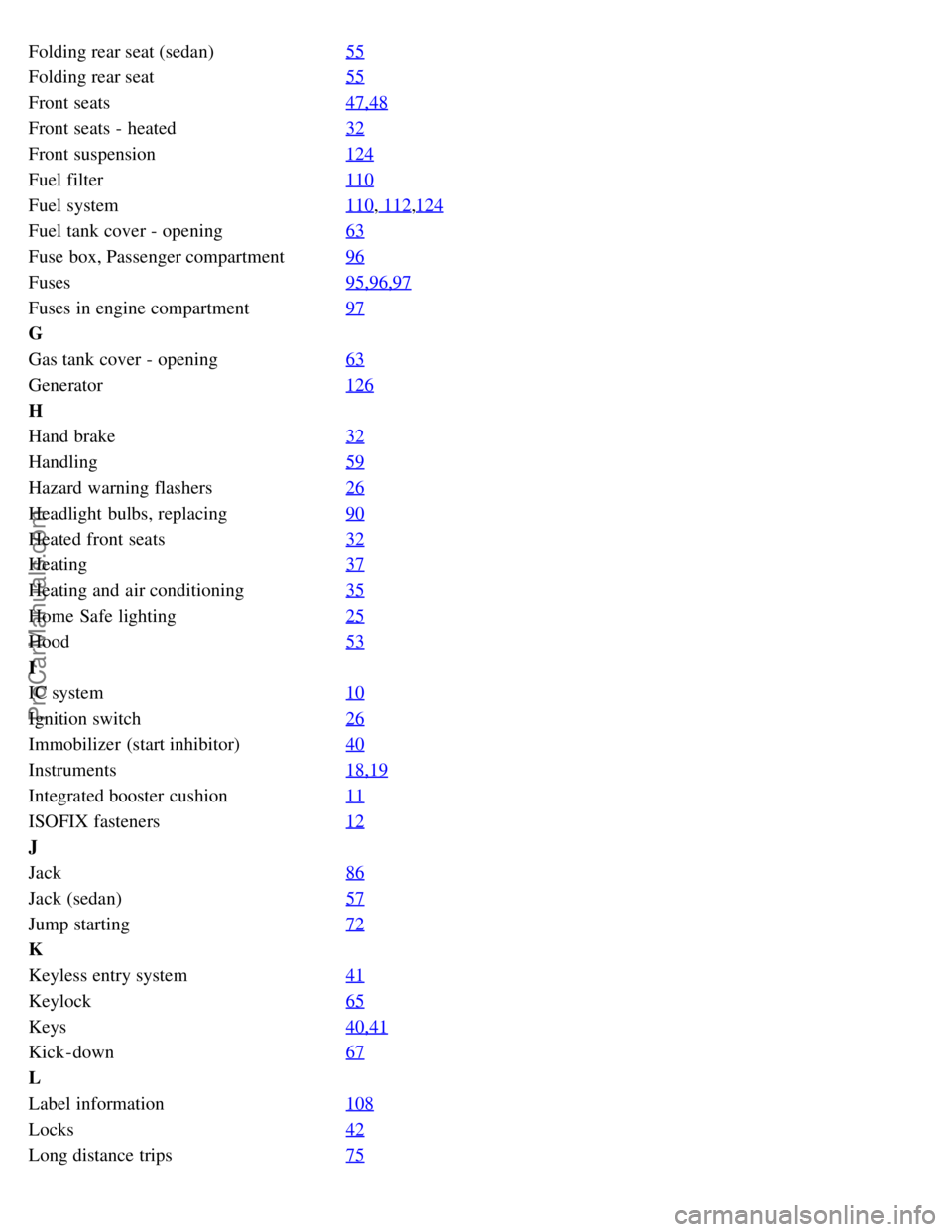
Folding rear seat (sedan)55
Folding rear seat55
Front seats47,48
Front seats - heated32
Front suspension124
Fuel filter110
Fuel system110, 112,124
Fuel tank cover - opening63
Fuse box, Passenger compartment96
Fuses95,96,97
Fuses in engine compartment97
G
Gas tank cover - opening63
Generator126
H
Hand brake32
Handling59
Hazard warning flashers26
Headlight bulbs, replacing90
Heated front seats32
Heating37
Heating and air conditioning35
Home Safe lighting25
Hood53
I
IC system10
Ignition switch26
Immobilizer (start inhibitor)40
Instruments18,19
Integrated booster cushion11
ISOFIX fasteners12
J
Jack86
Jack (sedan)57
Jump starting72
K
Keyless entry system41
Keylock65
Keys40,41
Kick -down67
L
Label information108
Locks42
Long distance trips75
ProCarManuals.com
Page 84 of 85
the vehicle and others sharing the roadway. Avoiding distractions is part of that responsibility.
Octane rating, see page 63
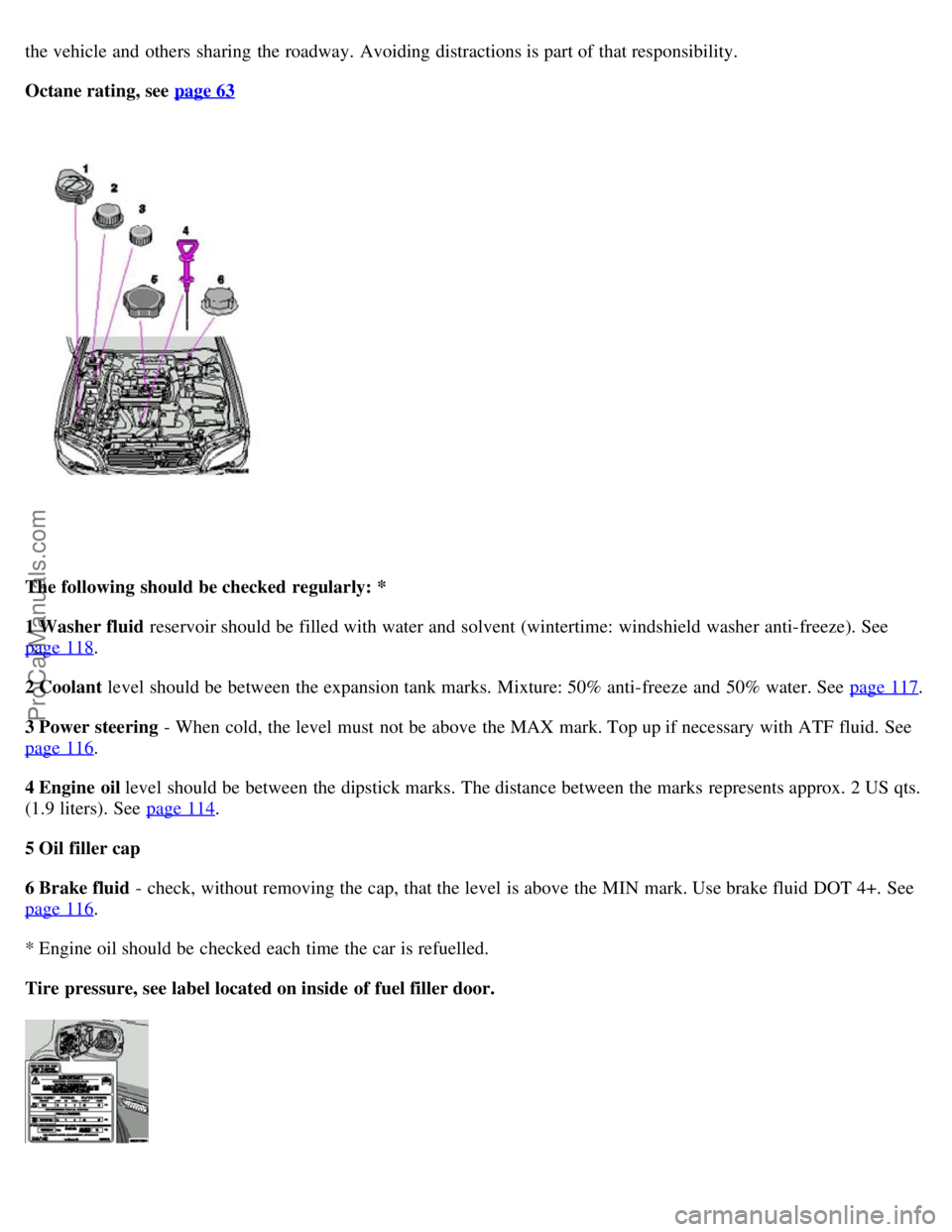
The following should be checked regularly: *
1 Washer fluid reservoir should be filled with water and solvent (wintertime: windshield washer anti-freeze). See
page 118
.
2 Coolant level should be between the expansion tank marks. Mixture: 50% anti-freeze and 50% water. See page 117
.
3 Power steering - When cold, the level must not be above the MAX mark. Top up if necessary with ATF fluid. See
page 116
.
4 Engine oil level should be between the dipstick marks. The distance between the marks represents approx. 2 US qts.
(1.9 liters). See page 114
.
5 Oil filler cap
6 Brake fluid - check, without removing the cap, that the level is above the MIN mark. Use brake fluid DOT 4+. See
page 116
.
* Engine oil should be checked each time the car is refuelled.
Tire pressure, see label located on inside of fuel filler door.
ProCarManuals.com