maintenance VOLVO S40 2005 User Guide
[x] Cancel search | Manufacturer: VOLVO, Model Year: 2005, Model line: S40, Model: VOLVO S40 2005Pages: 127, PDF Size: 2.32 MB
Page 62 of 127
occur.
As a minimum, the following items should be checked before any long trip:
Check that engine runs smoothly and that fuel consumption is normal.
Check for fuel, oil, and fluid leakage
Have the transmission oil level checked2.
Check condition of drive belts.
Check state of the battery's charge.
Examine tires carefully (the spare tire as well), and replace those that are worn. Check tire pressures.
The brakes, front wheel alignment, and steering gear should be checked by your Volvo retailer only.
Check all lights, including high beams.
Reflective warning triangles are legally required in some states/provinces.
Have a word with your Volvo retailer if you intend to drive in countries where it may be difficult to obtain the
correct fuel.
Consider your destination. If you will be driving through an area where snow or ice are likely to occur, consider
snow tires.
2. To prevent injury from contact with hot surfaces, do not inspect your vehicle's transmission fluid yourself. Have
your vehicle's transmission fluid level inspected by a qualified Volvo service technician.
pg. 101 Fuel requirements
Octane rating
Volvo engines are designed for optimum performance on unleaded premium gasoline with an AKI octane rating of 91
or above. AKI (ANTI KNOCK INDEX) is an average of the Research Octane Number, RON, and the Motor Octane
Number, MON. ((RON + MON)/2). The minimum octane requirement is AKI 87 (RON 91).
Deposit control gasoline (detergent additives)
Volvo recommends the use of detergent gasoline to control engine deposits. Detergent gasoline is effective in keeping
injectors and intake valves clean. Consistent use of deposit control gasolines will help ensure good driveability and
fuel economy. If you are not sure whether the gasoline contains deposit control additives, check with the service
station operator.
NOTE: Volvo does not recommend the use of store -bought fuel injector cleaning additives.
Unleaded fuel
Each Volvo has a three-way catalytic converter and must use only unleaded gasoline. U.S. and Canadian regulations
require that pumps delivering unleaded gasoline be labelled "UNLEADED". Only these pumps have nozzles which fit
your vehicle's filler inlet. It is unlawful to dispense leaded fuel into a vehicle labelled "unleaded gasoline only".
Leaded gasoline damages the three-way catalytic converter and the heated oxygen sensor system. Repeated use of
leaded gasoline will lessen the effectiveness of the emission control system and could result in loss of emission
warranty coverage. State and local vehicle inspection programs will make detection of misfueling easier, possibly
resulting in emission test failure for misfueled vehicles.
NOTE: Some U.S. and Canadian gasolines contain an octane enhancing additive called methyl-cyclopentadienyl
manganese tricarbonyl (MMT). If such fuels are used, your Emission Control System performance may be affected,
and the Check Engine Light (malfunction indicator lamp) located on your instrument panel may light. If this occurs,
please return your vehicle to an authorized Volvo retailer for maintenance.
Gasoline containing alcohol and ethers
Some fuel suppliers sell gasoline containing "oxygenates" which are usually alcohols or ethers. In some areas, state or
local laws require that the service pump be marked indicating use of alcohols or ethers. However, there are areas in
which the pumps are unmarked. If you are not sure whether there is alcohol or ethers in the gasoline you buy, check
with the service station operator. To meet seasonal air quality standards, some areas require the use of "oxygenated"
ProCarManuals.com
Page 78 of 127

luggage load capacity is 650 lbs. (1400-750 (5 x 150) = 650 lbs.)
(5) Determine the combined weight of luggage and cargo being loaded on the vehicle. That weight may not safely
exceed the available cargo and luggage load capacity calculated in Step 4.
(6) If your vehicle will be towing a trailer, load from your trailer will be transferred to your vehicle. Consult this
manual
1 to determine how this reduces the available cargo and luggage load capacity of your vehicle.
WARNING!
- Exceeding the permissible axle weight, gross vehicle weight, or any other weight rating limits can cause tire
overheating resulting in permanent deformation or catastrophic failure.
- Do not use replacement tires with lower load carrying capacities than the tires that were original equipment on the
vehicle because this will lower the vehicle's GVW rating. Replacement tires with a higher limit than the originals do
not increase the vehicle's GVW rating limitations.
1. See "Towing a trailer" on page 122
.
pg. 131 Uniform Tire Quality Grading
Uniform Tire Quality Grading
ALL PASSENGER VEHICLE TIRES MUST CONFORM TO FEDERAL SAFETY REQUIREMENTS IN
ADDITION TO THESE GRADES
Quality grades can be found, where applicable, on the tire sidewall between the tread shoulder and maximum
section width. For example:
Treadwear 200 Traction AA Temperature A
TREADWEAR
The treadwear grade is a comparative rating based on the wear rate of the tire when tested under controlled conditions
on a specified government test course. For example, a tire graded 150 would wear one and one half (1 1/2) times as
well on the government course as a tire graded 100. The relative performance of tires depends upon the actual
conditions of their use, however, and many depart significantly from the norm due to variation in driving habits,
maintenance practices and differences in road characteristics and climate.
TRACTION
The traction grades, from highest to lowest, are AA, A, B, and C, as measured under controlled conditions on specified
government test surfaces of asphalt and concrete. A tire marked C may have poor traction performance. The traction
grade assigned to this tire is based on braking (straight-ahead) traction tests and is not a measure of cornering (turning)
traction. WARNING!
The traction grade assigned to this tire is based on braking (straight-ahead) traction tests and is not a measure of
cornering (turning) traction.
TEMPERATURE
The temperature grades are AA (the highest), A, B, and C, representing the tire's resistance to the generation of heat
and its ability to dissipate heat when tested under controlled conditions on a specified indoor laboratory test wheel.
Sustained high temperature can cause the material of the tire to degenerate and reduce tire life, and excessive
temperature can lead to sudden tire failure. The grade C corresponds to a minimum level of performance that all
passenger vehicle tires must meet under the Federal Motor Safety Standard No. 109. Grades B and A represent higher
levels of performance on the laboratory test wheel than the minimum required by law. WARNING!
The temperature grade for this tire is established for a tire that is properly inflated and not overloaded. Excessive
speed, under-inflation, or excessive loading, either separately or in combination, can cause heat buildup and tire
ProCarManuals.com
Page 88 of 127
2 0 0 5
VOLVO S40
Chapter 10 - Maintenance and servicing
pg. 145 Maintenance and servicing
Volvo maintenance146
Maintaining your car147
Hood and engine compartment148
Oils and fluids149
Wiper blades152
Battery153
Bulbs155
Replacing front bulbs156
Replacing tail light bulbs159
Replacing interior bulbs160
Fuses161
pg. 146 Volvo maintenance
Volvo maintenance
Volvo advises you to follow the maintenance program outlined in the Warranty and Service Records Information
booklet. This maintenance program contains inspections and services necessary for the proper function of your vehicle.
The maintenance services contain several checks that require special tools and training, and therefore must be
performed by a qualified technician. To keep your Volvo in top condition, specify time-tested and proven Genuine
Volvo Parts and Accessories.
The Federal Clean Air Act - U.S
The Federal Clean Air Act requires vehicle manufacturers to furnish written instructions to the ultimate purchaser to
assure the proper servicing and function of the components that control emissions. These services, which are listed in
the "Warranty and Service Records Information" booklet, are not covered by the warranty. You will be required to pay
for labor and material used.
Maintenance
Your Volvo passed several major inspections before it was delivered to you, in accordance with Volvo specifications.
The maintenance procedures outlined in the Warranty and Service Records Information booklet, many of which will
ProCarManuals.com
Page 89 of 127
positively affect your vehicle's emissions, should be performed as indicated. It is recommended that receipts for
vehicle emission maintenance be retained in case questions arise concerning maintenance. Inspection and maintenance
should also be performed anytime a malfunction is observed or suspected.
Applicable warranties - U.S/Canada
In accordance with applicable U.S. and Canadian regulations, the following list of warranties is provided.
New Vehicle Limited Warranty
Parts and Accessories Limited Warranty
Corrosion Protection Limited Warranty
Seat Belt and Supplemental Restraint Systems Limited Warranty
Emission Design and Defect Warranty
Emission Performance Warranty
These are the federal warranties; other warranties are provided as required by state/provincial law. Refer to your
separate Warranty and Service Records Information booklet for detailed information concerning each of the warranties.
Periodic maintenance helps minimize emissions
Periodic maintenance will help keep your vehicle running well. Your Warranty and Service Records Information
booklet provides a comprehensive periodic maintenance schedule up to 150,000 miles (240,000 km) of vehicle
maintenance. The schedule includes components that affect vehicle emissions. This page describes some of the
emission-related components.
Vehicle Event Data
Your vehicle's driving and safety systems employ computers that monitor, and share with each other, information
about your vehicle's operation. One or more of these computers may store what they monitor, either during normal
vehicle operation or in a crash or near-crash event. Stored information may be read and used by:
Volvo Car Corporation
service and repair facilities
law enforcement or government agencies
others who may assert a legal right to know, or who obtain your consent to know such information.
pg. 147 Maintaining your car
Owner maintenance
Periodic maintenance requirements and intervals are described in your vehicle's Warranty and Service Records
Information booklet.
The following points can be carried out between the normally scheduled maintenance services.
Each time the car is refueled:
Check the engine oil level
Clean the windshield, windshield wipers, headlights, and tail lights
Monthly:
Check cold tire pressure in all tires. Inspect the tires for wear.
Check that engine coolant and other fluid levels are between the indicated "min" and "max" markings.
Clean interior glass surfaces with a glass cleaner and soft paper towels.
Wipe driver information displays with a soft cloth.
Visually inspect battery terminals for corrosion. Corrosion may indicate a loose terminal connector, or a battery near
the end of its useful service life. Consult your Volvo retailer for additional information.
As needed:
ProCarManuals.com
Page 91 of 127
WARNING!
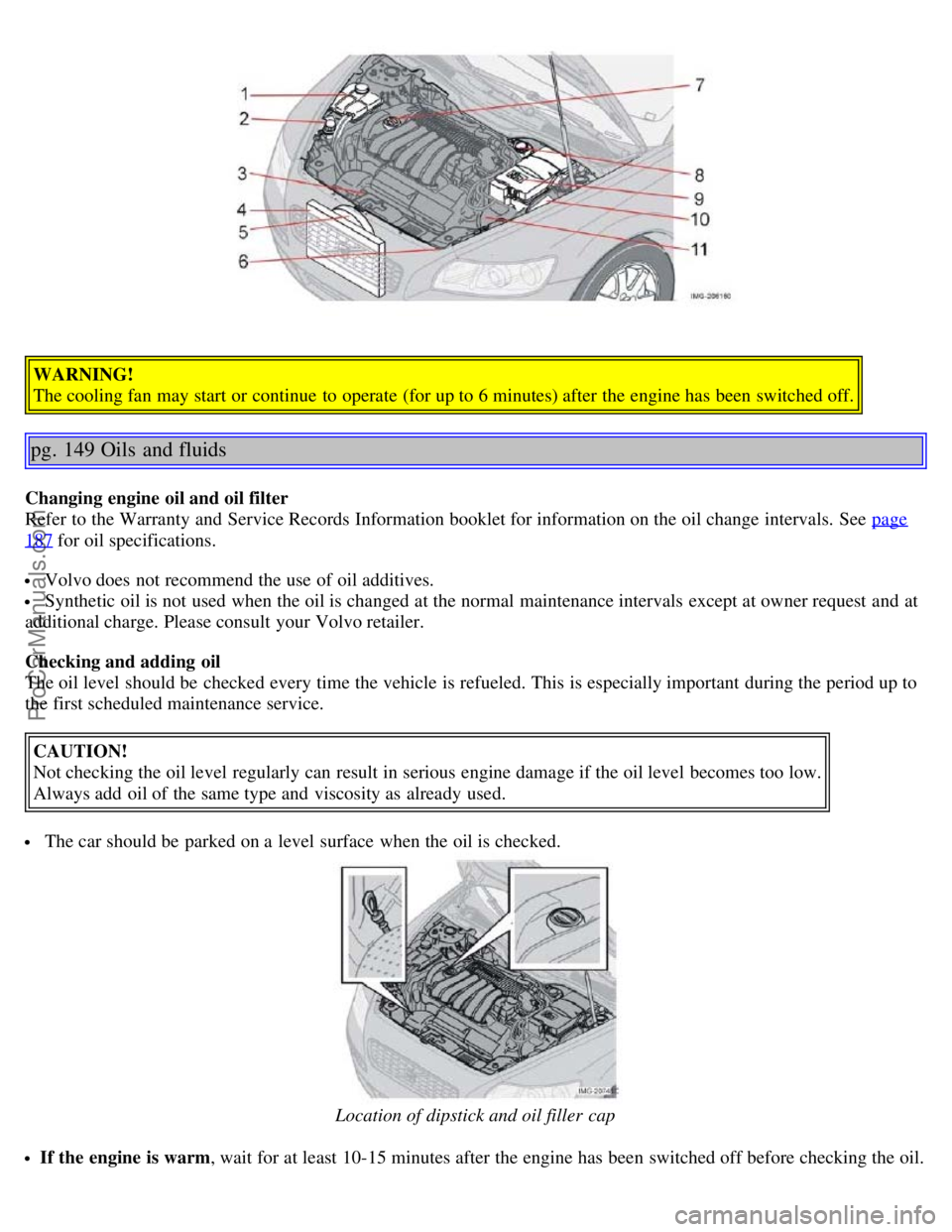
The cooling fan may start or continue to operate (for up to 6 minutes) after the engine has been switched off.
pg. 149 Oils and fluids
Changing engine oil and oil filter
Refer to the Warranty and Service Records Information booklet for information on the oil change intervals. See page
187 for oil specifications.
Volvo does not recommend the use of oil additives.
Synthetic oil is not used when the oil is changed at the normal maintenance intervals except at owner request and at
additional charge. Please consult your Volvo retailer.
Checking and adding oil
The oil level should be checked every time the vehicle is refueled. This is especially important during the period up to
the first scheduled maintenance service.
CAUTION!
Not checking the oil level regularly can result in serious engine damage if the oil level becomes too low.
Always add oil of the same type and viscosity as already used.
The car should be parked on a level surface when the oil is checked.
Location of dipstick and oil filler cap
If the engine is warm , wait for at least 10-15 minutes after the engine has been switched off before checking the oil.
ProCarManuals.com
Page 95 of 127
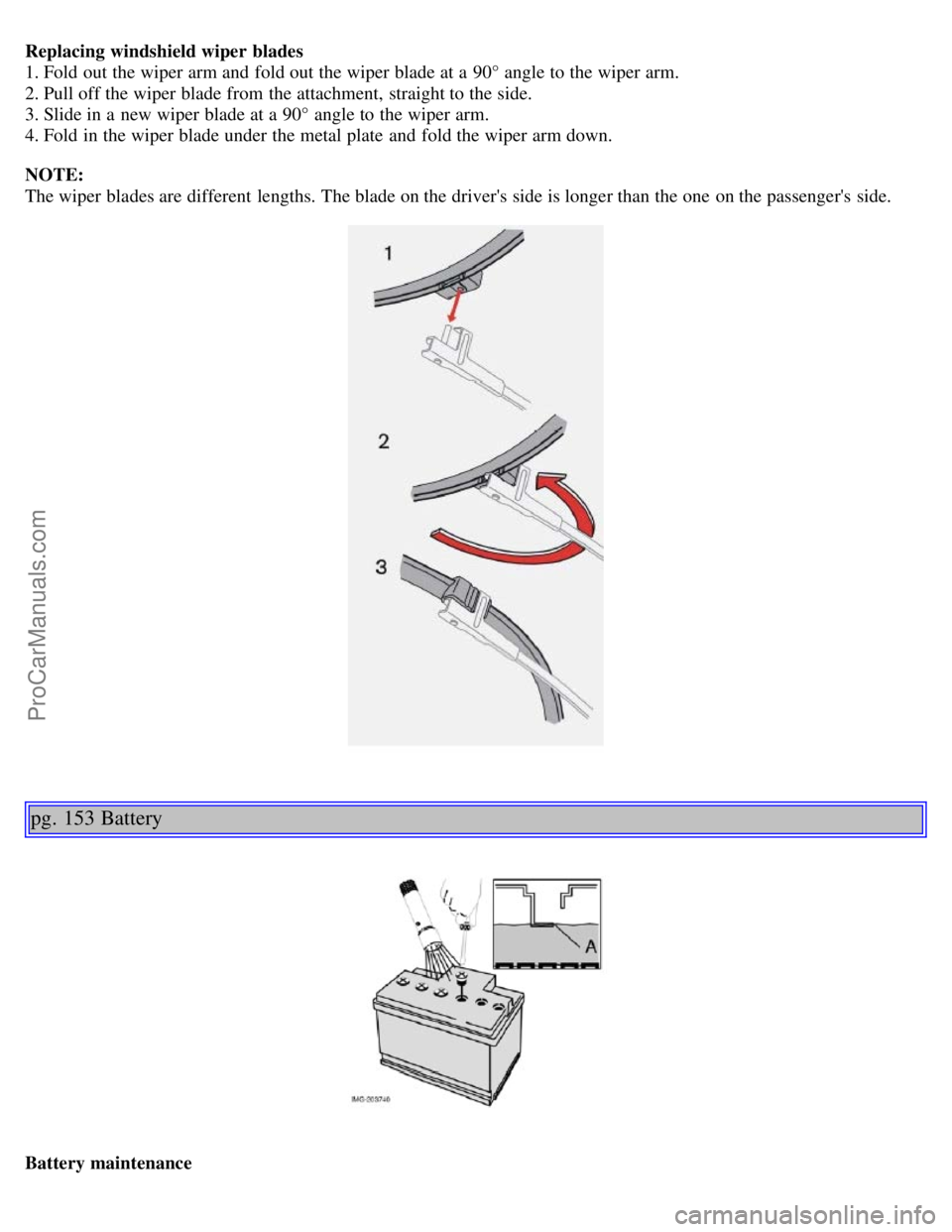
Replacing windshield wiper blades
1. Fold out the wiper arm and fold out the wiper blade at a 90° angle to the wiper arm.
2. Pull off the wiper blade from the attachment, straight to the side.
3. Slide in a new wiper blade at a 90° angle to the wiper arm.
4. Fold in the wiper blade under the metal plate and fold the wiper arm down.
NOTE:
The wiper blades are different lengths. The blade on the driver's side is longer than the one on the passenger's side.
pg. 153 Battery
Battery maintenance
ProCarManuals.com
Page 117 of 127
Battery
Voltage12 V12 V12 V
Cold start capacity (CCA) 520 A600 A*700 A**
Reserve capacity (RC) 100 min120 min150 min
If the battery must be replaced, replace it with one with the same cold start capacity and reserve capacity as the
original (see the decal on the battery).
* Cars equipped with the High Performance audio system
** Cars equipped with the Premium Sound audio system and/or the Volvo Navigation system
Generator
1 maximum current 120/150 A
Starter motor output 1.4/1.9 kW
1. Dependent on engine type
pg. 190 Three-way catalytic converter
Three-way catalytic converter - general information
Keep your engine properly tuned. Certain engine malfunctions, particularly involving the electrical, fuel or
distributor ignition systems, may cause unusually high three-way catalytic converter temperatures. Do not continue to
operate your vehicle if you detect engine misfire, noticeable loss of power or other unusual operating conditions, such
as engine overheating or backfiring. A properly tuned engine will help avoid malfunctions that could damage the three-
way catalytic converter.
Do not park your vehicle over combustible materials, such as grass or leaves, which can come into contact with the
hot exhaust system and cause such materials to ignite under certain wind and weather conditions.
Excessive starter cranking (in excess of one minute), or an intermittently firing or flooded engine can cause three-
way catalytic converter or exhaust system overheating.
Remember that tampering or unauthorized modifications to the engine, the Electronic Control Module, or the vehicle
may be illegal and can cause three-way catalytic converter or exhaust system overheating. This includes:
- Altering fuel injection settings or components.
- Altering emission system components or location or removing components.
- Repeated use of leaded fuel.
NOTE: Unleaded fuel is required for vehicles with three-way catalytic converters.
pg. 191 Volvo programs
Volvo On Call Roadside Assistance
Your new Volvo comes with a four year ON CALL roadside assistance. Additional information, features, and benefits
are described in a separate information package in your glove compartment. If you have misplaced your package, dial:
In the U.S.A. 1-800-638-6586 (1-800-63-VOLVO)
In Canada: 1-800-263-0475
Technician certification
In addition to Volvo factory training, Volvo supports certification by the National Institute for Automotive Excellence
(A.S.E.). Certified technicians have demonstrated a high degree of competence in specific areas. Besides passing
exams, each technician must also have worked in the field for two or more years before a certificate is issued. These
professional technicians are best able to analyze vehicle problems and perform the necessary maintenance procedures
to keep your Volvo at peak operating condition.
pg. 192
ProCarManuals.com
Page 119 of 127
2 0 0 5
VOLVO S40
Index
pg. 193-196 Index
Numerics
12 volt socket, in trunk 86
12 volt socket, rear seat54
12 volt sockets44
A
ABS (anti-lock brake system)2
Active yaw control - AYC113
Airbag deployment21
Alarm94
All Wheel Drive110
Antifreeze150
Anti-lock Brake System (ABS)2, 40
Approach lighting61, 89
ASC - speed compensated volume, audio system173
Audio functions171
Audio system - introduction168
Audio system menus, list of181
Audio system overview169
Autolock61
Automatic transmission - Geartronic108
Auxiliary equipment44
AWD110
B
Backrests, rear seat84
Battery drain - avoiding99
Battery maintenance153
Battery replacement154
Battery replacement, remote control91
Battery, conserving electrical current99
Battery, specifications189
Bi -Xenon headlights45, 156
Booster cushion33
ProCarManuals.com
Page 122 of 127
Inflation pressure tables127
Information display38
Information display, messages in43
Information symbol38, 39
Instrument overview8
Instrument panel38
Instrument panel lighting45
Interior lighting81
ISOFIX/LATCH anchors32
J
Jack, positioning correctly136
Jump starting118
K
Key blade90
Key blade, locking and unlocking the car90
Keylock2, 104
Kickdown109
L
Label information184
LATCH anchors33
License plate lighting, replacing159
Lighting panel45
Loading the vehicle130
Long distance trips100
Low beam bulb, replacing156
M
Maintenance146
Malfunction indicator light40
Manual front seat adjustment78
Manual shifting (Geartronic)108
Manual transmission107
Mirror, rearview57
Mirrors, door-mounted58
Moonroof59
O
Occupant safety12
Occupant Weight Sensor (OWS), disabling front passenger's side airbag19
Octane rating101
Oil pressure warning light41
Oil, changing149
On Call Roadside Assistance191
Opening the hood148
P
Paint touch up143
ProCarManuals.com
Page 124 of 127
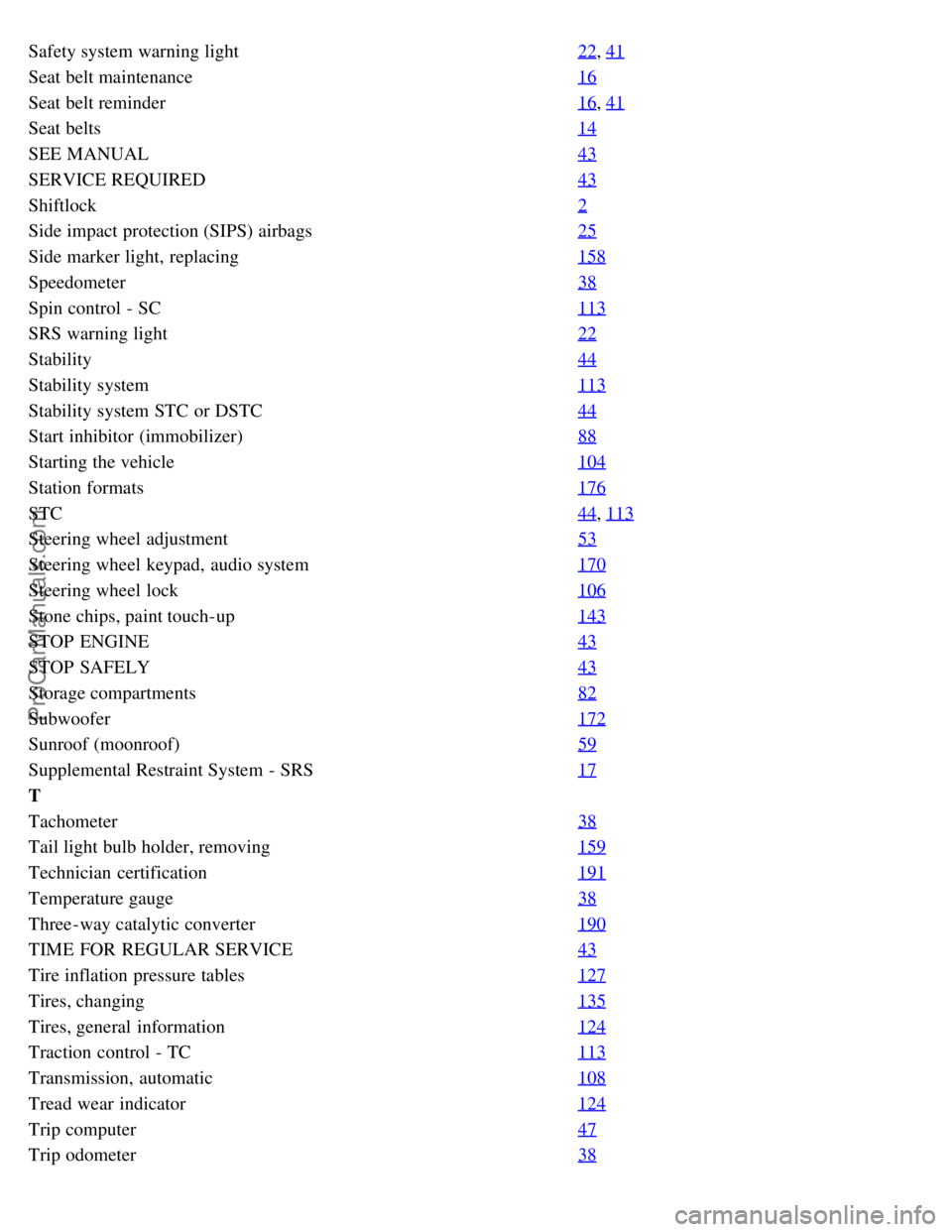
Safety system warning light22, 41
Seat belt maintenance16
Seat belt reminder16, 41
Seat belts14
SEE MANUAL43
SERVICE REQUIRED43
Shiftlock2
Side impact protection (SIPS) airbags25
Side marker light, replacing158
Speedometer38
Spin control - SC113
SRS warning light22
Stability44
Stability system113
Stability system STC or DSTC44
Start inhibitor (immobilizer)88
Starting the vehicle104
Station formats176
STC44, 113
Steering wheel adjustment53
Steering wheel keypad, audio system170
Steering wheel lock106
Stone chips, paint touch-up143
STOP ENGINE43
STOP SAFELY43
Storage compartments82
Subwoofer172
Sunroof (moonroof)59
Supplemental Restraint System - SRS17
T
Tachometer38
Tail light bulb holder, removing159
Technician certification191
Temperature gauge38
Three-way catalytic converter190
TIME FOR REGULAR SERVICE43
Tire inflation pressure tables127
Tires, changing135
Tires, general information124
Traction control - TC113
Transmission, automatic108
Tread wear indicator124
Trip computer47
Trip odometer38
ProCarManuals.com