warning light VOLVO S40 2005 Owner's Manual
[x] Cancel search | Manufacturer: VOLVO, Model Year: 2005, Model line: S40, Model: VOLVO S40 2005Pages: 127, PDF Size: 2.32 MB
Page 85 of 127
toward the rear side of the engine. Special moonroof cautions:
Always close the moonroof and sun shade before washing your vehicle.
Never use abrasive cleaning agents on the moonroof.
Never use wax on the rubber seals around the moonroof.
Automatic washing - simple and quick
We do NOT recommend washing your car in an automatic wash during the first six months (because the paint will
not have hardened sufficiently).
An automatic wash is a simple and quick way to clean your car, but it is worth remembering that it may not be as
thorough as when you yourself go over the car with sponge and water. Keeping the underbody clean is most important,
pg. 141 Washing and cleaning the car
especially in the winter. Some automatic washers do not have facilities for washing the underbody.
CAUTION!
Before driving into an automatic carwash, turn off the optional rain sensor to avoid damaging the windshield wipers.
Make sure that side view mirrors, auxiliary lamps, etc, are secure, and that any antenna(s) are retracted or removed.
Otherwise there is risk of the machine dislodging them.
WARNING!
When the car is driven immediately after being washed, apply the brakes several times in order to remove any
moisture from the brake linings.
Engine cleaning agents should not be used when the engine is warm. This constitutes a fire risk.
Polishing and Waxing
Normally, polishing is not required during the first year after delivery, however, waxing may be beneficial.
Before applying polish or wax the vehicle must be washed and dried. Tar spots can be removed with kerosene or tar
remover. Difficult spots may require a fine rubbing compound.
After polishing use liquid or paste wax.
Several commercially available products contain both polish and wax.
Waxing alone does not substitute for polishing a dull surface.
A wide range of polymer-based waxes can be purchased today. These waxes are easy to use and produce a long-
lasting, high-gloss finish that protects the bodywork against oxidation, road dirt and fading.
Do not polish or wax your vehicle in direct sunlight (the surface of the vehicle should not be warmer than 113° F
(45° C).
CAUTION!
Volvo does not recommend the use of long-life or durable paint protection coatings, some of which may claim to
prevent pitting, fading, oxidation, etc. These coatings have not been tested by Volvo for compatibility with your
vehicle's clear coat. Some of them may cause the clear coat to soften, crack, or cloud. Damage caused by application
of paint protection coatings may not be covered under your vehicle's paint warranty.
pg. 142 Upholstery care
Fabric
Clean with soapy water or a detergent. For more difficult spots caused by oil, ice cream, shoe polish, grease, etc.,
use a clothing/fabric stain remover.
ProCarManuals.com
Page 90 of 127

Wash the car, including the undercarriage, to reduce wear that can be caused by a buildup of dirt, and corrosion that
can be caused by salt residues.
Clean leaves and twigs from air intake vents at the base of the windshield, and from other places where they may
collect.
NOTE:
Complete service information for qualified technicians is available online for purchase or subscription at
www.volvotechinfo.com
.
pg. 148 Hood and engine compartment
Hood and engine compartment
Opening the hood
To open the hood:
Pull the lever located under the left side of the dash to release the hood lock.
Lift the hood slightly.
Press up the release control located under the front edge of the hood (at the center) up to the right, and lift the hood.
WARNING!
Check that the hood locks engage properly when closed.
Engine compartment
1. Cooling system expansion tank
2. Power steering fluid reservoir
3. Dipstick - engine oil
4. Radiator
5. Cooling fan
6. Washer fluid reservoir
7. Engine oil filler cap
8. Brake/clutch fluid reservoir
9. Battery
10. Relay/fuse box
11. Air cleaner
ProCarManuals.com
Page 96 of 127
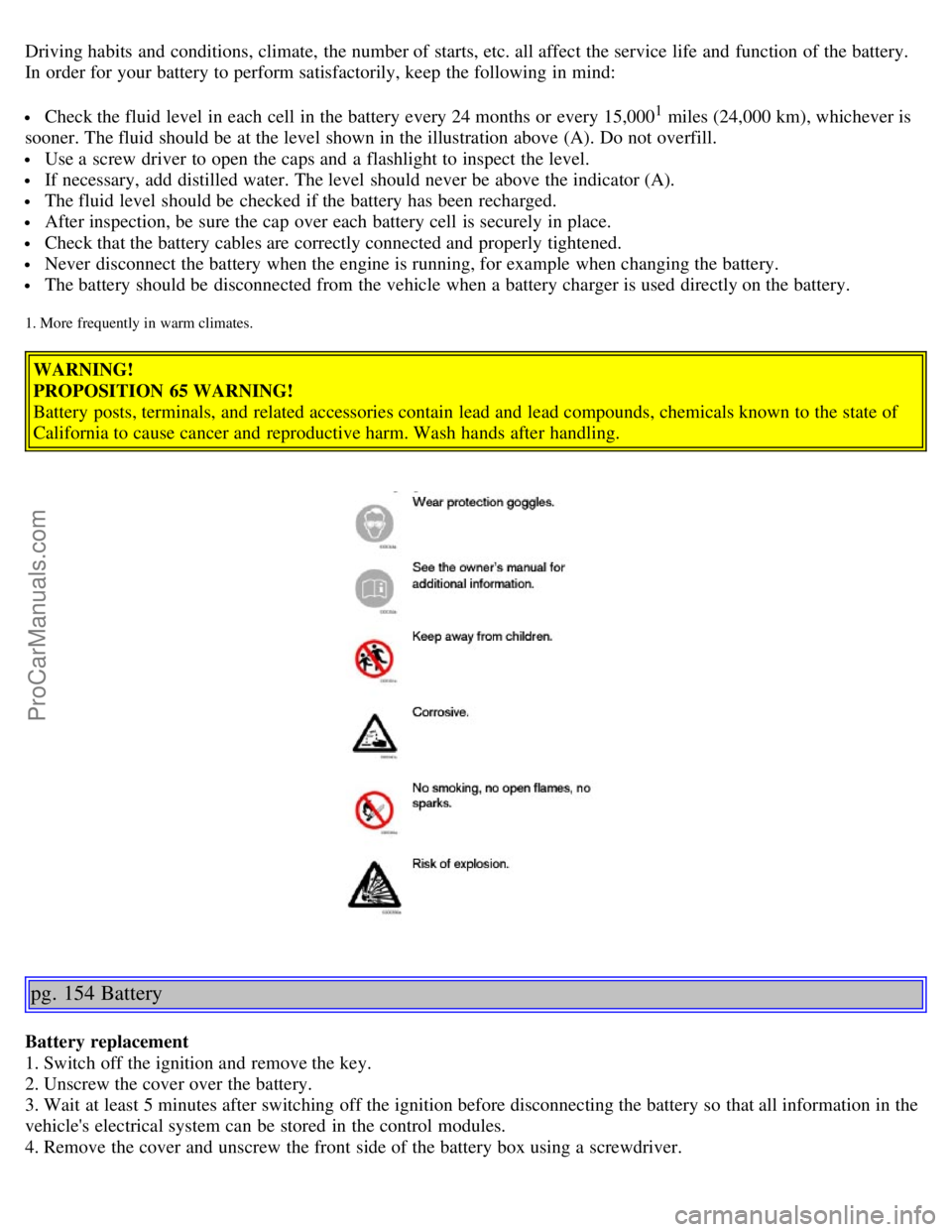
Driving habits and conditions, climate, the number of starts, etc. all affect the service life and function of the battery.
In order for your battery to perform satisfactorily, keep the following in mind:
Check the fluid level in each cell in the battery every 24 months or every 15,0001 miles (24,000 km), whichever is
sooner. The fluid should be at the level shown in the illustration above (A). Do not overfill.
Use a screw driver to open the caps and a flashlight to inspect the level.
If necessary, add distilled water. The level should never be above the indicator (A).
The fluid level should be checked if the battery has been recharged.
After inspection, be sure the cap over each battery cell is securely in place.
Check that the battery cables are correctly connected and properly tightened.
Never disconnect the battery when the engine is running, for example when changing the battery.
The battery should be disconnected from the vehicle when a battery charger is used directly on the battery.
1. More frequently in warm climates.
WARNING!
PROPOSITION 65 WARNING!
Battery posts, terminals, and related accessories contain lead and lead compounds, chemicals known to the state of
California to cause cancer and reproductive harm. Wash hands after handling.
pg. 154 Battery
Battery replacement
1. Switch off the ignition and remove the key.
2. Unscrew the cover over the battery.
3. Wait at least 5 minutes after switching off the ignition before disconnecting the battery so that all information in the
vehicle's electrical system can be stored in the control modules.
4. Remove the cover and unscrew the front side of the battery box using a screwdriver.
ProCarManuals.com
Page 120 of 127
Brake fluid151
Bulbs155
C
Capacities, fluids186
Catalytic converter, three-way190
CD changer179
CD player177
Central locking system, remote controls88
Changing a tire135
Changing oil149
Charge air cooler188
Child restraint anchorages35
Child safety32
Clock setting button38
Cold weather precautions99
Collision status30
Collisions, driving after30
Compact disc care177
Compass in rearview mirror57
Coolant150
Courtesy lighting81
Cruise control49
D
Dimensions185
Disabling the passenger's side front airbag19
Display, instrument panel38
Dolby Surround Pro Logic II172
Door mirrors58
Door open warning42
Driving after a collision30
DSTC44
E
Economical driving98
Electrical current - conserving99
Electrical system189
Electronic Brake Force Distribution (EBD)112
Emergency Brake Assistance - EBA113
Engine compartment148
Engine oil, changing149
Engine specifications188
Environment3
Equalizer, audio system172
F
Federal Clean Air Act146
ProCarManuals.com
Page 121 of 127

Floor mats104
Floor mats, cleaning142
Front airbags17
Front fog light, replacing158
Front fog lights (option)45
Front seats, manual adjustment78
Front seats, power79
Fuel filler cap2
Fuel filler door2, 102
Fuel gauge38
Fuel requirements101
Fuel system188
Fuel tank capacity102
Fuse box in the passenger compartment, accessing163
Fuses161
Fuses in the engine compartment162
Fuses in the passenger compartment164
G
Gasoline101
Geartronic (manual shifting)108
Generator189
Generator warning light41
Glossary of tire terminology129
Glove compartment83
Glove compartment, locking93
Grocery bag holder (option)86
H
Hazard warning flashers53
Head restraints, rear seat84
Headlight flasher47
Headlight housing, removing156
Headlight washers51
Headlights45
High beam bulb, replacing157
High beam indicator38
High beams47
High/low beam headlights45
Home safe lighting47, 62
Hood, opening148
I
Ignition switch106
Immobilizer88, 104
Indicator and warning symbols38
Inflatable Curtain26
ProCarManuals.com
Page 122 of 127
Inflation pressure tables127
Information display38
Information display, messages in43
Information symbol38, 39
Instrument overview8
Instrument panel38
Instrument panel lighting45
Interior lighting81
ISOFIX/LATCH anchors32
J
Jack, positioning correctly136
Jump starting118
K
Key blade90
Key blade, locking and unlocking the car90
Keylock2, 104
Kickdown109
L
Label information184
LATCH anchors33
License plate lighting, replacing159
Lighting panel45
Loading the vehicle130
Long distance trips100
Low beam bulb, replacing156
M
Maintenance146
Malfunction indicator light40
Manual front seat adjustment78
Manual shifting (Geartronic)108
Manual transmission107
Mirror, rearview57
Mirrors, door-mounted58
Moonroof59
O
Occupant safety12
Occupant Weight Sensor (OWS), disabling front passenger's side airbag19
Octane rating101
Oil pressure warning light41
Oil, changing149
On Call Roadside Assistance191
Opening the hood148
P
Paint touch up143
ProCarManuals.com
Page 123 of 127

Panic alarm, central locking system remote control89
Parking assist115
Parking brake54
Parking light bulb, replacing157
Parking lights45
Passenger's side front airbag, disabling19
Personal settings61
PI (Program Information) seek175
Polishing141
Power door mirrors58
Power front seats79
Power moonroof59
Power steering fluid151
Power windows55
PremAir ®4
Program Information seek175
Program type, audio system175
PROPOSITION 65 WARNING153
R
Radio Broadcast Data System - RBDS175
Radio functions174
Radio station formats176
Radio text175
Rain sensor52
Reading lights, rear81
Rear fog light46
Rear park assist115
Rear reading lights81
Rear seat backrests, folding down84
Rear seat head restraints84
Rearview mirror57
Rearview mirror with compass (option)57
Refueling102
Remote control functions89
Remote control, battery replacement91
Remote controls, central locking system88
Removing a wheel136
Replacing fuses161
Reporting safety defects12
Restraint anchorages35
S
Safety defects, reporting12
Safety locks, child93
Safety system components, inspecting31
ProCarManuals.com
Page 124 of 127
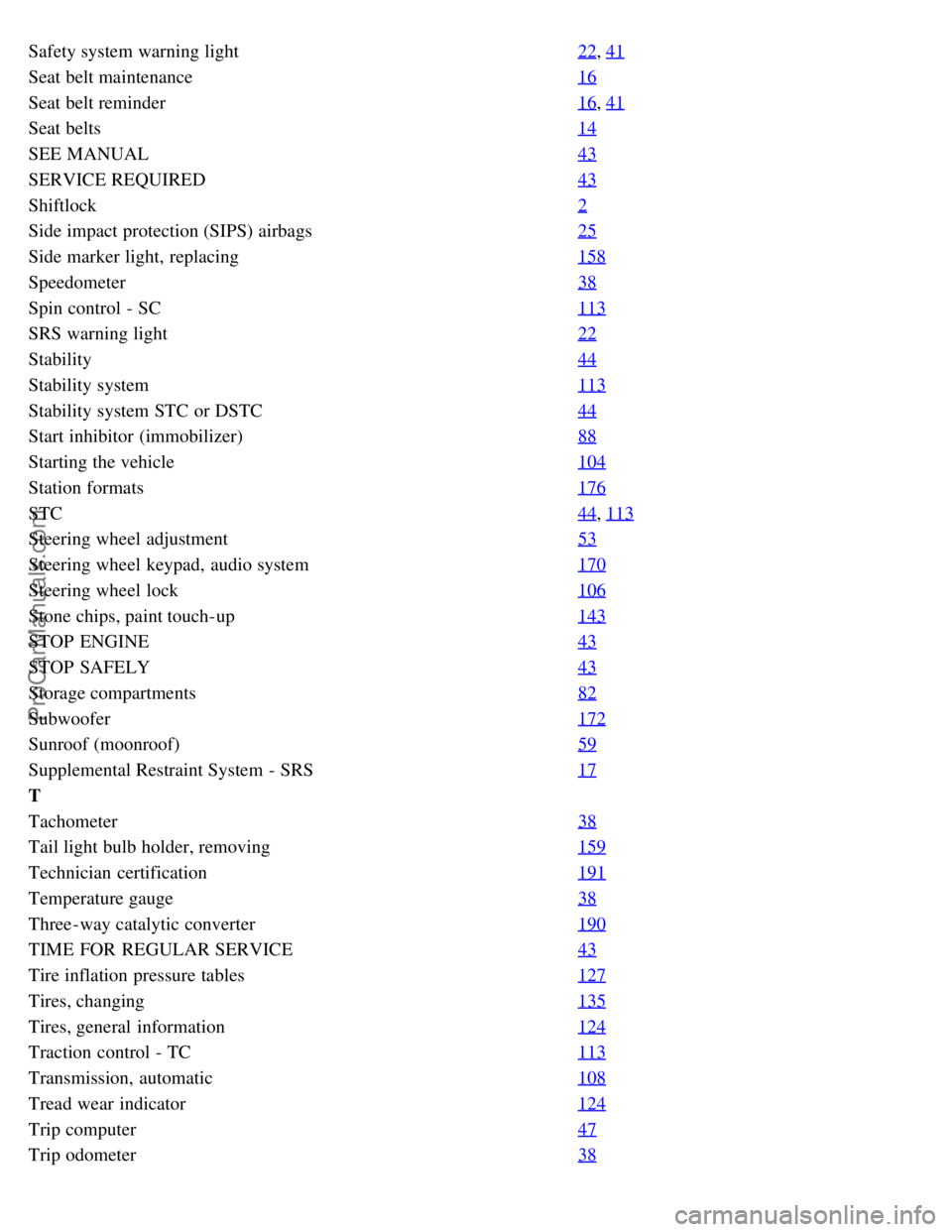
Safety system warning light22, 41
Seat belt maintenance16
Seat belt reminder16, 41
Seat belts14
SEE MANUAL43
SERVICE REQUIRED43
Shiftlock2
Side impact protection (SIPS) airbags25
Side marker light, replacing158
Speedometer38
Spin control - SC113
SRS warning light22
Stability44
Stability system113
Stability system STC or DSTC44
Start inhibitor (immobilizer)88
Starting the vehicle104
Station formats176
STC44, 113
Steering wheel adjustment53
Steering wheel keypad, audio system170
Steering wheel lock106
Stone chips, paint touch-up143
STOP ENGINE43
STOP SAFELY43
Storage compartments82
Subwoofer172
Sunroof (moonroof)59
Supplemental Restraint System - SRS17
T
Tachometer38
Tail light bulb holder, removing159
Technician certification191
Temperature gauge38
Three-way catalytic converter190
TIME FOR REGULAR SERVICE43
Tire inflation pressure tables127
Tires, changing135
Tires, general information124
Traction control - TC113
Transmission, automatic108
Tread wear indicator124
Trip computer47
Trip odometer38
ProCarManuals.com
Page 125 of 127
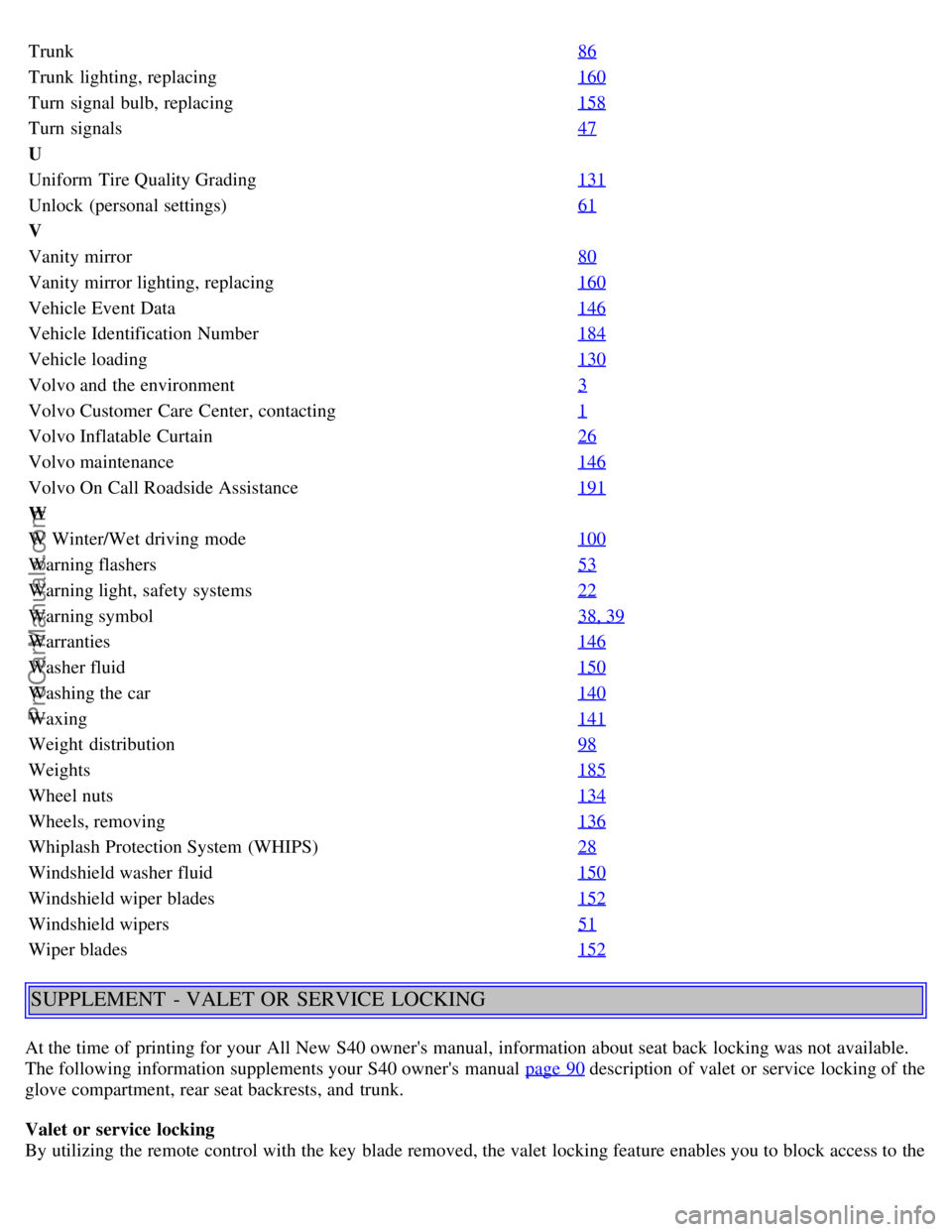
Trunk86
Trunk lighting, replacing160
Turn signal bulb, replacing158
Turn signals47
U
Uniform Tire Quality Grading131
Unlock (personal settings)61
V
Vanity mirror80
Vanity mirror lighting, replacing160
Vehicle Event Data146
Vehicle Identification Number184
Vehicle loading130
Volvo and the environment3
Volvo Customer Care Center, contacting1
Volvo Inflatable Curtain26
Volvo maintenance146
Volvo On Call Roadside Assistance191
W
W Winter/Wet driving mode100
Warning flashers53
Warning light, safety systems22
Warning symbol38, 39
Warranties146
Washer fluid150
Washing the car140
Waxing141
Weight distribution98
Weights185
Wheel nuts134
Wheels, removing136
Whiplash Protection System (WHIPS)28
Windshield washer fluid150
Windshield wiper blades152
Windshield wipers51
Wiper blades152
SUPPLEMENT - VALET OR SERVICE LOCKING
At the time of printing for your All New S40 owner's manual, information about seat back locking was not available.
The following information supplements your S40 owner's manual page 90
description of valet or service locking of the
glove compartment, rear seat backrests, and trunk.
Valet or service locking
By utilizing the remote control with the key blade removed, the valet locking feature enables you to block access to the
ProCarManuals.com