trunk VOLVO S40 2006 User Guide
[x] Cancel search | Manufacturer: VOLVO, Model Year: 2006, Model line: S40, Model: VOLVO S40 2006Pages: 127, PDF Size: 2.26 MB
Page 62 of 127
is not approved by Volvo. Different types of antifreeze must not be mixed.
Volvo recommends using only genuine Volvo antifreeze in your vehicle's radiator.
Try to keep the fuel tank well filled - this prevents the formation of condensation in the tank. In addition, in
extremely cold weather conditions it is worthwhile to add fuel line de -icer before refueling.
The viscosity of the engine oil is important. Oil with low viscosity (thinner oil) improves cold-weather starting as
well as decreasing fuel consumption while the engine is warming up. For winter use, 5W -30 oil, particularly the
synthetic type
1 , is recommended. Be sure to use good quality oil but do not use cold-weather oil for hard driving or in
warm weather. See page 179
for more information.
The load placed on the battery is greater during the winter since the windshield wipers, lighting, etc. are used more
often. Moreover, the capacity of the battery decreases as the temperature drops. In very cold weather, a poorly charged
battery can freeze and be damaged. It is therefore advisable to check the state of charge more frequently and spray an
anti-rust oil on the battery posts.
Volvo recommends the use of snow tires on all four wheels for winter driving - see the chapter "Wheels and tires."
To prevent the washer fluid reservoir from freezing, add washer solvents containing antifreeze (see page 145 for the
location of the washer fluid reservoir). This is important since dirt is often splashed on the windshield during winter
driving, requiring the frequent use of the washers and wipers. Volvo Washer Solvent should be diluted as follows:
Down to 14° F (-10° C): 1 part washer solvent and 4 parts water, Down to 5° F (-15° C): 1 part washer solvent and 3
parts water, Down to 0° F (-18° C): 1 part washer solvent and 2 parts water, Down to -18° F (-28° C): 1 part washer
solvent and 1 part water.
Use Volvo Teflon Lock Spray in the locks.
NOTE: Avoid using de -icing sprays as they can cause damage to the locks.
1. Synthetic oil is not used when the oil is changed at the normal maintenance intervals except at owner request and at
additional charge.
Conserving electrical current
Keep the following in mind to help minimize battery drain:
When the engine is not running, avoid turning the ignition key to position II. Many electrical systems (the audio
pg. 94 General information
system, the optional navigation system, power windows, etc) will function with the ignition key in position I. This
position reduces drain on the battery.
Please keep in mind that using systems, accessories, etc that consume a great deal of current when the engine is not
running could result in the battery being completely drained.
The optional 12 volt socket in the trunk provides electrical current even with the ignition switched off, which drains
the battery.
NOTE: If the ignition is switched on, a warning message will be displayed in the text window in the instrument panel
when the battery charge is low.
An energy conserving function designed into the vehicle's electrical system will switch off certain functions or reduce
the load on the battery by, e.g., reducing the audio system's volume.
Before a long distance trip
It is always worthwhile to have your vehicle checked by a trained and qualified Volvo service technician before
driving long distances. Your retailer will also be able to supply you with bulbs, fuses, spark plugs and wiper blades for
your use in the event that problems occur.
As a minimum, the following items should be checked before any long trip:
Check that engine runs smoothly and that fuel consumption is normal.
Check for fuel, oil, and fluid leakage
ProCarManuals.com
Page 64 of 127

Fuel Formulations
Do not use gasoline that contains lead as a knock inhibitor, and do not use lead additives. Besides damaging the
exhaust emission control systems on your vehicle, lead has been strongly linked to certain forms of cancer. Many fuels
contain benzene as a solvent. Unburned benzene has been strongly linked to certain forms of cancer. If you live in an
area where you must fill your own gas tank, take precautions.
These may include:
standing upwind away from the filler nozzle while refueling
pg. 96 Fuel requirements (contd.)
refueling only at gas stations with vapor recovery systems that fully seal the mouth of the filler neck during
refueling
wearing neoprene gloves while handling a fuel filler nozzle.
WARNING!
Carbon monoxide is a poisonous, colorless, and odorless gas. It is present in all exhaust gases. If you ever smell
exhaust fumes inside the vehicle, make sure the passenger compartment is ventilated, and immediately return the
vehicle to your retailer for correction.
Use of Additives
With the exception of fuel line antifreeze during winter months, do not add solvents, thickeners, or other store -bought
additives to your vehicle's fuel, cooling, or lubricating systems. Overuse may damage your engine, and some of these
additives contain organically volatile chemicals. Do not needlessly expose yourself to these chemicals.
Fuel filler door
Press the button on the light switch panel (see the illustration on page 41
) with the ignition switched off to unlock the
fuel filler door. Please note that the fuel filler door will remain unlocked until the vehicle begins to move forward. An
audible click will be heard when the fuel filler door relocks.
If you intend to leave your vehicle while it is being refueled, this feature enables you to lock the doors/trunk while
leaving the fuel filler door unlocked.
You can also keep the vehicle locked if you remain inside it during refueling. The central locking button does not lock
the fuel filler door.
Be sure the fuel filler door is not obstructed and is completely closed after refueling.
Open the fuel filler cap slowly during hot weather.
Refueling
The fuel tank is designed to hold approximately 15.9 US gallons (60 liters)
1 with sufficient volume left over to
accommodate possible expansion of the fuel in hot weather. Be aware that the "usable" tank capacity will be somewhat
less than the specified maximum. When the fuel level is low, such factors as ambient temperature, the fuel's "Reid
vapor pressure" characteristics, and terrain can affect the fuel pump's ability to supply the engine with an adequate
supply of fuel. Therefore, it is advisable to refuel as soon as possible when the needle nears the red zone, or when the
fuel warning light comes on.
1. Models with All Wheel Drive have a tank volume of 15 US gallons (57 liters).
Models with engine code 39 have a fuel tank capacity of 14 US gallons (53 liters). This code is the 6th and 7th digits
from the left in your vehicle's VIN number. See page 176
for the location of the VIN plate.
pg. 97 Fuel requirements
ProCarManuals.com
Page 84 of 127
Tires with tread designed to roll in only one direction are marked with an arrow on the sidewall.
Incorrectly mounted tires impair the car's braking properties and ability to force aside rain, snow and slush.
The tires with the most tread should always be at the rear (to reduce the risk of skidding).
Contact a Volvo workshop if you are unsure about the tread depth.
pg. 133 Changing a wheel
Changing a wheel
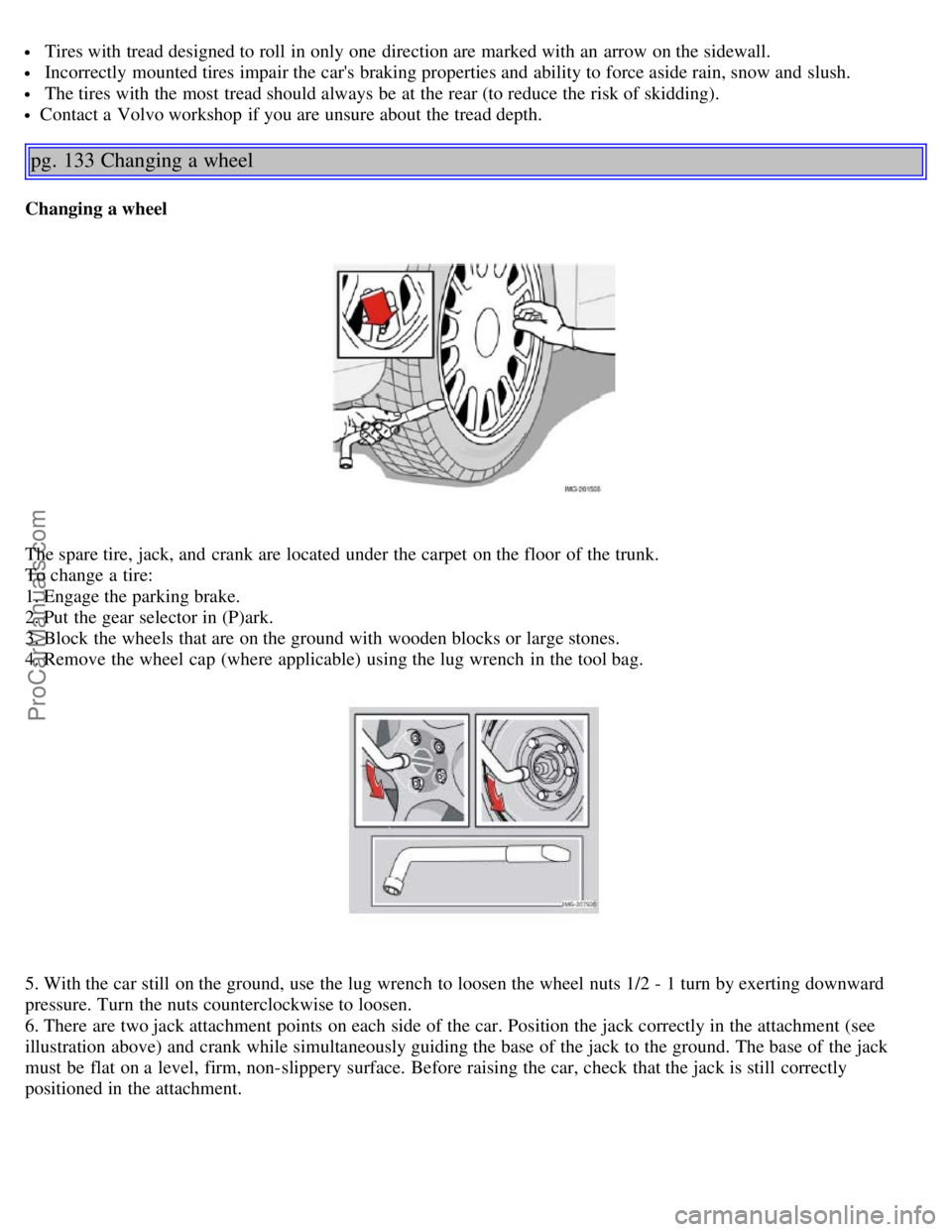
The spare tire, jack, and crank are located under the carpet on the floor of the trunk.
To change a tire:
1. Engage the parking brake.
2. Put the gear selector in (P)ark.
3. Block the wheels that are on the ground with wooden blocks or large stones.
4. Remove the wheel cap (where applicable) using the lug wrench in the tool bag.
5. With the car still on the ground, use the lug wrench to loosen the wheel nuts 1/2 - 1 turn by exerting downward
pressure. Turn the nuts counterclockwise to loosen.
6. There are two jack attachment points on each side of the car. Position the jack correctly in the attachment (see
illustration above) and crank while simultaneously guiding the base of the jack to the ground. The base of the jack
must be flat on a level, firm, non-slippery surface. Before raising the car, check that the jack is still correctly
positioned in the attachment.
ProCarManuals.com
Page 121 of 127
2 0 0 6
VOLVO S40
Index
pg. 185-188 Index
Numerics
12 volt socket, in trunk 80
12 volt socket, rear seat49
12 volt sockets40
A
ABS (anti-lock brake system)2
Active yaw control - AYC109
Airbag system14
Alarm89, 90
All Wheel Drive106
Antifreeze147
Anti-lock Brake System (ABS)2, 36
Approach lighting56, 83
ASC - speed compensated volume, audio system165
Audio system - introduction164
Audio system menus, list of173, 174
Autolock56
Automatic transmission - Geartronic103, 104
Auxiliary equipment40
AWD106
B
Backrests, rear seat78
Battery drain - avoiding93
Battery maintenance150
Battery replacement151
Battery replacement, remote control86
Battery, conserving electrical current93
Battery, specifications181
Bi -Xenon headlights153
Black box (Vehicle Event Data)142
Booster cushion28
Brake fluid148
ProCarManuals.com
Page 124 of 127
Information display, messages in39
Information symbol34, 35
Inspection readiness144
Instrument overview7
Instrument panel34
Instrument panel lighting41
Interior lighting75
ISOFIX/LATCH anchors28
J
Jack, positioning correctly133
Jump starting114
K
Key blade84
Keylock2, 99
Kickdown104
L
Label information176
LATCH anchors28
License plate lighting, replacing157
Lighting panel41
Loading the vehicle127
Long distance trips94
Low beam bulb, replacing153
Low beam headlights42
M
Maintenance142
Malfunction indicator light36
Manual front seat adjustment72
Manual shifting (Geartronic)103
Manual transmission101
Mirror, rearview52
Mirrors, door-mounted53
Moonroof54
O
OBD II144
Occupant safety10
Occupant Weight Sensor (OWS), disabling front passenger's side airbag18
Octane rating95
Oil pressure warning light37
Oil, changing146
On Call Roadside Assistance183
Onboard Diagnostic System (OBD II)144
Opening the hood145
Opening the trunk from the inside87
ProCarManuals.com
Page 126 of 127
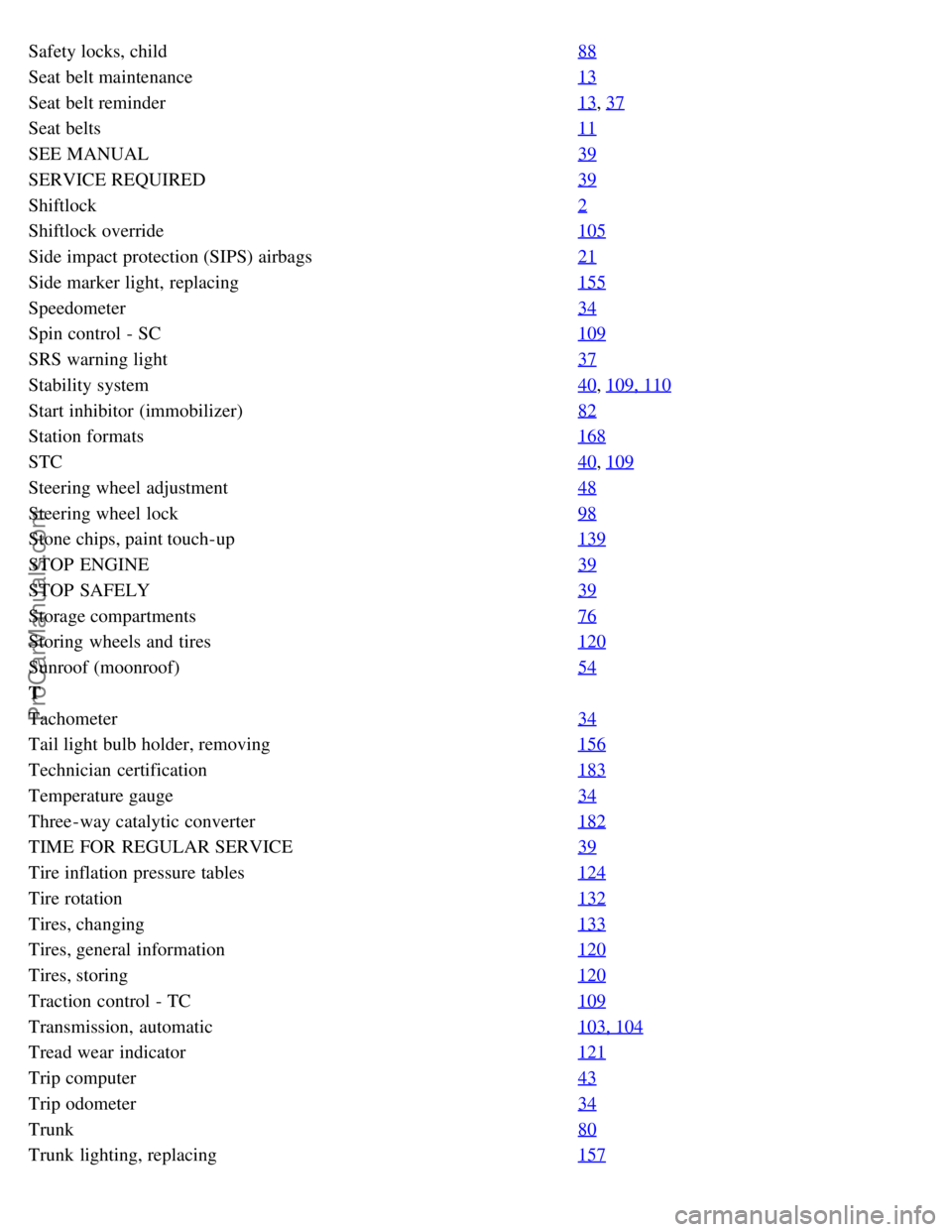
Safety locks, child88
Seat belt maintenance13
Seat belt reminder13, 37
Seat belts11
SEE MANUAL39
SERVICE REQUIRED39
Shiftlock2
Shiftlock override105
Side impact protection (SIPS) airbags21
Side marker light, replacing155
Speedometer34
Spin control - SC109
SRS warning light37
Stability system40, 109, 110
Start inhibitor (immobilizer)82
Station formats168
STC40, 109
Steering wheel adjustment48
Steering wheel lock98
Stone chips, paint touch-up139
STOP ENGINE39
STOP SAFELY39
Storage compartments76
Storing wheels and tires120
Sunroof (moonroof)54
T
Tachometer34
Tail light bulb holder, removing156
Technician certification183
Temperature gauge34
Three-way catalytic converter182
TIME FOR REGULAR SERVICE39
Tire inflation pressure tables124
Tire rotation132
Tires, changing133
Tires, general information120
Tires, storing120
Traction control - TC109
Transmission, automatic103, 104
Tread wear indicator121
Trip computer43
Trip odometer34
Trunk80
Trunk lighting, replacing157
ProCarManuals.com
Page 127 of 127
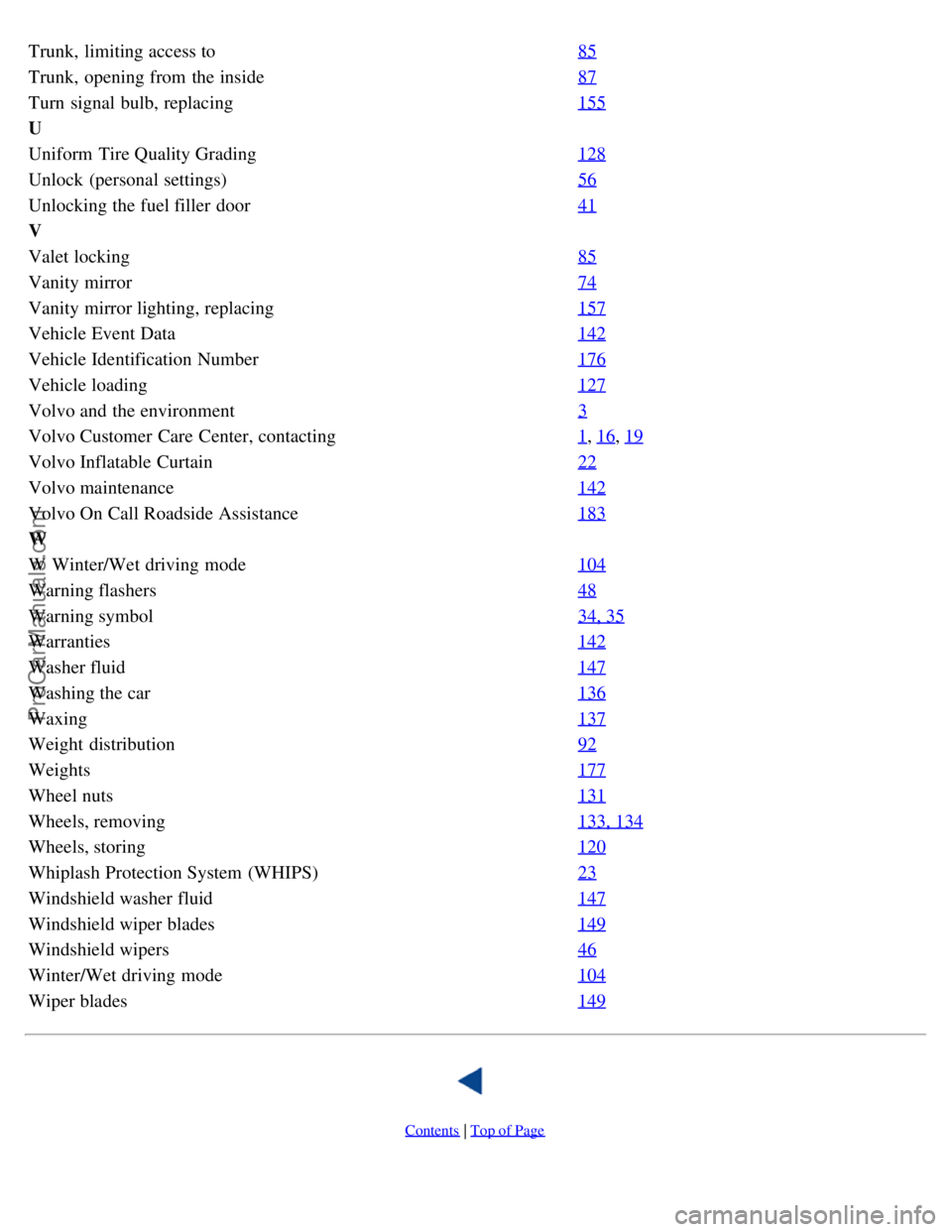
Trunk, limiting access to85
Trunk, opening from the inside87
Turn signal bulb, replacing155
U
Uniform Tire Quality Grading128
Unlock (personal settings)56
Unlocking the fuel filler door41
V
Valet locking85
Vanity mirror74
Vanity mirror lighting, replacing157
Vehicle Event Data142
Vehicle Identification Number176
Vehicle loading127
Volvo and the environment3
Volvo Customer Care Center, contacting1, 16, 19
Volvo Inflatable Curtain22
Volvo maintenance142
Volvo On Call Roadside Assistance183
W
W Winter/Wet driving mode104
Warning flashers48
Warning symbol34, 35
Warranties142
Washer fluid147
Washing the car136
Waxing137
Weight distribution92
Weights177
Wheel nuts131
Wheels, removing133, 134
Wheels, storing120
Whiplash Protection System (WHIPS)23
Windshield washer fluid147
Windshield wiper blades149
Windshield wipers46
Winter/Wet driving mode104
Wiper blades149
Contents | Top of Page
ProCarManuals.com