weight VOLVO S40 2006 User Guide
[x] Cancel search | Manufacturer: VOLVO, Model Year: 2006, Model line: S40, Model: VOLVO S40 2006Pages: 127, PDF Size: 2.26 MB
Page 79 of 127
2001. The numbers in between are marketing codes used at the manufacturer's discretion. This information helps a tire
manufacturer identify a tire for safety recall purposes.
9. Tire Ply Composition and Material Used: Indicates the number of plies indicates or the number of layers of
rubber-coated fabric in the tire tread and sidewall. Tire manufacturers also must indicate the ply materials in the tire
and the sidewall, which include steel, nylon, polyester, and others.
10. Maximum Load: Indicates the maximum load in pounds and kilograms that can be carried by the tire. Refer to the
vehicle's tire information placard or the safety certification label, located on the B-Pillar or the driver's door or on the
inside of the fuel filler door on Canadian models, for the correct tire pressure for your vehicle.
11. Treadwear, Traction, and Temperature grades: See page 128
for more information.
12. Maximum permissible inflation pressure: the greatest amount of air pressure that should ever be put in the tire.
This limit is set by the tire manufacturer.
pg. 126 Glossary of tire terminology
The tire suppliers may have additional markings, notes or warnings such as standard load, radial tubeless, etc.
Tire information placard: A placard showing the OE (Original Equipment) tire sizes, recommended inflation
pressure, and the maximum weight the vehicle can carry.
Tire Identification Number (TIN): A number on the sidewall of each tire providing information about the tire
brand and manufacturing plant, tire size and date of manufacturer.
Inflation pressure: A measure of the amount of air in a tire.
Standard load: A class of P-metric or Metric tires designed to carry a maximum load at 35 psi [37 psi (2.5 bar) for
Metric tires]. Increasing the inflation pressure beyond this pressure will not increase the tires load carrying capability.
Extra load: A class of P-metric or Metric tires designed to carry a heavier maximum load at 41 psi [43 psi (2.9 bar)
for Metric tires]. Increasing the inflation pressure beyond this pressure will not increase the tires load carrying
capability.
kPa: Kilopascal, a metric unit of air pressure.
PSI: Pounds per square inch, a standard unit of air pressure.
B-pillar: The structural member at the side of the vehicle behind the front door.
Bead area of the tire: Area of the tire next to the rim.
Sidewall of the tire: Area between the bead area and the tread.
Tread area of the tire: Area of the perimeter of the tire that contacts the road when mounted on the vehicle.
Rim: The metal support (wheel) for a tire or a tire and tube assembly upon which the tire beads are seated.
Maximum load rating: a figure indicating the maximum load in pounds and kilograms that can be carried by the
tire. This rating is established by the tire manufacturer.
Maximum permissible inflation pressure: the greatest amount of air pressure that should ever be put in the tire.
This limit is set by the tire manufacturer.
Recommended tire inflation pressure: inflation pressure, established by Volvo, which is based on the type of tires
that are mounted on a vehicle at the factory. This inflation pressure is affected by the number of occupants in the car,
the amount of cargo, and the speed at which the vehicle will be driven for a prolonged period. This information can be
found on the tire inflation placard(s) located on the driver's side B-pillar or on the inside of the fuel filler door on
Canadian models, and in the tire inflation table in this chapter.
Cold tires: The tires are considered to be cold when they have the same temperature as the surrounding (ambient)
air. This temperature is normally reached after the car has been parked for at least 3 hours.
pg. 127 Vehicle loading
Vehicle loading
Properly loading your vehicle will provide maximum return of vehicle design performance.
ProCarManuals.com
Page 80 of 127
Before loading your vehicle, familiarize yourself with the following terms for determining your vehicle's weight
ratings, with or without a trailer, from the vehicle's Federal/ Canadian Motor Vehicle Safety Standards
(FMVSS/CMVSS) label, and the vehicle's tire information placard:
Curb weight
The weight of the vehicle including a full tank of fuel and all standard equipment. It does not include passengers,
cargo, or optional equipment.
Capacity weight
All weight added to the curb weight, including cargo and optional equipment. When towing, trailer hitch tongue load
is also part of cargo weight.
NOTE: For trailer towing information, please refer to the section "Towing a trailer" on page 115
.
Permissible axle weight
The maximum allowable weight that can be carried by a single axle (front or rear). These numbers are shown on the
Federal/Canadian Motor Vehicle Safety Standards (FMVSS/CMVSS) label. The total load on each axle must never
exceed its maximum permissible weight.
Gross vehicle weight (GVW)
The vehicle's curb weight + cargo + passengers.
NOTE:
The location of the various labels in your vehicle can be found on page 176.
A table listing important weight limits for your vehicle can be found on page 177.
Steps for Determining Correct Load Limit
(1) Locate the statement ''the combined weight of occupants and cargo should never exceed XXX pounds'' on your
vehicle's placard.
(2) Determine the combined weight of the driver and passengers that will be riding in your vehicle.
(3) Subtract the combined weight of the driver and passengers from XXX kilograms or XXX pounds.
(4) The resulting figure equals the available amount of cargo and luggage load capacity. For example, if the ''XXX''
amount equals 1400 lbs. and there will be five 150 lb. passengers in your vehicle, the amount of available cargo and
luggage load capacity is 650 lbs. (1400-750 (5 x 150) = 650 lbs.)
(5) Determine the combined weight of luggage and cargo being loaded on the vehicle. That weight may not safely
exceed the available cargo and luggage load capacity calculated in Step 4.
(6) If your vehicle will be towing a trailer, load from your trailer will be transferred to your vehicle. Consult this
manual
1 to determine how this reduces the available cargo and luggage load capacity of your vehicle.
WARNING!
- Exceeding the permissible axle weight, gross vehicle weight, or any other weight rating limits can cause tire
overheating resulting in permanent deformation or catastrophic failure.
- Do not use replacement tires with lower load carrying capacities than the tires that were original equipment on the
vehicle because this will lower the vehicle's GVW rating. Replacement tires with a higher limit than the originals do
not increase the vehicle's GVW rating limitations.
1. See "Towing a trailer" on page 115
.
pg. 128 Uniform Tire Quality Grading
Uniform Tire Quality Grading
ALL PASSENGER VEHICLE TIRES MUST CONFORM TO FEDERAL SAFETY REQUIREMENTS IN
ProCarManuals.com
Page 114 of 127
2 0 0 6
VOLVO S40
Chapter 12 - Specifications
pg. 175 Specifications
Label information176
Dimensions and weights177
Fuel, oils, and fluids178
Engine oil179
Engine specifications180
Electrical system181
Three-way catalytic converter182
Volvo programs183
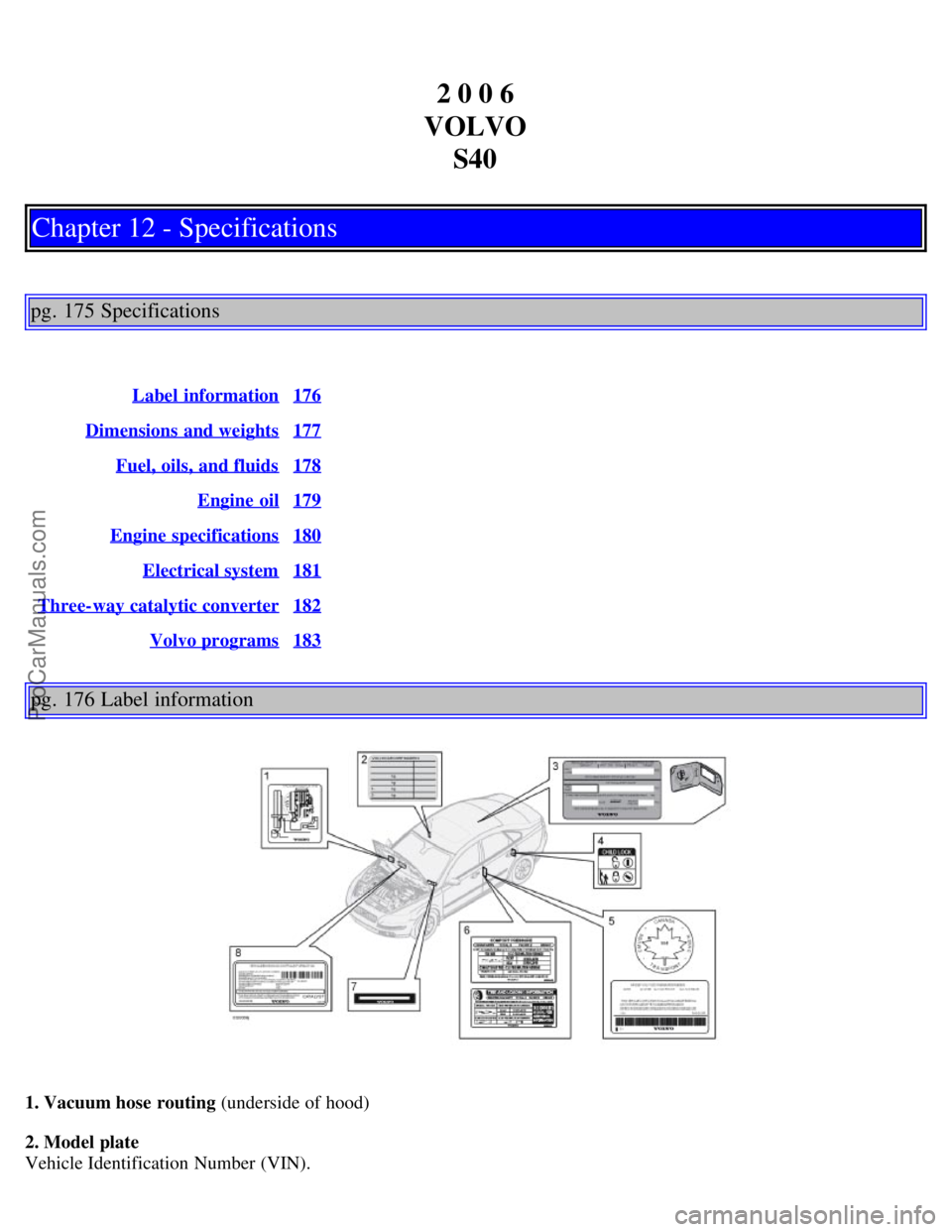
pg. 176 Label information
1. Vacuum hose routing (underside of hood)
2. Model plate
Vehicle Identification Number (VIN).
ProCarManuals.com
Page 115 of 127
Codes for color and upholstery, etc. The label is located on the passenger's side center door pillar.
3. Loads and Tire Pressures
(on inside of fuel filler door): Canadian models only.
4. Child safety lock
This information is stamped on the rear inside edges of the doors.
5. Federal Motor Vehicle Safety Standards (FMVSS) specifications (USA) and Ministry of Transport (CMVSS)
standards (Canada)
Your Volvo is designed to meet all applicable safety standards, as evidenced by the certification label on the facing
side of the driver's door. For further information regarding these regulations, please consult your Volvo retailer.
6. Loads and Tire Pressures U.S. models only
Certain models will only have one decal, depending on the specifications of the vehicle.
7. Vehicle Identification Number (VIN)
1
The VIN plate is located on the top left surface of the dashboard. The VIN is also stamped on the right hand door
pillar.
8. Vehicle Emission Control Information
Your Volvo is designed to meet all applicable emission standards, as evidenced by the certification label on the
underside of the hood. For further information regarding these regulations, please consult your Volvo retailer.
1. The Vehicle Identification Number (VIN) should always be quoted in correspondence concerning your vehicle with the retailer and when
ordering parts.
pg. 177 Dimensions and weights
Dimensions and weights
DimensionsLength 175.9 in. (447 cm)
Width 69.7 in. (177 cm)
Height 57.2 in. (145 cm)
Wheelbase 103.9 in. (264 cm)
Front track 60.4/60.9 in. (154/155 cm)
Rear track 60.3/60.8 in. (153/154 cm)
Turning circle 34.9 ft. (10.6 m)
Cargo capacity 31.2 cu. ft. (883 liters)
1
1. 38.4 cu. ft. (1088 liters) with the front passenger's seat backrest folded down (certain models only).
Category USACanada
Gross vehicle weight FWD
1: 4320 lbs
FWD Turbo: 4320 lbs
AWD
2 Turbo: 4450 lbs 1960 kg
1960 kg
2020 kg
Capacity weight FWD: 800 lbs
AWD: 800 lbs365 kg
365 kg
Permissible axle weight, front FWD: 2380 lbs
FWD Turbo: 2380 lbs
AWD Turbo: 2420 lbs1080 kg
1080 kg
1100 kg
ProCarManuals.com
Page 116 of 127
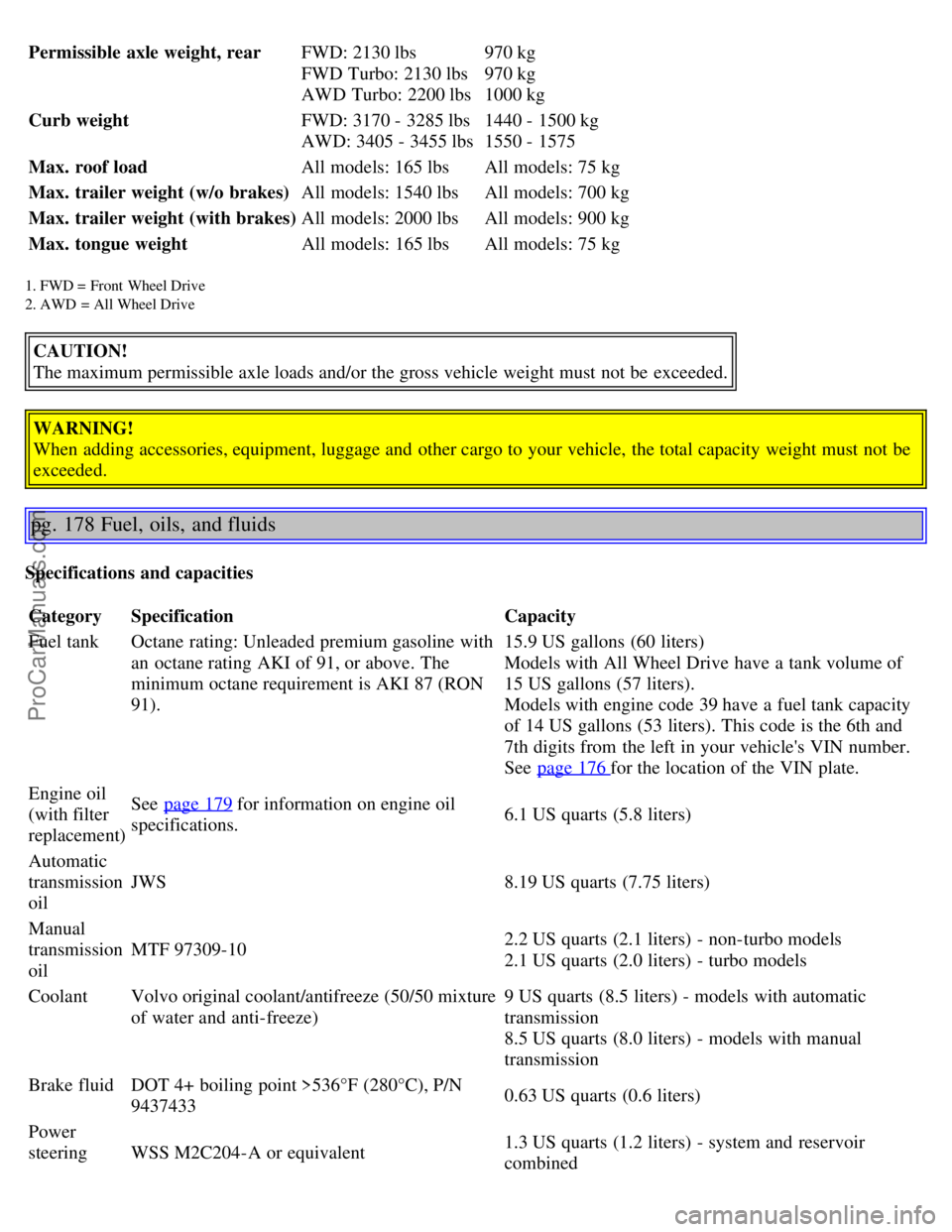
Permissible axle weight, rearFWD: 2130 lbs
FWD Turbo: 2130 lbs
AWD Turbo: 2200 lbs
970 kg
970 kg
1000 kg
Curb weight FWD: 3170 - 3285 lbs
AWD: 3405 - 3455 lbs1440 - 1500 kg
1550 - 1575
Max. roof load All models: 165 lbsAll models: 75 kg
Max. trailer weight (w/o brakes) All models: 1540 lbsAll models: 700 kg
Max. trailer weight (with brakes) All models: 2000 lbsAll models: 900 kg
Max. tongue weight All models: 165 lbsAll models: 75 kg
1. FWD = Front Wheel Drive
2. AWD = All Wheel Drive
CAUTION!
The maximum permissible axle loads and/or the gross vehicle weight must not be exceeded.
WARNING!
When adding accessories, equipment, luggage and other cargo to your vehicle, the total capacity weight must not be
exceeded.
pg. 178 Fuel, oils, and fluids
Specifications and capacities
Category Specification Capacity
Fuel tank Octane rating: Unleaded premium gasoline with
an octane rating AKI of 91, or above. The
minimum octane requirement is AKI 87 (RON
91). 15.9 US gallons (60 liters)
Models with All Wheel Drive have a tank volume of
15 US gallons (57 liters).
Models with engine code 39 have a fuel tank capacity
of 14 US gallons (53 liters). This code is the 6th and
7th digits from the left in your vehicle's VIN number.
See page 176
for the location of the VIN plate.
Engine oil
(with filter
replacement) See page 179
for information on engine oil
specifications. 6.1 US quarts (5.8 liters)
Automatic
transmission
oil JWS
8.19 US quarts (7.75 liters)
Manual
transmission
oil MTF 97309-10
2.2 US quarts (2.1 liters) - non-turbo models
2.1 US quarts (2.0 liters) - turbo models
Coolant Volvo original coolant/antifreeze (50/50 mixture
of water and anti-freeze) 9 US quarts (8.5 liters) - models with automatic
transmission
8.5 US quarts (8.0 liters) - models with manual
transmission
Brake fluid DOT 4+ boiling point >536°F (280°C), P/N
9437433 0.63 US quarts (0.6 liters)
Power
steering WSS M2C204-A or equivalent 1.3 US quarts (1.2 liters) - system and reservoir
combined
ProCarManuals.com
Page 117 of 127
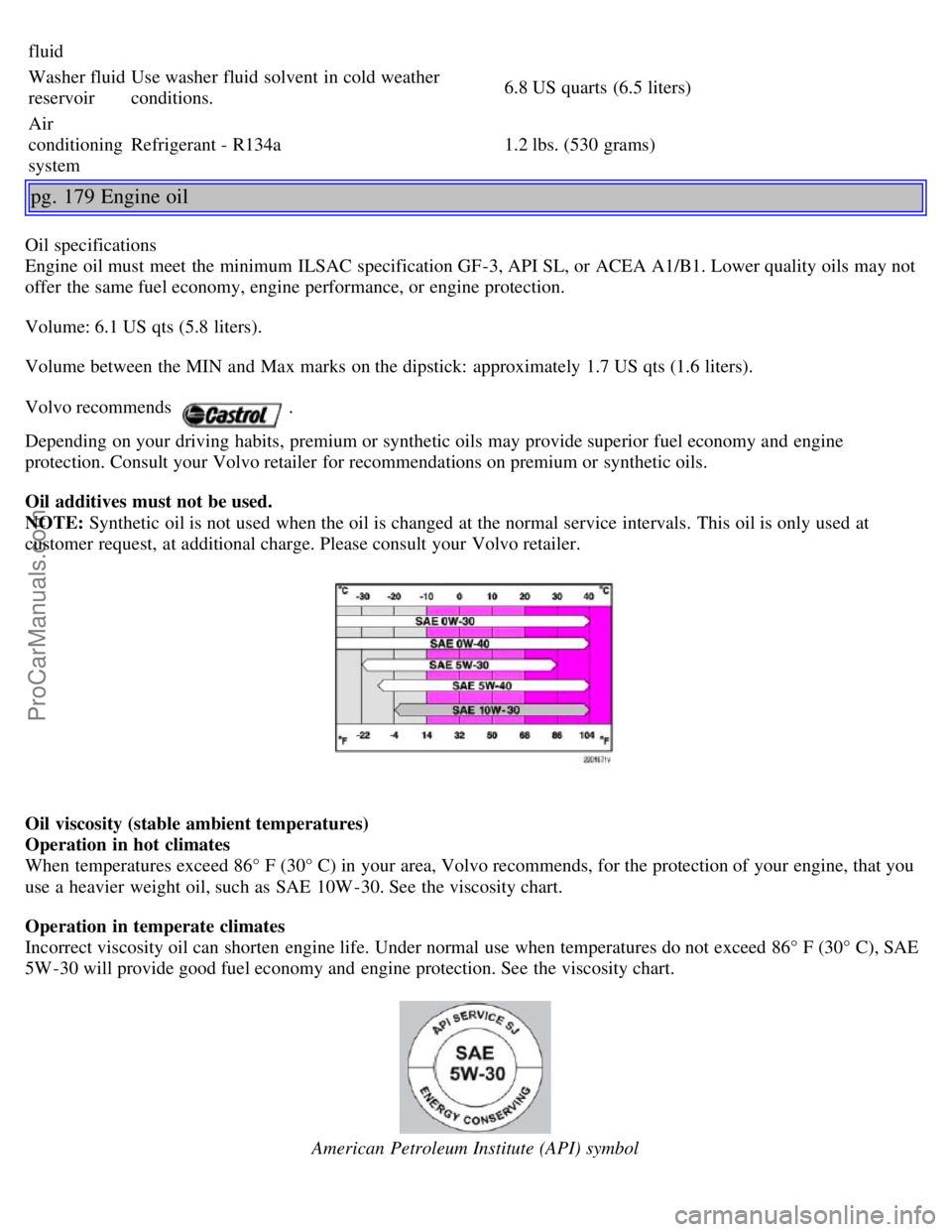
fluid
Washer fluid
reservoirUse washer fluid solvent in cold weather
conditions.
6.8 US quarts (6.5 liters)
Air
conditioning
system Refrigerant - R134a
1.2 lbs. (530 grams)
pg. 179 Engine oil
Oil specifications
Engine oil must meet the minimum ILSAC specification GF-3, API SL, or ACEA A1/B1. Lower quality oils may not
offer the same fuel economy, engine performance, or engine protection.
Volume: 6.1 US qts (5.8 liters).
Volume between the MIN and Max marks on the dipstick: approximately 1.7 US qts (1.6 liters).
Volvo recommends
.
Depending on your driving habits, premium or synthetic oils may provide superior fuel economy and engine
protection. Consult your Volvo retailer for recommendations on premium or synthetic oils.
Oil additives must not be used.
NOTE: Synthetic oil is not used when the oil is changed at the normal service intervals. This oil is only used at
customer request, at additional charge. Please consult your Volvo retailer.
Oil viscosity (stable ambient temperatures)
Operation in hot climates
When temperatures exceed 86° F (30° C) in your area, Volvo recommends, for the protection of your engine, that you
use a heavier weight oil, such as SAE 10W -30. See the viscosity chart.
Operation in temperate climates
Incorrect viscosity oil can shorten engine life. Under normal use when temperatures do not exceed 86° F (30° C), SAE
5W -30 will provide good fuel economy and engine protection. See the viscosity chart.
American Petroleum Institute (API) symbol
ProCarManuals.com
Page 124 of 127
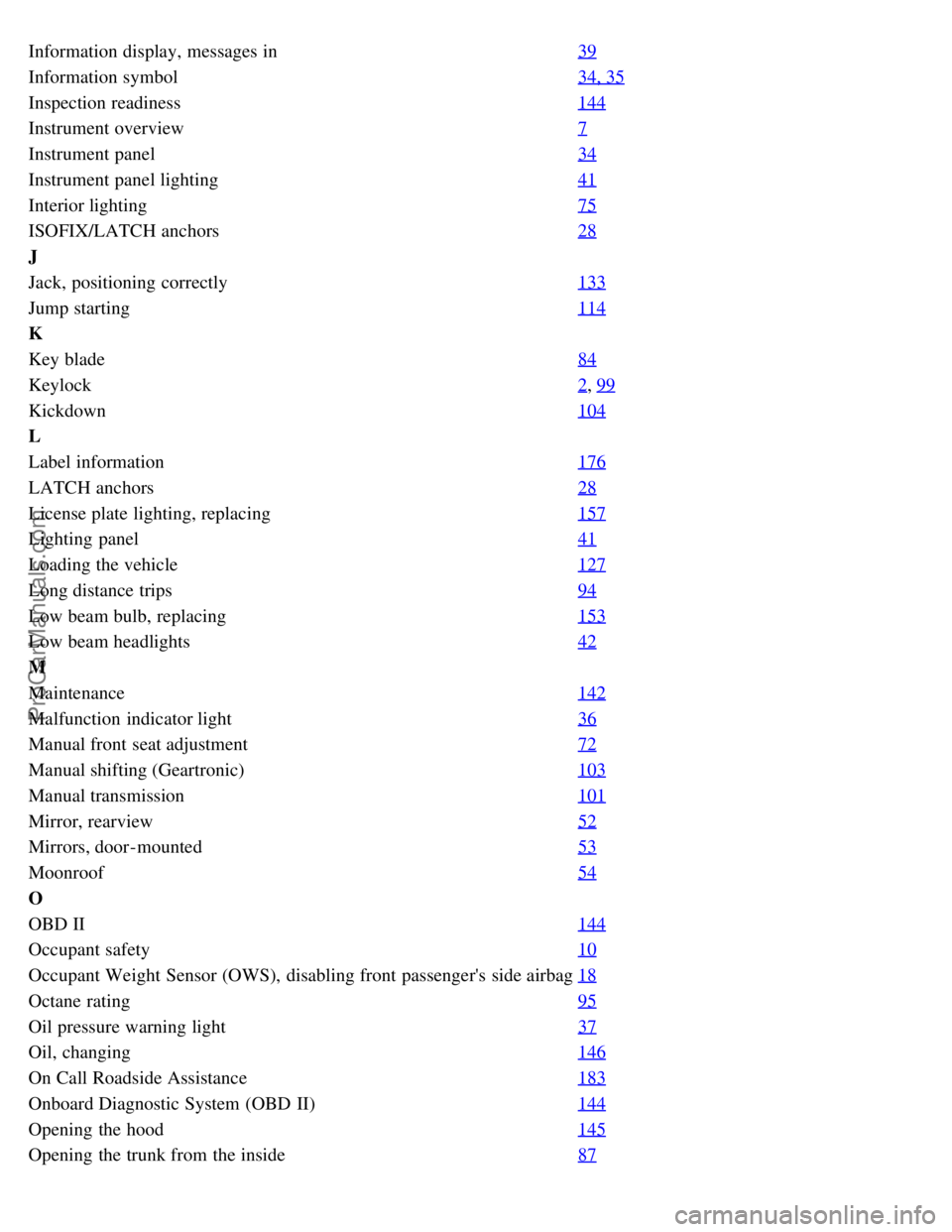
Information display, messages in39
Information symbol34, 35
Inspection readiness144
Instrument overview7
Instrument panel34
Instrument panel lighting41
Interior lighting75
ISOFIX/LATCH anchors28
J
Jack, positioning correctly133
Jump starting114
K
Key blade84
Keylock2, 99
Kickdown104
L
Label information176
LATCH anchors28
License plate lighting, replacing157
Lighting panel41
Loading the vehicle127
Long distance trips94
Low beam bulb, replacing153
Low beam headlights42
M
Maintenance142
Malfunction indicator light36
Manual front seat adjustment72
Manual shifting (Geartronic)103
Manual transmission101
Mirror, rearview52
Mirrors, door-mounted53
Moonroof54
O
OBD II144
Occupant safety10
Occupant Weight Sensor (OWS), disabling front passenger's side airbag18
Octane rating95
Oil pressure warning light37
Oil, changing146
On Call Roadside Assistance183
Onboard Diagnostic System (OBD II)144
Opening the hood145
Opening the trunk from the inside87
ProCarManuals.com
Page 127 of 127
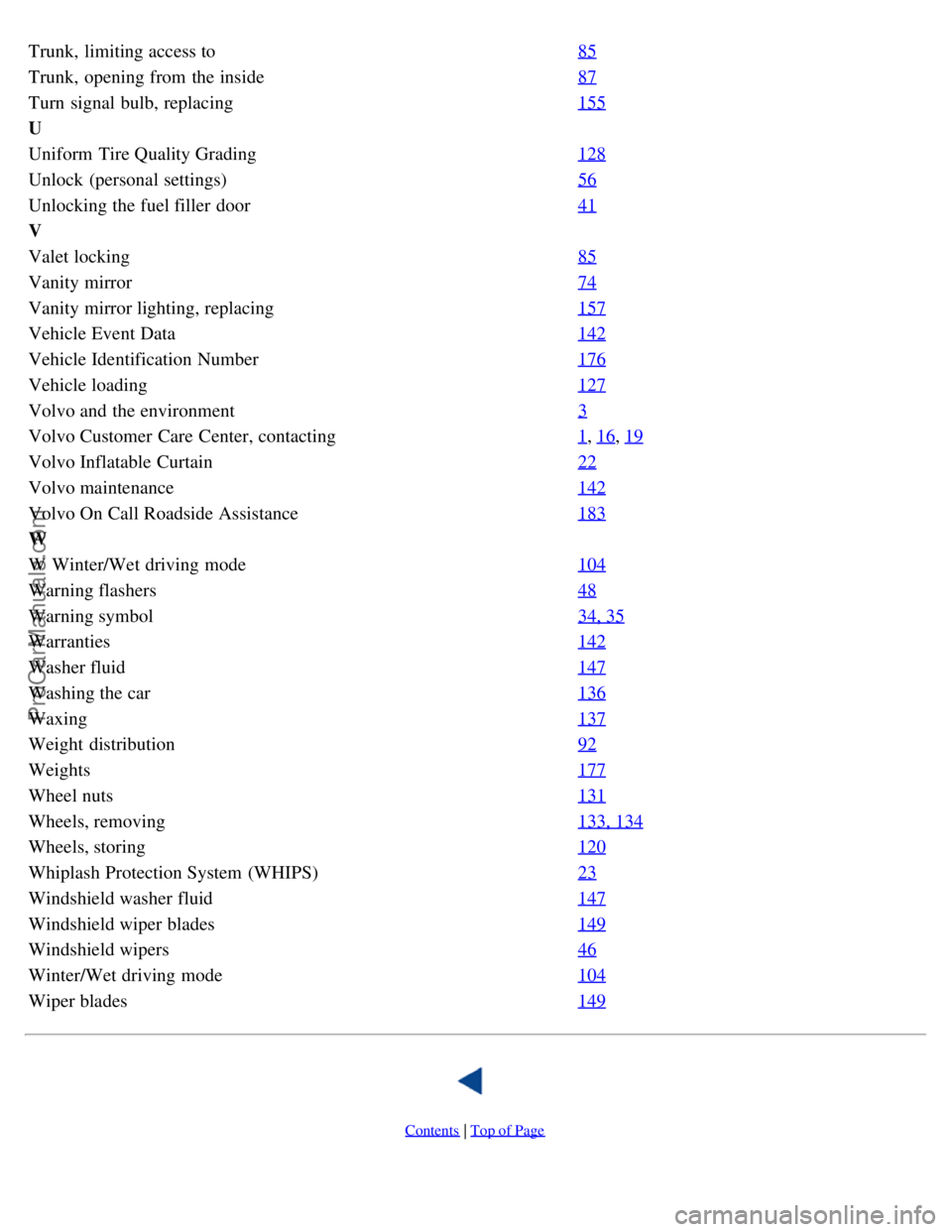
Trunk, limiting access to85
Trunk, opening from the inside87
Turn signal bulb, replacing155
U
Uniform Tire Quality Grading128
Unlock (personal settings)56
Unlocking the fuel filler door41
V
Valet locking85
Vanity mirror74
Vanity mirror lighting, replacing157
Vehicle Event Data142
Vehicle Identification Number176
Vehicle loading127
Volvo and the environment3
Volvo Customer Care Center, contacting1, 16, 19
Volvo Inflatable Curtain22
Volvo maintenance142
Volvo On Call Roadside Assistance183
W
W Winter/Wet driving mode104
Warning flashers48
Warning symbol34, 35
Warranties142
Washer fluid147
Washing the car136
Waxing137
Weight distribution92
Weights177
Wheel nuts131
Wheels, removing133, 134
Wheels, storing120
Whiplash Protection System (WHIPS)23
Windshield washer fluid147
Windshield wiper blades149
Windshield wipers46
Winter/Wet driving mode104
Wiper blades149
Contents | Top of Page
ProCarManuals.com