oil VOLVO S40 2008 Owner's Manual
[x] Cancel search | Manufacturer: VOLVO, Model Year: 2008, Model line: S40, Model: VOLVO S40 2008Pages: 239, PDF Size: 5.94 MB
Page 186 of 239
Volvo service technician.
NOTE
Do not top off with water only. This reduces the rust-protective and antifreeze qualities of the coolant and has a
lower boiling point. It can also cause damage to the cooling system if it should freeze. Top off with Volvo Genuine
Coolant/Antifreeze only (a 50/50 mix of water and antifreeze).
207 09 Maintenance and servicing
Fluids
CAUTION
The cooling system must always be kept filled to the correct level, and the level must be between the MIN and
MAX marks. If it is not kept filled, there can be high local temperatures in the engine which could result in damage.
Different types of antifreeze/coolant may not be mixed. Check coolant regularly!
WARNING
Never remove the radiator cap while the engine is warm. Wait until the vehicle cools. If it is necessary to top off the
coolant when the engine is warm, unscrew the expansion tank cap slowly so that the overpressure dissipates.
Brake fluid
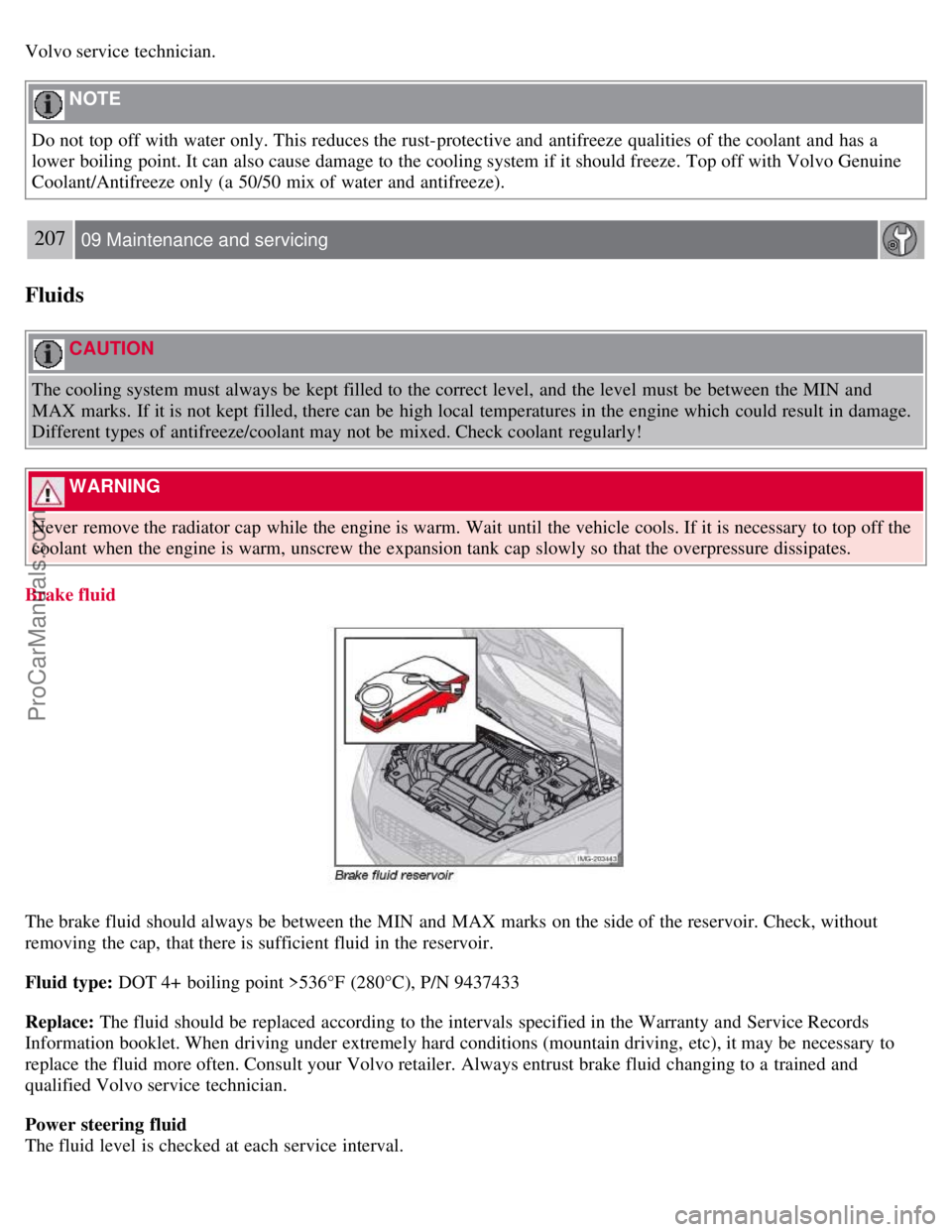
The brake fluid should always be between the MIN and MAX marks on the side of the reservoir. Check, without
removing the cap, that there is sufficient fluid in the reservoir.
Fluid type: DOT 4+ boiling point >536°F (280°C), P/N 9437433
Replace: The fluid should be replaced according to the intervals specified in the Warranty and Service Records
Information booklet. When driving under extremely hard conditions (mountain driving, etc), it may be necessary to
replace the fluid more often. Consult your Volvo retailer. Always entrust brake fluid changing to a trained and
qualified Volvo service technician.
Power steering fluid
The fluid level is checked at each service interval.
ProCarManuals.com
Page 191 of 239
4. Connect the positive cable.
5. Connect the ground cable.
6. Reinstall the cover over the battery.
NOTE
Used batteries should be properly disposed of at a recycling station or similar facility, or taken to your Volvo
retailer.
WARNING
Never expose the battery to open flame or electric spark.
Do not smoke near the battery.
Battery fluid contains sulfuric acid. Do not allow battery fluid to contact eyes, skin, fabrics or painted surfaces. If
contact occurs, flush the affected area immediately with water. Obtain medical help immediately if eyes are affected.
211 09 Maintenance and servicing
Replacing bulbs
Introduction
Before replacing bulbs in your vehicle, please keep the following points in mind:
NOTE
Never touch the glass of bulbs with your fingers. Grease and oils from your fingers vaporize in the heat and will
leave a deposit on the reflector, which will damage it.
The optional Bi -Xenon® headlight bulbs contain trace amounts of mercury. These bulbs should always be
disposed of by an authorized Volvo retailer.
Certain bulbs should only be replaced by a trained and qualified Volvo service technician:
- Courtesy (dome) lighting
- Reading lights
- Glove compartment lights
- Turn signals and courtesy lights in the side door mirrors
- High-mounted brake lights
- Bi -Xenon® headlights
- Brake lights
212 09 Maintenance and servicing
Replacing bulbs
Removing the headlight housing
ProCarManuals.com
Page 223 of 239
2 0 0 8
VOLVO S40
246 11 Specifications
Label information 248
Dimensions and weights250
Engine oil253
Engine specifications255
Electrical system256
Volvo programs259
247 11 Specifications
248 11 Specifications
Label information
ProCarManuals.com
Page 226 of 239
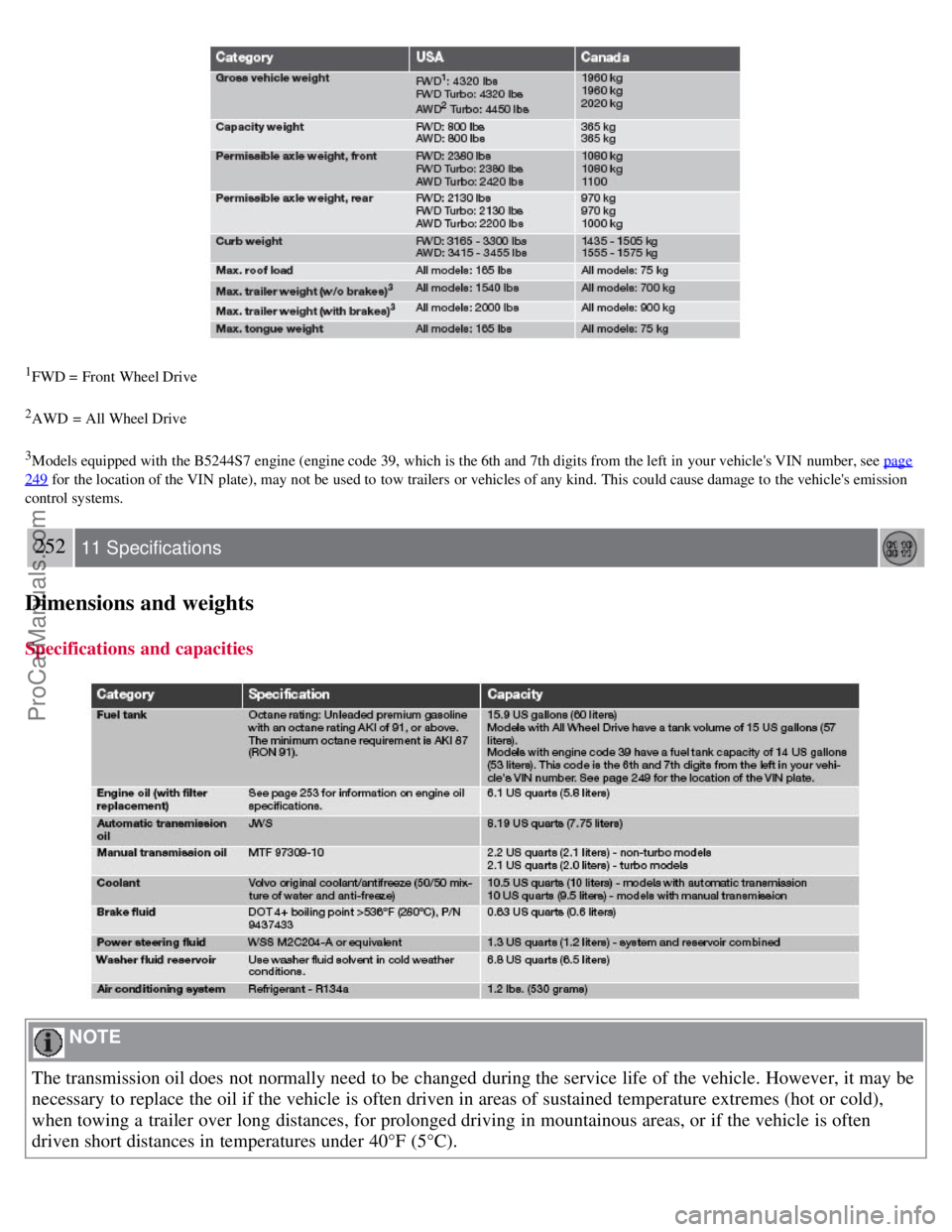
1FWD = Front Wheel Drive
2AWD = All Wheel Drive
3Models equipped with the B5244S7 engine (engine code 39, which is the 6th and 7th digits from the left in your vehicle's VIN number, see page
249 for the location of the VIN plate), may not be used to tow trailers or vehicles of any kind. This could cause damage to the vehicle's emission
control systems.
252 11 Specifications
Dimensions and weights
Specifications and capacities
NOTE
The transmission oil does not normally need to be changed during the service life of the vehicle. However, it may be
necessary to replace the oil if the vehicle is often driven in areas of sustained temperature extremes (hot or cold),
when towing a trailer over long distances, for prolonged driving in mountainous areas, or if the vehicle is often
driven short distances in temperatures under 40°F (5°C).
ProCarManuals.com
Page 227 of 239
253 11 Specifications
Engine oil
Oil specifications
Engine oil must meet the minimum ILSAC specification GF-3, API SL, or ACEA A1/B1. Lower quality oils may not
offer the same fuel economy, engine performance, or engine protection.
Volume: 6.1 US qts (5.8 liters).
Volume between the MIN and Max marks on the dipstick: approximately 1.4 US qts (1.3 liters).
Volvo recommends Castrol.
Depending on your driving habits, premium or synthetic oils may provide superior fuel economy and engine
protection. Consult your Volvo retailer or a trained and qualified Volvo service technician for recommendations on
premium or synthetic oils.
Oil additives must not be used.
NOTE
Synthetic oil is not used when the oil is changed at the normal service intervals. This oil is only used at customer
request, at additional charge. Please consult a trained and qualified Volvo service technician.
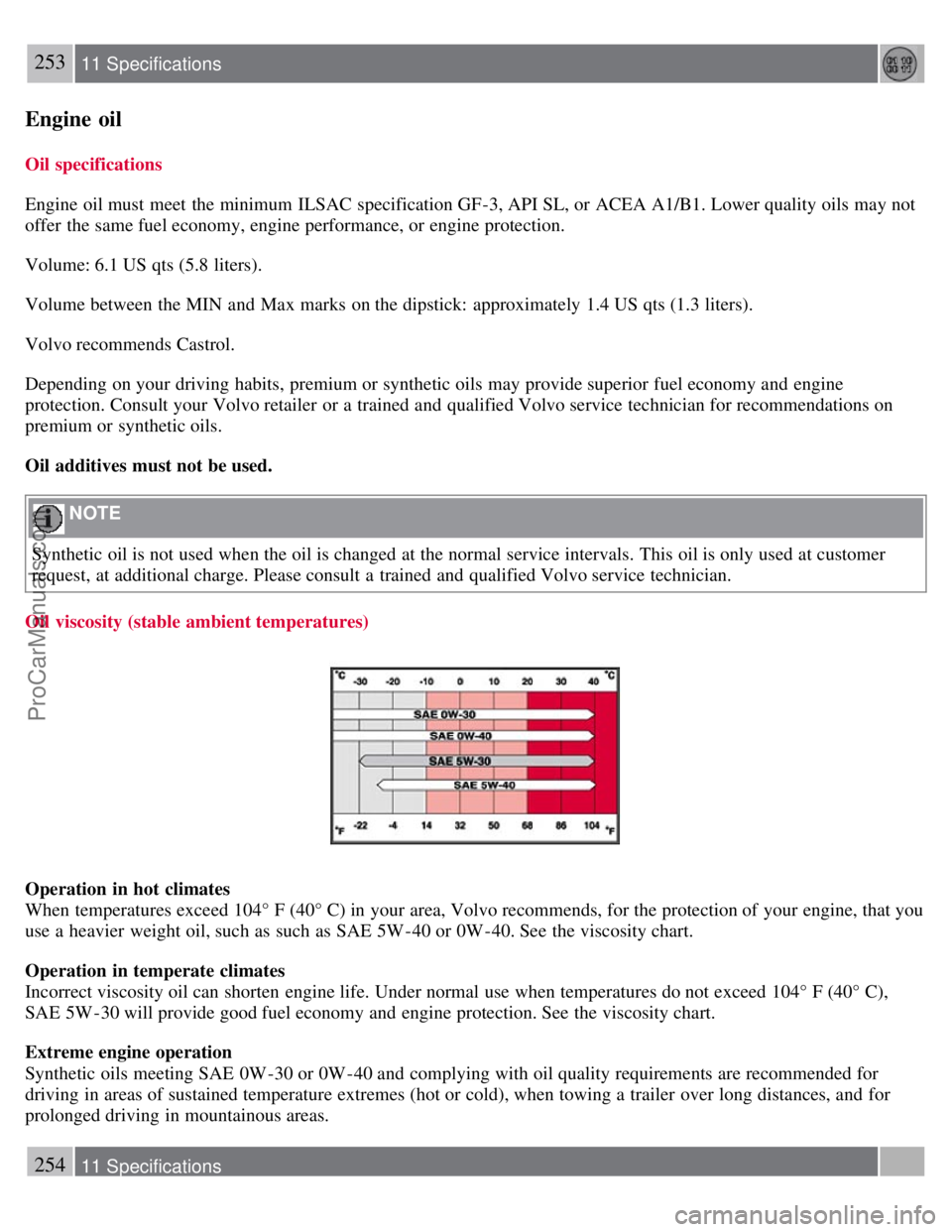
Oil viscosity (stable ambient temperatures)
Operation in hot climates
When temperatures exceed 104° F (40° C) in your area, Volvo recommends, for the protection of your engine, that you
use a heavier weight oil, such as such as SAE 5W -40 or 0W -40. See the viscosity chart.
Operation in temperate climates
Incorrect viscosity oil can shorten engine life. Under normal use when temperatures do not exceed 104° F (40° C),
SAE 5W -30 will provide good fuel economy and engine protection. See the viscosity chart.
Extreme engine operation
Synthetic oils meeting SAE 0W -30 or 0W -40 and complying with oil quality requirements are recommended for
driving in areas of sustained temperature extremes (hot or cold), when towing a trailer over long distances, and for
prolonged driving in mountainous areas.
254 11 Specifications
ProCarManuals.com
Page 228 of 239
Engine oil
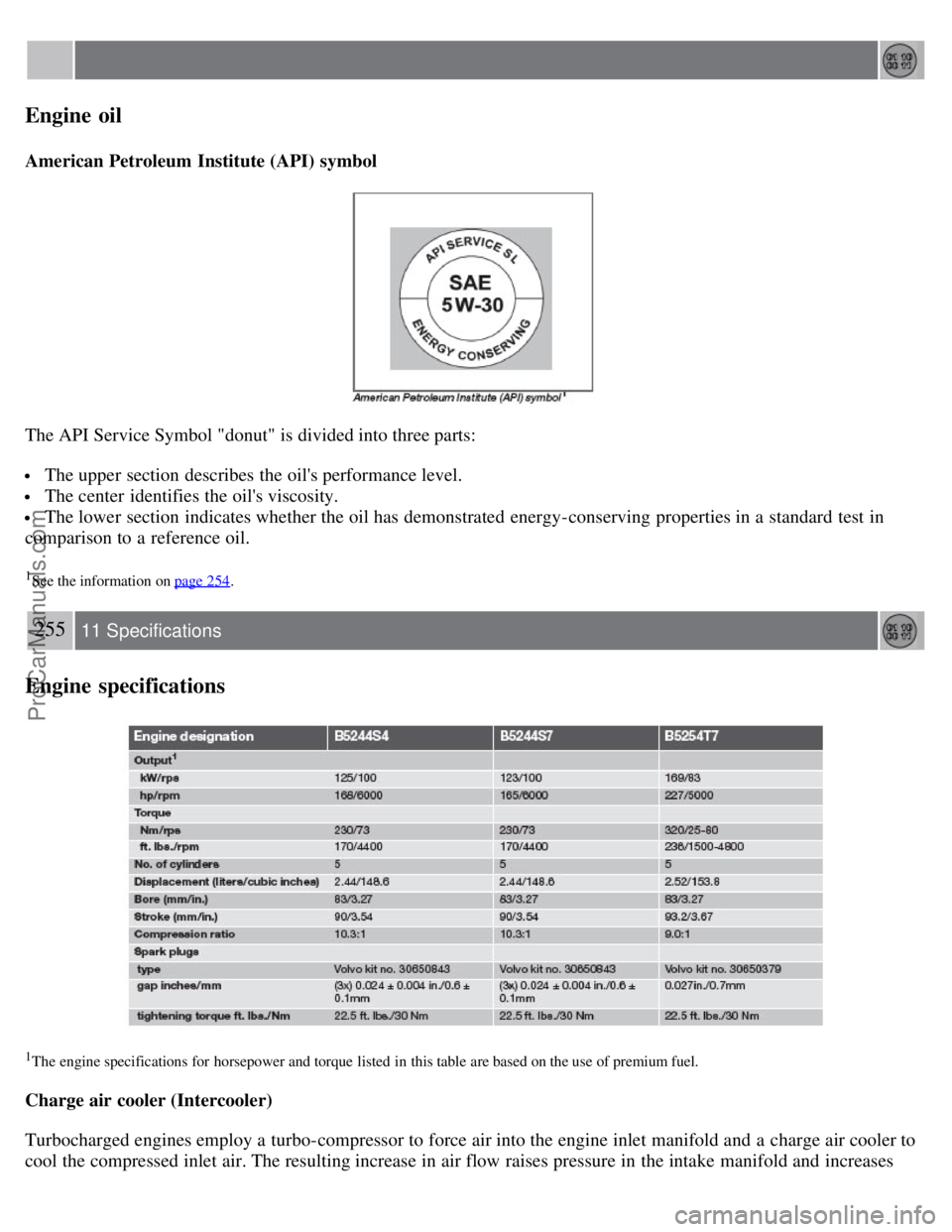
American Petroleum Institute (API) symbol
The API Service Symbol "donut" is divided into three parts:
The upper section describes the oil's performance level.
The center identifies the oil's viscosity.
The lower section indicates whether the oil has demonstrated energy-conserving properties in a standard test in
comparison to a reference oil.
1See the information on page 254.
255 11 Specifications
Engine specifications
1The engine specifications for horsepower and torque listed in this table are based on the use of premium fuel.
Charge air cooler (Intercooler)
Turbocharged engines employ a turbo-compressor to force air into the engine inlet manifold and a charge air cooler to
cool the compressed inlet air. The resulting increase in air flow raises pressure in the intake manifold and increases
ProCarManuals.com
Page 233 of 239
conserving electrical current130
maintenance209
replacement210
specifications256
Battery replacement, remote control114
Bi -Xenon® headlights59, 212, 214
Black box (Vehicle Event Data)200
Blind Spot Information System (BLIS)158 - 160
Booster cushion accessory40
Brake fluid207
Brake lights60
Bulbs
list of257
replacing211
C
Capacities, fluids252
Cargo area lighting, replacing218
Catalytic converter, three-way258
CD
changer241
changer menu (option)245
eject241
files with MP3 or WMA format242
menu245
pause242
player241
single player241
Central locking system, remote controls112
Changing oil205
Charge air cooler255
Child restraint anchors41, 42
Child restraints33
recalls and registration43
Child safety30
Child safety locks123
Clock setting77
Cold weather precautions129
Compact disc care243
Compass, rear view mirror (option)73
Convertible seats37
Coolant206
Courtesy lighting101
Crash mode29
Cup holders106
ProCarManuals.com
Page 234 of 239
D
Dimensions250
Disabling the passenger's side front airbag21
Display, instrument panel49
Door open warning55
Driving through water129
DSTC, stability system53
Dynamic Stability and Traction Control (DSTC)149
E
Economical driving128
Electrical current - conserving130
Electrical system256
Electronic Brake Force Distribution (EBD)148
Electronic Climate Control (ECC) - option92
Emergency brake lights60
Emission inspection readiness202
Engine oil
changing205
specifications253
Engine specifications255
Environment7
Equalizer, audio system233
F
Federal Clean Air Act200
Floor mats placing correctly137
FM1/FM2 menu245
Fog lights
front (option)60
rear53, 60
Front airbags18-19, 21
Front fog light, replacing216
Front seats, manual adjustment98
Front seats, power99
Fuel filler cap6
Fuel filler door6, 133
Fuel filler door, unlocking60
Fuel level warning light53
Fuel requirements132
Fuel system255
Fuses, replacing220
G
Gasoline131
Geartronic (manual shifting)141
General information86
ProCarManuals.com
Page 236 of 239
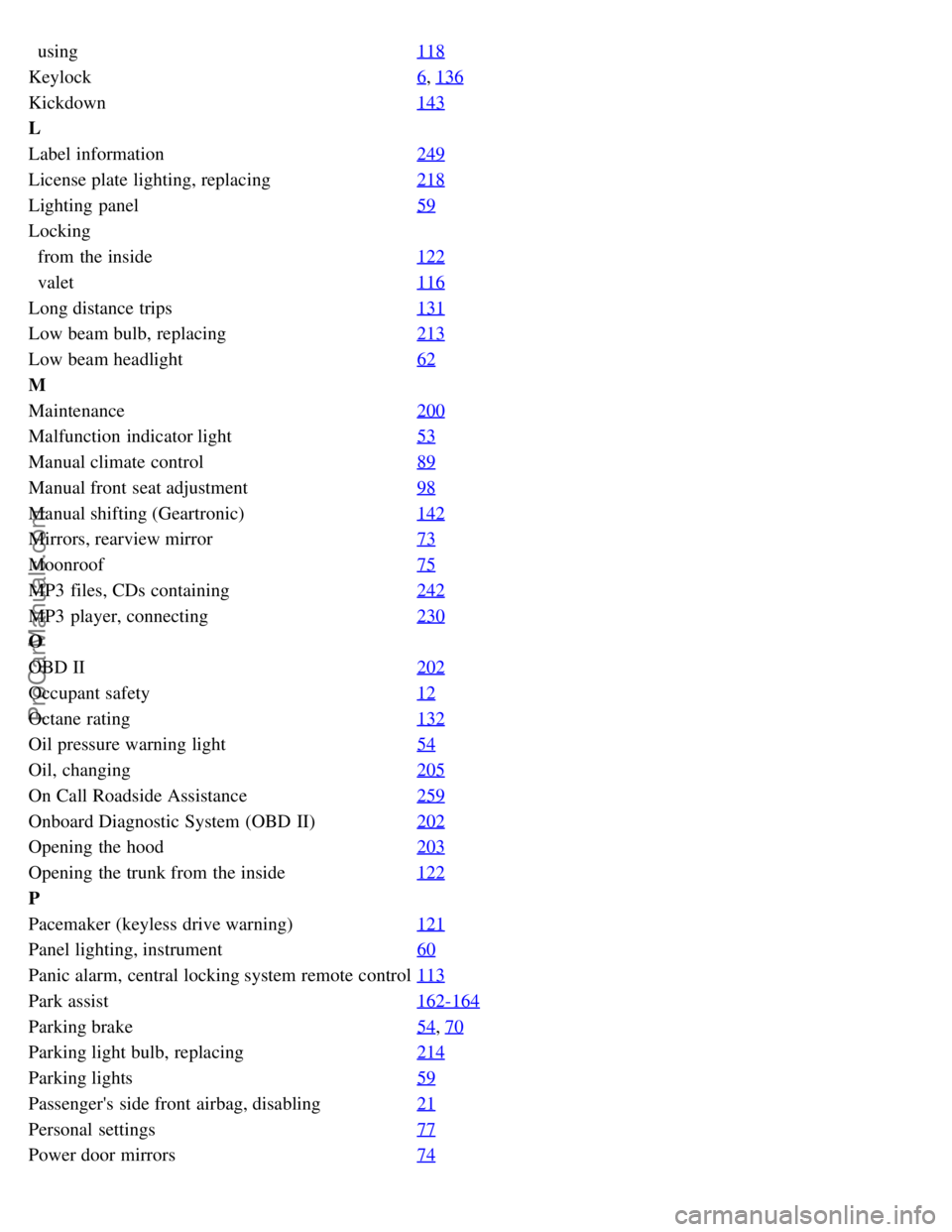
using118
Keylock6, 136
Kickdown143
L
Label information249
License plate lighting, replacing218
Lighting panel59
Locking
from the inside122
valet116
Long distance trips131
Low beam bulb, replacing213
Low beam headlight62
M
Maintenance200
Malfunction indicator light53
Manual climate control89
Manual front seat adjustment98
Manual shifting (Geartronic)142
Mirrors, rearview mirror73
Moonroof75
MP3 files, CDs containing242
MP3 player, connecting230
O
OBD II202
Occupant safety12
Octane rating132
Oil pressure warning light54
Oil, changing205
On Call Roadside Assistance259
Onboard Diagnostic System (OBD II)202
Opening the hood203
Opening the trunk from the inside122
P
Pacemaker (keyless drive warning)121
Panel lighting, instrument60
Panic alarm, central locking system remote control113
Park assist162-164
Parking brake54, 70
Parking light bulb, replacing214
Parking lights59
Passenger's side front airbag, disabling21
Personal settings77
Power door mirrors74
ProCarManuals.com