ABS VOLVO S40 2009 Owner´s Manual
[x] Cancel search | Manufacturer: VOLVO, Model Year: 2009, Model line: S40, Model: VOLVO S40 2009Pages: 286, PDF Size: 7.08 MB
Page 158 of 286
06 Starting and drivingTowing
06158
WARNING
•
Never allow a vehicle to be towed with-
out a driver behind the wheel of the
disabled vehicle.
•
Never remove the key from the ignition
while the vehicle is moving. The steering
wheel could lock, making it impossible
to steer the vehicle.
•
When the engine is not running, steering
resistance and the effort needed to
apply the brakes will be great.
•
Never attempt to tow a vehicle with a
dead battery at night.CAUTION
•
Check with state and local authorities
before attempting this type of towing,
as vehicles being towed are subject to
regulations regarding maximum towing
speed, length and type of towing
device, lighting, marker flags, etc.
•
Never attempt to push- or tow-start a
vehicle with a dead battery. This would
inject unburned fuel into the three-way
catalytic converter(s), causing over-
heating, backfiring, and damage, see
page 159 for instructions on jump star-
ting the vehicle.
Towing vehicles with front wheel driveVolvo recommends the use of flat bed equip-
ment for towing vehicles with front wheel drive.
If wheel lift equipment must be used, please
use extreme caution to help avoid damage to
the vehicle.
In this case, the vehicle should be towed with
the rear wheels on the ground if at all possible.
If it is absolutely necessary to tow the vehicle
with the front wheels on the ground, please
refer to the towing information on the previous
page.•
Sling-type equipment applied at the front
will damage radiator and air conditioning
lines.
•
It is equally important not to use sling-type
equipment at the rear or apply lifting equip-
ment inside the rear wheels; serious dam-
age to the rear axle may result.
•
If the vehicle is being towed on a flat bed
truck, the towing eyelets must not be used
to secure the vehicle on the flat bed. Con-
sult the tow truck operator.
WARNING
•
Remember that the power brakes and
power steering will not function when
engine is not running. The braking and
steering systems will function but the
brake pedal pressure required is
3 – 5 times above normal and greater
steering effort must be exerted.
•
The towing eyelets must not be used for
pulling the vehicle out of a ditch or for
any similar purpose involving severe
strain. Do not use the towing eyelets to
pull the vehicle up onto a flat bed tow
truck.
Page 160 of 286
06 Starting and drivingTowing a trailer
06160
General information•
Volvo recommends the use of Volvo trailer
hitches that are specially designed for the
vehicle.CAUTION
Models equipped with the B5244S7 engine
(engine code 39 , which is the 6th and
7th digits from the left in your vehicle's VIN
number, see page 262 for the location of
the VIN plate), may not be used to tow trail-
ers or vehicles of any kind. This could cause
damage to the vehicle's emission control
systems.Maximum trailer weights recommended by
Volvo are:•
Trailers without brakes: 1,540 lbs
(700 kg).
•
Trailers with brakes: 2,000 lbs (900 kg)
Observe the legal requirements of the
state/province in which the vehicles are
registered.
•
The maximum recommended hitch
tongue load is 165 lbs (75 kg).
•
All Volvo models are equipped with
energy-absorbing shock-mounted bump-
ers. Trailer hitch installation should not
interfere with the proper operation of this
bumper system.Trailer towing does not normally present any
particular problems, but take into considera-
tion:
•
Increase tire pressure to recommended
full. See the chapter "Wheels and tires."
•
When your vehicle is new, avoid towing
heavy trailers during the first 620 miles
(1,000 km).
•
Maximum speed when towing a trailer:
50 mph (80 km/h).
•
Engine and transmission are subject to
increased loads. Therefore, engine coolant
temperature should be closely watched
when driving in hot climates or hilly terrain.
Use a lower gear and turn off the air con-
ditioner if the temperature gauge needle
enters the red range.
•
If the automatic transmission begins to
overheat, a message will be displayed in
the information display.
•
Avoid overload and other abusive opera-
tion.
•
Hauling a trailer affects handling, durabil-
ity, and economy.
•
It is necessary to balance trailer brakes
with the towing vehicle brakes to provide a
safe stop (check and observe state/local
regulations).
•
Do not connect the trailer's brake system
directly to the vehicle's brake system.
•
More frequent vehicle maintenance is
required.
•
Remove the ball and drawbar assembly
when the hitch is not being used.
•
Volvo recommends the use of synthetic
engine oil when towing a trailer over long
distances or in mountainous areas.WARNING
•
Bumper-attached trailer hitches must
not be used on Volvos, nor should
safety chains be attached to the
bumper.
•
Trailer hitches attaching to the vehicle's
rear axle must not be used.
•
Never connect a trailer's hydraulic
brake system directly to the vehicle
brake system, nor a trailer's lighting
system directly to the vehicle lighting
system. Consult your nearest trained
and qualified Volvo service technician
for correct installation.
•
When towing a trailer, the trailer's safety
wire must be correctly fastened to the
hole or hook provided in the trailer hitch
on the vehicle. The safety wire should
never be fastened to or wound around
the drawbar ball.
Page 204 of 286
08 Car careWashing and cleaning the car
08204
CAUTION
Volvo does not recommend the use of long-
life or durable paint protection coatings,
some of which may claim to prevent pitting,
fading, oxidation, etc. These coatings have
not been tested by Volvo for compatibility
with your vehicle's clear coat. Some of them
may cause the clear coat to soften, crack,
or cloud. Damage caused by application of
paint protection coatings may not be cov-
ered under your vehicle's paint warranty.Upholstery careFabricClean with soapy water or a detergent. For
more difficult spots caused by oil, ice cream,
shoe polish, grease, etc., use a clothing/fabric
stain remover. Consult your Volvo retailer.Interior plastic componentsCleaning interior plastic components should
be done with a cleaning agent specially
designed for this purpose. Consult your Volvo
retailer.Alcantera™ suede-like materialSuede-like upholstery can be cleaned with a
soft cloth and mild soap solution.
Leather careVolvo's leather upholstery is manufactured
with a protectant to repel soiling. Over time,
sunlight, grease and dirt can break down the
protection. Staining, cracking, scuffing, and
fading can result.
Volvo offers an easy-to-use, non-greasy
leather care kit formulated to clean and beau-
tify your vehicle's leather, and to renew the
protective qualities of its finish. The cleaner
removes dirt and oil buildup. The light cream
protectant restores a barrier against soil and
sunlight.
Volvo also offers a special leather softener that
should be applied after the cleaner and pro-
tectant. It leaves leather soft and smooth, and
reduces friction between leather and other fin-
ishes in the vehicle.
Volvo recommends cleaning, protecting and
conditioning your vehicle's leather two to four
times a year. Ask your Volvo retailer about
Leather Care Kit 951 0251 and Leather Soft-
ener 943 7429.Cleaning leather upholstery1. Pour leather cleaner on a damp sponge
and squeeze it until the cleaner foams.
2. Apply the foam to the stain by moving the
sponge with circular movements.3. Dampen the stain thoroughly with the
sponge. Let the sponge absorb the stain,
do not rub.
4. Dry the stain with soft paper towels or a
towel, and allow the leather to dry com-
pletely.
Protecting leather upholstery1. Put a small amount of protectant cream on
a cloth and apply a thin coating of cream
to the upholstery with light circular move-
ments.
2. Allow the leather to dry for 20 minutes.
This will help the leather resist staining and
protect against sunlight's harmful UV rays.
Page 232 of 286
09 Maintenance and servicingFuses
09232
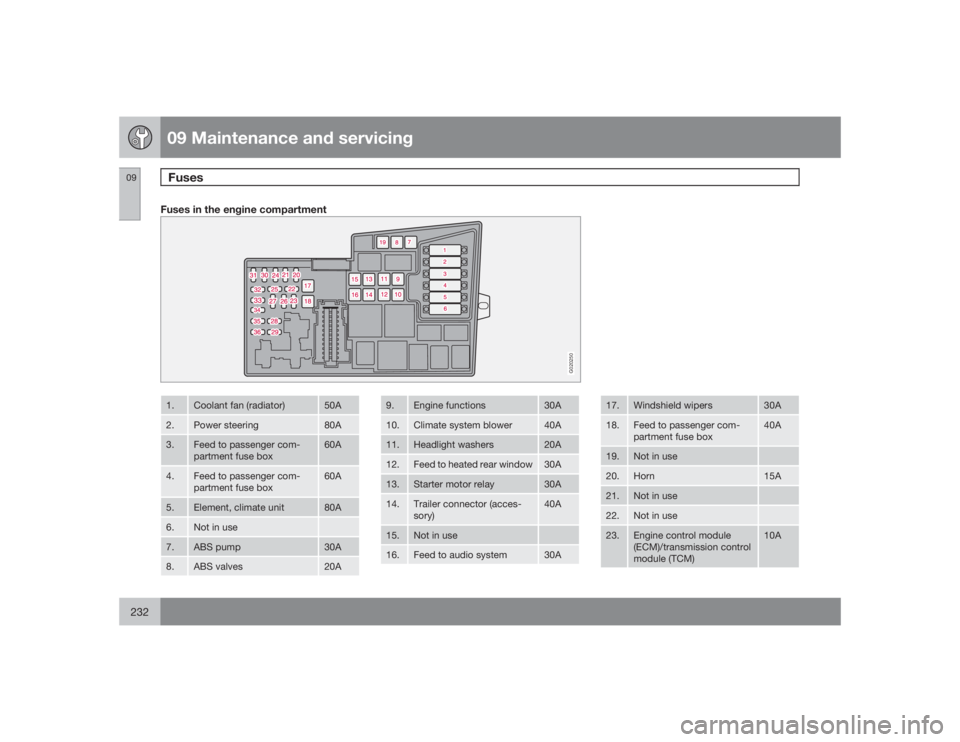
Fuses in the engine compartment
G020250
1.
Coolant fan (radiator)
50A
2.
Power steering
80A
3.
Feed to passenger com-
partment fuse box
60A
4.
Feed to passenger com-
partment fuse box
60A
5.
Element, climate unit
80A
6.
Not in use
7.
ABS pump
30A
8.
ABS valves
20A
9.
Engine functions
30A
10.
Climate system blower
40A
11.
Headlight washers
20A
12.
Feed to heated rear window
30A
13.
Starter motor relay
30A
14.
Trailer connector (acces-
sory)
40A
15.
Not in use
16.
Feed to audio system
30A
17.
Windshield wipers
30A
18.
Feed to passenger com-
partment fuse box
40A
19.
Not in use
20.
Horn
15A
21.
Not in use
22.
Not in use
23.
Engine control module
(ECM)/transmission control
module (TCM)
10A
Page 235 of 286
09 Maintenance and servicing
Fuses
09``235
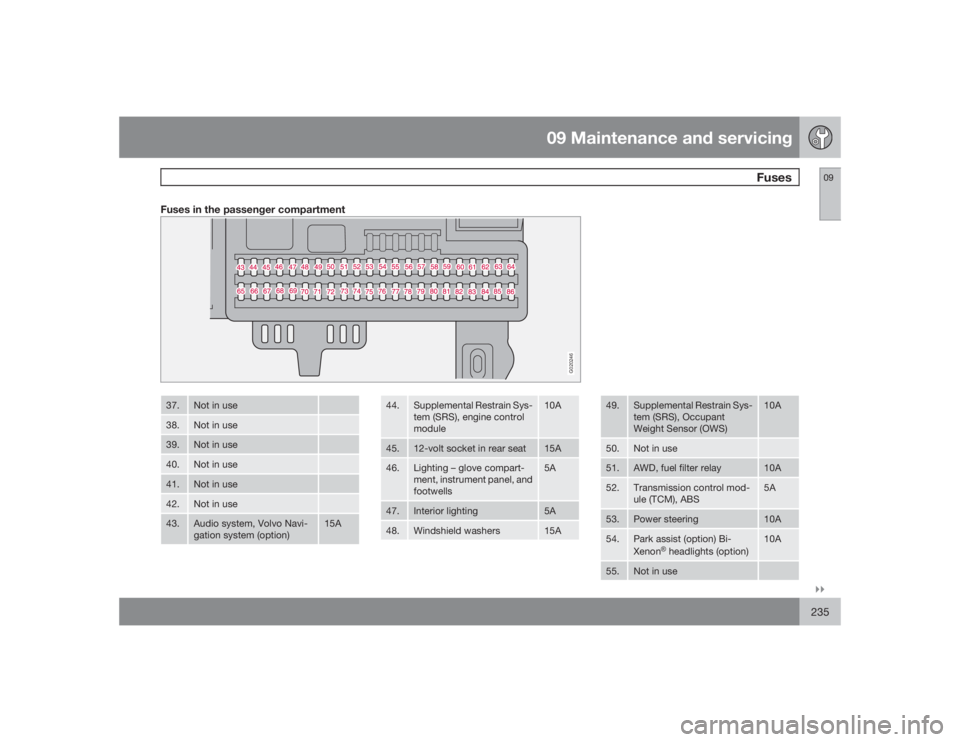
Fuses in the passenger compartment
G020246
37.
Not in use
38.
Not in use
39.
Not in use
40.
Not in use
41.
Not in use
42.
Not in use
43.
Audio system, Volvo Navi-
gation system (option)
15A
44.
Supplemental Restrain Sys-
tem (SRS), engine control
module
10A
45.
12-volt socket in rear seat
15A
46.
Lighting – glove compart-
ment, instrument panel, and
footwells
5A
47.
Interior lighting
5A
48.
Windshield washers
15A
49.
Supplemental Restrain Sys-
tem (SRS), Occupant
Weight Sensor (OWS)
10A
50.
Not in use
51.
AWD, fuel filter relay
10A
52.
Transmission control mod-
ule (TCM), ABS
5A
53.
Power steering
10A
54.
Park assist (option) Bi-
Xenon
Ÿ headlights (option)
10A
55.
Not in use
Page 276 of 286
12 Index
12276
1, 2, 3 ...12-volt sockets.......................................... 62AA/C (air conditioning)................................. 92
ABS (anti-lock brake system).................. 153
Active Bi-Xenon headlights........................ 63
Airbags
front...................................................... 22
inflatable curtain................................... 30
side impact........................................... 29
Airbag system............................................ 22
Air conditioning.......................................... 92
Air distribution table................................. 101
Air vents..................................................... 94
Alarm system........................................... 130
turning off sensors.............................. 131
All Wheel Drive......................................... 152
Anti-lock Brake System (ABS)................. 153
Approach lighting....................................... 84
Audio files................................................ 250Audio system
audio functions................................... 240
automatic sound control..................... 243
AUX port............................................. 240
CD changer......................................... 249
CD player/changer.............................. 249
compact disc care.............................. 251
Dolby Surround Pro Logic II............... 243
equalizer............................................. 243
menu settings..................................... 253
radio functions.................................... 244
selecting a sound source.................... 240
Sirius satellite radio............................ 245
sound settings.................................... 242
steering wheel keypad........................ 241
storing radio stations.......................... 244
subwoofer...........................................242
USB/iPOD connector.......................... 241
Auto-dim rearview mirror........................... 78
Autolock..................................................... 83
Automatic locking retractor....................... 36
Automatic sound control.........................243
Automatic transmission........................... 149
kickdown............................................ 150
oil........................................................ 267
shiftlock override................................ 151
Automatic transmission - Geartronic....... 150AUX port.................................................. 240
Axle weight......................................183, 265
BBackrest, rear seat, folding...................... 113
Bass......................................................... 242
Battery
maintenance....................................... 221
remote control, replacing................... 120
specifications...................................... 272
warning symbols................................. 221
Battery – replacing................................... 221
Bi-Xenon headlights.................................. 63
Black Box (Vehicle Event Data)............... 210
Blind Spot Information System (BLIS)..... 164
Booster cushion
accessory............................................. 42
Brake fluid........................................ 219, 267
Brake lights................................................ 64
Brake system
anti-lock brakes (ABS)........................ 153
emergency brake assistance.............. 154