sensor VOLVO S40 2009 Owner´s Manual
[x] Cancel search | Manufacturer: VOLVO, Model Year: 2009, Model line: S40, Model: VOLVO S40 2009Pages: 286, PDF Size: 7.08 MB
Page 34 of 286
01 SafetyCrash mode
0134
Driving after a collision
G026363
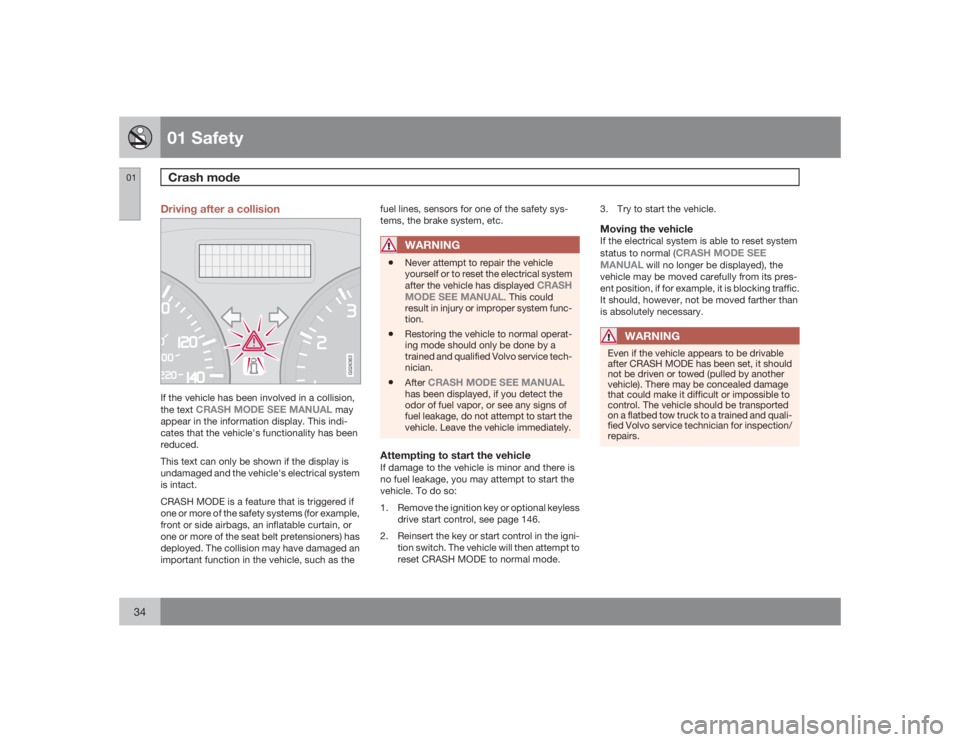
If the vehicle has been involved in a collision,
the text
CRASH MODE SEE MANUAL
may
appear in the information display. This indi-
cates that the vehicle's functionality has been
reduced.
This text can only be shown if the display is
undamaged and the vehicle's electrical system
is intact.
CRASH MODE is a feature that is triggered if
one or more of the safety systems (for example,
front or side airbags, an inflatable curtain, or
one or more of the seat belt pretensioners) has
deployed. The collision may have damaged an
important function in the vehicle, such as thefuel lines, sensors for one of the safety sys-
tems, the brake system, etc.
WARNING
•
Never attempt to repair the vehicle
yourself or to reset the electrical system
after the vehicle has displayed
CRASH
MODE SEE MANUAL
. This could
result in injury or improper system func-
tion.
•
Restoring the vehicle to normal operat-
ing mode should only be done by a
trained and qualified Volvo service tech-
nician.
•
After
CRASH MODE SEE MANUAL
has been displayed, if you detect the
odor of fuel vapor, or see any signs of
fuel leakage, do not attempt to start the
vehicle. Leave the vehicle immediately.
Attempting to start the vehicleIf damage to the vehicle is minor and there is
no fuel leakage, you may attempt to start the
vehicle. To do so:
1. Remove the ignition key or optional keyless
drive start control, see page 146.
2. Reinsert the key or start control in the igni-
tion switch. The vehicle will then attempt to
reset CRASH MODE to normal mode.3. Try to start the vehicle.
Moving the vehicleIf the electrical system is able to reset system
status to normal (
CRASH MODE SEE
MANUAL
will no longer be displayed), the
vehicle may be moved carefully from its pres-
ent position, if for example, it is blocking traffic.
It should, however, not be moved farther than
is absolutely necessary.
WARNING
Even if the vehicle appears to be drivable
after CRASH MODE has been set, it should
not be driven or towed (pulled by another
vehicle). There may be concealed damage
that could make it difficult or impossible to
control. The vehicle should be transported
on a flatbed tow truck to a trained and quali-
fied Volvo service technician for inspection/
repairs.
Page 37 of 286
01 Safety
Child restraint systems
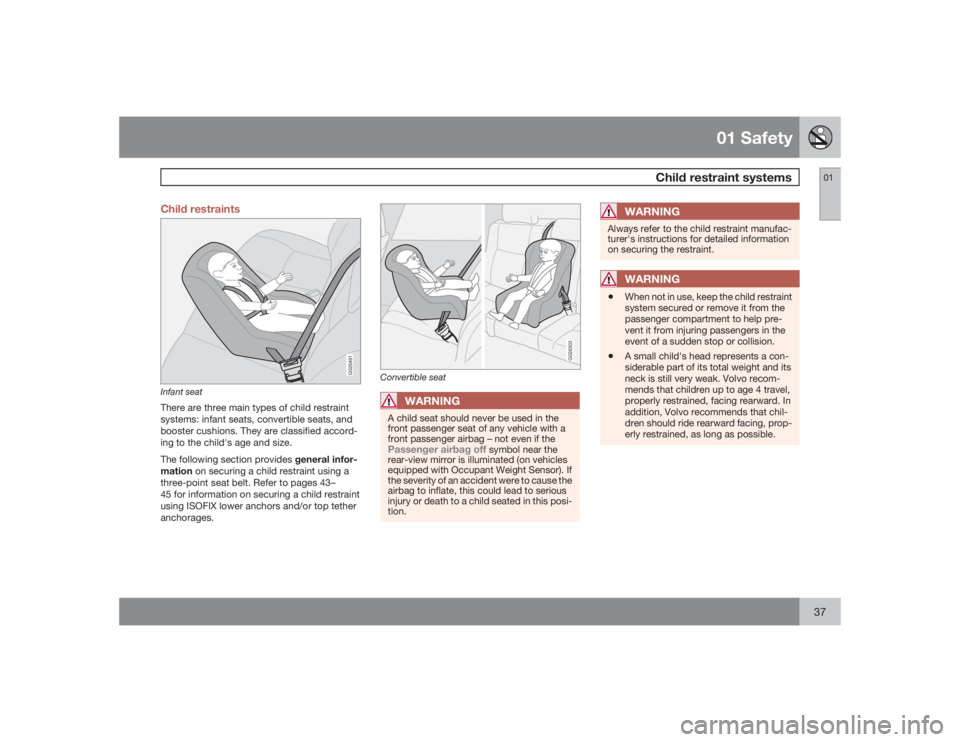
0137 Child restraints
G026491
Infant seatThere are three main types of child restraint
systems: infant seats, convertible seats, and
booster cushions. They are classified accord-
ing to the child's age and size.
The following section provides general infor-
mation on securing a child restraint using a
three-point seat belt. Refer to pages 43–
45 for information on securing a child restraint
using ISOFIX lower anchors and/or top tether
anchorages.
G026503
Convertible seat
WARNING
A child seat should never be used in the
front passenger seat of any vehicle with a
front passenger airbag – not even if thePassenger airbag off
symbol near the
rear-view mirror is illuminated (on vehicles
equipped with Occupant Weight Sensor). If
the severity of an accident were to cause the
airbag to inflate, this could lead to serious
injury or death to a child seated in this posi-
tion.
WARNING
Always refer to the child restraint manufac-
turer's instructions for detailed information
on securing the restraint.
WARNING
•
When not in use, keep the child restraint
system secured or remove it from the
passenger compartment to help pre-
vent it from injuring passengers in the
event of a sudden stop or collision.
•
A small child's head represents a con-
siderable part of its total weight and its
neck is still very weak. Volvo recom-
mends that children up to age 4 travel,
properly restrained, facing rearward. In
addition, Volvo recommends that chil-
dren should ride rearward facing, prop-
erly restrained, as long as possible.
Page 38 of 286
01 SafetyInfant seats
0138
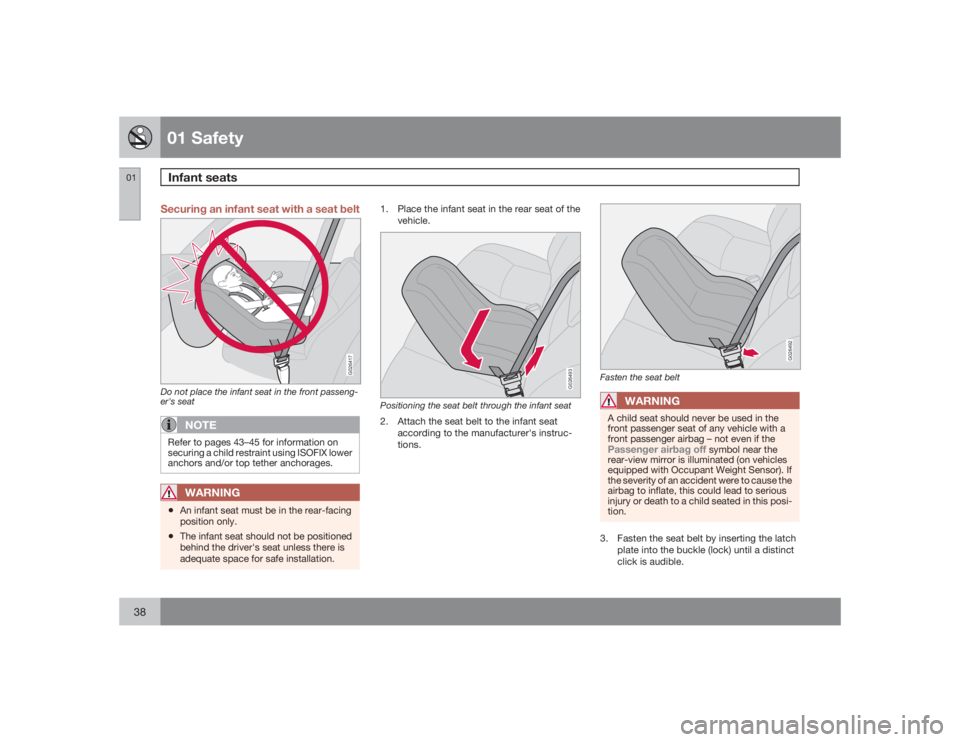
Securing an infant seat with a seat belt
G026417
Do not place the infant seat in the front passeng-
er's seat
NOTE
Refer to pages 43–45 for information on
securing a child restraint using ISOFIX lower
anchors and/or top tether anchorages.
WARNING
•An infant seat must be in the rear-facing
position only.•The infant seat should not be positioned
behind the driver's seat unless there is
adequate space for safe installation.
1. Place the infant seat in the rear seat of the
vehicle.
G026493
Positioning the seat belt through the infant seat2. Attach the seat belt to the infant seat
according to the manufacturer's instruc-
tions.
G026492
Fasten the seat belt
WARNING
A child seat should never be used in the
front passenger seat of any vehicle with a
front passenger airbag – not even if thePassenger airbag off
symbol near the
rear-view mirror is illuminated (on vehicles
equipped with Occupant Weight Sensor). If
the severity of an accident were to cause the
airbag to inflate, this could lead to serious
injury or death to a child seated in this posi-
tion.
3. Fasten the seat belt by inserting the latch
plate into the buckle (lock) until a distinct
click is audible.
Page 42 of 286
01 SafetyBooster cushions
0142
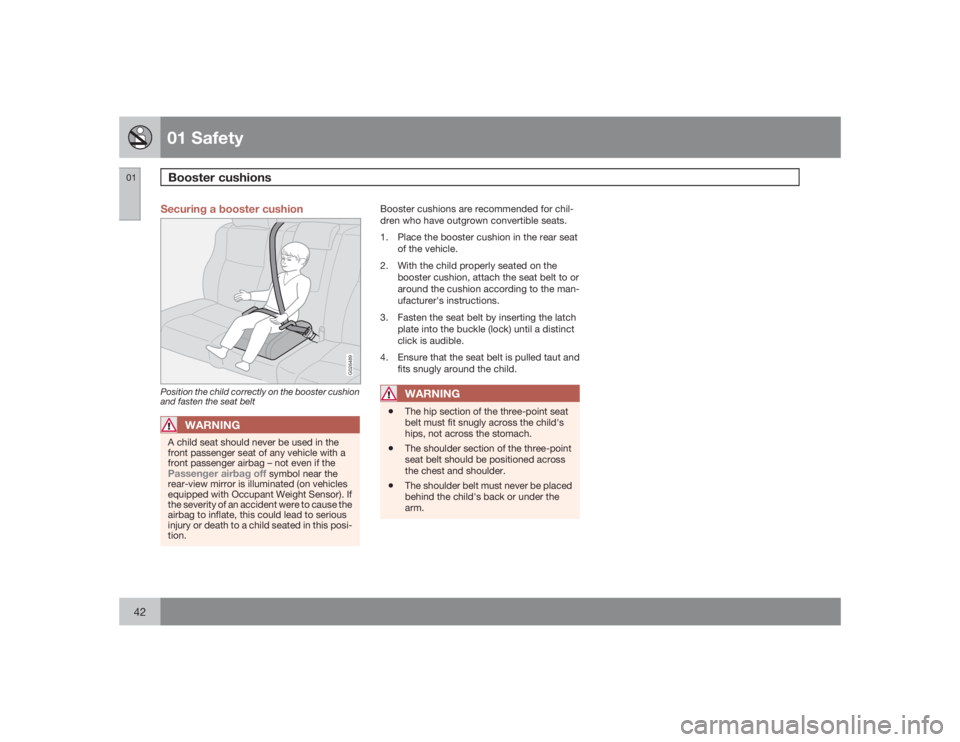
Securing a booster cushion
G026489
Position the child correctly on the booster cushion
and fasten the seat belt
WARNING
A child seat should never be used in the
front passenger seat of any vehicle with a
front passenger airbag – not even if thePassenger airbag off
symbol near the
rear-view mirror is illuminated (on vehicles
equipped with Occupant Weight Sensor). If
the severity of an accident were to cause the
airbag to inflate, this could lead to serious
injury or death to a child seated in this posi-
tion.
Booster cushions are recommended for chil-
dren who have outgrown convertible seats.
1. Place the booster cushion in the rear seat
of the vehicle.
2. With the child properly seated on the
booster cushion, attach the seat belt to or
around the cushion according to the man-
ufacturer's instructions.
3. Fasten the seat belt by inserting the latch
plate into the buckle (lock) until a distinct
click is audible.
4. Ensure that the seat belt is pulled taut and
fits snugly around the child.
WARNING
•
The hip section of the three-point seat
belt must fit snugly across the child's
hips, not across the stomach.
•
The shoulder section of the three-point
seat belt should be positioned across
the chest and shoulder.
•
The shoulder belt must never be placed
behind the child's back or under the
arm.
Page 51 of 286
02 Instruments and controls
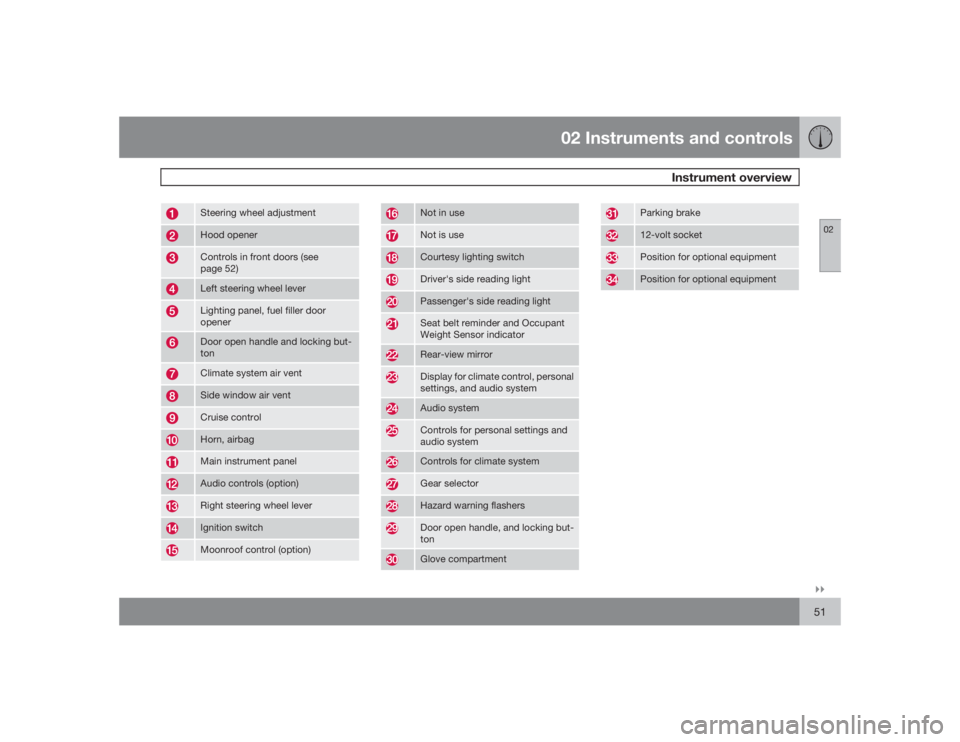
Instrument overview
02``51
Steering wheel adjustmentHood openerControls in front doors (see
page 52)Left steering wheel leverLighting panel, fuel filler door
openerDoor open handle and locking but-
tonClimate system air ventSide window air ventCruise controlHorn, airbagMain instrument panelAudio controls (option)Right steering wheel leverIgnition switchMoonroof control (option)
Not in useNot is useCourtesy lighting switchDriver's side reading lightPassenger's side reading lightSeat belt reminder and Occupant
Weight Sensor indicatorRear-view mirrorDisplay for climate control, personal
settings, and audio systemAudio systemControls for personal settings and
audio systemControls for climate systemGear selectorHazard warning flashersDoor open handle, and locking but-
tonGlove compartment
Parking brake12-volt socketPosition for optional equipmentPosition for optional equipment
Page 54 of 286
02 Instruments and controlsInstrument panel
0254
odometer, trip odometers, optional rain
sensor, and cruise control.Trip odometer reset button – The trip
odometers are used to measure short dis-
tances. Press the button briefly to switch
between the odometer for the car's total
mileage and the two trip odometers, T1
and T2. A long press (more than 2 seconds)
resets the currently selected trip odometer.Temperature gauge – The gauge indicates
the temperature of the engine cooling sys-
tem. If the temperature is abnormally high
and the needle enters the red zone, a mes-
sage is shown in the display. Bear in mind
that auxiliary lamps in front of the air intake
reduce the cooling capacity at high outside
temperatures and high engine loads.Indicator and warning symbols
Page 72 of 286
02 Instruments and controlsRight-side steering wheel lever
0272
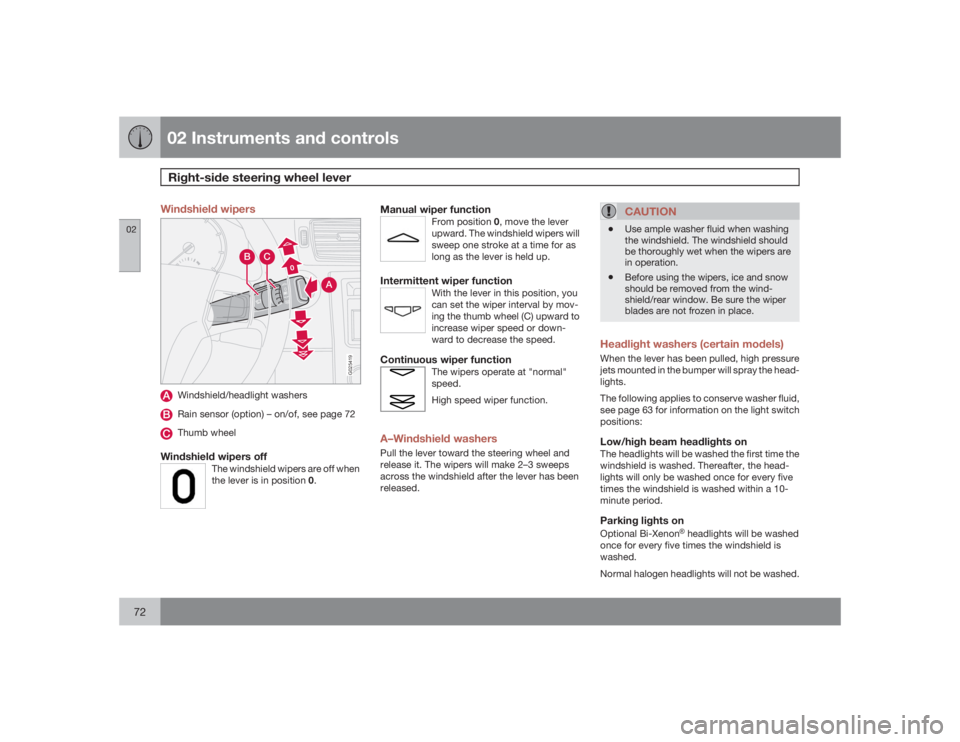
Windshield wipers
00
A
C
B
G025419
Windshield/headlight washersRain sensor (option) – on/of, see page 72Thumb wheel
Windshield wipers off
The windshield wipers are off when
the lever is in position 0.
Manual wiper function
From position 0, move the lever
upward. The windshield wipers will
sweep one stroke at a time for as
long as the lever is held up.
Intermittent wiper function
With the lever in this position, you
can set the wiper interval by mov-
ing the thumb wheel (C) upward to
increase wiper speed or down-
ward to decrease the speed.
Continuous wiper function
The wipers operate at "normal"
speed.
High speed wiper function.
A–Windshield washersPull the lever toward the steering wheel and
release it. The wipers will make 2–3 sweeps
across the windshield after the lever has been
released.
CAUTION
•
Use ample washer fluid when washing
the windshield. The windshield should
be thoroughly wet when the wipers are
in operation.
•
Before using the wipers, ice and snow
should be removed from the wind-
shield/rear window. Be sure the wiper
blades are not frozen in place.
Headlight washers (certain models)When the lever has been pulled, high pressure
jets mounted in the bumper will spray the head-
lights.
The following applies to conserve washer fluid,
see page 63 for information on the light switch
positions:Low/high beam headlights onThe headlights will be washed the first time the
windshield is washed. Thereafter, the head-
lights will only be washed once for every five
times the windshield is washed within a 10-
minute period.Parking lights onOptional Bi-Xenon
Ÿ headlights will be washed
once for every five times the windshield is
washed.
Normal halogen headlights will not be washed.
Page 73 of 286
02 Instruments and controls
Right-side steering wheel lever
0273 B – Rain sensor (option)
G026422
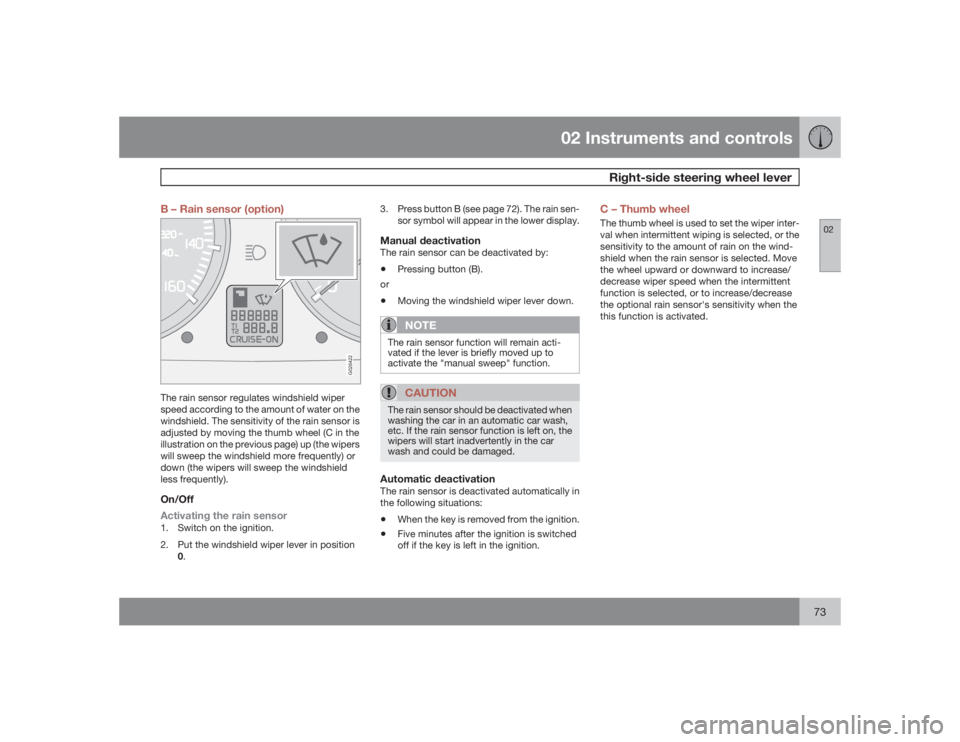
The rain sensor regulates windshield wiper
speed according to the amount of water on the
windshield. The sensitivity of the rain sensor is
adjusted by moving the thumb wheel (C in the
illustration on the previous page) up (the wipers
will sweep the windshield more frequently) or
down (the wipers will sweep the windshield
less frequently).On/Off
Activating the rain sensor1. Switch on the ignition.
2. Put the windshield wiper lever in position
0.3. Press button B (see page 72). The rain sen-
sor symbol will appear in the lower display.
Manual deactivationThe rain sensor can be deactivated by:•
Pressing button (B).
or
•
Moving the windshield wiper lever down.NOTE
The rain sensor function will remain acti-
vated if the lever is briefly moved up to
activate the "manual sweep" function.
CAUTION
The rain sensor should be deactivated when
washing the car in an automatic car wash,
etc. If the rain sensor function is left on, the
wipers will start inadvertently in the car
wash and could be damaged.Automatic deactivationThe rain sensor is deactivated automatically in
the following situations:•
When the key is removed from the ignition.
•
Five minutes after the ignition is switched
off if the key is left in the ignition.
C – Thumb wheelThe thumb wheel is used to set the wiper inter-
val when intermittent wiping is selected, or the
sensitivity to the amount of rain on the wind-
shield when the rain sensor is selected. Move
the wheel upward or downward to increase/
decrease wiper speed when the intermittent
function is selected, or to increase/decrease
the optional rain sensor's sensitivity when the
this function is activated.
Page 78 of 286
02 Instruments and controlsMirrors
0278
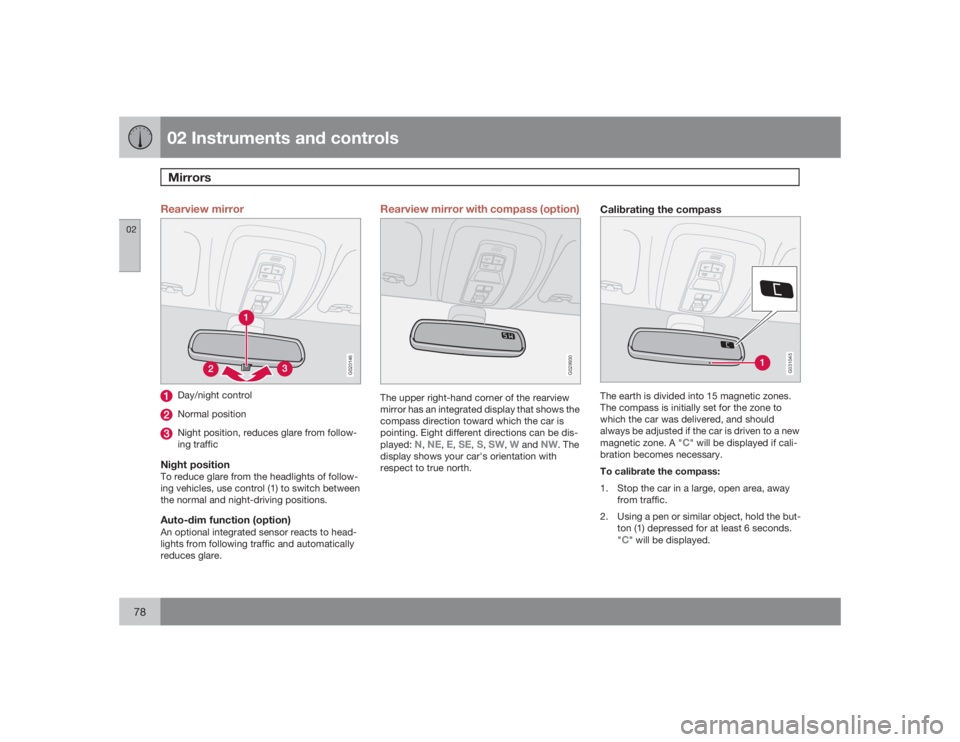
Rearview mirror
G020146
Day/night controlNormal positionNight position, reduces glare from follow-
ing traffic
Night positionTo reduce glare from the headlights of follow-
ing vehicles, use control (1) to switch between
the normal and night-driving positions.Auto-dim function (option)An optional integrated sensor reacts to head-
lights from following traffic and automatically
reduces glare.
Rearview mirror with compass (option)
G029930
The upper right-hand corner of the rearview
mirror has an integrated display that shows the
compass direction toward which the car is
pointing. Eight different directions can be dis-
played:
N,NE
,E,SE
,S,SW
,W and
NW
. The
display shows your car's orientation with
respect to true north.
Calibrating the compass
G031045
The earth is divided into 15 magnetic zones.
The compass is initially set for the zone to
which the car was delivered, and should
always be adjusted if the car is driven to a new
magnetic zone. A "
C" will be displayed if cali-
bration becomes necessary.
To calibrate the compass:
1. Stop the car in a large, open area, away
from traffic.
2. Using a pen or similar object, hold the but-
ton (1) depressed for at least 6 seconds.
"
C" will be displayed.
Page 84 of 286
02 Instruments and controlsPersonal settings
0284
•
Global (All doors) – unlocks all doors and
the trunk with one press on the remote
control.
•
Two Step (Two-stage unlocking) – This
alternative unlocks the driver's door with
one press on the remote control. A second
press unlocks the passenger's door and
the trunk
Automatically folding the door mirrorsThe setting makes it possible to automatically
fold the door mirrors in or out when the vehicle
is locked or unlocked. See page 79.Operating side windowsThe following alternative can be selected for
opening all side windows at the same time by
pressing and holding the Unlock switch in
either of the front doors (see page 127 for
additional information)
1
NOTE
The ignition key must be in position I or
higher (see page 143) before all side win-
dows can be opened using the switches in
the front doors.•
Auto open all windows On/Off
Temporarily turning off the alarm
sensor(s)The alarm sensors can be temporarily turned
off (if, for example, a person or a pet remains
in the vehicle when the doors are locked from
outside with the remote control). There are two
alternatives:
Activate once
and
Ask on exit
,
see page 118 and 130 .
Approach lightingThis alternative determines the length of time
for which the car's lights will remain on when
the Approach light button on the central lock-
ing system's remote control is pressed. Inter-
vals of 30/60/90 seconds may be selected, see
teh section "Remote control functions" for
more information.Home safe lightingThis alternative determines the length of time
for which the car's lights will remain on when
the high beam lever on the steering column is
pulled toward the wheel with the ignition
switched off. Intervals of 30/60/90 seconds
may be selected, see page 66 for information
on using this function.
Information•
VIN number – The VIN (Vehicle Identifica-
tion Number) is the car's unique identity
number.
•
Number of Keys – the number of keys reg-
istered for the car is displayed here.
Climate functions•
Blower speed in AUTO mode – the blower
speed can be set to AUTO mode in models
equipped with ECC. Choose between
"Low", "Normal" and "High".
•
Timer for recirculation – when the timer is
active, the air recirculates in the car for 3–
12 minutes depending on the ambient tem-
perature. Select On/Off depending on
whether the recirculation timer is to be
active or not.
Keyless locking and unlocking (option as
available)The following alternatives can be selected for
locking and unlocking the doors and trunk:•
All doors – all doors are locked or unlocked
at the same time.
•
Doors on the same side – front and rear
doors on the same side are unlocked
together.
1This menu alternative also makes it possible to open all side windows by pressing and holding the Unlock button on the remote control for several seconds.