check engine VOLVO S40 2009 Owner´s Manual
[x] Cancel search | Manufacturer: VOLVO, Model Year: 2009, Model line: S40, Model: VOLVO S40 2009Pages: 286, PDF Size: 7.08 MB
Page 160 of 286
06 Starting and drivingTowing a trailer
06160
General information•
Volvo recommends the use of Volvo trailer
hitches that are specially designed for the
vehicle.CAUTION
Models equipped with the B5244S7 engine
(engine code 39 , which is the 6th and
7th digits from the left in your vehicle's VIN
number, see page 262 for the location of
the VIN plate), may not be used to tow trail-
ers or vehicles of any kind. This could cause
damage to the vehicle's emission control
systems.Maximum trailer weights recommended by
Volvo are:•
Trailers without brakes: 1,540 lbs
(700 kg).
•
Trailers with brakes: 2,000 lbs (900 kg)
Observe the legal requirements of the
state/province in which the vehicles are
registered.
•
The maximum recommended hitch
tongue load is 165 lbs (75 kg).
•
All Volvo models are equipped with
energy-absorbing shock-mounted bump-
ers. Trailer hitch installation should not
interfere with the proper operation of this
bumper system.Trailer towing does not normally present any
particular problems, but take into considera-
tion:
•
Increase tire pressure to recommended
full. See the chapter "Wheels and tires."
•
When your vehicle is new, avoid towing
heavy trailers during the first 620 miles
(1,000 km).
•
Maximum speed when towing a trailer:
50 mph (80 km/h).
•
Engine and transmission are subject to
increased loads. Therefore, engine coolant
temperature should be closely watched
when driving in hot climates or hilly terrain.
Use a lower gear and turn off the air con-
ditioner if the temperature gauge needle
enters the red range.
•
If the automatic transmission begins to
overheat, a message will be displayed in
the information display.
•
Avoid overload and other abusive opera-
tion.
•
Hauling a trailer affects handling, durabil-
ity, and economy.
•
It is necessary to balance trailer brakes
with the towing vehicle brakes to provide a
safe stop (check and observe state/local
regulations).
•
Do not connect the trailer's brake system
directly to the vehicle's brake system.
•
More frequent vehicle maintenance is
required.
•
Remove the ball and drawbar assembly
when the hitch is not being used.
•
Volvo recommends the use of synthetic
engine oil when towing a trailer over long
distances or in mountainous areas.WARNING
•
Bumper-attached trailer hitches must
not be used on Volvos, nor should
safety chains be attached to the
bumper.
•
Trailer hitches attaching to the vehicle's
rear axle must not be used.
•
Never connect a trailer's hydraulic
brake system directly to the vehicle
brake system, nor a trailer's lighting
system directly to the vehicle lighting
system. Consult your nearest trained
and qualified Volvo service technician
for correct installation.
•
When towing a trailer, the trailer's safety
wire must be correctly fastened to the
hole or hook provided in the trailer hitch
on the vehicle. The safety wire should
never be fastened to or wound around
the drawbar ball.
Page 163 of 286
06 Starting and driving
Transporting loads
06
163 Loading the vehicle
Your vehicle's load-carrying capacity is affec-
ted by factors such as:•
the number of passengers
•
tire inflation
•
the amount of optional or accessory equip-
ment installed
•
the amount of cargo.
See the chapter "Wheels and tires" for more
detailed information.
Before loading the car, turn off the engine, and
apply the parking brake when loading or
unloading long objects. The gear selector can
be inadvertently knocked out of position by
long cargo, causing the car to move.
Keep the following in mind when
loading the vehicle:•
Load objects in the trunk against the rear
seat backrest.
•
Load heavy cargo as low as possible.
•
Center wide loads.
•
Secure all cargo with restraining straps
anchored to the load securing eyelets.
•
Cover sharp edges on the load.
•
Seats can be folded down and head
restraints removed to extend the cargo
compartment, see page 113.
WARNING
•
Remember that an object weighing
44 lbs (20 kg) produces a force of
2,200 lbs (1,000 kg) in a head-on colli-
sion at 30 mph (50 km/h)!
•
When the rear backrest(s) are folded
down, the vehicle should not be loaded
to a level higher than 2 in. (5 cm) below
the upper edge of the rear side win-
dows. Objects placed higher than this
level could impede the function of the
Volvo Inflatable Curtain.
Load carriers (accessory)Load carriers are available as Volvo accesso-
ries. Follow the installation instructions sup-
plied with the load carriers.
Observe the following points when using load
carriers:•
To avoid damaging your car and to achieve
maximum safety when driving, we recom-
mend using the load carriers that Volvo has
developed especially for your car.
•
Volvo-approved removable roof racks are
designed to carry the maximum allowable
roof load for this vehicle: 165 lbs (75 kg).
For Non-Volvo roof racks, check the man-
ufacturer's weight limits for the rack.
•
Never exceed the rack manufacturer's
weigh limits and never exceed the maxi-
mum rated roof load of 165 lbs (75 kg).
•
Avoid single-point loads. Distribute loads
evenly.
•
Place heavier cargo at the bottom of the
load.
•
Secure the cargo correctly with appropri-
ate tie-down equipment.
•
Check periodically that the load carriers
and load are properly secured.
•
Remember that the car's center of gravity
and handling change when you carry a
load on the roof.
•
The car's wind resistance and fuel con-
sumption will increase with the size of the
load.
•
Drive smoothly. Avoid rapid starts, fast
cornering and hard braking.
Page 196 of 286
07 Wheels and tiresTire Sealing System
07196
NOTE
•
After use, the sealing compound bottle,
the hose, and certain other system
components must be replaced. Please
consult your Volvo retailer for replace-
ment parts.
•
If the sealing compound bottle’s expi-
ration date has passed, please take it to
a Volvo retailer or a recycling station
that can properly dispose of harmful
substances.
Inflating tiresThe tire sealing system can be used to inflate
the tires. To do so:
1. Park the car in a safe place.
2. The compressor should be switched off.
Ensure that the on/off switch is in posi-
tion0 (the 0 side of the switch should be
pressed down).
3. Take out the electrical wire and hose.
4. Remove the valve cap from the tire’s infla-
tion valve and screw the hose connector
onto the valve as tightly as possible by
hand.
5. Connect the electrical wire to the nearest
12-volt socket in the vehicle.6. Start the vehicle’s engine.
WARNING
•The vehicle’s engine should be running
when the tire sealing system is used to
avoid battery drain. Therefore, be sure
the vehicle is parked in a well ventilated
place, or outdoors, before using the sys-
tem.•Children should never be left unattended
in the vehicle when the engine is running.
7. Check the tire’s inflation pressure on the
gauge. Switch off the compressor briefly to
get a clear reading from the pressure
gauge.
8. Refer to the tire inflation tables for the cor-
rect inflation pressure. If the tire needs to
be inflated, start the tire sealing system’s
compressor (press the on/off switch to
position I). If necessary, release air from the
tire by turning the air release knob coun-
terclockwise.
CAUTION
The compressor should not be used for
more than 10 minutes at a time to avoid
overheating.
9. Turn off the compressor (press the on/off
switch to position 0) when the correct infla-
tion pressure has been reached.
10. Unscrew the hose from the tire’s inflation
valve and reinstall the valve cap.
11. Disconnect the electrical wire from the
12-volt socket.
Page 212 of 286
09 Maintenance and servicingMaintaining your car
09212
Owner maintenancePeriodic maintenance requirements and inter-
vals are described in your vehicle's Warranty
and Service Records Information booklet.
The following points can be carried out
between the normally scheduled maintenance
services.Each time the car is refueled:•
Check the engine oil level.
•
Clean the windshield, windshield wipers,
headlights, and taillights.
Monthly:•
Check cold tire pressure in all tires. Inspect
the tires for wear.
•
Check that engine coolant and other fluid
levels are between the indicated "min" and
"max" markings.
•
Clean interior glass surfaces with a glass
cleaner and soft paper towels.
•
Wipe driver information displays with a soft
cloth.
•
Visually inspect battery terminals for cor-
rosion. Corrosion may indicate a loose ter-
minal connector, or a battery near the end
of its useful service life. Consult a trained
and qualified Volvo service technician for
additional information.
As needed:•
Wash the car, including the undercarriage,
to reduce wear that can be caused by a
buildup of dirt, and corrosion that can be
caused by salt residues.
•
Clean leaves and twigs from air intake
vents at the base of the windshield, and
from other places where they may collect.NOTE
Complete service information for qualified
technicians is available online for purchase
or subscription at www.volvotechinfo.com.Emission inspection readinessWhat is an Onboard Diagnostic System
(OBD II)?OBD II is part of your vehicle's computerized
engine management system. It stores diagnos-
tic information about your vehicle's emission
controls. It can light the Check Engine light
(MIL) if it detects an emission control "fault." A
"fault" is a component or system that is not
performing within an expected range. A fault
may be permanent or temporary. OBD II will
store a message about any fault.
How Do States Use OBD II for Emission
Inspections?Many states connect a computer directly to a
vehicle's OBD II system. The inspector can
then read "faults." In some states, this type of
inspection has replaced the tailpipe emission
test.How Can My Vehicle Fail OBD II Emission
Inspection?Your vehicle can fail OBD II emission inspec-
tion for any of the following reasons.•
If your Check Engine (MIL) light is lit, your
vehicle may fail inspection.
•
If your vehicle's Check Engine light was lit,
but went out without any action on your
part, OBD II will still have a recorded fault.
Your vehicle may pass or fail, depending
on the inspection practices in your area.
•
If you had recent service that required dis-
connecting the battery, OBD II diagnostic
information may be incomplete and "not
ready" for inspection. A vehicle that is not
ready may fail inspection.
How Can I Prepare for My Next OBD II
Emission Inspection?•
If your Check Engine (MIL) light is lit – or
was lit but went out without service, have
Page 213 of 286
09 Maintenance and servicing
Maintaining your car
09
213
your vehicle diagnosed and, if necessary,
serviced by a qualified Volvo technician.
•
If you recently had service for a lit Check
Engine light, or if you had service that
required disconnecting the battery, a
period of driving is necessary to bring the
OBD II system to "ready" for inspection. A
half-hour trip of mixed stop-and-go/high-
way driving is typically needed to allow
OBD II to reach readiness. Your Volvo
retailer can provide you with more infor-
mation on planning a trip.
•
Maintain your vehicle in accordance with
your vehicle's maintenance schedule.
Page 216 of 286
09 Maintenance and servicingEngine oil
09216
Changing engine oil and oil filterSee page 269 for oil specifications. Refer to
the Warranty and Service Records Information
booklet for information on the oil change inter-
vals.
Volvo recommends Castrol.
NOTE
•
Volvo does not recommend the use of
oil additives.
•
Synthetic oil is not used when the oil is
changed at the normal maintenance
intervals except at owner request and at
additional charge. Please consult a
trained and qualified Volvo service tech-
nician.
Checking and adding oilThe oil level should be checked every time the
vehicle is refueled. This is especially important
during the period up to the first scheduled
maintenance service•
The car should be parked on a level surface
when the oil is checked.
•
If the engine is warm, wait for at least 10–
15 minutes after the engine has been
switched off before checking the oil.
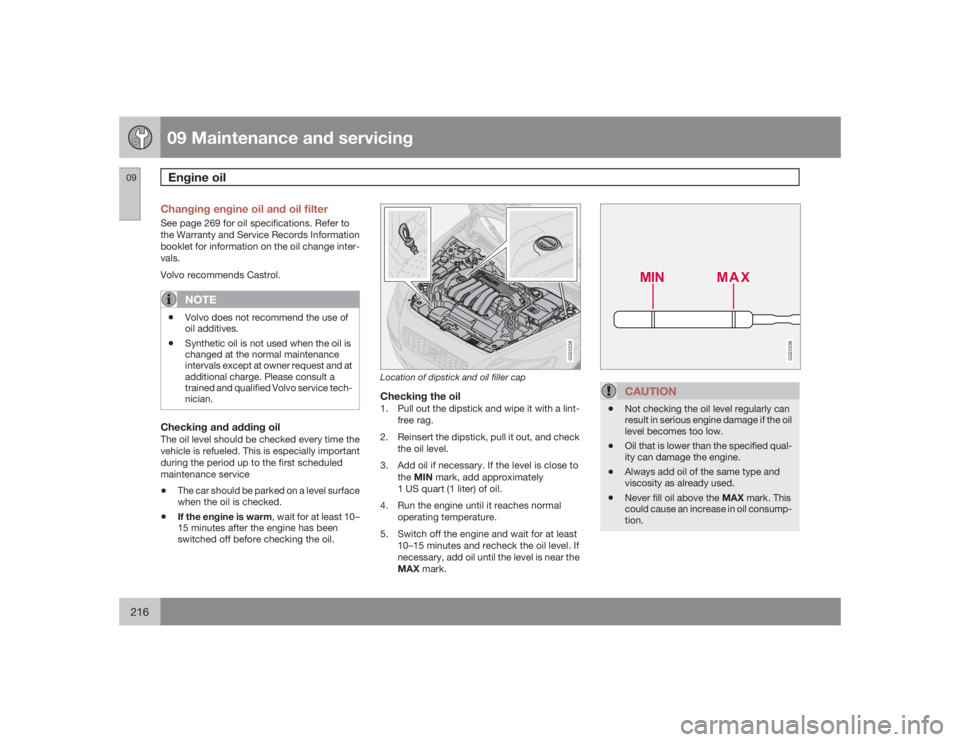
G020338
Location of dipstick and oil filler capChecking the oil1. Pull out the dipstick and wipe it with a lint-
free rag.
2. Reinsert the dipstick, pull it out, and check
the oil level.
3. Add oil if necessary. If the level is close to
theMIN mark, add approximately
1 US quart (1 liter) of oil.
4. Run the engine until it reaches normal
operating temperature.
5. Switch off the engine and wait for at least
10–15 minutes and recheck the oil level. If
necessary, add oil until the level is near the
MAX mark.
G020336
CAUTION
•
Not checking the oil level regularly can
result in serious engine damage if the oil
level becomes too low.
•
Oil that is lower than the specified qual-
ity can damage the engine.
•
Always add oil of the same type and
viscosity as already used.
•
Never fill oil above the MAX mark. This
could cause an increase in oil consump-
tion.
Page 218 of 286
09 Maintenance and servicingFluids
09218
Washer fluid
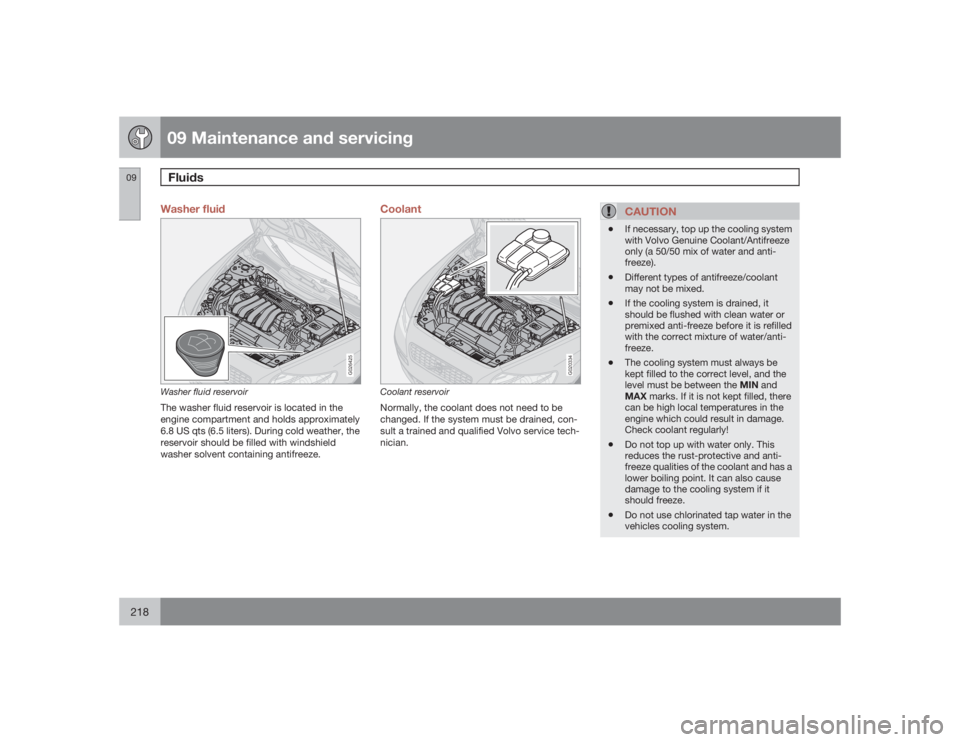
G026425
Washer fluid reservoirThe washer fluid reservoir is located in the
engine compartment and holds approximately
6.8 US qts (6.5 liters). During cold weather, the
reservoir should be filled with windshield
washer solvent containing antifreeze.
Coolant
G020334
Coolant reservoirNormally, the coolant does not need to be
changed. If the system must be drained, con-
sult a trained and qualified Volvo service tech-
nician.
CAUTION
•
If necessary, top up the cooling system
with Volvo Genuine Coolant/Antifreeze
only (a 50/50 mix of water and anti-
freeze).
•
Different types of antifreeze/coolant
may not be mixed.
•
If the cooling system is drained, it
should be flushed with clean water or
premixed anti-freeze before it is refilled
with the correct mixture of water/anti-
freeze.
•
The cooling system must always be
kept filled to the correct level, and the
level must be between the MIN and
MAX marks. If it is not kept filled, there
can be high local temperatures in the
engine which could result in damage.
Check coolant regularly!
•
Do not top up with water only. This
reduces the rust-protective and anti-
freeze qualities of the coolant and has a
lower boiling point. It can also cause
damage to the cooling system if it
should freeze.
•
Do not use chlorinated tap water in the
vehicles cooling system.
Page 219 of 286
09 Maintenance and servicing
Fluids
09
219
WARNING
Never remove the radiator cap while the
engine is warm. Wait until the vehicle cools.
If it is necessary to top off the coolant when
the engine is warm, unscrew the expansion
tank cap slowly so that the overpressure
dissipates.Brake fluid
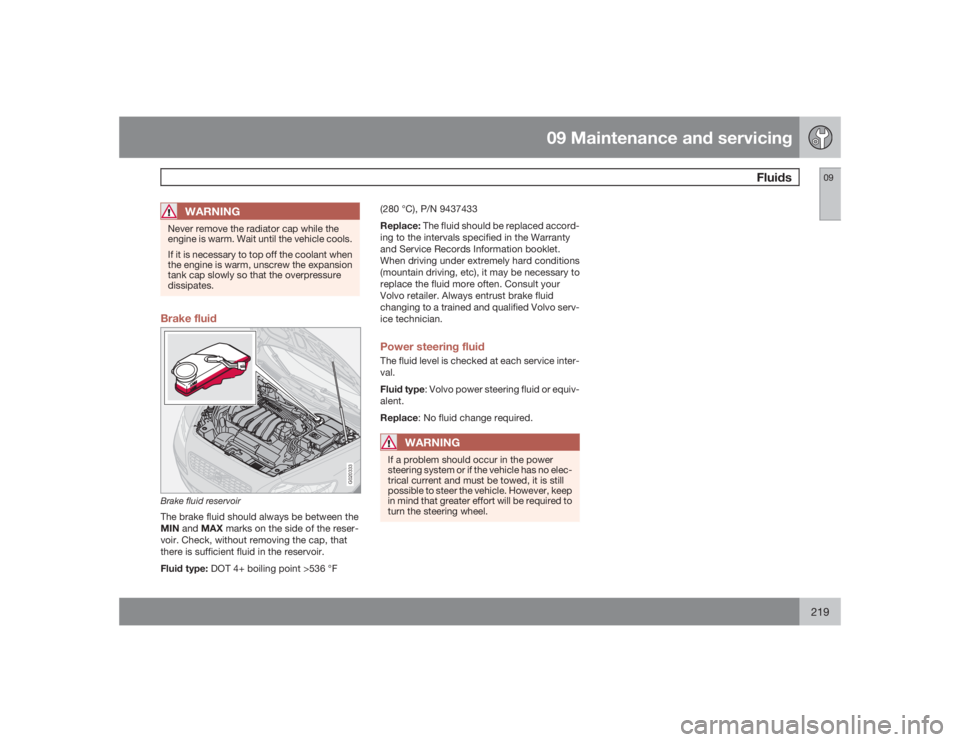
G020333
Brake fluid reservoirThe brake fluid should always be between the
MIN and MAX marks on the side of the reser-
voir. Check, without removing the cap, that
there is sufficient fluid in the reservoir.
Fluid type: DOT 4+ boiling point >536 °F(280 °C), P/N 9437433
Replace: The fluid should be replaced accord-
ing to the intervals specified in the Warranty
and Service Records Information booklet.
When driving under extremely hard conditions
(mountain driving, etc), it may be necessary to
replace the fluid more often. Consult your
Volvo retailer. Always entrust brake fluid
changing to a trained and qualified Volvo serv-
ice technician.
Power steering fluidThe fluid level is checked at each service inter-
val.
Fluid type: Volvo power steering fluid or equiv-
alent.
Replace: No fluid change required.
WARNING
If a problem should occur in the power
steering system or if the vehicle has no elec-
trical current and must be towed, it is still
possible to steer the vehicle. However, keep
in mind that greater effort will be required to
turn the steering wheel.
Page 221 of 286
09 Maintenance and servicing
Battery
09``221 Battery maintenance
Driving habits and conditions, climate, the
number of starts, etc., all affect the service life
and function of the battery. In order for your
battery to perform satisfactorily, keep the fol-
lowing in mind:
Check the fluid level in each cell in the battery
every 24 months or every 15,000
1 miles
(24,000 km), whichever is sooner.
•
Use a screw driver to open the caps or
cover and a flashlight to inspect the level.
•
If necessary, add distilled water. The level
should never be above the indicator.
•
The fluid level should be checked if the
battery has been recharged.
•
After inspection, be sure the cap over each
battery cell or the cover is securely in
place.
•
Check that the battery cables are correctly
connected and properly tightened.
•
Never disconnect the battery when the
engine is running, or when the key is in the
ignition. This could damage the vehicle's
electrical system.
•
The battery should be disconnected from
the vehicle when a battery charger is used
directly on the battery.
WARNING
PROPOSITION 65 WARNING!
Battery posts, terminals, and related acces-
sories contain lead and lead compounds,
chemicals known to the state of California
to cause cancer and reproductive harm.
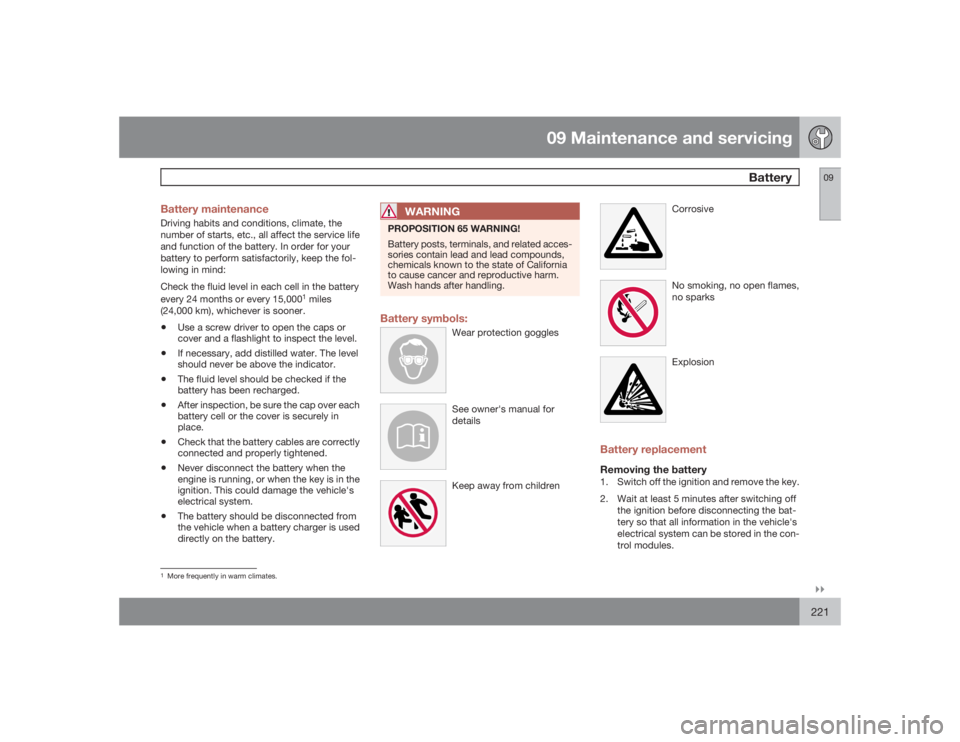
Wash hands after handling.Battery symbols:
Wear protection gogglesSee owner's manual for
detailsKeep away from children
CorrosiveNo smoking, no open flames,
no sparksExplosion
Battery replacementRemoving the battery1. Switch off the ignition and remove the key.
2. Wait at least 5 minutes after switching off
the ignition before disconnecting the bat-
tery so that all information in the vehicle's
electrical system can be stored in the con-
trol modules.
1More frequently in warm climates.
Page 278 of 286
12 Index
12278
DSTC, stability system............................. 155EEconomical driving..................................136
Electrical current – conserving................ 138
Electrically operated moonroof.................. 81
Electrical system...................................... 272
Electronic Brake Force Distribution
(EBD)........................................................ 154
Electronic Climate Control......................... 93
air distribution table............................ 101
Electronic Climate Control (ECC) - option. 98
Emergency brake....................................... 75
Emergency locking retractor...................... 36
Emergency starting.................................. 159
Emergency towing................................... 157
Emission inspection readiness................ 212
Engine
specifications...................................... 270
starting................................................ 144
starting with keyless drive.................. 146
Engine compartment overview................ 215Engine oil................................................. 216
changing............................................. 216
checking............................................. 216
specifications...................................... 269
volumes.............................................. 267
Equalizer, audio system........................... 243
Eyelets for anchoring loads..................... 115
FFederal Clean Air Act............................... 210
Flat tires
changing............................................. 190
repairing with tire sealing system....... 192
Fluids and oils.......................................... 267
FM1/FM2 menu....................................... 244
Fog lights
front...................................................... 64
rear........................................................ 64
Front airbags.............................................. 22
disconnecting passenger’s side airbag 26
Front fog lights........................................... 64
Front park assist...................................... 168
Front seats............................................... 104
folding backrests................................ 104manually operated.............................. 104
power.................................................. 105
Fuel filler door
unlocking.............................................. 65
Fuel gauge................................................. 53
Fuel requirements.................................... 140
Fuel tank volume...................................... 267
Fuses, replacing....................................... 230
GGasoline requirements............................. 140
Geartronic................................................ 150
Generator................................................. 272
Glossary of tire terminology..................... 182
Glove compartment................................. 110
locking................................................ 128
Gross vehicle weight (GVW)............183, 265