fuel VOLVO S40 2009 Owner´s Manual
[x] Cancel search | Manufacturer: VOLVO, Model Year: 2009, Model line: S40, Model: VOLVO S40 2009Pages: 286, PDF Size: 7.08 MB
Page 148 of 286
06 Starting and drivingManual transmission, 6-speed (certain markets only)
06148
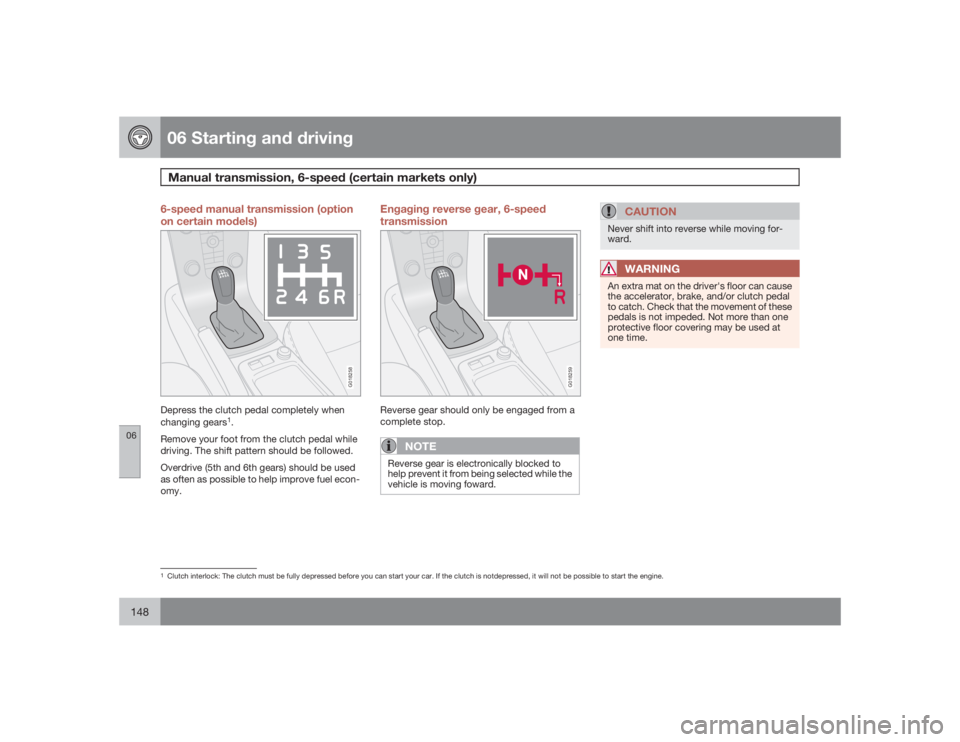
6-speed manual transmission (option
on certain models)
G018258
Depress the clutch pedal completely when
changing gears
1.
Remove your foot from the clutch pedal while
driving. The shift pattern should be followed.
Overdrive (5th and 6th gears) should be used
as often as possible to help improve fuel econ-
omy.
Engaging reverse gear, 6-speed
transmission
G018259
Reverse gear should only be engaged from a
complete stop.
NOTE
Reverse gear is electronically blocked to
help prevent it from being selected while the
vehicle is moving foward.
CAUTION
Never shift into reverse while moving for-
ward.
WARNING
An extra mat on the driver's floor can cause
the accelerator, brake, and/or clutch pedal
to catch. Check that the movement of these
pedals is not impeded. Not more than one
protective floor covering may be used at
one time.
1Clutch interlock: The clutch must be fully depressed before you can start your car. If the clutch is notdepressed, it will not be possible to start the engine.
Page 158 of 286
06 Starting and drivingTowing
06158
WARNING
•
Never allow a vehicle to be towed with-
out a driver behind the wheel of the
disabled vehicle.
•
Never remove the key from the ignition
while the vehicle is moving. The steering
wheel could lock, making it impossible
to steer the vehicle.
•
When the engine is not running, steering
resistance and the effort needed to
apply the brakes will be great.
•
Never attempt to tow a vehicle with a
dead battery at night.CAUTION
•
Check with state and local authorities
before attempting this type of towing,
as vehicles being towed are subject to
regulations regarding maximum towing
speed, length and type of towing
device, lighting, marker flags, etc.
•
Never attempt to push- or tow-start a
vehicle with a dead battery. This would
inject unburned fuel into the three-way
catalytic converter(s), causing over-
heating, backfiring, and damage, see
page 159 for instructions on jump star-
ting the vehicle.
Towing vehicles with front wheel driveVolvo recommends the use of flat bed equip-
ment for towing vehicles with front wheel drive.
If wheel lift equipment must be used, please
use extreme caution to help avoid damage to
the vehicle.
In this case, the vehicle should be towed with
the rear wheels on the ground if at all possible.
If it is absolutely necessary to tow the vehicle
with the front wheels on the ground, please
refer to the towing information on the previous
page.•
Sling-type equipment applied at the front
will damage radiator and air conditioning
lines.
•
It is equally important not to use sling-type
equipment at the rear or apply lifting equip-
ment inside the rear wheels; serious dam-
age to the rear axle may result.
•
If the vehicle is being towed on a flat bed
truck, the towing eyelets must not be used
to secure the vehicle on the flat bed. Con-
sult the tow truck operator.
WARNING
•
Remember that the power brakes and
power steering will not function when
engine is not running. The braking and
steering systems will function but the
brake pedal pressure required is
3 – 5 times above normal and greater
steering effort must be exerted.
•
The towing eyelets must not be used for
pulling the vehicle out of a ditch or for
any similar purpose involving severe
strain. Do not use the towing eyelets to
pull the vehicle up onto a flat bed tow
truck.
Page 159 of 286
06 Starting and driving
Jump starting
06
159
G020298
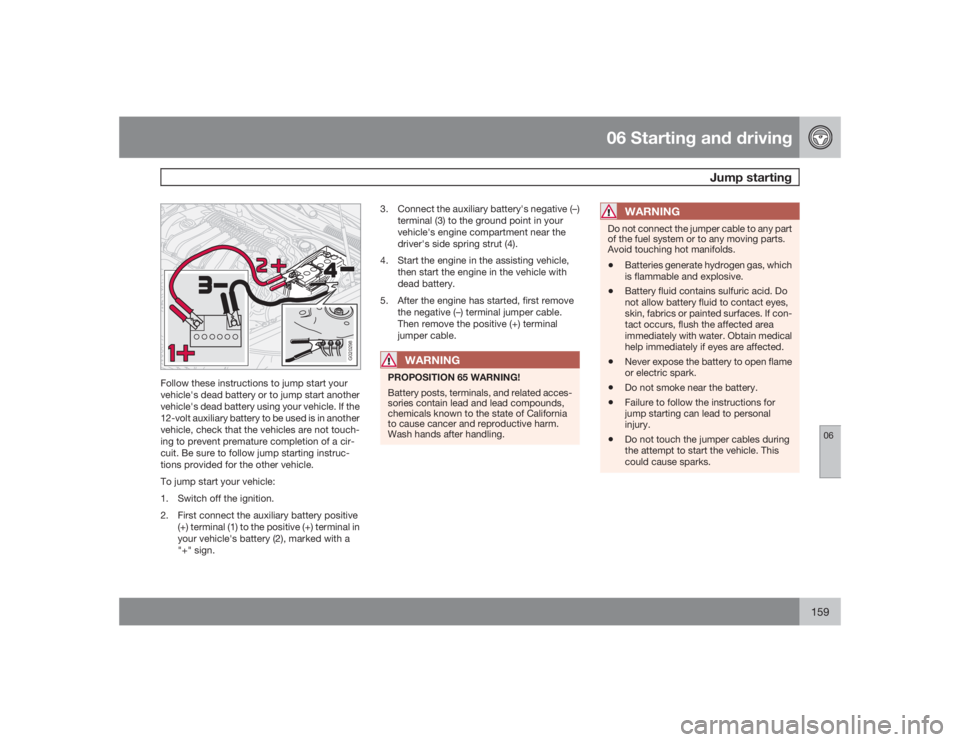
Follow these instructions to jump start your
vehicle's dead battery or to jump start another
vehicle's dead battery using your vehicle. If the
12-volt auxiliary battery to be used is in another
vehicle, check that the vehicles are not touch-
ing to prevent premature completion of a cir-
cuit. Be sure to follow jump starting instruc-
tions provided for the other vehicle.
To jump start your vehicle:
1. Switch off the ignition.
2. First connect the auxiliary battery positive
(+) terminal (1) to the positive (+) terminal in
your vehicle's battery (2), marked with a
"+" sign.3. Connect the auxiliary battery's negative (–)
terminal (3) to the ground point in your
vehicle's engine compartment near the
driver's side spring strut (4).
4. Start the engine in the assisting vehicle,
then start the engine in the vehicle with
dead battery.
5. After the engine has started, first remove
the negative (–) terminal jumper cable.
Then remove the positive (+) terminal
jumper cable.
WARNING
PROPOSITION 65 WARNING!
Battery posts, terminals, and related acces-
sories contain lead and lead compounds,
chemicals known to the state of California
to cause cancer and reproductive harm.
Wash hands after handling.
WARNING
Do not connect the jumper cable to any part
of the fuel system or to any moving parts.
Avoid touching hot manifolds.•
Batteries generate hydrogen gas, which
is flammable and explosive.
•
Battery fluid contains sulfuric acid. Do
not allow battery fluid to contact eyes,
skin, fabrics or painted surfaces. If con-
tact occurs, flush the affected area
immediately with water. Obtain medical
help immediately if eyes are affected.
•
Never expose the battery to open flame
or electric spark.
•
Do not smoke near the battery.
•
Failure to follow the instructions for
jump starting can lead to personal
injury.
•
Do not touch the jumper cables during
the attempt to start the vehicle. This
could cause sparks.
Page 163 of 286
06 Starting and driving
Transporting loads
06
163 Loading the vehicle
Your vehicle's load-carrying capacity is affec-
ted by factors such as:•
the number of passengers
•
tire inflation
•
the amount of optional or accessory equip-
ment installed
•
the amount of cargo.
See the chapter "Wheels and tires" for more
detailed information.
Before loading the car, turn off the engine, and
apply the parking brake when loading or
unloading long objects. The gear selector can
be inadvertently knocked out of position by
long cargo, causing the car to move.
Keep the following in mind when
loading the vehicle:•
Load objects in the trunk against the rear
seat backrest.
•
Load heavy cargo as low as possible.
•
Center wide loads.
•
Secure all cargo with restraining straps
anchored to the load securing eyelets.
•
Cover sharp edges on the load.
•
Seats can be folded down and head
restraints removed to extend the cargo
compartment, see page 113.
WARNING
•
Remember that an object weighing
44 lbs (20 kg) produces a force of
2,200 lbs (1,000 kg) in a head-on colli-
sion at 30 mph (50 km/h)!
•
When the rear backrest(s) are folded
down, the vehicle should not be loaded
to a level higher than 2 in. (5 cm) below
the upper edge of the rear side win-
dows. Objects placed higher than this
level could impede the function of the
Volvo Inflatable Curtain.
Load carriers (accessory)Load carriers are available as Volvo accesso-
ries. Follow the installation instructions sup-
plied with the load carriers.
Observe the following points when using load
carriers:•
To avoid damaging your car and to achieve
maximum safety when driving, we recom-
mend using the load carriers that Volvo has
developed especially for your car.
•
Volvo-approved removable roof racks are
designed to carry the maximum allowable
roof load for this vehicle: 165 lbs (75 kg).
For Non-Volvo roof racks, check the man-
ufacturer's weight limits for the rack.
•
Never exceed the rack manufacturer's
weigh limits and never exceed the maxi-
mum rated roof load of 165 lbs (75 kg).
•
Avoid single-point loads. Distribute loads
evenly.
•
Place heavier cargo at the bottom of the
load.
•
Secure the cargo correctly with appropri-
ate tie-down equipment.
•
Check periodically that the load carriers
and load are properly secured.
•
Remember that the car's center of gravity
and handling change when you carry a
load on the roof.
•
The car's wind resistance and fuel con-
sumption will increase with the size of the
load.
•
Drive smoothly. Avoid rapid starts, fast
cornering and hard braking.
Page 174 of 286
07 Wheels and tiresGeneral information
07174
Your vehicle is equipped with tires according
to the vehicle's tire information placard on the
B-pillar (the structural member at the side of
the vehicle, at the rear of the driver's door
opening), or on the inside of the fuel filler door
on Canadian models.
CAUTION
Some Volvo models are equipped with an
Ultra High Performance tire and wheel com-
bination designed to provide maximum dry
pavement performance with consideration
for hydroplaning resistance. As such, they
may be more susceptible to road hazard
damage and, depending on driving condi-
tions, may achieve a tread life of less than
20,000 miles (30,000 km). Even if this vehi-
cle is equipped with Volvo’s advanced AWD
or DSTC system, these tires are not
designed for winter driving, and should be
replaced with winter tires when weather
conditions dictate.The tires have good road holding characteris-
tics and offer good handling on dry and wet
surfaces. It should be noted however that the
tires have been developed to give these fea-
tures on snow/ice-free surfaces.
Certain models are equipped with "all-season"
tires, which provide a somewhat higher degree
of road holding on slippery surfaces than tires
without the "all-season" rating. However, foroptimum road holding on icy or snow-covered
roads, we recommend suitable winter tires on
all four wheels.
When replacing tires, be sure that the new tires
are the same size designation, type (radial) and
preferably from the same manufacturer, on all
four wheels. Otherwise there is a risk of altering
the car's roadholding and handling characte-
ristics.
Storing wheels and tiresWhen storing complete wheels (tires mounted
on rims), they should be suspended off the
floor or placed on their sides on the floor.
Tires not mounted on rims should be stored on
their sides or standing upright, but should not
be suspended.
CAUTION
Tires should preferably be stored in a cool,
dry, dark place, and should never be stored
in close proximity to solvents, gasoline, oils,
etc.
WARNING
•
The wheel and tire sizes for your Volvo
are specified to meet stringent stability
and handling requirements. Unap-
proved wheel/tire size combinations
can negatively affect your vehicle's sta-
bility and handling. Approved tire sizes
are shown in the Tire inflation pressure
tables, see page 178.
•
Any damage caused by installation of
unapproved wheel/tire size combina-
tions will not be covered by your new
vehicle warranty. Volvo assumes no
responsibility for death, injury, or
expenses that may result from such
installations.
Page 179 of 286
07 Wheels and tires
Inflation pressure—Canadian models
07
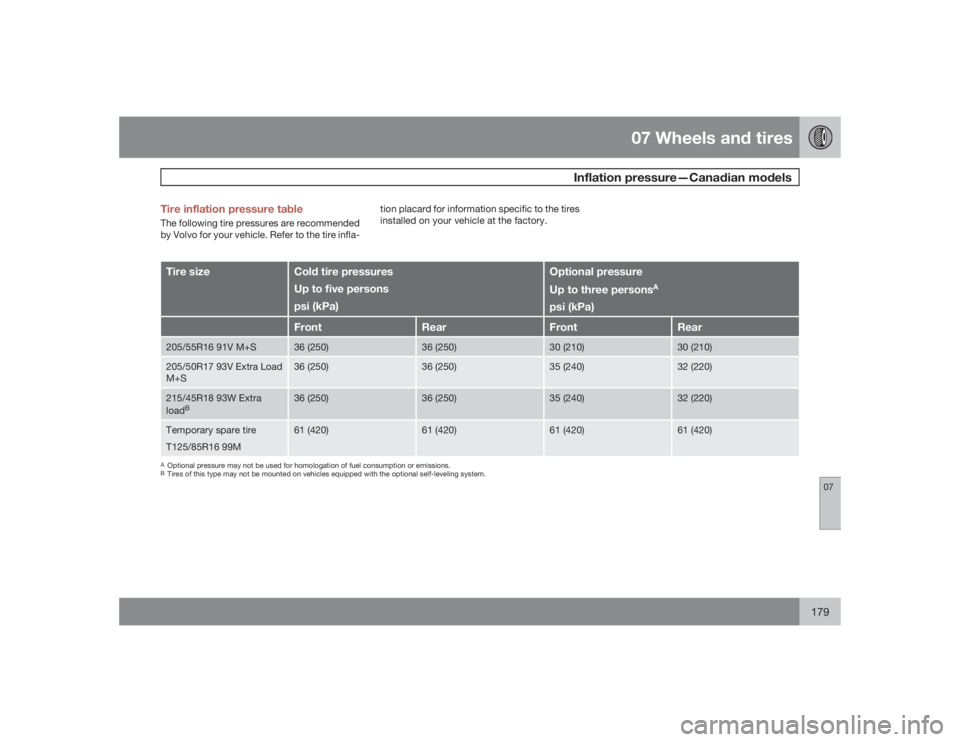
179 Tire inflation pressure table
The following tire pressures are recommended
by Volvo for your vehicle. Refer to the tire infla-tion placard for information specific to the tires
installed on your vehicle at the factory.Tire size
Cold tire pressures
Up to five persons
psi (kPa)
Optional pressure
Up to three persons
A
psi (kPa)
Front
Rear
Front
Rear
205/55R16 91V M+S
36 (250)
36 (250)
30 (210)
30 (210)
205/50R17 93V Extra Load
M+S
36 (250)
36 (250)
35 (240)
32 (220)
215/45R18 93W Extra
load
B
36 (250)
36 (250)
35 (240)
32 (220)
Temporary spare tire
T125/85R16 99M
61 (420)
61 (420)
61 (420)
61 (420)
AOptional pressure may not be used for homologation of fuel consumption or emissions.BTires of this type may not be mounted on vehicles equipped with the optional self-leveling system.
Page 181 of 286
07 Wheels and tires
Tire designations
07
181
Maximum Load: Indicates the maximum
load in pounds and kilograms that can be
carried by the tire. Refer to the vehicle's tire
information placard or the safety certifica-
tion label, located on the B-Pillar or the
driver's door or on the inside of the fuel filler
door on Canadian models, for the correct
tire pressure for your vehicle.Treadwear, Traction, and Temperature
grades: See page 185 for more informa-
tion.Maximum permissible inflation
pressure: The greatest amount of air pres-
sure that should ever be put in the tire. This
limit is set by the tire manufacturer.
The tire suppliers may have additional mark-
ings, notes or warnings such as standard load,
radial tubeless, etc.
Page 182 of 286
07 Wheels and tiresGlossary of tire terminology
07182
Terminology•
Tire information placard: A placard
showing the OE (Original Equipment) tire
sizes, recommended inflation pressure,
and the maximum weight the vehicle can
carry.
•
Tire Identification Number (TIN): A num-
ber on the sidewall of each tire providing
information about the tire brand and man-
ufacturing plant, tire size and date of man-
ufacturer.
•
Inflation pressure: A measure of the
amount of air in a tire.
•
Standard load: A class of P-metric or Met-
ric tires designed to carry a maximum load
at 35 psi [37 psi (2.5 bar) for Metric tires].
Increasing the inflation pressure beyond
this pressure will not increase the tires load
carrying capability.
•
Extra load: A class of P-metric or Metric
tires designed to carry a heavier maximum
load at 41 psi [43 psi (2.9 bar) for Metric
tires]. Increasing the inflation pressure
beyond this pressure will not increase the
tires load carrying capability.
•
kPa: Kilopascal, a metric unit of air pres-
sure.
•
PSI: Pounds per square inch, a standard
unit of air pressure.
•
B-pillar: The structural member at the side
of the vehicle behind the front door.
•
Bead area of the tire: Area of the tire next
to the rim.
•
Sidewall of the tire: Area between the
bead area and the tread.
•
Tread area of the tire: Area of the perim-
eter of the tire that contacts the road when
mounted on the vehicle.
•
Rim: The metal support (wheel) for a tire or
a tire and tube assembly upon which the
tire beads are seated.
•
Maximum load rating: a figure indicating
the maximum load in pounds and kilo-
grams that can be carried by the tire. This
rating is established by the tire manufac-
turer.
•
Maximum permissible inflation pres-
sure: the greatest amount of air pressure
that should ever be put in the tire. This limit
is set by the tire manufacturer.
•
Recommended tire inflation pressure:
inflation pressure, established by Volvo,
which is based on the type of tires that are
mounted on a vehicle at the factory. This
inflation pressure is affected by the number
of occupants in the car, the amount of
cargo, and the speed at which the vehicle
will be driven for a prolonged period. This
information can be found on the tire infla-
tion placard(s) located on the driver's sideB-pillar or on the inside of the fuel filler door
on Canadian models, and in the tire infla-
tion table in this chapter.
•
Cold tires: The tires are considered to be
cold when they have the same temperature
as the surrounding (ambient) air. This tem-
perature is normally reached after the car
has been parked for at least 3 hours.
Properly loading your vehicle will provide maxi-
mum return of vehicle design performance.
Page 183 of 286
07 Wheels and tires
Vehicle loading
07``183 Loading the vehicle
Before loading your vehicle, familiarize yourself
with the following terms for determining your
vehicle's weight ratings, with or without a
trailer, from the vehicle's Federal/Canadian
Motor Vehicle Safety Standards (FMVSS/
CMVSS) label, and the vehicle's tire informa-
tion placard:Curb weightThe weight of the vehicle including a full tank
of fuel and all standard equipment. It does not
include passengers, cargo, or optional equip-
ment.Capacity weightAll weight added to the curb weight, including
cargo and optional equipment. When towing,
trailer hitch tongue load is also part of cargo
weight.
NOTE
For trailer towing information, please refer to
the section "Towing a trailer", see
page 160.Permissible axle weightThe maximum allowable weight that can be
carried by a single axle (front or rear). These
numbers are shown on the Federal/CanadianMotor Vehicle Safety Standards (FMVSS/
CMVSS) label. The total load on each axle must
never exceed its maximum permissible weight.
Gross vehicle weight (GVW)The vehicle's curb weight + cargo + passen-
gers.
NOTE
•
The location of the various labels in your
vehicle can be found on page 262.
•
A table listing important weight limits for
your vehicle can be found on page
265.
Steps for Determining Correct Load
Limit(1) Locate the statement "the combined weight
of occupants and cargo should never exceed
XXX pounds" on your vehicle's placard.
(2) Determine the combined weight of the driver
and passengers that will be riding in your vehi-
cle.
(3) Subtract the combined weight of the driver
and passengers from XXX kilograms or XXX
pounds.(4) The resulting figure equals the available
amount of cargo and luggage load capacity.
For example, if the "XXX" amount equals
1400 lbs. and there will be five 150 lbs. pas-
sengers in your vehicle, the amount of available
cargo and luggage load capacity is 650 lbs.
(1400–750 (5×150) = 650 lbs.)
(5) Determine the combined weight of luggage
and cargo being loaded on the vehicle. That
weight may not safely exceed the available
cargo and luggage load capacity calculated in
Step 4.
(6) If your vehicle will be towing a trailer, load
from your trailer will be transferred to your vehi-
cle. Consult this manual
1 to determine how this
reduces the available cargo and luggage load
capacity of your vehicle.
1See "Towing a trailer"
Page 187 of 286
07 Wheels and tires
Temporary spare
07
187 Temporary spare
The spare tire in your car is called a "Temporary
Spare".
Recommended tire pressure (see the placard
on the B-pillar or on the fuel filler door) should
be maintained irrespective of which position on
the car the temporary spare tire is used on.
In the event of damage to this tire, a new one
can be purchased from your Volvo retailer.
WARNING
Current legislation prohibits the use of the
"Temporary Spare" tire other than as a tem-
porary replacement for a punctured tire. It
must be replaced as soon as possible by a
standard tire. Road holding and handling
may be affected with the "Temporary
Spare" in use. Do not exceed a speed of
50 mph (80 km/h) with the "Temporary
Spare" in use.
CAUTION
The car must not be driven with wheels of
different dimensions or with a spare tire
other than the one that came with the car.
The use of different size wheels can seri-
ously damage your car's transmission.