tires VOLVO S40 2009 Owner´s Manual
[x] Cancel search | Manufacturer: VOLVO, Model Year: 2009, Model line: S40, Model: VOLVO S40 2009Pages: 286, PDF Size: 7.08 MB
Page 180 of 286
07 Wheels and tiresTire designations
07180
Tire designations
123456
1211108
7
9
G026442
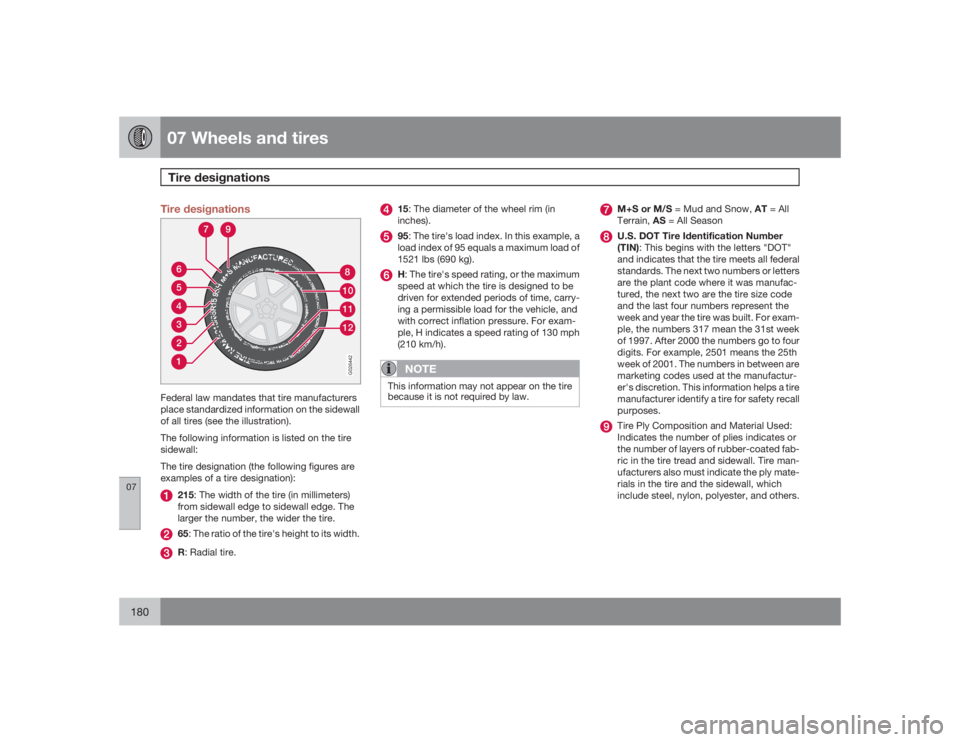
Federal law mandates that tire manufacturers
place standardized information on the sidewall
of all tires (see the illustration).
The following information is listed on the tire
sidewall:
The tire designation (the following figures are
examples of a tire designation):
215: The width of the tire (in millimeters)
from sidewall edge to sidewall edge. The
larger the number, the wider the tire.65: The ratio of the tire's height to its width.R: Radial tire.
15: The diameter of the wheel rim (in
inches).95: The tire's load index. In this example, a
load index of 95 equals a maximum load of
1521 lbs (690 kg).H: The tire's speed rating, or the maximum
speed at which the tire is designed to be
driven for extended periods of time, carry-
ing a permissible load for the vehicle, and
with correct inflation pressure. For exam-
ple, H indicates a speed rating of 130 mph
(210 km/h).NOTE
This information may not appear on the tire
because it is not required by law.
M+S or M/S = Mud and Snow, AT = All
Terrain,AS = All SeasonU.S. DOT Tire Identification Number
(TIN): This begins with the letters "DOT"
and indicates that the tire meets all federal
standards. The next two numbers or letters
are the plant code where it was manufac-
tured, the next two are the tire size code
and the last four numbers represent the
week and year the tire was built. For exam-
ple, the numbers 317 mean the 31st week
of 1997. After 2000 the numbers go to four
digits. For example, 2501 means the 25th
week of 2001. The numbers in between are
marketing codes used at the manufactur-
er's discretion. This information helps a tire
manufacturer identify a tire for safety recall
purposes.Tire Ply Composition and Material Used:
Indicates the number of plies indicates or
the number of layers of rubber-coated fab-
ric in the tire tread and sidewall. Tire man-
ufacturers also must indicate the ply mate-
rials in the tire and the sidewall, which
include steel, nylon, polyester, and others.
Page 181 of 286
07 Wheels and tires
Tire designations
07
181
Maximum Load: Indicates the maximum
load in pounds and kilograms that can be
carried by the tire. Refer to the vehicle's tire
information placard or the safety certifica-
tion label, located on the B-Pillar or the
driver's door or on the inside of the fuel filler
door on Canadian models, for the correct
tire pressure for your vehicle.Treadwear, Traction, and Temperature
grades: See page 185 for more informa-
tion.Maximum permissible inflation
pressure: The greatest amount of air pres-
sure that should ever be put in the tire. This
limit is set by the tire manufacturer.
The tire suppliers may have additional mark-
ings, notes or warnings such as standard load,
radial tubeless, etc.
Page 182 of 286
07 Wheels and tiresGlossary of tire terminology
07182
Terminology•
Tire information placard: A placard
showing the OE (Original Equipment) tire
sizes, recommended inflation pressure,
and the maximum weight the vehicle can
carry.
•
Tire Identification Number (TIN): A num-
ber on the sidewall of each tire providing
information about the tire brand and man-
ufacturing plant, tire size and date of man-
ufacturer.
•
Inflation pressure: A measure of the
amount of air in a tire.
•
Standard load: A class of P-metric or Met-
ric tires designed to carry a maximum load
at 35 psi [37 psi (2.5 bar) for Metric tires].
Increasing the inflation pressure beyond
this pressure will not increase the tires load
carrying capability.
•
Extra load: A class of P-metric or Metric
tires designed to carry a heavier maximum
load at 41 psi [43 psi (2.9 bar) for Metric
tires]. Increasing the inflation pressure
beyond this pressure will not increase the
tires load carrying capability.
•
kPa: Kilopascal, a metric unit of air pres-
sure.
•
PSI: Pounds per square inch, a standard
unit of air pressure.
•
B-pillar: The structural member at the side
of the vehicle behind the front door.
•
Bead area of the tire: Area of the tire next
to the rim.
•
Sidewall of the tire: Area between the
bead area and the tread.
•
Tread area of the tire: Area of the perim-
eter of the tire that contacts the road when
mounted on the vehicle.
•
Rim: The metal support (wheel) for a tire or
a tire and tube assembly upon which the
tire beads are seated.
•
Maximum load rating: a figure indicating
the maximum load in pounds and kilo-
grams that can be carried by the tire. This
rating is established by the tire manufac-
turer.
•
Maximum permissible inflation pres-
sure: the greatest amount of air pressure
that should ever be put in the tire. This limit
is set by the tire manufacturer.
•
Recommended tire inflation pressure:
inflation pressure, established by Volvo,
which is based on the type of tires that are
mounted on a vehicle at the factory. This
inflation pressure is affected by the number
of occupants in the car, the amount of
cargo, and the speed at which the vehicle
will be driven for a prolonged period. This
information can be found on the tire infla-
tion placard(s) located on the driver's sideB-pillar or on the inside of the fuel filler door
on Canadian models, and in the tire infla-
tion table in this chapter.
•
Cold tires: The tires are considered to be
cold when they have the same temperature
as the surrounding (ambient) air. This tem-
perature is normally reached after the car
has been parked for at least 3 hours.
Properly loading your vehicle will provide maxi-
mum return of vehicle design performance.
Page 183 of 286
07 Wheels and tires
Vehicle loading
07``183 Loading the vehicle
Before loading your vehicle, familiarize yourself
with the following terms for determining your
vehicle's weight ratings, with or without a
trailer, from the vehicle's Federal/Canadian
Motor Vehicle Safety Standards (FMVSS/
CMVSS) label, and the vehicle's tire informa-
tion placard:Curb weightThe weight of the vehicle including a full tank
of fuel and all standard equipment. It does not
include passengers, cargo, or optional equip-
ment.Capacity weightAll weight added to the curb weight, including
cargo and optional equipment. When towing,
trailer hitch tongue load is also part of cargo
weight.
NOTE
For trailer towing information, please refer to
the section "Towing a trailer", see
page 160.Permissible axle weightThe maximum allowable weight that can be
carried by a single axle (front or rear). These
numbers are shown on the Federal/CanadianMotor Vehicle Safety Standards (FMVSS/
CMVSS) label. The total load on each axle must
never exceed its maximum permissible weight.
Gross vehicle weight (GVW)The vehicle's curb weight + cargo + passen-
gers.
NOTE
•
The location of the various labels in your
vehicle can be found on page 262.
•
A table listing important weight limits for
your vehicle can be found on page
265.
Steps for Determining Correct Load
Limit(1) Locate the statement "the combined weight
of occupants and cargo should never exceed
XXX pounds" on your vehicle's placard.
(2) Determine the combined weight of the driver
and passengers that will be riding in your vehi-
cle.
(3) Subtract the combined weight of the driver
and passengers from XXX kilograms or XXX
pounds.(4) The resulting figure equals the available
amount of cargo and luggage load capacity.
For example, if the "XXX" amount equals
1400 lbs. and there will be five 150 lbs. pas-
sengers in your vehicle, the amount of available
cargo and luggage load capacity is 650 lbs.
(1400–750 (5×150) = 650 lbs.)
(5) Determine the combined weight of luggage
and cargo being loaded on the vehicle. That
weight may not safely exceed the available
cargo and luggage load capacity calculated in
Step 4.
(6) If your vehicle will be towing a trailer, load
from your trailer will be transferred to your vehi-
cle. Consult this manual
1 to determine how this
reduces the available cargo and luggage load
capacity of your vehicle.
1See "Towing a trailer"
Page 184 of 286
07 Wheels and tiresVehicle loading
07184
WARNING
•
Exceeding the permissible axle weight,
gross vehicle weight, or any other
weight rating limits can cause tire over-
heating resulting in permanent defor-
mation or catastrophic failure.
•
Do not use replacement tires with lower
load carrying capacities than the tires
that were original equipment on the
vehicle because this will lower the vehi-
cle's GVW rating. Replacement tires
with a higher limit than the originals do
not increase the vehicle's GVW rating
limitations.
Page 185 of 286
07 Wheels and tiresUniform tire quality gradings
07
185 Uniform tire quality gradings
ALL PASSENGER VEHICLE TIRES MUST
CONFORM TO FEDERAL SAFETY
REQUIREMENTS IN ADDITION TO THESE
GRADES
Quality grades can be found, where appli-
cable, on the tire sidewall between the tread
shoulder and maximum section width. For
example:
Treadwear 200 Traction AA
Temperature ATREADWEARThe treadwear grade is a comparative rating
based on the wear rate of the tire when tested
under controlled conditions on a specified gov-
ernment test course. For example, a tire gra-
ded 150 would wear one and one half (1 1/2)
times as well on the government course as a
tire graded 100. The relative performance of
tires depends upon the actual conditions of
their use, however, and many depart signifi-
cantly from the norm due to variation in driving
habits, maintenance practices and differences
in road characteristics and climate.TRACTIONThe traction grades, from highest to lowest, are
AA, A, B, and C, as measured under controlled
conditions on specified government test sur-faces of asphalt and concrete. A tire marked C
may have poor traction performance. The trac-
tion grade assigned to this tire is based on
braking (straight-ahead) traction tests and is
not a measure of cornering (turning) traction.
WARNING
The traction grade assigned to this tire is
based on braking (straight-ahead) traction
tests and is not a measure of cornering
(turning) traction.TEMPERATUREThe temperature grades are AA (the highest),
A, B, and C, representing the tire's resistance
to the generation of heat and its ability to dis-
sipate heat when tested under controlled con-
ditions on a specified indoor laboratory test
wheel. Sustained high temperature can cause
the material of the tire to degenerate and
reduce tire life, and excessive temperature can
lead to sudden tire failure. The grade C corre-
sponds to a minimum level of performance that
all passenger vehicle tires must meet under the
Federal Motor Safety Standard No. 109.
Grades B and A represent higher levels of per-
formance on the laboratory test wheel than the
minimum required by law.
WARNING
The temperature grade for this tire is estab-
lished for a tire that is properly inflated and
not overloaded. Excessive speed, under-
inflation, or excessive loading, either sepa-
rately or in combination, can cause heat
buildup and tire failure.
Page 186 of 286
07 Wheels and tiresSnow chains, snow tires, studded tires
07186
Snow chainsSnow chains can be used on your Volvo with
the following restrictions:•
Snow chains should be installed on front
wheels only. Use only Volvo approved
snow chains.
•
If accessory, aftermarket or "custom" tires
and wheels are installed and are of a size
different than the original tires and wheels,
chains in some cases CANNOT be used.
Sufficient clearances between chains and
brakes, suspension and body components
must be maintained.
•
Some strap-on type chains will interfere
with brake components and therefore
CANNOT be used.
•
All Wheel Drive models: Snow chains
should only be installed on the front
wheels. Only chains adapted for AWD
models should be used.
Consult your Volvo retailer for additional snow
chain information.
CAUTION
•
Check local regulations regarding the
use of snow chains before installing.
•
Always follow the chain manufacturer's
installation instructions carefully. Install
chains as tightly as possible and
retighten periodically.
•
Never exceed the chain manufacturer's
specified maximum speed limit. (Under
no circumstances should you exceed
31 mph (50 km/h).
•
Avoid bumps, holes or sharp turns
when driving with snow chains.
•
The handling of the vehicle can be
adversely affected when driving with
chains. Avoid fast or sharp turns as well
as locked wheel braking.
Snow tires, studded tiresTires for winter use:•
Owners who live in or regularly commute
through areas with sustained periods of
snow or icy driving conditions are strongly
advised to fit suitable winter tires to help
retain the highest degree of traction.
•
It is important to install winter tires on all
four wheels to help retain traction during
cornering, braking, and accelerating. Fail-ure to do so could reduce traction to an
unsafe level or adversely affect handling.
•
Do not mix tires of different design as this
could also negatively affect overall tire road
grip.
•
Winter tires wear more quickly on dry roads
in warm weather. They should be removed
when the winter driving season has ended.
•
Studded tires should be run-in 300–
600 miles (500–1000 km) during which the
car should be driven as smoothly as pos-
sible to give the studs the opportunity to
seat properly in the tires. The tires should
have the same rotational direction
throughout their entire lifetime.NOTE
Please consult state or provincial regula-
tions restricting the use of studded winter
tires before installing such tires.
Page 187 of 286
07 Wheels and tires
Temporary spare
07
187 Temporary spare
The spare tire in your car is called a "Temporary
Spare".
Recommended tire pressure (see the placard
on the B-pillar or on the fuel filler door) should
be maintained irrespective of which position on
the car the temporary spare tire is used on.
In the event of damage to this tire, a new one
can be purchased from your Volvo retailer.
WARNING
Current legislation prohibits the use of the
"Temporary Spare" tire other than as a tem-
porary replacement for a punctured tire. It
must be replaced as soon as possible by a
standard tire. Road holding and handling
may be affected with the "Temporary
Spare" in use. Do not exceed a speed of
50 mph (80 km/h) with the "Temporary
Spare" in use.
CAUTION
The car must not be driven with wheels of
different dimensions or with a spare tire
other than the one that came with the car.
The use of different size wheels can seri-
ously damage your car's transmission.
Page 188 of 286
07 Wheels and tiresWheel nuts
07188
Wheel nuts
G020324
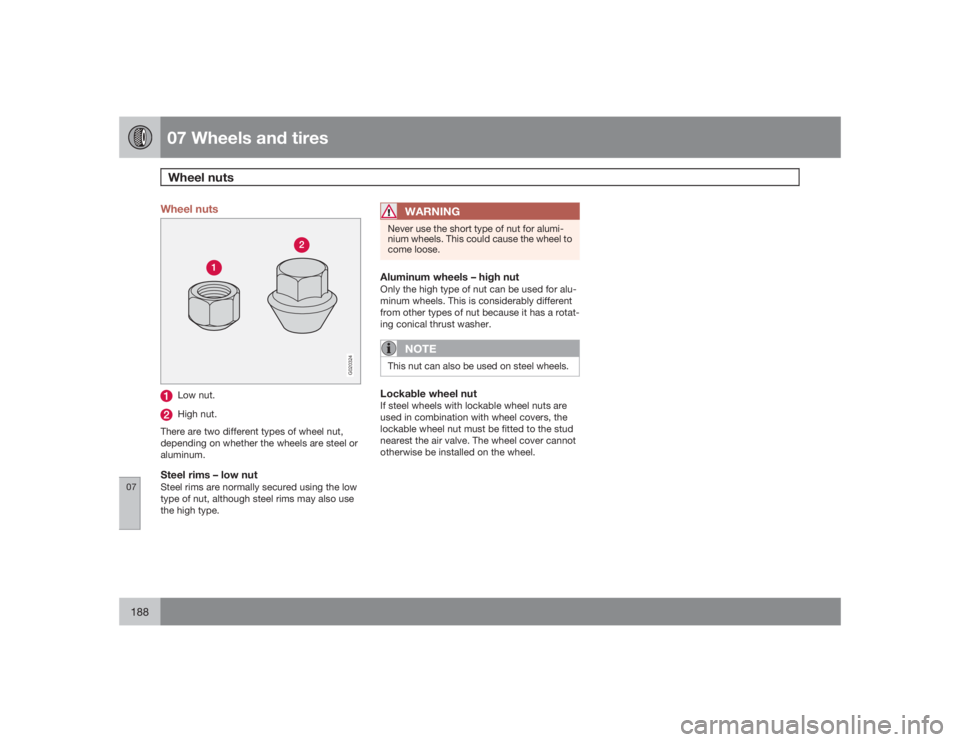
Low nut.High nut.
There are two different types of wheel nut,
depending on whether the wheels are steel or
aluminum.
Steel rims – low nutSteel rims are normally secured using the low
type of nut, although steel rims may also use
the high type.
WARNING
Never use the short type of nut for alumi-
nium wheels. This could cause the wheel to
come loose.Aluminum wheels – high nutOnly the high type of nut can be used for alu-
minum wheels. This is considerably different
from other types of nut because it has a rotat-
ing conical thrust washer.
NOTE
This nut can also be used on steel wheels.Lockable wheel nutIf steel wheels with lockable wheel nuts are
used in combination with wheel covers, the
lockable wheel nut must be fitted to the stud
nearest the air valve. The wheel cover cannot
otherwise be installed on the wheel.
Page 189 of 286
07 Wheels and tires
Tire rotation
07
189
G020325
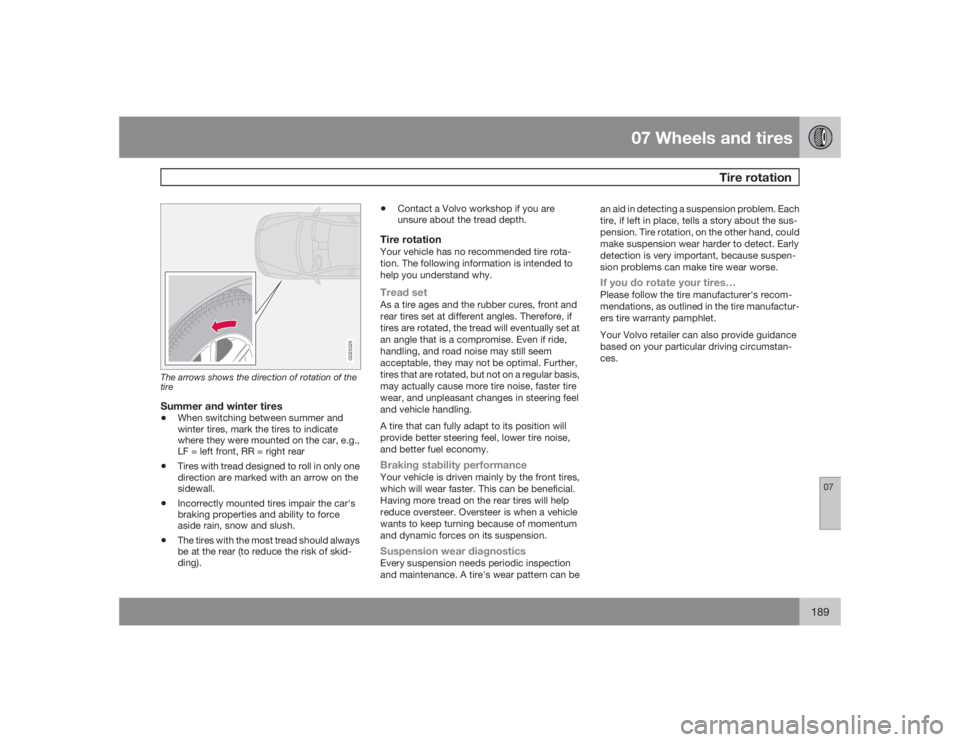
The arrows shows the direction of rotation of the
tireSummer and winter tires•
When switching between summer and
winter tires, mark the tires to indicate
where they were mounted on the car, e.g.,
LF = left front, RR = right rear
•
Tires with tread designed to roll in only one
direction are marked with an arrow on the
sidewall.
•
Incorrectly mounted tires impair the car's
braking properties and ability to force
aside rain, snow and slush.
•
The tires with the most tread should always
be at the rear (to reduce the risk of skid-
ding).
•
Contact a Volvo workshop if you are
unsure about the tread depth.
Tire rotationYour vehicle has no recommended tire rota-
tion. The following information is intended to
help you understand why.Tread setAs a tire ages and the rubber cures, front and
rear tires set at different angles. Therefore, if
tires are rotated, the tread will eventually set at
an angle that is a compromise. Even if ride,
handling, and road noise may still seem
acceptable, they may not be optimal. Further,
tires that are rotated, but not on a regular basis,
may actually cause more tire noise, faster tire
wear, and unpleasant changes in steering feel
and vehicle handling.
A tire that can fully adapt to its position will
provide better steering feel, lower tire noise,
and better fuel economy.Braking stability performanceYour vehicle is driven mainly by the front tires,
which will wear faster. This can be beneficial.
Having more tread on the rear tires will help
reduce oversteer. Oversteer is when a vehicle
wants to keep turning because of momentum
and dynamic forces on its suspension.Suspension wear diagnosticsEvery suspension needs periodic inspection
and maintenance. A tire's wear pattern can bean aid in detecting a suspension problem. Each
tire, if left in place, tells a story about the sus-
pension. Tire rotation, on the other hand, could
make suspension wear harder to detect. Early
detection is very important, because suspen-
sion problems can make tire wear worse.
If you do rotate your tires…Please follow the tire manufacturer's recom-
mendations, as outlined in the tire manufactur-
ers tire warranty pamphlet.
Your Volvo retailer can also provide guidance
based on your particular driving circumstan-
ces.