lock VOLVO S40 2009 Owner´s Manual
[x] Cancel search | Manufacturer: VOLVO, Model Year: 2009, Model line: S40, Model: VOLVO S40 2009Pages: 286, PDF Size: 7.08 MB
Page 158 of 286
06 Starting and drivingTowing
06158
WARNING
•
Never allow a vehicle to be towed with-
out a driver behind the wheel of the
disabled vehicle.
•
Never remove the key from the ignition
while the vehicle is moving. The steering
wheel could lock, making it impossible
to steer the vehicle.
•
When the engine is not running, steering
resistance and the effort needed to
apply the brakes will be great.
•
Never attempt to tow a vehicle with a
dead battery at night.CAUTION
•
Check with state and local authorities
before attempting this type of towing,
as vehicles being towed are subject to
regulations regarding maximum towing
speed, length and type of towing
device, lighting, marker flags, etc.
•
Never attempt to push- or tow-start a
vehicle with a dead battery. This would
inject unburned fuel into the three-way
catalytic converter(s), causing over-
heating, backfiring, and damage, see
page 159 for instructions on jump star-
ting the vehicle.
Towing vehicles with front wheel driveVolvo recommends the use of flat bed equip-
ment for towing vehicles with front wheel drive.
If wheel lift equipment must be used, please
use extreme caution to help avoid damage to
the vehicle.
In this case, the vehicle should be towed with
the rear wheels on the ground if at all possible.
If it is absolutely necessary to tow the vehicle
with the front wheels on the ground, please
refer to the towing information on the previous
page.•
Sling-type equipment applied at the front
will damage radiator and air conditioning
lines.
•
It is equally important not to use sling-type
equipment at the rear or apply lifting equip-
ment inside the rear wheels; serious dam-
age to the rear axle may result.
•
If the vehicle is being towed on a flat bed
truck, the towing eyelets must not be used
to secure the vehicle on the flat bed. Con-
sult the tow truck operator.
WARNING
•
Remember that the power brakes and
power steering will not function when
engine is not running. The braking and
steering systems will function but the
brake pedal pressure required is
3 – 5 times above normal and greater
steering effort must be exerted.
•
The towing eyelets must not be used for
pulling the vehicle out of a ditch or for
any similar purpose involving severe
strain. Do not use the towing eyelets to
pull the vehicle up onto a flat bed tow
truck.
Page 162 of 286
06 Starting and drivingDetachable trailer hitch
06162
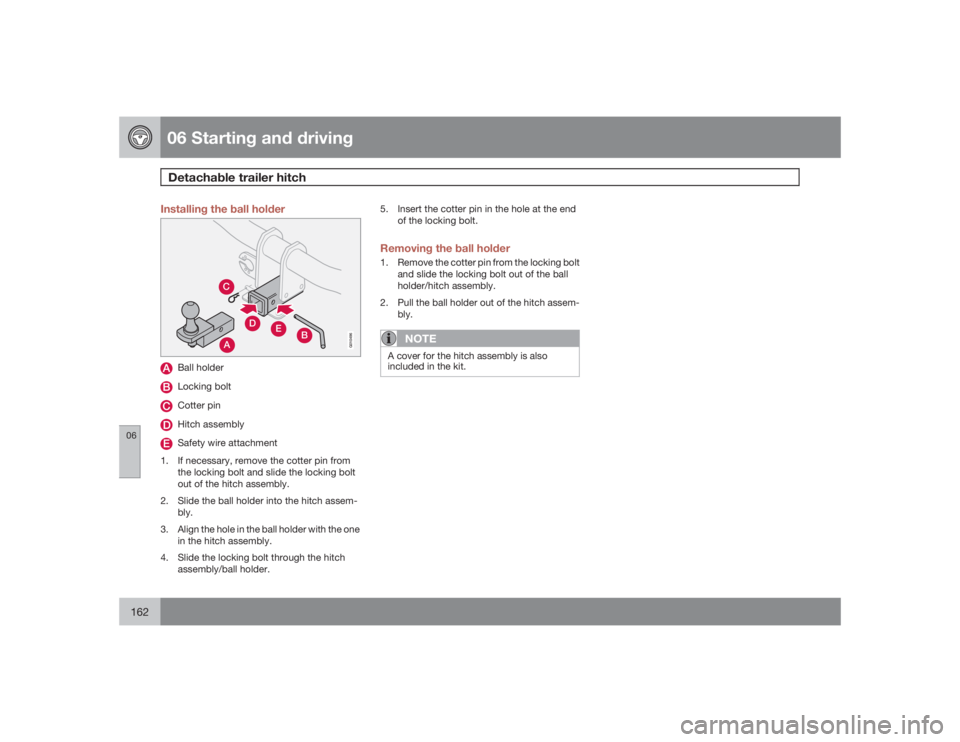
Installing the ball holder
AC
E
D
B
G010496
Ball holderLocking boltCotter pinHitch assemblySafety wire attachment
1. If necessary, remove the cotter pin from
the locking bolt and slide the locking bolt
out of the hitch assembly.
2. Slide the ball holder into the hitch assem-
bly.
3. Align the hole in the ball holder with the one
in the hitch assembly.
4. Slide the locking bolt through the hitch
assembly/ball holder.5. Insert the cotter pin in the hole at the end
of the locking bolt.
Removing the ball holder1. Remove the cotter pin from the locking bolt
and slide the locking bolt out of the ball
holder/hitch assembly.
2. Pull the ball holder out of the hitch assem-
bly.
NOTE
A cover for the hitch assembly is also
included in the kit.
Page 167 of 286
06 Starting and driving
Blind Spot Information System (BLIS)–option
06
167
when the system is switched off, and a text
message is displayed.
•
BLIS can be switched on again by pressing
the button. The indicator light in the button
will illuminate and a new text message will
be displayed. Press the READ button, see
page 60, to erase the message.
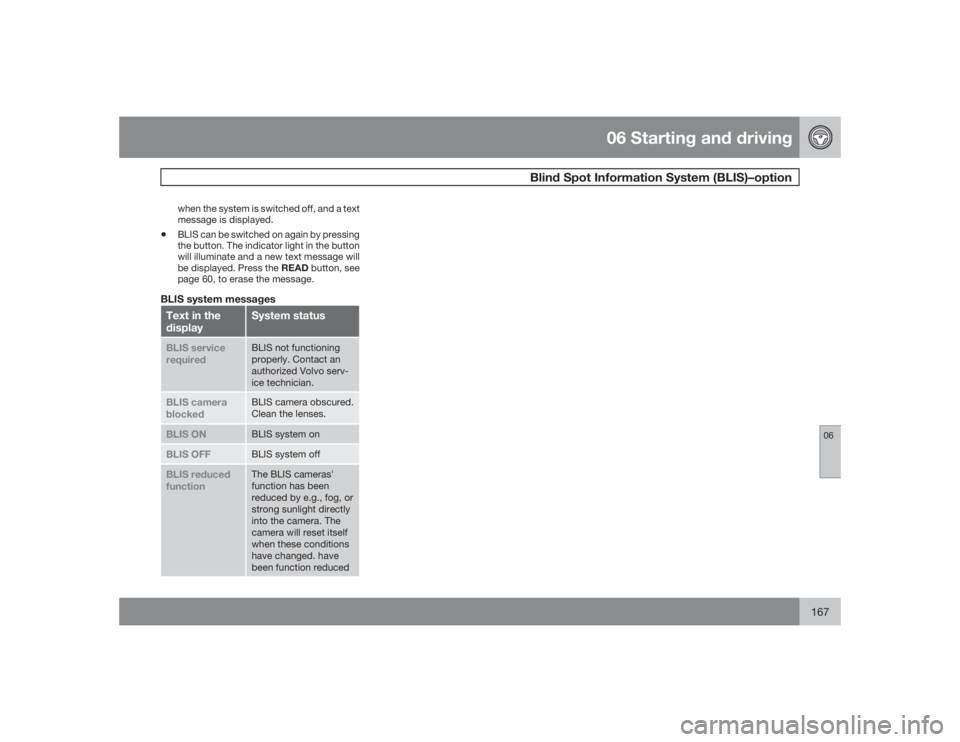
BLIS system messagesText in the
display
System status
BLIS service
required
BLIS not functioning
properly. Contact an
authorized Volvo serv-
ice technician.
BLIS camera
blocked
BLIS camera obscured.
Clean the lenses.
BLIS ON
BLIS system on
BLIS OFF
BLIS system off
BLIS reduced
function
The BLIS cameras'
function has been
reduced by e.g., fog, or
strong sunlight directly
into the camera. The
camera will reset itself
when these conditions
have changed. have
been function reduced
Page 186 of 286
07 Wheels and tiresSnow chains, snow tires, studded tires
07186
Snow chainsSnow chains can be used on your Volvo with
the following restrictions:•
Snow chains should be installed on front
wheels only. Use only Volvo approved
snow chains.
•
If accessory, aftermarket or "custom" tires
and wheels are installed and are of a size
different than the original tires and wheels,
chains in some cases CANNOT be used.
Sufficient clearances between chains and
brakes, suspension and body components
must be maintained.
•
Some strap-on type chains will interfere
with brake components and therefore
CANNOT be used.
•
All Wheel Drive models: Snow chains
should only be installed on the front
wheels. Only chains adapted for AWD
models should be used.
Consult your Volvo retailer for additional snow
chain information.
CAUTION
•
Check local regulations regarding the
use of snow chains before installing.
•
Always follow the chain manufacturer's
installation instructions carefully. Install
chains as tightly as possible and
retighten periodically.
•
Never exceed the chain manufacturer's
specified maximum speed limit. (Under
no circumstances should you exceed
31 mph (50 km/h).
•
Avoid bumps, holes or sharp turns
when driving with snow chains.
•
The handling of the vehicle can be
adversely affected when driving with
chains. Avoid fast or sharp turns as well
as locked wheel braking.
Snow tires, studded tiresTires for winter use:•
Owners who live in or regularly commute
through areas with sustained periods of
snow or icy driving conditions are strongly
advised to fit suitable winter tires to help
retain the highest degree of traction.
•
It is important to install winter tires on all
four wheels to help retain traction during
cornering, braking, and accelerating. Fail-ure to do so could reduce traction to an
unsafe level or adversely affect handling.
•
Do not mix tires of different design as this
could also negatively affect overall tire road
grip.
•
Winter tires wear more quickly on dry roads
in warm weather. They should be removed
when the winter driving season has ended.
•
Studded tires should be run-in 300–
600 miles (500–1000 km) during which the
car should be driven as smoothly as pos-
sible to give the studs the opportunity to
seat properly in the tires. The tires should
have the same rotational direction
throughout their entire lifetime.NOTE
Please consult state or provincial regula-
tions restricting the use of studded winter
tires before installing such tires.
Page 188 of 286
07 Wheels and tiresWheel nuts
07188
Wheel nuts
G020324
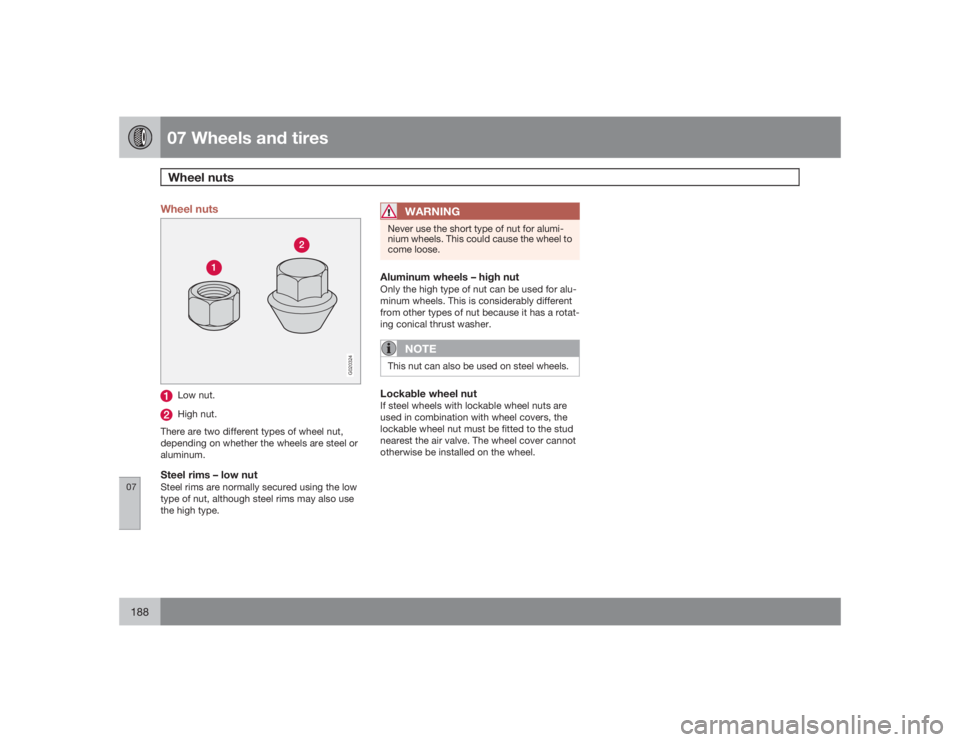
Low nut.High nut.
There are two different types of wheel nut,
depending on whether the wheels are steel or
aluminum.
Steel rims – low nutSteel rims are normally secured using the low
type of nut, although steel rims may also use
the high type.
WARNING
Never use the short type of nut for alumi-
nium wheels. This could cause the wheel to
come loose.Aluminum wheels – high nutOnly the high type of nut can be used for alu-
minum wheels. This is considerably different
from other types of nut because it has a rotat-
ing conical thrust washer.
NOTE
This nut can also be used on steel wheels.Lockable wheel nutIf steel wheels with lockable wheel nuts are
used in combination with wheel covers, the
lockable wheel nut must be fitted to the stud
nearest the air valve. The wheel cover cannot
otherwise be installed on the wheel.
Page 190 of 286
07 Wheels and tiresChanging a wheel
07190
Changing a wheel
G020331
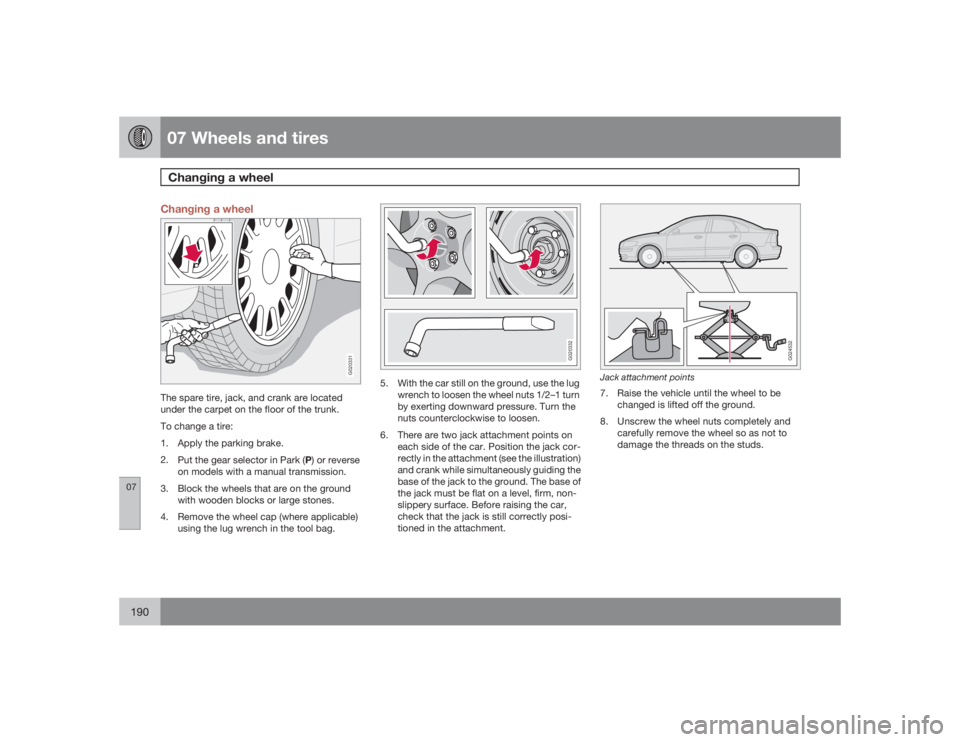
The spare tire, jack, and crank are located
under the carpet on the floor of the trunk.
To change a tire:
1. Apply the parking brake.
2.
Put the gear selector in Park (P) or reverse
on models with a manual transmission.
3. Block the wheels that are on the ground
with wooden blocks or large stones.
4. Remove the wheel cap (where applicable)
using the lug wrench in the tool bag.
G020332
5. With the car still on the ground, use the lug
wrench to loosen the wheel nuts 1/2–1 turn
by exerting downward pressure. Turn the
nuts counterclockwise to loosen.
6. There are two jack attachment points on
each side of the car. Position the jack cor-
rectly in the attachment (see the illustration)
and crank while simultaneously guiding the
base of the jack to the ground. The base of
the jack must be flat on a level, firm, non-
slippery surface. Before raising the car,
check that the jack is still correctly posi-
tioned in the attachment.
G024532
Jack attachment points7. Raise the vehicle until the wheel to be
changed is lifted off the ground.
8. Unscrew the wheel nuts completely and
carefully remove the wheel so as not to
damage the threads on the studs.
Page 191 of 286
07 Wheels and tires
Changing a wheel
07
191
WARNING
•
The jack must correctly engage the jack
attachment.
•
Be sure the jack is on a firm, level, non-
slippery surface.
•
Never allow any part of your body to be
extended under a car supported by a
jack.
•
Use the jack intended for the car when
changing a tire. For any other job, use
stands to support the car.
•
Apply the parking brake and put the
gear selector in the Park (P) position or
reverse on models with a manual trans-
mission.
•
Block the wheels standing on the
ground, use rigid wooden blocks or
large stones.
•
The jack should be kept well-greased
and clean, and should not be damaged.
•
No objects should be placed between
the base of jack and the ground, or
between the jack and the attachment
bar on the vehicle.
Installing the wheel1. Clean the contact surfaces on the wheel
and hub.
2. Lift the wheel and place it on the hub.
3. Install the wheel nuts and tighten hand-
tight. Using the lug wrench, tighten cross-
wise until all nuts are snug.
4. Lower the vehicle to the ground and alter-
nately tighten the bolts crosswise to
81 ft. lbs. (110 Nm).
5. Install the wheel cap (where applicable).Returning the jack to its storage space
G029335
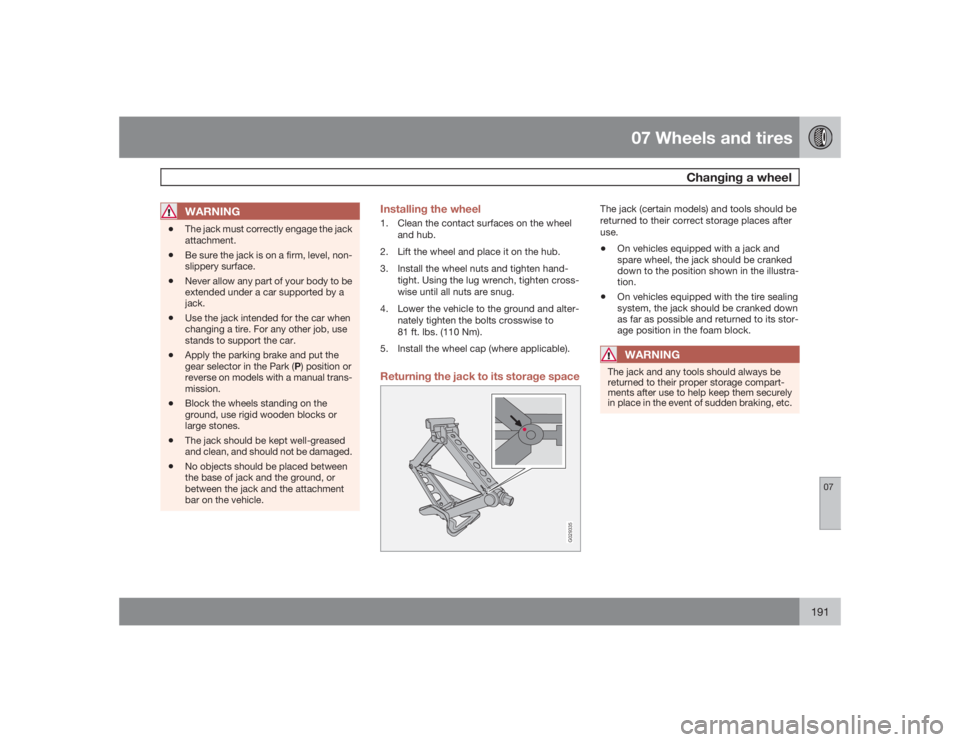
The jack (certain models) and tools should be
returned to their correct storage places after
use.•
On vehicles equipped with a jack and
spare wheel, the jack should be cranked
down to the position shown in the illustra-
tion.
•
On vehicles equipped with the tire sealing
system, the jack should be cranked down
as far as possible and returned to its stor-
age position in the foam block.WARNING
The jack and any tools should always be
returned to their proper storage compart-
ments after use to help keep them securely
in place in the event of sudden braking, etc.
Page 195 of 286
07 Wheels and tires
Tire Sealing System
07``195
CAUTION
The compressor should not be used for
more than 10 minutes at a time to avoid
overheating.
WARNING
If the pressure remains below 22 psi (1.8
bar) after approximately seven minutes, turn
off the compressor. In this case, the hole is
too large to be sealed and the vehicle should
not be driven.12. Switch off the compressor and disconnect
the electrical wire from the 12-volt socket.
13. Unscrew the hose from the tire’s inflation
valve and reinstall the valve cap.
14. Immediately drive the vehicle for approxi-
mately 2 miles (3 km) at a maximum speed
of 50 mph (80 km/h) to distribute the seal-
ing compound in the tire.
NOTE
•
Safely stow the tire sealing system in a
convenient place as it will soon be used
again to check the tire’s inflation pres-
sure.
•
The empty bottle of sealing compound
cannot be removed from the bottle
holder. Consult a trained and qualified
Volvo service technician to have the
bottle removed and properly disposed
of.WARNING
If heavy vibrations, unsteady steering
behavior, or noises should occur while driv-
ing, reduce speed and park the vehicle in a
safe place. Recheck the tire for bumps,
cracks, or other visible damage, and
recheck its inflation pressure. If the pressure
is below 19 psi (1.3 bar), do not continue
driving. Have the vehicle towed to a trained
and qualified Volvo service technician.Stage 2: Checking inflation pressure1. Connect the tire sealing system as descri-
bed in stage 1.
2. Refer to the inflation pressure tablesfor the
correct inflation pressure. If the tire needs
to be inflated, start the tire sealing system’s
compressor. If necessary, release air fromthe tire by turning the air release knob
counterclockwise.
CAUTION
The compressor should not be used for
more than 10 minutes at a time to avoid
overheating.
WARNING
If you interrupt your trip for more than 1
hour, check the inflation pressure in the
damaged tire again before continuing.Replacing the sealing compound
containerThe sealing compound container must be
replaced if:•
the tire sealing system has been used to
repair a tire
•
the container’s expiration date has passed
(see the date on decal).
Page 196 of 286
07 Wheels and tiresTire Sealing System
07196
NOTE
•
After use, the sealing compound bottle,
the hose, and certain other system
components must be replaced. Please
consult your Volvo retailer for replace-
ment parts.
•
If the sealing compound bottle’s expi-
ration date has passed, please take it to
a Volvo retailer or a recycling station
that can properly dispose of harmful
substances.
Inflating tiresThe tire sealing system can be used to inflate
the tires. To do so:
1. Park the car in a safe place.
2. The compressor should be switched off.
Ensure that the on/off switch is in posi-
tion0 (the 0 side of the switch should be
pressed down).
3. Take out the electrical wire and hose.
4. Remove the valve cap from the tire’s infla-
tion valve and screw the hose connector
onto the valve as tightly as possible by
hand.
5. Connect the electrical wire to the nearest
12-volt socket in the vehicle.6. Start the vehicle’s engine.
WARNING
•The vehicle’s engine should be running
when the tire sealing system is used to
avoid battery drain. Therefore, be sure
the vehicle is parked in a well ventilated
place, or outdoors, before using the sys-
tem.•Children should never be left unattended
in the vehicle when the engine is running.
7. Check the tire’s inflation pressure on the
gauge. Switch off the compressor briefly to
get a clear reading from the pressure
gauge.
8. Refer to the tire inflation tables for the cor-
rect inflation pressure. If the tire needs to
be inflated, start the tire sealing system’s
compressor (press the on/off switch to
position I). If necessary, release air from the
tire by turning the air release knob coun-
terclockwise.
CAUTION
The compressor should not be used for
more than 10 minutes at a time to avoid
overheating.
9. Turn off the compressor (press the on/off
switch to position 0) when the correct infla-
tion pressure has been reached.
10. Unscrew the hose from the tire’s inflation
valve and reinstall the valve cap.
11. Disconnect the electrical wire from the
12-volt socket.
Page 203 of 286
08 Car care
Washing and cleaning the car
08``203
CAUTION
•
During high pressure washing, the
spray mouthpiece must never be closer
to the vehicle than 13" (30 cm). Do not
spray into the locks.
•
Dirt, snow, etc., on the headlights can
reduce lighting capacity considerably.
Clean the headlights regularly, for
example when refueling.
•
When washing or steam cleaning the
engine, avoid spraying water or steam
directly on the electrical components or
toward the rear side of the engine.
•
Always close the moonroof (option) and
sun shade before washing your vehicle.
•
Never use abrasive cleaning agents on
the moonroof.
•
Never use wax on the rubber seals
around the moonroof.
Automatic washing – simple and quickWe do NOT recommend washing your car in an
automatic wash during the first six months
(because the paint will not have hardened suf-
ficiently).
An automatic wash is a simple and quick way
to clean your car, but it is worth remembering
that it may not be as thorough as when you
yourself go over the car with sponge and water.Keeping the underbody clean is most impor-
tant, especially in the winter. Some automatic
washers do not have facilities for washing the
underbody.
CAUTION
•
Before driving into an automatic car
wash, turn off the optional rain sensor
to avoid damaging the windshield wip-
ers.
•
Make sure that side view mirrors, auxil-
iary lamps, etc, are secure, and that any
antenna(s) are retracted or removed.
Otherwise there is risk of the machine
dislodging them
•
Chromed wheels: Clean chrome-
plated wheels using the same deter-
gents used for the body of the vehicle.
Aggressive wheel-cleaning agents can
permanently stain chrome-plated
wheels.WARNING
•
When the car is driven immediately after
being washed, apply the brakes several
times in order to remove any moisture
from the brake linings.
•
Engine cleaning agents should not be
used when the engine is warm. This
constitutes a fire risk.
Exterior lightingCondensation may form temporarily on the
inside of the lenses of exterior lights such as
headlights, fog lights, or taillights. This is nor-
mal and the lights are designed to withstand
moisture. Normally, condensation will dissi-
pate after the lights have been on for a short
time.Polishing and Waxing•
Normally, polishing is not required during
the first year after delivery, however, wax-
ing may be beneficial.
•
Before applying polish or wax the vehicle
must be washed and dried. Tar spots can
be removed with kerosene or tar remover.
Difficult spots may require a fine rubbing
compound.
•
After polishing use liquid or paste wax.
•
Several commercially available products
contain both polish and wax.
•
Waxing alone does not substitute for pol-
ishing a dull surface.
•
A wide range of polymer-based waxes can
be purchased today. These waxes are easy
to use and produce a long-lasting, high-
gloss finish that protects the bodywork
against oxidation, road dirt and fading.
•
Do not polish or wax your vehicle in direct
sunlight (the surface of the vehicle should
not be warmer than 113 °F (45 °C).