trailer VOLVO S40 2010 Owner´s Manual
[x] Cancel search | Manufacturer: VOLVO, Model Year: 2010, Model line: S40, Model: VOLVO S40 2010Pages: 292, PDF Size: 6.75 MB
Page 170 of 292
06 Starting and driving
Park assist*
06
170* Option/accessory, for more information, see Introduction.
Introduction
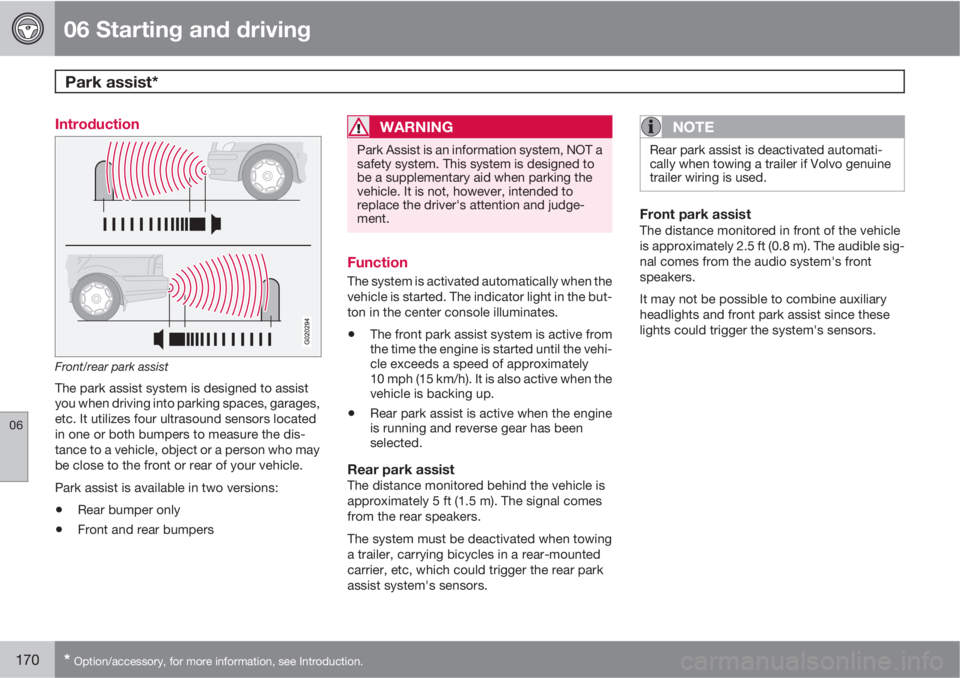
Front/rear park assist
The park assist system is designed to assist
you when driving into parking spaces, garages,
etc. It utilizes four ultrasound sensors located
in one or both bumpers to measure the dis-
tance to a vehicle, object or a person who may
be close to the front or rear of your vehicle.
Park assist is available in two versions:
•Rear bumper only
•Front and rear bumpers
WARNING
Park Assist is an information system, NOT a
safety system. This system is designed to
be a supplementary aid when parking the
vehicle. It is not, however, intended to
replace the driver's attention and judge-
ment.
Function
The system is activated automatically when the
vehicle is started. The indicator light in the but-
ton in the center console illuminates.
•The front park assist system is active from
the time the engine is started until the vehi-
cle exceeds a speed of approximately
10 mph (15 km/h). It is also active when the
vehicle is backing up.
•Rear park assist is active when the engine
is running and reverse gear has been
selected.
Rear park assistThe distance monitored behind the vehicle is
approximately 5 ft (1.5 m). The signal comes
from the rear speakers.
The system must be deactivated when towing
a trailer, carrying bicycles in a rear-mounted
carrier, etc, which could trigger the rear park
assist system's sensors.
NOTE
Rear park assist is deactivated automati-
cally when towing a trailer if Volvo genuine
trailer wiring is used.
Front park assistThe distance monitored in front of the vehicle
is approximately 2.5 ft (0.8 m). The audible sig-
nal comes from the audio system's front
speakers.
It may not be possible to combine auxiliary
headlights and front park assist since these
lights could trigger the system's sensors.
Page 186 of 292
07 Wheels and tires
Vehicle loading
07
186
Loading the vehicle
Before loading your vehicle, familiarize yourself
with the following terms for determining your
vehicle's weight ratings, with or without a
trailer, from the vehicle's Federal/Canadian
Motor Vehicle Safety Standards (FMVSS/
CMVSS) label, and the vehicle's tire informa-
tion placard:
Curb weightThe weight of the vehicle including a full tank
of fuel and all standard equipment. It does not
include passengers, cargo, or optional equip-
ment.
Capacity weightAll weight added to the curb weight, including
cargo and optional equipment. When towing,
trailer hitch tongue load is also part of cargo
weight.
NOTE
For trailer towing information, please refer to
the section "Towing a trailer", see
page 162.
Permissible axle weightThe maximum allowable weight that can be
carried by a single axle (front or rear). These
numbers are shown on the Federal/CanadianMotor Vehicle Safety Standards (FMVSS/
CMVSS) label. The total load on each axle must
never exceed its maximum permissible weight.
Gross vehicle weight (GVW)The vehicle's curb weight + cargo + passen-
gers.
NOTE
•The location of the various labels in your
vehicle can be found on page 268.
•A table listing important weight limits for
your vehicle can be found on page
271.
Steps for Determining Correct Load
Limit
1. Locate the statement "the combined
weight of occupants and cargo should
never exceed XXX pounds" on your vehi-
cle's placard.
2. Determine the combined weight of the
driver and passengers that will be riding in
your vehicle.3. Subtract the combined weight of the driver
and passengers from XXX kilograms or
XXX pounds.
4. The resulting figure equals the available
amount of cargo and luggage load
capacity. For example, if the "XXX" amount
equals 1400 lbs. and there will be five
150 lbs. passengers in your vehicle, the
amount of available cargo and luggage
load capacity is 650 lbs. (1400–750 (5×150)
= 650 lbs.)
5. Determine the combined weight of luggage
and cargo being loaded on the vehicle.
That weight may not safely exceed the
available cargo and luggage load capacity
calculated in Step 4.
6. If your vehicle will be towing a trailer, load
from your trailer will be transferred to your
vehicle. Consult this manual1 to determine
how this reduces the available cargo and
luggage load capacity of your vehicle.
1See "Towing a trailer"
Page 234 of 292
09 Maintenance and servicing
Fuses 09
234
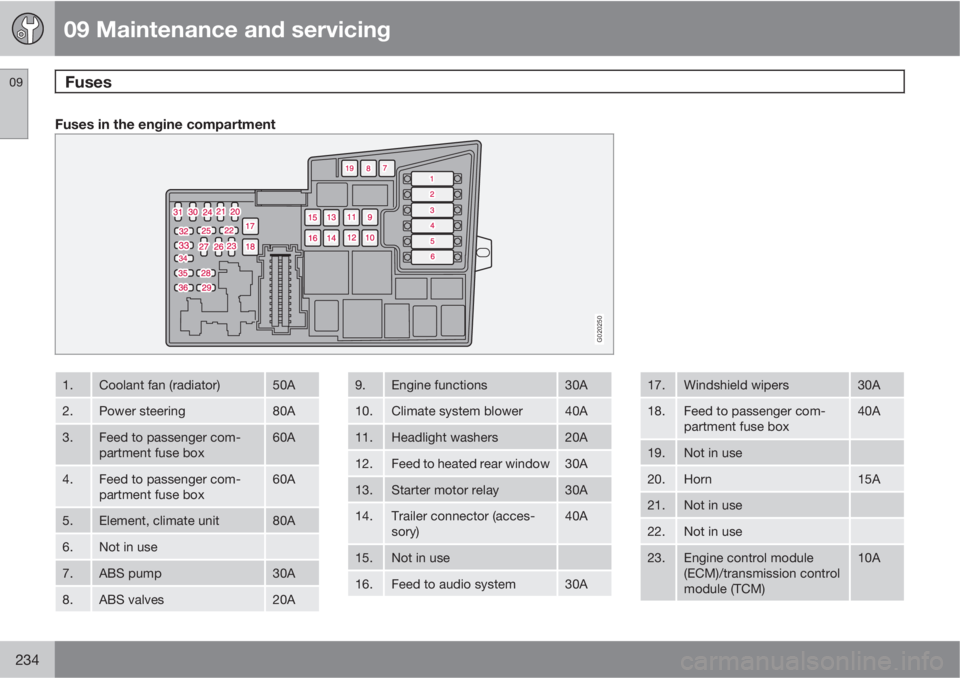
Fuses in the engine compartment
G020250
1.Coolant fan (radiator)50A
2.Power steering80A
3.Feed to passenger com-
partment fuse box60A
4.Feed to passenger com-
partment fuse box60A
5.Element, climate unit80A
6.Not in use
7.ABS pump30A
8.ABS valves20A
9.Engine functions30A
10.Climate system blower40A
11.Headlight washers20A
12.Feed to heated rear window30A
13.Starter motor relay30A
14.Trailer connector (acces-
sory)40A
15.Not in use
16.Feed to audio system30A
17.Windshield wipers30A
18.Feed to passenger com-
partment fuse box40A
19.Not in use
20.Horn15A
21.Not in use
22.Not in use
23.Engine control module
(ECM)/transmission control
module (TCM)10A
Page 272 of 292
11 Specifications
Dimensions and weights
11
272
CategoryUSACanada
Curb weightFWD: 3165–3300 lbs
AWD: 3415–3455 lbs1435–1505 kg
1555–1575 kg
Max. roof loadAll models: 165 lbsAll models: 75 kg
Max. trailer weight (w/o brakes)CAll models: 1540 lbsAll models: 700 kg
Max. trailer weight (with brakes)CAll models: 2000 lbsAll models: 900 kg
Max. tongue weightAll models: 165 lbsAll models: 75 kg
AFWD = Front Wheel DriveBAWD = All Wheel DriveCModels equipped with the B5244S7 engine (engine code 39, which is the 6th and 7th digits from the left in your vehicle's VIN number, see chapter Label information, for the location of the VIN plate),
may not be used to tow trailers or vehicles of any kind. This could cause damage to the vehicle's emission control systems.
CAUTION
The maximum permissible axle loads and/
or the gross vehicle weight must not be
exceeded.
WARNING
When adding accessories, equipment, lug-
gage and other cargo to your vehicle, the
total capacity weight must not be exceeded.
Page 274 of 292
11 Specifications
Fuel, oils, and fluids
11
274
CategorySpecificationCapacity
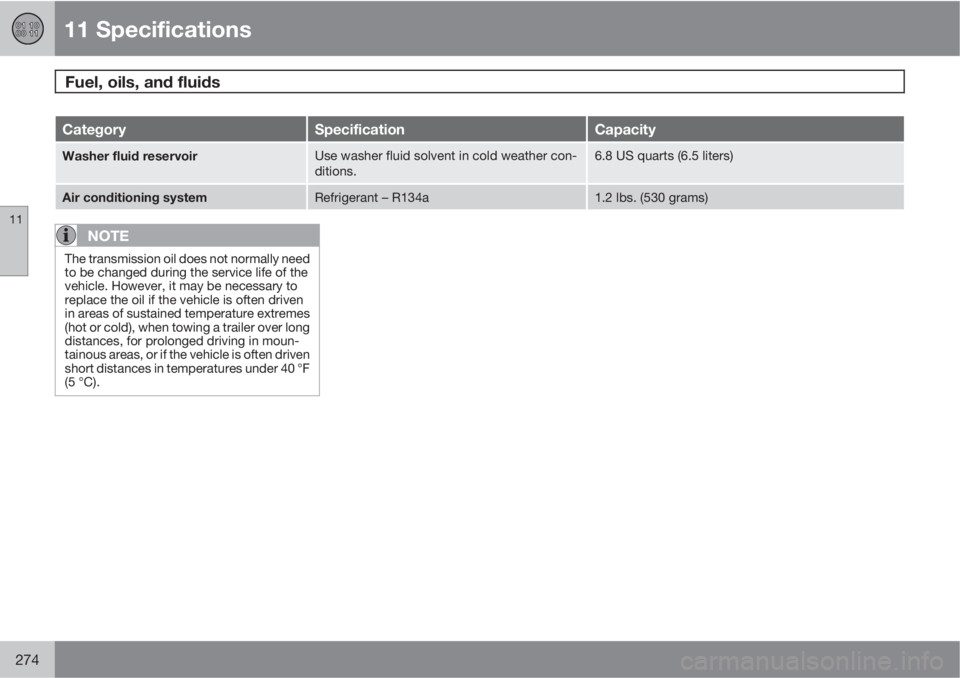
Washer fluid reservoirUse washer fluid solvent in cold weather con-
ditions.6.8 US quarts (6.5 liters)
Air conditioning systemRefrigerant – R134a1.2 lbs. (530 grams)
NOTE
The transmission oil does not normally need
to be changed during the service life of the
vehicle. However, it may be necessary to
replace the oil if the vehicle is often driven
in areas of sustained temperature extremes
(hot or cold), when towing a trailer over long
distances, for prolonged driving in moun-
tainous areas, or if the vehicle is often driven
short distances in temperatures under 40 °F
(5 °C).
Page 275 of 292
11 Specifications
Engine oil
11
275 Oil specifications
Engine oil must meet the minimum ILSAC
specification GF-4, API SL, or ACEA A1/B1.
Lower quality oils may not offer the same fuel
economy, engine performance, or engine pro-
tection.
Volume: 6.1 US qts (5.8 liters).
Volume between the MIN and Max marks on
the dipstick: approximately 1.4 US qts (1.3 lit-
ers).
Volvo recommends Castrol.
Depending on your driving habits, premium or
synthetic oils may provide superior fuel econ-
omy and engine protection. Consult your Volvo
retailer or a trained and qualified Volvo service
technician for recommendations on premium
or synthetic oils.
Oil additives must not be used.
NOTE
Synthetic oil is not used when the oil is
changed at the normal service intervals.
This oil is only used at customer request, at
additional charge. Please consult a trained
and qualified Volvo service technician.
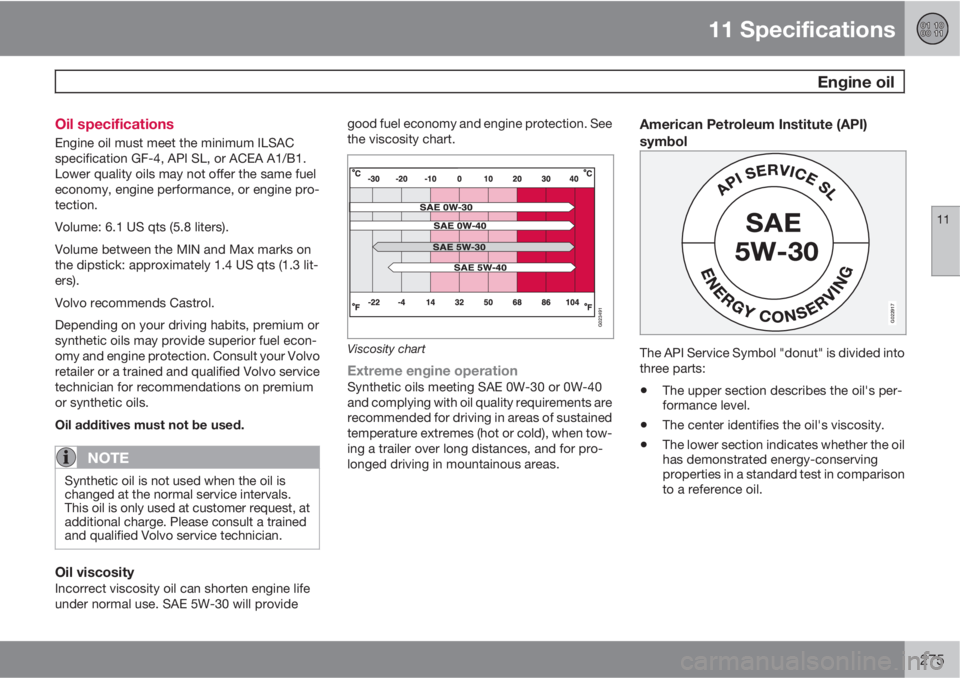
Oil viscosityIncorrect viscosity oil can shorten engine life
under normal use. SAE 5W-30 will providegood fuel economy and engine protection. See
the viscosity chart.
G023491
Viscosity chart
Extreme engine operationSynthetic oils meeting SAE 0W-30 or 0W-40
and complying with oil quality requirements are
recommended for driving in areas of sustained
temperature extremes (hot or cold), when tow-
ing a trailer over long distances, and for pro-
longed driving in mountainous areas.
American Petroleum Institute (API)
symbol
G022917
The API Service Symbol "donut" is divided into
three parts:
•The upper section describes the oil's per-
formance level.
•The center identifies the oil's viscosity.
•The lower section indicates whether the oil
has demonstrated energy-conserving
properties in a standard test in comparison
to a reference oil.
Page 283 of 292
12 Index
12
283
fluid..................................................... 221
general information............................. 155
Bulbs
headlights........................................... 225
list of................................................... 278
Bulbs, replacing....................................... 225
C
Capacities, fluids..................................... 273
Capacity weight............................... 186, 271
Catalytic converter, three-way................. 280
CD changer.............................................. 255
CD player................................................. 255
Cell phone, hands-free connection......... 260
Central locking system - remote key....... 120
Chains...................................................... 189
Changing a wheel.................................... 192
Child restraints
recalls and registration......................... 47
Child restraint systems.............................. 37
booster cushions.................................. 43
convertible seats.................................. 41
infant seats........................................... 39ISOFIX/LATCH anchors........................ 44
top tether anchors................................ 46
Child safety................................................ 35
booster cushions.................................. 43
child restraint systems.......................... 37
convertible seats.................................. 41
infant seats........................................... 39
Child safety locks....................................131
Climate system
air distribution..................................... 101
air vents................................................ 94
Electronic Climate Control.................... 98
manual climate control......................... 95
passenger compartment filter.............. 92
refrigerant.....................................92, 273
Climate system, general information......... 92
Clock
setting................................................... 83
Coat hanger............................................. 112
Cold weather precautions........................ 139
Compact disc care..................................257
Compass in rearview mirror....................... 78
Conserving electrical current................... 140
Convertible seats....................................... 41Coolant.................................................... 273
changing............................................. 220
checking level of................................. 220
Courtesy lighting...................................... 109
Crash mode............................................... 34
Cruise control............................................ 70
Cup holders.....................................111, 113
Curb weight.....................................186, 271
D
Detachable key blade.............................. 122
Detachable trailer hitch............................ 164
Dimensions.............................................. 270
Disconnecting the front passenger’s air-
bag............................................................. 26
Display.......................................................60
Dolby Pro Logic II (DPL II)........................ 245
Door mirrors............................................... 79
Driving economically................................ 138
Driving through water..............................139
DSTC, stability system............................ 157
Page 288 of 292
12 Index
12
288
inflation pressure table, Canadian mod-
els.......................................................182
inflation pressure table, US models.... 181
load ratings......................................... 180
rotation............................................... 177
snow...................................................189
spare................................................... 190
speed ratings...................................... 180
storing................................................. 177
studded............................................... 189
tire pressure monitoring system......... 199
tire sealing system.............................. 194
tread wear indicator............................ 178
uniform tire quality grading................. 188
winter driving...................................... 189
Tire sealing system.................................. 194
Top tether anchors (child restraint sys-
tems).......................................................... 46
Towing a trailer........................................ 162
trailer hitch.......................................... 164
Towing the vehicle................................... 159
Trailer hitch - detachable......................... 164
Trailer towing........................................... 162Transmission
Geartronic........................................... 152
manual........................................ 149, 150
shiftlock override................................ 153
Tread wear indicator................................ 178
Treble....................................................... 244
Trip computer............................................ 68
Trips, long distance................................. 140
Trunk
opening from the inside...................... 129
Turn signals............................................... 66
indicator lights...................................... 53
U
Uniform Tire Quality Grading...................188
V
Valet locking............................................ 124
Vehicle dimensions.................................. 270
Vehicle Event Data................................... 212
Vehicle loading........................................ 186
roof loads............................................ 165Vehicle maintenance
performed by the owner.....................214
Vehicle towing.........................................159
Vehicle weights........................................ 271
VIN (Vehicle Identification Number)......... 269
Volvo Inflatable Curtain.............................. 30
Volvo On Call Roadside Assistance........ 281
W
Warning flashers, hazard........................... 74
Warning symbol......................................... 55
Warranties................................................ 212
Washer fluid..................................... 220, 273
Washer fluid reservoir......................217, 220
Water, driving through............................. 139
Weights.................................................... 271
Wheel nuts............................................... 191
Wheels.....................................................176
changing............................................. 192
storing................................................. 177
Whiplash Protection System (WHIPS)....... 32