steering wheel VOLVO S60 2001 User Guide
[x] Cancel search | Manufacturer: VOLVO, Model Year: 2001, Model line: S60, Model: VOLVO S60 2001Pages: 128, PDF Size: 2.52 MB
Page 64 of 128

release of the powder may appear as smoke- like matter. This is a normal characteristic and does not indicate fire.
NOTE: Volvo's dual- threshold, dual- stage airbags use special sensors that are integrated with the front seat buckles.
The point at which the airbag deploys is determined by whether or not the seat belt is being used, as well as the
severity of the collision. Collisions can occur where only one of the airbags deploys.
If the impact is less severe, but severe enough to present a clear injury risk, the dual- stage airbags are triggered at
just 70% of their total capacity. If the impact is more severe, the dual- stage airbags are triggered at full capacity.
WARNING!
Do not use child safety seats or child booster cushions/ backrests in the front passenger's seat. We also recommend
that occupants under 4 feet 7 inches (140 cm) in height who have outgrown these devices sit in the rear seat with the
seat belt fastened. Never drive with the airbags deployed. The fact that they hang out can impair the steering of your
car. Other safety systems can also be damaged. The smoke and dust formed when the airbags are deployed can
cause skin and eye irritation in the event of prolonged exposure.
pg. 14 Airbags (Supplemental Restraint System)
WARNING!
Children must never be allowed in the front passenger's seat. Volvo recommends that ALL occupants (adults and
children) shorter than 4 feet 7 inches (140 cm) be seated in the back seat of any vehicle with a front passenger -side
airbag. See page 28
for guidelines.
Occupants in the front passenger's seat must never sit on the edge of the seat, sit leaning toward the instrument
panel or otherwise sit out of position. The occupant's back must be as upright as comfort allows and be against the
seat back with the seat belt properly fastened.
Feet must be on the floor, e. g. not on the dash, seat or out of the window. No objects or accessory equipment, e. g.
dash covers, may be placed on, attached to, or installed near the SRS hatch (the area above the glove compartment)
or the area affected by airbag deployment (see illustration on page 12
).
There should be no loose articles, e. g. coffee cups, on the floor, seat or dash area. Never try to open the SRS cover
on the steering wheel or the passenger side dash. This should only be done by an authorized Volvo service
technician.
Failure to follow these instructions can result in injury to the vehicle occupants
Warning light in the instrument panel
A self - diagnostic system incorporated in the sensor monitors the SRS. This system does not, however, monitor the
Side Impact Protection System (SIPS) airbags. If a fault is detected, the warning light will illuminate. The light is
included in the warning/ indicator light cluster in the instrument panel. Normally, the SRS warning lamp should light
ProCarManuals.com
Page 66 of 128
If your car has been subjected to flood conditions (e. g. soaked carpeting/ standing water on the floor of the vehicle)
or if your car has become flood-damaged in any way, do not attempt to start the vehicle or put the key in the
ignition before discon- necting the battery (see below). This may cause airbag deployment which could result in
personal injury. Have the car towed to an authorized Volvo retailer for repairs.
Automatic transmission:
Before attempting to tow the car, use the following procedure to override the shiftlock system to move the gear
selector to the neutral position.
Switch off the ignition for at least 10 minutes and disconnect the battery
Wait at least one minute
Insert the key in the ignition and turn it to position II
Press firmly on the brake pedal.
Move the gear selector from (P) ark to the (N) eutral position.
There is no maintenance to perform on the SRS yourself. The month and year shown on the decal on the door pillar
indicate when you should contact your Volvo retailer for specific servicing or replacement of airbags and seat belt
tensioners. This service must be performed by an authorized Volvo retailer.
Should you have any questions about the SRS system, please contact your authorized Volvo retailer or Volvo
Customer Support.:
In the USA:
Volvo Cars of North America
Customer Relations
P.O. Box 914
Rockleigh, New Jersey 07647-0914
800-458-1552
In Canada:
Volvo Canada Ltd.
175 Gordon Baker Road
Willowdale, Ontario M2H 2N7
800-663-8255
pg. 17 Airbags (Supplemental Restraint System)
Front airbag (SRS) system
As an enhancement to the three-point seat belt system, your Volvo is equipped with a Supple- mental Restraint
System (SRS). The Volvo SRS consists of an airbag (2) on both the driver's and passenger's sides and seat belt
tensioners in both front door pillars. The system is designed to supplement the protection provided by the three-point
seat belt system. All three rear seat belts are also equipped with tensioners.
The SRS system is indicated by the "SRS" embossed on the steering wheel pad and above the glove compartment,
and by decals on both sun visors and on the front and far right side of the dash.
ProCarManuals.com
Page 67 of 128
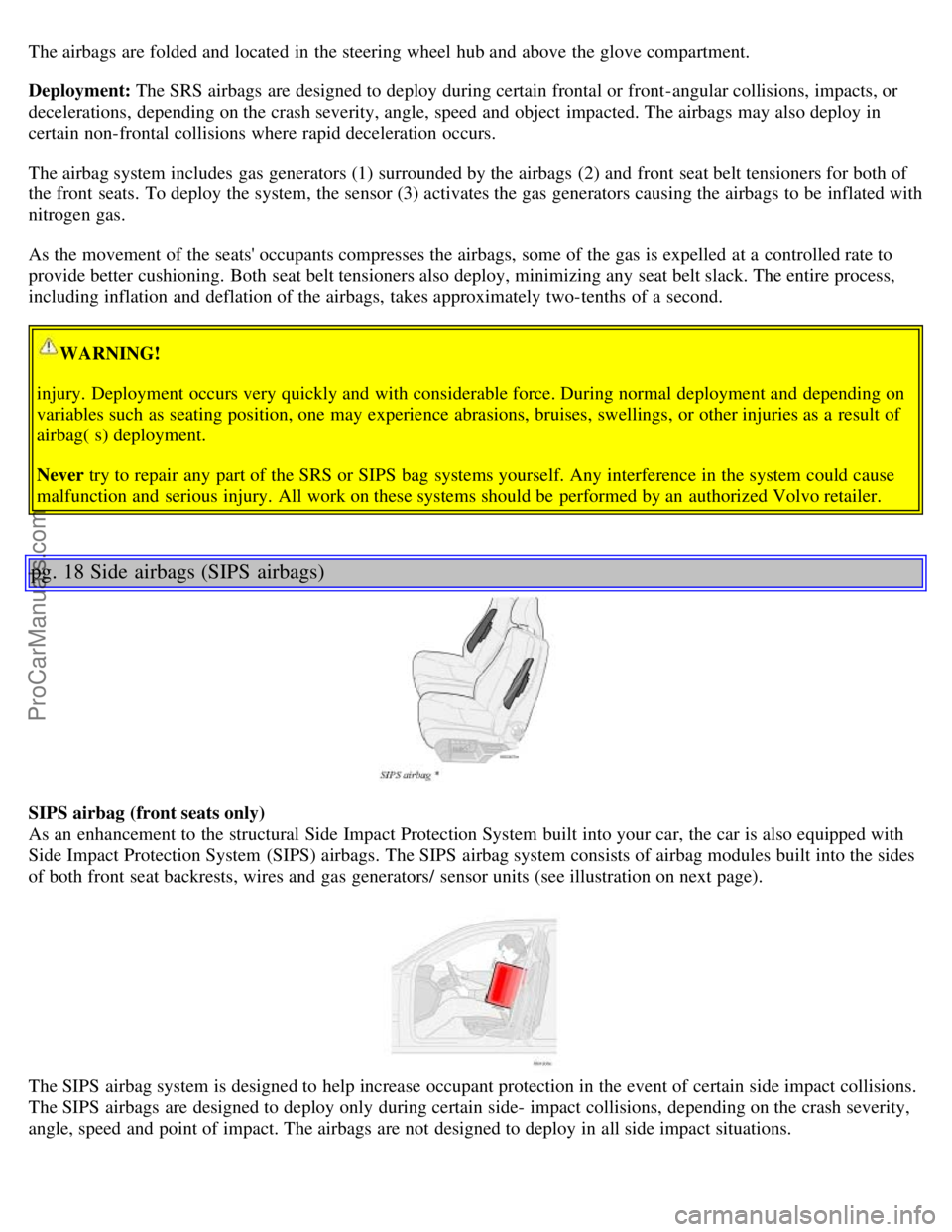
The airbags are folded and located in the steering wheel hub and above the glove compartment.
Deployment: The SRS airbags are designed to deploy during certain frontal or front -angular collisions, impacts, or
decelerations, depending on the crash severity, angle, speed and object impacted. The airbags may also deploy in
certain non-frontal collisions where rapid deceleration occurs.
The airbag system includes gas generators (1) surrounded by the airbags (2) and front seat belt tensioners for both of
the front seats. To deploy the system, the sensor (3) activates the gas generators causing the airbags to be inflated with
nitrogen gas.
As the movement of the seats' occupants compresses the airbags, some of the gas is expelled at a controlled rate to
provide better cushioning. Both seat belt tensioners also deploy, minimizing any seat belt slack. The entire process,
including inflation and deflation of the airbags, takes approximately two-tenths of a second.
WARNING!
injury. Deployment occurs very quickly and with considerable force. During normal deployment and depending on
variables such as seating position, one may experience abrasions, bruises, swellings, or other injuries as a result of
airbag( s) deployment.
Never try to repair any part of the SRS or SIPS bag systems yourself. Any interference in the system could cause
malfunction and serious injury. All work on these systems should be performed by an authorized Volvo retailer.
pg. 18 Side airbags (SIPS airbags)
SIPS airbag (front seats only)
As an enhancement to the structural Side Impact Protection System built into your car, the car is also equipped with
Side Impact Protection System (SIPS) airbags. The SIPS airbag system consists of airbag modules built into the sides
of both front seat backrests, wires and gas generators/ sensor units (see illustration on next page).
The SIPS airbag system is designed to help increase occupant protection in the event of certain side impact collisions.
The SIPS airbags are designed to deploy only during certain side- impact collisions, depending on the crash severity,
angle, speed and point of impact. The airbags are not designed to deploy in all side impact situations.
ProCarManuals.com
Page 79 of 128
with sufficient volume left over to accommodate possible expansion of the fuel in hot weather. Be aware that the
"usable" tank capacity will be somewhat less than the specified maximum. When the fuel level is low, such factors as
ambient temper- ature, the fuel's "Reid vapor pressure" charac- teristics, and terrain can affect the fuel pump's ability
to supply the engine with an adequate supply of fuel. Therefore, it is advisable to refuel as soon as possible when the
needle nears the red zone, or when the fuel warning light comes on.
CAUTION:
Do not refuel with the engine running *. Turn the ignition off or to position I. If the ignition is on, an incorrect
reading could occur in the fuel gauge After refueling, close the fuel filler cap by turning it clockwise until it clicks
into place*.
Allow for fuel expansion by not overfilling the tank. Overfilling could also cause damage to the emission control
systems. Avoid spilling gasoline during refueling. In addition to causing damage to the environment, gasolines
containing alcohol can cause damage to painted surfaces, which may not be covered under the New Vehicle Limited
Warranty.
Do not use gasolines containing methanol (methyl alcohol, wood alcohol). This practice can result in vehicle
performance deterioration and can damage critical parts in the fuel system. Such damage may not be covered under
the New Vehicle Limited Warranty.
* If the fuel filler cap is not closed tightly or if the engine is running when the car is refueled, the Check Engine Light
(malfunction indicator lamp) may indicate a fault. However, your vehicle's performance will not be affected. Use only
Volvo original or approved fuel filler caps.
pg. 128 Starting the car
Starting the engine
1. Fasten the seat belt.
WARNING!
Before starting, check that the seat, steering wheel and mirrors are adjusted properly. Make sure the brake pedal can
be depressed completely. Adjust the seat if necessary. See pages 100, 102.
2. Apply the parking brake (hand brake) if not already set. The gear selector (automatic transmission) is locked in the
(P) ark position (SHIFTLOCK). Manual transmission: the clutch must be fully depressed.
3. Without touching the accelerator pedal, turn the ignition key* to the starting position. Allow the starter to operate
for up to 10 seconds. Release the key as soon as the engine starts. If the engine fails to start, repeat this step.
For cold starts at altitudes above 6000 ft (1800 meters), depress the accelerator pedal halfway and turn the key to the
starting position. Release the pedal slowly when the engine starts.
4. To release the gear selector from the (P) ark position, the engine must be running (or theignition key must be in
position II) and the brake pedal must be depressed.
5. Select the desired gear. The gear engages after a very slight delay which is especially noticeable when selecting R.
NOTE: Your car is equipped with a KEYLOCK system (automatic transmission). When the engine is switched off,
the gear selector must be in the (P) ark position before the key can be removed from the ignition switch.
When starting in cold weather, the transmission may shift up at slightly higher engine speeds than normal until the
automatic transmission fluid reaches normal operating temperature.
CAUTION:
ProCarManuals.com
Page 80 of 128
Automatic transmission
The engine should be idling when you move the gear selector. Never accelerate until after you feel the transmission
engage! Acceler- ating immediately after selecting a gear will cause harsh engagement and premature transmission
wear.
Selecting P or N when idling at a standstill for prolonged periods of time will help prevent overheating of the
automatic trans - mission fluid.
WARNING!
Always place the gear selector in Park and apply the parking brake before leaving the vehicle. Never leave the car
unattended with the engine running.
Always open garage doors fully before starting the engine inside a garage to ensure adequate ventilation. The
exhaust gases contain carbon monoxide, which is invisible and odorless but very poisonous
Do not race a cold engine immediately after starting. Oil flow may not reach some lubrication points fast enough to
prevent engine damage.
* If two of the keys to your car are close together, e. g., on the same key ring, when you try to start the car, this could
cause interference in the immobilizer system and result in the car not starting. If this should occur, remove one of the
keys from the key ring before trying to start the car again.
pg. 129 Starting the car
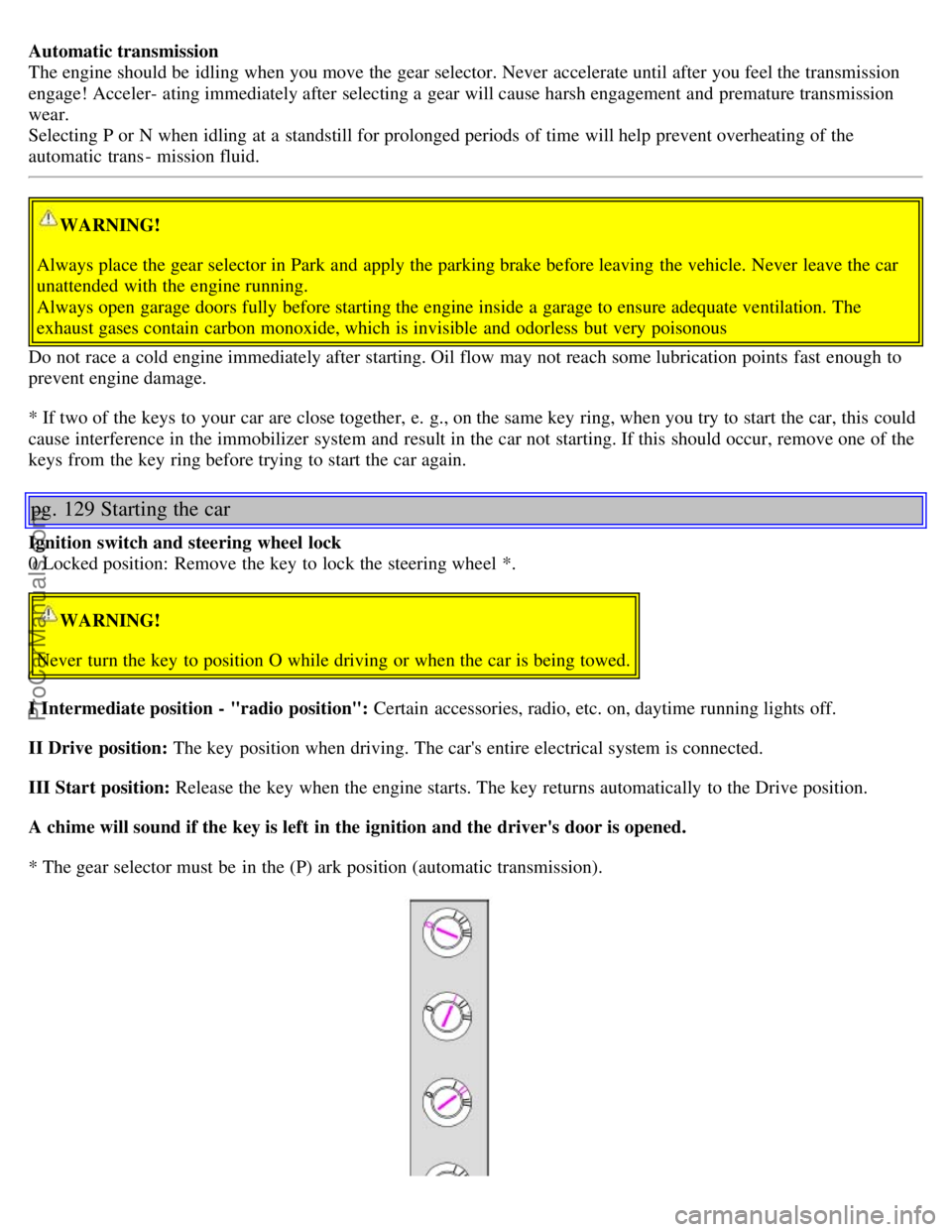
Ignition switch and steering wheel lock
0 Locked position: Remove the key to lock the steering wheel *.
WARNING!
Never turn the key to position O while driving or when the car is being towed.
I Intermediate position - "radio position": Certain accessories, radio, etc. on, daytime running lights off.
II Drive position: The key position when driving. The car's entire electrical system is connected.
III Start position: Release the key when the engine starts. The key returns automatically to the Drive position.
A chime will sound if the key is left in the ignition and the driver's door is opened.
* The gear selector must be in the (P) ark position (automatic transmission).
ProCarManuals.com
Page 81 of 128
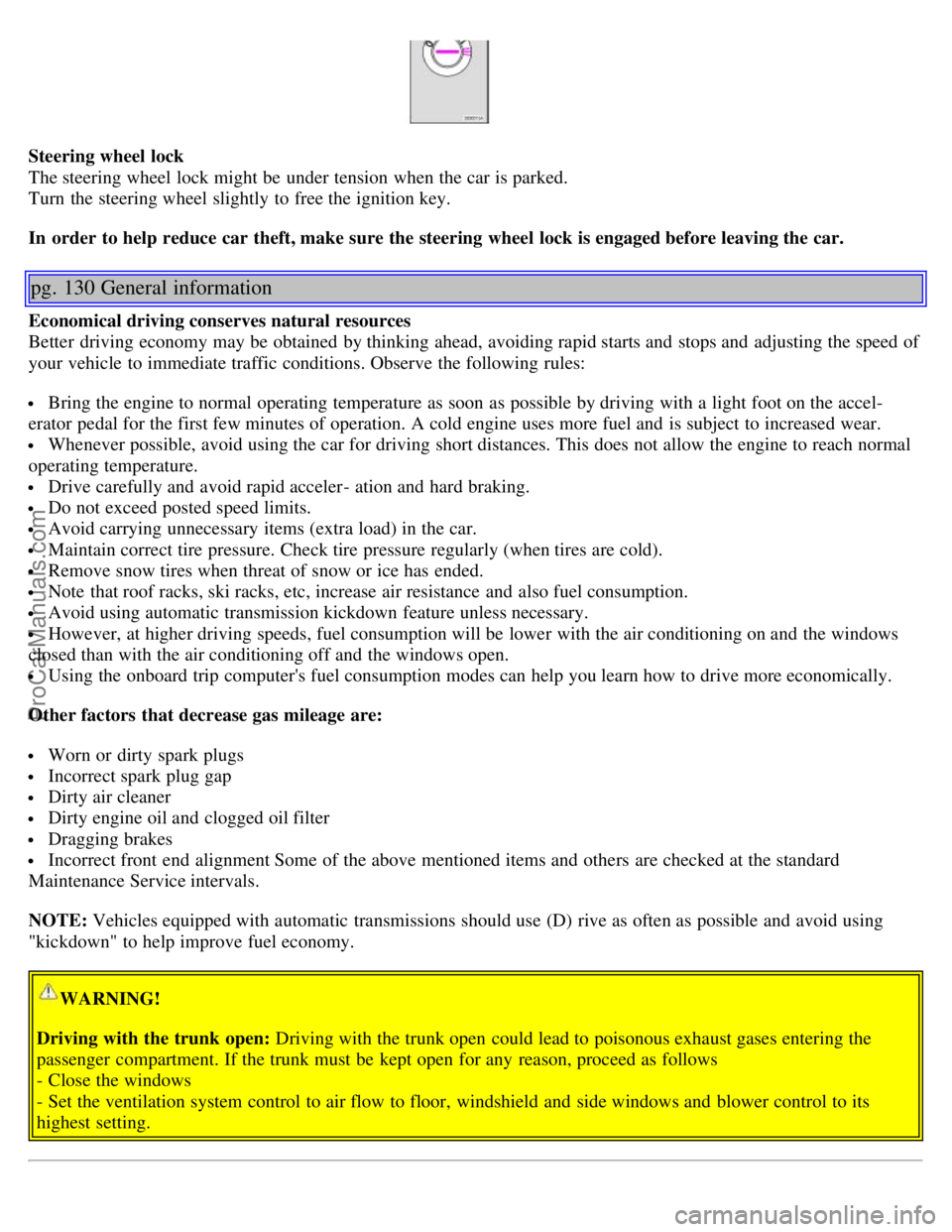
Steering wheel lock
The steering wheel lock might be under tension when the car is parked.
Turn the steering wheel slightly to free the ignition key.
In order to help reduce car theft, make sure the steering wheel lock is engaged before leaving the car.
pg. 130 General information
Economical driving conserves natural resources
Better driving economy may be obtained by thinking ahead, avoiding rapid starts and stops and adjusting the speed of
your vehicle to immediate traffic conditions. Observe the following rules:
Bring the engine to normal operating temperature as soon as possible by driving with a light foot on the accel-
erator pedal for the first few minutes of operation. A cold engine uses more fuel and is subject to increased wear.
Whenever possible, avoid using the car for driving short distances. This does not allow the engine to reach normal
operating temperature.
Drive carefully and avoid rapid acceler- ation and hard braking.
Do not exceed posted speed limits.
Avoid carrying unnecessary items (extra load) in the car.
Maintain correct tire pressure. Check tire pressure regularly (when tires are cold).
Remove snow tires when threat of snow or ice has ended.
Note that roof racks, ski racks, etc, increase air resistance and also fuel consumption.
Avoid using automatic transmission kickdown feature unless necessary.
However, at higher driving speeds, fuel consumption will be lower with the air conditioning on and the windows
closed than with the air conditioning off and the windows open.
Using the onboard trip computer's fuel consumption modes can help you learn how to drive more economically.
Other factors that decrease gas mileage are:
Worn or dirty spark plugs
Incorrect spark plug gap
Dirty air cleaner
Dirty engine oil and clogged oil filter
Dragging brakes
Incorrect front end alignment Some of the above mentioned items and others are checked at the standard
Maintenance Service intervals.
NOTE: Vehicles equipped with automatic transmissions should use (D) rive as often as possible and avoid using
"kickdown" to help improve fuel economy.
WARNING!
Driving with the trunk open: Driving with the trunk open could lead to poisonous exhaust gases entering the
passenger compartment. If the trunk must be kept open for any reason, proceed as follows
- Close the windows
- Set the ventilation system control to air flow to floor, windshield and side windows and blower control to its
highest setting.
ProCarManuals.com
Page 82 of 128
CAUTION: Drive slowly and carefully if going through standing water (i. e. flooded roadways, etc.). Damage to the
engine could result if excess water is drawn in through the air intake system. Never drive the vehicle in water deeper
than 1 foot (300 mm). See the flood warning on page 16.
Weight distribution affects handling
At the specified curb weight your car has a tendency to understeer, which means that the steering wheel has to be
turned more than might seem appropriate for the curvature of a bend. This ensures good stability and reduces the risk
of rear wheel skid. Remember that these properties can alter with the vehicle load.
pg. 131 General information
The heavier the load in the trunk (max. 220 lbs, 100 kg), the less the tendency to understeer.
Handling, roadholding
Vehicle load, tire design and inflation pressure all affect vehicle handling. Therefore, check that the tires are inflated
to the recommended pressure according to the vehicle load. See "Tire pressure" section.
Loads should be distributed so that capacity weight or maximum permissible axle loads are not exceeded.
pg. 132 Manual transmission
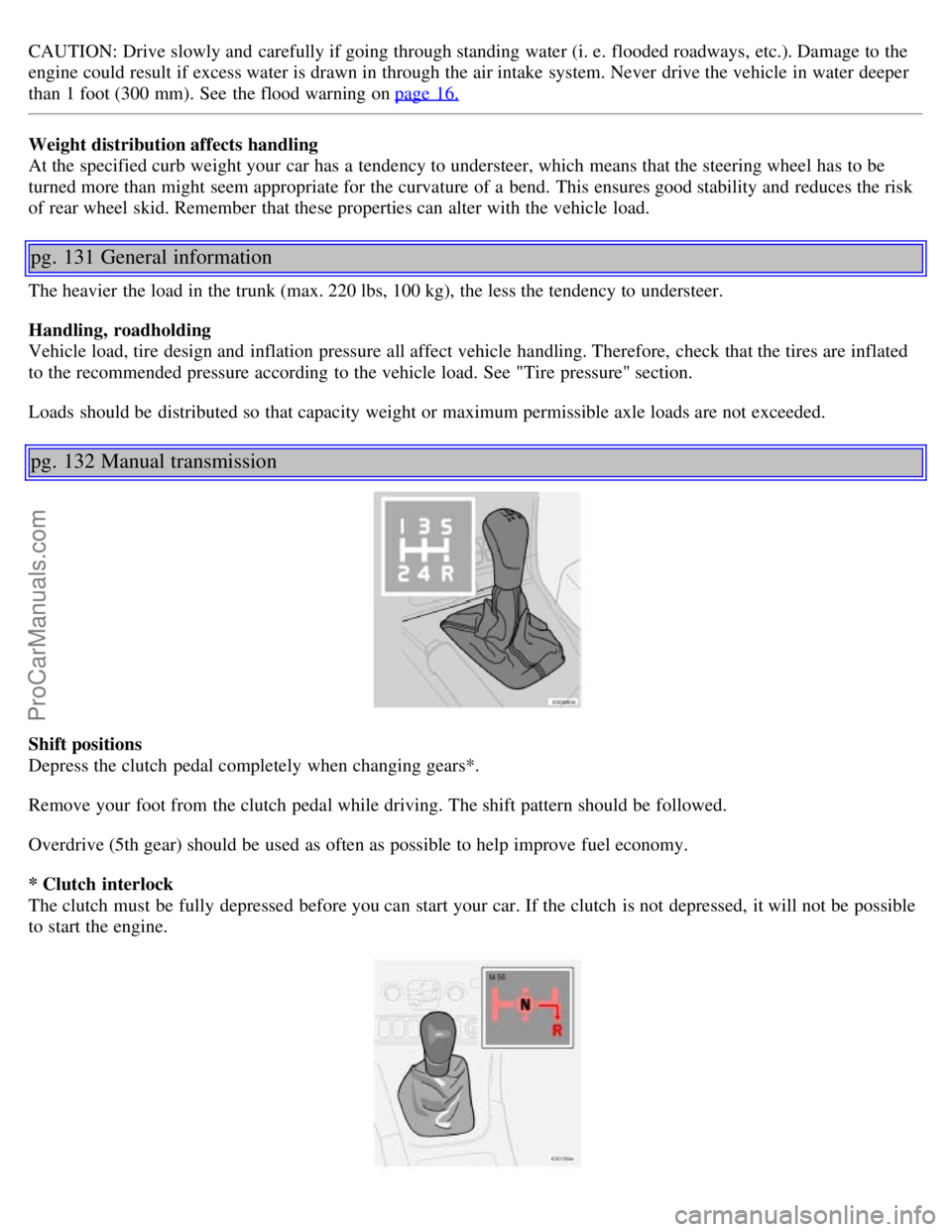
Shift positions
Depress the clutch pedal completely when changing gears*.
Remove your foot from the clutch pedal while driving. The shift pattern should be followed.
Overdrive (5th gear) should be used as often as possible to help improve fuel economy.
* Clutch interlock
The clutch must be fully depressed before you can start your car. If the clutch is not depressed, it will not be possible
to start the engine.
ProCarManuals.com
Page 115 of 128
three- way catalytic converter.
Do not park your car over combustible materials, such as grass or leaves, which can come into contact with the hot
exhaust system and cause such materials to ignite under certain wind and weather conditions.
Excessive starter cranking (in excess of one minute), or an intermittently firing or flooded engine can cause three-
way catalytic converter or exhaust system overheating.
Remember that tampering or unauthorized modifications to the engine, the Electronic Control Module, or the
vehicle may be illegal and can cause three- way catalytic converter or exhaust system overheating. This includes:
- Altering fuel injection setting or components.
- Altering emission system components or location or removing components.
- Repeated use of leaded fuel.
NOTE: Unleaded fuel is required for cars with three-way catalytic converters.)
pg. 197 Suspension
Wheel dimension 15"16"
Rim diameter (mm) 415440
tire side diameter(mm) 515540
Toe- in front (degrees) 0.1°± 0. 1°0.1°± 0. 1°
Toe- in rear (degrees) 0.2°+± 0.2°0.2+± 0. 2°
Toe- in front (mm) rim measurement 2. 2± 0. 72.3± 0.8
tire side measurement 2.7± 0.92. 8± 0. 9
Toe- in rear (mm) rim measurement 1. 4± 1. 41.5± 1.5
tire side measurement 1.8± 1.81. 9± 1. 9
Rear suspension
Individual rear wheel suspension with longitudinal support arms, double link arms and track rods.
Front suspension
Spring strut suspension with integrated shock absorbers and control arms linked to the support frame. Power-assisted
rack and pinion steering. Safety type steering column.
pg. 198 Bulbs
Bulbs OutputSocket
Low beam 55 WH 7
High beam 55 WHB3
Fog lights, front 55 WH 1
Parking lights, front W5 W-
Side indicator lamps P10 W-
Turn signals, front 21 WPY
Turn signals, rear 21 WPY
Parking lights, rear 5 WBA 15 s
Brake light 21 W BA 15 s
Back up lights 21 WBA 15 s
Fog light/ Parking lights, rear 5 WBA 15 s
License plate lighting 5 WW 2.1x9.5 d
Courtesy lighting, front 5 WSV 8.5
Trunk lighting 5 WSV 8.5
ProCarManuals.com
Page 119 of 128

2 0 0 1
VOLVO S60
Index
pg. 203 Index
A
A/ C (air conditioning) 56
, 59
ABS2 , 31 , 138
Accessory bracket109
Adjustable steering wheel36
Advanced User Mode (AUM) - radio72
Air bags - dual threshold/ stage13
Air distribution53 , 56 , 60
Air filter170
Air quality sensor57
Air vents53
Airbag - Side Impact (SIPS)18
Airbags (front)12
Alarm115 , 122
Anti-lock Brake System (ABS)02 , 31
Approach lighting40
Ashtray45 , 107
Audio61
Audio systems - general information81
Audio systems - specifications80
AUTO (climate control)55
Electronic Climate Control, ECC54
Automatic transmission130 , 133
Automatic transmission - adaptive system134
Automatic transmission - kickdown134
Auxiliary lamps37
Average speed43
B
Back up light183
Backrest111
Bass65
Battery168 , 176 , 199
Battery - replacing177
Belt check169
ProCarManuals.com
Page 123 of 128
LED illumination40
Lighting panel39
Load carriers148
Locking119
Locking steering wheel129
Locks115
Long distance trips150
Long loads - carrying112
Low beam bulb180
Lubricants195
M
Maintenance Schedule165
Maintenance services164
Malfunction indicator light33
Manual climate control with air conditioning58
Manual transmission132
Messages in the display35
Multifilter with air quality sensor57
N
Normal turns (direction indicators)40
O
Occupant safety28
Octane rating126
Odometer30
Oil pressure33
Oil quality171
Oil viscosity171
Opening/ locking the trunk120
P
P Park133
, 135
Paint162
Paint - color code162
Paintwork damage162
Parking brake33 , 45
Parking lights39
Pen holder108
Polishing161
Power seat102
Power steering fluid174
Power sun roof49
Prem- Air3
Programme type PT70
PROPOSITION 65 WARNING143
R
ProCarManuals.com