lock VOLVO S60 2001 Owner's Manual
[x] Cancel search | Manufacturer: VOLVO, Model Year: 2001, Model line: S60, Model: VOLVO S60 2001Pages: 128, PDF Size: 2.52 MB
Page 57 of 128
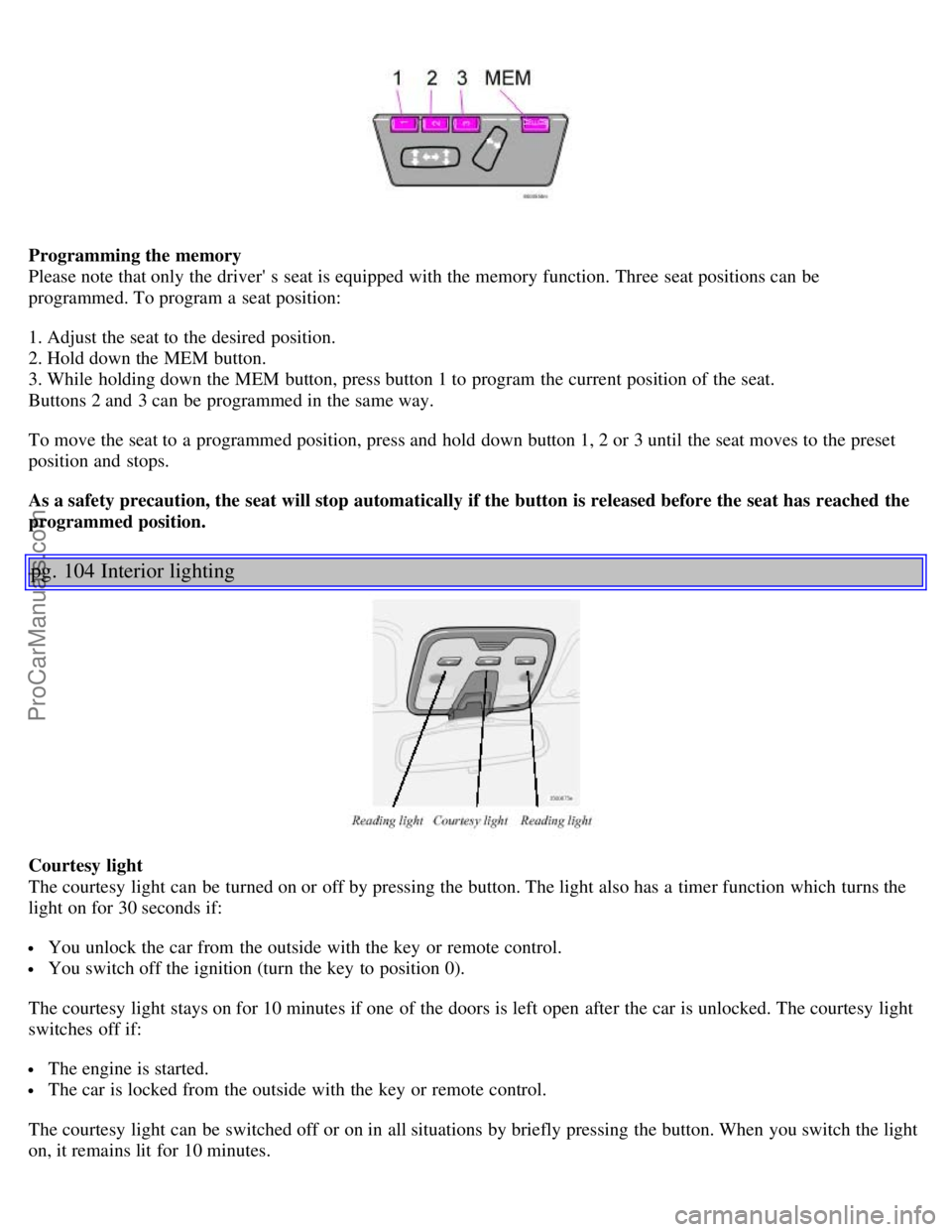
Programming the memory
Please note that only the driver' s seat is equipped with the memory function. Three seat positions can be
programmed. To program a seat position:
1. Adjust the seat to the desired position.
2. Hold down the MEM button.
3. While holding down the MEM button, press button 1 to program the current position of the seat.
Buttons 2 and 3 can be programmed in the same way.
To move the seat to a programmed position, press and hold down button 1, 2 or 3 until the seat moves to the preset
position and stops.
As a safety precaution, the seat will stop automatically if the button is released before the seat has reached the
programmed position.
pg. 104 Interior lighting
Courtesy light
The courtesy light can be turned on or off by pressing the button. The light also has a timer function which turns the
light on for 30 seconds if:
You unlock the car from the outside with the key or remote control.
You switch off the ignition (turn the key to position 0).
The courtesy light stays on for 10 minutes if one of the doors is left open after the car is unlocked. The courtesy light
switches off if:
The engine is started.
The car is locked from the outside with the key or remote control.
The courtesy light can be switched off or on in all situations by briefly pressing the button. When you switch the light
on, it remains lit for 10 minutes.
ProCarManuals.com
Page 61 of 128
Pull the belt out far enough to insert the latch plate into the receptacle until a distinct click is heard. The seat belt
retractor is normally "unlocked" and you can move freely, provided that the shoulder belt is not pulled out too far. The
retractor will lock up as follows:
if the belt is pulled out rapidly
during braking and acceleration
if the vehicle is leaning excessively
when driving in turns For the seat belt to provide maximum protection in the event of an accident, it must be worn
correctly. When wearing the seat belt remember:
The belt should not be twisted or turned.
The lap belt must be positioned low on the hips (not pressing against the abdomen).
Make sure that the shoulder belt is rolled up into its retractor and that the shoulder and lap belts are taut.
Before exiting the car, check that the seat belt retracts fully after being unbuckled. If necessary, guide the belt back
into the retractor slot.
Child seats:
Please refer to page 27
for information on securing child seats with the seat belts.
pg. 11 Seat belts
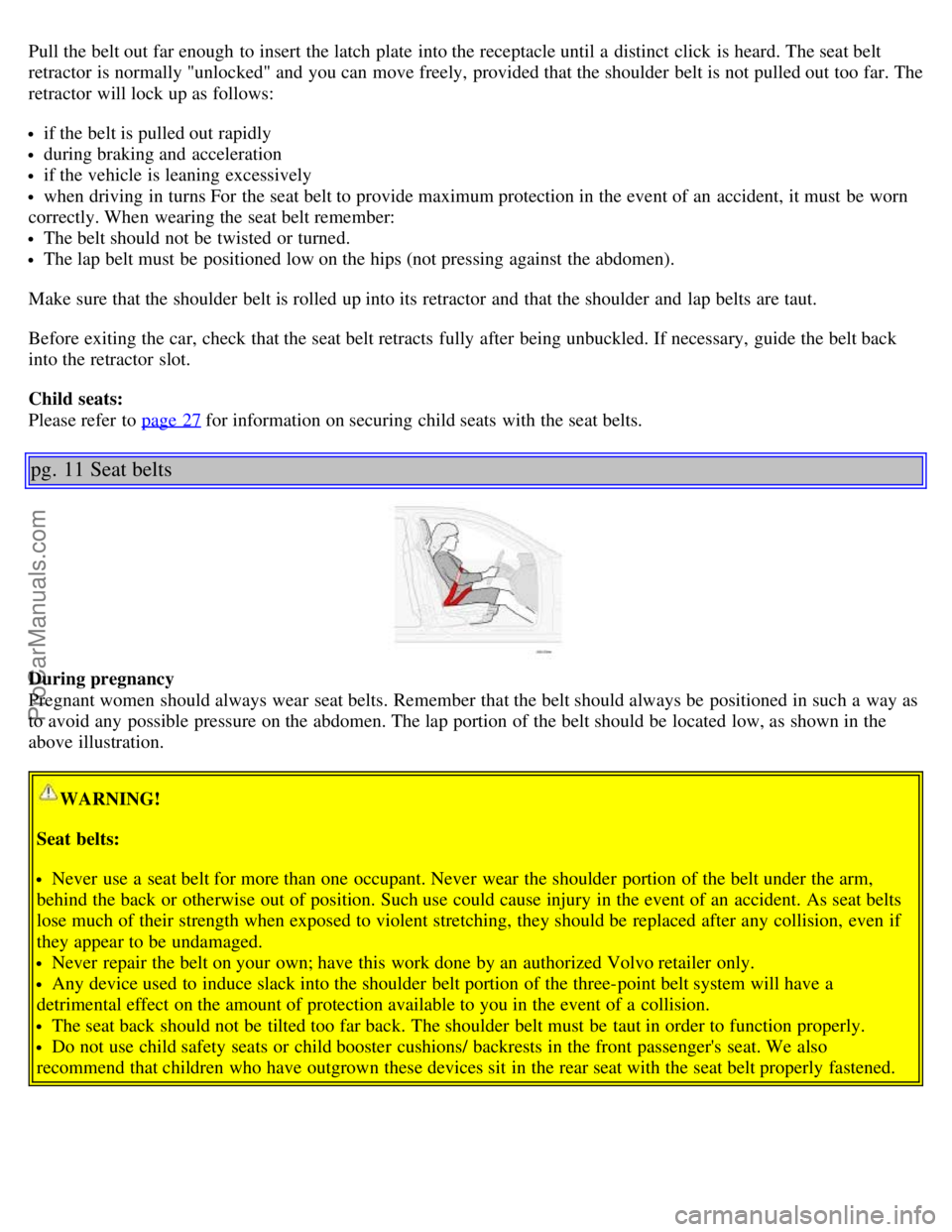
During pregnancy
Pregnant women should always wear seat belts. Remember that the belt should always be positioned in such a way as
to avoid any possible pressure on the abdomen. The lap portion of the belt should be located low, as shown in the
above illustration.
WARNING!
Seat belts:
Never use a seat belt for more than one occupant. Never wear the shoulder portion of the belt under the arm,
behind the back or otherwise out of position. Such use could cause injury in the event of an accident. As seat belts
lose much of their strength when exposed to violent stretching, they should be replaced after any collision, even if
they appear to be undamaged.
Never repair the belt on your own; have this work done by an authorized Volvo retailer only.
Any device used to induce slack into the shoulder belt portion of the three-point belt system will have a
detrimental effect on the amount of protection available to you in the event of a collision.
The seat back should not be tilted too far back. The shoulder belt must be taut in order to function properly.
Do not use child safety seats or child booster cushions/ backrests in the front passenger's seat. We also
recommend that children who have outgrown these devices sit in the rear seat with the seat belt properly fastened.
ProCarManuals.com
Page 66 of 128
If your car has been subjected to flood conditions (e. g. soaked carpeting/ standing water on the floor of the vehicle)
or if your car has become flood-damaged in any way, do not attempt to start the vehicle or put the key in the
ignition before discon- necting the battery (see below). This may cause airbag deployment which could result in
personal injury. Have the car towed to an authorized Volvo retailer for repairs.
Automatic transmission:
Before attempting to tow the car, use the following procedure to override the shiftlock system to move the gear
selector to the neutral position.
Switch off the ignition for at least 10 minutes and disconnect the battery
Wait at least one minute
Insert the key in the ignition and turn it to position II
Press firmly on the brake pedal.
Move the gear selector from (P) ark to the (N) eutral position.
There is no maintenance to perform on the SRS yourself. The month and year shown on the decal on the door pillar
indicate when you should contact your Volvo retailer for specific servicing or replacement of airbags and seat belt
tensioners. This service must be performed by an authorized Volvo retailer.
Should you have any questions about the SRS system, please contact your authorized Volvo retailer or Volvo
Customer Support.:
In the USA:
Volvo Cars of North America
Customer Relations
P.O. Box 914
Rockleigh, New Jersey 07647-0914
800-458-1552
In Canada:
Volvo Canada Ltd.
175 Gordon Baker Road
Willowdale, Ontario M2H 2N7
800-663-8255
pg. 17 Airbags (Supplemental Restraint System)
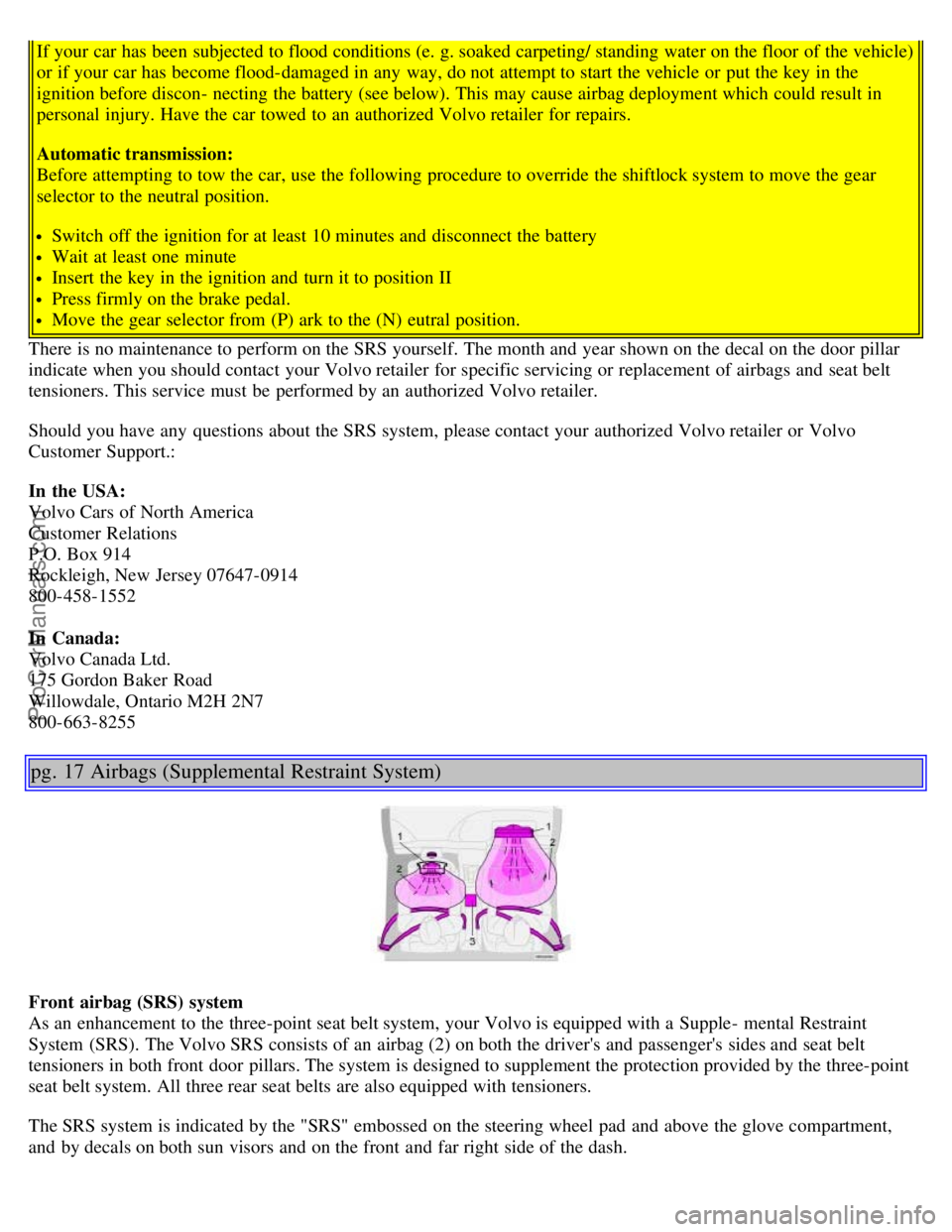
Front airbag (SRS) system
As an enhancement to the three-point seat belt system, your Volvo is equipped with a Supple- mental Restraint
System (SRS). The Volvo SRS consists of an airbag (2) on both the driver's and passenger's sides and seat belt
tensioners in both front door pillars. The system is designed to supplement the protection provided by the three-point
seat belt system. All three rear seat belts are also equipped with tensioners.
The SRS system is indicated by the "SRS" embossed on the steering wheel pad and above the glove compartment,
and by decals on both sun visors and on the front and far right side of the dash.
ProCarManuals.com
Page 69 of 128
2 0 0 1
VOLVO S60
Locks and alarm
pg. 115 Locks and alarm
Keys and remote controls 116
Locking and unlocking119
Child safety lock121
Alarm122
pg. 116 Keys and remote controls
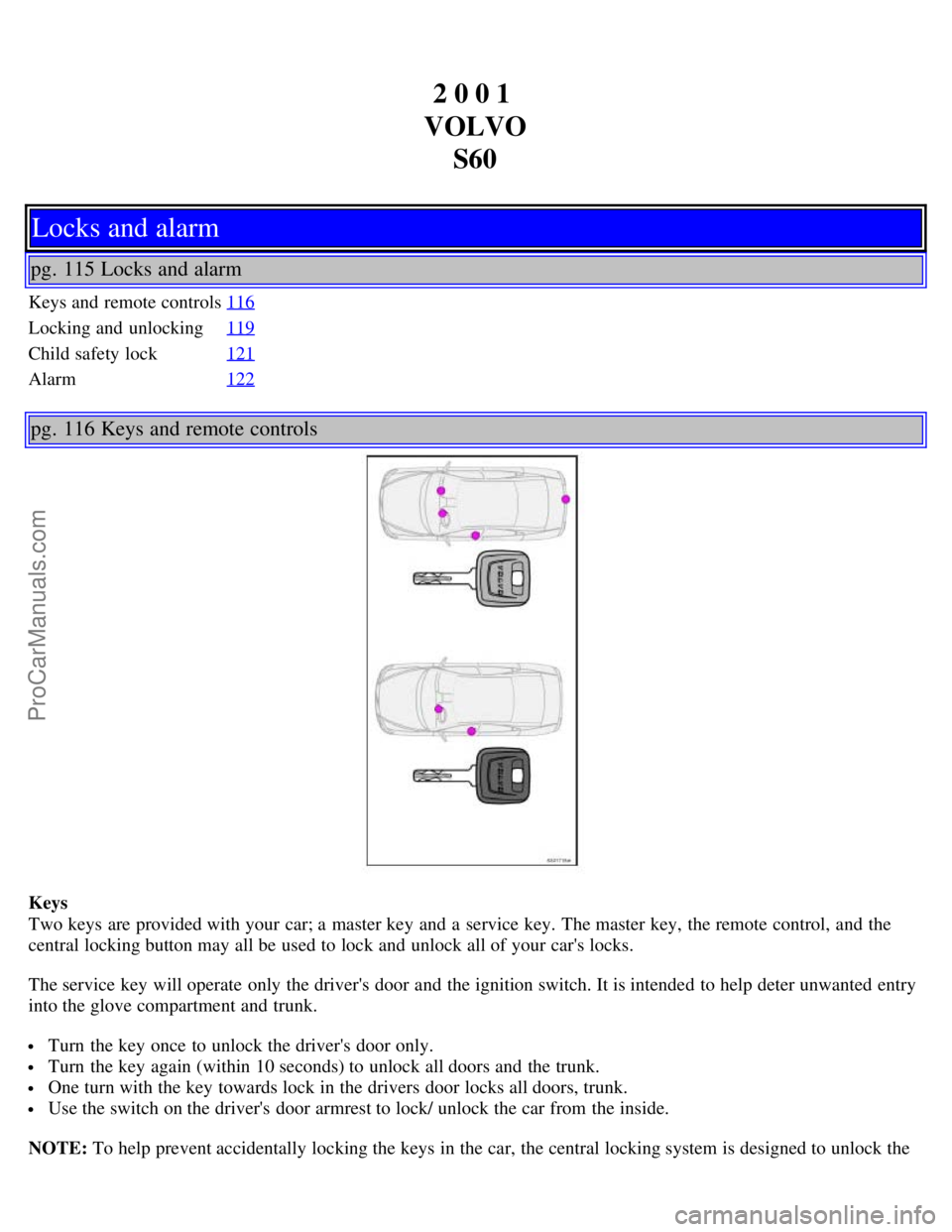
Keys
Two keys are provided with your car; a master key and a service key. The master key, the remote control, and the
central locking button may all be used to lock and unlock all of your car's locks.
The service key will operate only the driver's door and the ignition switch. It is intended to help deter unwanted entry
into the glove compartment and trunk.
Turn the key once to unlock the driver's door only.
Turn the key again (within 10 seconds) to unlock all doors and the trunk.
One turn with the key towards lock in the drivers door locks all doors, trunk.
Use the switch on the driver's door armrest to lock/ unlock the car from the inside.
NOTE: To help prevent accidentally locking the keys in the car, the central locking system is designed to unlock the
ProCarManuals.com
Page 70 of 128

doors immediately if the key is left in the ignition switch, the car is locked using the lock button on the door and the
door is then closed. A sound from the lock will be audible at this time. Please note that this function will not unlock
the doors if the engine is running.
Immobilizer (start inhibitor)
Each of the keys supplied with your car contains a coded transmitter. The code in the key is transmitted to an antenna
in the ignition switch where it is compared to the code stored in the start inhibitor module. The car will start only with
a properly coded key.
If you misplace a key, take the other keys to an authorized Volvo retailer for reprogramming as an antitheft measure.
NOTE: This device complies with part 15 of the FCC rules. Operation is subject to the following condition: (1) This
device may not cause harmful interference, and (2) this device must accept any interference received, including
interference that may cause undesired operation.
WARNING!
If the doors are locked while driving, this may hinder rapid access to the occupants of the car in the event of an
accident. (Also see information on "Child safety locks"
pg. 117 Keys and remote controls
Remote controls
Your car is equipped with a remote control transmitter. This transmitter uses a radio signal to allow "keyless" entry
into the passenger compartment or the trunk. You will be supplied with two coded key ring transmitters, which will
enable you to lock/ unlock all doors and the trunk from a distance of 10- 15 feet (3- 5 meters).
On vehicles equipped with an alarm, the alarm will also be activated/ deactivated by this system.
The car can also be locked/ unlocked with the key.
As an extra security precaution in certain situations (valet parking, etc.), Volvo recommends that the transmitter not be
included when the keys are given to anyone. The service key can be used instead. If one of the transmitters is
misplaced, contact the nearest authorized Volvo retailer for assistance.
ProCarManuals.com
Page 71 of 128

Using the remote control
Press the LOCK button once to lock all doors and trunk.
Press the UNLOCK button once to unlock the driver's door and fuel filler door. Press this button again (within 10
seconds) to unlock all doors and the trunk.
To pop open the trunk (without unlocking the doors), press the OPEN trunk button twice within 3 seconds.
NOTE:
Airbag deployment will automatically unlock the doors.
The keys may also be used to lock and unlock the doors, and to activate and deactivate the alarm system.
To avoid leaving your keys in the car, make a habit of always locking the car with the remote control.
* See page 122
for more information on this function.
pg. 118 Keys and remote controls
Automatic locking (retailer installed option on certain models)
If your car is equipped with this option, all unlocked doors will automatically be locked when the car exceeds a speed
of 3 mph (5 km/ h).
Please be aware of the following:
If the doors are unlocked using the central locking button after the doors have automatically locked and no door has
been opened, the doors will not automati- cally re-lock the next time the car exceeds 3 mph (5 km/ h).
If any doors are unlocked by pulling up the lock knob after the doors have been automatically locked and no door
has been opened, the doors will not automati- cally re-lock the next time the car exceeds 3 mph (5 km/ h).
If a door is opened after the car has exceeded 3 mph (5 km/ h), that door will not be re- locked.
Automatic re-locking
If the doors are unlocked, the locks will automatically reengage (re-lock) and the alarm will reset after 2 minutes
unless a door or the trunk has been opened.
WARNING!
Never use the transmitter to lock the doors from inside the car
Doing so would ACTIVATE:
the break
ProCarManuals.com
Page 72 of 128

in alarm, which would sound if one of the doors were opened
the optional interior motion and inclination alarm sensors.
Doing so would DEACTIVATE:
the sunroof and interior courtesy light controls.
the central locking buttons on the front door armrests, although the interior door handles would still function to
allow occupants to leave the car.
Disabled features would remain disabled until the remote were used again to unlock the car.
In addition, locking an occupied vehicle would hinder rapid access to the occupants in an accident or emergency.
Replacing the battery in the remote control
If the range of the transmitter is noticeably reduced, this indicates that the battery is weak and should be replaced.
To replace the battery
Remove the screw on the transmitter cover with a small screwdriver.
Remove the cover carefully pressing it rearward/ upward.
Replace the battery with a new 3- volt, CR 2032 battery. The battery should be inserted with the minus side
upward. Avoid touching the contact surfaces of the battery with your fingers.
Reinstall the cover and tighten the screw to help protect the transmitter.
pg. 119 Locking and unlocking
Locking and unlocking the car from the inside
The switch on the driver's door armrest can be used to lock or unlock all doors and the trunk, and to set the alarm.
ProCarManuals.com
Page 73 of 128

Locking the glove compartment
The glove compartment can be locked with the master key.
pg. 120 Locking and unlocking
Opening/ locking the trunk lid with the remote control
Do as follows to unlock the trunk lid only:
Press the "Open trunk" button on the remote control twice. If all doors are locked when you close the trunk lid, it
locks automatically.
Unlocking the trunk lid with the master key
The master key should only be used to unlock the trunk lid in emergencies (if the remote control is not working or the
car is without power). Open the trunk lid as follows:
Insert the master key into the upper or lower part of the plug covering the lock.
Twist upward or downward to remove the plug.
Unlock the trunk lid.
pg. 121 Child safety lock
ProCarManuals.com
Page 74 of 128

Manual child safety locks - rear doors
The controls are located on the rear door jambs. Use a screwdriver to adjust these controls.
A The door cannot be opened from the inside. Normal operation from the outside.
B The door lock functions normally.
WARNING!
Remember, in the event of an accident, the rear seat passengers cannot open the doors from the inside with the
buttons in position A
pg. 122 Alarm
Alarm The alarm is automatically armed whenever you lock your car.
When armed, the alarm continuously monitors a number of points on the car. The following conditions will set off the
alarm:
The hood is forced open.
The trunk is forced open.
A door is forced open.
The ignition switch is tampered with.
If there is movement in the passenger compartment (if the car is equipped with the optional movement sensor).
The car is lifted or towed (if the car is equipped with the optional inclination sensor).
The battery is disconnected (while the alarm is armed).
The siren is disconnected when the alarm is disarmed.
ProCarManuals.com
Page 75 of 128

Arming the alarm
Press the LOCK button on the remote control, lock the car using the key in the driver's door or press the central lock
button on one of the front doors with the door open. One long flash of the turn signals will confirm that the alarm is
armed.
Disarming the alarm
Press the UNLOCK button on the remote control or unlock the doors with the key.
Turning off (stopping) the alarm
If the alarm is sounding, it can be stopped by pressing the UNLOCK button on the remote control or by unlocking the
driver's door with the key.
Visual alarm signal
The visual alarm signal is given by flashing all turn signals and turning on the interior lighting for approximately 5
minutes.
Audible alarm signal
An audible alarm signal is given by a battery powered siren. One alarm cycle lasts for 25 seconds.
"Panic" button
In an emergency situation, this feature can be used to attract attention.
Activate the "panic" button by pressing the red button on the remote control (see illustration on page 117
) for at least
3 seconds or by pressing this button twice within 3 seconds. The turn signals will flash, the interior lights will go on
and the car's horn will sound.
The function can be turned off by pressing any of the buttons on the remote control or will stop automatically after 25
seconds. When a button is pressed, there is a 5 second delay before the panic alarm is deactivated.
NOTE: This button will NOT unlock the car.
pg. 123 Alarm
Temporarily turning off the alarm sensor( s) - option
This button will only be found in cars equipped with the optional inclination and/ or movement sensors.
In certain situations it may be desirable to turn off the optional inclination and movement alarm sensors if, for
example, you drive your car onto a ferry where the rocking of the boat could trigger the alarm or if a pet is left in the
car with the doors locked.
To temporarily turn off the inclination and movement alarm sensors from the alarm system: B From the time the
ignition key is turned from the Drive position (position II) until you lock the car, you can press the button in the
ProCarManuals.com