lights VOLVO S60 2002 User Guide
[x] Cancel search | Manufacturer: VOLVO, Model Year: 2002, Model line: S60, Model: VOLVO S60 2002Pages: 106, PDF Size: 1.96 MB
Page 52 of 106

The ignition switch is tampered with.
If there is movement in the passenger compartment (if the car is equipped with the optional movement sensor).
The car is lifted or towed (if the car is equipped with the optional inclination sensor).
The battery is disconnected (while the alarm is armed).
The siren is disconnected when the alarm is disarmed.
Arming the alarm
Press the LOCK button on the remote control, lock the car using the key in the driver's door or press the central lock
button on one of the front doors with the door open. One long flash of the turn signals will confirm that the alarm is
armed.
Disarming the alarm
Press the UNLOCK button on the remote control or unlock the doors with the key.
Turning off (stopping) the alarm
If the alarm is sounding, it can be stopped by pressing the UNLOCK button on the remote control or by unlocking the
driver's door with the key.
Visual alarm signal
The visual alarm signal is given by flashing all turn signals and turning on the interior lighting for approximately 5
minutes.
Audible alarm signal
An audible alarm signal is given by a battery powered siren. One alarm cycle lasts for 25 seconds.
"Panic" button
In an emergency situation, this feature can be used to attract attention.
Activate the "panic" button by pressing the red button on the remote control (see illustration on page 119
) for at least 3
seconds or by pressing this button twice within 3 seconds. The turn signals will flash, the interior lights will go on and
the car's horn will sound.
The function can be turned off by pressing any of the buttons on the remote control or will stop automatically after 25
seconds. When a button is pressed, there is a 5 second delay before the panic alarm is deactivated.
NOTE: This button will NOT unlock the car.
pg. 126 Alarm
Temporarily turning off the alarm sensor( s) - option
This button will only be found in cars equipped with the optional inclination and/or movement sensors.
ProCarManuals.com
Page 58 of 106

Ignition switch and steering wheel lock
0 Locked position: Remove the key to lock the steering wheel *.
WARNING!
Never turn the key to position O while driving or when the car is being towed.
I Intermediate position - "radio position": Certain accessories, radio, etc. on, daytime running lights off.
II Drive position: The key position when driving. The car's entire electrical system is connected.
III Start position: Release the key when the engine starts. The key returns automatically to the Drive position.
A chime will sound if the key is left in the ignition and the driver's door is opened.
* The gear selector must be in the (P) ark position (automatic transmission).
Steering wheel lock
The steering wheel lock might be under tension when the car is parked.
Turn the steering wheel slightly to free the ignition key.
In order to help reduce car theft, make sure the steering wheel lock is engaged before leaving the car.
pg. 133 General information
Economical driving conserves natural resources
Better driving economy may be obtained by thinking ahead, avoiding rapid starts and stops and adjusting the speed of
your vehicle to immediate traffic conditions. Observe the following rules:
Bring the engine to normal operating temperature as soon as possible by driving with a light foot on the accelerator
pedal for the first few minutes of operation. A cold engine uses more fuel and is subject to increased wear.
Whenever possible, avoid using the car for driving short distances. This does not allow the engine to reach normal
operating temperature.
Drive carefully and avoid rapid acceleration and hard braking.
ProCarManuals.com
Page 66 of 106

cold weather.
Severe strain on the brake system
The brakes will be subject to severe strain when driving in mountains or hilly areas or towing. Vehicle speed is usually
slower, which means that the cooling of the brakes is less efficient than when driving on level roads. To reduce the
strain on the brakes, it is advisable not to use the brakes excessively. Instead, shift into a lower gear and let the engine
help with the braking. Do not forget that, if you are towing a trailer, the brakes will be subjected to a greater than
normal load.
pg. 142 Brake system
Anti-lock brakes (ABS)
If the warning lamp lights up there is a malfunction of the ABS system (the standard braking system will however
function) and the vehicle should be driven cautiously to a Volvo retailer for inspection. The Anti-lock Braking System
(ABS) helps to improve vehicle control (stopping and steering) during severe braking conditions by limiting brake
lockup. When the system "senses" impending lockup, braking pressure is automatically modulated in order to help
prevent lockup, which could lead to a skid.
The system performs a self -diagnostic test when the engine is started and when the vehicle first reaches a speed
of approximately 12 mph (20 km/h). The brake pedal will pulsate several times and a sound may be audible from the
ABS control module. This is normal.
To obtain optimal effect from the ABS system, constant pressure should be kept on the brake pedal, keep constant
pressure on the brake pedal. Do not pump the brake pedal.
The switching of the ABS modulator will be audible and the brake pedal will pulsate during braking. Please be aware
that ABS does not increase the absolute braking potential of the vehicle. While control will be enhanced, ABS will not
shorten stopping distances on slippery surfaces.
ABS with EBD (Electronic Brake Force Distribution)
EBD is an integrated part of the ABS system. EBD regulates the hydraulic pressure to the rear brakes to help provide
optimal braking capacity.
If the BRAKE and ABS warning lights come on at the same time, this could indicate a fault in the brake system.
Stop the car in a suitable place and switch off the engine.
Restart the engine.
If both warning lights go off, no further action is required.
If both lights are still on after the engine has been restarted, switch off the engine again and check the brake fluid
level (see page 172
for the location of the brake fluid reservoir).
If the brake fluid level is above the MIN mark, drive carefully to an authorized Volvo retailer and have the brake
system inspected.
WARNING!
If the fluid level is below the MIN mark in the reservoir or if a "Brake failure - Service urgent" message is displayed
in the text window: DO NOT DRIVE. Have the car towed to a Volvo retailer and have the brake system inspected.
ProCarManuals.com
Page 92 of 106
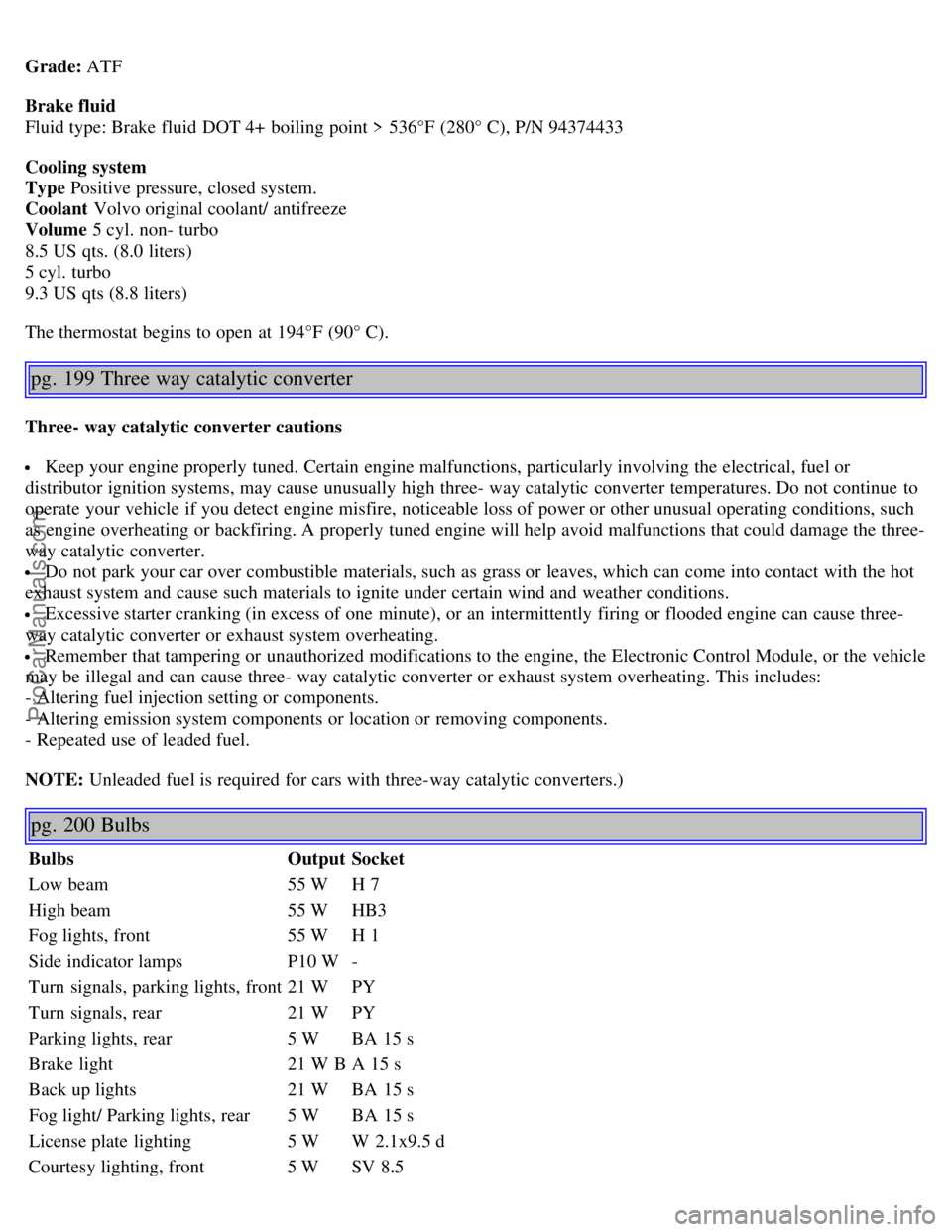
Grade: ATF
Brake fluid
Fluid type: Brake fluid DOT 4+ boiling point > 536°F (280° C), P/N 94374433
Cooling system
Type Positive pressure, closed system.
Coolant Volvo original coolant/ antifreeze
Volume 5 cyl. non- turbo
8.5 US qts. (8.0 liters)
5 cyl. turbo
9.3 US qts (8.8 liters)
The thermostat begins to open at 194°F (90° C).
pg. 199 Three way catalytic converter
Three- way catalytic converter cautions
Keep your engine properly tuned. Certain engine malfunctions, particularly involving the electrical, fuel or
distributor ignition systems, may cause unusually high three- way catalytic converter temperatures. Do not continue to
operate your vehicle if you detect engine misfire, noticeable loss of power or other unusual operating conditions, such
as engine overheating or backfiring. A properly tuned engine will help avoid malfunctions that could damage the three-
way catalytic converter.
Do not park your car over combustible materials, such as grass or leaves, which can come into contact with the hot
exhaust system and cause such materials to ignite under certain wind and weather conditions.
Excessive starter cranking (in excess of one minute), or an intermittently firing or flooded engine can cause three-
way catalytic converter or exhaust system overheating.
Remember that tampering or unauthorized modifications to the engine, the Electronic Control Module, or the vehicle
may be illegal and can cause three- way catalytic converter or exhaust system overheating. This includes:
- Altering fuel injection setting or components.
- Altering emission system components or location or removing components.
- Repeated use of leaded fuel.
NOTE: Unleaded fuel is required for cars with three-way catalytic converters.)
pg. 200 Bulbs
Bulbs OutputSocket
Low beam 55 WH 7
High beam 55 WHB3
Fog lights, front 55 WH 1
Side indicator lamps P10 W-
Turn signals, parking lights, front 21 WPY
Turn signals, rear 21 WPY
Parking lights, rear 5 WBA 15 s
Brake light 21 W BA 15 s
Back up lights 21 WBA 15 s
Fog light/ Parking lights, rear 5 WBA 15 s
License plate lighting 5 WW 2.1x9.5 d
Courtesy lighting, front 5 WSV 8.5
ProCarManuals.com
Page 99 of 106
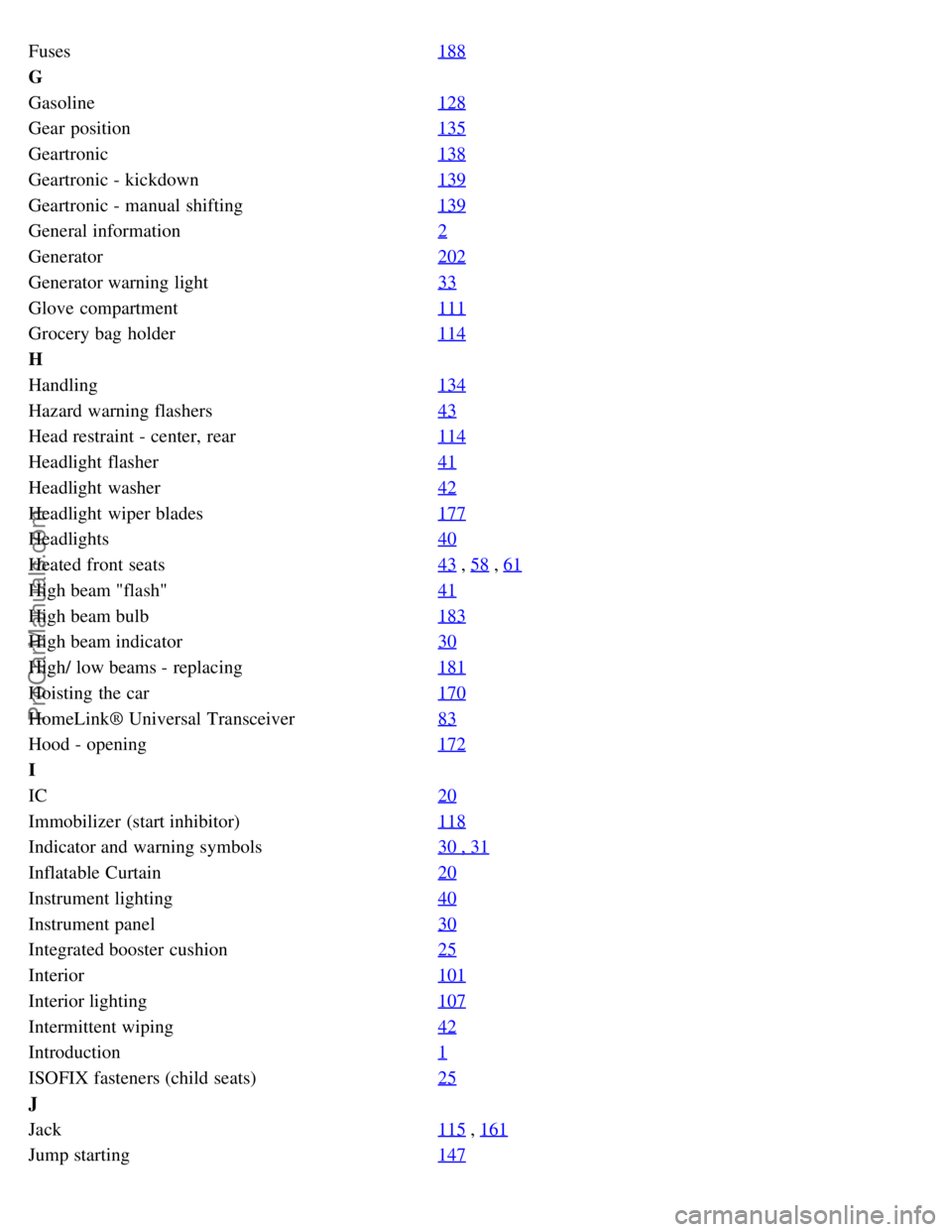
Fuses188
G
Gasoline128
Gear position135
Geartronic138
Geartronic - kickdown139
Geartronic - manual shifting139
General information2
Generator202
Generator warning light33
Glove compartment111
Grocery bag holder114
H
Handling134
Hazard warning flashers43
Head restraint - center, rear114
Headlight flasher41
Headlight washer42
Headlight wiper blades177
Headlights40
Heated front seats43 , 58 , 61
High beam "flash"41
High beam bulb183
High beam indicator30
High/ low beams - replacing181
Hoisting the car170
HomeLink® Universal Transceiver83
Hood - opening172
I
IC20
Immobilizer (start inhibitor)118
Indicator and warning symbols30 , 31
Inflatable Curtain20
Instrument lighting40
Instrument panel30
Integrated booster cushion25
Interior101
Interior lighting107
Intermittent wiping42
Introduction1
ISOFIX fasteners (child seats)25
J
Jack115
, 161
Jump starting147
ProCarManuals.com
Page 100 of 106

K
Keylock2 , 131
Keys118
Kickdown137
L
LED illumination41
Lighting panel40
Load carriers152
Locking121
Locking steering wheel132
Locks117
Long distance trips154
Long loads - carrying114
Low beam bulb182
Lubricants198
M
Maintenance Schedule168
Malfunction indicator light33
Manual climate control with air conditioning60
Manual transmission135
Messages in the display36
Multifilter with air quality sensor59
O
Occupant safety28
Octane rating128
Odometer30
Oil pressure33
Oil quality173
Oil viscosity173
Opening the trunk from the inside122
Opening/ locking the trunk122
P
P Park136
, 138
Paint - color code166
Paintwork damage166
Parking brake33 , 46
Parking lights40
Pen holder111
Polishing165
Power seat104
Power steering fluid176
Power sun roof50
Prem- Air3
Programme type PT72
ProCarManuals.com
Page 101 of 106

PROPOSITION 65 WARNING147
R
Radiator172
Radio67
Reading lamps107
Rear fog lights40
Rear seat113
Rear suspension201
Rear window defroster43 , 61
Rearview mirror/ door mirrors49
Recirculation58 , 62
REDUCE SPEED36
Refrigerant (A/ C system)54
Refueling128 , 130
Remote control - central locking system119
Replacing the battery179
Reporting safety defects28
Reverse gear inhibitor135
Roadholding134
Roof racks (load carriers)152
S
Safety9
Safety defects - reporting28
Seat belt10
Seat belt maintenance28
Seat belt reminder49
Seat belts (keeping child seats in place)27
Service168
Service key118
Service reminder34
SERVICE REQUIRED36
SERVICE URGENT36
Shiftlock2 , 131
Side airbags18
Side marker lamp185
SIPS airbags18
Ski hatch114
Snow chains157
Snow tires157
Spare tires158
Spare wheel115
Spark plugs202
Specifications193
Speedometer30
ProCarManuals.com