steering wheel VOLVO S60 2002 User Guide
[x] Cancel search | Manufacturer: VOLVO, Model Year: 2002, Model line: S60, Model: VOLVO S60 2002Pages: 106, PDF Size: 1.96 MB
Page 57 of 106
Volvo original or approved fuel filler caps.
pg. 131 Starting the car
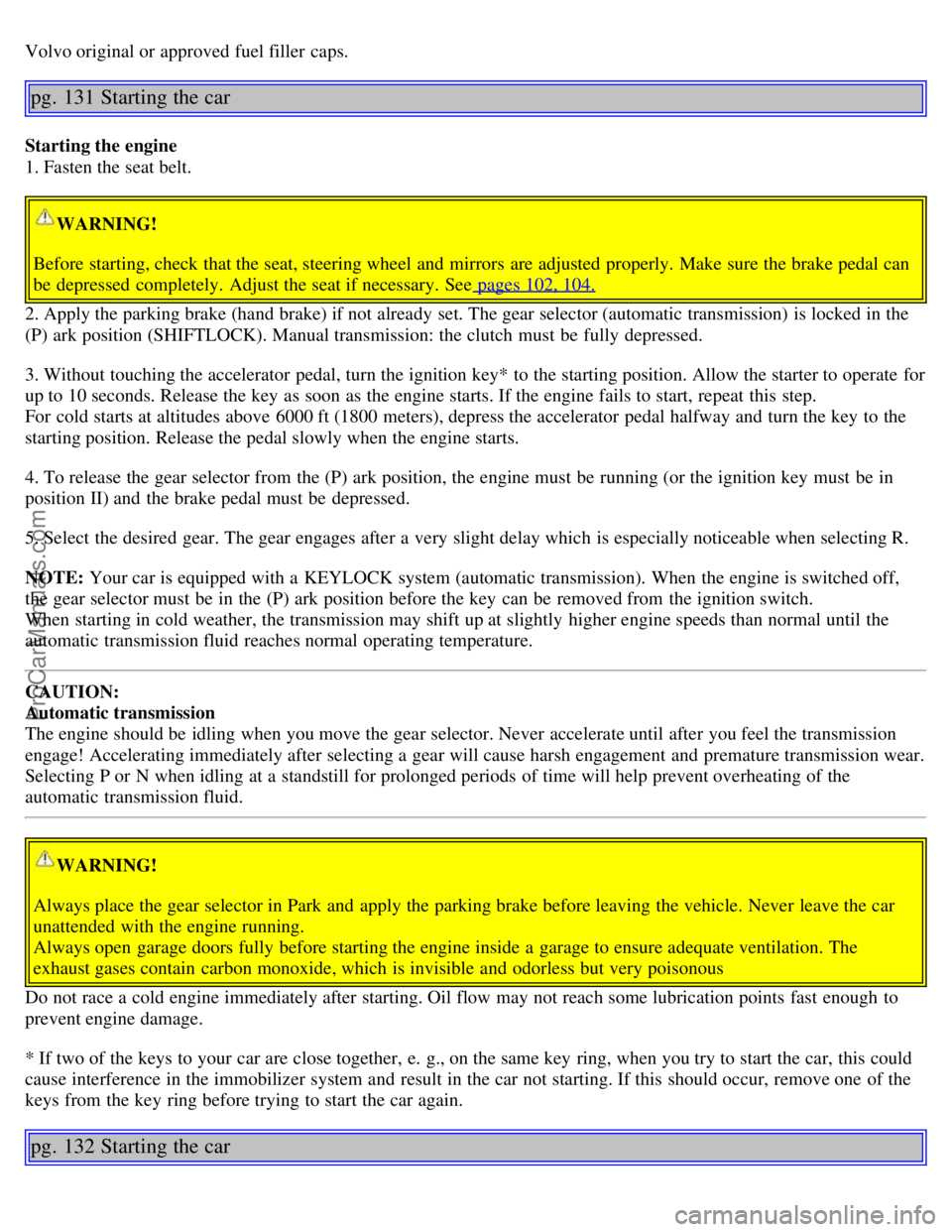
Starting the engine
1. Fasten the seat belt.
WARNING!
Before starting, check that the seat, steering wheel and mirrors are adjusted properly. Make sure the brake pedal can
be depressed completely. Adjust the seat if necessary. See pages 102, 104.
2. Apply the parking brake (hand brake) if not already set. The gear selector (automatic transmission) is locked in the
(P) ark position (SHIFTLOCK). Manual transmission: the clutch must be fully depressed.
3. Without touching the accelerator pedal, turn the ignition key* to the starting position. Allow the starter to operate for
up to 10 seconds. Release the key as soon as the engine starts. If the engine fails to start, repeat this step.
For cold starts at altitudes above 6000 ft (1800 meters), depress the accelerator pedal halfway and turn the key to the
starting position. Release the pedal slowly when the engine starts.
4. To release the gear selector from the (P) ark position, the engine must be running (or the ignition key must be in
position II) and the brake pedal must be depressed.
5. Select the desired gear. The gear engages after a very slight delay which is especially noticeable when selecting R.
NOTE: Your car is equipped with a KEYLOCK system (automatic transmission). When the engine is switched off,
the gear selector must be in the (P) ark position before the key can be removed from the ignition switch.
When starting in cold weather, the transmission may shift up at slightly higher engine speeds than normal until the
automatic transmission fluid reaches normal operating temperature.
CAUTION:
Automatic transmission
The engine should be idling when you move the gear selector. Never accelerate until after you feel the transmission
engage! Accelerating immediately after selecting a gear will cause harsh engagement and premature transmission wear.
Selecting P or N when idling at a standstill for prolonged periods of time will help prevent overheating of the
automatic transmission fluid.
WARNING!
Always place the gear selector in Park and apply the parking brake before leaving the vehicle. Never leave the car
unattended with the engine running.
Always open garage doors fully before starting the engine inside a garage to ensure adequate ventilation. The
exhaust gases contain carbon monoxide, which is invisible and odorless but very poisonous
Do not race a cold engine immediately after starting. Oil flow may not reach some lubrication points fast enough to
prevent engine damage.
* If two of the keys to your car are close together, e. g., on the same key ring, when you try to start the car, this could
cause interference in the immobilizer system and result in the car not starting. If this should occur, remove one of the
keys from the key ring before trying to start the car again.
pg. 132 Starting the car
ProCarManuals.com
Page 58 of 106

Ignition switch and steering wheel lock
0 Locked position: Remove the key to lock the steering wheel *.
WARNING!
Never turn the key to position O while driving or when the car is being towed.
I Intermediate position - "radio position": Certain accessories, radio, etc. on, daytime running lights off.
II Drive position: The key position when driving. The car's entire electrical system is connected.
III Start position: Release the key when the engine starts. The key returns automatically to the Drive position.
A chime will sound if the key is left in the ignition and the driver's door is opened.
* The gear selector must be in the (P) ark position (automatic transmission).
Steering wheel lock
The steering wheel lock might be under tension when the car is parked.
Turn the steering wheel slightly to free the ignition key.
In order to help reduce car theft, make sure the steering wheel lock is engaged before leaving the car.
pg. 133 General information
Economical driving conserves natural resources
Better driving economy may be obtained by thinking ahead, avoiding rapid starts and stops and adjusting the speed of
your vehicle to immediate traffic conditions. Observe the following rules:
Bring the engine to normal operating temperature as soon as possible by driving with a light foot on the accelerator
pedal for the first few minutes of operation. A cold engine uses more fuel and is subject to increased wear.
Whenever possible, avoid using the car for driving short distances. This does not allow the engine to reach normal
operating temperature.
Drive carefully and avoid rapid acceleration and hard braking.
ProCarManuals.com
Page 59 of 106

Do not exceed posted speed limits.
Avoid carrying unnecessary items (extra load) in the car.
Maintain correct tire pressure. Check tire pressure regularly (when tires are cold).
Remove snow tires when threat of snow or ice has ended.
Note that roof racks, ski racks, etc, increase air resistance and also fuel consumption.
Avoid using automatic transmission kickdown feature unless necessary.
However, at higher driving speeds, fuel consumption will be lower with the air conditioning on and the windows
closed than with the air conditioning off and the windows open.
Using the onboard trip computer's fuel consumption modes can help you learn how to drive more economically.
Other factors that decrease gas mileage are:
Worn or dirty spark plugs
Incorrect spark plug gap
Dirty air cleaner
Dirty engine oil and clogged oil filter
Dragging brakes
Incorrect front end alignment Some of the above mentioned items and others are checked at the standard
Maintenance Service intervals.
NOTE: Vehicles equipped with automatic transmissions should use (D) rive as often as possible and avoid using
"kickdown" to help improve fuel economy.
WARNING!
Driving with the trunk open: Driving with the trunk open could lead to poisonous exhaust gases entering the
passenger compartment. If the trunk must be kept open for any reason, proceed as follows
- Close the windows
- Set the ventilation system control to air flow to floor, windshield and side windows and blower control to its
highest setting.
CAUTION: Drive slowly and carefully if going through standing water (i. e. flooded roadways, etc.). Damage to the
engine could result if excess water is drawn in through the air intake system. Never drive the vehicle in water deeper
than 1 foot (300 mm).
Weight distribution affects handling
At the specified curb weight your car has a tendency to understeer, which means that the steering wheel has to be
turned more than might seem appropriate for the curvature of a bend. This ensures good stability and reduces the risk
of rear wheel skid. Remember that these properties can alter with the vehicle load.
pg. 134 General information
The heavier the load in the trunk (max. 220 lbs, 100 kg), the less the tendency to understeer.
Handling, roadholding
Vehicle load, tire design and inflation pressure all affect vehicle handling. Therefore, check that the tires are inflated to
the recommended pressure according to the vehicle load. See "Tire pressure" section.
Loads should be distributed so that capacity weight or maximum permissible axle loads are not exceeded.
pg. 135 Manual transmission
ProCarManuals.com
Page 93 of 106

Trunk lighting5 WSV 8.5
Glove compartment lighting 2 WBA 9 s
Vanity mirror 1.2 WSV 5.5
pg. 201 Suspension
Wheel dimension 15"16"
Rim diameter (mm) 415440
tire side diameter(mm) 515540
Toe- in front (degrees) 0.1°± 0. 1°0.1°± 0. 1°
Toe- in rear (degrees) 0.2°+± 0.2°0.2+± 0. 2°
Toe- in front (mm) rim measurement 2. 2± 0. 72.3± 0.8
tire side measurement 2.7± 0.92. 8± 0. 9
Toe- in rear (mm) rim measurement 1. 4± 1. 41.5± 1.5
tire side measurement 1.8± 1.81. 9± 1. 9
Rear suspension
Individual rear wheel suspension with longitudinal support arms, double link arms and track rods.
Front suspension
Spring strut suspension with integrated shock absorbers and control arms linked to the support frame. Power-assisted
rack and pinion steering. Safety type steering column.
pg. 202 Electrical system
Electrical system
12- volt system with voltage controlled generator. Single wire system in which the chassis and engine block are used
as conductors, grounded on the chassis.
Battery
Voltage 12 V
Cold start capacity (CCA) 600 A
Reserve capacity (RC) 115 min
If you must replace your battery, be sure to replace it with a battery of the same cold start capacity and reserve
capacity as the original (See the decal on the battery).
Generator max. current 140 A
Starter motor, power 1.4 kW
Spark plugs P/ N272313- 8 or equivalent
Gap 0.028- 0.032 in. 0.7- 0.8 mm
Tightening torque 22 ft. lbs. (30 Nm)
Firing order 1- 2- 4- 5- 3
WARNING!
The distributor ignition system operates at very high voltages. Special safety precautions must be followed to
prevent injury. Always turn the ignition off when:
áReplacing distributor ignition components e. g. plugs, coil, etc.
ProCarManuals.com
Page 96 of 106

2 0 0 2
VOLVO S60
Index
pg. 207 Index
A
A/C (air conditioning) 58
, 61
ABS2 , 31 , 142
Accessory bracket111
Adjustable steering wheel39
Advanced User Mode (AUM) - radio73
Air bags - dual threshold/stage13
Air cleaner172
Air distribution55 , 58 , 62
Air quality sensor59
Air vents55
Airbag - Side Impact (SIPS)18
Airbags (front)12
Alarm117 , 125
All Wheel Drive140
All Wheel Drive - snow chains157
All Wheel Drive - towing146
Anti-lock Brake System (ABS)02 , 31
Approach lighting41
Ashtray46 , 110
Audio63
Audio systems - general information82
Audio systems - specifications81
AUM73
AUTO (climate control)57
Automatic Climate Control, ECC56
Automatic gearbox133
Automatic transmission136
Automatic transmission - adaptive system137
Automatic transmission - kickdown137
Auxiliary lamps37
Average speed44
AWD140
B
ProCarManuals.com
Page 100 of 106

K
Keylock2 , 131
Keys118
Kickdown137
L
LED illumination41
Lighting panel40
Load carriers152
Locking121
Locking steering wheel132
Locks117
Long distance trips154
Long loads - carrying114
Low beam bulb182
Lubricants198
M
Maintenance Schedule168
Malfunction indicator light33
Manual climate control with air conditioning60
Manual transmission135
Messages in the display36
Multifilter with air quality sensor59
O
Occupant safety28
Octane rating128
Odometer30
Oil pressure33
Oil quality173
Oil viscosity173
Opening the trunk from the inside122
Opening/ locking the trunk122
P
P Park136
, 138
Paint - color code166
Paintwork damage166
Parking brake33 , 46
Parking lights40
Pen holder111
Polishing165
Power seat104
Power steering fluid176
Power sun roof50
Prem- Air3
Programme type PT72
ProCarManuals.com
Page 102 of 106
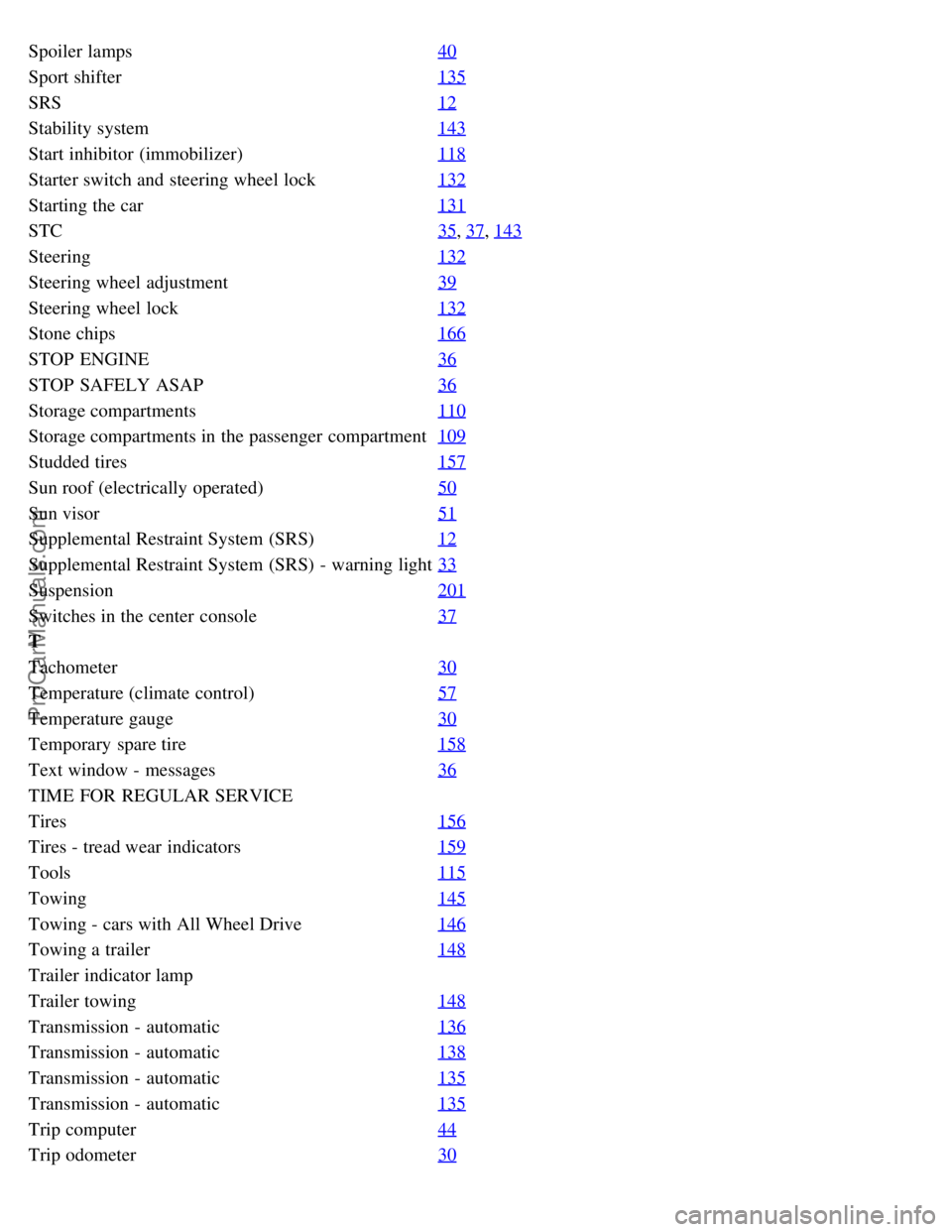
Spoiler lamps40
Sport shifter135
SRS12
Stability system143
Start inhibitor (immobilizer)118
Starter switch and steering wheel lock132
Starting the car131
STC35, 37, 143
Steering132
Steering wheel adjustment39
Steering wheel lock132
Stone chips166
STOP ENGINE36
STOP SAFELY ASAP36
Storage compartments110
Storage compartments in the passenger compartment109
Studded tires157
Sun roof (electrically operated)50
Sun visor51
Supplemental Restraint System (SRS)12
Supplemental Restraint System (SRS) - warning light33
Suspension201
Switches in the center console37
T
Tachometer30
Temperature (climate control)57
Temperature gauge30
Temporary spare tire158
Text window - messages36
TIME FOR REGULAR SERVICE
Tires156
Tires - tread wear indicators159
Tools115
Towing145
Towing - cars with All Wheel Drive146
Towing a trailer148
Trailer indicator lamp
Trailer towing148
Transmission - automatic136
Transmission - automatic138
Transmission - automatic135
Transmission - automatic135
Trip computer44
Trip odometer30
ProCarManuals.com