brake VOLVO S60 2002 Owner's Manual
[x] Cancel search | Manufacturer: VOLVO, Model Year: 2002, Model line: S60, Model: VOLVO S60 2002Pages: 106, PDF Size: 1.96 MB
Page 76 of 106
Automatic car wash
An automatic car wash is a simple and quick way of washing the car. Bear in mind, however, that an automatic car
wash can never replace a proper handwashing. During the first months of the car's life - while the paint is still curing -
we recommend that you handwash the car.
WARNING!
When the car is driven immediately after being washed, apply the brakes several times in order to remove any
moisture from the brake linings. Engine cleaning agents should not be used when the engine is warm. This
constitutes a fire risk.
Automatic washing - simple and quick
We do NOT recommend washing your car in an automatic wash during the first six months (because the paint will
not have hardened sufficiently).
An automatic wash is a simple and quick way to clean your car, but it is worth remembering that it may not be as
pg. 165 Washing and cleaning the car
thorough as when you yourself go over the car with sponge and water. Keeping the underbody clean is most important,
especially in the winter. Some automatic washers do not have facilities for washing the underbody.
Before driving into an automatic car wash, make sure that side view mirrors, auxiliary lamps, etc, are secure, and
that any antenna( s) are retracted or removed. Otherwise there is risk of the machine dislodging them.
Polishing and Waxing
Normally, polishing is not required during the first year after delivery, however, waxing may be beneficial.
Before applying polish or wax the car must be washed and dried. Tar spots can be removed with kerosene or tar
remover. Difficult spots may require a fine rubbing compound.
After polishing use liquid or paste wax.
Several commercially available products contain both polish and wax.
Waxing alone does not substitute for polishing a dull surface.
A wide range of polymer-based car waxes can be purchased today. These waxes are easy to use and produce a
long-lasting, high-gloss finish that protects the bodywork against oxidation, road dirt and fading.
Do not polish or wax your car in direct sunlight (the surface of the car should not be warmer than 113° F (45° C).
Cleaning the upholstery
The fabric can be cleaned with soapy water or a detergent. For more difficult spots caused by oil, ice cream, shoe
polish, grease, etc., use a clothing/fabric stain remover.
The plastic in the upholstery can be cleaned with a soft cloth and mild soap solution.
Leather upholstery/suede-like upholstery (alcanteraª) can be cleaned with a soft cloth and mild soap solution. For
more difficult spots, Volvo offers a leather care kit.
Under no circumstances should gasoline, naphtha or similar cleaning agents be used on the plastic or the leather
since these can cause damage.
Cleaning the seat belts
Clean only with lukewarm water and a mild soap solution.
Cleaning floor mats
The floor mats should be vacuumed or brushed clean regularly, especially during winter when they should be taken out
for drying. Spots on textile mats can be removed with a mild detergent.
ProCarManuals.com
Page 83 of 106
WARNING!
Check that the hood locks properly when closed!
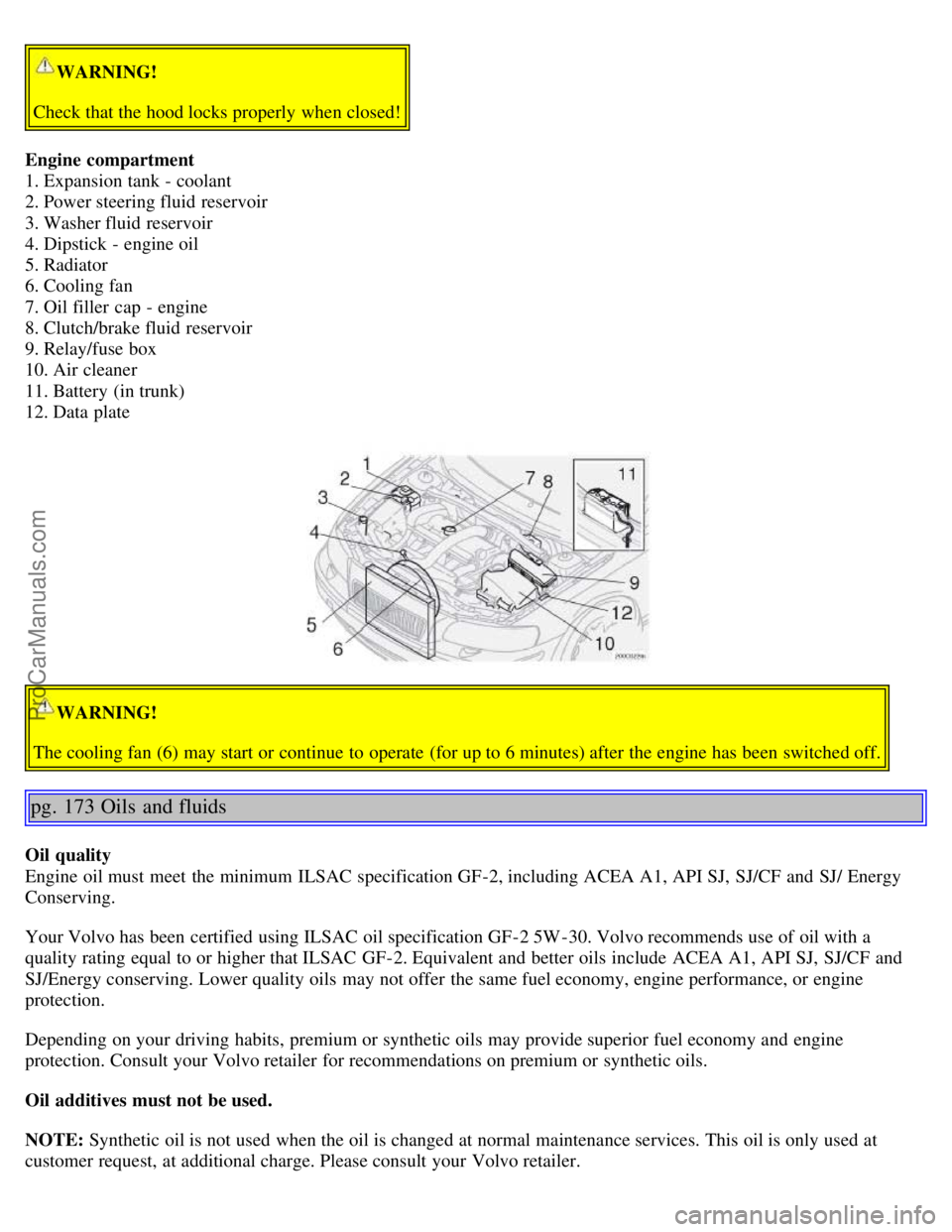
Engine compartment
1. Expansion tank - coolant
2. Power steering fluid reservoir
3. Washer fluid reservoir
4. Dipstick - engine oil
5. Radiator
6. Cooling fan
7. Oil filler cap - engine
8. Clutch/brake fluid reservoir
9. Relay/fuse box
10. Air cleaner
11. Battery (in trunk)
12. Data plate
WARNING!
The cooling fan (6) may start or continue to operate (for up to 6 minutes) after the engine has been switched off.
pg. 173 Oils and fluids
Oil quality
Engine oil must meet the minimum ILSAC specification GF-2, including ACEA A1, API SJ, SJ/CF and SJ/ Energy
Conserving.
Your Volvo has been certified using ILSAC oil specification GF-2 5W -30. Volvo recommends use of oil with a
quality rating equal to or higher that ILSAC GF-2. Equivalent and better oils include ACEA A1, API SJ, SJ/CF and
SJ/Energy conserving. Lower quality oils may not offer the same fuel economy, engine performance, or engine
protection.
Depending on your driving habits, premium or synthetic oils may provide superior fuel economy and engine
protection. Consult your Volvo retailer for recommendations on premium or synthetic oils.
Oil additives must not be used.
NOTE: Synthetic oil is not used when the oil is changed at normal maintenance services. This oil is only used at
customer request, at additional charge. Please consult your Volvo retailer.
ProCarManuals.com
Page 86 of 106
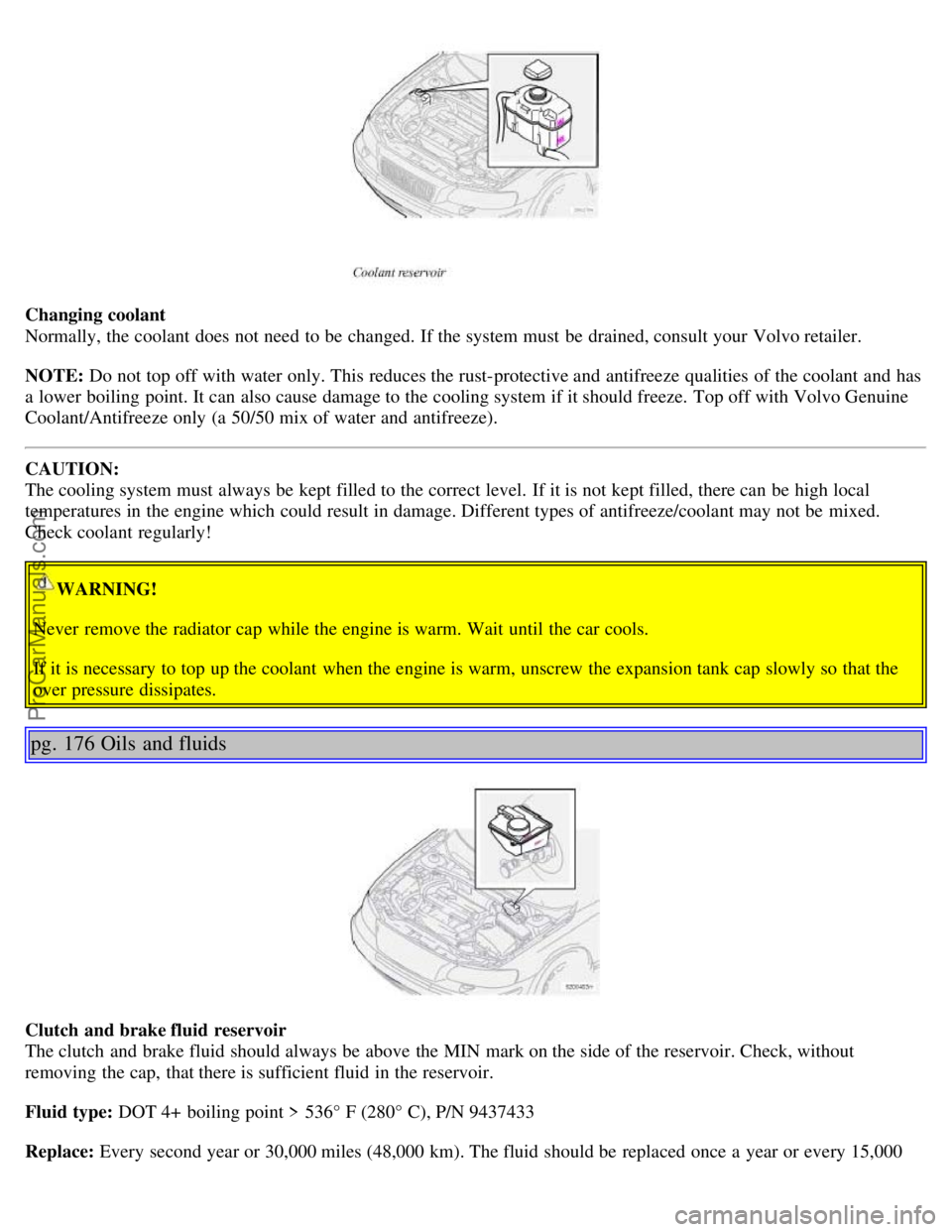
Changing coolant
Normally, the coolant does not need to be changed. If the system must be drained, consult your Volvo retailer.
NOTE: Do not top off with water only. This reduces the rust-protective and antifreeze qualities of the coolant and has
a lower boiling point. It can also cause damage to the cooling system if it should freeze. Top off with Volvo Genuine
Coolant/Antifreeze only (a 50/50 mix of water and antifreeze).
CAUTION:
The cooling system must always be kept filled to the correct level. If it is not kept filled, there can be high local
temperatures in the engine which could result in damage. Different types of antifreeze/coolant may not be mixed.
Check coolant regularly!
WARNING!
Never remove the radiator cap while the engine is warm. Wait until the car cools.
If it is necessary to top up the coolant when the engine is warm, unscrew the expansion tank cap slowly so that the
over pressure dissipates.
pg. 176 Oils and fluids
Clutch and brake fluid reservoir
The clutch and brake fluid should always be above the MIN mark on the side of the reservoir. Check, without
removing the cap, that there is sufficient fluid in the reservoir.
Fluid type: DOT 4+ boiling point > 536° F (280° C), P/N 9437433
Replace: Every second year or 30,000 miles (48,000 km). The fluid should be replaced once a year or every 15,000
ProCarManuals.com
Page 87 of 106
miles (24,000 km) when driving under extremely hard conditions (mountain driving, etc.)
Always entrust brake fluid changing to an authorized Volvo retailer.
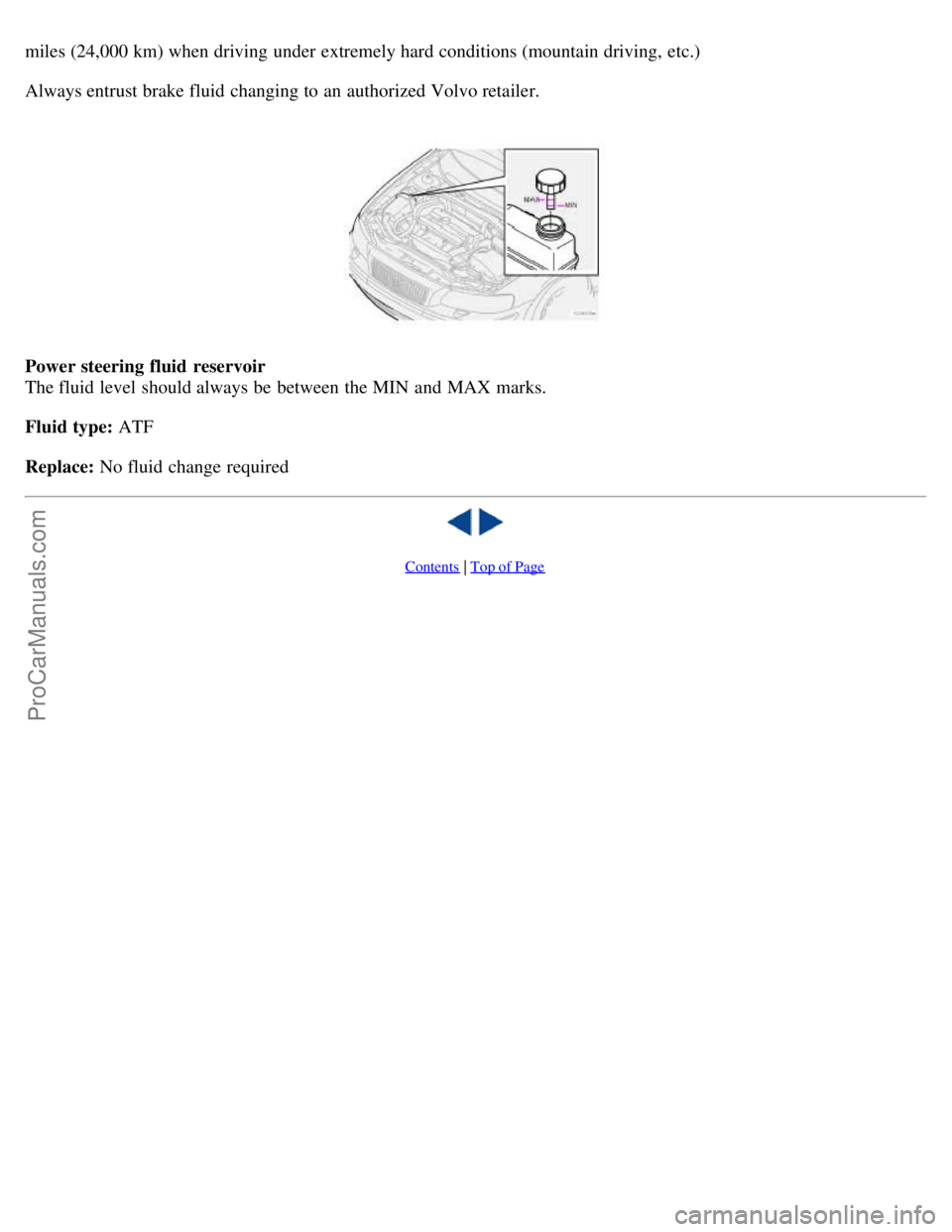
Power steering fluid reservoir
The fluid level should always be between the MIN and MAX marks.
Fluid type: ATF
Replace: No fluid change required
Contents | Top of Page
ProCarManuals.com
Page 91 of 106
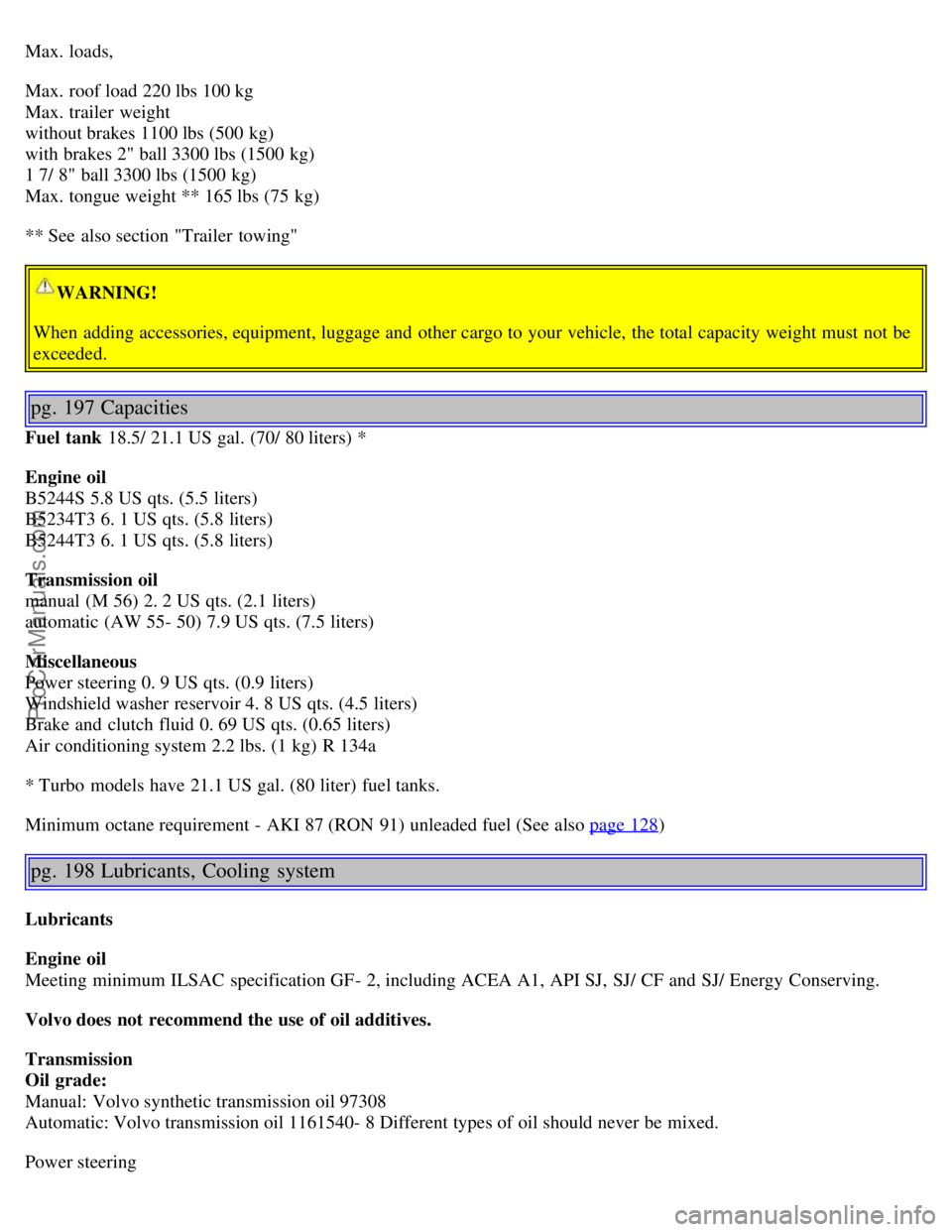
Max. loads,
Max. roof load 220 lbs 100 kg
Max. trailer weight
without brakes 1100 lbs (500 kg)
with brakes 2" ball 3300 lbs (1500 kg)
1 7/ 8" ball 3300 lbs (1500 kg)
Max. tongue weight ** 165 lbs (75 kg)
** See also section "Trailer towing"
WARNING!
When adding accessories, equipment, luggage and other cargo to your vehicle, the total capacity weight must not be
exceeded.
pg. 197 Capacities
Fuel tank 18.5/ 21.1 US gal. (70/ 80 liters) *
Engine oil
B5244S 5.8 US qts. (5.5 liters)
B5234T3 6. 1 US qts. (5.8 liters)
B5244T3 6. 1 US qts. (5.8 liters)
Transmission oil
manual (M 56) 2. 2 US qts. (2.1 liters)
automatic (AW 55- 50) 7.9 US qts. (7.5 liters)
Miscellaneous
Power steering 0. 9 US qts. (0.9 liters)
Windshield washer reservoir 4. 8 US qts. (4.5 liters)
Brake and clutch fluid 0. 69 US qts. (0.65 liters)
Air conditioning system 2.2 lbs. (1 kg) R 134a
* Turbo models have 21.1 US gal. (80 liter) fuel tanks.
Minimum octane requirement - AKI 87 (RON 91) unleaded fuel (See also page 128
)
pg. 198 Lubricants, Cooling system
Lubricants
Engine oil
Meeting minimum ILSAC specification GF- 2, including ACEA A1, API SJ, SJ/ CF and SJ/ Energy Conserving.
Volvo does not recommend the use of oil additives.
Transmission
Oil grade:
Manual: Volvo synthetic transmission oil 97308
Automatic: Volvo transmission oil 1161540- 8 Different types of oil should never be mixed.
Power steering
ProCarManuals.com
Page 92 of 106
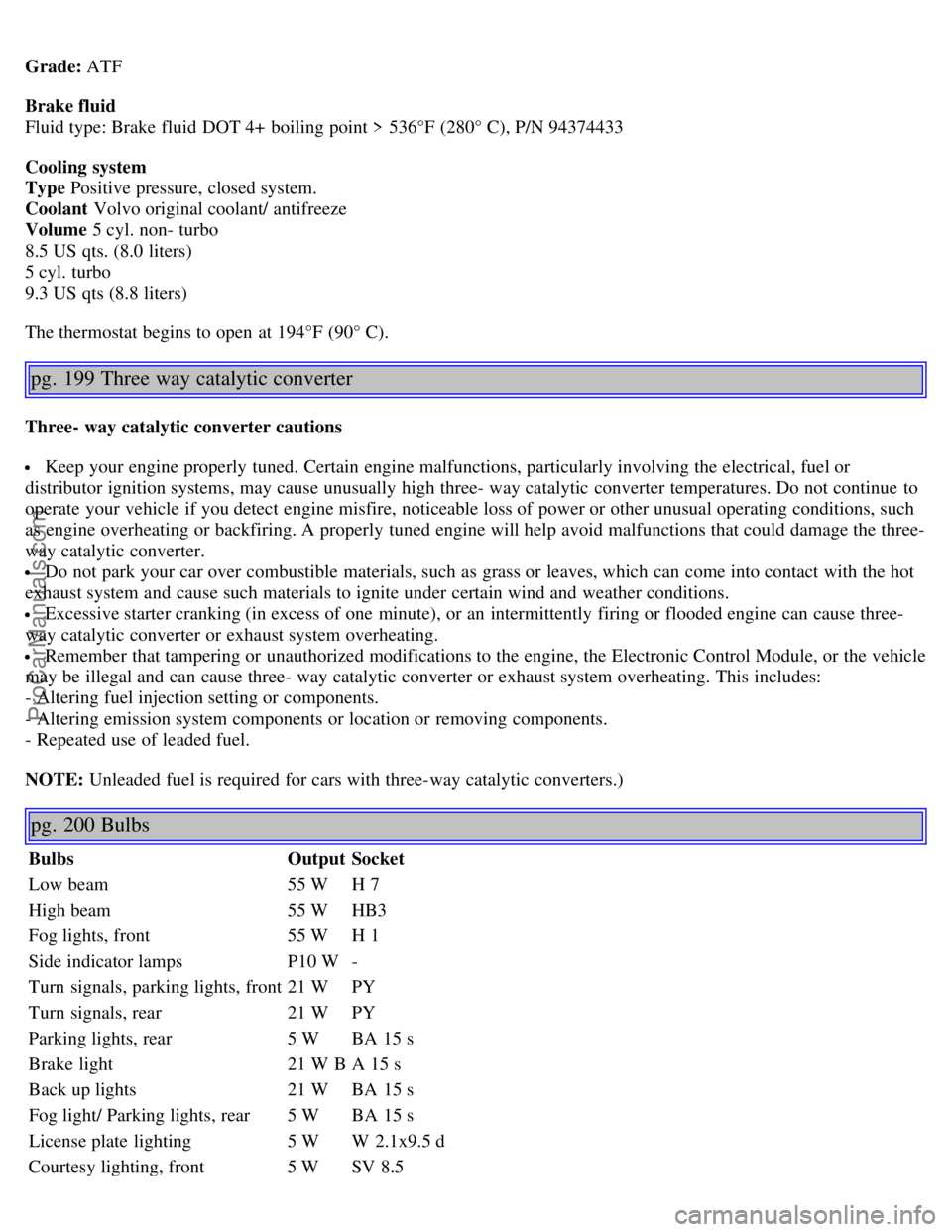
Grade: ATF
Brake fluid
Fluid type: Brake fluid DOT 4+ boiling point > 536°F (280° C), P/N 94374433
Cooling system
Type Positive pressure, closed system.
Coolant Volvo original coolant/ antifreeze
Volume 5 cyl. non- turbo
8.5 US qts. (8.0 liters)
5 cyl. turbo
9.3 US qts (8.8 liters)
The thermostat begins to open at 194°F (90° C).
pg. 199 Three way catalytic converter
Three- way catalytic converter cautions
Keep your engine properly tuned. Certain engine malfunctions, particularly involving the electrical, fuel or
distributor ignition systems, may cause unusually high three- way catalytic converter temperatures. Do not continue to
operate your vehicle if you detect engine misfire, noticeable loss of power or other unusual operating conditions, such
as engine overheating or backfiring. A properly tuned engine will help avoid malfunctions that could damage the three-
way catalytic converter.
Do not park your car over combustible materials, such as grass or leaves, which can come into contact with the hot
exhaust system and cause such materials to ignite under certain wind and weather conditions.
Excessive starter cranking (in excess of one minute), or an intermittently firing or flooded engine can cause three-
way catalytic converter or exhaust system overheating.
Remember that tampering or unauthorized modifications to the engine, the Electronic Control Module, or the vehicle
may be illegal and can cause three- way catalytic converter or exhaust system overheating. This includes:
- Altering fuel injection setting or components.
- Altering emission system components or location or removing components.
- Repeated use of leaded fuel.
NOTE: Unleaded fuel is required for cars with three-way catalytic converters.)
pg. 200 Bulbs
Bulbs OutputSocket
Low beam 55 WH 7
High beam 55 WHB3
Fog lights, front 55 WH 1
Side indicator lamps P10 W-
Turn signals, parking lights, front 21 WPY
Turn signals, rear 21 WPY
Parking lights, rear 5 WBA 15 s
Brake light 21 W BA 15 s
Back up lights 21 WBA 15 s
Fog light/ Parking lights, rear 5 WBA 15 s
License plate lighting 5 WW 2.1x9.5 d
Courtesy lighting, front 5 WSV 8.5
ProCarManuals.com
Page 96 of 106

2 0 0 2
VOLVO S60
Index
pg. 207 Index
A
A/C (air conditioning) 58
, 61
ABS2 , 31 , 142
Accessory bracket111
Adjustable steering wheel39
Advanced User Mode (AUM) - radio73
Air bags - dual threshold/stage13
Air cleaner172
Air distribution55 , 58 , 62
Air quality sensor59
Air vents55
Airbag - Side Impact (SIPS)18
Airbags (front)12
Alarm117 , 125
All Wheel Drive140
All Wheel Drive - snow chains157
All Wheel Drive - towing146
Anti-lock Brake System (ABS)02 , 31
Approach lighting41
Ashtray46 , 110
Audio63
Audio systems - general information82
Audio systems - specifications81
AUM73
AUTO (climate control)57
Automatic Climate Control, ECC56
Automatic gearbox133
Automatic transmission136
Automatic transmission - adaptive system137
Automatic transmission - kickdown137
Auxiliary lamps37
Average speed44
AWD140
B
ProCarManuals.com
Page 97 of 106

Back up light185
Backrest113
Bass67
Battery170 , 178 , 202
Battery - replacing179
Belt check171
Blower (fan)57, 61
Booster cushion24
Booster cushion (integrated)25
Brake circuit141
Brake fluid176
Brake light185
Brake system32 , 141
Bulbs181 , 200
C
Capacities197
Carbon Monoxide - Important Warning129
Cargo compartment113
Cassette player74
Catalytic converter199
CD player76 , 78
Ceiling lighting187
Center console - storage compartments110
Central locking system - remote control119
Changing coolant171
Changing oil and oil filter173
Changing wheels160
Check Engine warning light33
Child restraint anchorages26
Child safety24
Child safety locks124
Child seat (Isofix fasteners)25
Cigarette lighter46
Climate control systems -general information54
Clock30
Coat hanger112
Coin compartment110
Cold weather precautions153
Coolant175
Coolant - changing171, 175
Coolant - checking level of171
Cooling system198
Courtesy light107
Cruise control45
ProCarManuals.com
Page 100 of 106

K
Keylock2 , 131
Keys118
Kickdown137
L
LED illumination41
Lighting panel40
Load carriers152
Locking121
Locking steering wheel132
Locks117
Long distance trips154
Long loads - carrying114
Low beam bulb182
Lubricants198
M
Maintenance Schedule168
Malfunction indicator light33
Manual climate control with air conditioning60
Manual transmission135
Messages in the display36
Multifilter with air quality sensor59
O
Occupant safety28
Octane rating128
Odometer30
Oil pressure33
Oil quality173
Oil viscosity173
Opening the trunk from the inside122
Opening/ locking the trunk122
P
P Park136
, 138
Paint - color code166
Paintwork damage166
Parking brake33 , 46
Parking lights40
Pen holder111
Polishing165
Power seat104
Power steering fluid176
Power sun roof50
Prem- Air3
Programme type PT72
ProCarManuals.com
Page 105 of 106

the vehicle and others sharing the roadway. Avoiding distractions is part of that responsibility.
The following should be checked regularly: *
1 Washer fluid reservoir should be filled with water and solvent (wintertime: windshield washer anti-freeze). See page
175.
2 Power steering- When cold, the level must not be above the COLD mark and when hot it must not be above the
HOT mark. Top up if the level drops to the ADD mark with ATF fluid. See page 176.
3 Coolant level should be between the expansion tank marks. Mixture: 50% anti-freeze and 50% water. See page 171.
4 Engine oil level should be between the dipstick marks. The distance between the marks represents approx.
1.6 US qts (1.5 liters). See page 174.
5 Brake fluid - check, without removing the cap, that the level is above the MIN mark. Use brake fluid DOT 4+. See
page 176.
Fuel octane rating, see page 128.
Tire pressure, see label located on the inside of the fuel tank cover.
* Engine oil should be check each time the car is refueled.
BulbsPower Socket US no.
ProCarManuals.com