oil pressure VOLVO S60 2002 Owners Manual
[x] Cancel search | Manufacturer: VOLVO, Model Year: 2002, Model line: S60, Model: VOLVO S60 2002Pages: 106, PDF Size: 1.96 MB
Page 3 of 106
For Volvo, all homogeneous plastic parts weighing more than 1.7 oz. (50 grams) are marked with international
symbols that indicate how the component is to be sorted for recycling.
In addition to continuous environmental refinement of conventional gasoline-powered internal combustion engines,
Volvo is actively looking at advanced technology alternative-fuel vehicles.
When you drive a Volvo, you become our partner in the work to lessen the car's impact on the environment. To reduce
your vehicle's environmental impact, you can:
Maintain proper air pressure in your tires. Tests have shown decreased fuel economy with improperly inflated tires.
Follow the recommended maintenance schedule.
Drive at a constant speed.
See an authorized Volvo retailer as soon as possible for inspection if the check engine (malfunction indicator) lamp
illuminates, or stays on after the vehicle has started.
Properly dispose of any vehicle-related waste such as used motor oil, used batteries, brake pads, etc.
When cleaning your car, use Volvo's own car care products, all of which have systematically been adapted to the
environment.
For additional information regarding the environmental activities in which Volvo Cars of North America, Inc. and
Volvo Car Corporation are involved, visit our Internet Home Page at: http://www.volvocars.com
Prem-Air
On the surface of the radiator in the engine compartment, there is a special coating called Prem-Air. Prem-Air works
as a catalytic converter, converting most of the ground level ozone passing through the radiator into oxygen, thereby
reducing harmful ground-level ozone.
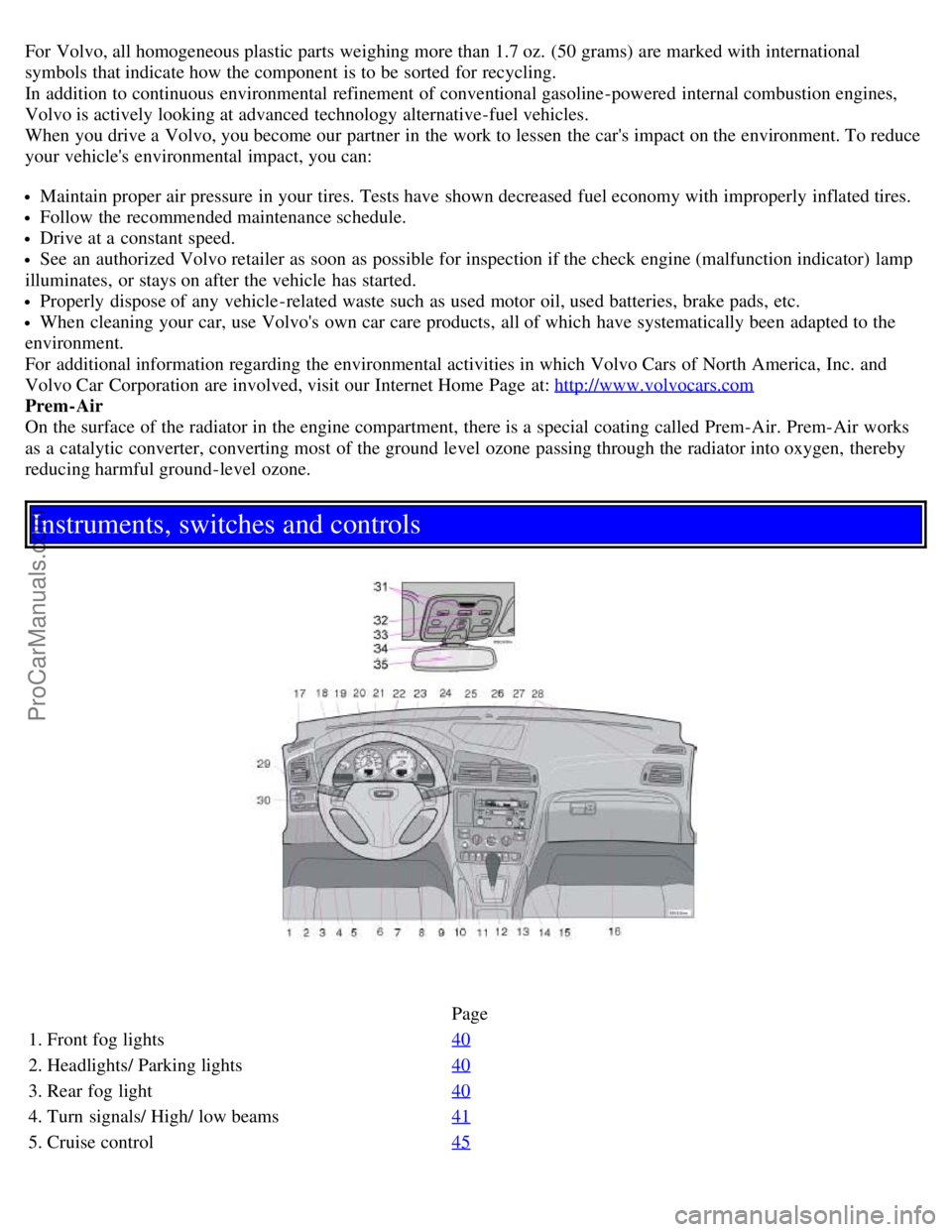
Instruments, switches and controls
Page
1. Front fog lights 40
2. Headlights/ Parking lights40
3. Rear fog light40
4. Turn signals/ High/ low beams41
5. Cruise control45
ProCarManuals.com
Page 18 of 106

Rear fog light
This light indicates that the fog light is on.
Oil pressure warning light
If the light comes on while driving, stop the car and then stop the engine immediately and check the engine oil level.
See page 172
. If the light stays on after restart, have the car towed to the nearest authorized Volvo retailer. After hard
driving, the light may come on occasionally when the engine is idling. This is normal, provided it goes off when the
engine speed is increased.
CHECK ENGINE Malfunction indicator light
On-Board Diagnostic II (OBDII): As you drive, a computer called "OBDII" monitors your car's engine, transmission,
electrical and emission systems. The CHECK ENGINE light will light up if the computer senses a condition that
potentially may need correcting. When this happens, please have your car checked by a Volvo retailer as soon as
possible.
A CHECK ENGINE light may have many causes. Sometimes, you may not notice a change in your car's behavior.
Even so, an uncorrected condition could hurt fuel economy, emission cleanliness, and driveability. Extended driving
without correcting the cause could even damage other components in your car.
Canadian models are equipped with this warning light:
pg. 34 Indicator and warning symbols
Turn signal indicator - trailer (certain models)
If you are towing a trailer, this light will flash simultaneously with the turn signals on the trailer. If the light does not
flash when signaling, neither the trailer's turn signals nor the car's turn signals are functioning.
Seat belt reminder
This symbol lights up to indicate that the driver has not fastened his/her seat belt.
pg. 35 Indicator and warning symbols
Cars equipped with STC or DSTC (option) Cars equipped with STC or DSTC have a switch in the center console
marked STC or DSTC. See pages 37, 38
.
If the indicator light flashes, it indicates that the STC or DSTC system is working.
ProCarManuals.com
Page 59 of 106

Do not exceed posted speed limits.
Avoid carrying unnecessary items (extra load) in the car.
Maintain correct tire pressure. Check tire pressure regularly (when tires are cold).
Remove snow tires when threat of snow or ice has ended.
Note that roof racks, ski racks, etc, increase air resistance and also fuel consumption.
Avoid using automatic transmission kickdown feature unless necessary.
However, at higher driving speeds, fuel consumption will be lower with the air conditioning on and the windows
closed than with the air conditioning off and the windows open.
Using the onboard trip computer's fuel consumption modes can help you learn how to drive more economically.
Other factors that decrease gas mileage are:
Worn or dirty spark plugs
Incorrect spark plug gap
Dirty air cleaner
Dirty engine oil and clogged oil filter
Dragging brakes
Incorrect front end alignment Some of the above mentioned items and others are checked at the standard
Maintenance Service intervals.
NOTE: Vehicles equipped with automatic transmissions should use (D) rive as often as possible and avoid using
"kickdown" to help improve fuel economy.
WARNING!
Driving with the trunk open: Driving with the trunk open could lead to poisonous exhaust gases entering the
passenger compartment. If the trunk must be kept open for any reason, proceed as follows
- Close the windows
- Set the ventilation system control to air flow to floor, windshield and side windows and blower control to its
highest setting.
CAUTION: Drive slowly and carefully if going through standing water (i. e. flooded roadways, etc.). Damage to the
engine could result if excess water is drawn in through the air intake system. Never drive the vehicle in water deeper
than 1 foot (300 mm).
Weight distribution affects handling
At the specified curb weight your car has a tendency to understeer, which means that the steering wheel has to be
turned more than might seem appropriate for the curvature of a bend. This ensures good stability and reduces the risk
of rear wheel skid. Remember that these properties can alter with the vehicle load.
pg. 134 General information
The heavier the load in the trunk (max. 220 lbs, 100 kg), the less the tendency to understeer.
Handling, roadholding
Vehicle load, tire design and inflation pressure all affect vehicle handling. Therefore, check that the tires are inflated to
the recommended pressure according to the vehicle load. See "Tire pressure" section.
Loads should be distributed so that capacity weight or maximum permissible axle loads are not exceeded.
pg. 135 Manual transmission
ProCarManuals.com
Page 75 of 106
2 0 0 2
VOLVO S60
Car care
pg. 163 Car care
Washing and cleaning the car 164
Paint touch up166
pg. 164 Washing and cleaning the car
Washing and cleaning the car
The car should be washed at regular intervals since dirt, dust, insects and tar spots adhere to the paint and may cause
damage. It is particularly important to wash the car frequently in the wintertime to prevent corrosion, when salt has
been used on the roads.
When washing the car, do not expose it to direct sunlight. Use lukewarm water to soften the dirt before you wash
with a sponge, and plenty of water, to avoid scratching.
Bird droppings: Remove from paintwork as soon as possible. Otherwise the finish may be permanently damaged.
A detergent can be used to facilitate the softening of dirt and oil.
A water-soluble grease solvent may be used in cases of sticky dirt. However, use a wash place equipped with a
drainage separator.
Dry the car with a clean chamois and remember to clean the drain holes in the doors and rocker panels.
Tar spots can be removed with kerosene or tar remover after the car has been washed.
A stiff-bristle brush and lukewarm soapy water can be used to clean the wiper blades. Frequent cleaning improves
visibility considerably.
Wash off the dirt from the underside (wheel housings, fenders, etc.).
In areas of high industrial fallout, more frequent washing is recommended.
CAUTION:
During high pressure washing, the spray mouthpiece must never be closer to the vehicle than 13" (30 cm). Do not
spray into the locks.
When washing or steam cleaning the engine, avoid spraying water or steam directly on the electrical components or
toward the rear side of the engine.
After cleaning the engine, the spark plug wells should be inspected for water and blown dry if necessary.
Suitable detergents: Special car washing detergents should be used. A suitable mixture is about 2.5 fl. oz. (8.5 cl) of
detergent to 2.6 US gal. (10 liters) of warm water. After washing with a detergent the car should be well rinsed with
clean water.
Bumpers: Wash the bumpers with the same cleaning agent used on the rest of the car. Never clean the bumpers with
gasoline or paint thinner. Difficult spots can be removed with denatured alcohol. To avoid scratches, do not dry the
bumpers with paper.
NOTE: When washing the car, remember to remove dirt from the drain holes in the doors and sills.
ProCarManuals.com
Page 86 of 106
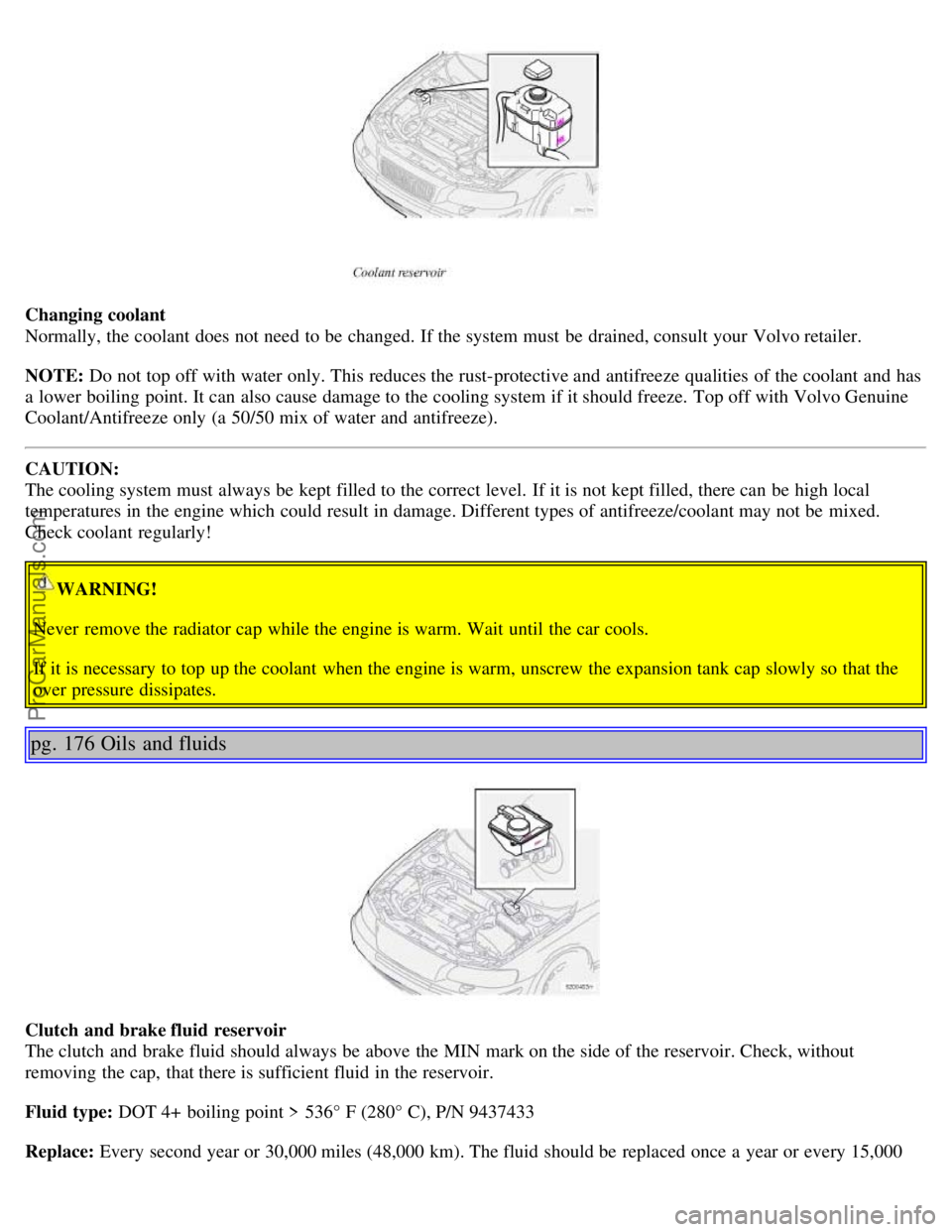
Changing coolant
Normally, the coolant does not need to be changed. If the system must be drained, consult your Volvo retailer.
NOTE: Do not top off with water only. This reduces the rust-protective and antifreeze qualities of the coolant and has
a lower boiling point. It can also cause damage to the cooling system if it should freeze. Top off with Volvo Genuine
Coolant/Antifreeze only (a 50/50 mix of water and antifreeze).
CAUTION:
The cooling system must always be kept filled to the correct level. If it is not kept filled, there can be high local
temperatures in the engine which could result in damage. Different types of antifreeze/coolant may not be mixed.
Check coolant regularly!
WARNING!
Never remove the radiator cap while the engine is warm. Wait until the car cools.
If it is necessary to top up the coolant when the engine is warm, unscrew the expansion tank cap slowly so that the
over pressure dissipates.
pg. 176 Oils and fluids
Clutch and brake fluid reservoir
The clutch and brake fluid should always be above the MIN mark on the side of the reservoir. Check, without
removing the cap, that there is sufficient fluid in the reservoir.
Fluid type: DOT 4+ boiling point > 536° F (280° C), P/N 9437433
Replace: Every second year or 30,000 miles (48,000 km). The fluid should be replaced once a year or every 15,000
ProCarManuals.com
Page 92 of 106
Grade: ATF
Brake fluid
Fluid type: Brake fluid DOT 4+ boiling point > 536°F (280° C), P/N 94374433
Cooling system
Type Positive pressure, closed system.
Coolant Volvo original coolant/ antifreeze
Volume 5 cyl. non- turbo
8.5 US qts. (8.0 liters)
5 cyl. turbo
9.3 US qts (8.8 liters)
The thermostat begins to open at 194°F (90° C).
pg. 199 Three way catalytic converter
Three- way catalytic converter cautions
Keep your engine properly tuned. Certain engine malfunctions, particularly involving the electrical, fuel or
distributor ignition systems, may cause unusually high three- way catalytic converter temperatures. Do not continue to
operate your vehicle if you detect engine misfire, noticeable loss of power or other unusual operating conditions, such
as engine overheating or backfiring. A properly tuned engine will help avoid malfunctions that could damage the three-
way catalytic converter.
Do not park your car over combustible materials, such as grass or leaves, which can come into contact with the hot
exhaust system and cause such materials to ignite under certain wind and weather conditions.
Excessive starter cranking (in excess of one minute), or an intermittently firing or flooded engine can cause three-
way catalytic converter or exhaust system overheating.
Remember that tampering or unauthorized modifications to the engine, the Electronic Control Module, or the vehicle
may be illegal and can cause three- way catalytic converter or exhaust system overheating. This includes:
- Altering fuel injection setting or components.
- Altering emission system components or location or removing components.
- Repeated use of leaded fuel.
NOTE: Unleaded fuel is required for cars with three-way catalytic converters.)
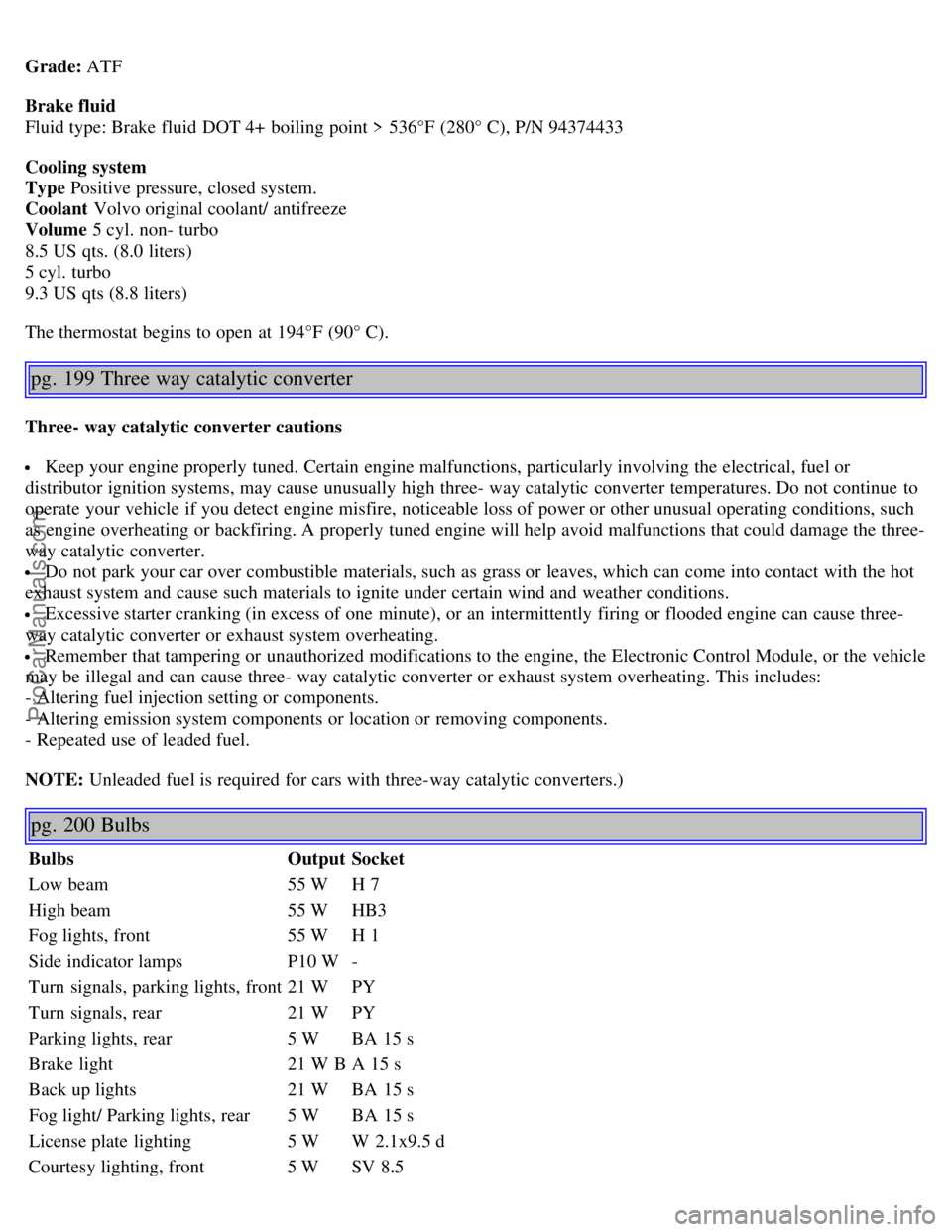
pg. 200 Bulbs
Bulbs OutputSocket
Low beam 55 WH 7
High beam 55 WHB3
Fog lights, front 55 WH 1
Side indicator lamps P10 W-
Turn signals, parking lights, front 21 WPY
Turn signals, rear 21 WPY
Parking lights, rear 5 WBA 15 s
Brake light 21 W BA 15 s
Back up lights 21 WBA 15 s
Fog light/ Parking lights, rear 5 WBA 15 s
License plate lighting 5 WW 2.1x9.5 d
Courtesy lighting, front 5 WSV 8.5
ProCarManuals.com
Page 100 of 106

K
Keylock2 , 131
Keys118
Kickdown137
L
LED illumination41
Lighting panel40
Load carriers152
Locking121
Locking steering wheel132
Locks117
Long distance trips154
Long loads - carrying114
Low beam bulb182
Lubricants198
M
Maintenance Schedule168
Malfunction indicator light33
Manual climate control with air conditioning60
Manual transmission135
Messages in the display36
Multifilter with air quality sensor59
O
Occupant safety28
Octane rating128
Odometer30
Oil pressure33
Oil quality173
Oil viscosity173
Opening the trunk from the inside122
Opening/ locking the trunk122
P
P Park136
, 138
Paint - color code166
Paintwork damage166
Parking brake33 , 46
Parking lights40
Pen holder111
Polishing165
Power seat104
Power steering fluid176
Power sun roof50
Prem- Air3
Programme type PT72
ProCarManuals.com
Page 105 of 106

the vehicle and others sharing the roadway. Avoiding distractions is part of that responsibility.
The following should be checked regularly: *
1 Washer fluid reservoir should be filled with water and solvent (wintertime: windshield washer anti-freeze). See page
175.
2 Power steering- When cold, the level must not be above the COLD mark and when hot it must not be above the
HOT mark. Top up if the level drops to the ADD mark with ATF fluid. See page 176.
3 Coolant level should be between the expansion tank marks. Mixture: 50% anti-freeze and 50% water. See page 171.
4 Engine oil level should be between the dipstick marks. The distance between the marks represents approx.
1.6 US qts (1.5 liters). See page 174.
5 Brake fluid - check, without removing the cap, that the level is above the MIN mark. Use brake fluid DOT 4+. See
page 176.
Fuel octane rating, see page 128.
Tire pressure, see label located on the inside of the fuel tank cover.
* Engine oil should be check each time the car is refueled.
BulbsPower Socket US no.
ProCarManuals.com