oil VOLVO S60 2003 User Guide
[x] Cancel search | Manufacturer: VOLVO, Model Year: 2003, Model line: S60, Model: VOLVO S60 2003Pages: 120, PDF Size: 2.43 MB
Page 86 of 120

Working on your car
Note the following before you begin working on your car:
Battery
Ensure that the battery cables are correctly connected and tightened.
Never disconnect the battery when the engine is running (e.g. when replacing the battery).
Never use a fast charger to charge the battery. The battery cables should be disconnected when recharging.
The battery contains acid that is both corrosive and poisonous. It is important that the battery is handled in an
environmentally friendly way. Let your Volvo dealer assist you.
Hoisting the car
If a garage jack is used to lift the car, the two jack attachments points should be used. They are specially reinforced to
bear the weight of the car. A garage jack can also be placed under the front of the engine support frame. Take care not
to damage the splash guard under the engine. Ensure that the jack is positioned so that the car cannot slide off it.
Always use axle stands or similar structures.
If a two-post hoist is used to lift the car, the front and rear lift arm pads should be centered under the reinforced lift
plates on the inboard edge of the sill rail (see illustration).
WARNING!
The car ignition system has very high voltage!
The voltage in the ignition system is dangerous!
Do not touch spark plugs, ignition cables or the ignition coil when the engine is running or the ignition is switched
on!
The ignition should be switched off when:
Conducting engine tests.
Replacing parts in the ignition system, such as spark plugs, ignition coil, distributor, ignition cables, etc.
WARNING!
Never try to repair any part of the SRS or SIPS bag systems yourself. Any interference in the system could cause
malfunction and serious injury. Any work should only be performed by an authorized Volvo workshop.
ProCarManuals.com
Page 87 of 120
pg. 121 Maintenance and service
Belt check
Check the belt regularly to make sure it is in good condition and is clean. A worn or dirty belt can cause poor cooling
and low alternator output as well as impair the operation of the power steering and the air conditioning unit.
NOTE: The drive belt is equipped with a self -tensioning mechanism and requires no adjustment between changes!
WARNING!
The engine must not be running when this check is performed.
Check coolant level
The cooling system must be filled with coolant and not leak to operate at maximum efficiency. Check the coolant level
regularly. The level should be between the "MAX" and "MIN" marks on the expansion tank. The check should be
made with particular thoroughness when the engine is new or when the cooling system has been drained.
Do not remove the filler cap other than for topping up with coolant. Frequent removal may prevent coolant circulation
between the engine and the expansion tank during engine warm up and cooling.
Changing coolant
Normally, the coolant does not need to be changed. If the system must be drained, consult your Volvo retailer.
NOTE: Do not top off with water only. This reduces the rust-protective and antifreeze qualities of the coolant and has
a lower boiling point. It can also cause damage to the cooling system if it should freeze. Top off with Volvo Genuine
Coolant/Antifreeze only (a 50/50 mix of water and antifreeze).
CAUTION:
The cooling system must always be kept filled to the correct level. If it is not kept filled, there can be high local
temperatures in the engine which could result in damage. Different types of antifreeze/coolant may not be mixed.
WARNING!
Never remove the radiator cap while the engine is warm. Wait until the car cools.
pg. 122 Maintenance and service
Hood and engine compartment
ProCarManuals.com
Page 88 of 120

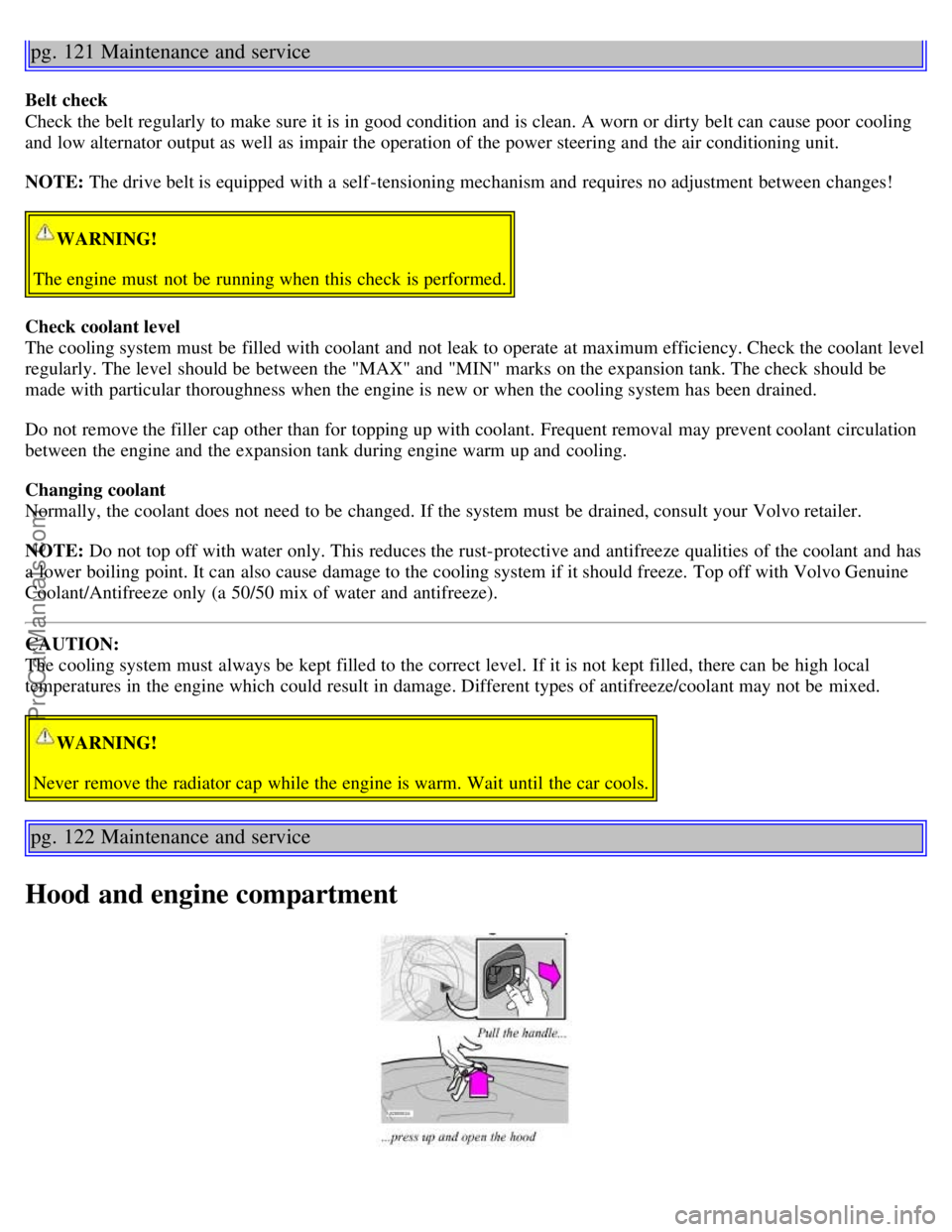
Opening the hood
Pull the lever located under the left side of the dash to release the hood lock.
Lift the hood slightly.
Press up the release control located under the front edge of the hood (at the center) and lift.
WARNING!
Check that the hood locks properly when closed!
Engine compartment
1. Expansion tank - coolant
2. Power steering fluid reservoir
3. Washer fluid reservoir
4. Dipstick - engine oil
5. Radiator
6. Cooling fan
7. Oil filler cap - engine
8. Clutch/brake fluid reservoir
9. Relay/fuse box
10. Air cleaner
11. Battery (in trunk)
12. Data plate
WARNING!
The cooling fan (6) may start or continue to operate (for up to 6 minutes) after the engine has been switched off.
pg. 123 Maintenance and service
Oils and fluids
Oil quality
Engine oil must meet the minimum ILSAC specification GF-2, including ACEA A1, API SJ, SJ/CF and SJ/ Energy
Conserving.
Your Volvo has been certified to standards using ILSAC oil specification GF-2 5W -30. Volvo recommends use of oil
with a quality rating equal to or higher than ILSAC GF-2. Equivalent and better oils include ACEA A1, API SJ,
SJ/CF, and SJ/Energy conserving. Lower quality oils may not offer the same fuel economy, engine performance, or
ProCarManuals.com
Page 89 of 120
engine protection.
Volvo Cars recommends Castrol.
Depending on your driving habits, premium or synthetic oils may provide superior fuel economy and engine
protection. Consult your Volvo retailer for recommendations on premium or synthetic oils.
Oil additives must not be used.
NOTE: Synthetic oil is not used when the oil is changed at normal maintenance services. This oil is only used at
customer request, at additional charge. Please consult your Volvo retailer.
Operation in hot climates
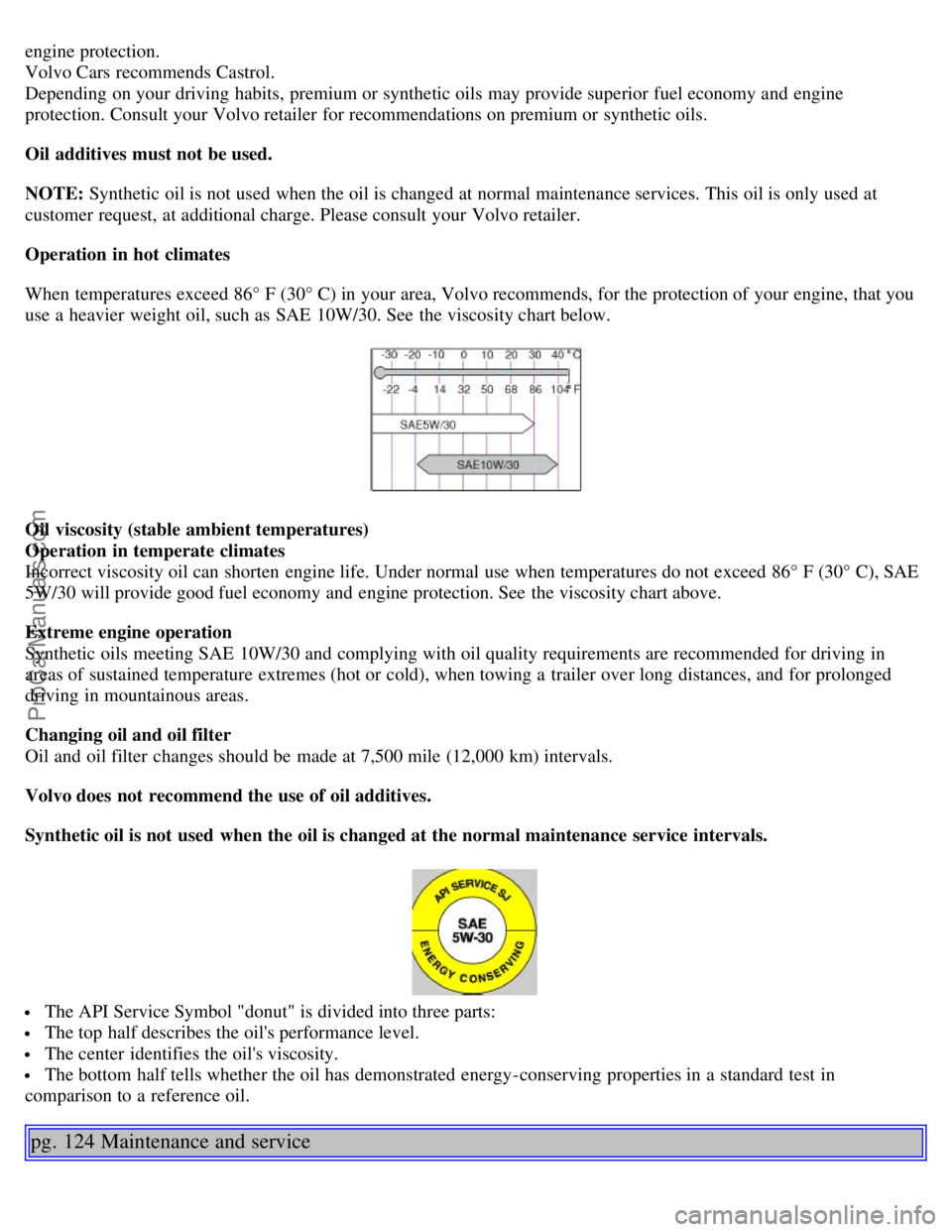
When temperatures exceed 86° F (30° C) in your area, Volvo recommends, for the protection of your engine, that you
use a heavier weight oil, such as SAE 10W/30. See the viscosity chart below.
Oil viscosity (stable ambient temperatures)
Operation in temperate climates
Incorrect viscosity oil can shorten engine life. Under normal use when temperatures do not exceed 86° F (30° C), SAE
5W/30 will provide good fuel economy and engine protection. See the viscosity chart above.
Extreme engine operation
Synthetic oils meeting SAE 10W/30 and complying with oil quality requirements are recommended for driving in
areas of sustained temperature extremes (hot or cold), when towing a trailer over long distances, and for prolonged
driving in mountainous areas.
Changing oil and oil filter
Oil and oil filter changes should be made at 7,500 mile (12,000 km) intervals.
Volvo does not recommend the use of oil additives.
Synthetic oil is not used when the oil is changed at the normal maintenance service intervals.
The API Service Symbol "donut" is divided into three parts:
The top half describes the oil's performance level.
The center identifies the oil's viscosity.
The bottom half tells whether the oil has demonstrated energy-conserving properties in a standard test in
comparison to a reference oil.
pg. 124 Maintenance and service
ProCarManuals.com
Page 90 of 120

Oils and fluids (Contd)
Checking the oil level
The oil level should be checked every time the car is refueled. This is especially important during the period up
to the first service.
CAUTION:
Not checking the oil level regularly can result in serious engine damage if the oil level becomes too low.
Park the car on a level surface and wait for at least 5 minutes after the engine has been switched off. Be sure the oil
level is maintained between the upper and lower marks on the dipstick. Low oil level can cause internal damage to the
engine and overfilling can result in high oil consumption. The distance between the dipstick marks represents approx.
1.6 US qt (1.5 liter). The oil should preferably be checked when cold, before the engine has been started.
NOTE: The engine must be stopped when checking the oil.
WARNING!
Do not allow oil to spill onto or come into contact with hot exhaust pipe surfaces.
Adding oil (topping up)
Add oil of the same kind as already used.
Capacity (including filter): Normally-aspirated 5-cylinder engine - 5.8 US qts (5.5 liters). Turbo 5-cylinder engine -
6.1 US qts (5.8 liters).
The oil filter should be replaced at every oil change.
pg. 125 Maintenance and service
Washer fluid reservoir
Washer fluid reservoir
The washer fluid reservoir is located in the engine compartment and holds approx. 4.7 US qts. (4.5 liters).
ProCarManuals.com
Page 91 of 120
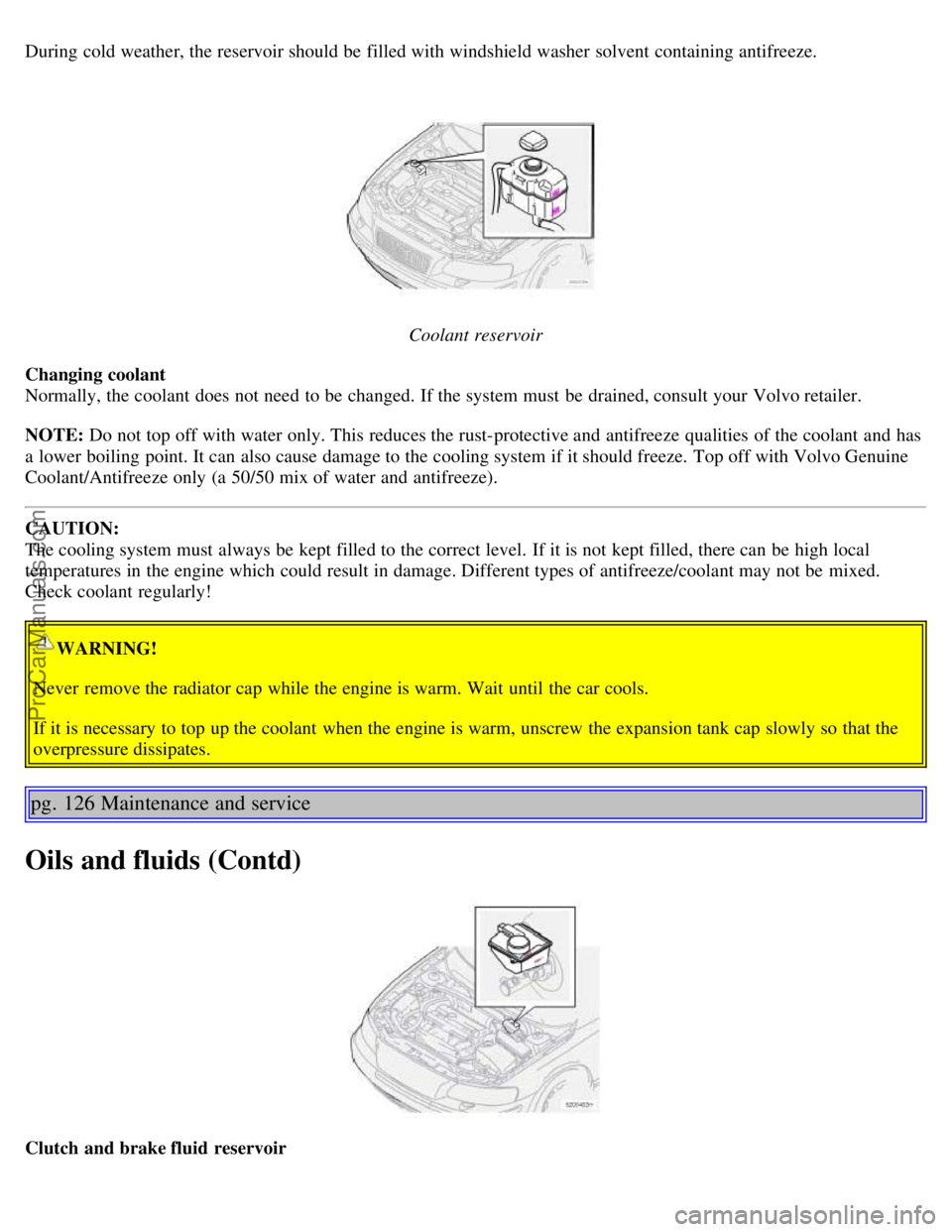
During cold weather, the reservoir should be filled with windshield washer solvent containing antifreeze.
Coolant reservoir
Changing coolant
Normally, the coolant does not need to be changed. If the system must be drained, consult your Volvo retailer.
NOTE: Do not top off with water only. This reduces the rust-protective and antifreeze qualities of the coolant and has
a lower boiling point. It can also cause damage to the cooling system if it should freeze. Top off with Volvo Genuine
Coolant/Antifreeze only (a 50/50 mix of water and antifreeze).
CAUTION:
The cooling system must always be kept filled to the correct level. If it is not kept filled, there can be high local
temperatures in the engine which could result in damage. Different types of antifreeze/coolant may not be mixed.
Check coolant regularly!
WARNING!
Never remove the radiator cap while the engine is warm. Wait until the car cools.
If it is necessary to top up the coolant when the engine is warm, unscrew the expansion tank cap slowly so that the
overpressure dissipates.
pg. 126 Maintenance and service
Oils and fluids (Contd)
Clutch and brake fluid reservoir
ProCarManuals.com
Page 92 of 120
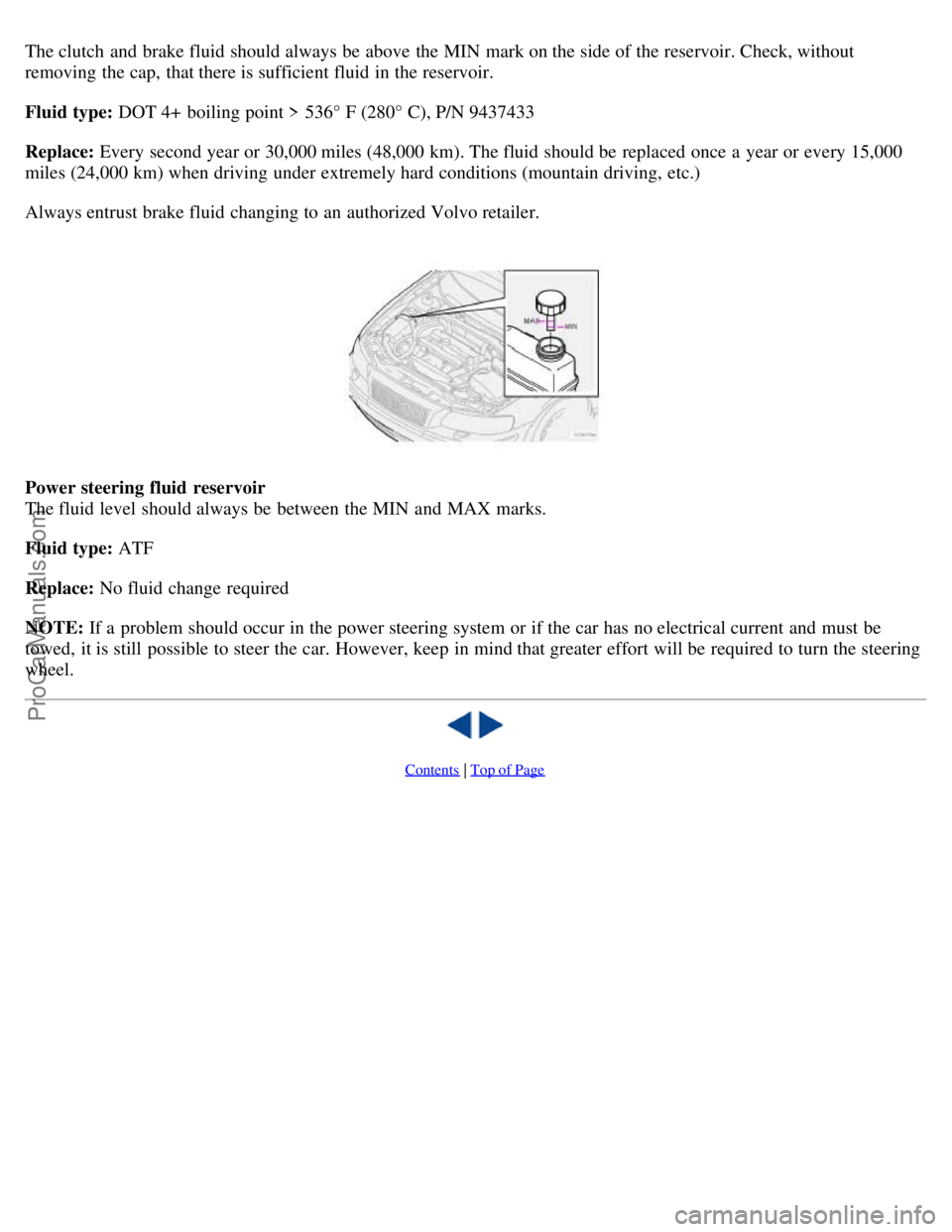
The clutch and brake fluid should always be above the MIN mark on the side of the reservoir. Check, without
removing the cap, that there is sufficient fluid in the reservoir.
Fluid type: DOT 4+ boiling point > 536° F (280° C), P/N 9437433
Replace: Every second year or 30,000 miles (48,000 km). The fluid should be replaced once a year or every 15,000
miles (24,000 km) when driving under extremely hard conditions (mountain driving, etc.)
Always entrust brake fluid changing to an authorized Volvo retailer.
Power steering fluid reservoir
The fluid level should always be between the MIN and MAX marks.
Fluid type: ATF
Replace: No fluid change required
NOTE: If a problem should occur in the power steering system or if the car has no electrical current and must be
towed, it is still possible to steer the car. However, keep in mind that greater effort will be required to turn the steering
wheel.
Contents | Top of Page
ProCarManuals.com
Page 96 of 120
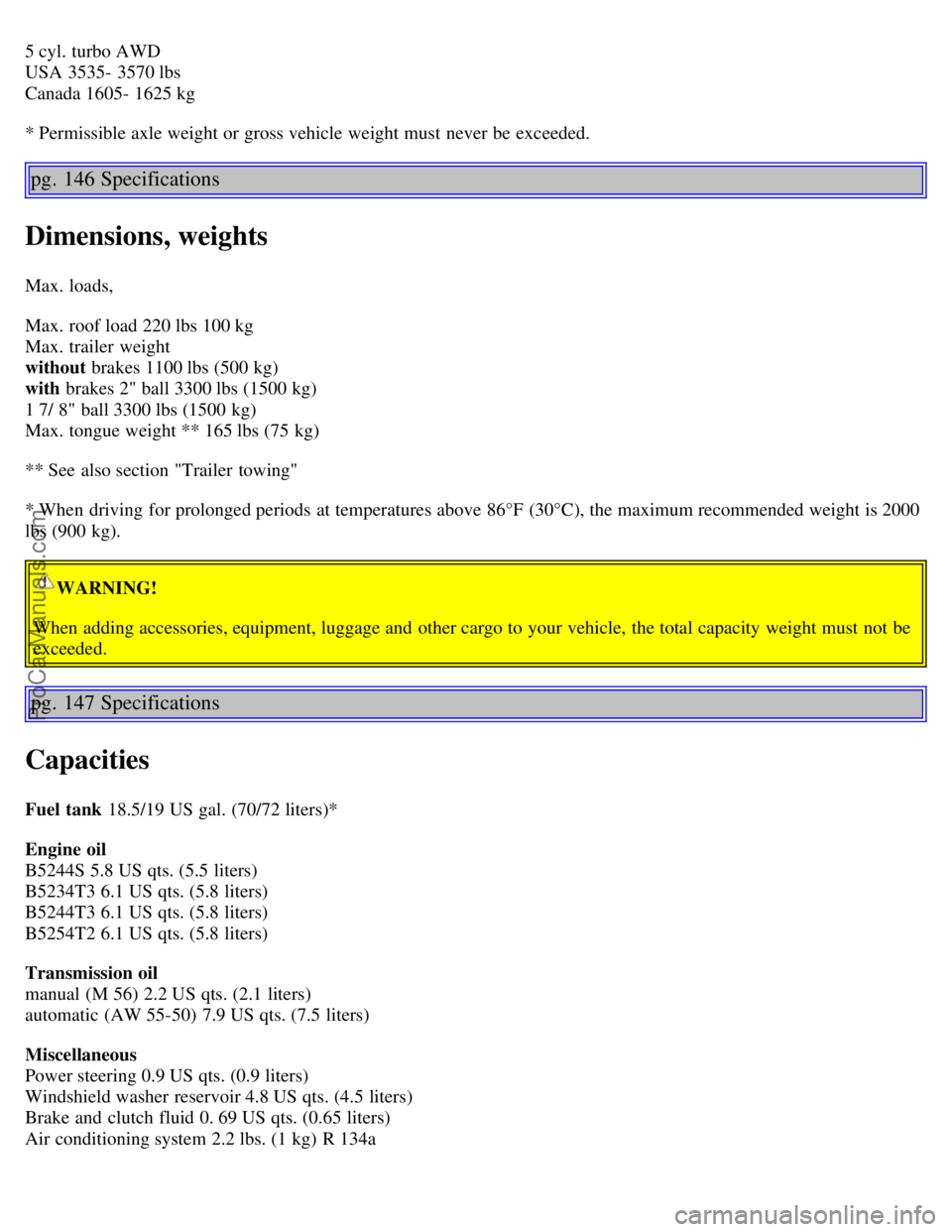
5 cyl. turbo AWD
USA 3535- 3570 lbs
Canada 1605- 1625 kg
* Permissible axle weight or gross vehicle weight must never be exceeded.
pg. 146 Specifications
Dimensions, weights
Max. loads,
Max. roof load 220 lbs 100 kg
Max. trailer weight
without brakes 1100 lbs (500 kg)
with brakes 2" ball 3300 lbs (1500 kg)
1 7/ 8" ball 3300 lbs (1500 kg)
Max. tongue weight ** 165 lbs (75 kg)
** See also section "Trailer towing"
* When driving for prolonged periods at temperatures above 86°F (30°C), the maximum recommended weight is 2000
lbs (900 kg).
WARNING!
When adding accessories, equipment, luggage and other cargo to your vehicle, the total capacity weight must not be
exceeded.
pg. 147 Specifications
Capacities
Fuel tank 18.5/19 US gal. (70/72 liters)*
Engine oil
B5244S 5.8 US qts. (5.5 liters)
B5234T3 6.1 US qts. (5.8 liters)
B5244T3 6.1 US qts. (5.8 liters)
B5254T2 6.1 US qts. (5.8 liters)
Transmission oil
manual (M 56) 2.2 US qts. (2.1 liters)
automatic (AW 55-50) 7.9 US qts. (7.5 liters)
Miscellaneous
Power steering 0.9 US qts. (0.9 liters)
Windshield washer reservoir 4.8 US qts. (4.5 liters)
Brake and clutch fluid 0. 69 US qts. (0.65 liters)
Air conditioning system 2.2 lbs. (1 kg) R 134a
ProCarManuals.com
Page 97 of 120
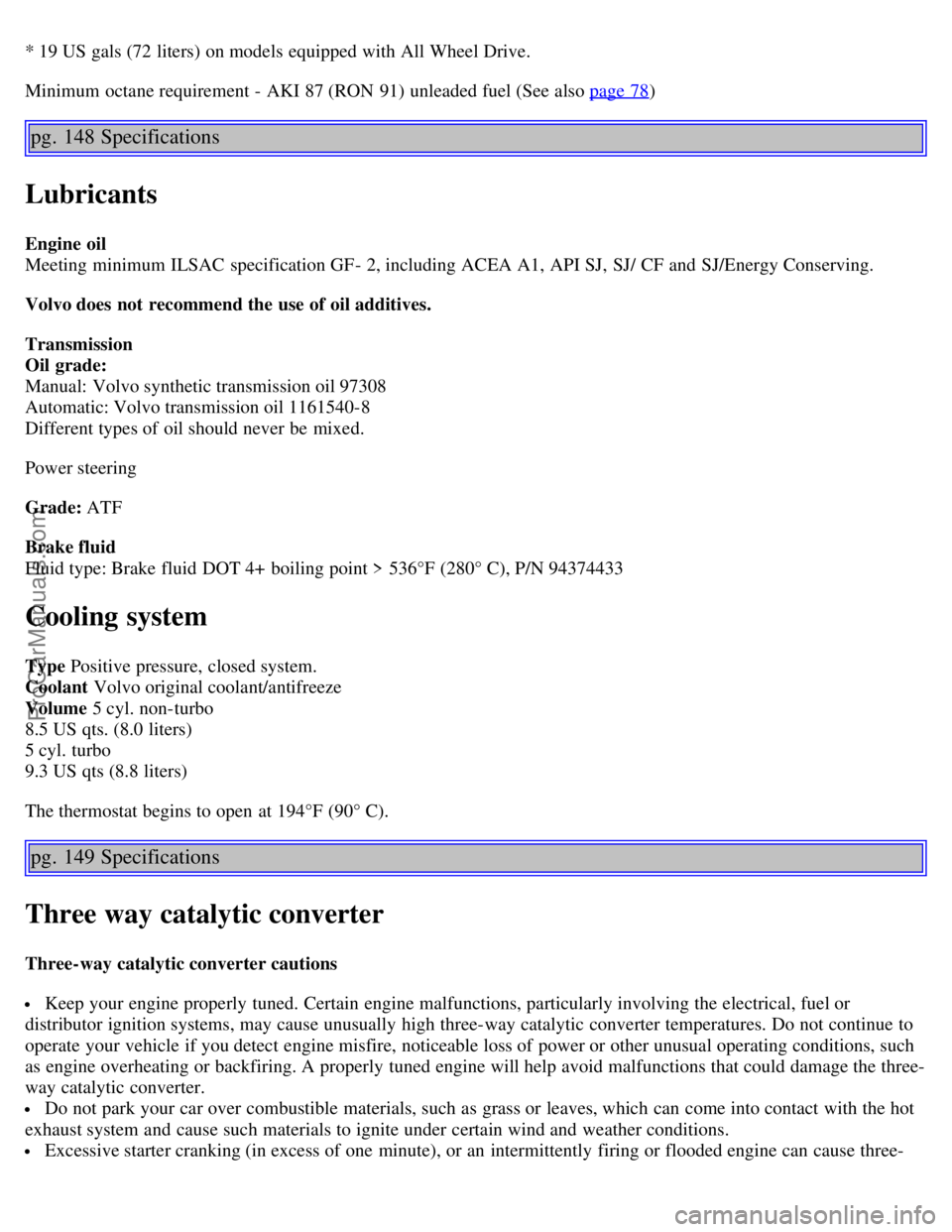
* 19 US gals (72 liters) on models equipped with All Wheel Drive.
Minimum octane requirement - AKI 87 (RON 91) unleaded fuel (See also page 78)
pg. 148 Specifications
Lubricants
Engine oil
Meeting minimum ILSAC specification GF- 2, including ACEA A1, API SJ, SJ/ CF and SJ/Energy Conserving.
Volvo does not recommend the use of oil additives.
Transmission
Oil grade:
Manual: Volvo synthetic transmission oil 97308
Automatic: Volvo transmission oil 1161540-8
Different types of oil should never be mixed.
Power steering
Grade: ATF
Brake fluid
Fluid type: Brake fluid DOT 4+ boiling point > 536°F (280° C), P/N 94374433
Cooling system
Type Positive pressure, closed system.
Coolant Volvo original coolant/antifreeze
Volume 5 cyl. non-turbo
8.5 US qts. (8.0 liters)
5 cyl. turbo
9.3 US qts (8.8 liters)
The thermostat begins to open at 194°F (90° C).
pg. 149 Specifications
Three way catalytic converter
Three-way catalytic converter cautions
Keep your engine properly tuned. Certain engine malfunctions, particularly involving the electrical, fuel or
distributor ignition systems, may cause unusually high three-way catalytic converter temperatures. Do not continue to
operate your vehicle if you detect engine misfire, noticeable loss of power or other unusual operating conditions, such
as engine overheating or backfiring. A properly tuned engine will help avoid malfunctions that could damage the three-
way catalytic converter.
Do not park your car over combustible materials, such as grass or leaves, which can come into contact with the hot
exhaust system and cause such materials to ignite under certain wind and weather conditions.
Excessive starter cranking (in excess of one minute), or an intermittently firing or flooded engine can cause three-
ProCarManuals.com
Page 99 of 120

Individual rear wheel suspension with longitudinal support arms, double link arms and track rods.
Front suspension
Spring strut suspension with integrated shock absorbers and control arms linked to the support frame. Power-assisted
rack and pinion steering. Safety type steering column.
pg. 152 Specifications
Electrical system
12-volt system with voltage controlled generator. Single wire system in which the chassis and engine block are used as
conductors, grounded on the chassis.
Battery
Voltage 12 V
Cold start capacity (CCA) 600 A
Reserve capacity (RC) 115 min
If you must replace your battery, be sure to replace it with a battery of the same cold start capacity and reserve
capacity as the original (See the decal on the battery).
Generator max. current 140 A
Starter motor, power 1.4 kW
Spark plugs P/N272313-8 or equivalent
Gap 0.028- 0.032 in. 0.7-0.8 mm
Tightening torque 22 ft. lbs. (30 Nm)
Firing order 1-2-4-5-3
WARNING!
The distributor ignition system operates at very high voltages. Special safety precautions must be followed to
prevent injury. Always turn the ignition off when:
-Replacing distributor ignition components e.g. plugs, coil, etc.
-Do not touch any part of the distributor ignition system while the engine is running. This may result in unintended
movements and body injury.
pg. 153 Specifications
Engine specifications
B5244S B5234T3B5244T3 B5254T2
Output (kW/rps) 123/100184/87147/100 154/83
(hp/rpm) 165/6000247/5200197/6000 208/5000
Torque (Nm/rps) 225/75330/42-87285/30-83 320/25-75
(ft. lbs./rpm) 166/4500243/2400-5200210/1800-5000 236/1500-4500
No. of cylinders 555 5
Bore (mm) 838183 81
ProCarManuals.com