maintenance VOLVO S60 2003 Owners Manual
[x] Cancel search | Manufacturer: VOLVO, Model Year: 2003, Model line: S60, Model: VOLVO S60 2003Pages: 120, PDF Size: 2.43 MB
Page 1 of 120
2 0 0 3
VOLVO S60
Introduction
Welcome to the world-wide family of Volvo owners. We trust that you will enjoy many years of safe driving in your
Volvo, an automobile designed with your safety and comfort in mind. To help ensure your satisfaction with this
vehicle, we encourage you to familiarize yourself with the equipment descriptions, operating instructions and
maintenance requirements/recommendations in this manual. We also urge you and your passengers to wear seat belts
at all times in this (or any other) automobile. And, of course, please do not operate a vehicle if you may be affected by
alcohol, medication or any impairment that could hinder your ability to drive.
Your Volvo is designed to meet all applicable safety and emission standards, as evidenced by the certification labels
attached to the driver's door opening and on the left wheel housing in the engine compartment.
For further information please contact your retailer, or:
In the USA:
Volvo Cars of North America
ProCarManuals.com
Page 3 of 120
Volvo reserves the right to make model changes at any time, or to change specifications or design without notice and
without incurring obligation.
WARNING!
CALIFORNIA Proposition 65 Warning!
Engine exhaust, some of its constituents, and certain vehicle components contain or emit chemicals known to the
state of California to cause cancer, and birth defects or other reproductive harm. In addition, certain fluids contained
in vehicles and certain products of component wear contain or emit chemicals known to the State of California to
cause cancer, and birth defects or other reproductive harm.
Volvo and the environment
Volvo is committed to the well being of its customers. As a natural part of this commitment, we care about the
environment in which we all live. Caring for the environment means an everyday involvement in reducing our
environmental impact.
Volvo's environmental activities are based on a holistic view, which means we consider the overall environmental
impact of a product throughout its complete life cycle. In this context, design, production, product use, and recycling
are all important considerations.
In production, Volvo has partly or completely phased out several chemicals including freons, lead chromates,
naphtanates, asbestos, mercury and cadmium; and reduced the amount of chemicals used in our plants 50% since 1991.
Volvo was the first in the world to introduce into production a three-way catalytic converter with a Lambda sond, now
called oxygen sensor, in 1976. The current version of this highly efficient system reduces emissions of harmful
substances (CO, HC, NOx) from the exhaust pipe by approximately 95% and the search to eliminate the remaining
emissions continues. Volvo is the only automobile manufacturer to offer CFC-free retrofit kits for the air conditioning
system of all models as far back as the 1975 model 240. Advanced electronic engine controls, refined purification
systems and cleaner fuels are bringing us closer to our goal.
After Volvo cars and parts have fulfilled their use, recycling is the next critical step in completing the life cycle. The
metal content is about 75% of the total weight of a car, which makes the car among the most recycled industrial
products. In order to have efficient and well controlled recycling, many Volvo variants have printed dismantling
manuals, indicating the weight and material of individual components.
For Volvo, all homogeneous plastic parts weighing more than 1.7 oz. (50 grams) are marked with international
symbols that indicate how the component is to be sorted for recycling.
In addition to continuous environmental refinement of conventional gasoline-powered internal combustion engines,
Volvo is actively looking at advanced technology alternative-fuel vehicles.
When you drive a Volvo, you become our partner in the work to lessen the car's impact on the environment. To reduce
your vehicle's environmental impact, you can:
Maintain proper air pressure in your tires. Tests have shown decreased fuel economy with improperly inflated tires.
Follow the recommended maintenance schedule.
Drive at a constant speed.
See an authorized Volvo retailer as soon as possible for inspection if the check engine (malfunction indicator) lamp
illuminates, or stays on after the vehicle has started.
Properly dispose of any vehicle-related waste such as used motor oil, used batteries, brake pads, etc.
When cleaning your car, use Volvo's own car care products, all of which have systematically been adapted to the
environment.
For additional information regarding the environmental activities in which Volvo Cars of North America, LLC. and
Volvo Car Corporation are involved, visit our Internet Home Page at: http://www.volvocars.com
PremAir®
On the surface of the radiator in the engine compartment, there is a special coating called PremAir®. PremAir® works
as a catalytic converter, converting most of the ground level ozone passing through the radiator into oxygen, thereby
ProCarManuals.com
Page 6 of 120
Car care
Maintenance and service
Specifications
Audio
Index
Back Cover
Contents | Top of Page
ProCarManuals.com
Page 13 of 120
supplement to the seat belts.
WARNING!
Never drive with the airbags deployed. The fact that they hang out can impair the steering of your car. Other safety
systems can also be damaged. The smoke and dust formed when the airbags are deployed can cause skin and eye
irritation in the event of prolonged exposure.
pg. 7 Safety
Airbags (Supplemental Restraint System) (Contd)
WARNING!
If your car has been subjected to flood conditions (e.g. soaked carpeting/standing water on the floor of the vehicle)
or if your car has become flood-damaged in any way, do not attempt to start the vehicle or put the key in the ignition
before disconnecting the battery (see below). This may cause airbag deployment which could result in personal
injury. Have the car towed to an authorized Volvo retailer for repairs.
Automatic transmission:
Before attempting to tow the car, use the following procedure to override the shiftlock system to move the gear
selector to the neutral position.
Switch off the ignition for at least 10 minutes and disconnect the battery
Wait at least one minute
Insert the key in the ignition and turn it to position II
Press firmly on the brake pedal.
Move the gear selector from (P)ark to the (N) eutral position.
There is no maintenance to perform on the SRS yourself. The month and year shown on the decal on the door pillar
indicate when you should contact your Volvo retailer for specific servicing or replacement of airbags and seat belt
tensioners. This service must be performed by an authorized Volvo retailer.
Should you have any questions about the SRS system, please contact your authorized Volvo retailer or Volvo
Customer Support.:
In the USA:
Volvo Cars of North America, LLC.
Customer Relations
P.O. Box 914
Rockleigh, New Jersey 07647-0914
800-458-1552
In Canada:
Volvo Canada Ltd.
175 Gordon Baker Road
North York, Ontario M2H 2N7
800-663-8255
pg. 9 Safety
ProCarManuals.com
Page 21 of 120
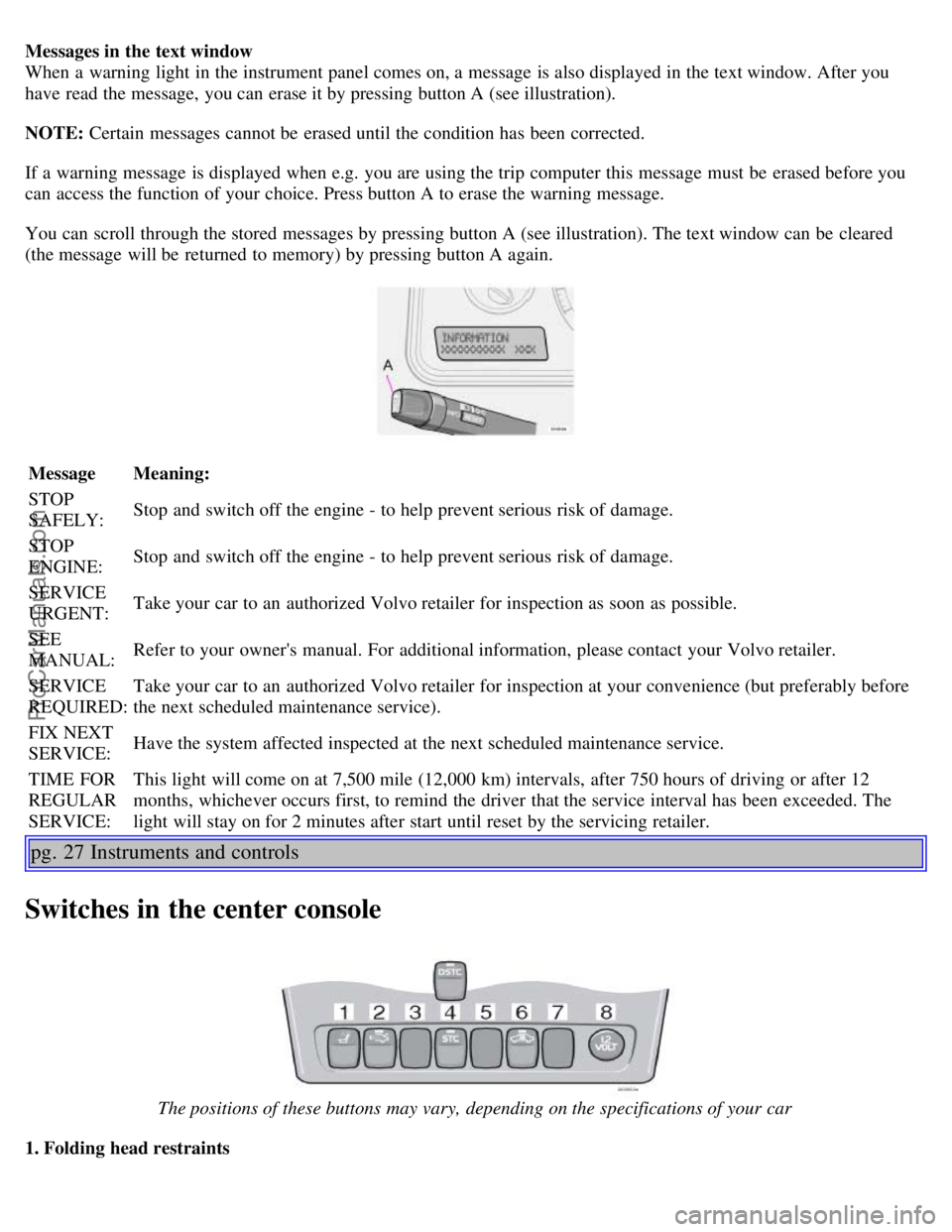
Messages in the text window
When a warning light in the instrument panel comes on, a message is also displayed in the text window. After you
have read the message, you can erase it by pressing button A (see illustration).
NOTE: Certain messages cannot be erased until the condition has been corrected.
If a warning message is displayed when e.g. you are using the trip computer this message must be erased before you
can access the function of your choice. Press button A to erase the warning message.
You can scroll through the stored messages by pressing button A (see illustration). The text window can be cleared
(the message will be returned to memory) by pressing button A again.
MessageMeaning:
STOP
SAFELY: Stop and switch off the engine - to help prevent serious risk of damage.
STOP
ENGINE: Stop and switch off the engine - to help prevent serious risk of damage.
SERVICE
URGENT: Take your car to an authorized Volvo retailer for inspection as soon as possible.
SEE
MANUAL: Refer to your owner's manual. For additional information, please contact your Volvo retailer.
SERVICE
REQUIRED: Take your car to an authorized Volvo retailer for inspection at your convenience (but preferably before
the next scheduled maintenance service).
FIX NEXT
SERVICE: Have the system affected inspected at the next scheduled maintenance service.
TIME FOR
REGULAR
SERVICE: This light will come on at 7,500 mile (12,000 km) intervals, after 750 hours of driving or after 12
months, whichever occurs first, to remind the driver that the service interval has been exceeded. The
light will stay on for 2 minutes after start until reset by the servicing retailer.
pg. 27 Instruments and controls
Switches in the center console
The positions of these buttons may vary, depending on the specifications of your car
1. Folding head restraints
ProCarManuals.com
Page 36 of 120

2 0 0 3
VOLVO S60
Climate control
pg. 43 Climate control
Climate control systems - general information 44
Air distribution45
Electronic climate control, ECC (2.4T and T5)46
Manual climate control with air conditioning, (A/C)50
pg. 44 Climate control
Climate control systems - general information
Condensation on the inside of the windows
Keeping the insides of the windows clean will help reduce the amount of condensation that forms on the windows. Use
a commercial window cleaning agent to clean the windows.
Ice and snow
Always keep the air intake grille at the base of the windshield free of snow.
Cabin air filter
Replace the cabin air filter with a new one at the recommended intervals. The filter should be replaced more often
when driving under dirty and dusty conditions. The filter cannot be cleaned and therefore should always be replaced
with a new one.
Sensors
The sunlight sensor on the dashboard and passenger compartment temperature sensor in the ECC control panel should
not be covered in any way as this could cause incorrect information to be sent to the ECC system.
Parking the car in warm weather
If your car has been parked in the sun in warm weather, opening the windows and sun roof (option) for several
minutes before driving will help release the warm air from the passenger compartment. When the engine is running,
close the windows and sun roof and use the recirculation function for several minutes to enable the air conditioning to
cool the compartment as quickly as possible.
Windows and optional sun roof
The ECC system (2.4T and T5 models only) will function best if the windows and optional sun roof are closed. If you
drive with the sun roof open, we recommend that you manually adjust the temperature and blower control (the LED in
the AUTO switch should be off).
Acceleration
The air conditioning is momentarily disengaged during full-throttle acceleration.
Climate control maintenance
ProCarManuals.com
Page 37 of 120
All maintenance on the climate control systems should be carried out by an authorized Volvo service technician only.
Refrigerant
Volvo cares about the environment. The air conditioning system in your car contains a CFC-free refrigerant - R134a.
This substance will not deplete the ozone layer. The system contains 2.2 lbs (1000 g) R134a and uses PAG oil.
Passenger compartment blower
Approximately 50 minutes after the ignition is turned off, the blower may come on automatically, and run for seven
minutes, to remove condensation in the A/C evaporator.
pg. 45 Climate control
Air distribution
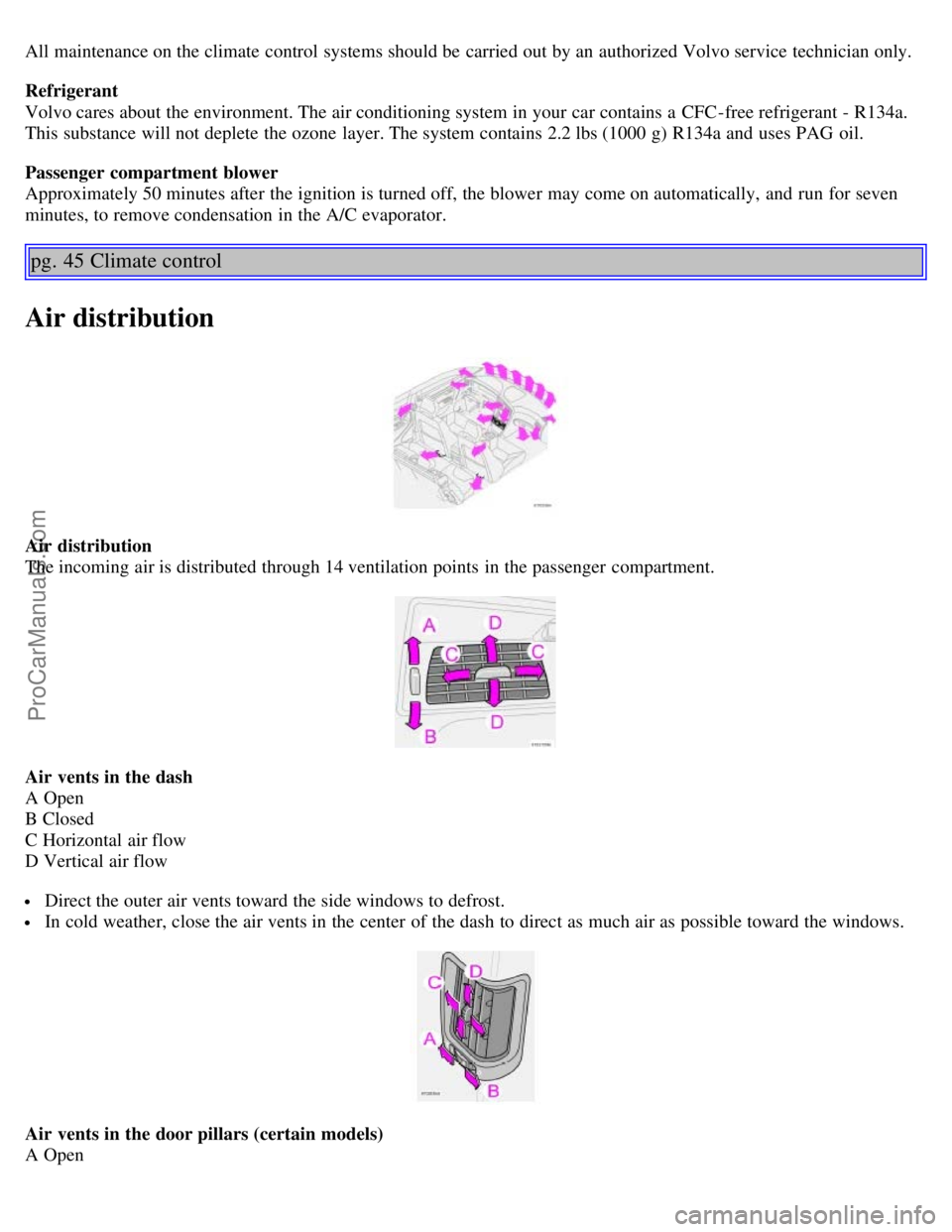
Air distribution
The incoming air is distributed through 14 ventilation points in the passenger compartment.
Air vents in the dash
A Open
B Closed
C Horizontal air flow
D Vertical air flow
Direct the outer air vents toward the side windows to defrost.
In cold weather, close the air vents in the center of the dash to direct as much air as possible toward the windows.
Air vents in the door pillars (certain models)
A Open
ProCarManuals.com
Page 63 of 120
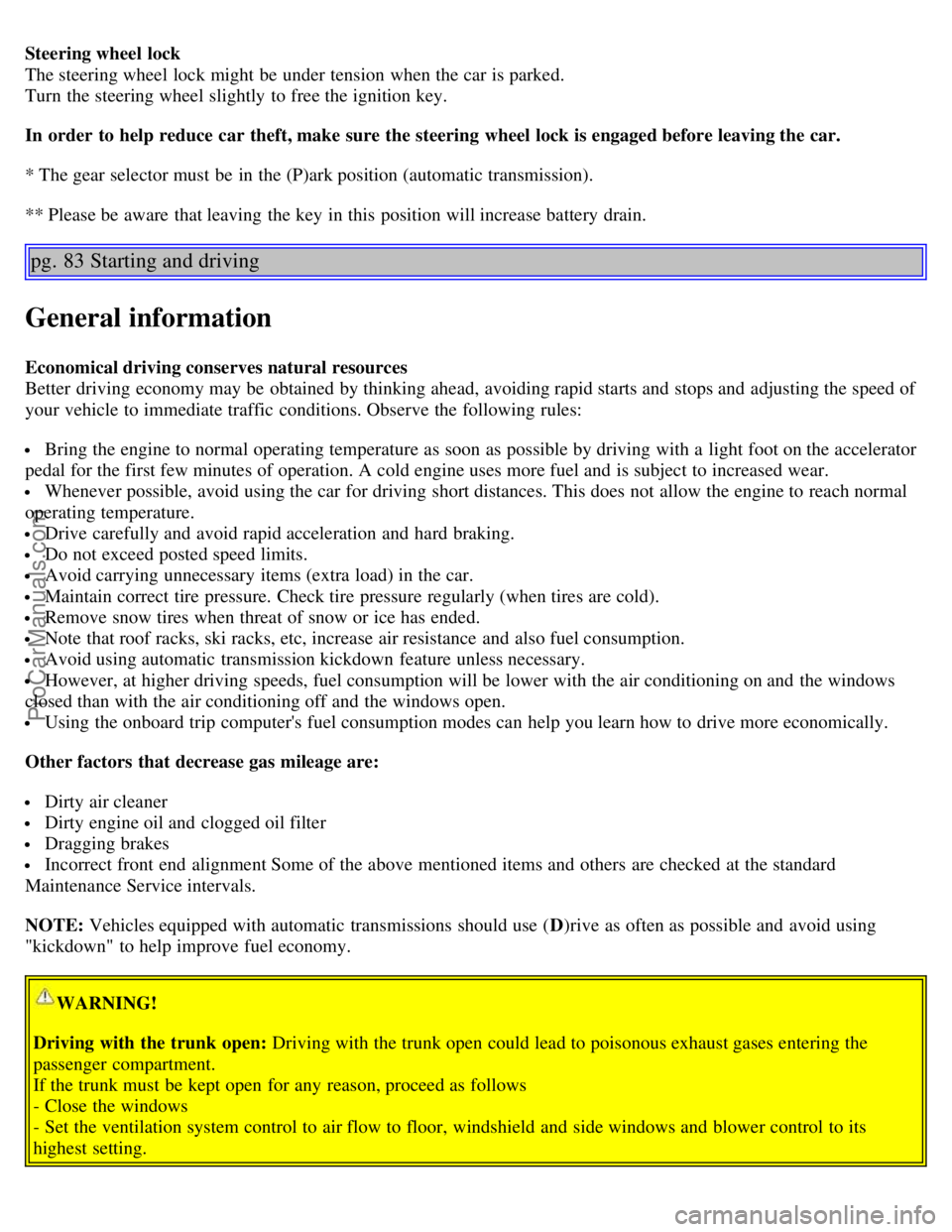
Steering wheel lock
The steering wheel lock might be under tension when the car is parked.
Turn the steering wheel slightly to free the ignition key.
In order to help reduce car theft, make sure the steering wheel lock is engaged before leaving the car.
* The gear selector must be in the (P)ark position (automatic transmission).
** Please be aware that leaving the key in this position will increase battery drain.
pg. 83 Starting and driving
General information
Economical driving conserves natural resources
Better driving economy may be obtained by thinking ahead, avoiding rapid starts and stops and adjusting the speed of
your vehicle to immediate traffic conditions. Observe the following rules:
Bring the engine to normal operating temperature as soon as possible by driving with a light foot on the accelerator
pedal for the first few minutes of operation. A cold engine uses more fuel and is subject to increased wear.
Whenever possible, avoid using the car for driving short distances. This does not allow the engine to reach normal
operating temperature.
Drive carefully and avoid rapid acceleration and hard braking.
Do not exceed posted speed limits.
Avoid carrying unnecessary items (extra load) in the car.
Maintain correct tire pressure. Check tire pressure regularly (when tires are cold).
Remove snow tires when threat of snow or ice has ended.
Note that roof racks, ski racks, etc, increase air resistance and also fuel consumption.
Avoid using automatic transmission kickdown feature unless necessary.
However, at higher driving speeds, fuel consumption will be lower with the air conditioning on and the windows
closed than with the air conditioning off and the windows open.
Using the onboard trip computer's fuel consumption modes can help you learn how to drive more economically.
Other factors that decrease gas mileage are:
Dirty air cleaner
Dirty engine oil and clogged oil filter
Dragging brakes
Incorrect front end alignment Some of the above mentioned items and others are checked at the standard
Maintenance Service intervals.
NOTE: Vehicles equipped with automatic transmissions should use ( D)rive as often as possible and avoid using
"kickdown" to help improve fuel economy.
WARNING!
Driving with the trunk open: Driving with the trunk open could lead to poisonous exhaust gases entering the
passenger compartment.
If the trunk must be kept open for any reason, proceed as follows
- Close the windows
- Set the ventilation system control to air flow to floor, windshield and side windows and blower control to its
highest setting.
ProCarManuals.com
Page 84 of 120
2 0 0 3
VOLVO S60
Maintenance and service
pg. 117
Volvo service 118
Working on your car120
Hood and engine compartment122
Oils and fluids123
Wiper blades127
Battery128
Bulbs131
Fuses138
pg. 118 Maintenance and service
Volvo service
Maintenance service
Volvo advises you to follow the service program outlined in the Warranty and Service Records Information booklet.
This maintenance program contains inspections and services necessary for the proper function of your car. The
maintenance services contain several checks which require special instruments and tools and therefore must be
performed by a qualified technician. To keep your Volvo in top condition, specify time-tested and proven Genuine
Volvo Parts and Accessories.
The Federal Clean Air Act - U. S.
The Federal Clean Air Act requires vehicle manufacturers to furnish written instructions to the ultimate purchaser to
assure the proper servicing and function of the components that control emissions. These services, which are listed in
the "Warranty and Service Records Information booklet," are not covered by the warranty. You will be required to pay
for labor and material used.
Maintenance services
Your Volvo passed several major inspections before it was delivered to you, in accordance with Volvo specifications.
The maintenance services outlined in the Warranty and Service Records Information booklet, many of which will
positively affect your vehicle's emissions, should be performed as indicated. It is recommended that receipts for
vehicle emission services be retained in case questions arise concerning maintenance.
Inspection and service should also be performed anytime a malfunction is observed or suspected.
Page 119
provides more information about maintenance of emission-related components.
Applicable warranties - U.S.
In accordance with applicable U.S. and Canadian regulations, the following list of warranties is provided
ProCarManuals.com
Page 85 of 120
New Car Limited Warranty
Parts and Accessories Limited Warranty
Corrosion Protection Limited Warranty
Seat Belt and Supplemental Restraint Systems Limited Warranty
Emission Design and Defect Warranty
Emission Performance Warranty
These are the Federal warranties; other warranties are provided as required by state/provincial law. Refer to your
separate Warranty and Service Records Information booklet for detailed information concerning each of the warranties.
pg. 119 Maintenance and service
Periodic maintenance helps minimize emissions
Periodic maintenance will help keep your vehicle running well. Your Warranty and Service Records Information
booklet provides a comprehensive periodic maintenance schedule up to 150,000 miles (240,000 km) of vehicle service.
The schedule includes components that affect vehicle emissions. This page describes some of the emission-related
components.
Engine air filter
The engine air filter cleans particles from air entering the engine. Replace the engine air filter cartridge with a new one
every 37,500 miles (60,000 km) under normal driving conditions. Replace the cartridge more often when the vehicle is
driven under dirty and dusty conditions. The cartridge cannot be cleaned, and should always be replaced with a new
one.
Fuel filter
The fuel filter should be replaced at 105,000 miles (168,000 km). The filter is replaced as one complete unit. Replace
more frequently if contaminated fuel is introduced into the tank, or if there is reason to suspect that this has occurred.
Fuel filler cap, tank and lines and connections
The ability of the fuel system to contain hydrocarbons is dependent upon a leak-free system. Inspect fuel lines every
30,000 miles (48,000 km). Check for proper sealing of the fuel filler cap which contains "O" ring type seals.
NOTE: If the fuel filler cap is not closed tightly or if the engine is running when the car is refueled, the Check Engine
light (Malfunction Indicator) may indicate a fault. However, your vehicle's performance will not be affected. Use only
Volvo original or approved fuel filler caps.
Timing belt
For proper functioning of the engine and emission control systems, the timing belt and belt tensioner must be replaced
every 105,000 miles (168,000 km). Engine damage will occur if the belt fails.
PCV system
(on turbocharged models)
The nipple in the intake manifold and the filter at the end of the PCV hose in the air cleaner should be inspected at
105,000 miles (168,000 km) and thereafter, at 150,000 mile (240,000 km) intervals.
Spark plugs
The spark plugs should be replaced every 60,000 miles (96,000 km) under normal driving conditions. City driving or
fast highway driving may necessitate replacement sooner.
Under normal driving conditions, spark plugs require no maintenance between replacement intervals. When installing
new plugs, be sure to use the right type and to tighten them correctly. When changing the plugs, clean the terminals
and rubber seals. Also check that the suppressor connectors are in good condition. Cracked or damaged connectors
should be replaced.
pg. 120 Maintenance and service
ProCarManuals.com