maintenance VOLVO S60 2004 User Guide
[x] Cancel search | Manufacturer: VOLVO, Model Year: 2004, Model line: S60, Model: VOLVO S60 2004Pages: 113, PDF Size: 2.35 MB
Page 79 of 113
The ignition should be switched off when:
Conducting engine tests.
Replacing parts in the ignition system, such as spark plugs, ignition coil, distributor, ignition cables, etc.
WARNING!
Never try to repair any part of the SRS or SIPS bag systems yourself. Any interference in the system could cause
malfunction and serious injury. Any work should only be performed by an authorized Volvo workshop.
pg. 123 Maintenance and service
Belt check
Check the belt regularly to make sure it is in good condition and is clean. A worn or dirty belt can cause poor cooling
and low alternator output as well as impair the operation of the power steering and the air conditioning unit.
NOTE: The drive belt is equipped with a self -tensioning mechanism and requires no adjustment between changes!
WARNING!
The engine must not be running when this check is performed.
Check coolant level
The cooling system must be filled with coolant and not leak to operate at maximum efficiency. Check the coolant level
regularly. The level should be between the "MAX" and "MIN" marks on the expansion tank. The check should be
made with particular thoroughness when the engine is new or when the cooling system has been drained.
Do not remove the filler cap other than for topping up with coolant. Frequent removal may prevent coolant circulation
between the engine and the expansion tank during engine warm up and cooling.
Changing coolant
Normally, the coolant does not need to be changed. If the system must be drained, consult your Volvo retailer.
NOTE: Do not top off with water only. This reduces the rust-protective and antifreeze qualities of the coolant and has
a lower boiling point. It can also cause damage to the cooling system if it should freeze. Top off with Volvo Genuine
Coolant/Antifreeze only (a 50/50 mix of water and antifreeze).
CAUTION:
The cooling system must always be kept filled to the correct level. If it is not kept filled, there can be high local
temperatures in the engine which could result in damage. Different types of antifreeze/coolant may not be mixed.
WARNING!
Never remove the radiator cap while the engine is warm. Wait until the car cools.
pg. 124 Maintenance and service
Hood and engine compartment
ProCarManuals.com
Page 80 of 113
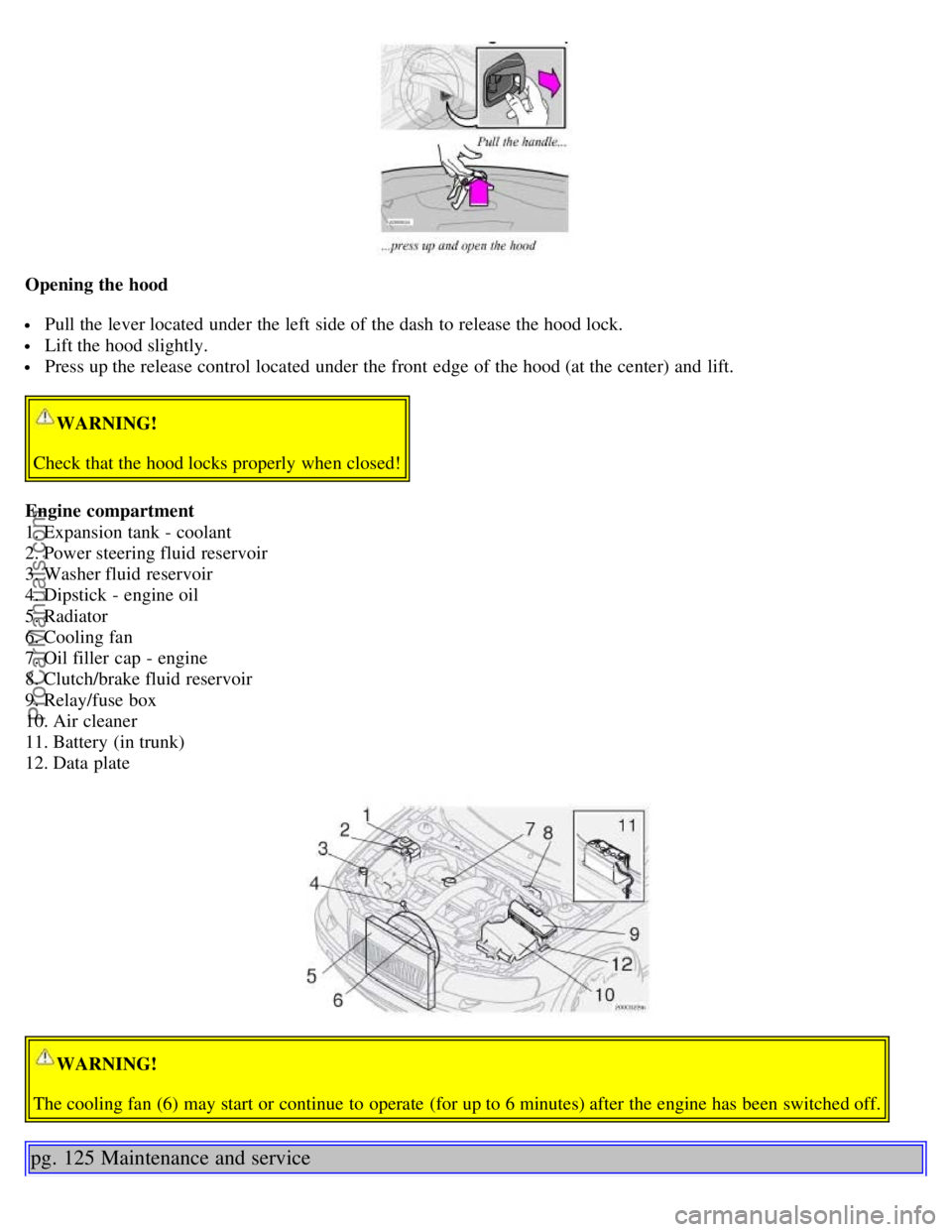
Opening the hood
Pull the lever located under the left side of the dash to release the hood lock.
Lift the hood slightly.
Press up the release control located under the front edge of the hood (at the center) and lift.
WARNING!
Check that the hood locks properly when closed!
Engine compartment
1. Expansion tank - coolant
2. Power steering fluid reservoir
3. Washer fluid reservoir
4. Dipstick - engine oil
5. Radiator
6. Cooling fan
7. Oil filler cap - engine
8. Clutch/brake fluid reservoir
9. Relay/fuse box
10. Air cleaner
11. Battery (in trunk)
12. Data plate
WARNING!
The cooling fan (6) may start or continue to operate (for up to 6 minutes) after the engine has been switched off.
pg. 125 Maintenance and service
ProCarManuals.com
Page 81 of 113
Oils and fluids
Oil quality
Engine oil must meet the minimum ILSAC specification GF-2, including ACEA A1, API SJ, SJ/CF and SJ/ Energy
Conserving.
Your Volvo has been certified to standards using ILSAC oil specification GF-2 5W -30. Volvo recommends use of oil
with a quality rating equal to or higher than ILSAC GF-2. Equivalent and better oils include ACEA A1, API SJ,
SJ/CF, and SJ/Energy conserving. Lower quality oils may not offer the same fuel economy, engine performance, or
engine protection.
Volvo Cars recommends Castrol.
Depending on your driving habits, premium or synthetic oils may provide superior fuel economy and engine
protection. Consult your Volvo retailer for recommendations on premium or synthetic oils.
Oil additives must not be used.
NOTE: Synthetic oil is not used when the oil is changed at normal maintenance services. This oil is only used at
customer request, at additional charge. Please consult your Volvo retailer.
Operation in hot climates
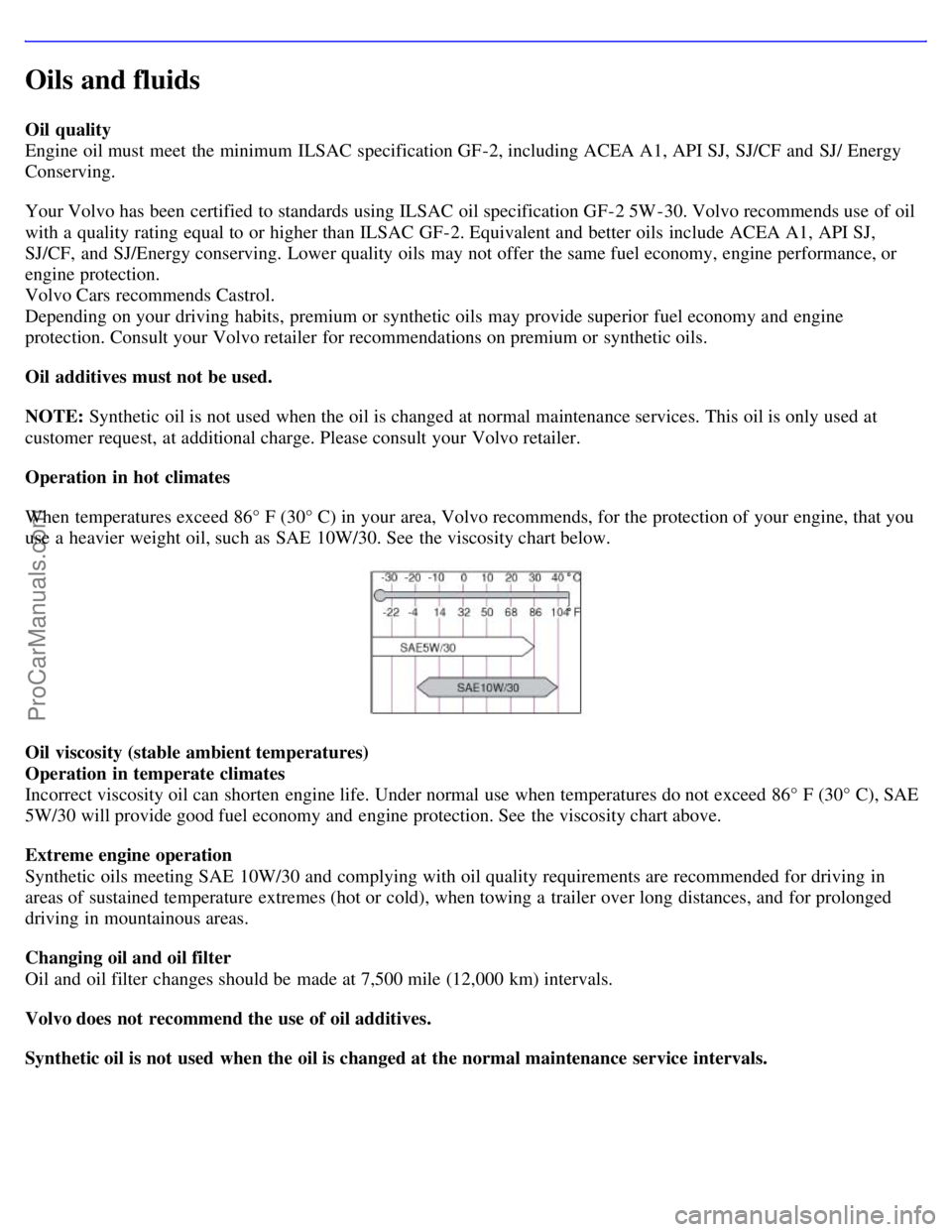
When temperatures exceed 86° F (30° C) in your area, Volvo recommends, for the protection of your engine, that you
use a heavier weight oil, such as SAE 10W/30. See the viscosity chart below.
Oil viscosity (stable ambient temperatures)
Operation in temperate climates
Incorrect viscosity oil can shorten engine life. Under normal use when temperatures do not exceed 86° F (30° C), SAE
5W/30 will provide good fuel economy and engine protection. See the viscosity chart above.
Extreme engine operation
Synthetic oils meeting SAE 10W/30 and complying with oil quality requirements are recommended for driving in
areas of sustained temperature extremes (hot or cold), when towing a trailer over long distances, and for prolonged
driving in mountainous areas.
Changing oil and oil filter
Oil and oil filter changes should be made at 7,500 mile (12,000 km) intervals.
Volvo does not recommend the use of oil additives.
Synthetic oil is not used when the oil is changed at the normal maintenance service intervals.
ProCarManuals.com
Page 82 of 113

The API Service Symbol "donut" is divided into three parts:
The top half describes the oil's performance level.
The center identifies the oil's viscosity.
The bottom half tells whether the oil has demonstrated energy-conserving properties in a standard test in
comparison to a reference oil.
pg. 126 Maintenance and service
Oils and fluids (Contd)
Checking the oil level
The oil level should be checked every time the car is refueled. This is especially important during the period up
to the first service.
CAUTION:
Not checking the oil level regularly can result in serious engine damage if the oil level becomes too low.
Park the car on a level surface and wait for at least 5 minutes after the engine has been switched off. Be sure the oil
level is maintained between the upper and lower marks on the dipstick. Low oil level can cause internal damage to the
engine and overfilling can result in high oil consumption. The distance between the dipstick marks represents approx.
1.6 US qt (1.5 liter). The oil should preferably be checked when cold, before the engine has been started.
NOTE: The engine must be stopped when checking the oil.
WARNING!
Do not allow oil to spill onto or come into contact with hot exhaust pipe surfaces.
Adding oil (topping up)
Add oil of the same kind as already used.
Capacity (including filter): Normally-aspirated 5-cylinder engine - 5.8 US qts (5.5 liters). Turbo 5-cylinder engine -
6.1 US qts (5.8 liters).
The oil filter should be replaced at every oil change.
R-models
R-models are equipped with an oil level warning system. If the engine oil level becomes too low, the warning light in
ProCarManuals.com
Page 83 of 113
the instrument panel will come on and a warning will be displayed in the text window.
If the yellow warning light in the instrument panel comes on and the text OIL LEVEL LOW/ FILL OIL is displayed,
stop safely as soon as possible and add 1 qt (1 liter) of oil. Check the oil level with the dipstick before restarting the
engine.
If the red warning light in the instrument panel comes on and the text OIL LEVEL LOW/STOP SAFELY-->STOP
ENGINE-->SEE MANUAL is displayed, stop safely as soon as possible and add oil (not more than 1.6 qts (1.5 liters).
Check the oil level with the dipstick before restarting the engine. If no oil level is visible on the dipstick, do not start
the engine. Have the car towed to an authorized Volvo workshop.
pg. 127 Maintenance and service
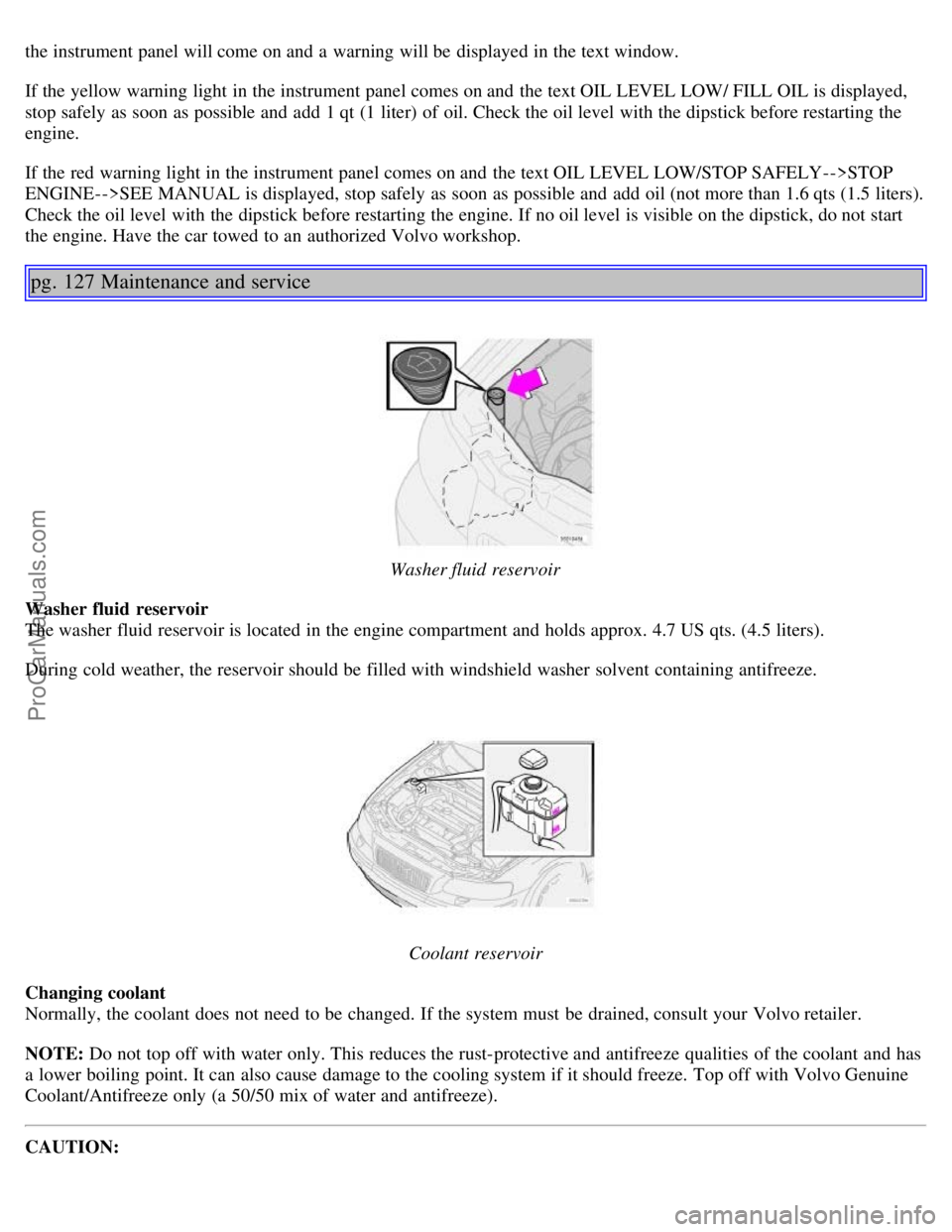
Washer fluid reservoir
Washer fluid reservoir
The washer fluid reservoir is located in the engine compartment and holds approx. 4.7 US qts. (4.5 liters).
During cold weather, the reservoir should be filled with windshield washer solvent containing antifreeze.
Coolant reservoir
Changing coolant
Normally, the coolant does not need to be changed. If the system must be drained, consult your Volvo retailer.
NOTE: Do not top off with water only. This reduces the rust-protective and antifreeze qualities of the coolant and has
a lower boiling point. It can also cause damage to the cooling system if it should freeze. Top off with Volvo Genuine
Coolant/Antifreeze only (a 50/50 mix of water and antifreeze).
CAUTION:
ProCarManuals.com
Page 84 of 113
The cooling system must always be kept filled to the correct level. If it is not kept filled, there can be high local
temperatures in the engine which could result in damage. Different types of antifreeze/coolant may not be mixed.
Check coolant regularly!
WARNING!
Never remove the radiator cap while the engine is warm. Wait until the car cools.
If it is necessary to top up the coolant when the engine is warm, unscrew the expansion tank cap slowly so that the
overpressure dissipates.
pg. 128 Maintenance and service
Oils and fluids (Contd)
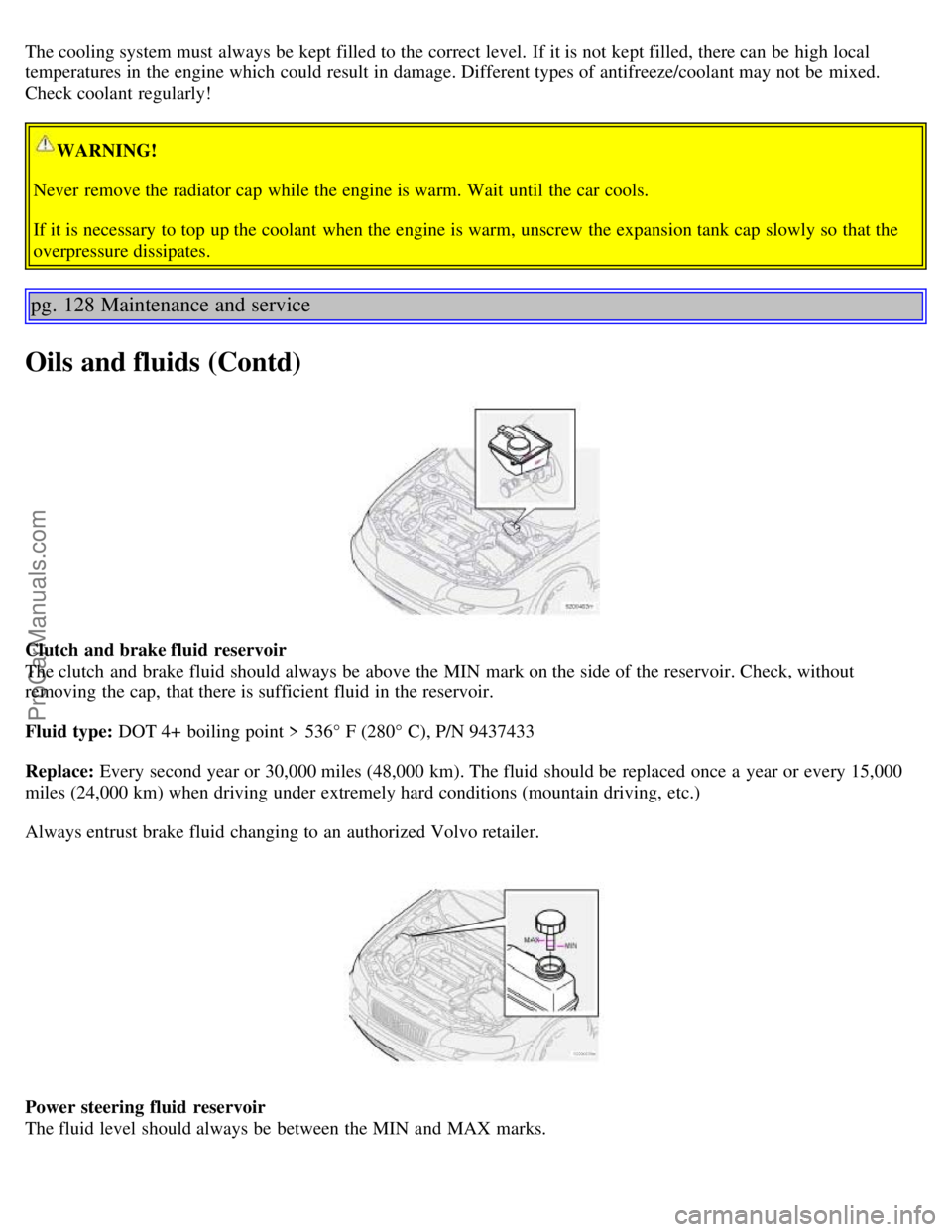
Clutch and brake fluid reservoir
The clutch and brake fluid should always be above the MIN mark on the side of the reservoir. Check, without
removing the cap, that there is sufficient fluid in the reservoir.
Fluid type: DOT 4+ boiling point > 536° F (280° C), P/N 9437433
Replace: Every second year or 30,000 miles (48,000 km). The fluid should be replaced once a year or every 15,000
miles (24,000 km) when driving under extremely hard conditions (mountain driving, etc.)
Always entrust brake fluid changing to an authorized Volvo retailer.
Power steering fluid reservoir
The fluid level should always be between the MIN and MAX marks.
ProCarManuals.com
Page 106 of 113
Introductioni
ISOFIX fasteners (child seats)17
J
Jack65
, 113
Jump starting98
K
Keylockii
, 81
Keys67
Kickdown87
L
LED illumination32
Lighting panel30
Load carriers103
Locking71
Locking steering wheel82
Locks67
Long distance trips105
Long loads - carrying64
Low beam bulb134
Lubricants150
M
Maintenance service120
Malfunction indicator light25
Manual climate control with air conditioning50
Manual transmission85
Messages in the display26
Moonroof41
Multifilter with air quality sensor49
O
Occupant safety20
Octane rating78
Odometer22
Oil pressure25
Oil quality125
Oil viscosity125
Opening the trunk from the inside72
Opening/ locking the trunk71
P
P Park86
, 88
Paint118
Paint - color code118
Paintwork damage118
Parking brake25 , 37
Parking lamps30
ProCarManuals.com
Page 107 of 113
Parking lights30
Pen holder62
Polishing117
Power moonroof41
Power seat56
Power steering fluid128
Power steering, speed sensitive84
PremAiriii
Programme type PT165
PROPOSITION 65 WARNING98
R
Radiator124
Radio160
Rain sensor33
Rain sensor - windshield wipers33
Reading lamps58
Rear fog lamps31
Rear seat63
Rear suspension152
Rear window defroster34 , 51
Rearview mirror/door mirrors40
Recirculation48 , 52
REDUCE SPEED26
Refrigerant (A/C system)44
Refueling77, 80
Remote control - central locking system69
Replacing the battery131
Reporting safety defects20
Roadholding84
Roof racks (load carriers)103
S
Safety1
Safety defects - reporting20
Seat belt2
Seat belt maintenance20
Seat belt reminder40
Seat belts (keeping child seats in place)19
Service120
Service key68
Service reminder25
SERVICE REQUIRED26
SERVICE URGENT26
Shiftlockii , 81
Side airbags10
ProCarManuals.com