warning light VOLVO S60 2004 Owner's Manual
[x] Cancel search | Manufacturer: VOLVO, Model Year: 2004, Model line: S60, Model: VOLVO S60 2004Pages: 113, PDF Size: 2.35 MB
Page 64 of 113
function) and the vehicle should be driven cautiously to a Volvo retailer for inspection. The Anti-lock Braking System
(ABS) helps to improve vehicle control (stopping and steering) during severe braking conditions by limiting brake
lockup. When the system "senses" impending lockup, braking pressure is automatically modulated in order to help
prevent lockup, which could lead to a skid.
The system performs a self -diagnostic test when the engine is started and when the vehicle first reaches a speed
of approximately 12 mph (20 km/h). The brake pedal will pulsate several times and a sound may be audible from the
ABS control module. This is normal.
To obtain optimal effect from the ABS system, constant pressure should be kept on the brake pedal, keep constant
pressure on the brake pedal. Do not pump the brake pedal.
The switching of the ABS modulator will be audible and the brake pedal will pulsate during braking. Please be aware
that ABS does not increase the absolute braking potential of the vehicle. While control will be enhanced, ABS will not
shorten stopping distances on slippery surfaces.
ABS with EBD (Electronic Brake Force Distribution)
EBD is an integrated part of the ABS system. EBD regulates the hydraulic pressure to the rear brakes to help provide
optimal braking capacity. The brake pedal will pulsate during braking, which is normal.
If the BRAKE and ABS warning lights come on at the same time, this could indicate a fault in the brake system.
Stop the car in a suitable place and switch off the engine.
Restart the engine.
If both warning lights go off, no further action is required.
If both lights are still on after the engine has been restarted, switch off the engine again and check the brake fluid
level (see page 124
for the location of the brake fluid reservoir).
WARNING!
If the fluid level is below the MIN mark in the reservoir or if a "Brake failure - Service urgent" message is displayed
in the text window: DO NOT DRIVE. Have the car towed to a Volvo retailer and have the brake system inspected.
If the brake fluid level is above the MIN mark, drive carefully to an authorized Volvo retailer and have the brake
system inspected.
Contents | Top of Page
ProCarManuals.com
Page 73 of 113
Bumpers: Wash the bumpers with the same cleaning agent used on the rest of the car. Never clean the bumpers with
gasoline or paint thinner. Difficult spots can be removed with denatured alcohol. To avoid scratches, do not dry the
bumpers with paper.
NOTE: When washing the car, remember to remove dirt from the drain holes in the doors and sills.
Automatic car wash
An automatic car wash is a simple and quick way of washing the car. Bear in mind, however, that an automatic car
wash can never replace a proper handwashing. During the first months of the car's life - while the paint is still curing -
we recommend that you handwash the car.
WARNING!
When the car is driven immediately after being washed, apply the brakes several times in order to remove any
moisture from the brake linings.
Engine cleaning agents should not be used when the engine is warm. This constitutes a fire risk.
pg. 117 Car care
Automatic washing - simple and quick
We do NOT recommend washing your car in an automatic wash during the first six months (because the paint will
not have hardened sufficiently).
An automatic wash is a simple and quick way to clean your car, but it is worth remembering that it may not be as
thorough as when you yourself go over the car with sponge and water. Keeping the underbody clean is most important,
especially in the winter. Some automatic washers do not have facilities for washing the underbody.
Before driving into an automatic car wash, make sure that side view mirrors, auxiliary lamps, etc, are secure, and
that any antenna( s) are retracted or removed. Otherwise there is risk of the machine dislodging them.
Polishing and Waxing
Normally, polishing is not required during the first year after delivery, however, waxing may be beneficial.
Before applying polish or wax the car must be washed and dried. Tar spots can be removed with kerosene or tar
remover. Difficult spots may require a fine rubbing compound.
After polishing use liquid or paste wax.
Several commercially available products contain both polish and wax.
Waxing alone does not substitute for polishing a dull surface.
A wide range of polymer-based car waxes can be purchased today. These waxes are easy to use and produce a
long-lasting, high-gloss finish that protects the bodywork against oxidation, road dirt and fading.
Do not polish or wax your car in direct sunlight (the surface of the car should not be warmer than 113° F (45° C).
Cleaning the upholstery
The fabric can be cleaned with soapy water or a detergent. For more difficult spots caused by oil, ice cream, shoe
polish, grease, etc., use a clothing/fabric stain remover.
The plastic in the upholstery can be cleaned with a soft cloth and mild soap solution.
Leather upholstery/suede-like upholstery (alcanteraTM) can be cleaned with a soft cloth and mild soap solution. For
more difficult spots, Volvo offers a leather care kit.
Under no circumstances should gasoline, naphtha or similar cleaning agents be used on the plastic or the leather
since these can cause damage.
Cleaning the seat belts
Clean only with lukewarm water and a mild soap solution.
ProCarManuals.com
Page 80 of 113
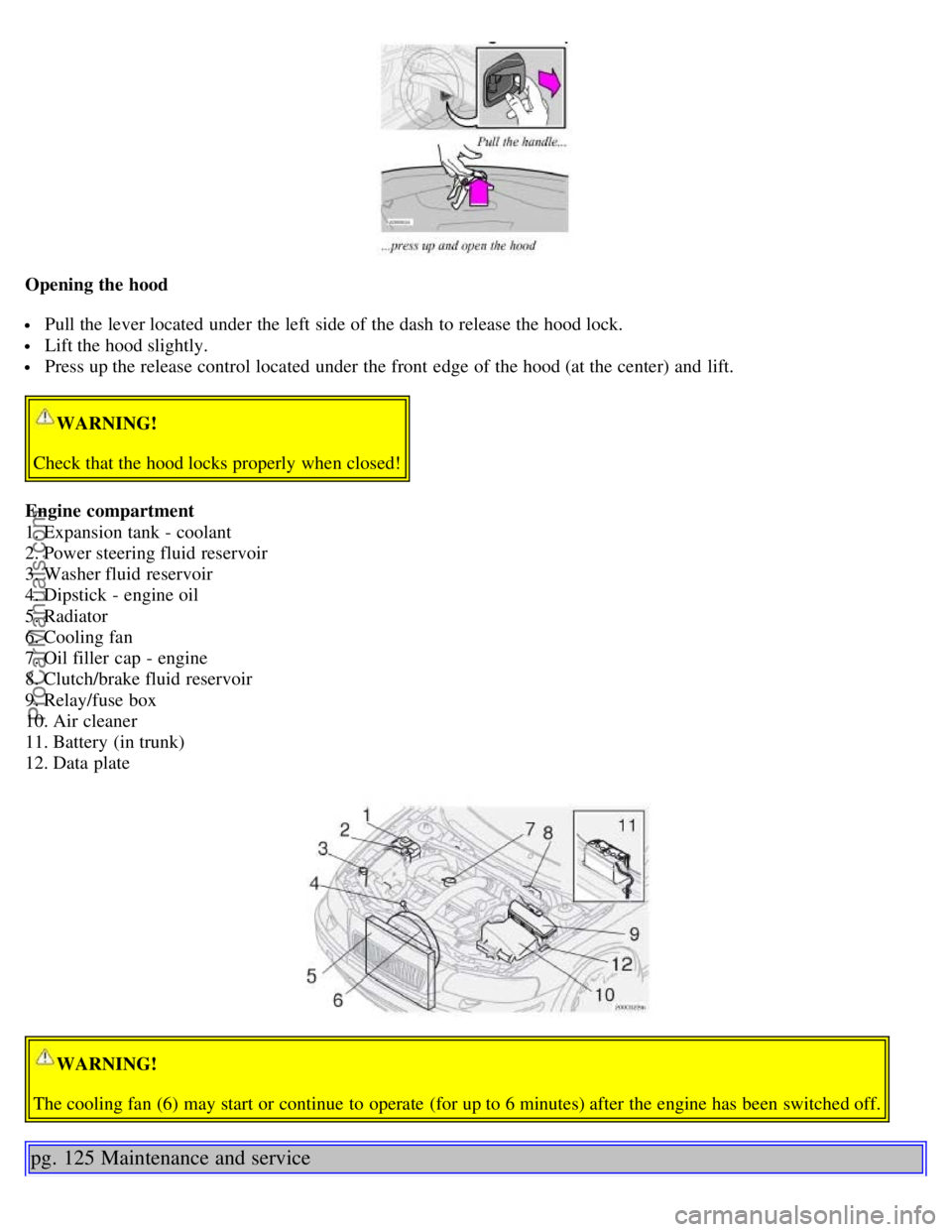
Opening the hood
Pull the lever located under the left side of the dash to release the hood lock.
Lift the hood slightly.
Press up the release control located under the front edge of the hood (at the center) and lift.
WARNING!
Check that the hood locks properly when closed!
Engine compartment
1. Expansion tank - coolant
2. Power steering fluid reservoir
3. Washer fluid reservoir
4. Dipstick - engine oil
5. Radiator
6. Cooling fan
7. Oil filler cap - engine
8. Clutch/brake fluid reservoir
9. Relay/fuse box
10. Air cleaner
11. Battery (in trunk)
12. Data plate
WARNING!
The cooling fan (6) may start or continue to operate (for up to 6 minutes) after the engine has been switched off.
pg. 125 Maintenance and service
ProCarManuals.com
Page 82 of 113

The API Service Symbol "donut" is divided into three parts:
The top half describes the oil's performance level.
The center identifies the oil's viscosity.
The bottom half tells whether the oil has demonstrated energy-conserving properties in a standard test in
comparison to a reference oil.
pg. 126 Maintenance and service
Oils and fluids (Contd)
Checking the oil level
The oil level should be checked every time the car is refueled. This is especially important during the period up
to the first service.
CAUTION:
Not checking the oil level regularly can result in serious engine damage if the oil level becomes too low.
Park the car on a level surface and wait for at least 5 minutes after the engine has been switched off. Be sure the oil
level is maintained between the upper and lower marks on the dipstick. Low oil level can cause internal damage to the
engine and overfilling can result in high oil consumption. The distance between the dipstick marks represents approx.
1.6 US qt (1.5 liter). The oil should preferably be checked when cold, before the engine has been started.
NOTE: The engine must be stopped when checking the oil.
WARNING!
Do not allow oil to spill onto or come into contact with hot exhaust pipe surfaces.
Adding oil (topping up)
Add oil of the same kind as already used.
Capacity (including filter): Normally-aspirated 5-cylinder engine - 5.8 US qts (5.5 liters). Turbo 5-cylinder engine -
6.1 US qts (5.8 liters).
The oil filter should be replaced at every oil change.
R-models
R-models are equipped with an oil level warning system. If the engine oil level becomes too low, the warning light in
ProCarManuals.com
Page 83 of 113
the instrument panel will come on and a warning will be displayed in the text window.
If the yellow warning light in the instrument panel comes on and the text OIL LEVEL LOW/ FILL OIL is displayed,
stop safely as soon as possible and add 1 qt (1 liter) of oil. Check the oil level with the dipstick before restarting the
engine.
If the red warning light in the instrument panel comes on and the text OIL LEVEL LOW/STOP SAFELY-->STOP
ENGINE-->SEE MANUAL is displayed, stop safely as soon as possible and add oil (not more than 1.6 qts (1.5 liters).
Check the oil level with the dipstick before restarting the engine. If no oil level is visible on the dipstick, do not start
the engine. Have the car towed to an authorized Volvo workshop.
pg. 127 Maintenance and service
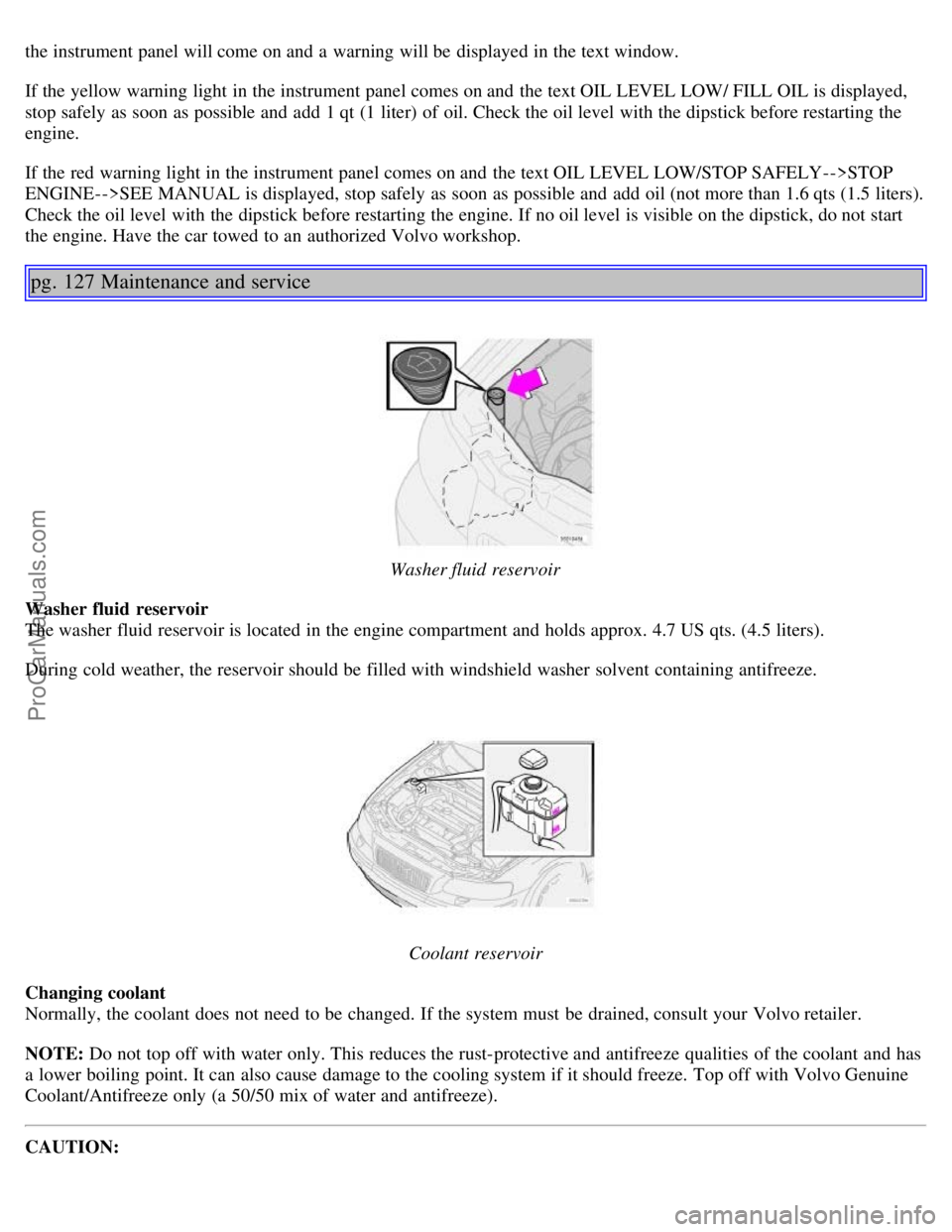
Washer fluid reservoir
Washer fluid reservoir
The washer fluid reservoir is located in the engine compartment and holds approx. 4.7 US qts. (4.5 liters).
During cold weather, the reservoir should be filled with windshield washer solvent containing antifreeze.
Coolant reservoir
Changing coolant
Normally, the coolant does not need to be changed. If the system must be drained, consult your Volvo retailer.
NOTE: Do not top off with water only. This reduces the rust-protective and antifreeze qualities of the coolant and has
a lower boiling point. It can also cause damage to the cooling system if it should freeze. Top off with Volvo Genuine
Coolant/Antifreeze only (a 50/50 mix of water and antifreeze).
CAUTION:
ProCarManuals.com
Page 103 of 113
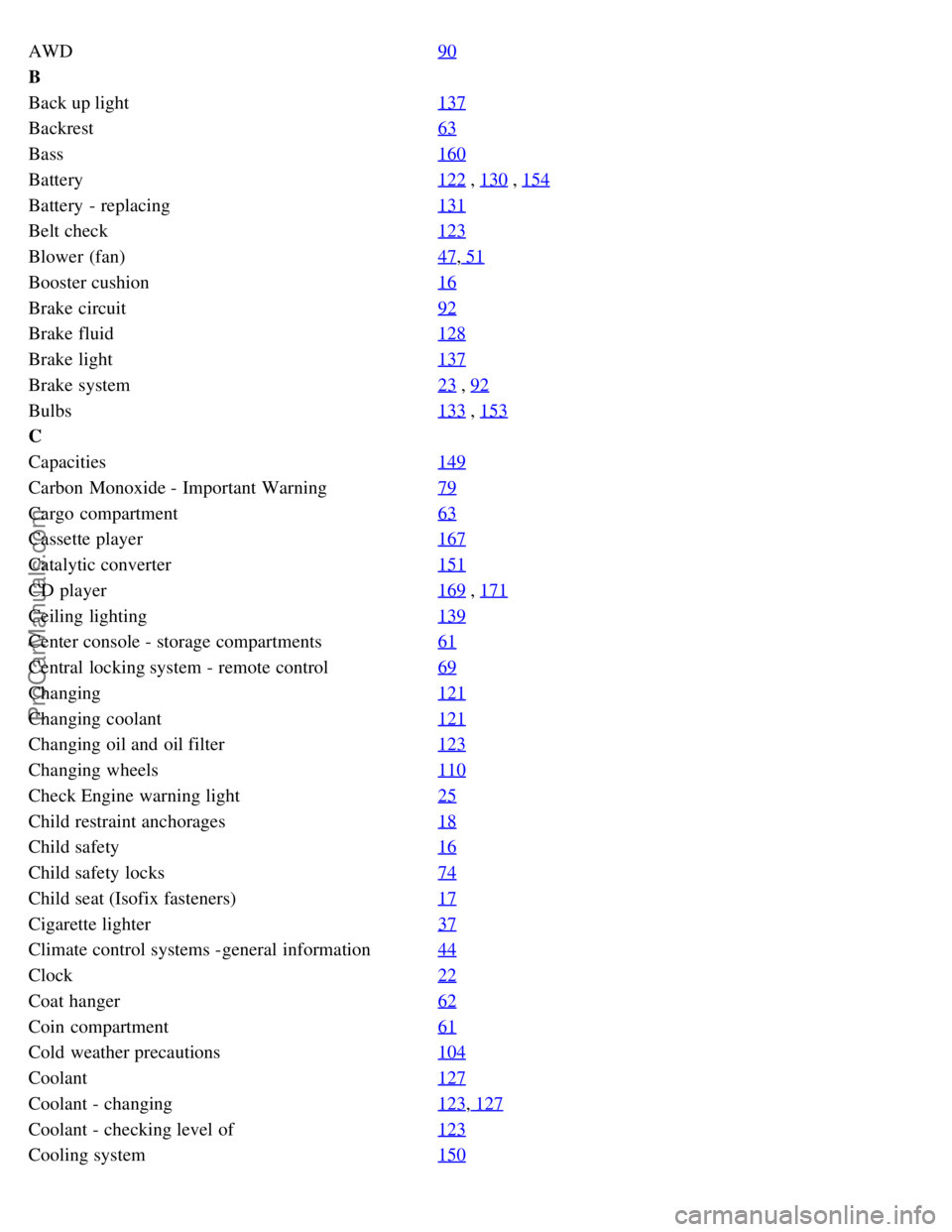
AWD90
B
Back up light137
Backrest63
Bass160
Battery122 , 130 , 154
Battery - replacing131
Belt check123
Blower (fan)47, 51
Booster cushion16
Brake circuit92
Brake fluid128
Brake light137
Brake system23 , 92
Bulbs133 , 153
C
Capacities149
Carbon Monoxide - Important Warning79
Cargo compartment63
Cassette player167
Catalytic converter151
CD player169 , 171
Ceiling lighting139
Center console - storage compartments61
Central locking system - remote control69
Changing121
Changing coolant121
Changing oil and oil filter123
Changing wheels110
Check Engine warning light25
Child restraint anchorages18
Child safety16
Child safety locks74
Child seat (Isofix fasteners)17
Cigarette lighter37
Climate control systems -general information44
Clock22
Coat hanger62
Coin compartment61
Cold weather precautions104
Coolant127
Coolant - changing123, 127
Coolant - checking level of123
Cooling system150
ProCarManuals.com
Page 105 of 113
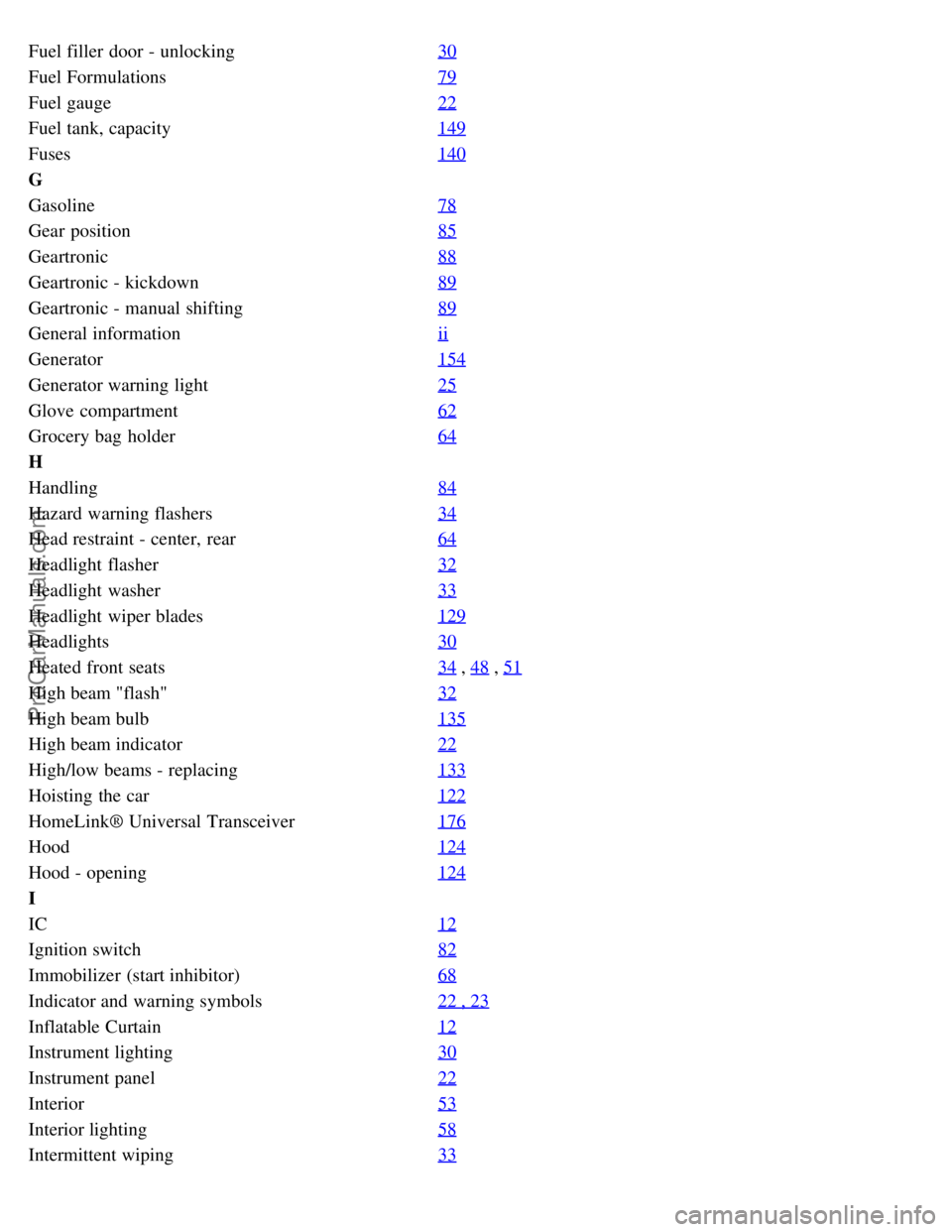
Fuel filler door - unlocking30
Fuel Formulations79
Fuel gauge22
Fuel tank, capacity149
Fuses140
G
Gasoline78
Gear position85
Geartronic88
Geartronic - kickdown89
Geartronic - manual shifting89
General informationii
Generator154
Generator warning light25
Glove compartment62
Grocery bag holder64
H
Handling84
Hazard warning flashers34
Head restraint - center, rear64
Headlight flasher32
Headlight washer33
Headlight wiper blades129
Headlights30
Heated front seats34 , 48 , 51
High beam "flash"32
High beam bulb135
High beam indicator22
High/low beams - replacing133
Hoisting the car122
HomeLink® Universal Transceiver176
Hood124
Hood - opening124
I
IC12
Ignition switch82
Immobilizer (start inhibitor)68
Indicator and warning symbols22 , 23
Inflatable Curtain12
Instrument lighting30
Instrument panel22
Interior53
Interior lighting58
Intermittent wiping33
ProCarManuals.com
Page 107 of 113
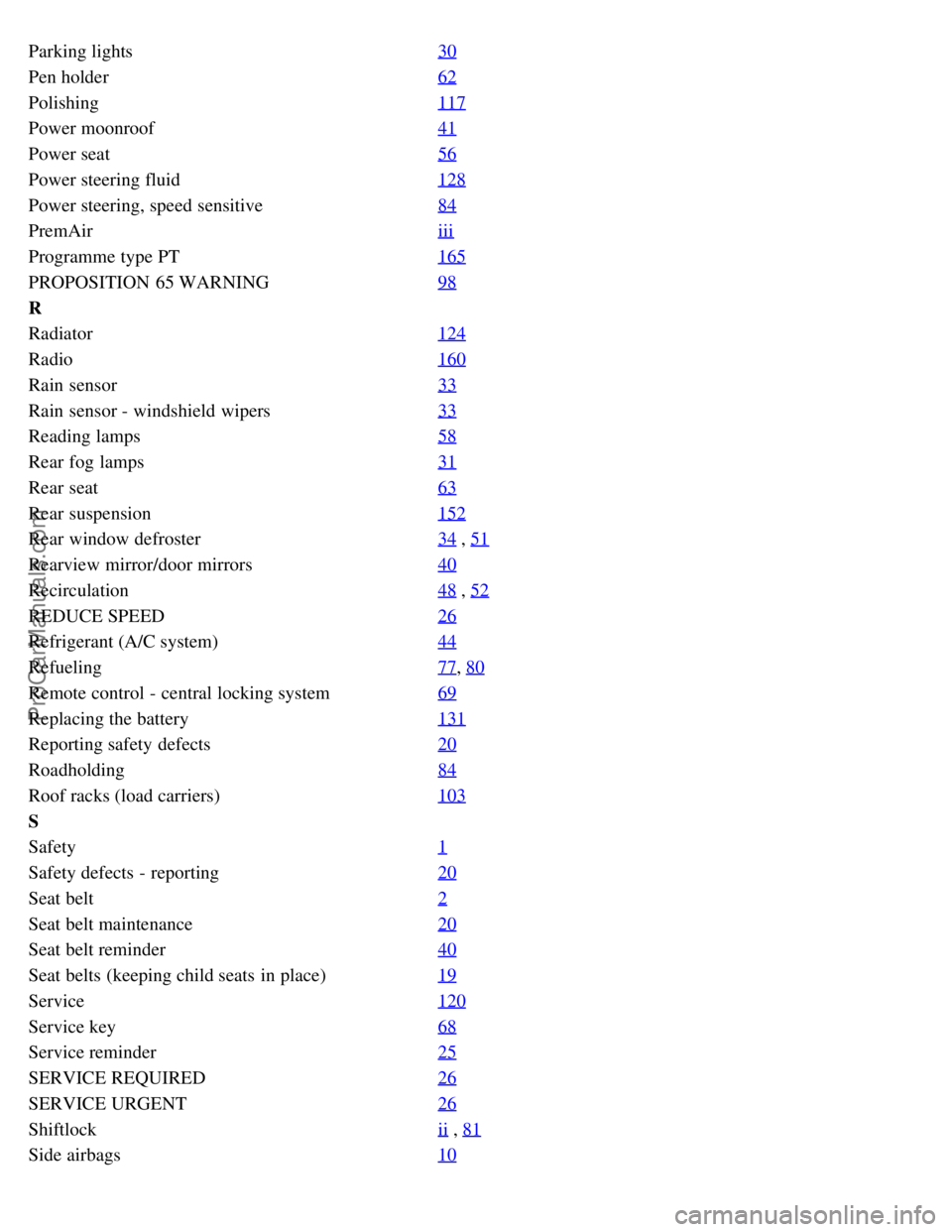
Parking lights30
Pen holder62
Polishing117
Power moonroof41
Power seat56
Power steering fluid128
Power steering, speed sensitive84
PremAiriii
Programme type PT165
PROPOSITION 65 WARNING98
R
Radiator124
Radio160
Rain sensor33
Rain sensor - windshield wipers33
Reading lamps58
Rear fog lamps31
Rear seat63
Rear suspension152
Rear window defroster34 , 51
Rearview mirror/door mirrors40
Recirculation48 , 52
REDUCE SPEED26
Refrigerant (A/C system)44
Refueling77, 80
Remote control - central locking system69
Replacing the battery131
Reporting safety defects20
Roadholding84
Roof racks (load carriers)103
S
Safety1
Safety defects - reporting20
Seat belt2
Seat belt maintenance20
Seat belt reminder40
Seat belts (keeping child seats in place)19
Service120
Service key68
Service reminder25
SERVICE REQUIRED26
SERVICE URGENT26
Shiftlockii , 81
Side airbags10
ProCarManuals.com
Page 108 of 113
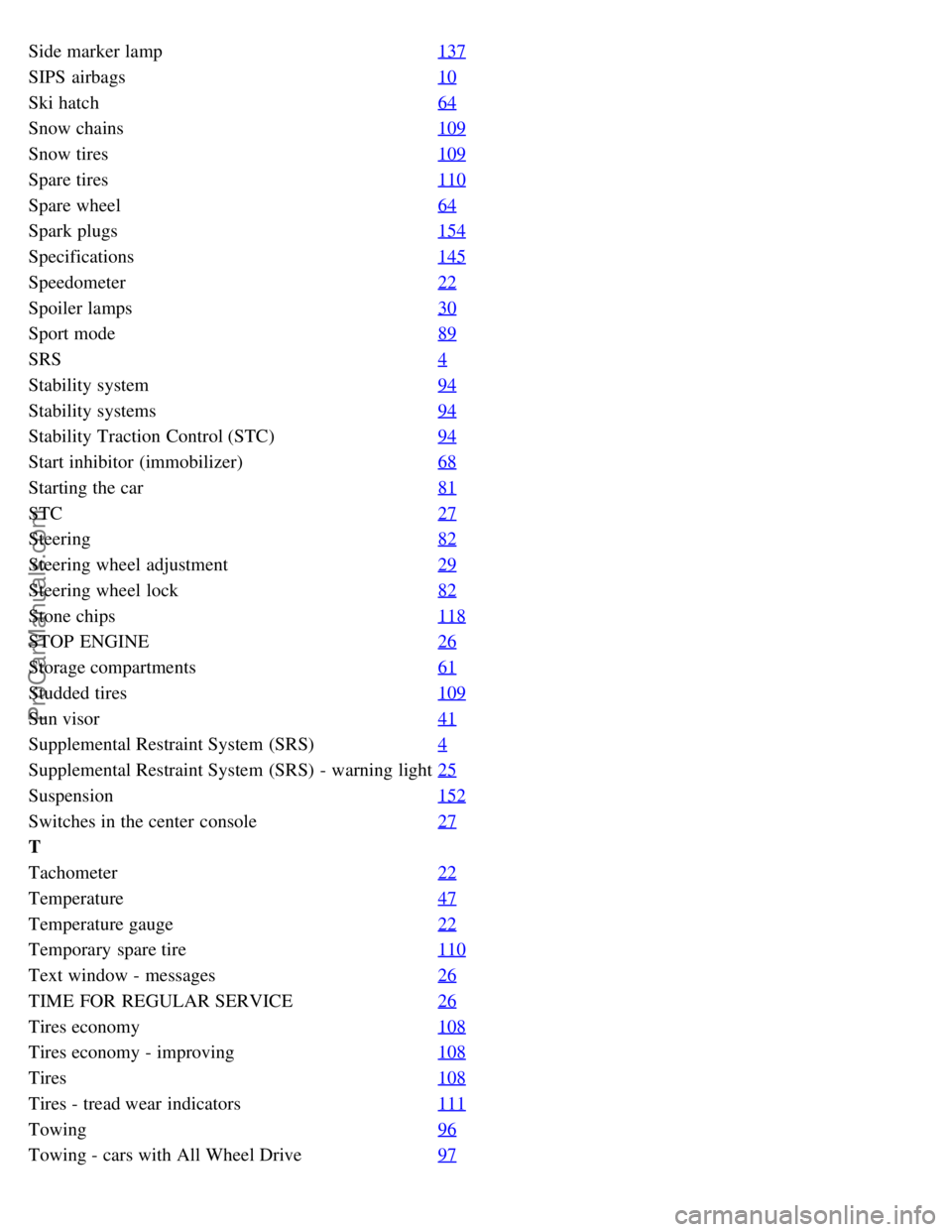
Side marker lamp137
SIPS airbags10
Ski hatch64
Snow chains109
Snow tires109
Spare tires110
Spare wheel64
Spark plugs154
Specifications145
Speedometer22
Spoiler lamps30
Sport mode89
SRS4
Stability system94
Stability systems94
Stability Traction Control (STC)94
Start inhibitor (immobilizer)68
Starting the car81
STC27
Steering82
Steering wheel adjustment29
Steering wheel lock82
Stone chips118
STOP ENGINE26
Storage compartments61
Studded tires109
Sun visor41
Supplemental Restraint System (SRS)4
Supplemental Restraint System (SRS) - warning light25
Suspension152
Switches in the center console27
T
Tachometer22
Temperature47
Temperature gauge22
Temporary spare tire110
Text window - messages26
TIME FOR REGULAR SERVICE26
Tires economy108
Tires economy - improving108
Tires108
Tires - tread wear indicators111
Towing96
Towing - cars with All Wheel Drive97
ProCarManuals.com