ABS VOLVO S60 2004 Owners Manual
[x] Cancel search | Manufacturer: VOLVO, Model Year: 2004, Model line: S60, Model: VOLVO S60 2004Pages: 113, PDF Size: 2.35 MB
Page 2 of 113
Volvo Cars of North America
Customer Relations
P.O. Box 914
Rockleigh, New Jersey 07647-0914
800-458-1552
In Canada:
Volvo Cars of Canada Ltd.
175 Gordon Baker Road
North York, Ontario M2H 2N7
800-663-8255
General Information
Shiftlock (automatic transmission)
When your car is parked, the gear selector is locked in the (P)ark position. To release the selector from this position,
turn the ignition key to position II (or start the engine), depress the brake pedal, press the button on the front side of the
gear selector and move the selector from (P)ark.
Keylock (automatic transmission)
When you switch off the ignition, the gear selector must be in the ( P)ark position before the key can be removed from
the ignition switch.
Anti-lock Brake System (ABS)
The ABS system in your car performs a self -diagnostic test when the vehicle first reaches the speed of approximately
12 mph (20 km/h). The brake pedal will pulsate several times and a sound may be audible from the ABS control
module. This is normal.
Fuel filler door
The fuel filler door, located on the right rear fender, is connected to your car's central locking system.
Press the button on the light switch panel (see illustration on page 30
) when the car is at a standstill to unlock the fuel
filler door. Please note that the fuel filler door will remain unlocked until the car begins to move forward. An audible
click will be heard when the fuel filler door relocks.
Fuel filler cap
After refueling, close the fuel filler cap by turning it clockwise until it clicks into place. If this cap is not closed tightly
or if the engine is running when the car is refueled, the Malfunction Indicator Lamp ("Check Engine" light) will
illuminate.
Important information
Before you operate your car for the first time, please familiarize yourself with the new-engine oil consumption
information on page 78.
You should also be familiar with the information in chapters one, two and four of this manual.
Information contained in the balance of the manual is extremely useful and should be read after operating the vehicle
for the first time.
The manual is structured so that it can be used for reference. For this reason, it should be kept in the car for ready
access.
Do not export your Volvo to another country before investigating that country's applicable safety and exhaust emission
requirements. In some cases it may be difficult or impossible to comply with these requirements. Modifications to the
emission control system(s) may render your Volvo not certifiable for legal operation in the U.S., Canada and other
countries.
All information, illustrations and specifications contained in this manual are based on the latest product information
available at the time of publication. Please note that some vehicles may be equipped differently, depending on special
ProCarManuals.com
Page 19 of 113
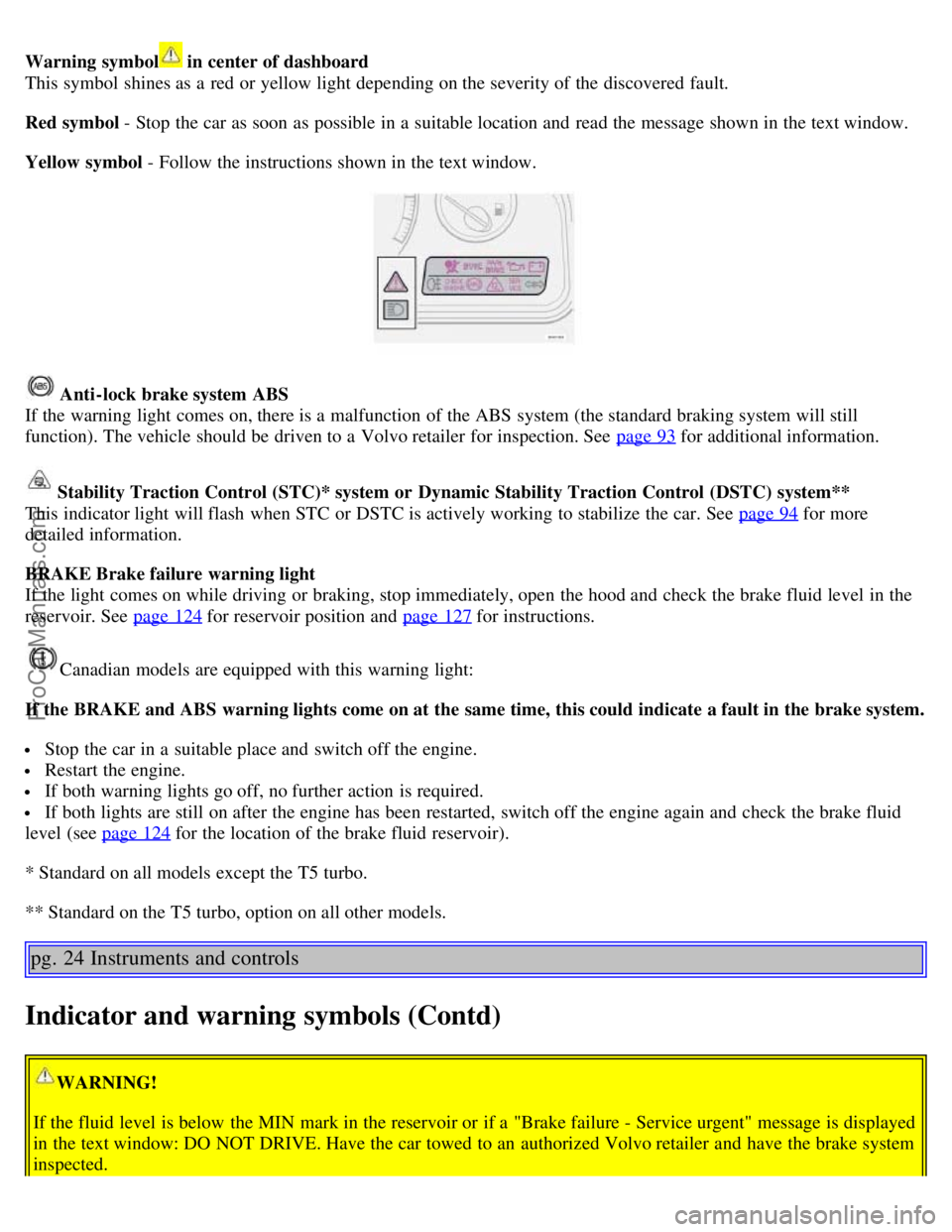
Warning symbol in center of dashboard
This symbol shines as a red or yellow light depending on the severity of the discovered fault.
Red symbol - Stop the car as soon as possible in a suitable location and read the message shown in the text window.
Yellow symbol - Follow the instructions shown in the text window.
Anti-lock brake system ABS
If the warning light comes on, there is a malfunction of the ABS system (the standard braking system will still
function). The vehicle should be driven to a Volvo retailer for inspection. See page 93
for additional information.
Stability Traction Control (STC)* system or Dynamic Stability Traction Control (DSTC) system**
This indicator light will flash when STC or DSTC is actively working to stabilize the car. See page 94
for more
detailed information.
BRAKE Brake failure warning light
If the light comes on while driving or braking, stop immediately, open the hood and check the brake fluid level in the
reservoir. See page 124
for reservoir position and page 127 for instructions.
Canadian models are equipped with this warning light:
If the BRAKE and ABS warning lights come on at the same time, this could indicate a fault in the brake system.
Stop the car in a suitable place and switch off the engine.
Restart the engine.
If both warning lights go off, no further action is required.
If both lights are still on after the engine has been restarted, switch off the engine again and check the brake fluid
level (see page 124
for the location of the brake fluid reservoir).
* Standard on all models except the T5 turbo.
** Standard on the T5 turbo, option on all other models.
pg. 24 Instruments and controls
Indicator and warning symbols (Contd)
WARNING!
If the fluid level is below the MIN mark in the reservoir or if a "Brake failure - Service urgent" message is displayed
in the text window: DO NOT DRIVE. Have the car towed to an authorized Volvo retailer and have the brake system
inspected.
ProCarManuals.com
Page 62 of 113
Four-C active chassis system
Four-C (R-models only)
R-models are equipped with the Four-C (Continuously Controlled Chassis Concept) system.
This system is based on a number of sensors that continuously monitor factors such as the car's lateral and vertical
movements, speed, and movements of the wheels. The sensors receive data up to 500 times per second, which is used
to provide extremely fast and precise adjustment of each shock absorber. The system adjusts the stiffness of the shock
absorbers approximately 100 times per second.
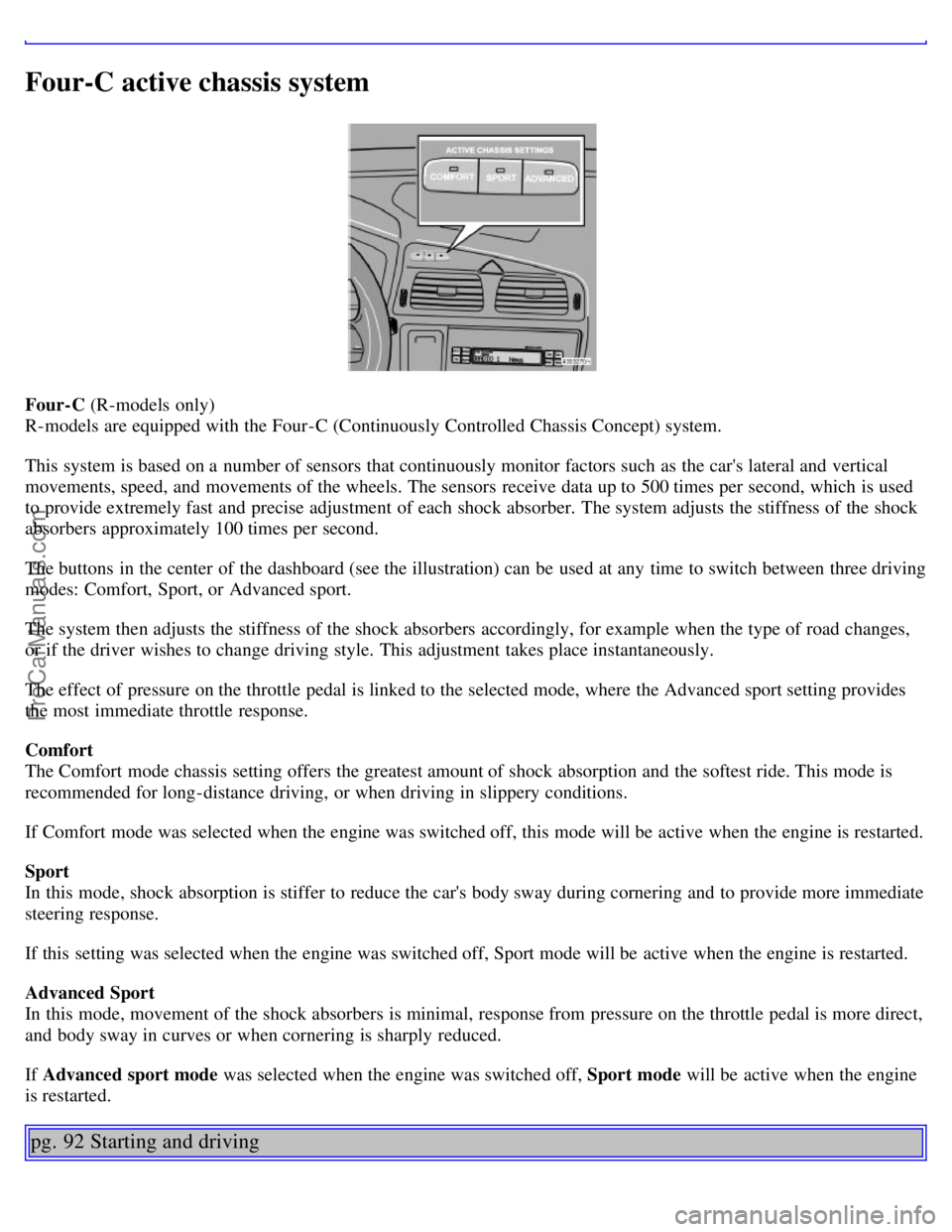
The buttons in the center of the dashboard (see the illustration) can be used at any time to switch between three driving
modes: Comfort, Sport, or Advanced sport.
The system then adjusts the stiffness of the shock absorbers accordingly, for example when the type of road changes,
or if the driver wishes to change driving style. This adjustment takes place instantaneously.
The effect of pressure on the throttle pedal is linked to the selected mode, where the Advanced sport setting provides
the most immediate throttle response.
Comfort
The Comfort mode chassis setting offers the greatest amount of shock absorption and the softest ride. This mode is
recommended for long-distance driving, or when driving in slippery conditions.
If Comfort mode was selected when the engine was switched off, this mode will be active when the engine is restarted.
Sport
In this mode, shock absorption is stiffer to reduce the car's body sway during cornering and to provide more immediate
steering response.
If this setting was selected when the engine was switched off, Sport mode will be active when the engine is restarted.
Advanced Sport
In this mode, movement of the shock absorbers is minimal, response from pressure on the throttle pedal is more direct,
and body sway in curves or when cornering is sharply reduced.
If Advanced sport mode was selected when the engine was switched off, Sport mode will be active when the engine
is restarted.
pg. 92 Starting and driving
ProCarManuals.com
Page 63 of 113
Brake system
BRAKE Brake circuit malfunction
The brake system is a hydraulic system consisting of two master cylinders and two separate brake circuits. If a
problem should occur in one of these circuits, it is still possible to stop the car with the other brake circuit.
If the brake pedal must be depressed farther than normal and requires greater foot pressure, the stopping distance will
be longer.
A warning light in the instrument panel will light up to warn the driver that a fault has occurred.
If this light comes on while driving or braking, stop immediately and check the brake fluid level in the reservoir.
NOTE: Press the brake pedal hard and maintain pressure on the pedal Ð do not pump the brakes.
WARNING!
If the fluid level is below the MIN mark in the reservoir or if a "Brake failure - Service urgent" message is displayed
in the text window: DO NOT DRIVE. Have the car towed to a Volvo retailer and have the brake system inspected.
NOTE: When the car is at a standstill and the engine is idling, e.g. at a traffic light and the brake pedal is depressed,
the pedal may go down slightly. This is a normal function of the power-assisted brake system.
Power brakes function only when the engine is running
The power brakes utilize vacuum pressure which is only created when the engine is running. Never let the vehicle roll
to a stop with the engine switched off.
If the power brakes are not working, the brake pedal must be pressed approximately four times harder than usual to
make up for the lack of power assistance. This can happen for example when towing your vehicle or if the engine is
switched off when the vehicle is rolling. The brake pedal feels harder than usual.
Water on brake discs and brake pads affects braking
Driving in rain and slush or passing through an automatic car wash can cause water to collect on the brake discs and
pads. This will cause a delay in braking effect when the pedal is depressed. To avoid such a delay when the brakes are
needed, depress the pedal occasionally when driving through rain, slush etc. This will remove the water from the
brakes. Check that brake application feels normal. This should also be done after washing or starting in very damp or
cold weather.
Severe strain on the brake system
The brakes will be subject to severe strain when driving in mountains or hilly areas or towing. Vehicle speed is usually
slower, which means that the cooling of the brakes is less efficient than when driving on level roads. To reduce the
strain on the brakes, shift into a lower gear and let the engine help with the braking. Do not forget that, if you are
towing a trailer, the brakes will be subjected to a greater than normal load.
pg. 93 Starting and driving
Brake system (contd)
Anti-lock brakes (ABS)
If the warning lamp lights up there is a malfunction of the ABS system (the standard braking system will however
ProCarManuals.com
Page 64 of 113
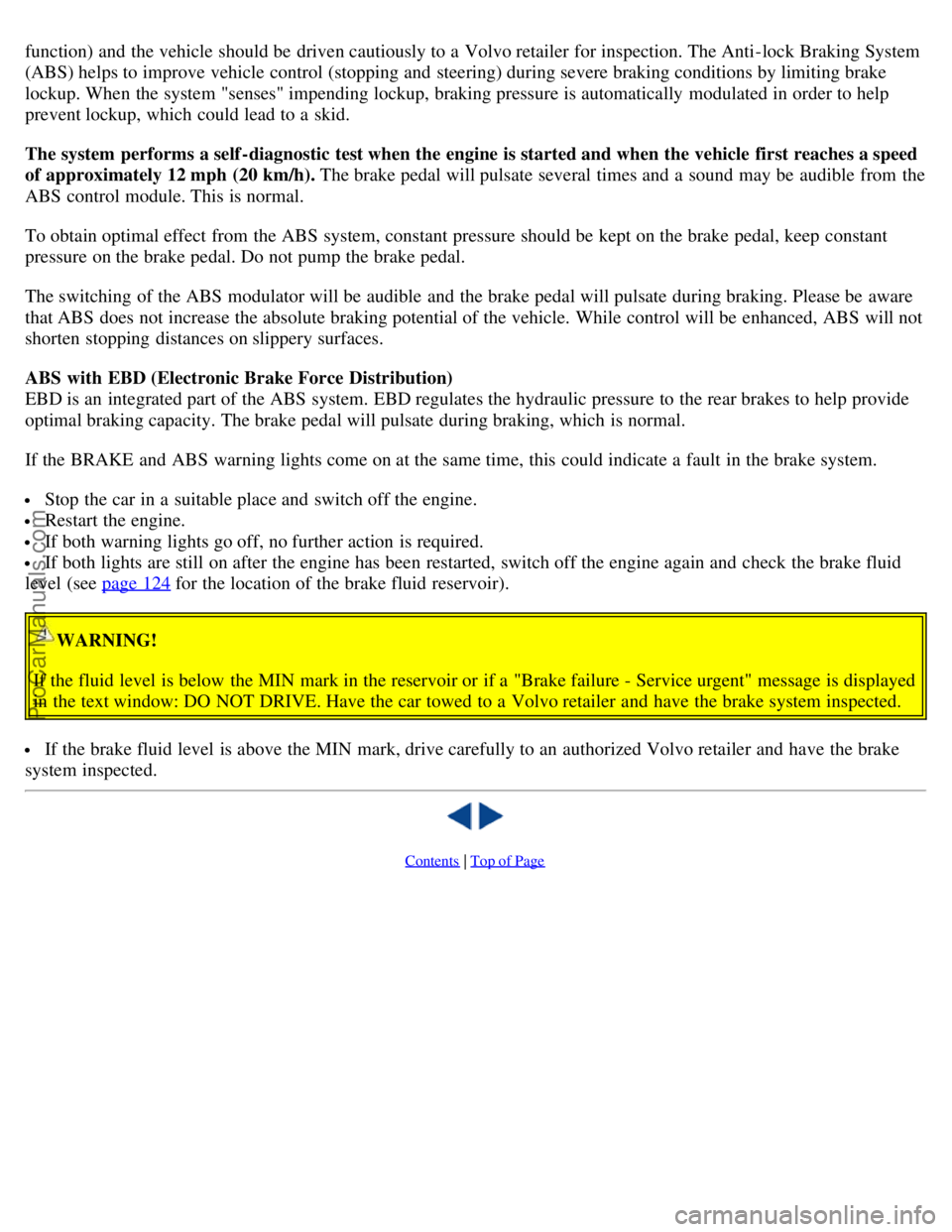
function) and the vehicle should be driven cautiously to a Volvo retailer for inspection. The Anti-lock Braking System
(ABS) helps to improve vehicle control (stopping and steering) during severe braking conditions by limiting brake
lockup. When the system "senses" impending lockup, braking pressure is automatically modulated in order to help
prevent lockup, which could lead to a skid.
The system performs a self -diagnostic test when the engine is started and when the vehicle first reaches a speed
of approximately 12 mph (20 km/h). The brake pedal will pulsate several times and a sound may be audible from the
ABS control module. This is normal.
To obtain optimal effect from the ABS system, constant pressure should be kept on the brake pedal, keep constant
pressure on the brake pedal. Do not pump the brake pedal.
The switching of the ABS modulator will be audible and the brake pedal will pulsate during braking. Please be aware
that ABS does not increase the absolute braking potential of the vehicle. While control will be enhanced, ABS will not
shorten stopping distances on slippery surfaces.
ABS with EBD (Electronic Brake Force Distribution)
EBD is an integrated part of the ABS system. EBD regulates the hydraulic pressure to the rear brakes to help provide
optimal braking capacity. The brake pedal will pulsate during braking, which is normal.
If the BRAKE and ABS warning lights come on at the same time, this could indicate a fault in the brake system.
Stop the car in a suitable place and switch off the engine.
Restart the engine.
If both warning lights go off, no further action is required.
If both lights are still on after the engine has been restarted, switch off the engine again and check the brake fluid
level (see page 124
for the location of the brake fluid reservoir).
WARNING!
If the fluid level is below the MIN mark in the reservoir or if a "Brake failure - Service urgent" message is displayed
in the text window: DO NOT DRIVE. Have the car towed to a Volvo retailer and have the brake system inspected.
If the brake fluid level is above the MIN mark, drive carefully to an authorized Volvo retailer and have the brake
system inspected.
Contents | Top of Page
ProCarManuals.com
Page 91 of 113
Front suspension
Spring strut suspension with integrated shock absorbers and control arms linked to the support frame. Power-assisted
rack and pinion steering. Safety type steering column.
pg. 153 Specifications
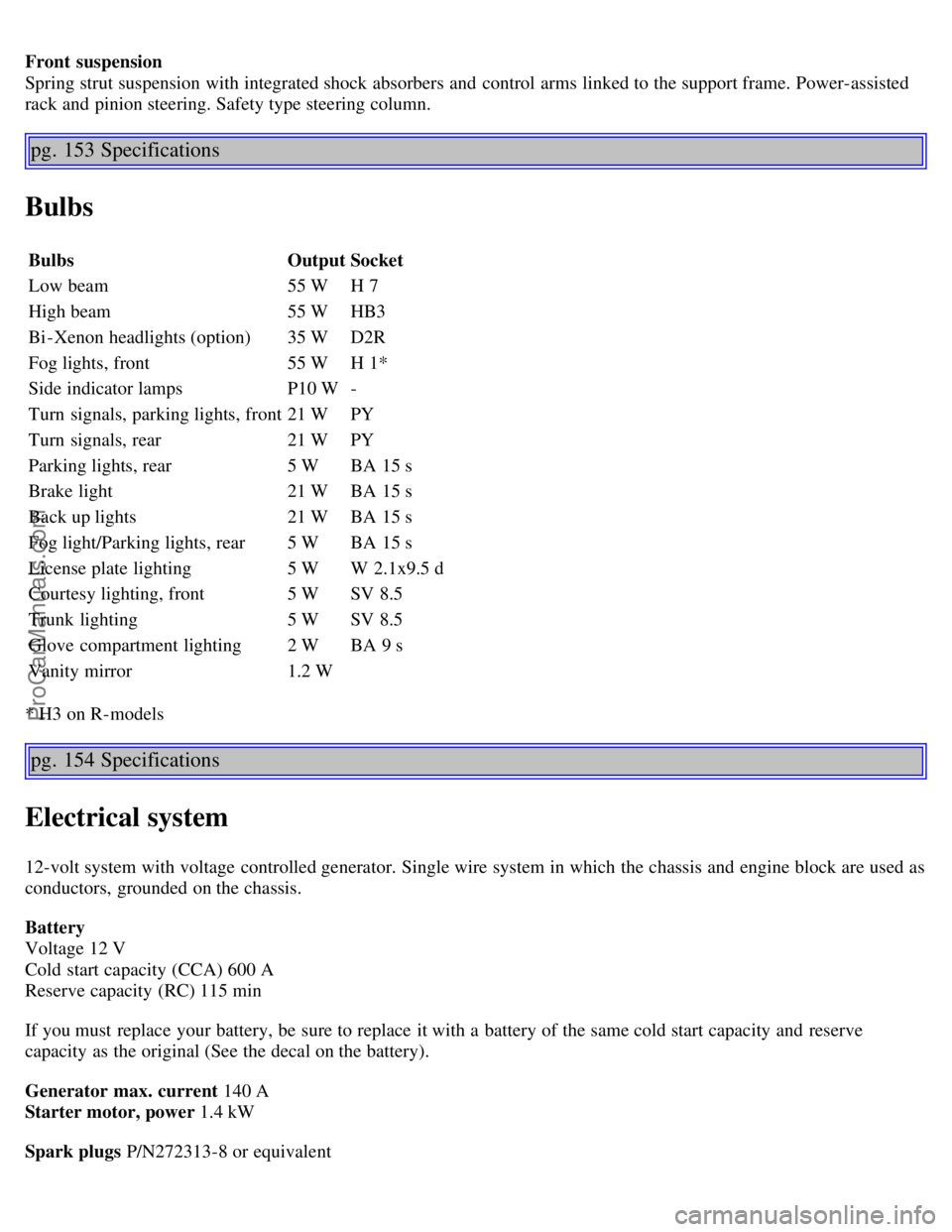
Bulbs
BulbsOutputSocket
Low beam 55 WH 7
High beam 55 WHB3
Bi -Xenon headlights (option) 35 WD2R
Fog lights, front 55 WH 1*
Side indicator lamps P10 W-
Turn signals, parking lights, front 21 WPY
Turn signals, rear 21 WPY
Parking lights, rear 5 WBA 15 s
Brake light 21 WBA 15 s
Back up lights 21 WBA 15 s
Fog light/Parking lights, rear 5 WBA 15 s
License plate lighting 5 WW 2.1x9.5 d
Courtesy lighting, front 5 WSV 8.5
Trunk lighting 5 WSV 8.5
Glove compartment lighting 2 WBA 9 s
Vanity mirror 1.2 W
* H3 on R-models
pg. 154 Specifications
Electrical system
12-volt system with voltage controlled generator. Single wire system in which the chassis and engine block are used as
conductors, grounded on the chassis.
Battery
Voltage 12 V
Cold start capacity (CCA) 600 A
Reserve capacity (RC) 115 min
If you must replace your battery, be sure to replace it with a battery of the same cold start capacity and reserve
capacity as the original (See the decal on the battery).
Generator max. current 140 A
Starter motor, power 1.4 kW
Spark plugs P/N272313-8 or equivalent
ProCarManuals.com
Page 102 of 113
2 0 0 4
VOLVO S60
Index
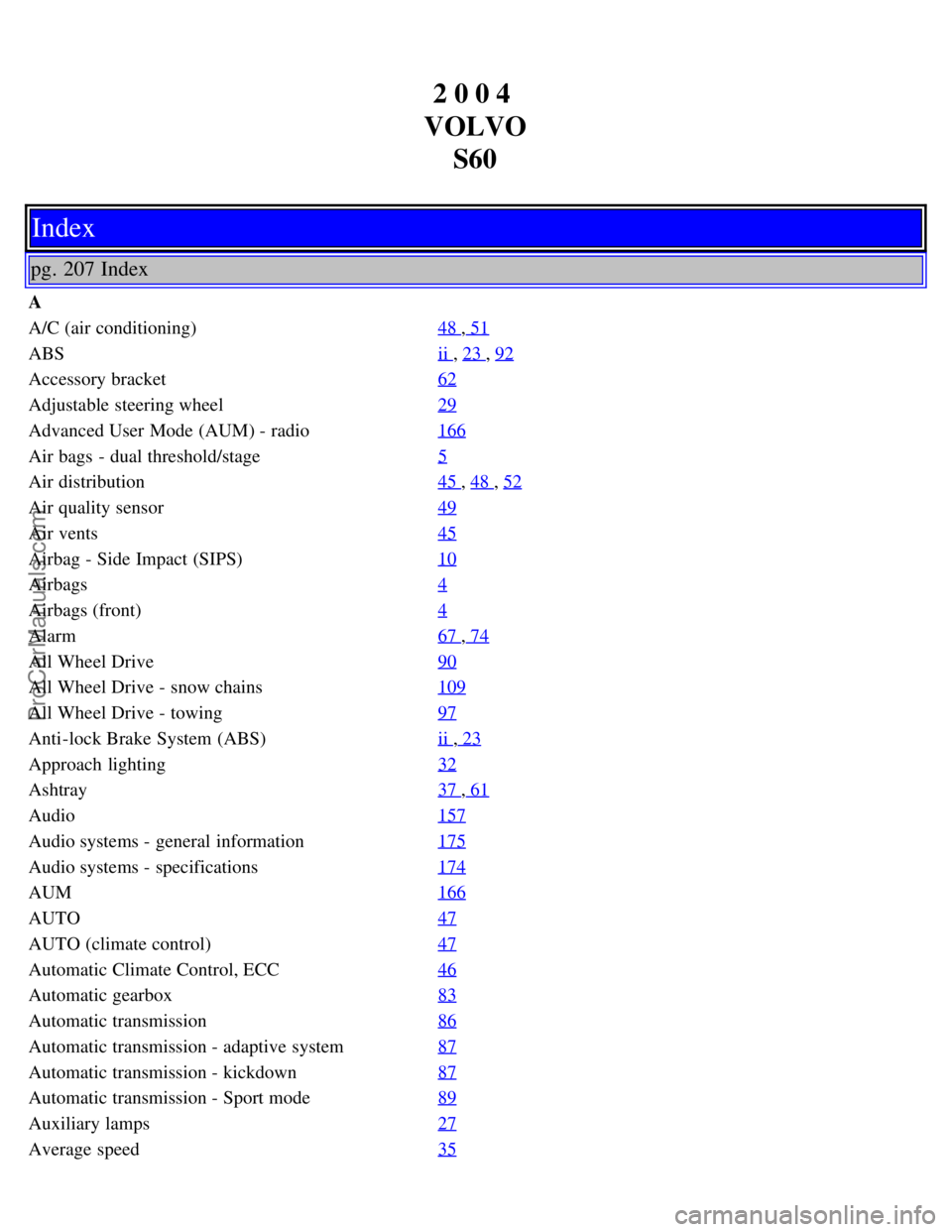
pg. 207 Index
A
A/C (air conditioning) 48
, 51
ABSii , 23 , 92
Accessory bracket62
Adjustable steering wheel29
Advanced User Mode (AUM) - radio166
Air bags - dual threshold/stage5
Air distribution45 , 48 , 52
Air quality sensor49
Air vents45
Airbag - Side Impact (SIPS)10
Airbags4
Airbags (front)4
Alarm67 , 74
All Wheel Drive90
All Wheel Drive - snow chains109
All Wheel Drive - towing97
Anti-lock Brake System (ABS)ii , 23
Approach lighting32
Ashtray37 , 61
Audio157
Audio systems - general information175
Audio systems - specifications174
AUM166
AUTO47
AUTO (climate control)47
Automatic Climate Control, ECC46
Automatic gearbox83
Automatic transmission86
Automatic transmission - adaptive system87
Automatic transmission - kickdown87
Automatic transmission - Sport mode89
Auxiliary lamps27
Average speed35
ProCarManuals.com