steering wheel VOLVO S60 2004 Owners Manual
[x] Cancel search | Manufacturer: VOLVO, Model Year: 2004, Model line: S60, Model: VOLVO S60 2004Pages: 113, PDF Size: 2.35 MB
Page 4 of 113
When cleaning your car, use Volvo's own car care products, all of which have systematically been adapted to the
environment.
For additional information regarding the environmental activities in which Volvo Cars of North America, LLC. and
Volvo Car Corporation are involved, visit our Internet Home Page at: http://www.volvocars.com
PremAir®
On the surface of the radiator in the engine compartment, there is a special coating called PremAir®. PremAir® works
as a catalytic converter, converting most of the ground level ozone passing through the radiator into oxygen, thereby
reducing harmful ground-level ozone.
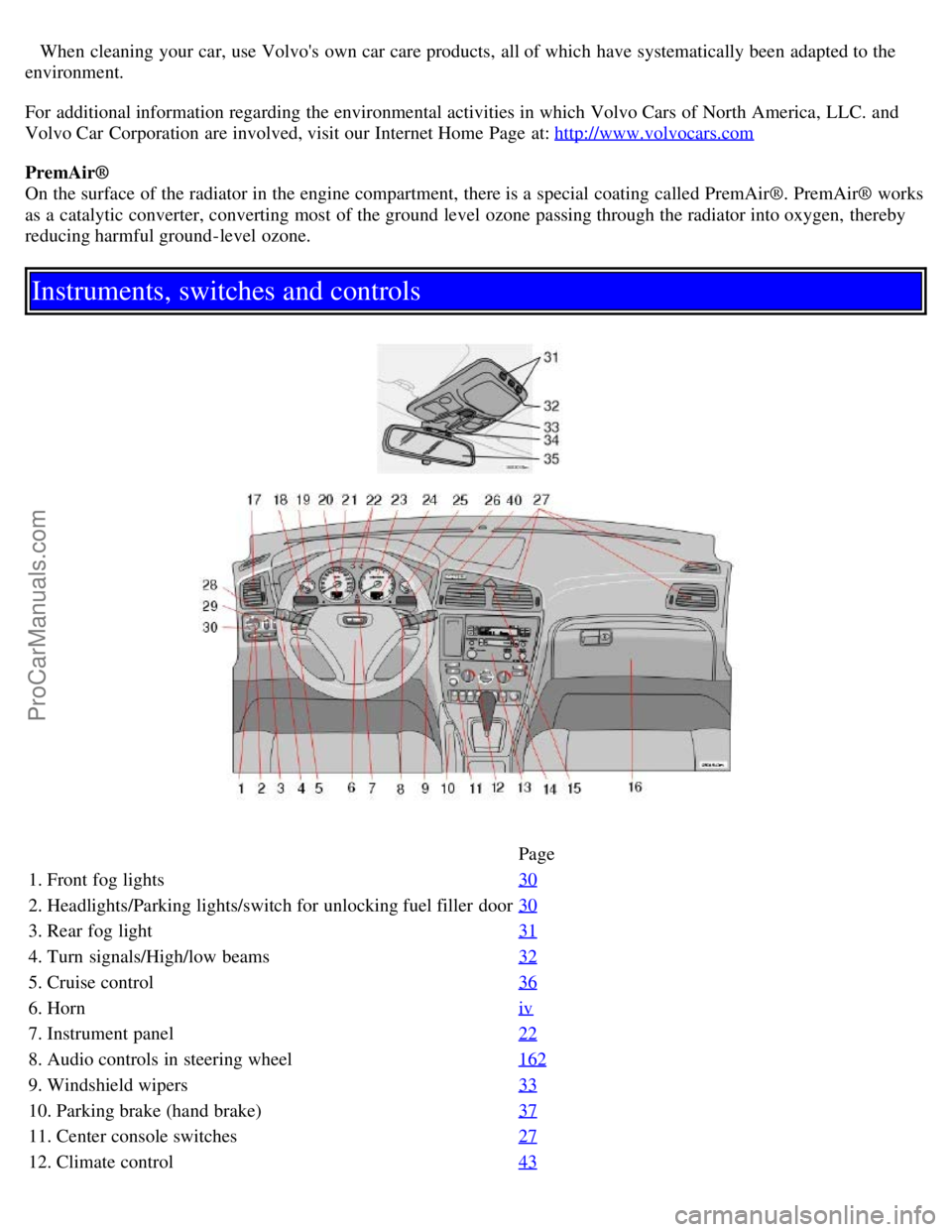
Instruments, switches and controls
Page
1. Front fog lights 30
2. Headlights/Parking lights/switch for unlocking fuel filler door30
3. Rear fog light31
4. Turn signals/High/low beams32
5. Cruise control36
6. Horniv
7. Instrument panel22
8. Audio controls in steering wheel162
9. Windshield wipers33
10. Parking brake (hand brake)37
11. Center console switches27
12. Climate control43
ProCarManuals.com
Page 9 of 113
WARNING!
Seat belts:
Never use a seat belt for more than one occupant. Never wear the shoulder portion of the belt under the arm,
behind the back or otherwise out of position. Such use could cause injury in the event of an accident. As seat belts
lose much of their strength when exposed to violent stretching, they should be replaced after any collision, even if
they appear to be undamaged.
Never repair the belt on your own; have this work done by an authorized Volvo retailer only.
Any device used to induce slack into the shoulder belt portion of the three-point belt system will have a
detrimental effect on the amount of protection available to you in the event of a collision.
The seat back should not be tilted too far back. The shoulder belt must be taut in order to function properly.
Do not use child safety seats or child booster cushions/backrests in the front passenger's seat. We also recommend
that children who have outgrown these devices sit in the rear seat with the seat belt properly fastened.
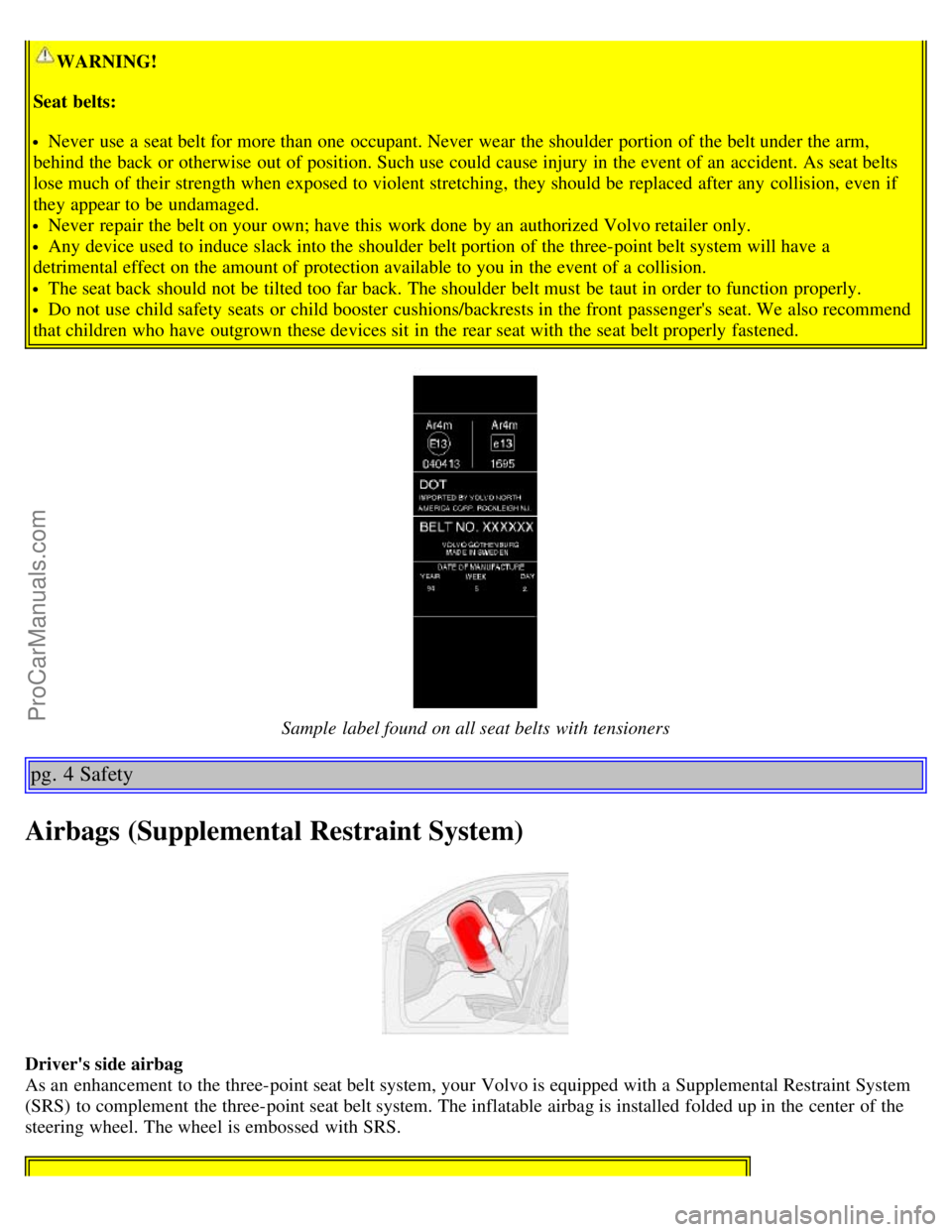
Sample label found on all seat belts with tensioners
pg. 4 Safety
Airbags (Supplemental Restraint System)
Driver's side airbag
As an enhancement to the three-point seat belt system, your Volvo is equipped with a Supplemental Restraint System
(SRS) to complement the three-point seat belt system. The inflatable airbag is installed folded up in the center of the
steering wheel. The wheel is embossed with SRS.
ProCarManuals.com
Page 10 of 113
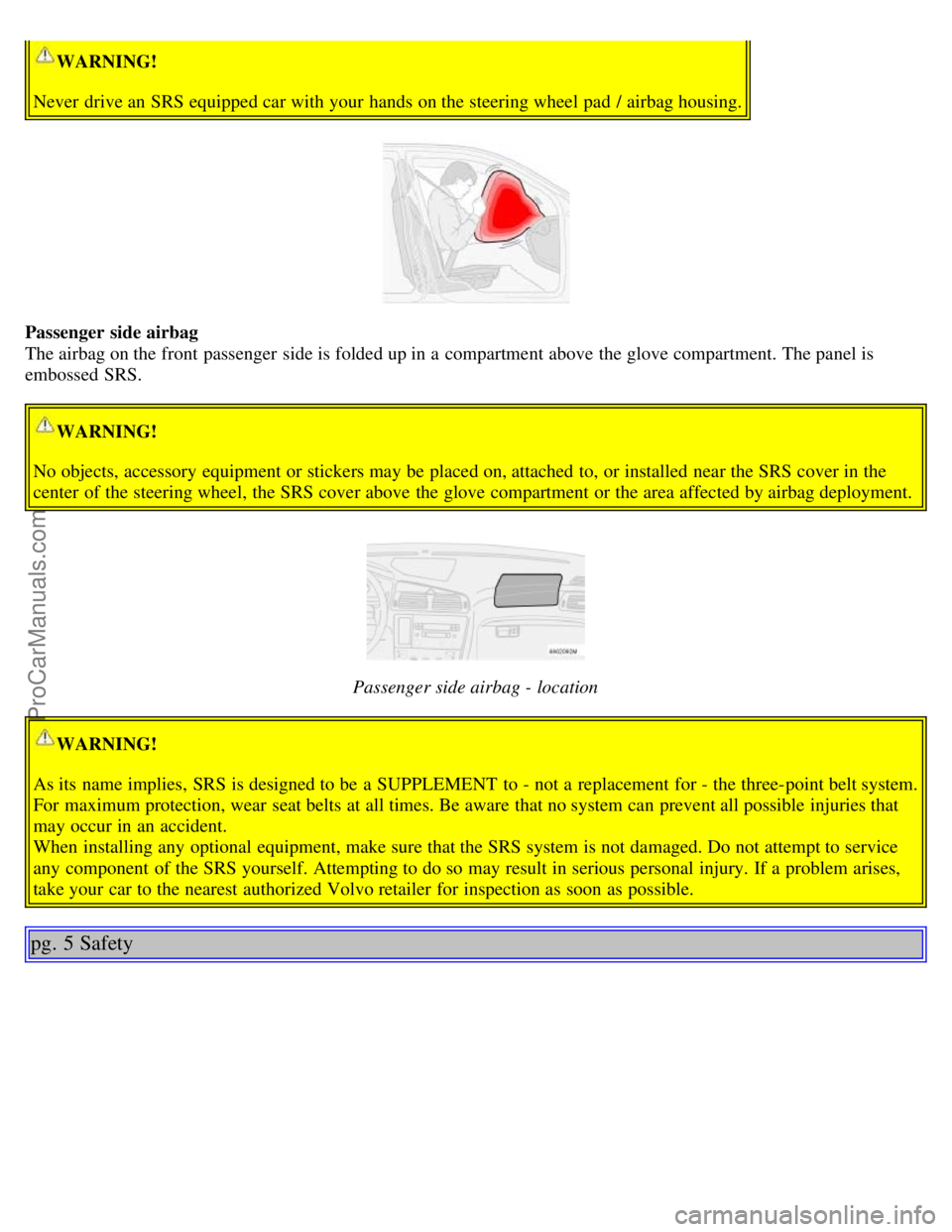
WARNING!
Never drive an SRS equipped car with your hands on the steering wheel pad / airbag housing.
Passenger side airbag
The airbag on the front passenger side is folded up in a compartment above the glove compartment. The panel is
embossed SRS.
WARNING!
No objects, accessory equipment or stickers may be placed on, attached to, or installed near the SRS cover in the
center of the steering wheel, the SRS cover above the glove compartment or the area affected by airbag deployment.
Passenger side airbag - location
WARNING!
As its name implies, SRS is designed to be a SUPPLEMENT to - not a replacement for - the three-point belt system.
For maximum protection, wear seat belts at all times. Be aware that no system can prevent all possible injuries that
may occur in an accident.
When installing any optional equipment, make sure that the SRS system is not damaged. Do not attempt to service
any component of the SRS yourself. Attempting to do so may result in serious personal injury. If a problem arises,
take your car to the nearest authorized Volvo retailer for inspection as soon as possible.
pg. 5 Safety
ProCarManuals.com
Page 12 of 113
Children must never be allowed in the front passenger's seat. Volvo recommends that ALL occupants (adults and
children) shorter than 4 feet 7 inches (140 cm) be seated in the back seat of any vehicle with a front passenger -side
airbag. See page 19
for guidelines.
Occupants in the front passenger's seat must never sit on the edge of the seat, sit leaning toward the instrument panel
or otherwise sit out of position. The occupant's back must be as upright as comfort allows and be against the seat
back with the seat belt properly fastened.
Feet must be on the floor, e.g. not on the dash, seat or out of the window.
No objects or accessory equipment, e.g. dash covers, may be placed on, attached to, or installed near the SRS hatch
(the area above the glove compartment) or the area affected by airbag deployment (see illustration on page 4
).
There should be no loose articles, e.g. coffee cups, on the floor, seat or dash area.
Never try to open the SRS cover on the steering wheel or the passenger side dash. This should only be done by an
authorized Volvo service technician.
Failure to follow these instructions can result in injury to the vehicle occupants
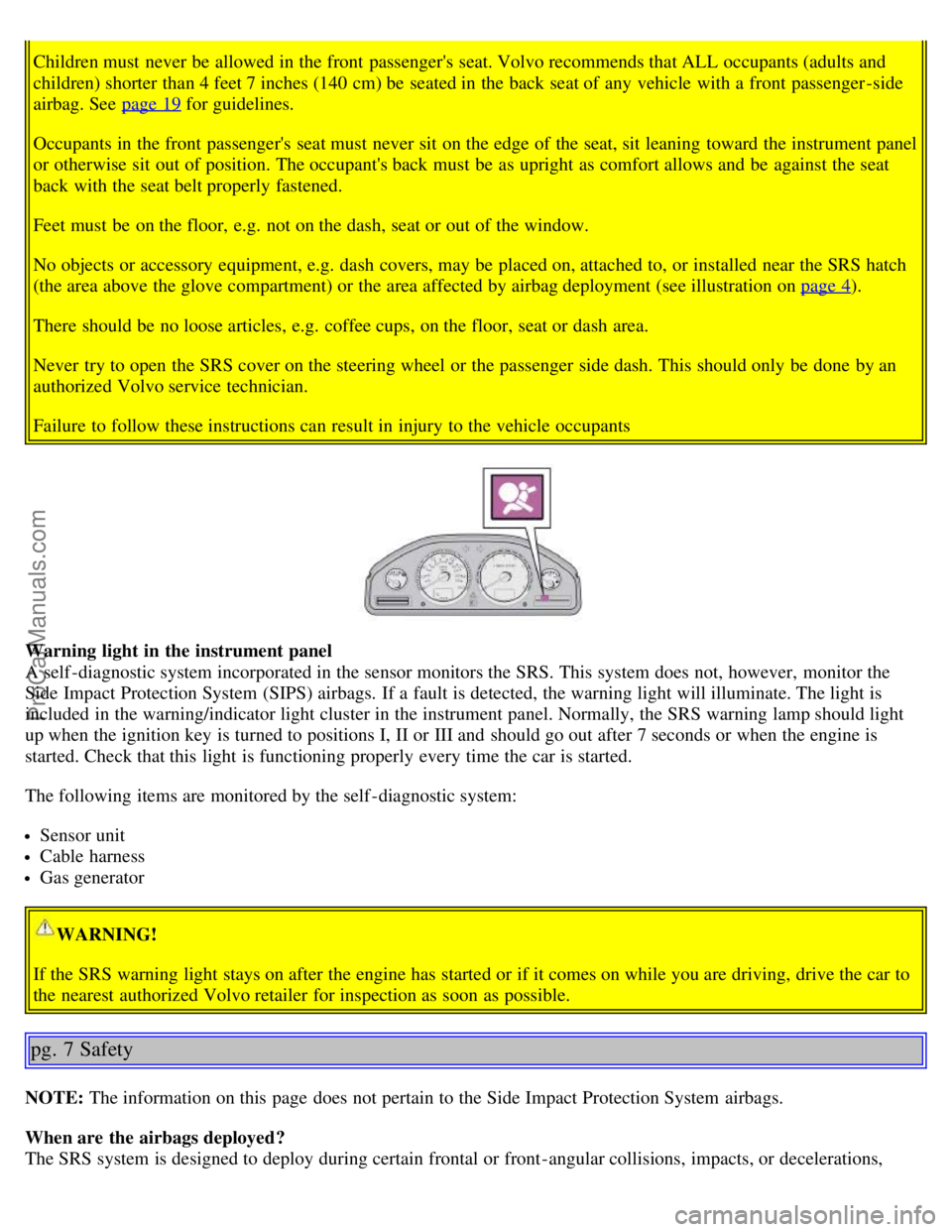
Warning light in the instrument panel
A self -diagnostic system incorporated in the sensor monitors the SRS. This system does not, however, monitor the
Side Impact Protection System (SIPS) airbags. If a fault is detected, the warning light will illuminate. The light is
included in the warning/indicator light cluster in the instrument panel. Normally, the SRS warning lamp should light
up when the ignition key is turned to positions I, II or III and should go out after 7 seconds or when the engine is
started. Check that this light is functioning properly every time the car is started.
The following items are monitored by the self -diagnostic system:
Sensor unit
Cable harness
Gas generator
WARNING!
If the SRS warning light stays on after the engine has started or if it comes on while you are driving, drive the car to
the nearest authorized Volvo retailer for inspection as soon as possible.
pg. 7 Safety
NOTE: The information on this page does not pertain to the Side Impact Protection System airbags.
When are the airbags deployed?
The SRS system is designed to deploy during certain frontal or front -angular collisions, impacts, or decelerations,
ProCarManuals.com
Page 14 of 113
Should you have any questions about the SRS system, please contact your authorized Volvo retailer or Volvo
Customer Support.:
In the USA:
Volvo Cars of North America, LLC.
Customer Relations
P.O. Box 914
Rockleigh, New Jersey 07647-0914
800-458-1552
In Canada:
Volvo Cars of Canada Ltd.
175 Gordon Baker Road
North York, Ontario M2H 2N7
800-663-8255
pg. 9 Safety
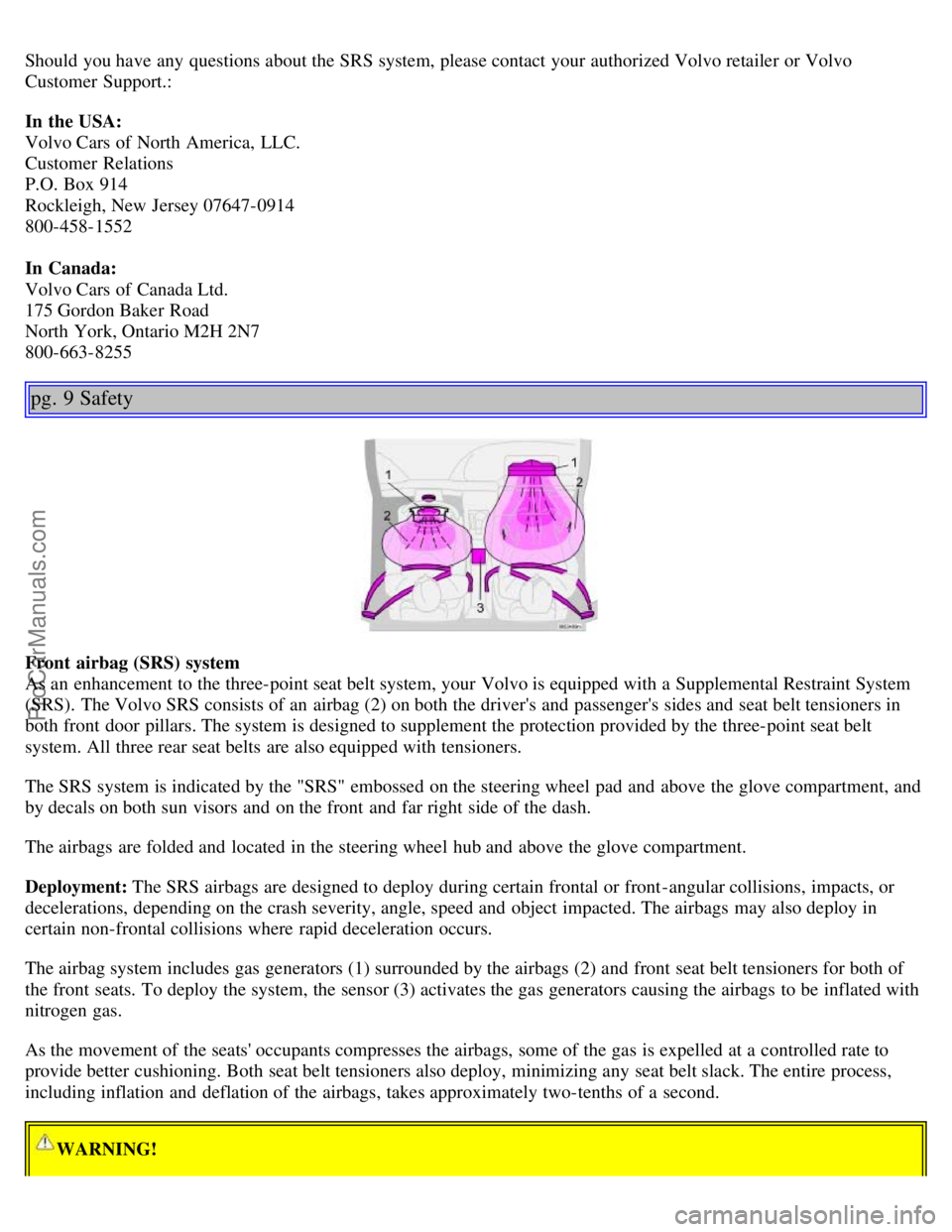
Front airbag (SRS) system
As an enhancement to the three-point seat belt system, your Volvo is equipped with a Supplemental Restraint System
(SRS). The Volvo SRS consists of an airbag (2) on both the driver's and passenger's sides and seat belt tensioners in
both front door pillars. The system is designed to supplement the protection provided by the three-point seat belt
system. All three rear seat belts are also equipped with tensioners.
The SRS system is indicated by the "SRS" embossed on the steering wheel pad and above the glove compartment, and
by decals on both sun visors and on the front and far right side of the dash.
The airbags are folded and located in the steering wheel hub and above the glove compartment.
Deployment: The SRS airbags are designed to deploy during certain frontal or front -angular collisions, impacts, or
decelerations, depending on the crash severity, angle, speed and object impacted. The airbags may also deploy in
certain non-frontal collisions where rapid deceleration occurs.
The airbag system includes gas generators (1) surrounded by the airbags (2) and front seat belt tensioners for both of
the front seats. To deploy the system, the sensor (3) activates the gas generators causing the airbags to be inflated with
nitrogen gas.
As the movement of the seats' occupants compresses the airbags, some of the gas is expelled at a controlled rate to
provide better cushioning. Both seat belt tensioners also deploy, minimizing any seat belt slack. The entire process,
including inflation and deflation of the airbags, takes approximately two-tenths of a second.
WARNING!
ProCarManuals.com
Page 17 of 113
2 0 0 4
VOLVO S60
Instruments and controls
pg. 21 Instruments and controls
Instrument panel 22
Indicator and warning symbols23
Switches in the center console27
Steering wheel adjustment29
Lighting panel30
Lighting panel, Manually unlocking the fuel filler door31
Turn signals32
Windshield wipers/washer33
Hazard warning flashers, rear window/sideview mirror defroster, heated front seats34
Trip computer (option)35
Cruise control36
Parking brake, electric socket/cigarette lighter37
Electrically operated windows38
Rearview mirror/sideview mirrors40
Electrically operated moonroof (option)41
pg. 22 Instruments and controls
Instrument panel
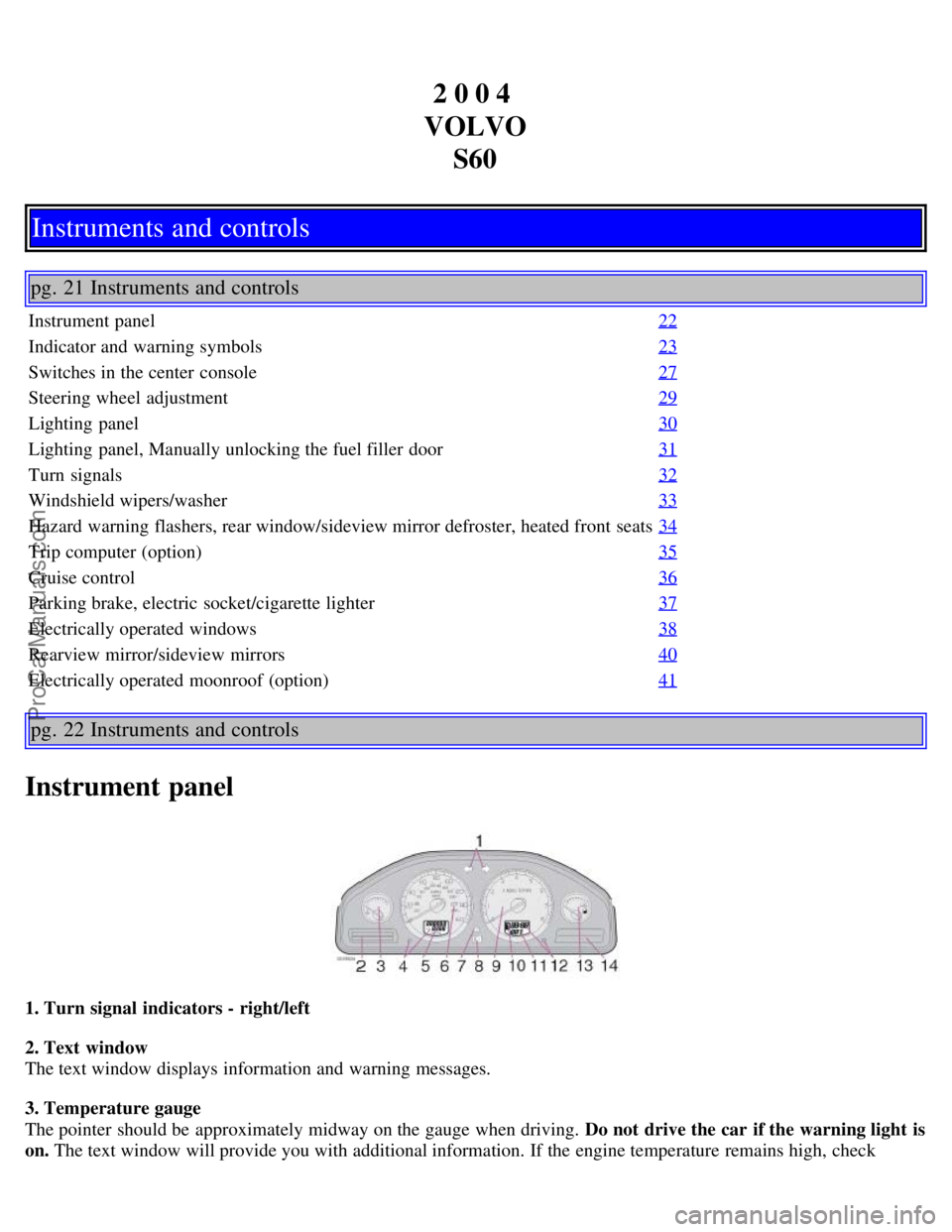
1. Turn signal indicators - right/left
2. Text window
The text window displays information and warning messages.
3. Temperature gauge
The pointer should be approximately midway on the gauge when driving. Do not drive the car if the warning light is
on. The text window will provide you with additional information. If the engine temperature remains high, check
ProCarManuals.com
Page 23 of 113
pg. 28 Instruments and controls
Switches in the center console (Contd)
R-models only:
The Active Yaw Control function can be deactivated. See page 94
for more information.
Note: To help reduce the risk that the SC function is turned off inadvertently, the switch must be held in for at least
half a second to disable this function. "STC/DSTC SPIN CONTROL OFF" will be displayed in the text window.
This function will be automatically reactivated when the engine is restarted.
WARNING!
Please be aware that the car's handling characteristics may be affected if Spin Control function is switched off.
5. Not in Use
6. Temporarily disconnecting the alarm sensors (option)
See page 75
for more details.
7. Not in use
8. 12 volt socket
This 12 volt socket can be used to plug in certain accessories such as cellular telephones, etc. The ignition key must be
in position 1 (or higher) for the auxiliary socket to function.
NOTE: The auxiliary sockets can also be used for cigarette lighters, which are available at your Volvo retailer.
Four-C active chassis system
(R-models only)
Please see page 91 for information on adjusting the active chassis settings.
pg. 29 Instruments and controls
Steering wheel adjustment
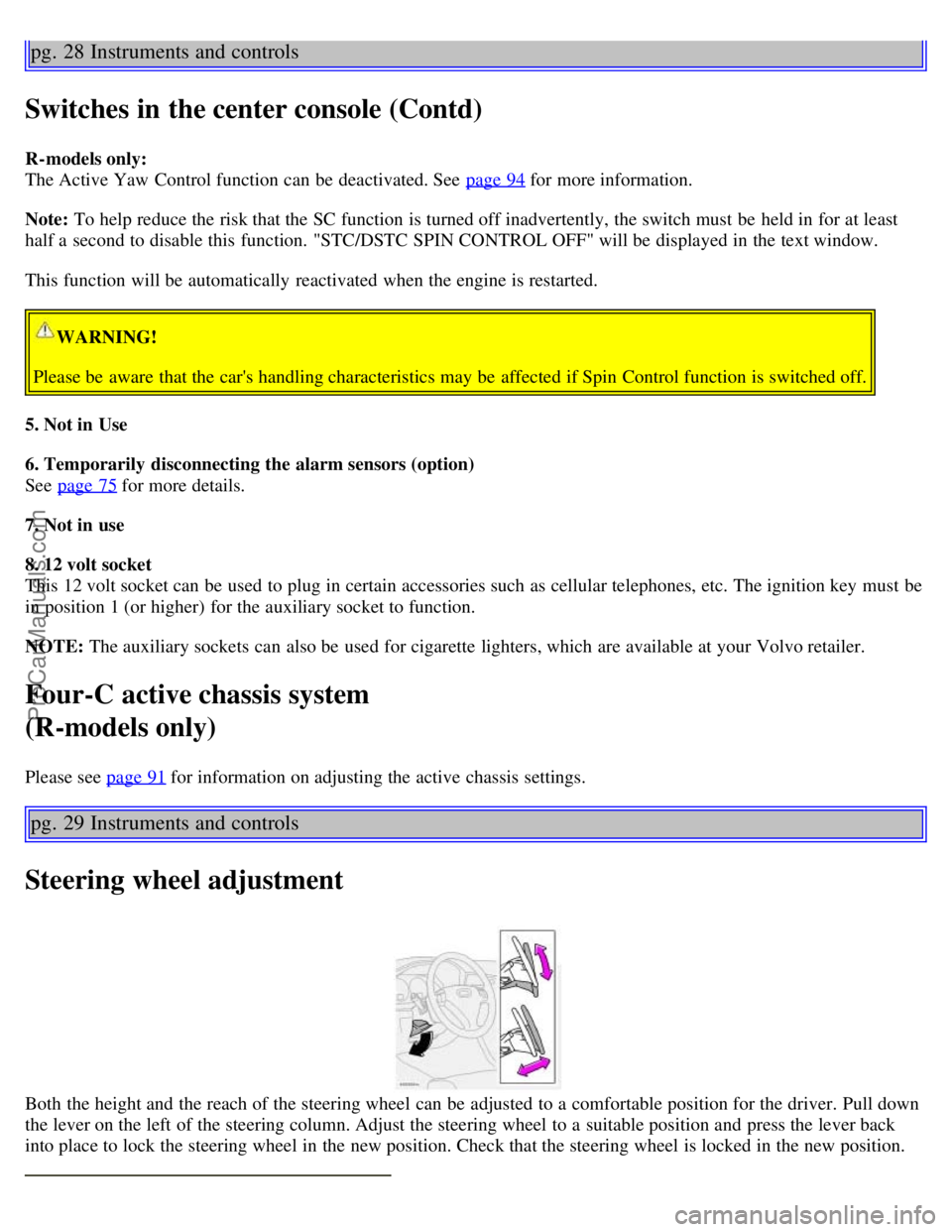
Both the height and the reach of the steering wheel can be adjusted to a comfortable position for the driver. Pull down
the lever on the left of the steering column. Adjust the steering wheel to a suitable position and press the lever back
into place to lock the steering wheel in the new position. Check that the steering wheel is locked in the new position.
ProCarManuals.com
Page 24 of 113
WARNING!
Never adjust the steering wheel while driving.
pg. 30 Instruments and controls
Lighting panel
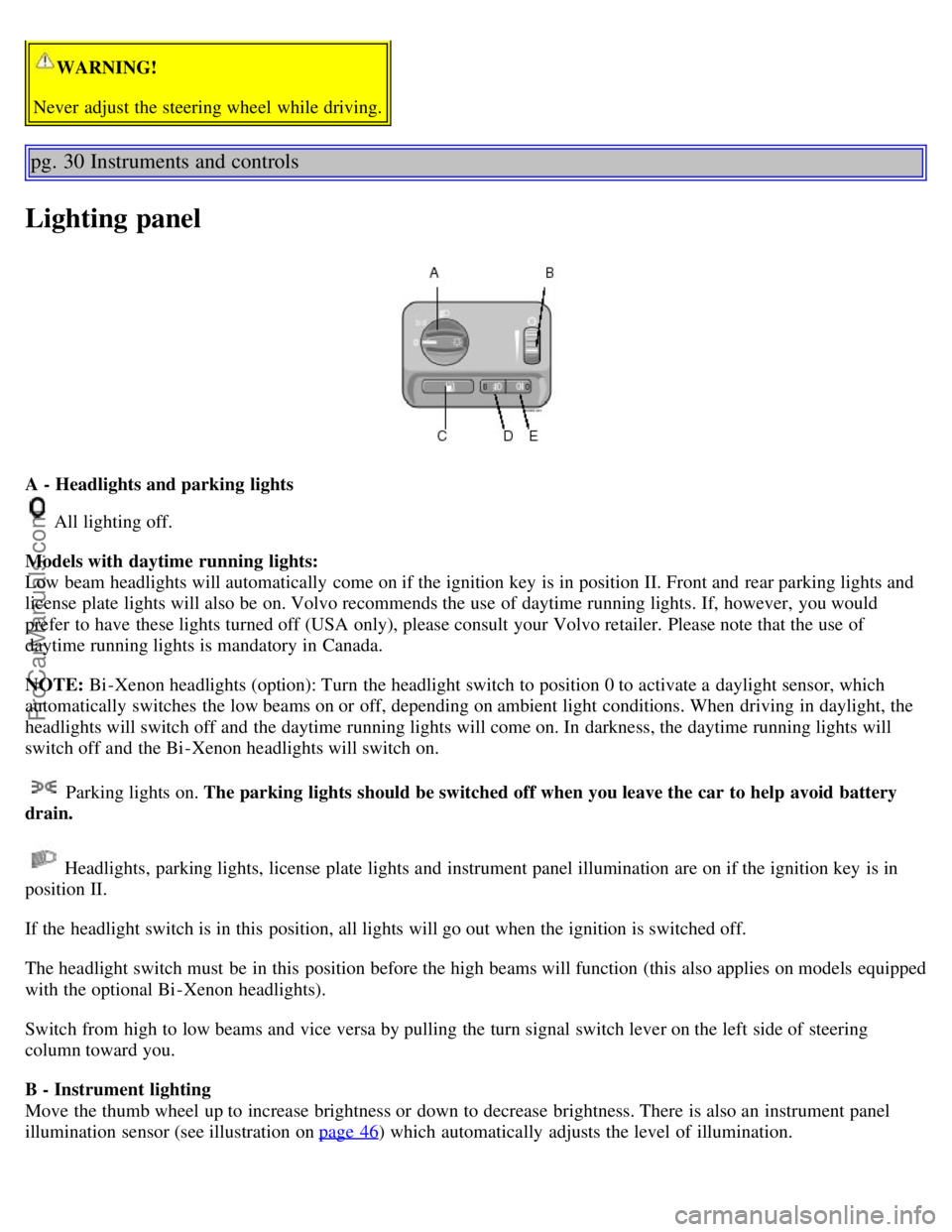
A - Headlights and parking lights
All lighting off.
Models with daytime running lights:
Low beam headlights will automatically come on if the ignition key is in position II. Front and rear parking lights and
license plate lights will also be on. Volvo recommends the use of daytime running lights. If, however, you would
prefer to have these lights turned off (USA only), please consult your Volvo retailer. Please note that the use of
daytime running lights is mandatory in Canada.
NOTE: Bi -Xenon headlights (option): Turn the headlight switch to position 0 to activate a daylight sensor, which
automatically switches the low beams on or off, depending on ambient light conditions. When driving in daylight, the
headlights will switch off and the daytime running lights will come on. In darkness, the daytime running lights will
switch off and the Bi -Xenon headlights will switch on.
Parking lights on. The parking lights should be switched off when you leave the car to help avoid battery
drain.
Headlights, parking lights, license plate lights and instrument panel illumination are on if the ignition key is in
position II.
If the headlight switch is in this position, all lights will go out when the ignition is switched off.
The headlight switch must be in this position before the high beams will function (this also applies on models equipped
with the optional Bi -Xenon headlights).
Switch from high to low beams and vice versa by pulling the turn signal switch lever on the left side of steering
column toward you.
B - Instrument lighting
Move the thumb wheel up to increase brightness or down to decrease brightness. There is also an instrument panel
illumination sensor (see illustration on page 46
) which automatically adjusts the level of illumination.
ProCarManuals.com
Page 52 of 113
After refueling, close the fuel filler cap by turning it clockwise until it clicks into place*.
Allow for fuel expansion by not overfilling the tank. Overfilling could also cause damage to the emission control
systems. Avoid spilling gasoline during refueling. In addition to causing damage to the environment, gasolines
containing alcohol can cause damage to painted surfaces, which may not be covered under the New Vehicle Limited
Warranty.
Do not use gasolines containing methanol (methyl alcohol, wood alcohol). This practice can result in vehicle
performance deterioration and can damage critical parts in the fuel system. Such damage may not be covered under the
New Vehicle Limited Warranty.
* If the fuel filler cap is not closed tightly or if the engine is running when the car is refueled, the Check Engine Light
(malfunction indicator lamp) may indicate a fault. However, your vehicle's performance will not be affected. Use only
Volvo original or approved fuel filler caps.
pg. 81 Starting and driving
Starting the car
Starting the engine
1. Fasten the seat belt.
WARNING!
Before starting, check that the seat, steering wheel and mirrors are adjusted properly. Make sure the brake pedal can
be depressed completely. Adjust the seat if necessary. See pages 54, 56.
2. Apply the parking brake (hand brake) if not already set. The gear selector (automatic transmission) is locked in the
(P )ark position ( SHIFTLOCK ).
Manual transmission: the clutch must be fully depressed.
3. Without touching the accelerator pedal, turn the ignition key* to the starting position. Allow the starter to operate for
up to 10 seconds. Release the key as soon as the engine starts. If the engine fails to start, repeat this step.
NOTE: On certain models, when the car is started, idle speed may be noticeably higher than normal for a short period,
depending on the temperature of the engine. This has been done to help bring components in the emission control
system to their normal operating temperature as quickly as possible, which enables them to function normally.
For cold starts at altitudes above 6000 ft (1800 meters), depress the accelerator pedal halfway and turn the key to the
starting position. Release the pedal slowly when the engine starts.
4. To release the gear selector from the ( P)ark position, the engine must be running (or the ignition key must be in
position II) and the brake pedal must be depressed.
5. Select the desired gear. The gear engages after a very slight delay which is especially noticeable when selecting R.
NOTE: Your car is equipped with a KEYLOCK system (automatic transmission). When the engine is switched off,
the gear selector must be in the ( P)ark position before the key can be removed from the ignition switch.
When starting in cold weather, the transmission may shift up at slightly higher engine speeds than normal until the
automatic transmission fluid reaches normal operating temperature.
CAUTION:
Automatic transmission
ProCarManuals.com
Page 53 of 113
The engine should be idling when you move the gear selector. Never accelerate until after you feel the transmission
engage! Accelerating immediately after selecting a gear will cause harsh engagement and premature transmission wear.
Selecting P or N when idling at a standstill for prolonged periods of time will help prevent overheating of the
automatic transmission fluid.
WARNING!
Always place the gear selector in Park and apply the parking brake before leaving the vehicle. Never leave the car
unattended with the engine running.
Always open garage doors fully before starting the engine inside a garage to ensure adequate ventilation. The
exhaust gases contain carbon monoxide, which is invisible and odorless but very poisonous
Do not race a cold engine immediately after starting. Oil flow may not reach some lubrication points fast enough to
prevent engine damage.
* If two of the keys to your car are close together, e.g., on the same key ring, when you try to start the car, this could
cause interference in the immobilizer system and result in the car not starting. If this should occur, remove one of the
keys from the key ring before trying to start the car again.
pg. 82 Starting and driving
Starting the car (contd)
Ignition switch and steering wheel lock
0 - Locked position:
Remove the key to lock the steering wheel*.
WARNING!
Never turn the key to position O while driving or when the car is being towed.
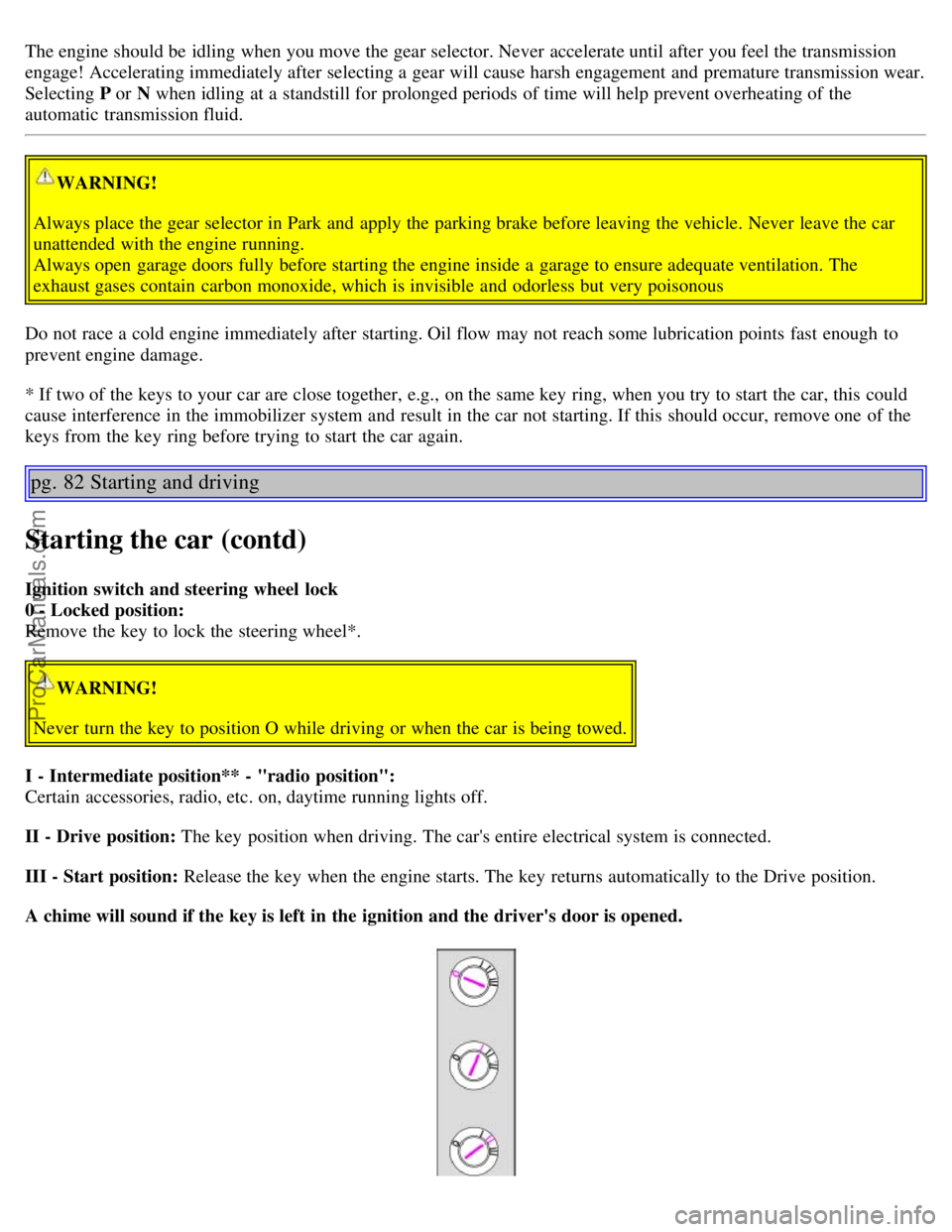
I - Intermediate position** - "radio position":
Certain accessories, radio, etc. on, daytime running lights off.
II - Drive position: The key position when driving. The car's entire electrical system is connected.
III - Start position: Release the key when the engine starts. The key returns automatically to the Drive position.
A chime will sound if the key is left in the ignition and the driver's door is opened.
ProCarManuals.com