inflation pressure VOLVO S60 2006 User Guide
[x] Cancel search | Manufacturer: VOLVO, Model Year: 2006, Model line: S60, Model: VOLVO S60 2006Pages: 132, PDF Size: 2.33 MB
Page 84 of 132
![VOLVO S60 2006 User Guide Standard load: A class of P-metric or Metric tires designed to carry a maximum load at 35 psi [37 psi (2.5 bar) for
Metric tires]. Increasing the inflation pressure beyond this pressure will not](/img/45/58512/w960_58512-83.png "VOLVO S60 2006 User Guide Standard load: A class of P-metric or Metric tires designed to carry a maximum load at 35 psi [37 psi (2.5 bar) for
Metric tires]. Increasing the inflation pressure beyond this pressure will not")
Standard load: A class of P-metric or Metric tires designed to carry a maximum load at 35 psi [37 psi (2.5 bar) for
Metric tires]. Increasing the inflation pressure beyond this pressure will not increase the tires load carrying capability.
Extra load: A class of P-metric or Metric tires designed to carry a heavier maximum load at 41 psi [43 psi (2.9 bar)
for Metric tires]. Increasing the inflation pressure beyond this pressure will not increase the tires load carrying
capability.
kPa : Kilopascal, a metric unit of air pressure.
PSI: Pounds per square inch, a standard unit of air pressure.
B-pillar : The structural member at the side of the vehicle behind the front door.
Bead area of the tire : Area of the tire next to the rim.
Sidewall of the tire: Area between the bead area and the tread.
Tread area of the tire : Area of the perimeter of the tire that contacts the road when mounted on the vehicle.
Rim: The metal support (wheel) for a tire or a tire and tube assembly upon which the tire beads are seated.
Maximum load rating : a figure indicating the maximum load in pounds and kilograms that can be carried by the
tire. This rating is established by the tire manufacturer.
Maximum permissible inflation pressure : the greatest amount of air pressure that should ever be put in the tire.
This limit is set by the tire manufacturer.
Recommended tire inflation pressure : inflation pressure, established by Volvo, which is based on the type of tires
that are mounted on a vehicle at the factory. This inflation pressure is affected by the number of occupants in the car,
the amount of cargo, and the speed at which the vehicle will be driven for a prolonged period. This information can be
found on the tire inflation placard(s) located on the driver's side B-pillar or on the inside of the fuel filler door on
Canadian models, and in the tire inflation table in this chapter.
Cold tires : The tires are considered to be cold when they have the same temperature as the surrounding (ambient)
air. This temperature is normally reached after the car has been parked for at least 3 hours.
pg. 121 Wheels and tires
Vehicle loading
Properly loading your vehicle will provide maximum return of vehicle design performance.
Before loading your vehicle, familiarize yourself with the following terms for determining your vehicle's weight
ratings, with or without a trailer, from the vehicle's Federal/ Canadian Motor Vehicle Safety Standards
(FMVSS/CMVSS) label, and the vehicle's tire information placard:
Curb weight
The weight of the vehicle including a full tank of fuel and all standard equipment. It does not include passengers,
cargo, or optional equipment.
Capacity weight
All weight added to the curb weight, including cargo and optional equipment. When towing, trailer hitch tongue load
is also part of cargo weight.
NOTE: For trailer towing information, please refer to the section "Towing a trailer" on page 103
.
Permissible axle weight
The maximum allowable weight that can be carried by a single axle (front or rear). These numbers are shown on the
Federal/Canadian Motor Vehicle Safety Standards (FMVSS/CMVSS) label. The total load on each axle must never
exceed its maximum permissible weight.
Gross vehicle weight (GVW)
The vehicle's curb weight + cargo + passengers.
NOTE:
The location of the various labels in your vehicle can be found on page 164.
ProCarManuals.com
Page 125 of 132
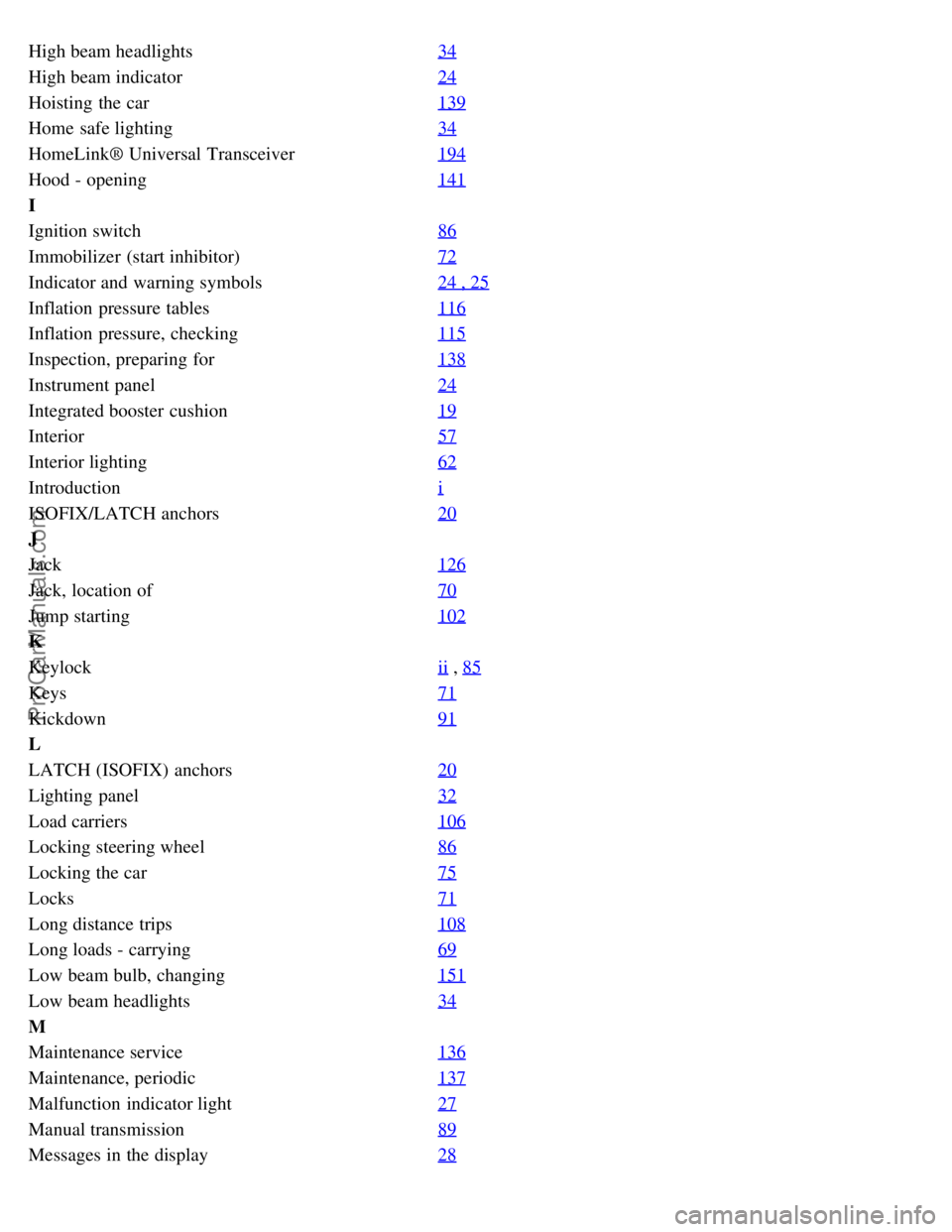
High beam headlights34
High beam indicator24
Hoisting the car139
Home safe lighting34
HomeLink® Universal Transceiver194
Hood - opening141
I
Ignition switch86
Immobilizer (start inhibitor)72
Indicator and warning symbols24 , 25
Inflation pressure tables116
Inflation pressure, checking115
Inspection, preparing for138
Instrument panel24
Integrated booster cushion19
Interior57
Interior lighting62
Introductioni
ISOFIX/LATCH anchors20
J
Jack126
Jack, location of70
Jump starting102
K
Keylockii
, 85
Keys71
Kickdown91
L
LATCH (ISOFIX) anchors20
Lighting panel32
Load carriers106
Locking steering wheel86
Locking the car75
Locks71
Long distance trips108
Long loads - carrying69
Low beam bulb, changing151
Low beam headlights34
M
Maintenance service136
Maintenance, periodic137
Malfunction indicator light27
Manual transmission89
Messages in the display28
ProCarManuals.com
Page 128 of 132
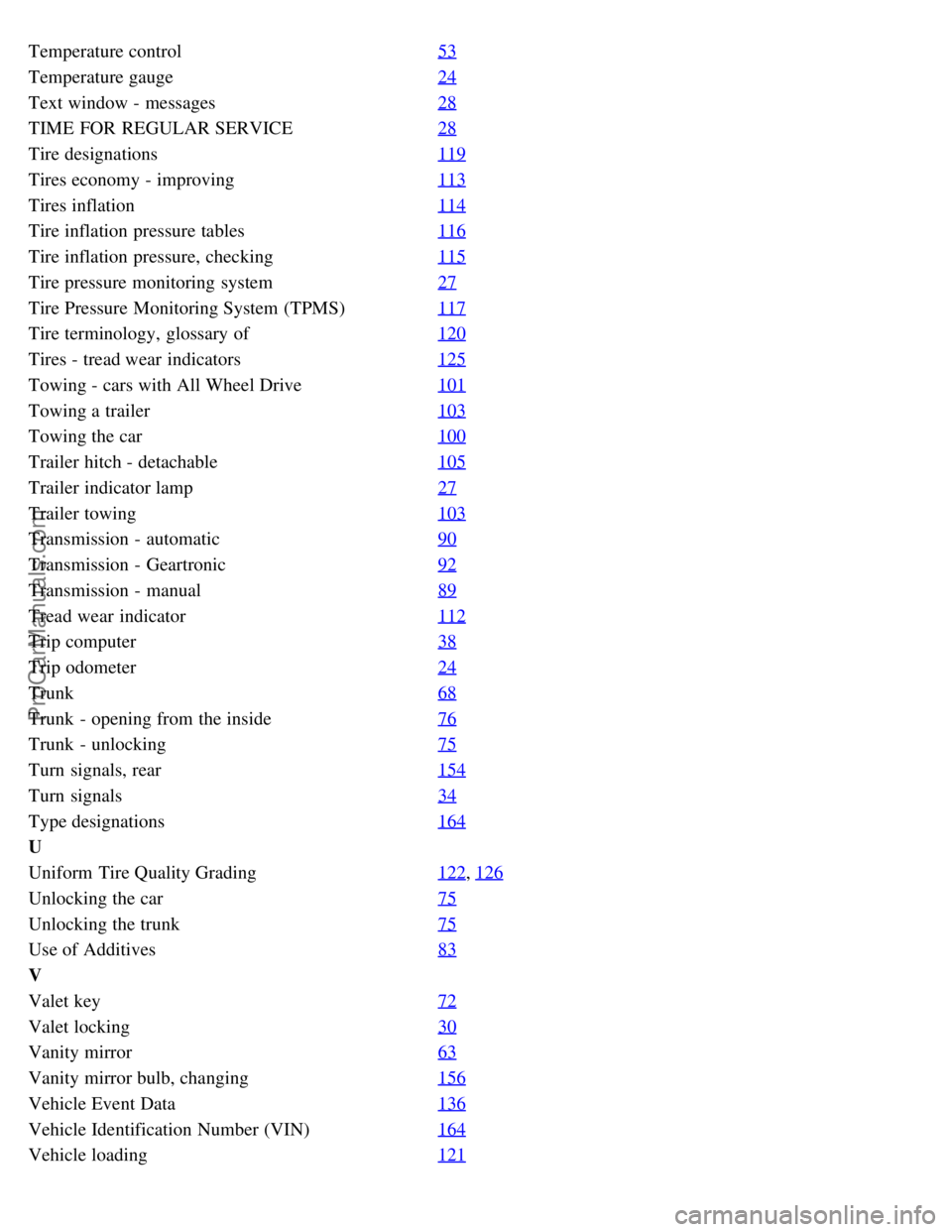
Temperature control53
Temperature gauge24
Text window - messages28
TIME FOR REGULAR SERVICE28
Tire designations119
Tires economy - improving113
Tires inflation114
Tire inflation pressure tables116
Tire inflation pressure, checking115
Tire pressure monitoring system27
Tire Pressure Monitoring System (TPMS)117
Tire terminology, glossary of120
Tires - tread wear indicators125
Towing - cars with All Wheel Drive101
Towing a trailer103
Towing the car100
Trailer hitch - detachable105
Trailer indicator lamp27
Trailer towing103
Transmission - automatic90
Transmission - Geartronic92
Transmission - manual89
Tread wear indicator112
Trip computer38
Trip odometer24
Trunk68
Trunk - opening from the inside76
Trunk - unlocking75
Turn signals, rear154
Turn signals34
Type designations164
U
Uniform Tire Quality Grading122
, 126
Unlocking the car75
Unlocking the trunk75
Use of Additives83
V
Valet key72
Valet locking30
Vanity mirror63
Vanity mirror bulb, changing156
Vehicle Event Data136
Vehicle Identification Number (VIN)164
Vehicle loading121
ProCarManuals.com