mirror VOLVO S60 2006 User Guide
[x] Cancel search | Manufacturer: VOLVO, Model Year: 2006, Model line: S60, Model: VOLVO S60 2006Pages: 132, PDF Size: 2.33 MB
Page 50 of 132
Vanity mirror
The light comes on when you open the cover.
Floor mats
Volvo offers floor mats specially manufactured for your car. They must be properly placed and secured in the mat
clips.
WARNING!
An extra mat on the driver's floor can cause the accelerator pedal to catch. Check that the movement of the
accelerator pedal is not impeded. No more than one protective floor covering may be used at one time.
Contents | Top of Page
ProCarManuals.com
Page 53 of 132
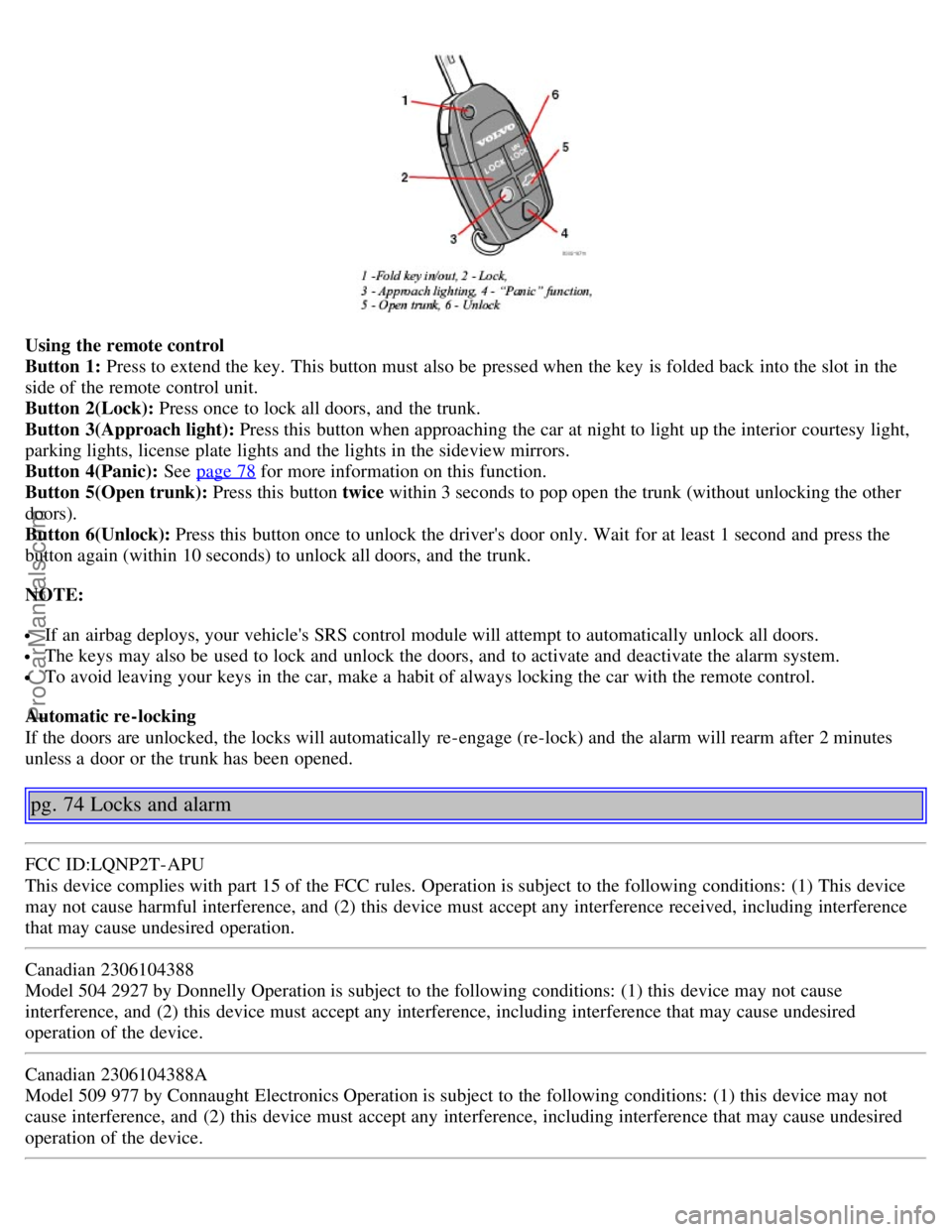
Using the remote control
Button 1: Press to extend the key. This button must also be pressed when the key is folded back into the slot in the
side of the remote control unit.
Button 2(Lock): Press once to lock all doors, and the trunk.
Button 3(Approach light): Press this button when approaching the car at night to light up the interior courtesy light,
parking lights, license plate lights and the lights in the sideview mirrors.
Button 4(Panic): See page 78
for more information on this function.
Button 5(Open trunk): Press this button twice within 3 seconds to pop open the trunk (without unlocking the other
doors).
Button 6(Unlock): Press this button once to unlock the driver's door only. Wait for at least 1 second and press the
button again (within 10 seconds) to unlock all doors, and the trunk.
NOTE:
If an airbag deploys, your vehicle's SRS control module will attempt to automatically unlock all doors.
The keys may also be used to lock and unlock the doors, and to activate and deactivate the alarm system.
To avoid leaving your keys in the car, make a habit of always locking the car with the remote control.
Automatic re-locking
If the doors are unlocked, the locks will automatically re-engage (re-lock) and the alarm will rearm after 2 minutes
unless a door or the trunk has been opened.
pg. 74 Locks and alarm
FCC ID:LQNP2T-APU
This device complies with part 15 of the FCC rules. Operation is subject to the following conditions: (1) This device
may not cause harmful interference, and (2) this device must accept any interference received, including interference
that may cause undesired operation.
Canadian 2306104388
Model 504 2927 by Donnelly Operation is subject to the following conditions: (1) this device may not cause
interference, and (2) this device must accept any interference, including interference that may cause undesired
operation of the device.
Canadian 2306104388A
Model 509 977 by Connaught Electronics Operation is subject to the following conditions: (1) this device may not
cause interference, and (2) this device must accept any interference, including interference that may cause undesired
operation of the device.
ProCarManuals.com
Page 63 of 132
systems. Avoid spilling gasoline during refueling. In addition to causing damage to the environment, gasolines
containing alcohol can cause damage to painted surfaces, which may not be covered under the New Vehicle Limited
Warranty.
Do not use gasolines containing methanol (methyl alcohol, wood alcohol). This practice can result in vehicle
performance deterioration and can damage critical parts in the fuel system. Such damage may not be covered under the
New Vehicle Limited Warranty.
* If the fuel filler cap is not closed tightly or if the engine is running when the car is refueled, the Check Engine Light
(malfunction indicator lamp) may indicate a fault. However, your vehicle's performance will not be affected. Use only
Volvo original or approved fuel filler caps.
pg. 85 Starting and driving
Starting the car
Starting the engine
1. Fasten the seat belt.
WARNING!
Before starting, check that the seat, steering wheel and mirrors are adjusted properly. Make sure the brake pedal can
be depressed completely. Adjust the seat if necessary. See pages 58,
60.
2. Apply the parking brake (hand brake) if not already set. The gear selector (automatic transmission) is locked in the
(P )ark position ( SHIFTLOCK ).
Manual transmission: the clutch must be fully depressed.
3. Without touching the accelerator pedal, turn the ignition key* to the starting position. Allow the starter to operate for
up to 10 seconds. Release the key as soon as the engine starts. If the engine fails to start, repeat this step.
NOTE: On certain models, when the car is started, idle speed may be noticeably higher than normal for a short period,
depending on the temperature of the engine. This has been done to help bring components in the emission control
system to their normal operating temperature as quickly as possible, which enables them to function normally.
For cold starts at altitudes above 6000 ft (1800 meters), depress the accelerator pedal halfway and turn the key to the
starting position. Release the pedal slowly when the engine starts.
4. To release the gear selector from the ( P)ark position, the engine must be running (or the ignition key must be in
position II) and the brake pedal must be depressed.
5. Select the desired gear. The gear engages after a very slight delay which is especially noticeable when selecting R.
NOTE: Your car is equipped with a KEYLOCK system (automatic transmission). When the engine is switched off,
the gear selector must be in the ( P)ark position before the key can be removed from the ignition switch.
When starting in cold weather, the transmission may shift up at slightly higher engine speeds than normal until the
automatic transmission fluid reaches normal operating temperature.
CAUTION:
Automatic transmission
The engine should be idling when you move the gear selector. Never accelerate until after you feel the transmission
engage! Accelerating immediately after selecting a gear will cause harsh engagement and premature transmission wear.
ProCarManuals.com
Page 92 of 132
clean water.
Exterior plastic components
Cleaning exterior plastic components should be done with a cleaning agent specially designed for this purpose.
Solvents or stain removers should not be used. Consult your Volvo retailer.
NOTE: When washing the car, remember to remove dirt from the drain holes in the doors and sills.
WARNING!
When the car is driven immediately after being washed, apply the brakes several times in order to remove any
moisture from the brake linings.
Engine cleaning agents should not be used when the engine is warm. This constitutes a fire risk.
Automatic washing - simple and quick
We do NOT recommend washing your car in an automatic wash during the first six months (because the paint will
not have hardened sufficiently).
An automatic wash is a simple and quick way to clean your car, but it is worth remembering that it may not be as
thorough as when you yourself go over the car with sponge and water. Keeping the underbody clean is most important,
pg. 131 Car care
especially in the winter. Some automatic washers do not have facilities for washing the underbody.
Before driving into an automatic car wash, make sure that side view mirrors, auxiliary lamps, etc, are secure, and
that any antenna(s) are retracted or removed. Otherwise there is risk of the machine dislodging them.
Polishing and Waxing
Normally, polishing is not required during the first year after delivery, however, waxing may be beneficial.
Before applying polish or wax the car must be washed and dried. Tar spots can be removed with kerosene or tar
remover. Difficult spots may require a fine rubbing compound.
After polishing use liquid or paste wax.
Several commercially available products contain both polish and wax.
Waxing alone does not substitute for polishing a dull surface.
A wide range of polymer-based car waxes can be purchased today. These waxes are easy to use and produce a
long-lasting, high-gloss finish that protects the bodywork against oxidation, road dirt and fading.
Do not polish or wax your car in direct sunlight (the surface of the car should not be warmer than 113° F (45° C).
CAUTION:
Volvo does not recommend the use of long life or durable paint protection coatings, some of which may claim to
prevent pitting, fading, oxidation, etc. These coatings have not been tested by Volvo for compatibility with your
vehicle's clear coat. Some of them may cause the clear coat to soften, crack, or cloud. Damage caused by application
of paint protection coatings may not be covered under your vehicle's paint warranty.
Mirrors/side windows with the water repellent glass coating-option
Do not apply wax, degreasing agents, etc to this glass. This could damage the coating.
Clean the glass surface with care to avoid scratching.
Use only suitable plastic scrapers to remove ice or snow from the windows.
NOTE: The water repellent coating is subject to natural wear. In order to maintain the coating's water repellent
ProCarManuals.com
Page 111 of 132
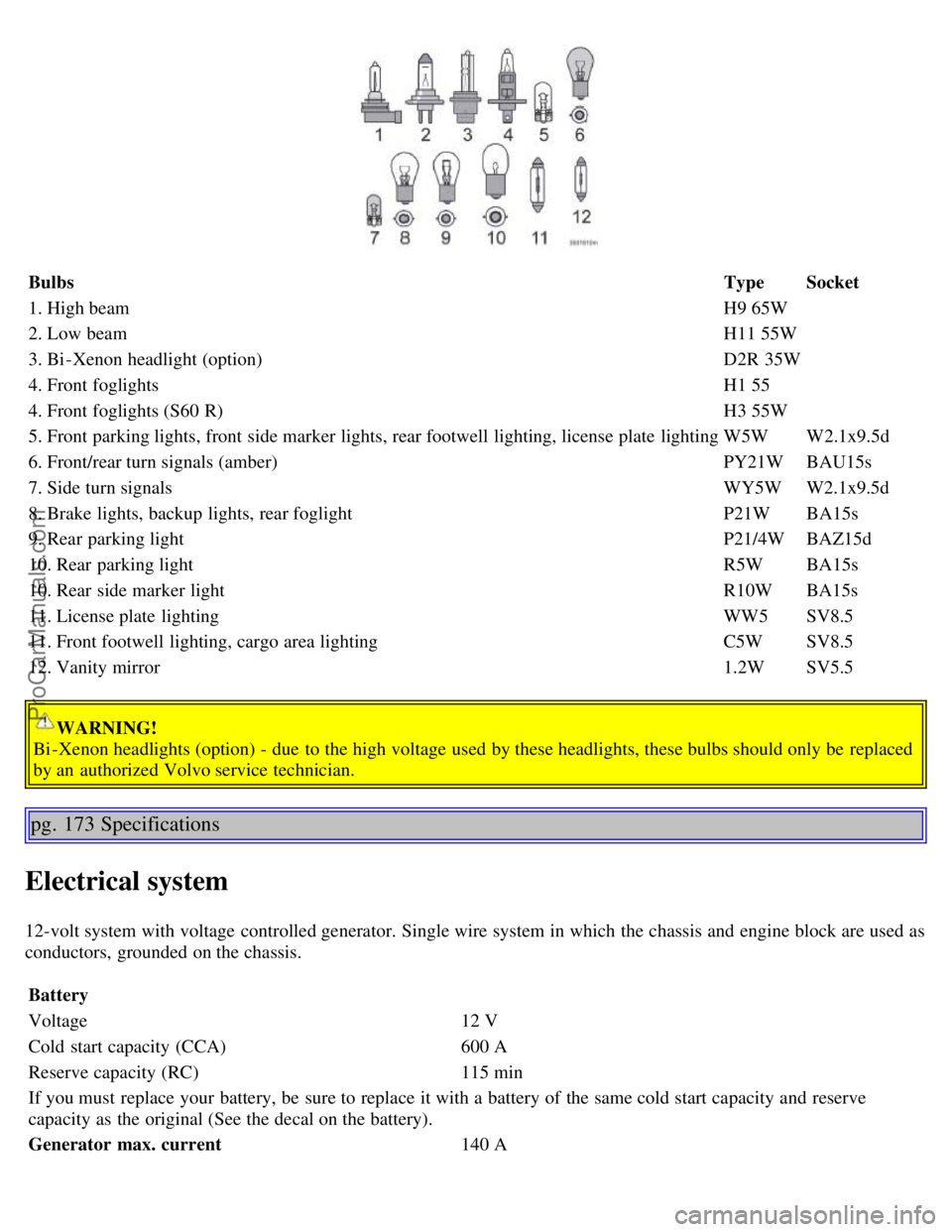
BulbsTypeSocket
1. High beam H9 65W
2. Low beam H11 55W
3. Bi -Xenon headlight (option) D2R 35W
4. Front foglights H1 55
4. Front foglights (S60 R) H3 55W
5. Front parking lights, front side marker lights, rear footwell lighting, license plate lighting W5WW2.1x9.5d
6. Front/rear turn signals (amber) PY21WBAU15s
7. Side turn signals WY5WW2.1x9.5d
8. Brake lights, backup lights, rear foglight P21WBA15s
9. Rear parking light P21/4WBAZ15d
10. Rear parking light R5WBA15s
10. Rear side marker light R10WBA15s
11. License plate lighting WW5SV8.5
11. Front footwell lighting, cargo area lighting C5WSV8.5
12. Vanity mirror 1.2WSV5.5
WARNING!
Bi -Xenon headlights (option) - due to the high voltage used by these headlights, these bulbs should only be replaced
by an authorized Volvo service technician.
pg. 173 Specifications
Electrical system
12-volt system with voltage controlled generator. Single wire system in which the chassis and engine block are used as
conductors, grounded on the chassis.
Battery
Voltage 12 V
Cold start capacity (CCA) 600 A
Reserve capacity (RC) 115 min
If you must replace your battery, be sure to replace it with a battery of the same cold start capacity and reserve
capacity as the original (See the decal on the battery).
Generator max. current 140 A
ProCarManuals.com
Page 123 of 132
C
Capacities167
Capacity weight121
Carbon Monoxide - Important Warning83
Catalytic converter170
Ceiling lighting156
Central locking system - remote control73
Changing coolant140
Changing wheels125
Check Engine warning light27
Child restraint anchorages21
Child safety locks77
Child seat anchors20
Cigarette lighter41
Climate control systems -general information50
Clock24
Coat hanger67
Cold weather precautions107
Coolant144
Coolant - changing140, 144
Coolant - checking level of140
Cooling system169
Courtesy light62
Cruise control39
Curb weight121
Current fuel consumption38
D
Defroster53
Detachable trailer hitch105
Door mirror defroster37
Door mirrors30
Driving economically87
DSTC29
E
ECC52
Economical driving87
Electric socket30 , 41
Electrical system173
Electrically operated moonroof46
Electrically operated windows42
Emission inspection138
Engine - starting85
Engine compartment141
Engine oil142
ProCarManuals.com
Page 126 of 132
Moonroof46
Multifilter with air quality sensor55
O
Occupant safety2
Occupant Weight Sensor8
Octane rating82
Odometer24
Oil pressure27
Oil quality142
Opening the trunk from the inside76
Opening/locking the trunk75
Owner maintenance137
P
P Park90
, 92
Paint - color code133
Park assist109
Parking brake27 , 41
Parking light bulb, changing152
Periodic owner-performed maintenance137
Permissible axle weight121
Polishing131
Power moonroof46
Power seat60
Power steering fluid145
Power steering, speed sensitive88
Power sunroof46
PremAiriii
PROPOSITION 65 WARNING102
R
Radiator141
Radio181
Rain sensor - windshield wipers35
Reading lights62
Rear park assist109
Rear seat, folding backrests68
Rear suspension171
Rear window defroster37
Rearview mirror/door mirrors44
Recirculation54 , 58
REDUCE SPEED28
Refrigerant (A/C system)50
Refueling81, 84
Remote control - central locking system73
Replacing the battery147
ProCarManuals.com
Page 128 of 132
Temperature control53
Temperature gauge24
Text window - messages28
TIME FOR REGULAR SERVICE28
Tire designations119
Tires economy - improving113
Tires inflation114
Tire inflation pressure tables116
Tire inflation pressure, checking115
Tire pressure monitoring system27
Tire Pressure Monitoring System (TPMS)117
Tire terminology, glossary of120
Tires - tread wear indicators125
Towing - cars with All Wheel Drive101
Towing a trailer103
Towing the car100
Trailer hitch - detachable105
Trailer indicator lamp27
Trailer towing103
Transmission - automatic90
Transmission - Geartronic92
Transmission - manual89
Tread wear indicator112
Trip computer38
Trip odometer24
Trunk68
Trunk - opening from the inside76
Trunk - unlocking75
Turn signals, rear154
Turn signals34
Type designations164
U
Uniform Tire Quality Grading122
, 126
Unlocking the car75
Unlocking the trunk75
Use of Additives83
V
Valet key72
Valet locking30
Vanity mirror63
Vanity mirror bulb, changing156
Vehicle Event Data136
Vehicle Identification Number (VIN)164
Vehicle loading121
ProCarManuals.com