engine oil VOLVO S60 2006 Owner's Manual
[x] Cancel search | Manufacturer: VOLVO, Model Year: 2006, Model line: S60, Model: VOLVO S60 2006Pages: 132, PDF Size: 2.33 MB
Page 112 of 132
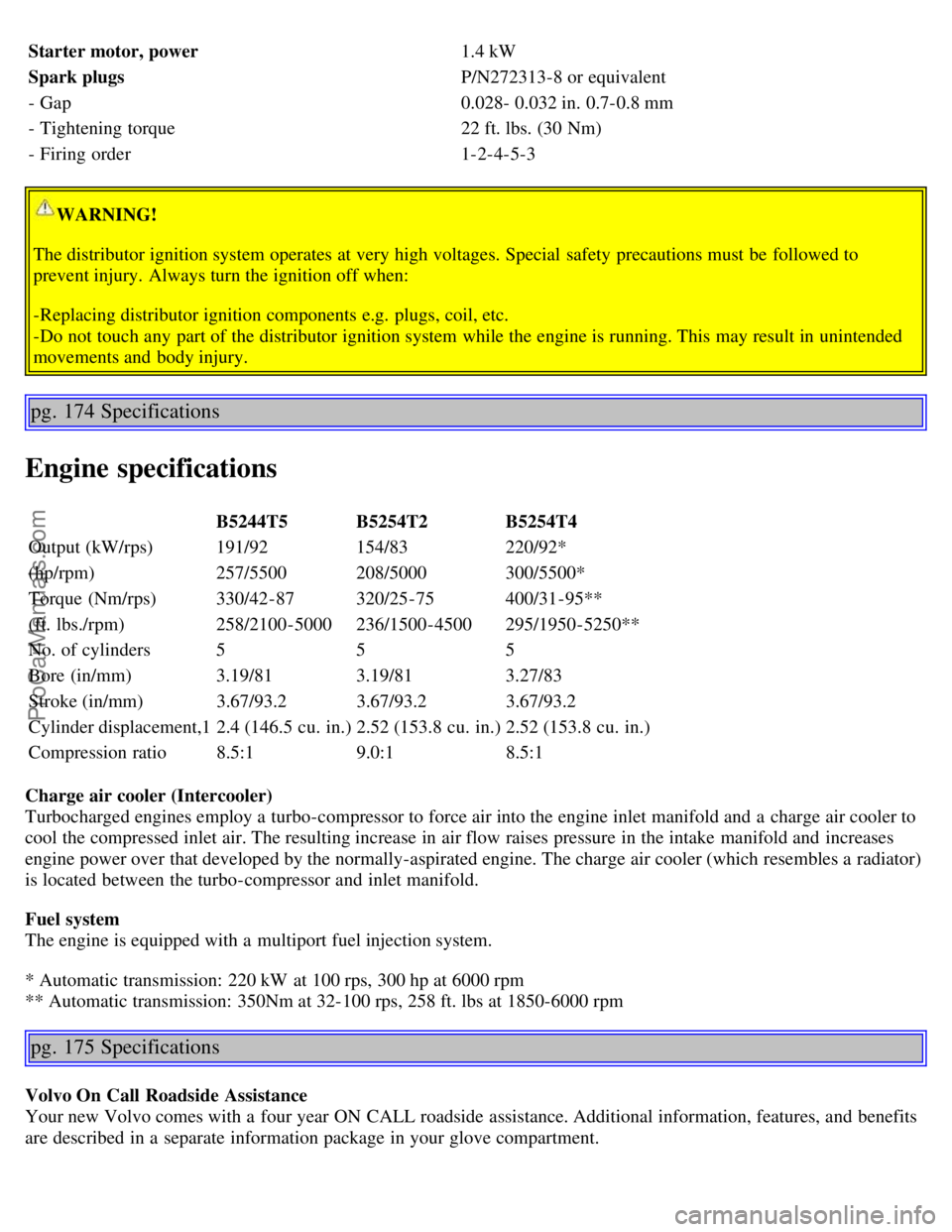
Starter motor, power1.4 kW
Spark plugsP/N272313-8 or equivalent
- Gap 0.028- 0.032 in. 0.7-0.8 mm
- Tightening torque 22 ft. lbs. (30 Nm)
- Firing order 1-2-4-5-3
WARNING!
The distributor ignition system operates at very high voltages. Special safety precautions must be followed to
prevent injury. Always turn the ignition off when:
-Replacing distributor ignition components e.g. plugs, coil, etc.
-Do not touch any part of the distributor ignition system while the engine is running. This may result in unintended
movements and body injury.
pg. 174 Specifications
Engine specifications
B5244T5 B5254T2 B5254T4
Output (kW/rps) 191/92154/83 220/92*
(hp/rpm) 257/5500208/5000 300/5500*
Torque (Nm/rps) 330/42-87320/25-75 400/31-95**
(ft. lbs./rpm) 258/2100-5000236/1500-4500 295/1950-5250**
No. of cylinders 55 5
Bore (in/mm) 3.19/813.19/81 3.27/83
Stroke (in/mm) 3.67/93.23.67/93.2 3.67/93.2
Cylinder displacement,1 2.4 (146.5 cu. in.)2.52 (153.8 cu. in.) 2.52 (153.8 cu. in.)
Compression ratio 8.5:19.0:1 8.5:1
Charge air cooler (Intercooler)
Turbocharged engines employ a turbo-compressor to force air into the engine inlet manifold and a charge air cooler to
cool the compressed inlet air. The resulting increase in air flow raises pressure in the intake manifold and increases
engine power over that developed by the normally-aspirated engine. The charge air cooler (which resembles a radiator)
is located between the turbo-compressor and inlet manifold.
Fuel system
The engine is equipped with a multiport fuel injection system.
* Automatic transmission: 220 kW at 100 rps, 300 hp at 6000 rpm
** Automatic transmission: 350Nm at 32-100 rps, 258 ft. lbs at 1850-6000 rpm
pg. 175 Specifications
Volvo On Call Roadside Assistance
Your new Volvo comes with a four year ON CALL roadside assistance. Additional information, features, and benefits
are described in a separate information package in your glove compartment.
ProCarManuals.com
Page 123 of 132
C
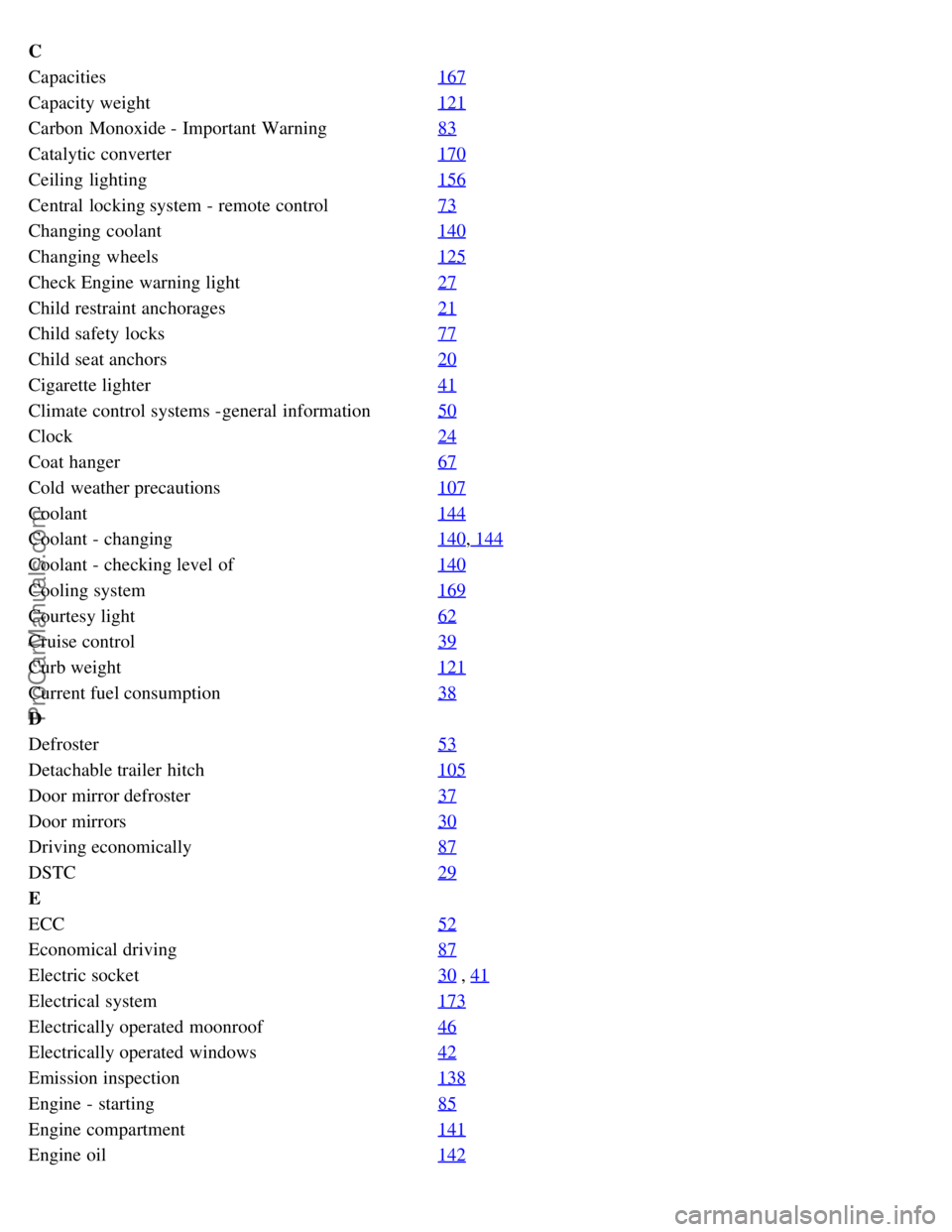
Capacities167
Capacity weight121
Carbon Monoxide - Important Warning83
Catalytic converter170
Ceiling lighting156
Central locking system - remote control73
Changing coolant140
Changing wheels125
Check Engine warning light27
Child restraint anchorages21
Child safety locks77
Child seat anchors20
Cigarette lighter41
Climate control systems -general information50
Clock24
Coat hanger67
Cold weather precautions107
Coolant144
Coolant - changing140, 144
Coolant - checking level of140
Cooling system169
Courtesy light62
Cruise control39
Curb weight121
Current fuel consumption38
D
Defroster53
Detachable trailer hitch105
Door mirror defroster37
Door mirrors30
Driving economically87
DSTC29
E
ECC52
Economical driving87
Electric socket30 , 41
Electrical system173
Electrically operated moonroof46
Electrically operated windows42
Emission inspection138
Engine - starting85
Engine compartment141
Engine oil142
ProCarManuals.com
Page 131 of 132
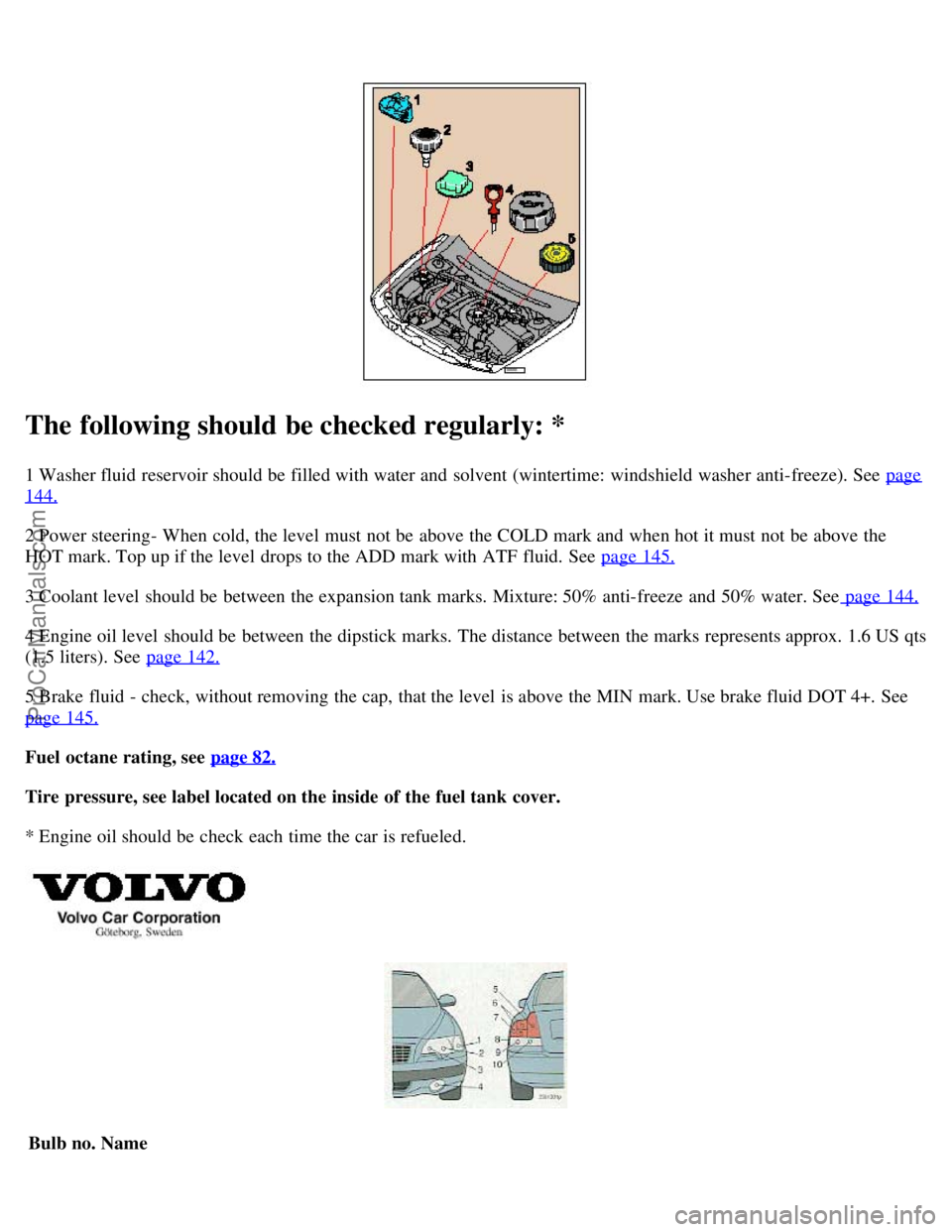
The following should be checked regularly: *
1 Washer fluid reservoir should be filled with water and solvent (wintertime: windshield washer anti-freeze). See page
144.
2 Power steering- When cold, the level must not be above the COLD mark and when hot it must not be above the
HOT mark. Top up if the level drops to the ADD mark with ATF fluid. See page 145.
3 Coolant level should be between the expansion tank marks. Mixture: 50% anti-freeze and 50% water. See page 144.
4 Engine oil level should be between the dipstick marks. The distance between the marks represents approx. 1.6 US qts
(1.5 liters). See page 142.
5 Brake fluid - check, without removing the cap, that the level is above the MIN mark. Use brake fluid DOT 4+. See
page 145.
Fuel octane rating, see page 82.
Tire pressure, see label located on the inside of the fuel tank cover.
* Engine oil should be check each time the car is refueled.
Bulb no.Name
ProCarManuals.com