height VOLVO S60 2006 Owners Manual
[x] Cancel search | Manufacturer: VOLVO, Model Year: 2006, Model line: S60, Model: VOLVO S60 2006Pages: 132, PDF Size: 2.33 MB
Page 8 of 132
Keep your windshield and headlights clean.
Replace wiper blades when they start to leave streaks.
Take into account the traffic, road, and weather conditions, particularly with regard to stopping distance.
Reporting Safety Defects in the U.S.
If you believe that your vehicle has a defect which could cause a crash or could cause injury or death, you should
immediately inform the National Highway Traffic Safety Administration (NHTSA) in addition to notifying Volvo Cars
of North America. If NHTSA receives similar complaints, it may open an investigation, and if it finds that a safety
defect exists in a group of vehicles, it may order a recall and remedy campaign. However, NHTSA cannot become
involved in individual problems between you, your retailer, or Volvo Cars of North America. To contact NHTSA, you
may either call the Auto Safety Hotline toll-free at 1-800-424-9393 (or 202-366-0123 in Washington, D.C. area) or
write to: NHTSA, U.S. Department of Transportation, Washington D. C. 20590. You can also obtain other information
about motor vehicle safety from the Hotline.
Volvo strongly recommends that if your vehicle is covered under a service campaign, safety or emission recall or
similar action, it should be completed as soon as possible. Please check with your local retailer or Volvo Cars of North
America, LLC if your vehicle is covered under these conditions.
NHTSA can be reached at:
Internet : http://www.nhtsa.dot.gov
Telephone:
1-888-DASH-2-DOT (1-888-327-4236) (toll free)
1-800-424-9393 (toll free)
1-202-366-0123 (in Washington DC area)
pg. 3 Safety
Using seat belts
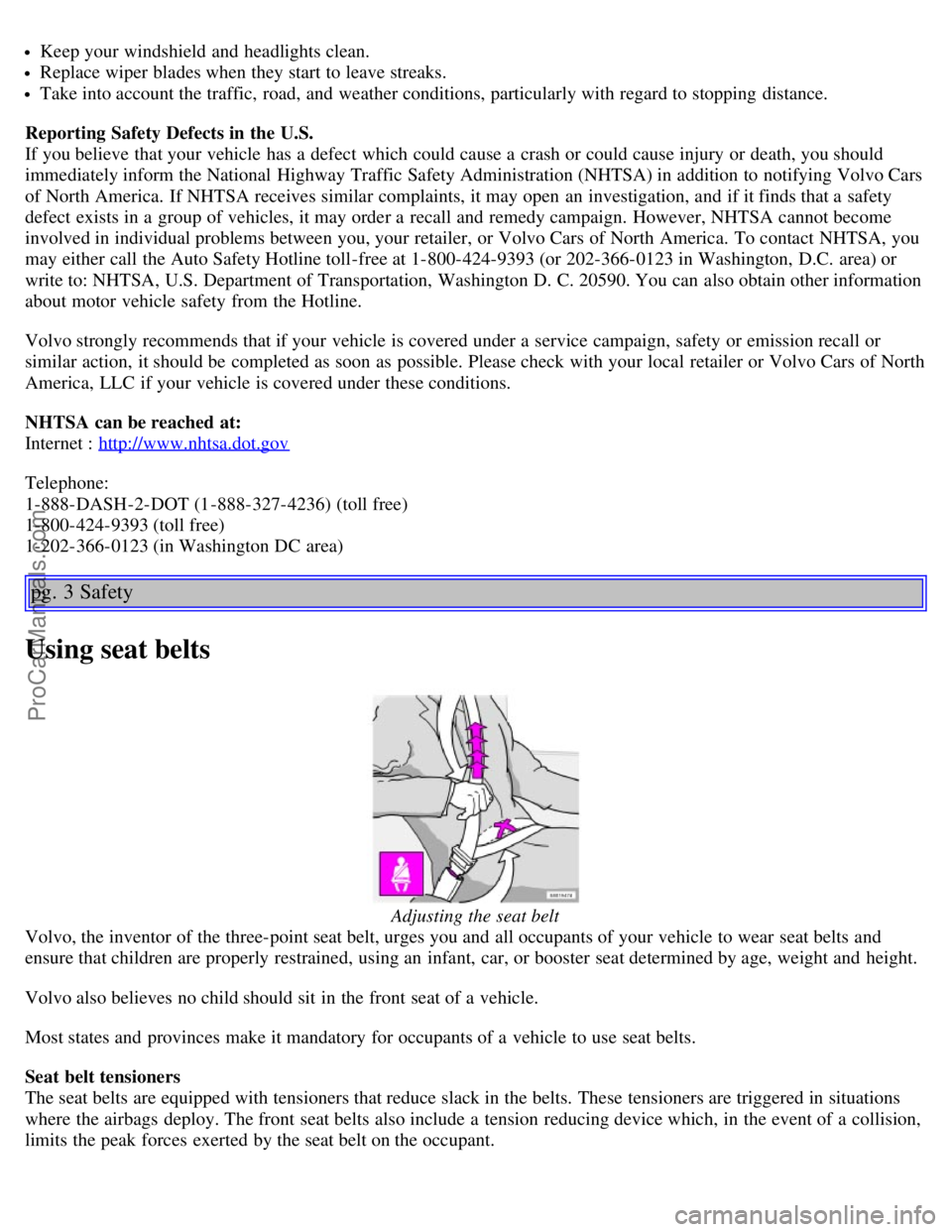
Adjusting the seat belt
Volvo, the inventor of the three-point seat belt, urges you and all occupants of your vehicle to wear seat belts and
ensure that children are properly restrained, using an infant, car, or booster seat determined by age, weight and height.
Volvo also believes no child should sit in the front seat of a vehicle.
Most states and provinces make it mandatory for occupants of a vehicle to use seat belts.
Seat belt tensioners
The seat belts are equipped with tensioners that reduce slack in the belts. These tensioners are triggered in situations
where the airbags deploy. The front seat belts also include a tension reducing device which, in the event of a collision,
limits the peak forces exerted by the seat belt on the occupant.
ProCarManuals.com
Page 13 of 132
service technician or Volvo Customer Support:
In the USA:
Volvo Cars of North America
Customer Care Center
P.O. Box 914
Rockleigh, New Jersey 07647-0914
800-458-1552
http://www.volvocars.us
In Canada:
Volvo Cars of Canada Ltd.
National Customer Service
175 Gordon Baker Road
North York, Ontario M2H 2N7
800-663-8255
http://www.volvocanada.com
WARNING!
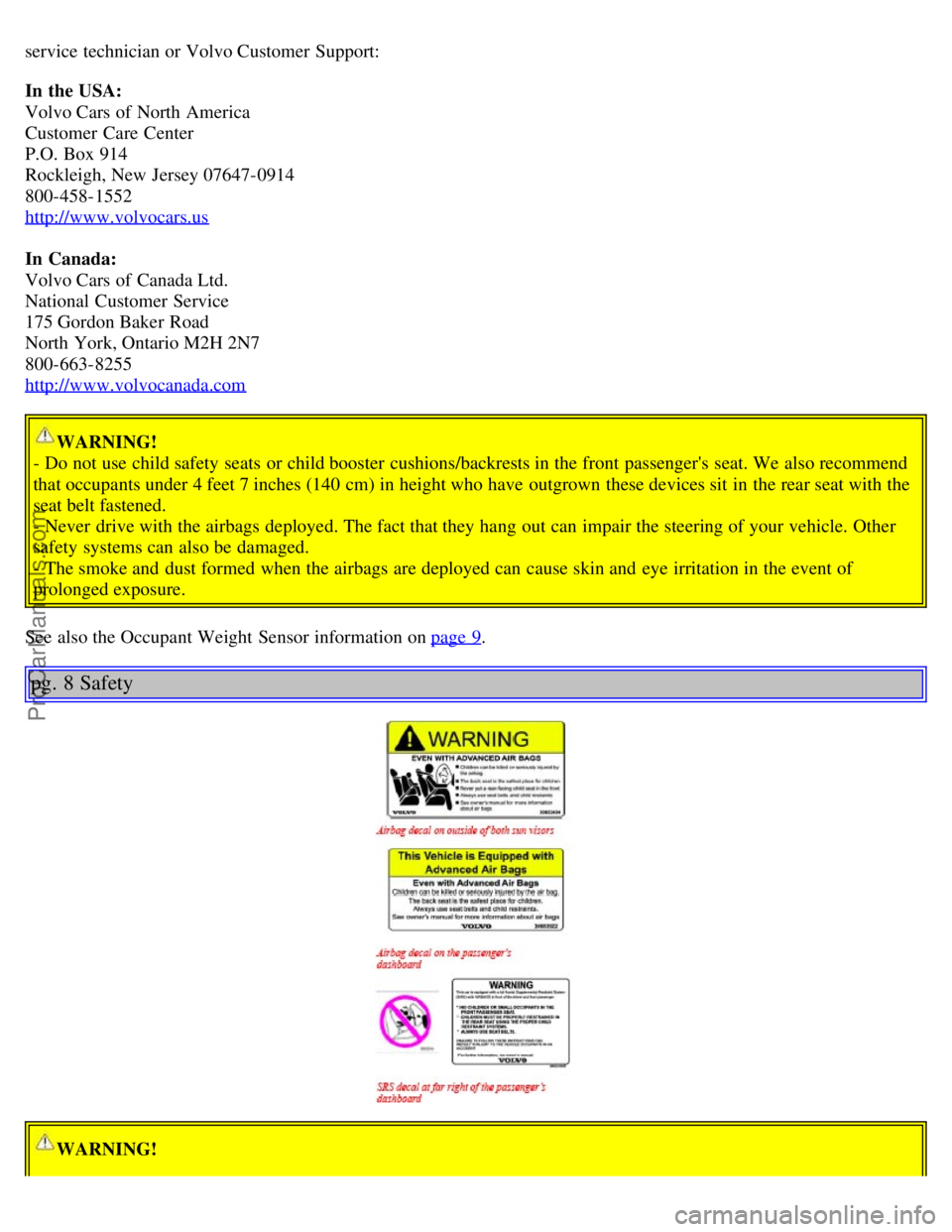
- Do not use child safety seats or child booster cushions/backrests in the front passenger's seat. We also recommend
that occupants under 4 feet 7 inches (140 cm) in height who have outgrown these devices sit in the rear seat with the
seat belt fastened.
- Never drive with the airbags deployed. The fact that they hang out can impair the steering of your vehicle. Other
safety systems can also be damaged.
- The smoke and dust formed when the airbags are deployed can cause skin and eye irritation in the event of
prolonged exposure.
See also the Occupant Weight Sensor information on page 9
.
pg. 8 Safety
WARNING!
ProCarManuals.com
Page 24 of 132
Temporarily disconnecting the alarm sensors (option)
See page 79
for more details.
12 volt socket
This 12 volt socket can be used to plug in certain accessories such as cellular telephones, etc. The ignition key must be
in position 1 (or higher) for the auxiliary socket to function.
NOTE: The auxiliary sockets can also be used for cigarette lighters, which are available at your Volvo retailer.
Front/rear park assist (option/accessory)
See page 109
for more information on this function.
pg. 31 Instruments and controls
Steering wheel adjustment
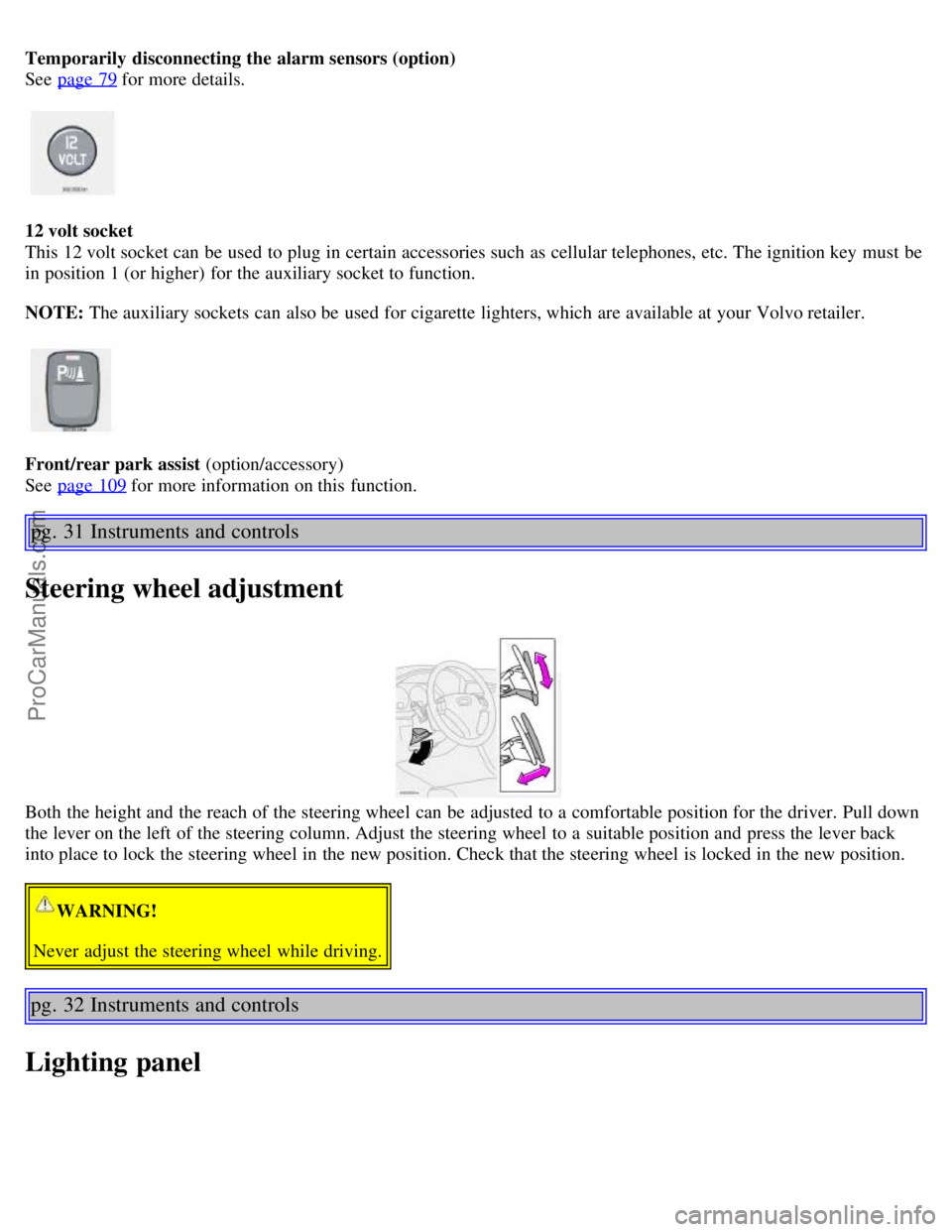
Both the height and the reach of the steering wheel can be adjusted to a comfortable position for the driver. Pull down
the lever on the left of the steering column. Adjust the steering wheel to a suitable position and press the lever back
into place to lock the steering wheel in the new position. Check that the steering wheel is locked in the new position.
WARNING!
Never adjust the steering wheel while driving.
pg. 32 Instruments and controls
Lighting panel
ProCarManuals.com
Page 45 of 132
2 0 0 6
VOLVO S60
Interior
pg. 57 Interior
Front seats 58
Interior lighting62
Floor mats63
Storage compartments64
Rear seat and trunk68
Spare wheel, tools and jack70
pg. 58 Interior
Front seats
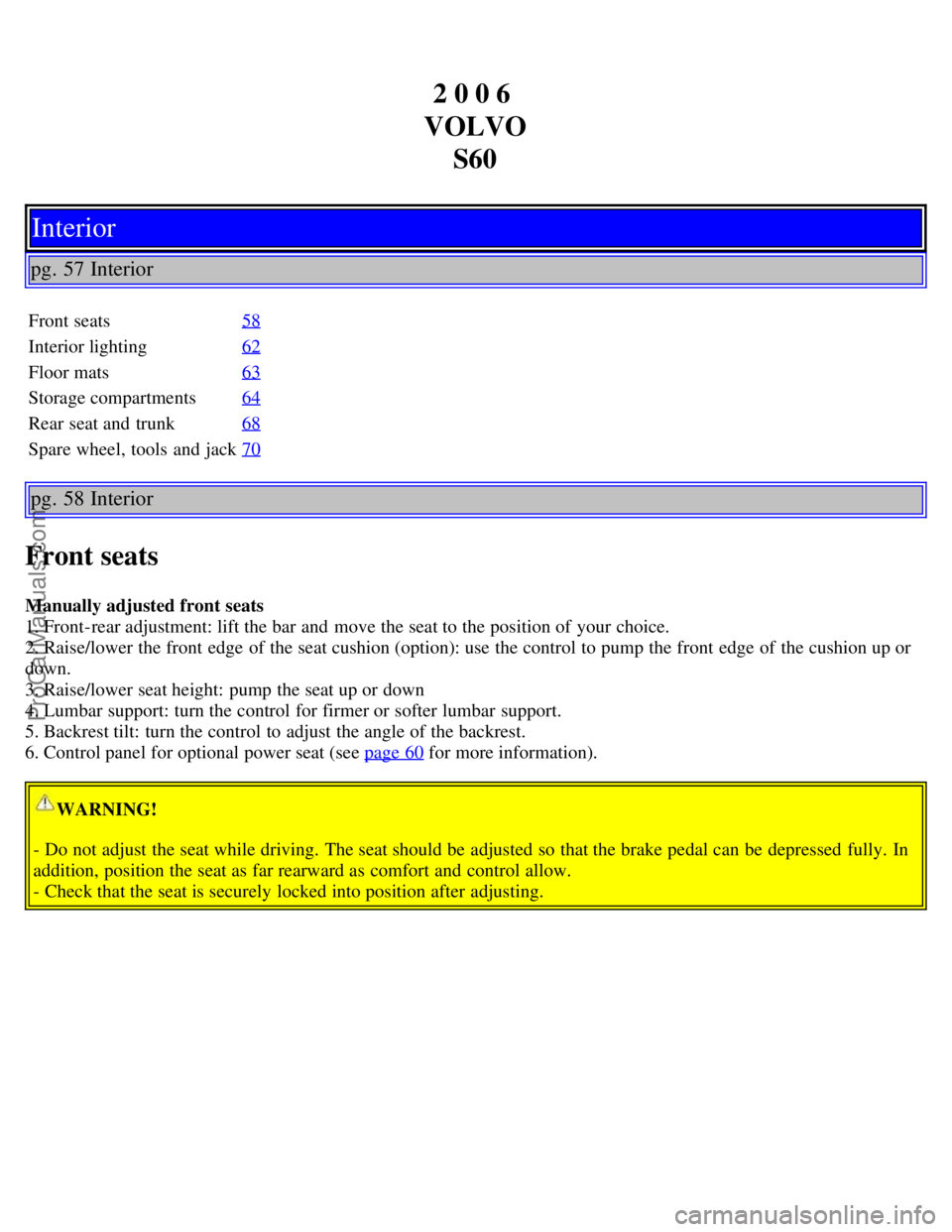
Manually adjusted front seats
1. Front-rear adjustment: lift the bar and move the seat to the position of your choice.
2. Raise/lower the front edge of the seat cushion (option): use the control to pump the front edge of the cushion up or
down.
3. Raise/lower seat height: pump the seat up or down
4. Lumbar support: turn the control for firmer or softer lumbar support.
5. Backrest tilt: turn the control to adjust the angle of the backrest.
6. Control panel for optional power seat (see page 60
for more information).
WARNING!
- Do not adjust the seat while driving. The seat should be adjusted so that the brake pedal can be depressed fully. In
addition, position the seat as far rearward as comfort and control allow.
- Check that the seat is securely locked into position after adjusting.
ProCarManuals.com
Page 83 of 132
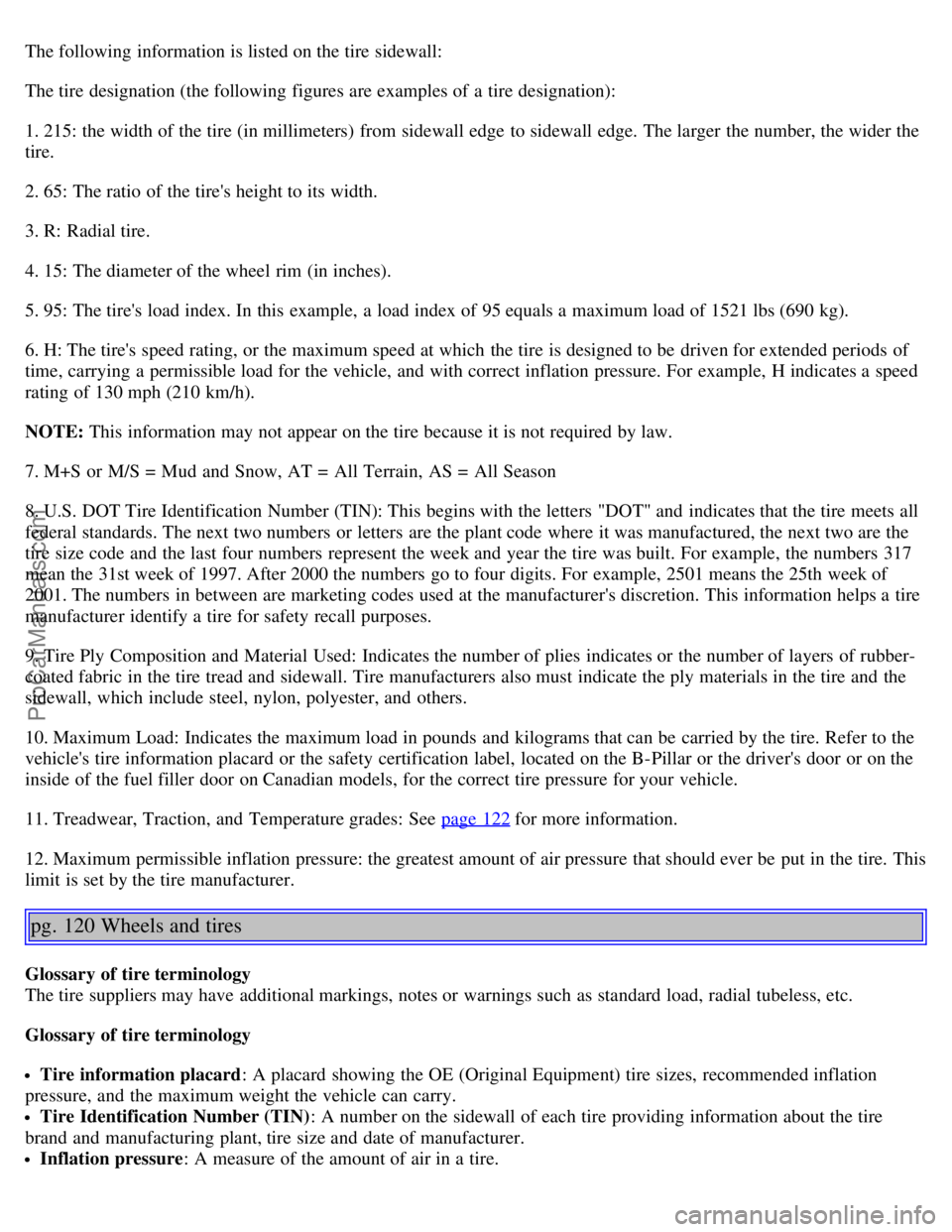
The following information is listed on the tire sidewall:
The tire designation (the following figures are examples of a tire designation):
1. 215: the width of the tire (in millimeters) from sidewall edge to sidewall edge. The larger the number, the wider the
tire.
2. 65: The ratio of the tire's height to its width.
3. R: Radial tire.
4. 15: The diameter of the wheel rim (in inches).
5. 95: The tire's load index. In this example, a load index of 95 equals a maximum load of 1521 lbs (690 kg).
6. H: The tire's speed rating, or the maximum speed at which the tire is designed to be driven for extended periods of
time, carrying a permissible load for the vehicle, and with correct inflation pressure. For example, H indicates a speed
rating of 130 mph (210 km/h).
NOTE: This information may not appear on the tire because it is not required by law.
7. M+S or M/S = Mud and Snow, AT = All Terrain, AS = All Season
8. U.S. DOT Tire Identification Number (TIN): This begins with the letters "DOT" and indicates that the tire meets all
federal standards. The next two numbers or letters are the plant code where it was manufactured, the next two are the
tire size code and the last four numbers represent the week and year the tire was built. For example, the numbers 317
mean the 31st week of 1997. After 2000 the numbers go to four digits. For example, 2501 means the 25th week of
2001. The numbers in between are marketing codes used at the manufacturer's discretion. This information helps a tire
manufacturer identify a tire for safety recall purposes.
9. Tire Ply Composition and Material Used: Indicates the number of plies indicates or the number of layers of rubber-
coated fabric in the tire tread and sidewall. Tire manufacturers also must indicate the ply materials in the tire and the
sidewall, which include steel, nylon, polyester, and others.
10. Maximum Load: Indicates the maximum load in pounds and kilograms that can be carried by the tire. Refer to the
vehicle's tire information placard or the safety certification label, located on the B-Pillar or the driver's door or on the
inside of the fuel filler door on Canadian models, for the correct tire pressure for your vehicle.
11. Treadwear, Traction, and Temperature grades: See page 122
for more information.
12. Maximum permissible inflation pressure: the greatest amount of air pressure that should ever be put in the tire. This
limit is set by the tire manufacturer.
pg. 120 Wheels and tires
Glossary of tire terminology
The tire suppliers may have additional markings, notes or warnings such as standard load, radial tubeless, etc.
Glossary of tire terminology
Tire information placard : A placard showing the OE (Original Equipment) tire sizes, recommended inflation
pressure, and the maximum weight the vehicle can carry.
Tire Identification Number (TIN) : A number on the sidewall of each tire providing information about the tire
brand and manufacturing plant, tire size and date of manufacturer.
Inflation pressure : A measure of the amount of air in a tire.
ProCarManuals.com
Page 107 of 132
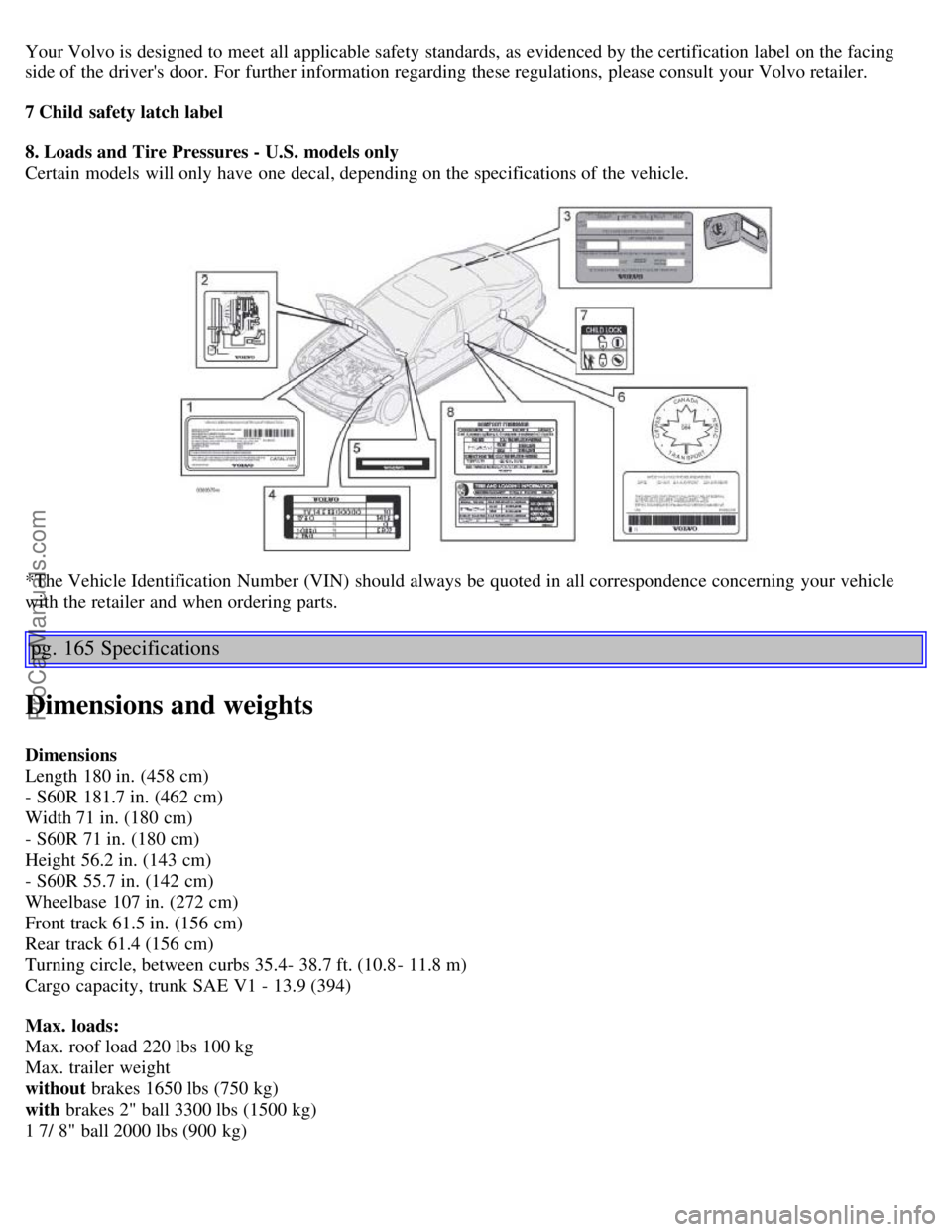
Your Volvo is designed to meet all applicable safety standards, as evidenced by the certification label on the facing
side of the driver's door. For further information regarding these regulations, please consult your Volvo retailer.
7 Child safety latch label
8. Loads and Tire Pressures - U.S. models only
Certain models will only have one decal, depending on the specifications of the vehicle.
*The Vehicle Identification Number (VIN) should always be quoted in all correspondence concerning your vehicle
with the retailer and when ordering parts.
pg. 165 Specifications
Dimensions and weights
Dimensions
Length 180 in. (458 cm)
- S60R 181.7 in. (462 cm)
Width 71 in. (180 cm)
- S60R 71 in. (180 cm)
Height 56.2 in. (143 cm)
- S60R 55.7 in. (142 cm)
Wheelbase 107 in. (272 cm)
Front track 61.5 in. (156 cm)
Rear track 61.4 (156 cm)
Turning circle, between curbs 35.4- 38.7 ft. (10.8- 11.8 m)
Cargo capacity, trunk SAE V1 - 13.9 (394)
Max. loads:
Max. roof load 220 lbs 100 kg
Max. trailer weight
without brakes 1650 lbs (750 kg)
with brakes 2" ball 3300 lbs (1500 kg)
1 7/ 8" ball 2000 lbs (900 kg)
ProCarManuals.com