rims VOLVO S60 2006 Owners Manual
[x] Cancel search | Manufacturer: VOLVO, Model Year: 2006, Model line: S60, Model: VOLVO S60 2006Pages: 132, PDF Size: 2.33 MB
Page 76 of 132
2 0 0 6
VOLVO S60
Wheels and tires
pg. 111 Wheels and tires
General information 112
Tire inflation pressure tables116
Tire Pressure Monitoring System (TPMS) - option on certain U.S. models only117
Changing tires118
Tire designations119
Glossary of tire terminology120
Vehicle loading121
Uniform Tire Quality Grading122
Snow chains, snow tires, studded tires123
Temporary Spare124
Changing wheels125
pg. 112 Wheels and tires
General information
Your vehicle is equipped with tires according to the vehicle's tire information placard on the B-pillar (the structural
member at the side of the vehicle, at the rear of the driver's door opening), or on the inside of the fuel filler door on
Canadian models.
The tires have good road holding characteristics and offer good handling on dry and wet surfaces. It should be noted
however that the tires have been developed to give these features on snow/ice-free surfaces.
Certain models are equipped with "all-season" tires, which provide a somewhat higher degree of road holding on
slippery surfaces than tires without the "all-season" rating. However, for optimum road holding on icy or snow-
covered roads, we recommend suitable winter tires on all four wheels.
When replacing tires, be sure that the new tires are the same size designation, type (radial) and preferably from the
same manufacturer, on all four wheels. Otherwise there is a risk of altering the car's roadholding and handling
characteristics.
Storing wheels and tires
When storing complete wheels (tires mounted on rims), they should be suspended off the floor or placed on their sides
on the floor. Tires not mounted on rims should be stored on their sides or standing upright, but should not be
suspended.
CAUTION:
Tires should preferably be stored in a cool, dry, dark place, and should never be stored in close proximity to solvents,
gasoline, oils, etc.
ProCarManuals.com
Page 82 of 132
moving sensors back and forth between sets of wheels.
CAUTION:
When inflating tires with TPMS valves, press the pump's mouthpiece straight onto the valve to help avoid bending or
otherwise damaging the valve.
Self supporting run flat tires (option)
Certain models equipped with the Tire Pressure Monitoring System (TPMS) can also be equipped with self supporting
run flat tires. Tires of this type have specially reinforced sidewalls that make it possible to continue driving in the
event of a drop in inflation pressure. Tires of this type are mounted on special rims.
NOTE: Self supporting run flat tires are only available in conjunction with TPMS. If a self supporting run flat tire
should lose inflation pressure, the yellow TPMS warning symbol (
) in the instrument panel lights up to alert the
driver, and a message will be shown in the text window in the instrument panel.
If this occurs, reduce vehicle speed to a maximum of 50 mph (80 km/h). The vehicle can be driven approximately 50
miles (80 km), or somewhat farther if the vehicle is not heavily loaded. The tire should be replaced as soon as
possible.
Hard braking and sudden steering maneuvers should be avoided.
In certain cases, it may be difficult to see which self supporting run flat tire is defective. To determine which tire is
damaged, check the inflation pressure of all four tires.
WARNING!
Only specially trained persons should mount self supporting run flat tires.
If self supporting run flat tires are mounted, the vehicle must be equipped with a Tire Pressure Monitoring
System.
After a low pressure warning has been displayed, do not exceed 50 mph (80 km/h).
Avoid severe cornering and hard braking, and minimize the distance traveled before replacing the self supporting
run flat tire.
Self supporting run flat tires cannot be repaired. They must be replaced if damaged or punctured.
pg. 119 Wheels and tires
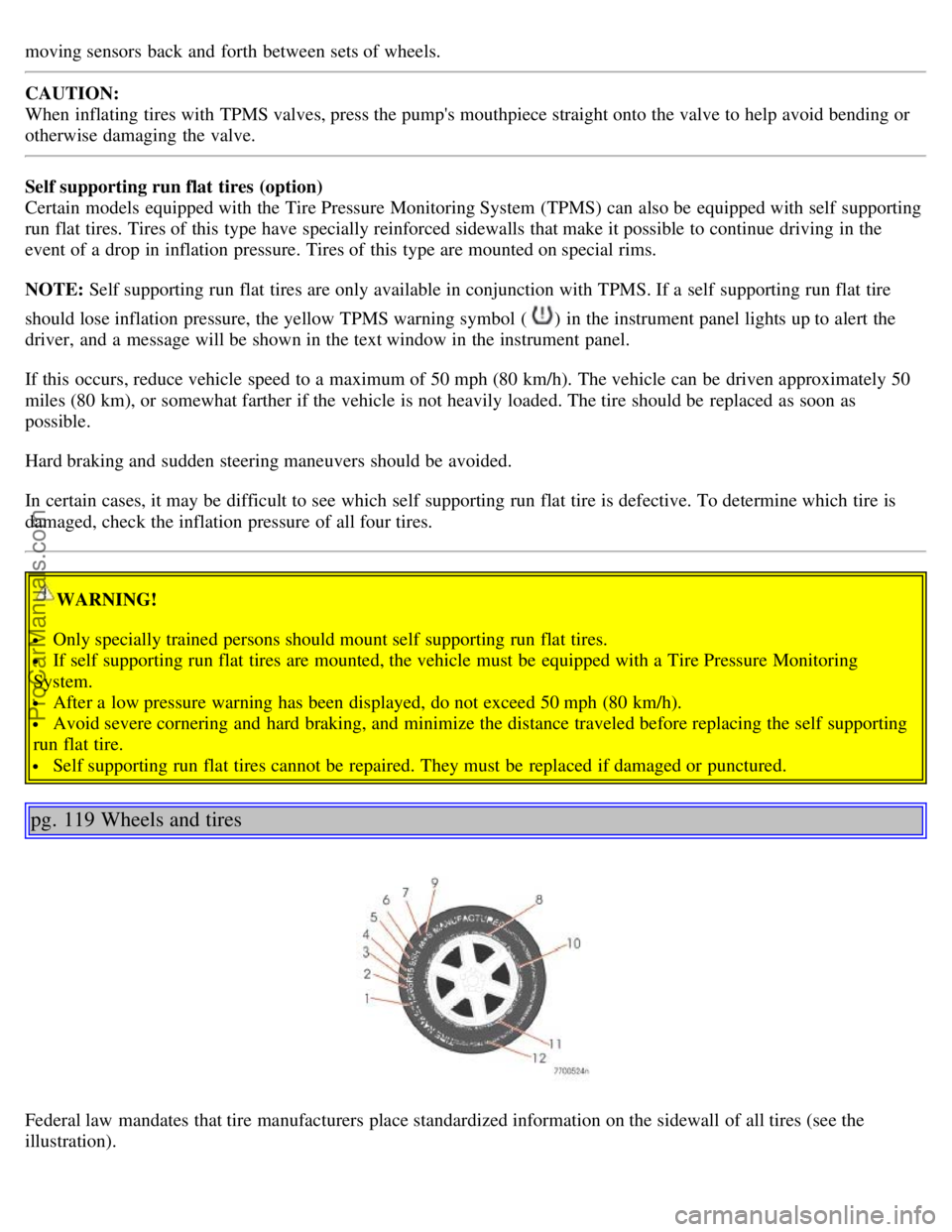
Federal law mandates that tire manufacturers place standardized information on the sidewall of all tires (see the
illustration).
ProCarManuals.com
Page 88 of 132
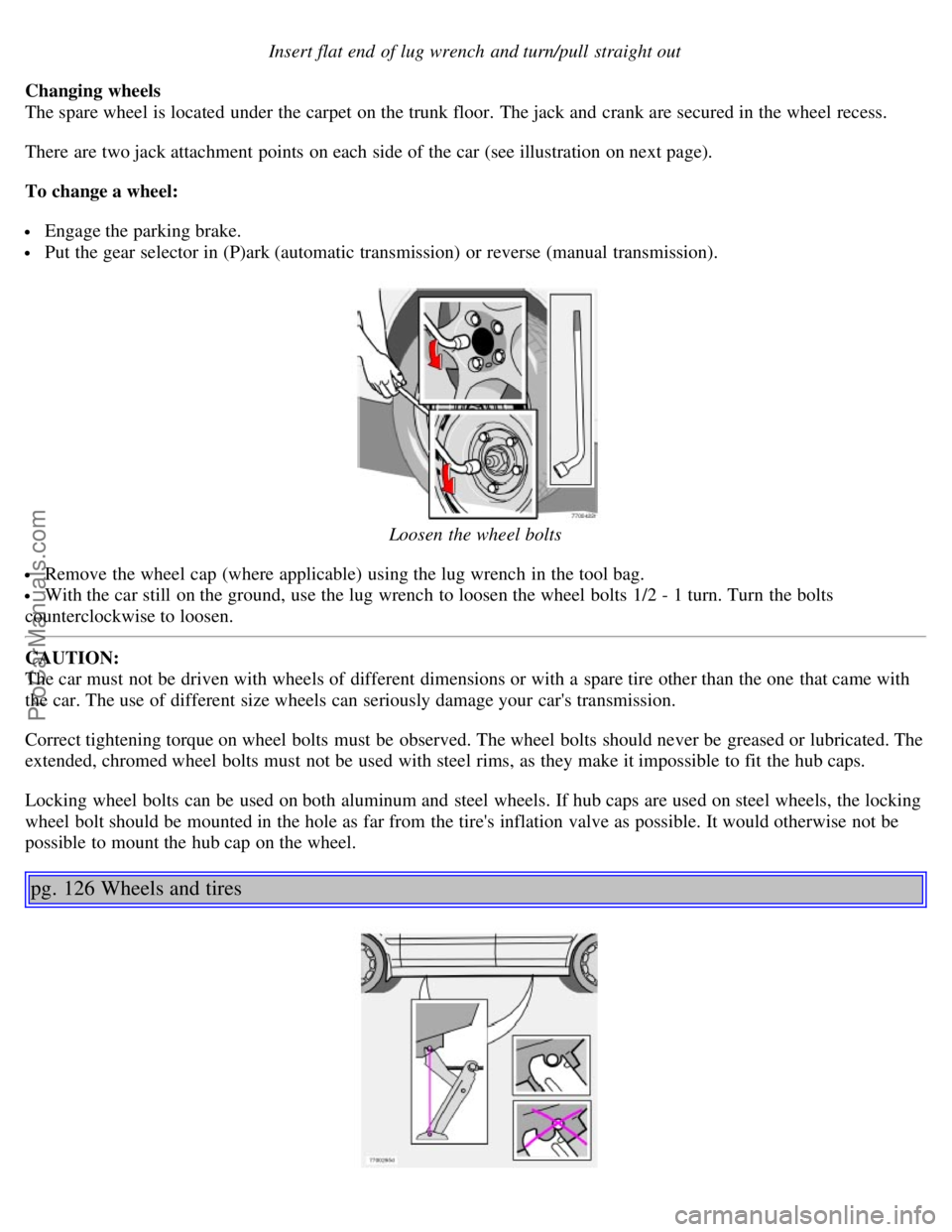
Insert flat end of lug wrench and turn/pull straight out
Changing wheels
The spare wheel is located under the carpet on the trunk floor. The jack and crank are secured in the wheel recess.
There are two jack attachment points on each side of the car (see illustration on next page).
To change a wheel:
Engage the parking brake.
Put the gear selector in (P)ark (automatic transmission) or reverse (manual transmission).
Loosen the wheel bolts
Remove the wheel cap (where applicable) using the lug wrench in the tool bag.
With the car still on the ground, use the lug wrench to loosen the wheel bolts 1/2 - 1 turn. Turn the bolts
counterclockwise to loosen.
CAUTION:
The car must not be driven with wheels of different dimensions or with a spare tire other than the one that came with
the car. The use of different size wheels can seriously damage your car's transmission.
Correct tightening torque on wheel bolts must be observed. The wheel bolts should never be greased or lubricated. The
extended, chromed wheel bolts must not be used with steel rims, as they make it impossible to fit the hub caps.
Locking wheel bolts can be used on both aluminum and steel wheels. If hub caps are used on steel wheels, the locking
wheel bolt should be mounted in the hole as far from the tire's inflation valve as possible. It would otherwise not be
possible to mount the hub cap on the wheel.
pg. 126 Wheels and tires
ProCarManuals.com