parking brake VOLVO S60 2007 User Guide
[x] Cancel search | Manufacturer: VOLVO, Model Year: 2007, Model line: S60, Model: VOLVO S60 2007Pages: 200, PDF Size: 4.03 MB
Page 102 of 200
higher engine speeds to heat the three-way catalytic converter as quickly as possible.
Automatic transmission - adaptive system
The automatic transmission is controlled by an adaptive control system that constantly monitors the way in which the
transmission functions. It senses and adapts each gear shift for optimal performance.
pg. 118 Starting and driving
Geartronic (option)
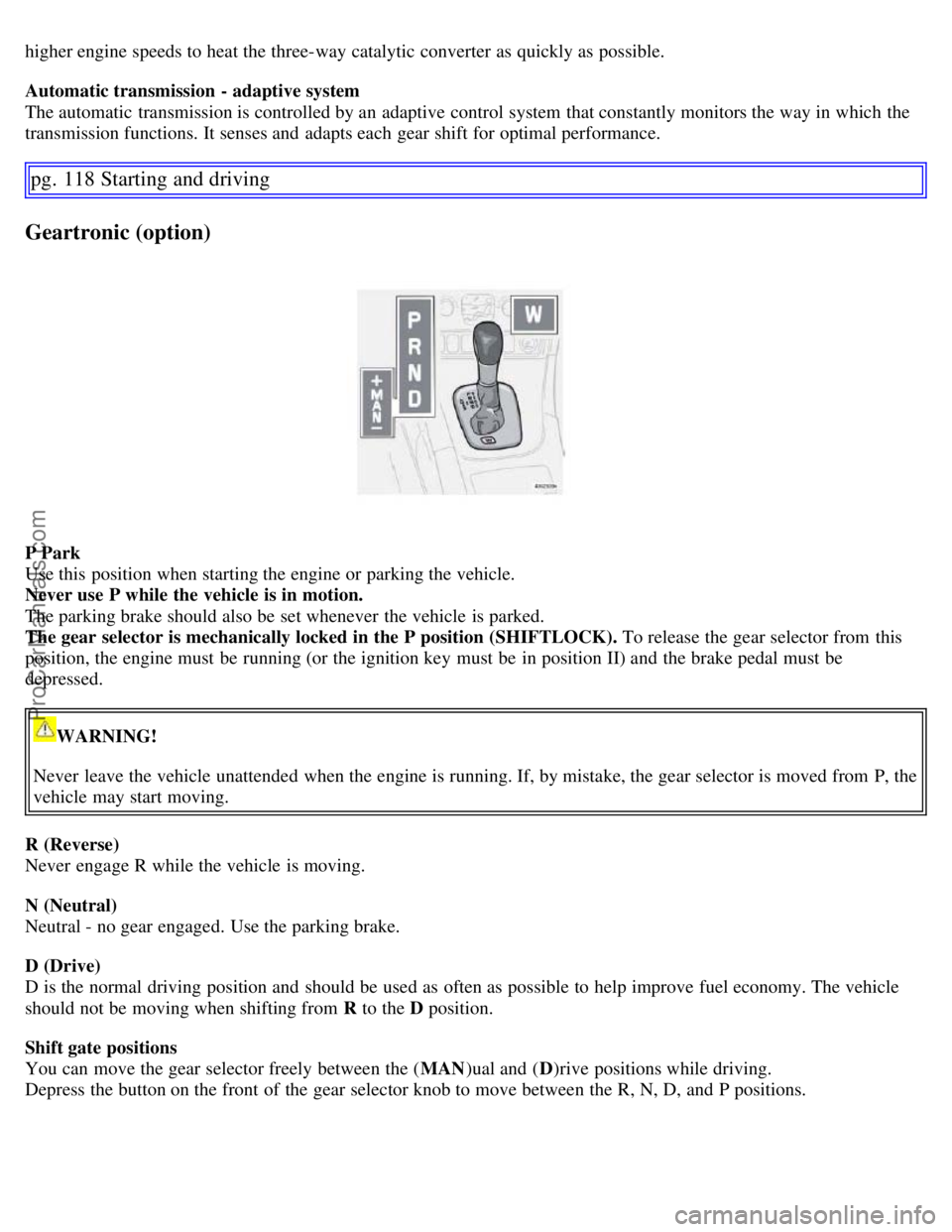
P Park
Use this position when starting the engine or parking the vehicle.
Never use P while the vehicle is in motion.
The parking brake should also be set whenever the vehicle is parked.
The gear selector is mechanically locked in the P position (SHIFTLOCK). To release the gear selector from this
position, the engine must be running (or the ignition key must be in position II) and the brake pedal must be
depressed.
WARNING!
Never leave the vehicle unattended when the engine is running. If, by mistake, the gear selector is moved from P, the
vehicle may start moving.
R (Reverse)
Never engage R while the vehicle is moving.
N (Neutral)
Neutral - no gear engaged. Use the parking brake.
D (Drive)
D is the normal driving position and should be used as often as possible to help improve fuel economy. The vehicle
should not be moving when shifting from R to the D position.
Shift gate positions
You can move the gear selector freely between the ( MAN)ual and ( D)rive positions while driving.
Depress the button on the front of the gear selector knob to move between the R, N, D, and P positions.
ProCarManuals.com
Page 114 of 200
Engine and transmission are subject to increased loads. Therefore, engine coolant temperature should be closely
watched when driving in hot climates or hilly terrain. Use a lower gear and turn off the air conditioner if the
temperature gauge needle enters the red range.
If the automatic transmission begins to overheat, a message will be displayed in the text window.
Avoid overload and other abusive operation.
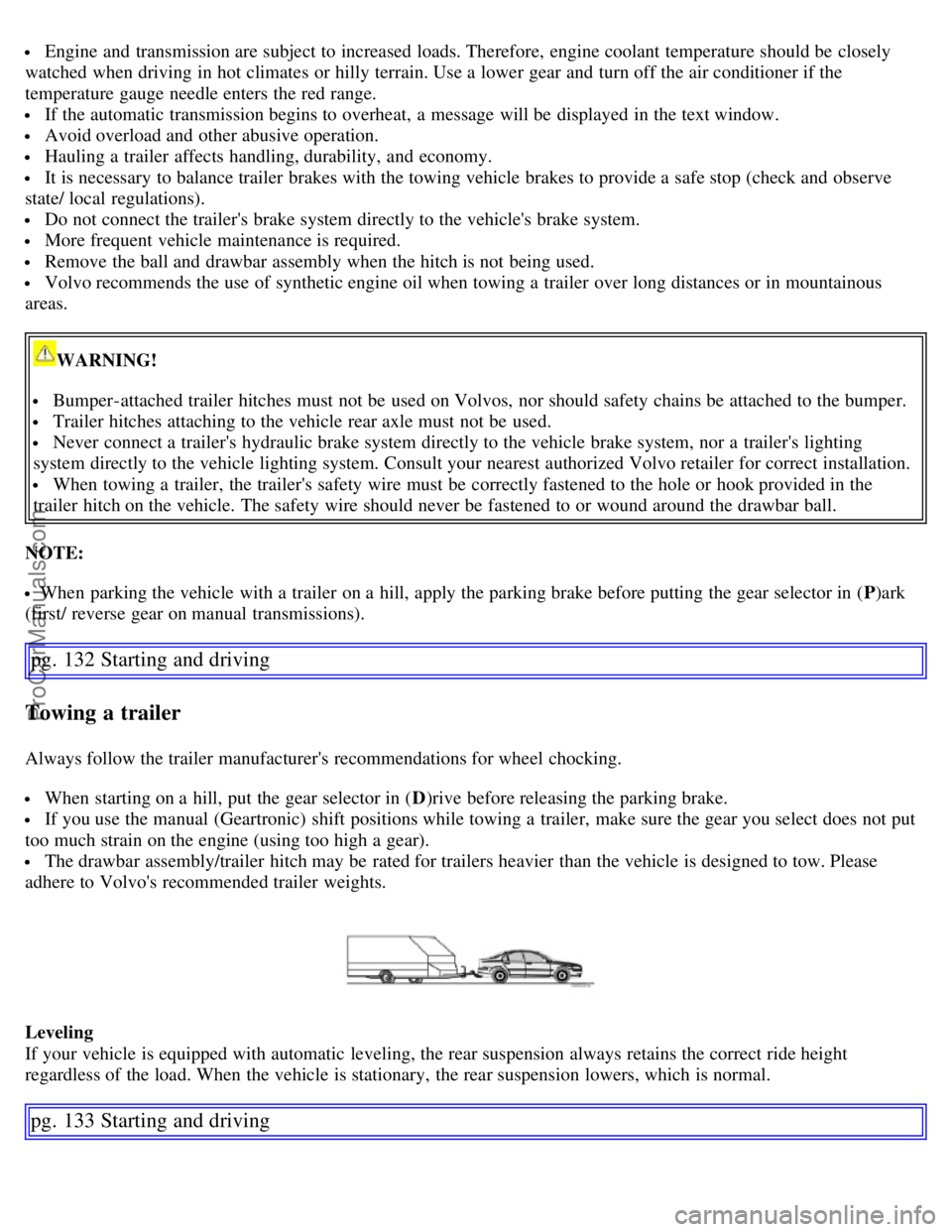
Hauling a trailer affects handling, durability, and economy.
It is necessary to balance trailer brakes with the towing vehicle brakes to provide a safe stop (check and observe
state/ local regulations).
Do not connect the trailer's brake system directly to the vehicle's brake system.
More frequent vehicle maintenance is required.
Remove the ball and drawbar assembly when the hitch is not being used.
Volvo recommends the use of synthetic engine oil when towing a trailer over long distances or in mountainous
areas.
WARNING!
Bumper-attached trailer hitches must not be used on Volvos, nor should safety chains be attached to the bumper.
Trailer hitches attaching to the vehicle rear axle must not be used.
Never connect a trailer's hydraulic brake system directly to the vehicle brake system, nor a trailer's lighting
system directly to the vehicle lighting system. Consult your nearest authorized Volvo retailer for correct installation.
When towing a trailer, the trailer's safety wire must be correctly fastened to the hole or hook provided in the
trailer hitch on the vehicle. The safety wire should never be fastened to or wound around the drawbar ball.
NOTE:
When parking the vehicle with a trailer on a hill, apply the parking brake before putting the gear selector in ( P)ark
(first/ reverse gear on manual transmissions).
pg. 132 Starting and driving
Towing a trailer
Always follow the trailer manufacturer's recommendations for wheel chocking.
When starting on a hill, put the gear selector in ( D)rive before releasing the parking brake.
If you use the manual (Geartronic) shift positions while towing a trailer, make sure the gear you select does not put
too much strain on the engine (using too high a gear).
The drawbar assembly/trailer hitch may be rated for trailers heavier than the vehicle is designed to tow. Please
adhere to Volvo's recommended trailer weights.
Leveling
If your vehicle is equipped with automatic leveling, the rear suspension always retains the correct ride height
regardless of the load. When the vehicle is stationary, the rear suspension lowers, which is normal.
pg. 133 Starting and driving
ProCarManuals.com
Page 118 of 200
Check state of the battery's charge.
Examine tires carefully (the spare tire as well), and replace those that are worn. Check tire pressures.
The brakes, front wheel alignment, and steering gear should be checked by your Volvo retailer only.
Check all lights, including high beams.
Reflective warning triangles are legal requirement in some countries.
Have a word with your Volvo retailer if you intend to drive in countries where it may be difficult to obtain the
correct fuel.
Consider your destination. If you will be driving through an area where snow or ice are likely to occur, consider
snow tires.
1. To prevent injury from contact with hot surfaces, do not inspect your vehicle's transmission fluid yourself. Have your vehicle's transmission fluid
level inspected by a qualified Volvo service technician.
pg. 138 Starting and driving
Front/rear park assist (option/accessory)
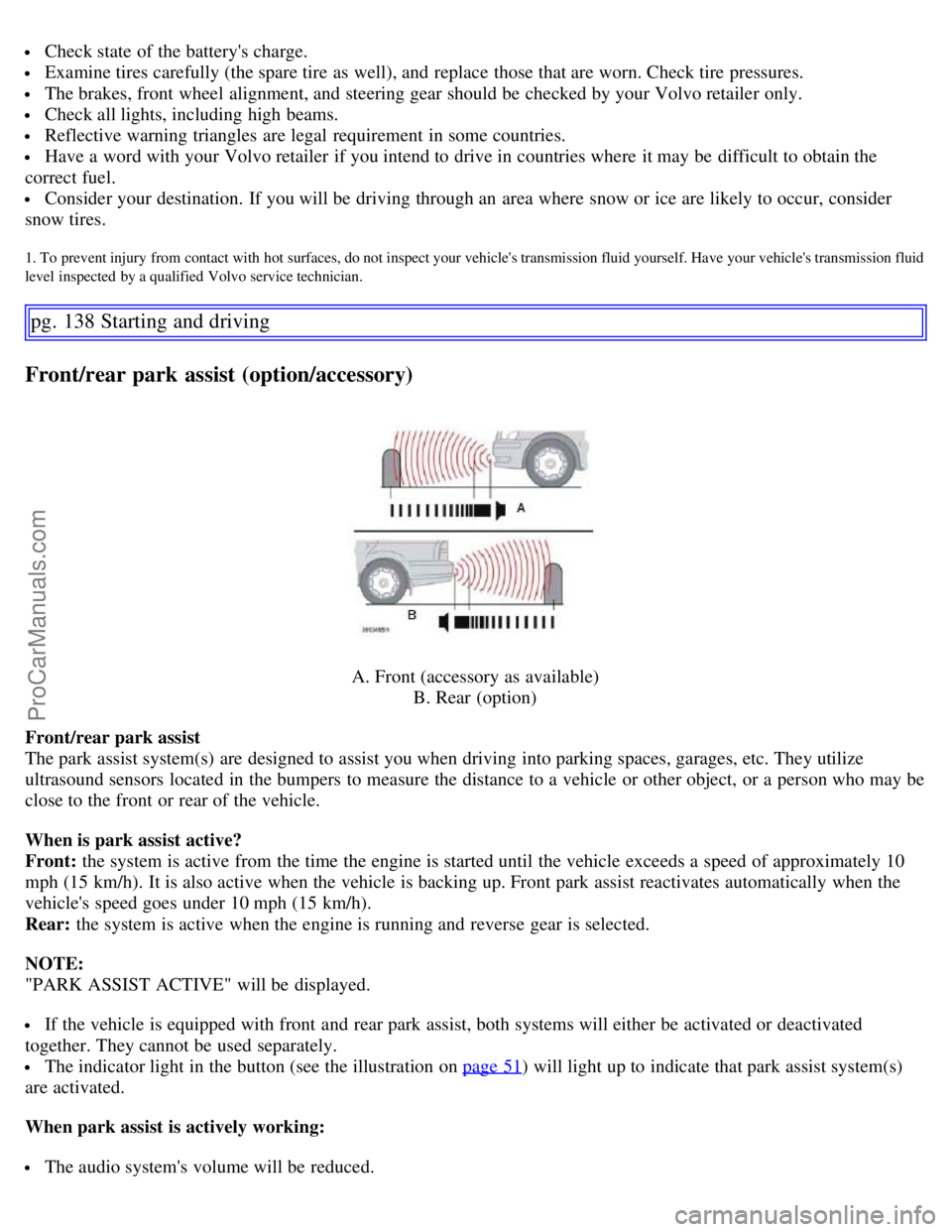
A. Front (accessory as available) B. Rear (option)
Front/rear park assist
The park assist system(s) are designed to assist you when driving into parking spaces, garages, etc. They utilize
ultrasound sensors located in the bumpers to measure the distance to a vehicle or other object, or a person who may be
close to the front or rear of the vehicle.
When is park assist active?
Front: the system is active from the time the engine is started until the vehicle exceeds a speed of approximately 10
mph (15 km/h). It is also active when the vehicle is backing up. Front park assist reactivates automatically when the
vehicle's speed goes under 10 mph (15 km/h).
Rear: the system is active when the engine is running and reverse gear is selected.
NOTE:
"PARK ASSIST ACTIVE" will be displayed.
If the vehicle is equipped with front and rear park assist, both systems will either be activated or deactivated
together. They cannot be used separately.
The indicator light in the button (see the illustration on page 51) will light up to indicate that park assist system(s)
are activated.
When park assist is actively working:
The audio system's volume will be reduced.
ProCarManuals.com
Page 119 of 200
An intermittent signal will be audible from the speakers to indicate that you are approaching a person, object,
parked vehicle, etc. The signals begin when the distance between the bumper and the object is:
Rear: approximately 5 feet (1.5 meters)
Front : approximately 2.5 ft (0.8 meters)
At a distance of approximately 1 foot (30 cm), the signal will become constant. If objects are close to both the front
and rear bumpers, the signal will alternate between the front and rear speakers.
Deactivating the system(s)
- Press the Park assist button on the center console (see page 51
) to temporarily deactivate the system(s).
- The indicator light in the button will go out when the system(s) have been deactivated.
- If the vehicle is equipped with front and rear park assist, both systems will be deactivated by pressing the button.
Park assist will be automatically reactivated the next time the engine is started.
NOTE: It may be necessary to deactivate one or both of the park assist systems in certain cases.
Rear park assist : towing a trailer, carrying bicycles in a rear-mounted carrier, etc, could trigger the rear park assist
system's sensors.
Front park assist : it may not be possible to combine auxiliary headlights and front park assist since these lights
could trigger the system's sensors.
pg. 139 Starting and driving
Front/rear park assist (option/accessory)
Faults in the system
If the yellow warning symbol illuminates and a message is shown in the information display, the system is not
functioning properly. Consult a Volvo retailer or authorized service technician.
Cleaning the sensors
For the system to function properly, the sensors in the front and/or rear bumpers should be kept clean. They can be
cleaned with car washing detergent and a sponge.
WARNING!
These systems are designed to be a supplementary aid when parking the vehicle. They are not, however, intended to
replace the driver's attention and judgement.
CAUTION!
In certain circumstances, the park assist system may give unexpected warning signals that can be caused by external
sound sources that use the same ultrasound frequencies as the system. This may include such things as the horns of
other vehicles, wet tires on asphalt, pneumatic brakes, motorcycle exhaust pipes, etc. This does not indicate a fault in
the system.
pg. 140 Starting and driving
This page left intentionally blank.
ProCarManuals.com
Page 133 of 200

pg. 157 Wheels and tires
Temporary spare
The spare tire in your vehicle is called a "Temporary Spare".
Recommended tire pressure (see the placard on the B-pillar or on the fuel filler door) should be maintained irrespective
of which position on the vehicle the temporary spare tire is used on.
In the event of damage to this tire, a new one can be purchased from your Volvo retailer.
WARNING!
Current legislation prohibits the use of the "Temporary Spare" tire other than as a temporary replacement for a
punctured tire. It must be replaced as soon as possible by a standard tire. Road holding and handling may be affected
with the "Temporary Spare" in use. Do not exceed 50 mph (80 km/h). Do not drive farther than 50 miles (80 km) on
a temporary spare tire.
CAUTION!
The vehicle must not be driven with wheels of different dimensions or with a spare tire other than the one that came
with the vehicle. The use of different size wheels can seriously damage your vehicle's transmission.
pg. 158 Wheels and tires
Changing wheels
Changing wheels
The spare wheel is located under the carpet on the trunk floor. The jack and crank are secured in the wheel recess.
There are two jack attachment points on each side of the vehicle (see illustration on next page).
To change a wheel:
- Engage the parking brake.
- Put the gear selector in (P)ark (automatic transmission) or reverse (manual transmission).
ProCarManuals.com
Page 135 of 200
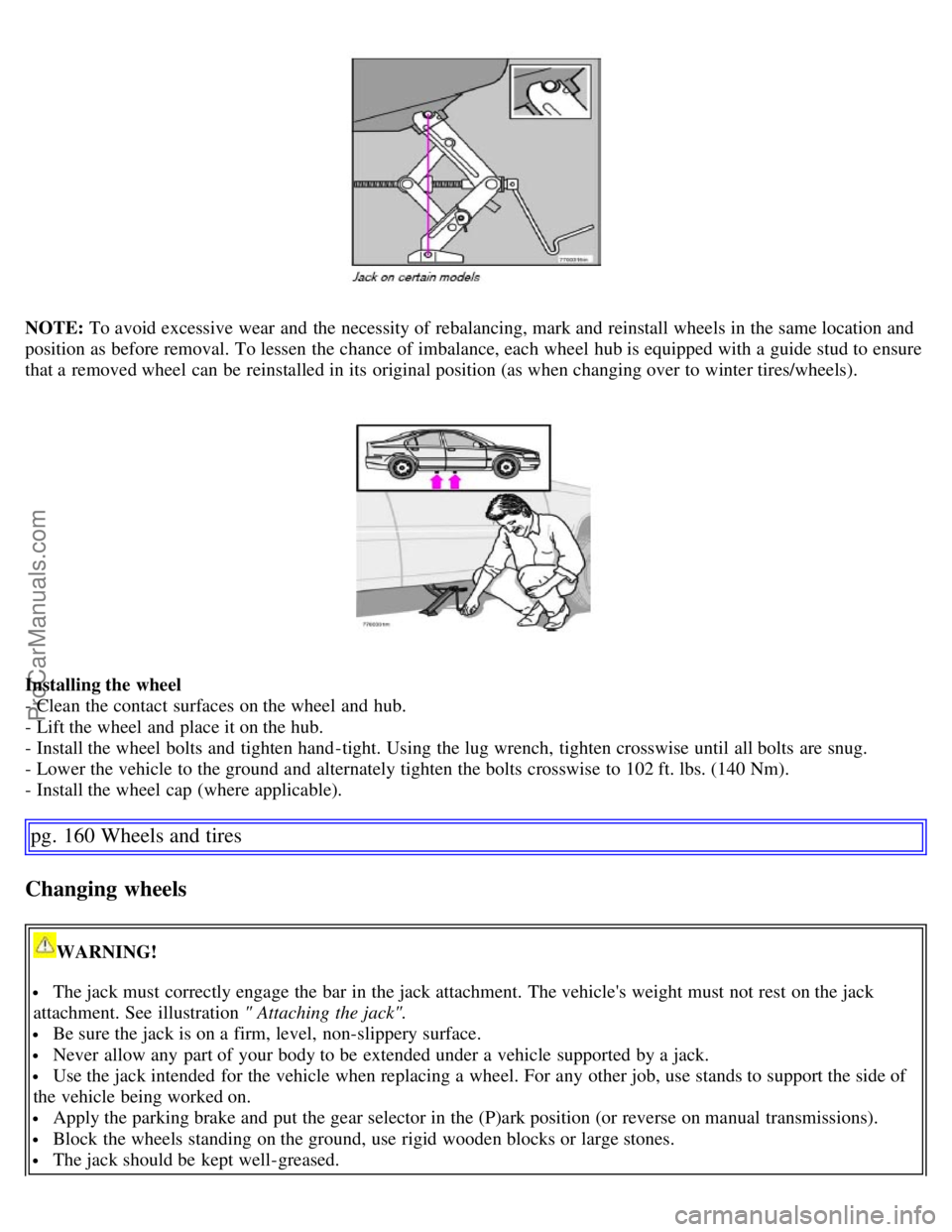
NOTE: To avoid excessive wear and the necessity of rebalancing, mark and reinstall wheels in the same location and
position as before removal. To lessen the chance of imbalance, each wheel hub is equipped with a guide stud to ensure
that a removed wheel can be reinstalled in its original position (as when changing over to winter tires/wheels).
Installing the wheel
- Clean the contact surfaces on the wheel and hub.
- Lift the wheel and place it on the hub.
- Install the wheel bolts and tighten hand -tight. Using the lug wrench, tighten crosswise until all bolts are snug.
- Lower the vehicle to the ground and alternately tighten the bolts crosswise to 102 ft. lbs. (140 Nm).
- Install the wheel cap (where applicable).
pg. 160 Wheels and tires
Changing wheels
WARNING!
The jack must correctly engage the bar in the jack attachment. The vehicle's weight must not rest on the jack
attachment. See illustration " Attaching the jack".
Be sure the jack is on a firm, level, non-slippery surface.
Never allow any part of your body to be extended under a vehicle supported by a jack.
Use the jack intended for the vehicle when replacing a wheel. For any other job, use stands to support the side of
the vehicle being worked on.
Apply the parking brake and put the gear selector in the (P)ark position (or reverse on manual transmissions).
Block the wheels standing on the ground, use rigid wooden blocks or large stones.
The jack should be kept well-greased.
ProCarManuals.com
Page 162 of 200
NOTE: If the message indicating a burned out bulb remains in the information display after the bulb has been
replaced, consult an authorized Volvo retailer or workshop.
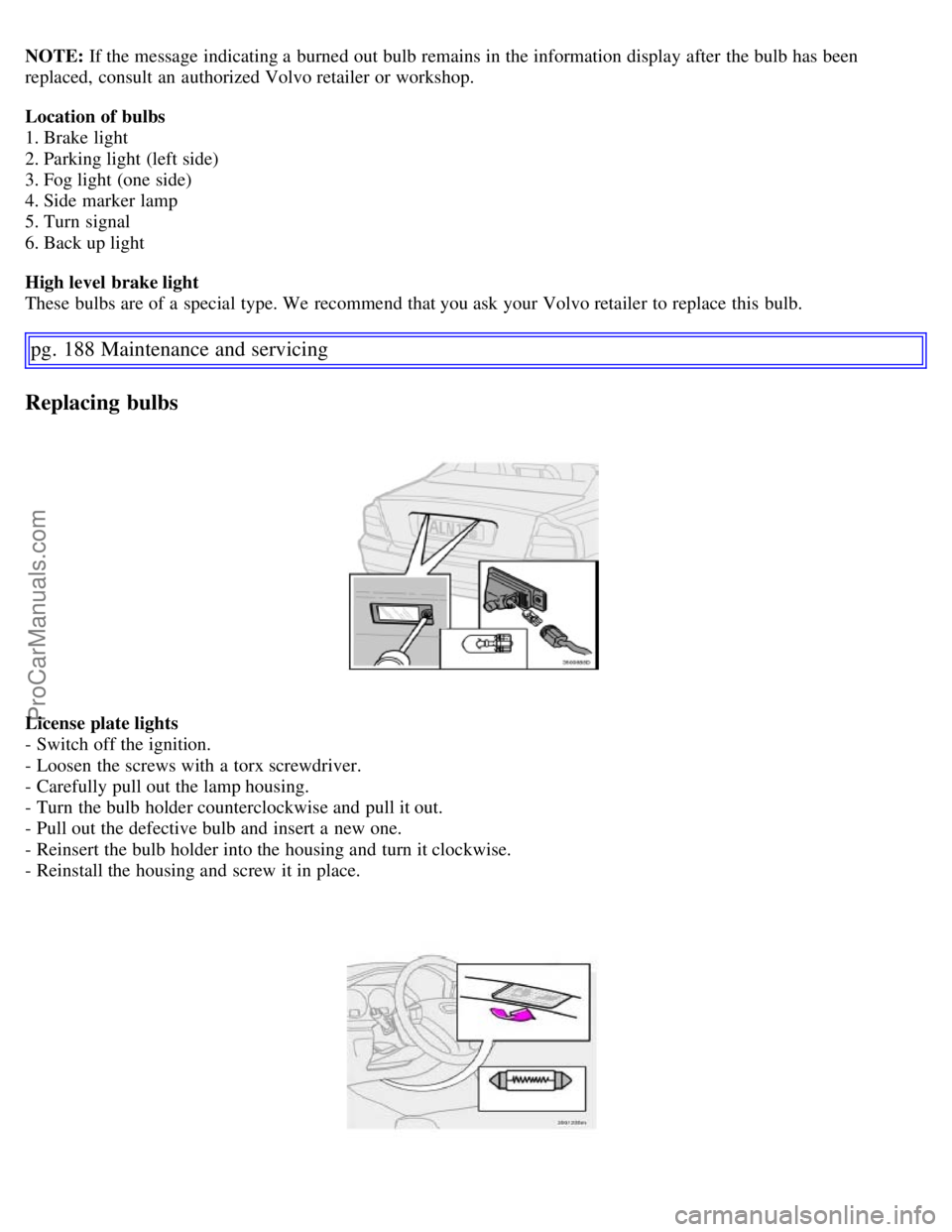
Location of bulbs
1. Brake light
2. Parking light (left side)
3. Fog light (one side)
4. Side marker lamp
5. Turn signal
6. Back up light
High level brake light
These bulbs are of a special type. We recommend that you ask your Volvo retailer to replace this bulb.
pg. 188 Maintenance and servicing
Replacing bulbs
License plate lights
- Switch off the ignition.
- Loosen the screws with a torx screwdriver.
- Carefully pull out the lamp housing.
- Turn the bulb holder counterclockwise and pull it out.
- Pull out the defective bulb and insert a new one.
- Reinsert the bulb holder into the housing and turn it clockwise.
- Reinstall the housing and screw it in place.
ProCarManuals.com
Page 168 of 200
29.-
30.-
31. -
32. -
33. -
34. -
35. -
36. -
37. -
38. -
pg. 194 Maintenance and servicing
Fuses
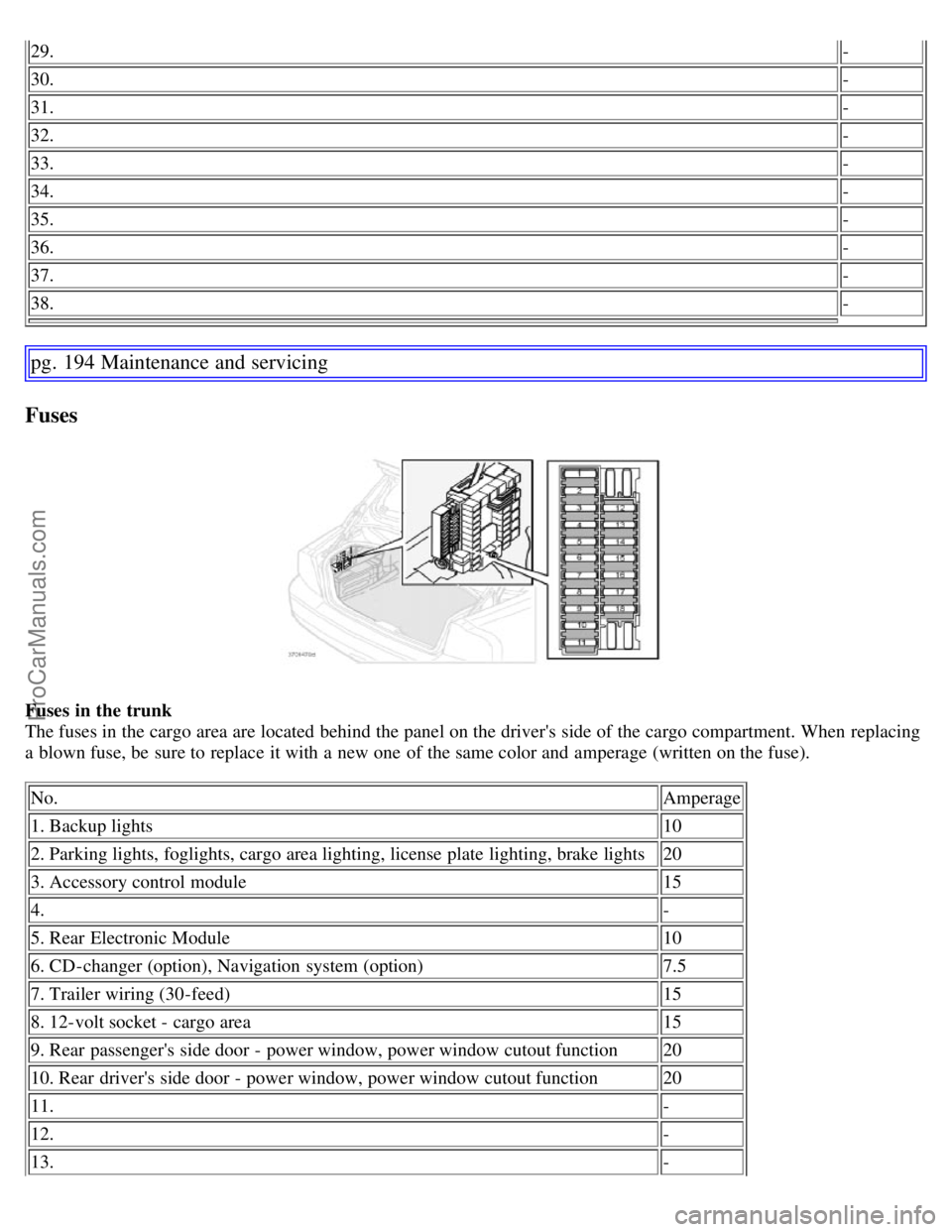
Fuses in the trunk
The fuses in the cargo area are located behind the panel on the driver's side of the cargo compartment. When replacing
a blown fuse, be sure to replace it with a new one of the same color and amperage (written on the fuse).
No. Amperage
1. Backup lights 10
2. Parking lights, foglights, cargo area lighting, license plate lighting, brake lights 20
3. Accessory control module 15
4. -
5. Rear Electronic Module 10
6. CD-changer (option), Navigation system (option) 7.5
7. Trailer wiring (30-feed) 15
8. 12-volt socket - cargo area 15
9. Rear passenger's side door - power window, power window cutout function 20
10. Rear driver's side door - power window, power window cutout function 20
11. -
12. -
13. -
ProCarManuals.com
Page 169 of 200
14.-
15.-
16. -
17. Accessory audio 5
18. -
19. Folding head restraints 15
20. Trailer wiring (15-feed) 20
21. -
22. -
23. All Wheel Drive 7.5
24. Four-C chassis system (option) 15
25. -
26. Park assist (option) 5
27. Main fuse: trailer wiring, Four-C, park assist, All Wheel Drive 30
28. Central locking system 15
29. Driver's side trailer lighting: parking lights, turn signal 25
30. Passenger's side trailer lighting: parking light, brake light, fog light, turn signal 25
31. Main fuse: fuses 37 and 38 40
32. -
33. -
34. -
pg. 195 Maintenance and servicing
Fuses
No.Amperage
35. -
36. -
37. Heated rear window 20
38. Heated rear window 20
pg. 196 Maintenance and servicing
This page left intentionally blank.
Contents | Top of Page
ProCarManuals.com
Page 175 of 200
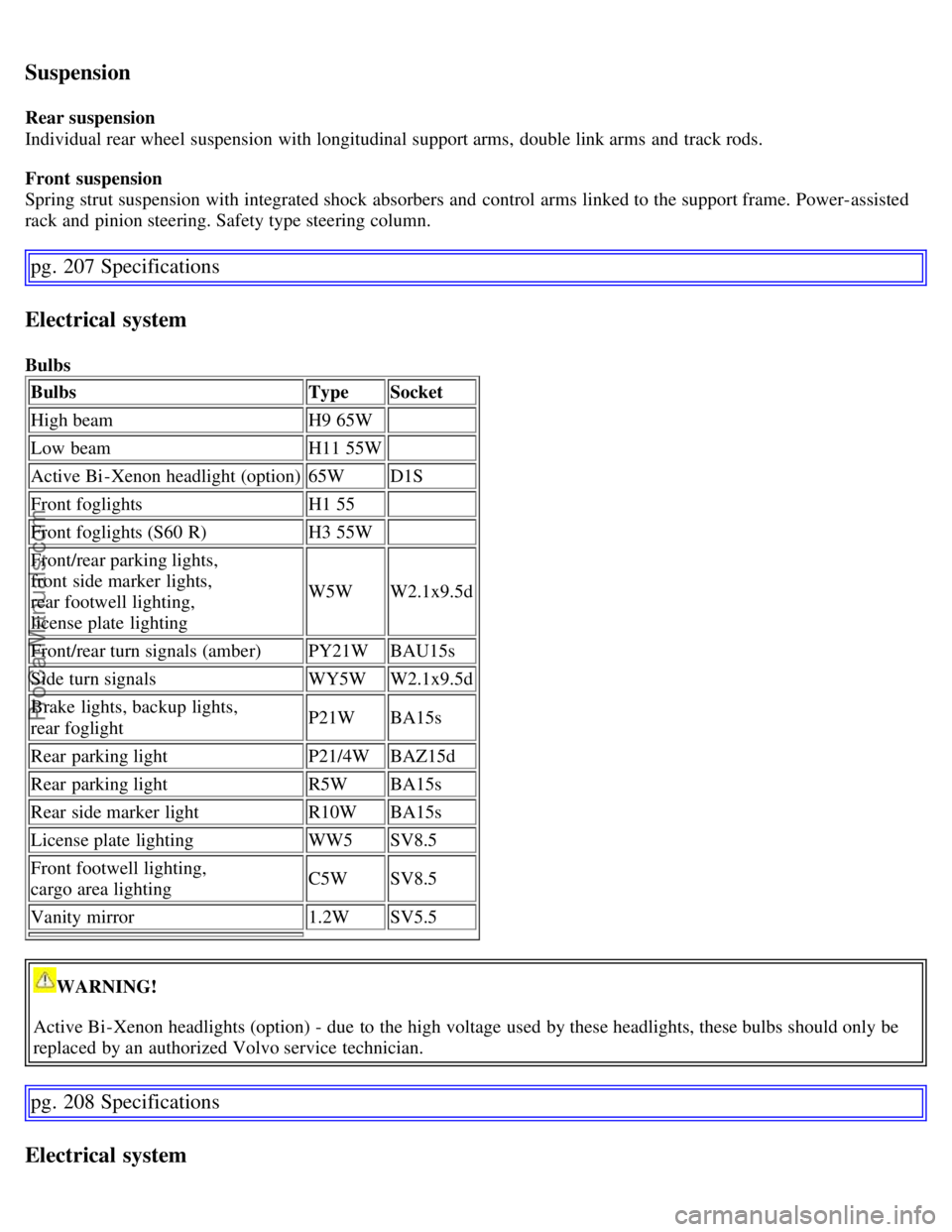
Suspension
Rear suspension
Individual rear wheel suspension with longitudinal support arms, double link arms and track rods.
Front suspension
Spring strut suspension with integrated shock absorbers and control arms linked to the support frame. Power-assisted
rack and pinion steering. Safety type steering column.
pg. 207 Specifications
Electrical system
BulbsBulbs TypeSocket
High beam H9 65W
Low beam H11 55W
Active Bi -Xenon headlight (option) 65WD1S
Front foglights H1 55
Front foglights (S60 R) H3 55W
Front/rear parking lights,
front side marker lights,
rear footwell lighting,
license plate lighting W5W
W2.1x9.5d
Front/rear turn signals (amber) PY21WBAU15s
Side turn signals WY5WW2.1x9.5d
Brake lights, backup lights,
rear foglight P21W
BA15s
Rear parking light P21/4WBAZ15d
Rear parking light R5WBA15s
Rear side marker light R10WBA15s
License plate lighting WW5SV8.5
Front footwell lighting,
cargo area lighting C5W
SV8.5
Vanity mirror 1.2WSV5.5
WARNING!
Active Bi -Xenon headlights (option) - due to the high voltage used by these headlights, these bulbs should only be
replaced by an authorized Volvo service technician.
pg. 208 Specifications
Electrical system
ProCarManuals.com