trailer VOLVO S60 2007 User Guide
[x] Cancel search | Manufacturer: VOLVO, Model Year: 2007, Model line: S60, Model: VOLVO S60 2007Pages: 200, PDF Size: 4.03 MB
Page 130 of 200
Maximum permissible inflation pressure: the greatest amount of air pressure that should ever be put in the tire.
This limit is set by the tire manufacturer.
Recommended tire inflation pressure: inflation pressure, established by Volvo, which is based on the type of tires
that are mounted on a vehicle at the factory. This inflation pressure is affected by the number of occupants in the
vehicle, the amount of cargo, and the speed at which the vehicle will be driven for a prolonged period. This
information can be found on the tire inflation placard(s) located on the driver's side B-pillar or on the inside of the fuel
filler door on Canadian models, and in the tire inflation table in this chapter.
Cold tires : The tires are considered to be cold when they have the same temperature as the surrounding (ambient)
air. This temperature is normally reached after the vehicle has been parked for at least 3 hours.
pg. 153 Wheels and tires
Vehicle loading
Properly loading your vehicle will provide maximum return of vehicle design performance.
Before loading your vehicle, familiarize yourself with the following terms for determining your vehicle's weight
ratings, with or without a trailer, from the vehicle's Federal/ Canadian Motor Vehicle Safety Standards
(FMVSS/CMVSS) label, and the vehicle's tire information placard:
Curb weight
The weight of the vehicle including a full tank of fuel and all standard equipment. It does not include passengers,
cargo, or optional equipment.
Capacity weight
All weight added to the curb weight, including cargo and optional equipment. When towing, trailer hitch tongue load
is also part of cargo weight.
NOTE: For trailer towing information, please refer to the section "Towing a trailer" on page 131
.
Permissible axle weight
The maximum allowable weight that can be carried by a single axle (front or rear). These numbers are shown on the
Federal/Canadian Motor Vehicle Safety Standards (FMVSS/ CMVSS) label. The total load on each axle must never
exceed its maximum permissible weight.
Gross vehicle weight (GVW)
The vehicle's curb weight + cargo + passengers.
NOTE:
The location of the various labels in your vehicle can be found on page 199.
A table listing important weight limits for your vehicle can be found on page 201.
Steps for Determining Correct Load Limit
- Locate the statement "the combined weight of occupants and cargo should never exceed XXX pounds'' on your
vehicle's placard.
- Determine the combined weight of the driver and passengers that will be riding in your vehicle.
- Subtract the combined weight of the driver and passengers from XXX kilograms or XXX pounds.
- The resulting figure equals the available amount of cargo and luggage load capacity. For example, if the Ô'XXX''
amount equals 1400 lbs. and there will be five 150 lb. passengers in your vehicle, the amount of available cargo and
luggage load capacity is 650 lbs. (1400- 750 (5 x 150) = 650 lbs.)
- Determine the combined weight of luggage and cargo being loaded on the vehicle. That weight may not safely
exceed the available cargo and luggage load capacity calculated in Step 4.
- If your vehicle will be towing a trailer, load from your trailer will be transferred to your vehicle. Consult this
1
ProCarManuals.com
Page 131 of 200
manual to determine how this reduces the available cargo and luggage load capacity of your vehicle.
1. See "Towing a trailer" on page 131.
pg. 154 Wheels and tires
Vehicle loading
WARNING!
Exceeding the permissible axle weight, gross vehicle weight, or any other weight rating limits can cause tire
overheating resulting in permanent deformation or catastrophic failure.
Do not use replacement tires with lower load carrying capacities than the tires that were original equipment on the
vehicle because this will lower the vehicle's GVW rating. Replacement tires with a higher limit than the originals do
not increase the vehicle's GVW rating limitations.
pg. 155 Wheels and tires
Uniform Tire Quality Grading
ALL PASSENGER VEHICLE TIRES MUST CONFORM TO FEDERAL SAFETY REQUIREMENTS IN
ADDITION TO THESE GRADES
Quality grades can be found, where applicable, on the tire sidewall between the tread shoulder and maximum
section width. For example:
Treadwear 200 Traction AA Temperature A
TREADWEAR
The treadwear grade is a comparative rating based on the wear rate of the tire when tested under controlled conditions
on a specified government test course. For example, a tire graded 150 would wear one and one half (1 1/2) times as
well on the government course as a tire graded 100. The relative performance of tires depends upon the actual
conditions of their use, however, and many depart significantly from the norm due to variation in driving habits,
maintenance practices and differences in road characteristics and climate.
TRACTION
The traction grades, from highest to lowest, are AA, A, B, and C, as measured under controlled conditions on specified
government test surfaces of asphalt and concrete. A tire marked C may have poor traction performance.
WARNING!
The traction grade assigned to this tire is based on braking (straight-ahead) traction tests and is not a measure of
cornering (turning) traction.
TEMPERATURE
The temperature grades are AA (the highest), A, B, and C, representing the tire's resistance to the generation of heat
and its ability to dissipate heat when tested under controlled conditions on a specified indoor laboratory test wheel.
Sustained high temperature can cause the material of the tire to degenerate and reduce tire life, and excessive
temperature can lead to sudden tire failure. The grade C corresponds to a minimum level of performance that all
passenger vehicle tires must meet under the Federal Motor Safety Standard No. 109. Grades B and A represent higher
levels of performance on the laboratory test wheel than the minimum required by law.
ProCarManuals.com
Page 148 of 200
Operation in temperate climates
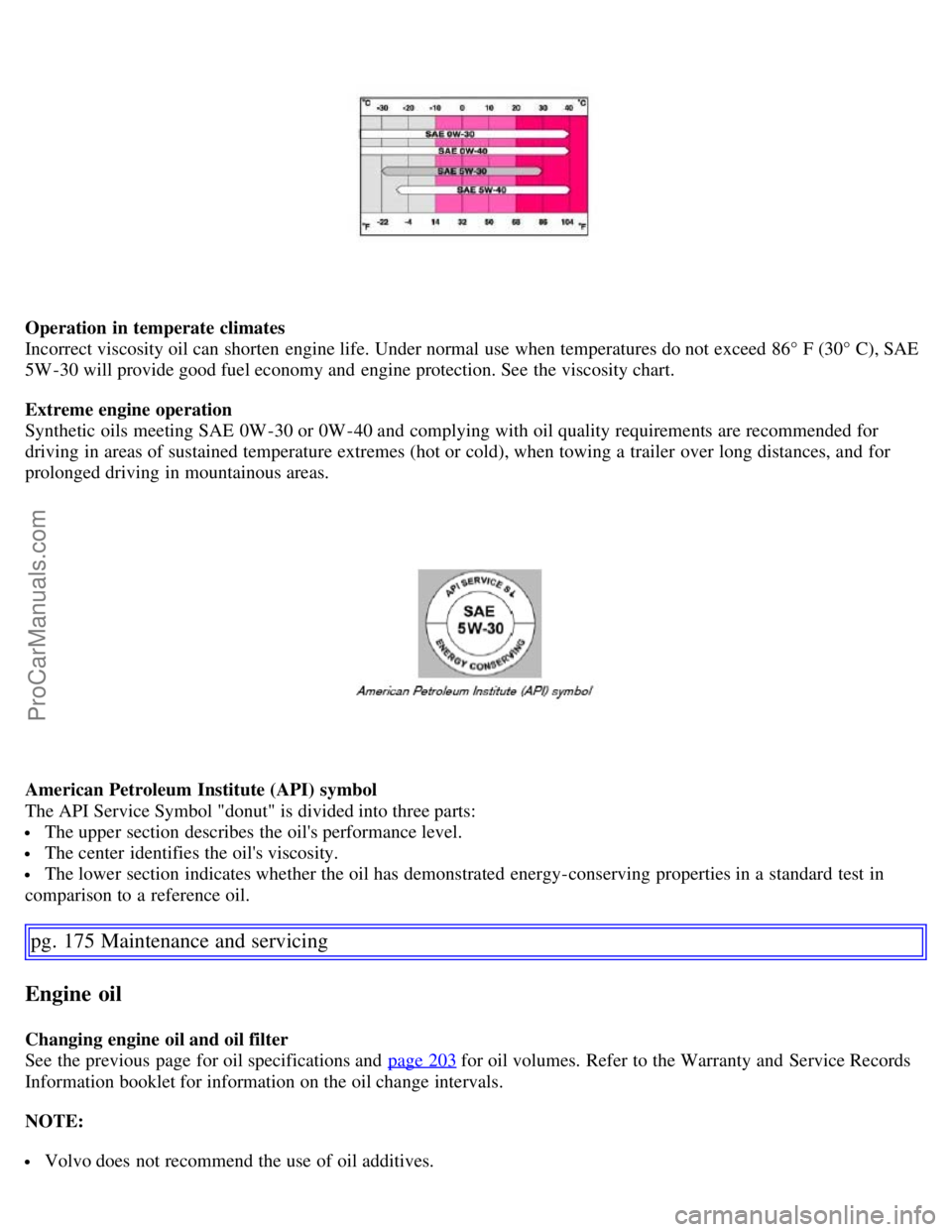
Incorrect viscosity oil can shorten engine life. Under normal use when temperatures do not exceed 86° F (30° C), SAE
5W -30 will provide good fuel economy and engine protection. See the viscosity chart.
Extreme engine operation
Synthetic oils meeting SAE 0W -30 or 0W -40 and complying with oil quality requirements are recommended for
driving in areas of sustained temperature extremes (hot or cold), when towing a trailer over long distances, and for
prolonged driving in mountainous areas.
American Petroleum Institute (API) symbol
The API Service Symbol "donut" is divided into three parts:
The upper section describes the oil's performance level.
The center identifies the oil's viscosity.
The lower section indicates whether the oil has demonstrated energy-conserving properties in a standard test in
comparison to a reference oil.
pg. 175 Maintenance and servicing
Engine oil
Changing engine oil and oil filter
See the previous page for oil specifications and page 203
for oil volumes. Refer to the Warranty and Service Records
Information booklet for information on the oil change intervals.
NOTE:
Volvo does not recommend the use of oil additives.
ProCarManuals.com
Page 157 of 200
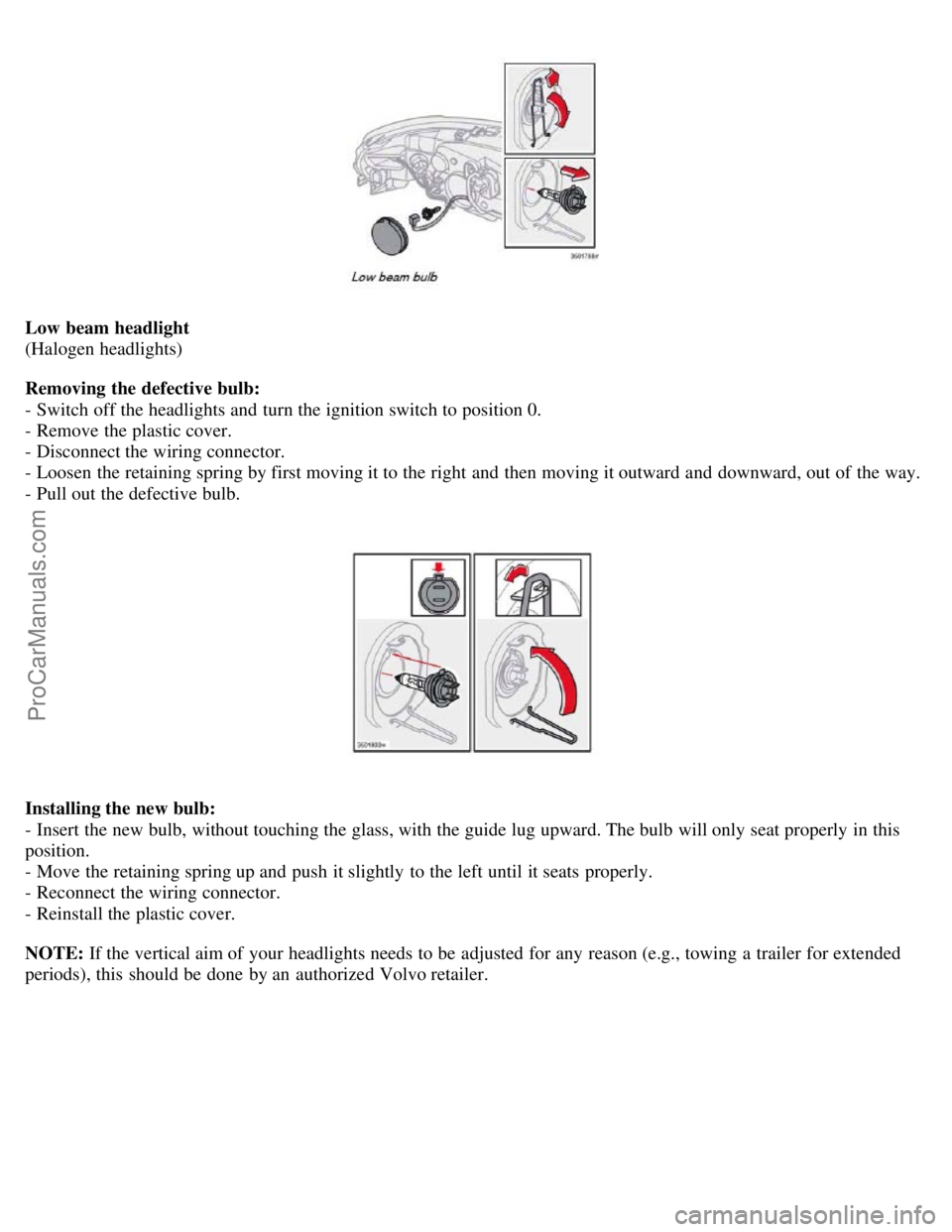
Low beam headlight
(Halogen headlights)
Removing the defective bulb:
- Switch off the headlights and turn the ignition switch to position 0.
- Remove the plastic cover.
- Disconnect the wiring connector.
- Loosen the retaining spring by first moving it to the right and then moving it outward and downward, out of the way.
- Pull out the defective bulb.
Installing the new bulb:
- Insert the new bulb, without touching the glass, with the guide lug upward. The bulb will only seat properly in this
position.
- Move the retaining spring up and push it slightly to the left until it seats properly.
- Reconnect the wiring connector.
- Reinstall the plastic cover.
NOTE: If the vertical aim of your headlights needs to be adjusted for any reason (e.g., towing a trailer for extended
periods), this should be done by an authorized Volvo retailer.
ProCarManuals.com
Page 168 of 200
29.-
30.-
31. -
32. -
33. -
34. -
35. -
36. -
37. -
38. -
pg. 194 Maintenance and servicing
Fuses
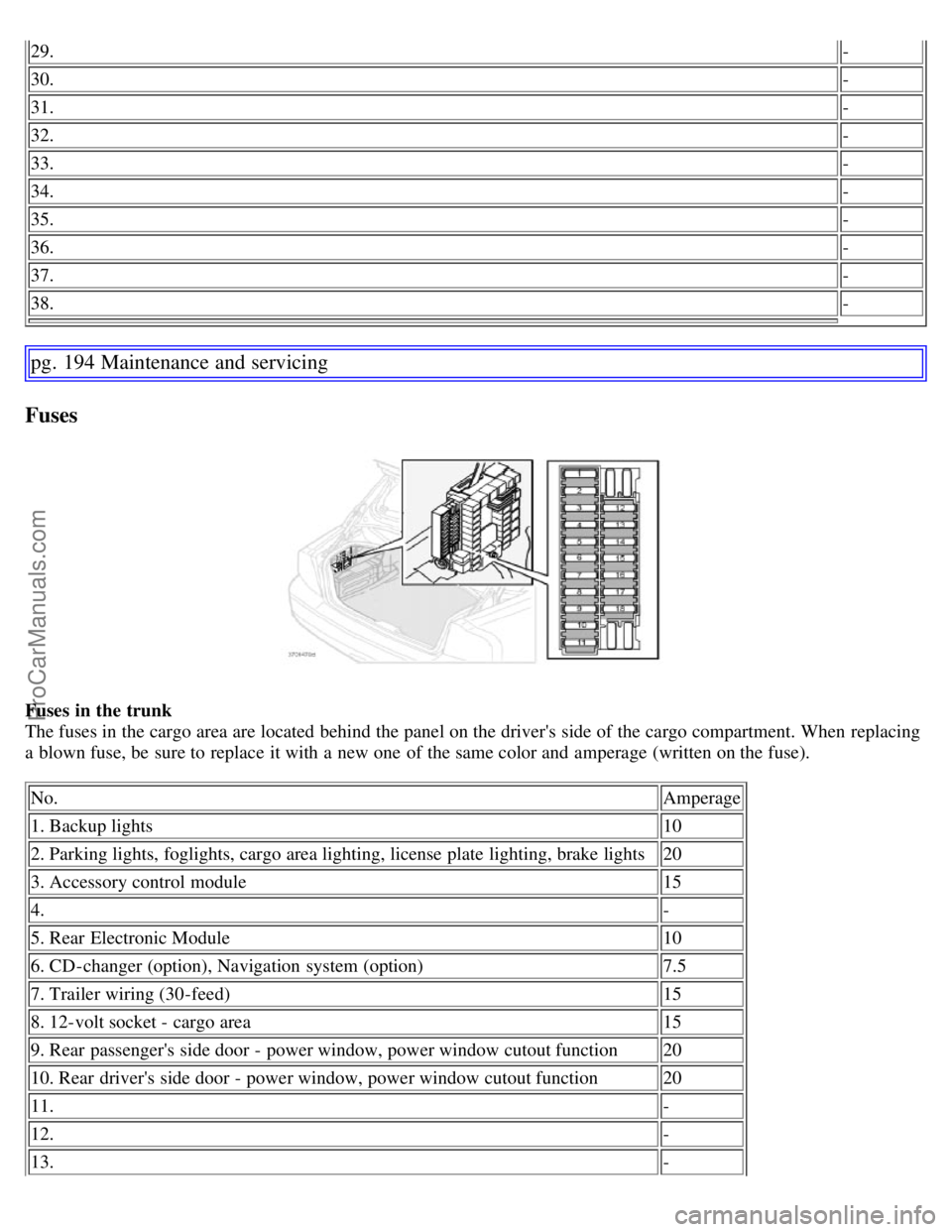
Fuses in the trunk
The fuses in the cargo area are located behind the panel on the driver's side of the cargo compartment. When replacing
a blown fuse, be sure to replace it with a new one of the same color and amperage (written on the fuse).
No. Amperage
1. Backup lights 10
2. Parking lights, foglights, cargo area lighting, license plate lighting, brake lights 20
3. Accessory control module 15
4. -
5. Rear Electronic Module 10
6. CD-changer (option), Navigation system (option) 7.5
7. Trailer wiring (30-feed) 15
8. 12-volt socket - cargo area 15
9. Rear passenger's side door - power window, power window cutout function 20
10. Rear driver's side door - power window, power window cutout function 20
11. -
12. -
13. -
ProCarManuals.com
Page 169 of 200
14.-
15.-
16. -
17. Accessory audio 5
18. -
19. Folding head restraints 15
20. Trailer wiring (15-feed) 20
21. -
22. -
23. All Wheel Drive 7.5
24. Four-C chassis system (option) 15
25. -
26. Park assist (option) 5
27. Main fuse: trailer wiring, Four-C, park assist, All Wheel Drive 30
28. Central locking system 15
29. Driver's side trailer lighting: parking lights, turn signal 25
30. Passenger's side trailer lighting: parking light, brake light, fog light, turn signal 25
31. Main fuse: fuses 37 and 38 40
32. -
33. -
34. -
pg. 195 Maintenance and servicing
Fuses
No.Amperage
35. -
36. -
37. Heated rear window 20
38. Heated rear window 20
pg. 196 Maintenance and servicing
This page left intentionally blank.
Contents | Top of Page
ProCarManuals.com
Page 172 of 200
Max. roof load220 lbs (100 kg)
Max. trailer weight:
- without brakes
- with brakes, 2" ball
1
- with brakes, 1 7/8" ball1650 lbs (750 kg)
3300 lbs (1500 kg)
2000 lbs (900 kg)
Max. tongue weight: 165 lbs (75 kg)
Trailer weights below 2,650 lbs (1,200 kg) 110 lbs (50 kg)
Trailer weights above 2,650 lbs (1,200 kg) 165 lbs (75 kg)
1. When driving for prolonged periods at temperatures above 86 °F (30 °C), the maximum recommended weight is 2000 lbs (900 kg).
See also page 131
for additional information.
WARNING!
When adding accessories, equipment, luggage and other cargo to your vehicle, the total capacity weight must not be
exceeded.
pg. 201 Specifications
Dimensions and weights
Weights
AWD = All Wheel Drive Gross vehicle weight
1USA Canada
5-cyl. turbo manual 4430 lbs2010 kg
5-cyl. turbo automatic 4470 lbs2030 kg
5-cyl turbo AWD automatic 4540 lbs2060 kg
5-cyl turbo AWD-R manual/automatic 4540 lbs2060 kg
Capacity weight
5-cyl. turbo 870 lbs395 kg
5 cyl. turbo AWD 805 lbs365 kg
5 cyl. turbo AWD-R 770 Ibs350 kg
Permissible axle weights, front
1
5-cyl. turbo 2400 lbs1090 kg
5-cyl. turbo AWD automatic 2420 lbs1100 kg
5-cyl. turbo AWD-R manual 2400 lbs1090 kg
5-cyl. turbo AWD-R automatic 2420 lbs1100 kg
Permissible axle weights, rear
1
5-cyl., 5-cyl. turbo 2220 lbs1010 kg
5-cyl. turbo AWD, AWD-R 2310 lbs1050 kg
Curb weight
5-cyl. turbo 3430-3505 lbs1545-1580 kg
ProCarManuals.com
Page 174 of 200
Fluids
Transmission1
Oil grade
Manual: MTF 97309
Automatic :
AW5
TF-80SC (S60R) JWS 3309
JWS 3309
Different types of oil should never be mixed.
Power steering
Grade: Volvo synthetic power steering fluid (Pentosin CHF 11S) P/N 1161529 or equivalent.
Brake fluid
Fluid type: DOT 4+ boiling point >536°F (280°C).
Cooling system Type Positive pressure, closed system.
Coolant Volvo original coolant/ antifreeze
Volume 9.3 US qts (8.8 liters)
The thermostat begins to open at 194°F (90°C).
1. The transmission oil does not normally need to be changed during the service life of the vehicle. However, it may be necessary to replace the oil
if the vehicle is often driven in areas of sustained temperature extremes (hot or cold), when towing a trailer over long distances, for prolonged
driving in mountainous areas, or if the vehicle is often driven short distances in temperatures under 40°F (5°C).
pg. 205 Specifications
Three way catalytic converter
Three-way catalytic converter cautions
Keep your engine properly tuned. Certain engine malfunctions, particularly involving the electrical, fuel or
distributor ignition systems, may cause unusually high three-way catalytic converter temperatures. Do not continue to
operate your vehicle if you detect engine misfire, noticeable loss of power or other unusual operating conditions, such
as engine overheating or backfiring. A properly tuned engine will help avoid malfunctions that could damage the three-
way catalytic converter.
Do not park your vehicle over combustible materials, such as grass or leaves, which can come into contact with the
hot exhaust system and cause such materials to ignite under certain wind and weather conditions.
Excessive starter cranking (in excess of one minute), or an intermittently firing or flooded engine can cause three-
way catalytic converter or exhaust system overheating.
Remember that tampering or unauthorized modifications to the engine, the Electronic Control Module, or the vehicle
may be illegal and can cause three-way catalytic converter or exhaust system overheating. This includes:
- Altering fuel injection setting or components.
- Altering emission system components or location or removing components.
- Repeated use of leaded fuel.
NOTE: Unleaded fuel is required for vehicles with three-way catalytic converters.
pg. 206 Specifications
ProCarManuals.com
Page 195 of 200
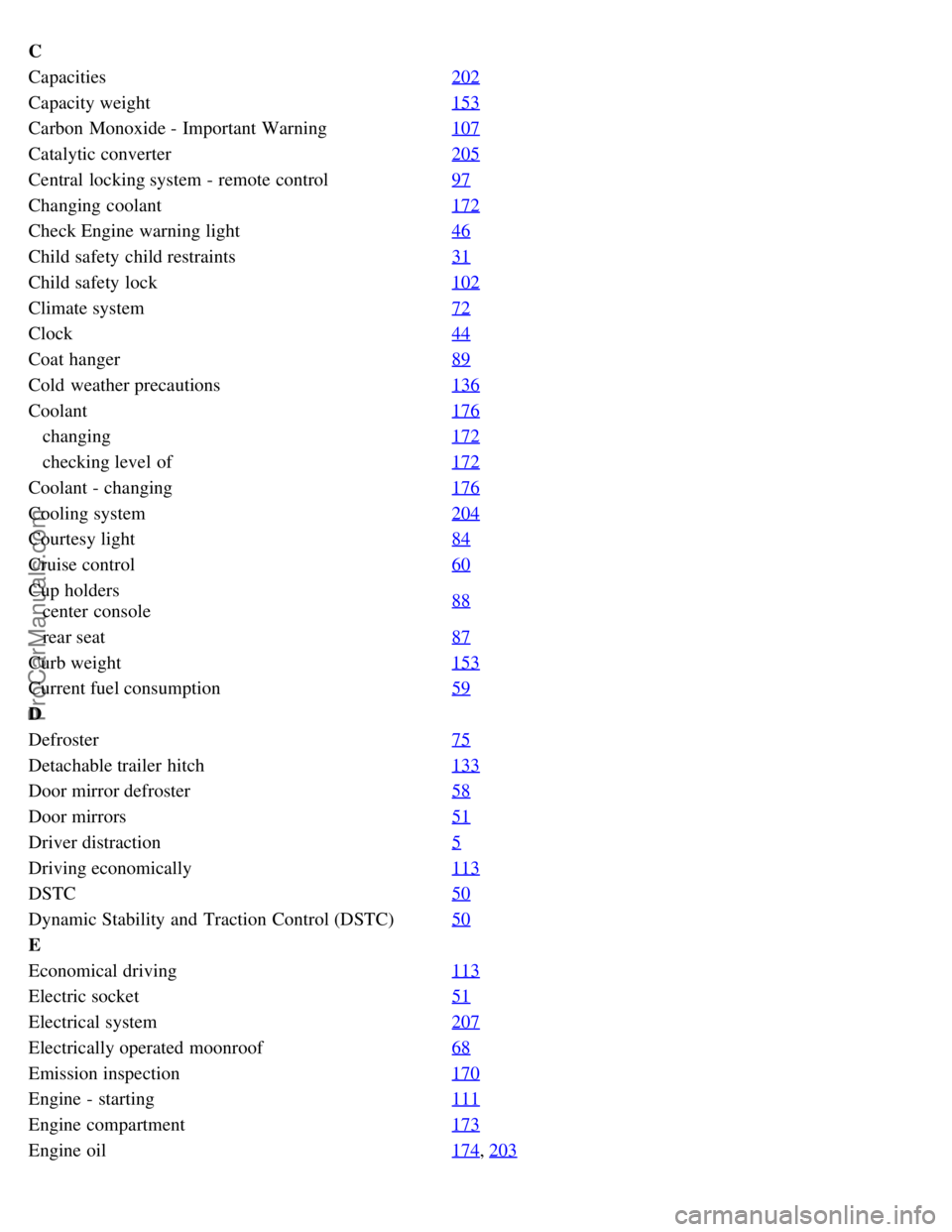
C
Capacities202
Capacity weight153
Carbon Monoxide - Important Warning107
Catalytic converter205
Central locking system - remote control97
Changing coolant172
Check Engine warning light46
Child safety child restraints31
Child safety lock102
Climate system72
Clock44
Coat hanger89
Cold weather precautions136
Coolant176
changing172
checking level of172
Coolant - changing176
Cooling system204
Courtesy light84
Cruise control60
Cup holders
center console88
rear seat
87
Curb weight153
Current fuel consumption59
D
Defroster75
Detachable trailer hitch133
Door mirror defroster58
Door mirrors51
Driver distraction5
Driving economically113
DSTC50
Dynamic Stability and Traction Control (DSTC)50
E
Economical driving113
Electric socket51
Electrical system207
Electrically operated moonroof68
Emission inspection170
Engine - starting111
Engine compartment173
Engine oil174, 203
ProCarManuals.com
Page 199 of 200
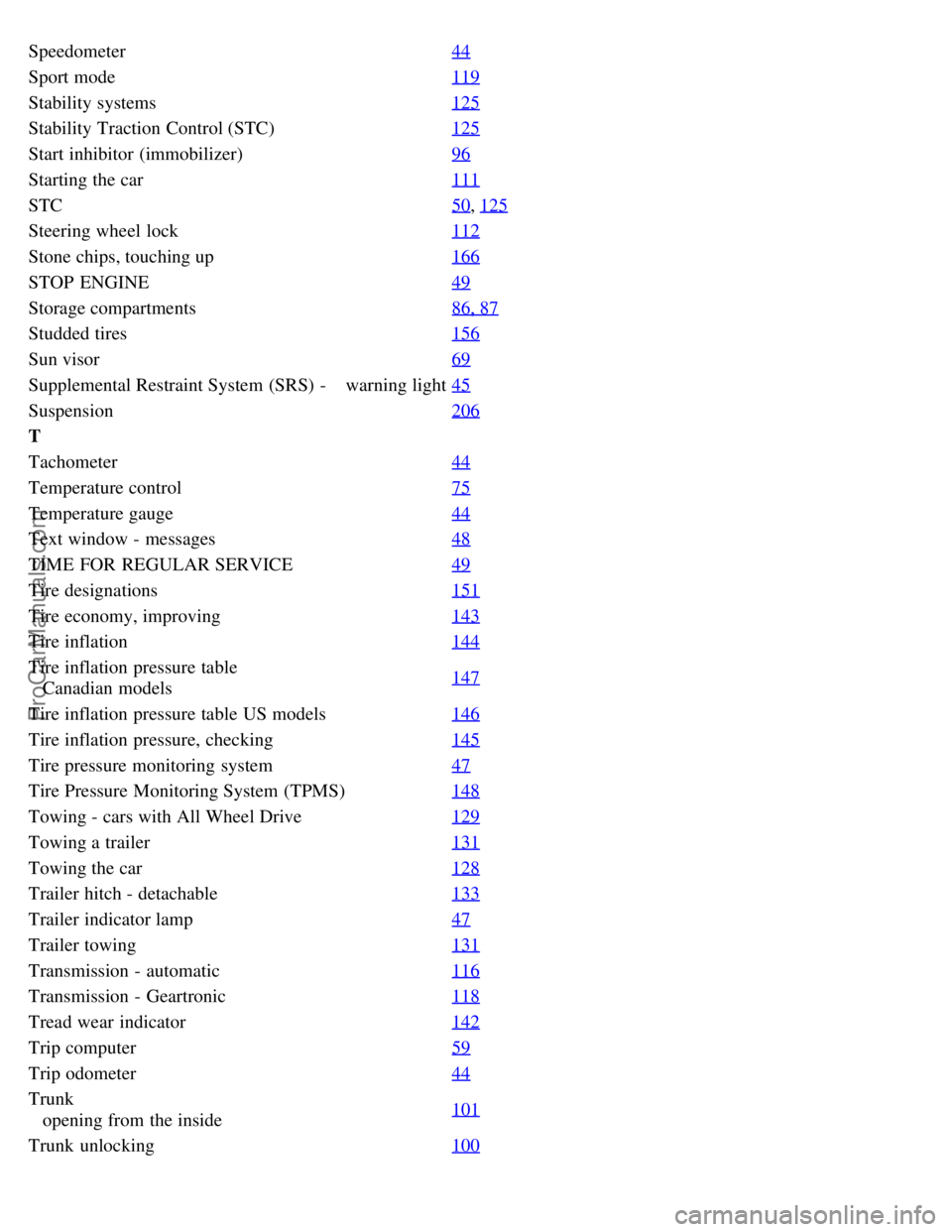
Speedometer44
Sport mode119
Stability systems125
Stability Traction Control (STC)125
Start inhibitor (immobilizer)96
Starting the car111
STC50, 125
Steering wheel lock112
Stone chips, touching up166
STOP ENGINE49
Storage compartments86, 87
Studded tires156
Sun visor69
Supplemental Restraint System (SRS) - warning light45
Suspension206
T
Tachometer44
Temperature control75
Temperature gauge44
Text window - messages48
TIME FOR REGULAR SERVICE49
Tire designations151
Tire economy, improving143
Tire inflation144
Tire inflation pressure table
Canadian models147
Tire inflation pressure table US models
146
Tire inflation pressure, checking145
Tire pressure monitoring system47
Tire Pressure Monitoring System (TPMS)148
Towing - cars with All Wheel Drive129
Towing a trailer131
Towing the car128
Trailer hitch - detachable133
Trailer indicator lamp47
Trailer towing131
Transmission - automatic116
Transmission - Geartronic118
Tread wear indicator142
Trip computer59
Trip odometer44
Trunk
opening from the inside101
Trunk unlocking
100
ProCarManuals.com