fuel VOLVO S60 2007 Owner's Guide
[x] Cancel search | Manufacturer: VOLVO, Model Year: 2007, Model line: S60, Model: VOLVO S60 2007Pages: 200, PDF Size: 4.03 MB
Page 133 of 200

pg. 157 Wheels and tires
Temporary spare
The spare tire in your vehicle is called a "Temporary Spare".
Recommended tire pressure (see the placard on the B-pillar or on the fuel filler door) should be maintained irrespective
of which position on the vehicle the temporary spare tire is used on.
In the event of damage to this tire, a new one can be purchased from your Volvo retailer.
WARNING!
Current legislation prohibits the use of the "Temporary Spare" tire other than as a temporary replacement for a
punctured tire. It must be replaced as soon as possible by a standard tire. Road holding and handling may be affected
with the "Temporary Spare" in use. Do not exceed 50 mph (80 km/h). Do not drive farther than 50 miles (80 km) on
a temporary spare tire.
CAUTION!
The vehicle must not be driven with wheels of different dimensions or with a spare tire other than the one that came
with the vehicle. The use of different size wheels can seriously damage your vehicle's transmission.
pg. 158 Wheels and tires
Changing wheels
Changing wheels
The spare wheel is located under the carpet on the trunk floor. The jack and crank are secured in the wheel recess.
There are two jack attachment points on each side of the vehicle (see illustration on next page).
To change a wheel:
- Engage the parking brake.
- Put the gear selector in (P)ark (automatic transmission) or reverse (manual transmission).
ProCarManuals.com
Page 143 of 200
Vehicle Event Data (Black Box)
Your vehicle's driving and safety systems employ computers that monitor, and share with each other, information
about your vehicle's operation. One or more of these computers may store what they monitor, either during normal
vehicle operation or in a crash or near-crash event. Stored information may be read and used by:
Volvo Car Corporation
service and repair facilities
law enforcement or government agencies
others who may assert a legal right to know, or who obtain your consent to know such information.
Applicable warranties
In accordance with applicable U.S. and Canadian regulations, the following list of warranties is provided.
New Car Limited Warranty
Parts and Accessories Limited Warranty
Corrosion Protection Limited Warranty
Seat Belt and Supplemental Restraint Systems Limited Warranty
Emission Design and Defect Warranty
Emission Performance Warranty
These are the Federal warranties; other warranties are provided as required by state/ provincial law. Refer to your
separate Warranty and Service Records Information booklet for detailed information concerning each of the warranties.
pg. 169 Maintenance and servicing
Maintaining your vehicle
Owner maintenance
Periodic maintenance requirements and intervals are described in your vehicle's Warranty and Service Records
Information booklet.
The following points can be carried out between the normally scheduled maintenance services.
Each time the vehicle is refueled:
Check the engine oil level
Clean the windshield, windshield wipers, headlights, and tail lights
Monthly:
Check cold tire pressure in all tires. Inspect the tires for wear.
Check that engine coolant and other fluid levels are between the indicated "min" and "max" markings.
Clean interior glass surfaces with a glass cleaner and soft paper towels.
Wipe driver information displays with a soft cloth.
Visually inspect battery terminals for corrosion. Corrosion may indicate a loose terminal connector, or a battery near
the end of its useful service life. Consult your Volvo retailer for additional information.
As needed:
Wash the vehicle, including the undercarriage, to reduce wear that can be caused by a buildup of dirt, and corrosion
that can be caused by salt residues.
Clean leaves and twigs from air intake vents at the base of the windshield, and from other places where they may
collect.
ProCarManuals.com
Page 147 of 200
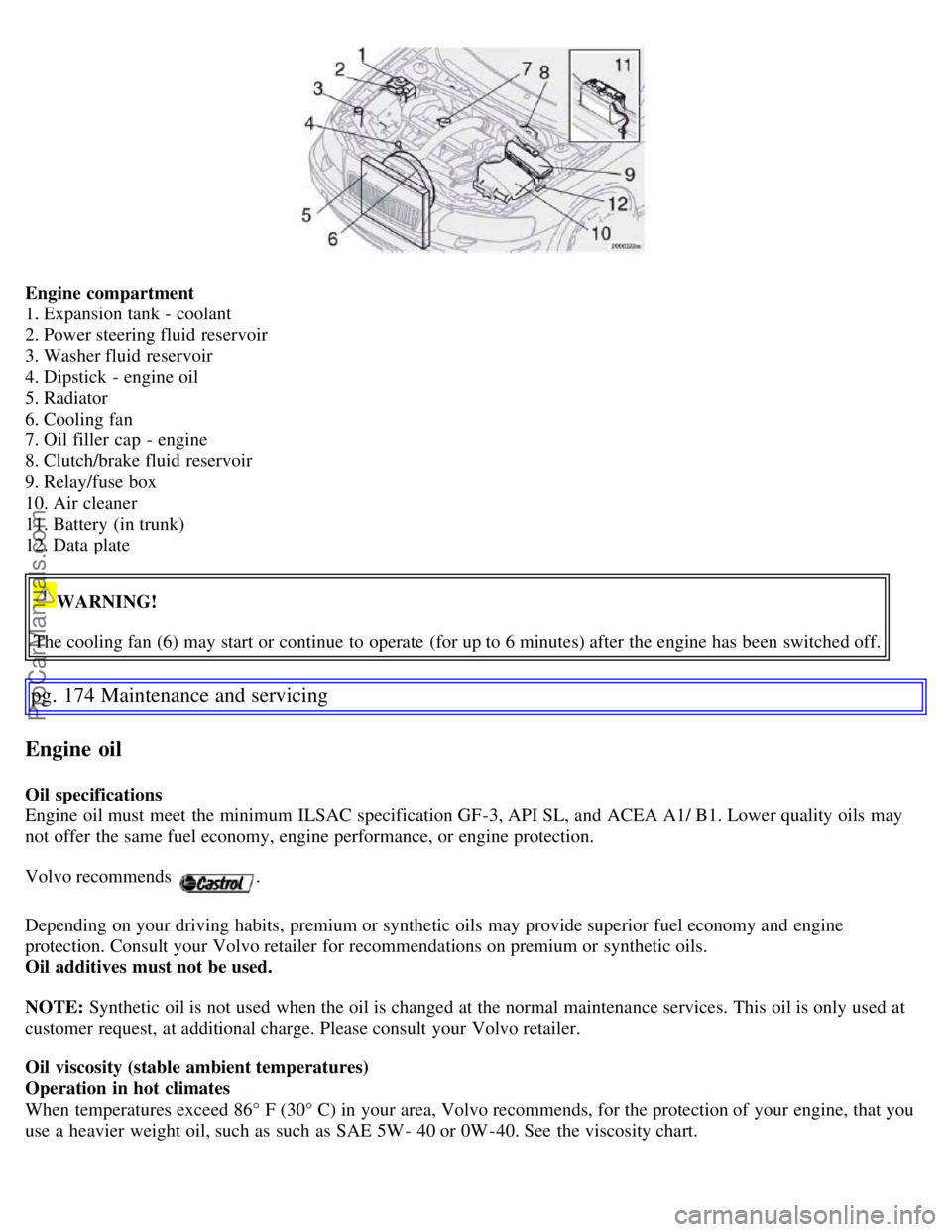
Engine compartment
1. Expansion tank - coolant
2. Power steering fluid reservoir
3. Washer fluid reservoir
4. Dipstick - engine oil
5. Radiator
6. Cooling fan
7. Oil filler cap - engine
8. Clutch/brake fluid reservoir
9. Relay/fuse box
10. Air cleaner
11. Battery (in trunk)
12. Data plate
WARNING!
The cooling fan (6) may start or continue to operate (for up to 6 minutes) after the engine has been switched off.
pg. 174 Maintenance and servicing
Engine oil
Oil specifications
Engine oil must meet the minimum ILSAC specification GF-3, API SL, and ACEA A1/ B1. Lower quality oils may
not offer the same fuel economy, engine performance, or engine protection.
Volvo recommends
.
Depending on your driving habits, premium or synthetic oils may provide superior fuel economy and engine
protection. Consult your Volvo retailer for recommendations on premium or synthetic oils.
Oil additives must not be used.
NOTE: Synthetic oil is not used when the oil is changed at the normal maintenance services. This oil is only used at
customer request, at additional charge. Please consult your Volvo retailer.
Oil viscosity (stable ambient temperatures)
Operation in hot climates
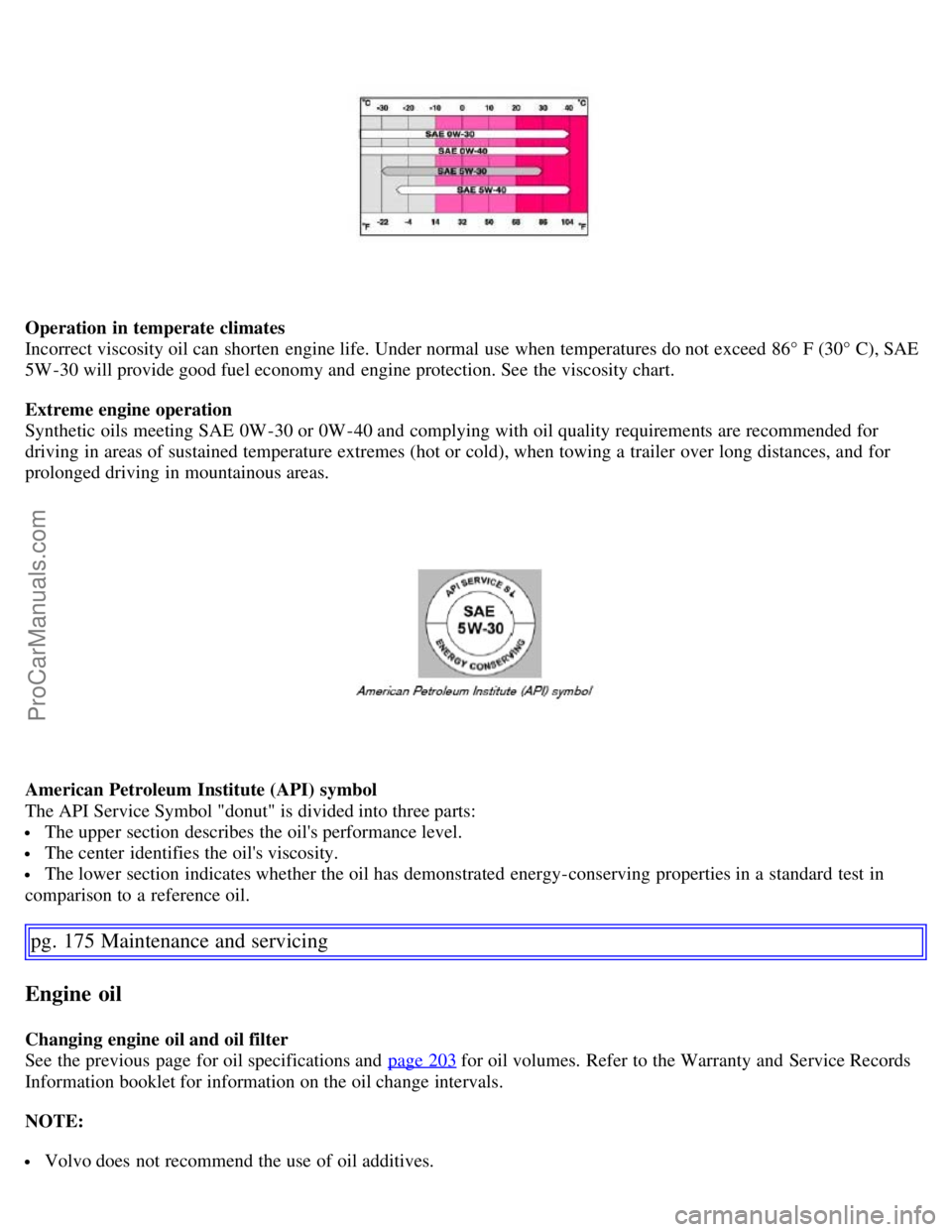
When temperatures exceed 86° F (30° C) in your area, Volvo recommends, for the protection of your engine, that you
use a heavier weight oil, such as such as SAE 5W - 40 or 0W -40. See the viscosity chart.
ProCarManuals.com
Page 148 of 200
Operation in temperate climates
Incorrect viscosity oil can shorten engine life. Under normal use when temperatures do not exceed 86° F (30° C), SAE
5W -30 will provide good fuel economy and engine protection. See the viscosity chart.
Extreme engine operation
Synthetic oils meeting SAE 0W -30 or 0W -40 and complying with oil quality requirements are recommended for
driving in areas of sustained temperature extremes (hot or cold), when towing a trailer over long distances, and for
prolonged driving in mountainous areas.
American Petroleum Institute (API) symbol
The API Service Symbol "donut" is divided into three parts:
The upper section describes the oil's performance level.
The center identifies the oil's viscosity.
The lower section indicates whether the oil has demonstrated energy-conserving properties in a standard test in
comparison to a reference oil.
pg. 175 Maintenance and servicing
Engine oil
Changing engine oil and oil filter
See the previous page for oil specifications and page 203
for oil volumes. Refer to the Warranty and Service Records
Information booklet for information on the oil change intervals.
NOTE:
Volvo does not recommend the use of oil additives.
ProCarManuals.com
Page 149 of 200
Synthetic oil is not used when the oil is changed at the normal maintenance intervals except at owner request and at
additional charge. Please consult your Volvo retailer.
Checking and adding oil
The oil level should be checked every time the vehicle is refueled. This is especially important during the period up to
the first scheduled maintenance service.
The vehicle should be parked on a level surface when the oil is checked.
If the engine is warm, wait for at least 10-15 minutes after the engine has been switched off before checking the oil.
Checking the oil
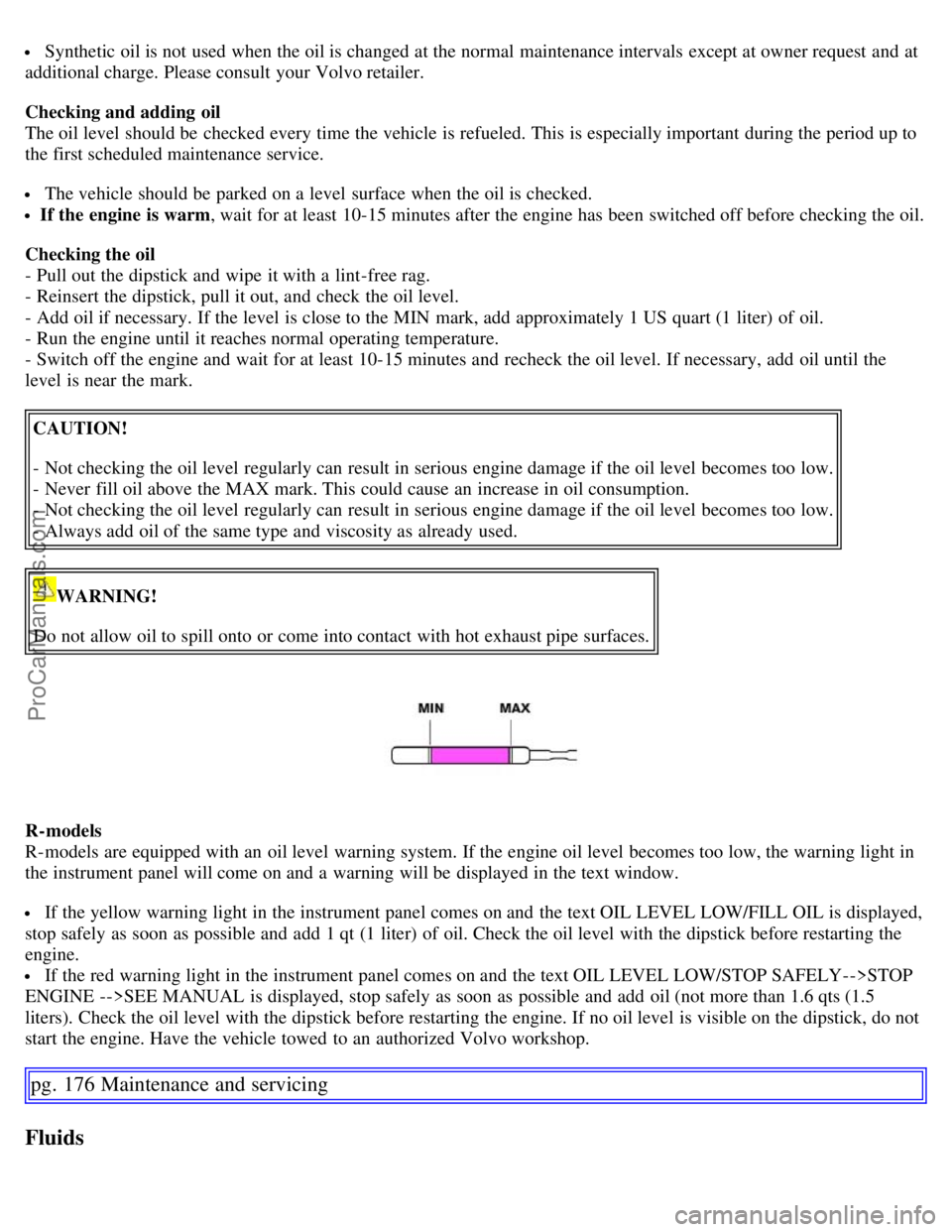
- Pull out the dipstick and wipe it with a lint-free rag.
- Reinsert the dipstick, pull it out, and check the oil level.
- Add oil if necessary. If the level is close to the MIN mark, add approximately 1 US quart (1 liter) of oil.
- Run the engine until it reaches normal operating temperature.
- Switch off the engine and wait for at least 10-15 minutes and recheck the oil level. If necessary, add oil until the
level is near the mark.
CAUTION!
- Not checking the oil level regularly can result in serious engine damage if the oil level becomes too low.
- Never fill oil above the MAX mark. This could cause an increase in oil consumption.
- Not checking the oil level regularly can result in serious engine damage if the oil level becomes too low.
- Always add oil of the same type and viscosity as already used.
WARNING!
Do not allow oil to spill onto or come into contact with hot exhaust pipe surfaces.
R-models
R-models are equipped with an oil level warning system. If the engine oil level becomes too low, the warning light in
the instrument panel will come on and a warning will be displayed in the text window.
If the yellow warning light in the instrument panel comes on and the text OIL LEVEL LOW/FILL OIL is displayed,
stop safely as soon as possible and add 1 qt (1 liter) of oil. Check the oil level with the dipstick before restarting the
engine.
If the red warning light in the instrument panel comes on and the text OIL LEVEL LOW/STOP SAFELY-->STOP
ENGINE -->SEE MANUAL is displayed, stop safely as soon as possible and add oil (not more than 1.6 qts (1.5
liters). Check the oil level with the dipstick before restarting the engine. If no oil level is visible on the dipstick, do not
start the engine. Have the vehicle towed to an authorized Volvo workshop.
pg. 176 Maintenance and servicing
Fluids
ProCarManuals.com
Page 165 of 200
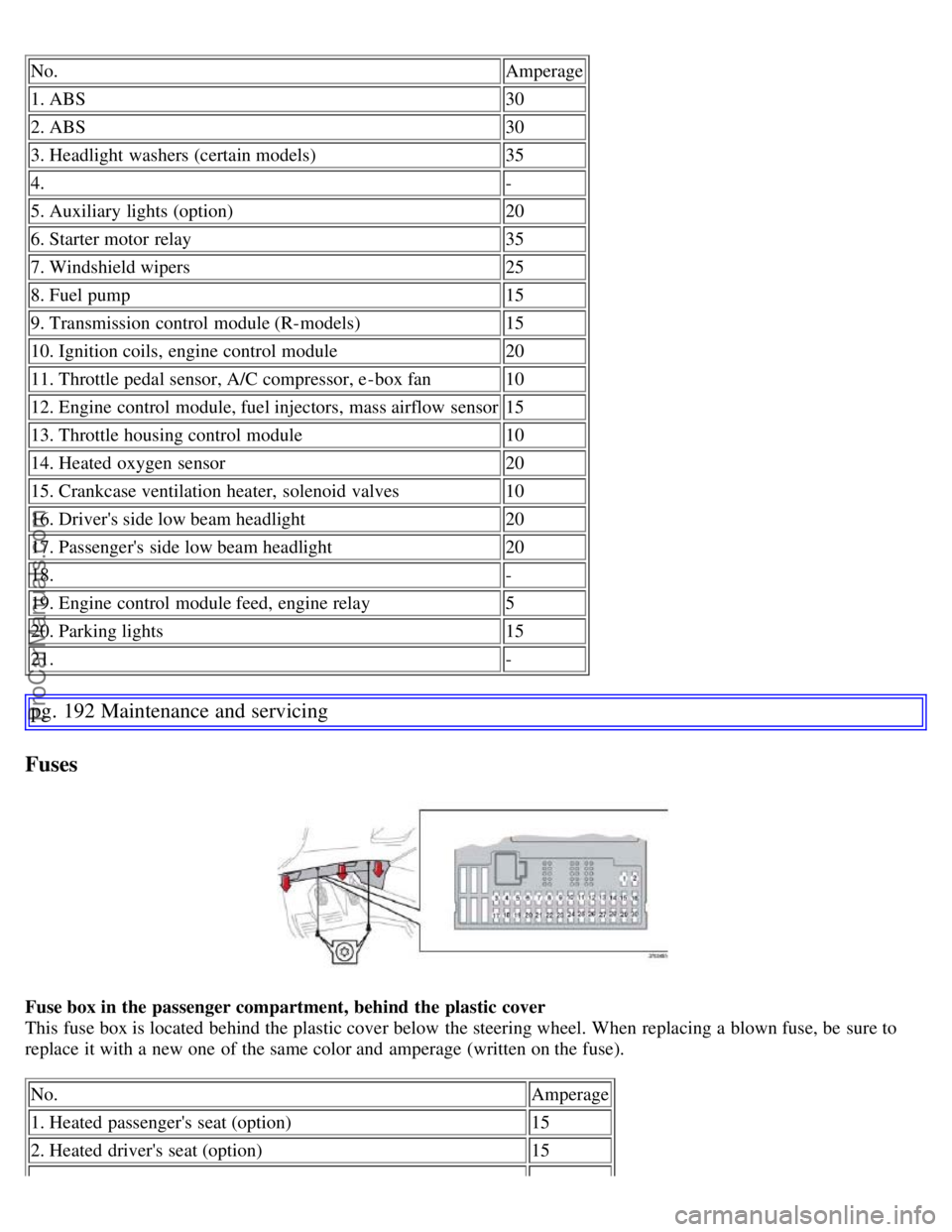
No.Amperage
1. ABS 30
2. ABS 30
3. Headlight washers (certain models) 35
4. -
5. Auxiliary lights (option) 20
6. Starter motor relay 35
7. Windshield wipers 25
8. Fuel pump 15
9. Transmission control module (R-models) 15
10. Ignition coils, engine control module 20
11. Throttle pedal sensor, A/C compressor, e -box fan 10
12. Engine control module, fuel injectors, mass airflow sensor 15
13. Throttle housing control module 10
14. Heated oxygen sensor 20
15. Crankcase ventilation heater, solenoid valves 10
16. Driver's side low beam headlight 20
17. Passenger's side low beam headlight 20
18. -
19. Engine control module feed, engine relay 5
20. Parking lights 15
21. -
pg. 192 Maintenance and servicing
Fuses
Fuse box in the passenger compartment, behind the plastic cover
This fuse box is located behind the plastic cover below the steering wheel. When replacing a blown fuse, be sure to
replace it with a new one of the same color and amperage (written on the fuse).
No. Amperage
1. Heated passenger's seat (option) 15
2. Heated driver's seat (option) 15
ProCarManuals.com
Page 173 of 200
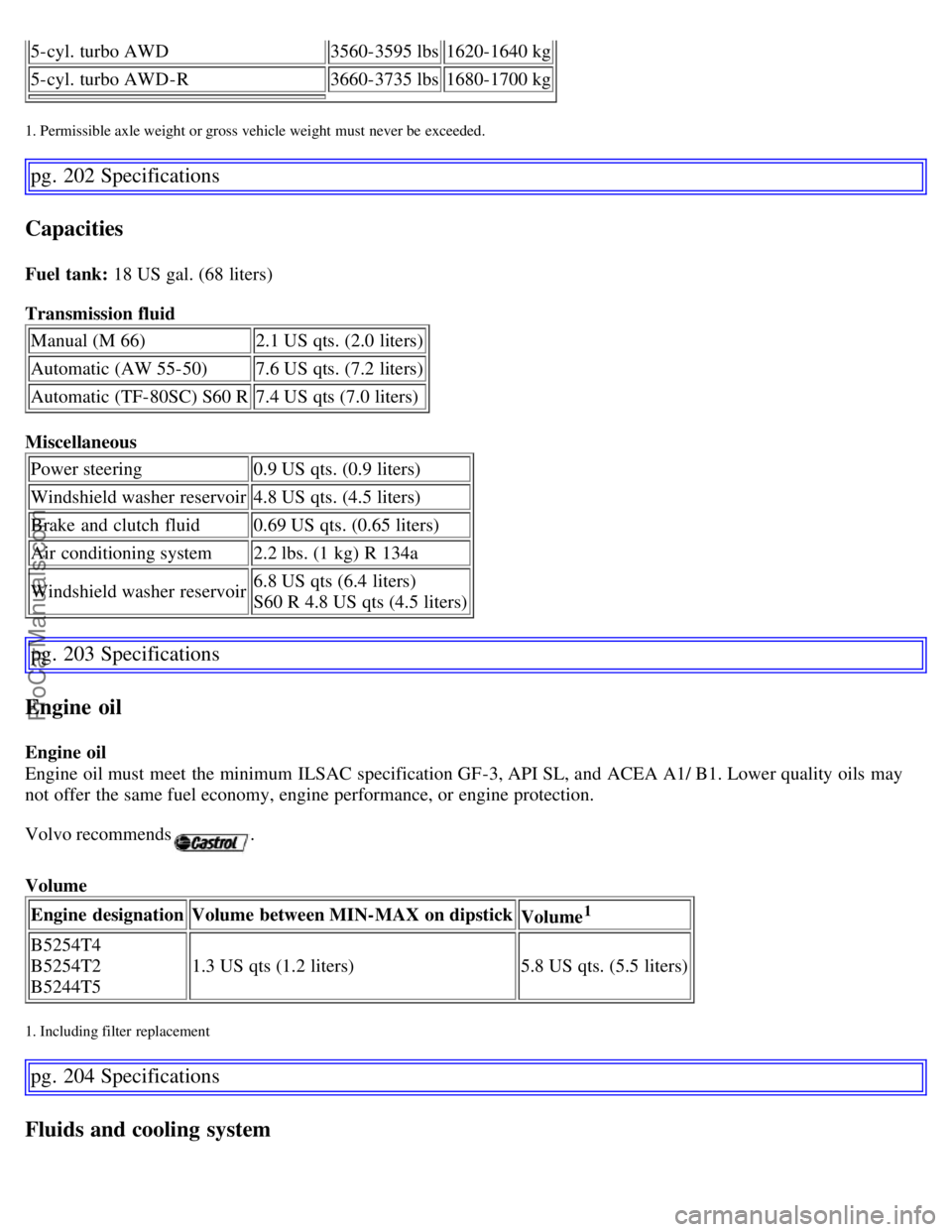
5-cyl. turbo AWD3560-3595 lbs1620-1640 kg
5-cyl. turbo AWD-R 3660-3735 lbs1680-1700 kg
1. Permissible axle weight or gross vehicle weight must never be exceeded.
pg. 202 Specifications
Capacities
Fuel tank: 18 US gal. (68 liters)
Transmission fluid
Manual (M 66) 2.1 US qts. (2.0 liters)
Automatic (AW 55-50) 7.6 US qts. (7.2 liters)
Automatic (TF-80SC) S60 R 7.4 US qts (7.0 liters)
Miscellaneous Power steering 0.9 US qts. (0.9 liters)
Windshield washer reservoir 4.8 US qts. (4.5 liters)
Brake and clutch fluid 0.69 US qts. (0.65 liters)
Air conditioning system 2.2 lbs. (1 kg) R 134a
Windshield washer reservoir 6.8 US qts (6.4 liters)
S60 R 4.8 US qts (4.5 liters)
pg. 203 Specifications
Engine oil
Engine oil
Engine oil must meet the minimum ILSAC specification GF-3, API SL, and ACEA A1/ B1. Lower quality oils may
not offer the same fuel economy, engine performance, or engine protection.
Volvo recommends
.
Volume Engine designation Volume between MIN-MAX on dipstick
Volume
1
B5254T4
B5254T2
B5244T51.3 US qts (1.2 liters)
5.8 US qts. (5.5 liters)
1. Including filter replacement
pg. 204 Specifications
Fluids and cooling system
ProCarManuals.com
Page 174 of 200
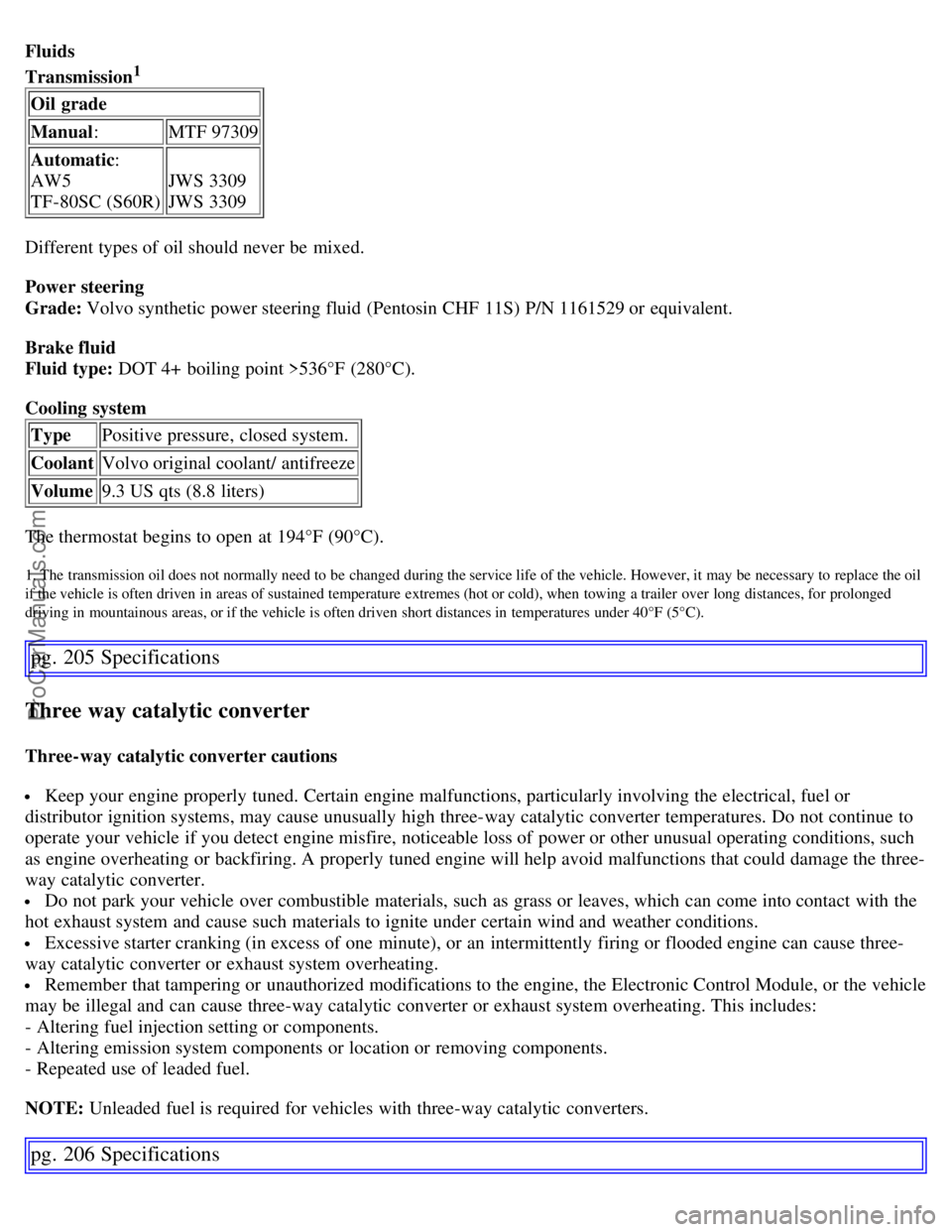
Fluids
Transmission1
Oil grade
Manual: MTF 97309
Automatic :
AW5
TF-80SC (S60R) JWS 3309
JWS 3309
Different types of oil should never be mixed.
Power steering
Grade: Volvo synthetic power steering fluid (Pentosin CHF 11S) P/N 1161529 or equivalent.
Brake fluid
Fluid type: DOT 4+ boiling point >536°F (280°C).
Cooling system Type Positive pressure, closed system.
Coolant Volvo original coolant/ antifreeze
Volume 9.3 US qts (8.8 liters)
The thermostat begins to open at 194°F (90°C).
1. The transmission oil does not normally need to be changed during the service life of the vehicle. However, it may be necessary to replace the oil
if the vehicle is often driven in areas of sustained temperature extremes (hot or cold), when towing a trailer over long distances, for prolonged
driving in mountainous areas, or if the vehicle is often driven short distances in temperatures under 40°F (5°C).
pg. 205 Specifications
Three way catalytic converter
Three-way catalytic converter cautions
Keep your engine properly tuned. Certain engine malfunctions, particularly involving the electrical, fuel or
distributor ignition systems, may cause unusually high three-way catalytic converter temperatures. Do not continue to
operate your vehicle if you detect engine misfire, noticeable loss of power or other unusual operating conditions, such
as engine overheating or backfiring. A properly tuned engine will help avoid malfunctions that could damage the three-
way catalytic converter.
Do not park your vehicle over combustible materials, such as grass or leaves, which can come into contact with the
hot exhaust system and cause such materials to ignite under certain wind and weather conditions.
Excessive starter cranking (in excess of one minute), or an intermittently firing or flooded engine can cause three-
way catalytic converter or exhaust system overheating.
Remember that tampering or unauthorized modifications to the engine, the Electronic Control Module, or the vehicle
may be illegal and can cause three-way catalytic converter or exhaust system overheating. This includes:
- Altering fuel injection setting or components.
- Altering emission system components or location or removing components.
- Repeated use of leaded fuel.
NOTE: Unleaded fuel is required for vehicles with three-way catalytic converters.
pg. 206 Specifications
ProCarManuals.com
Page 177 of 200
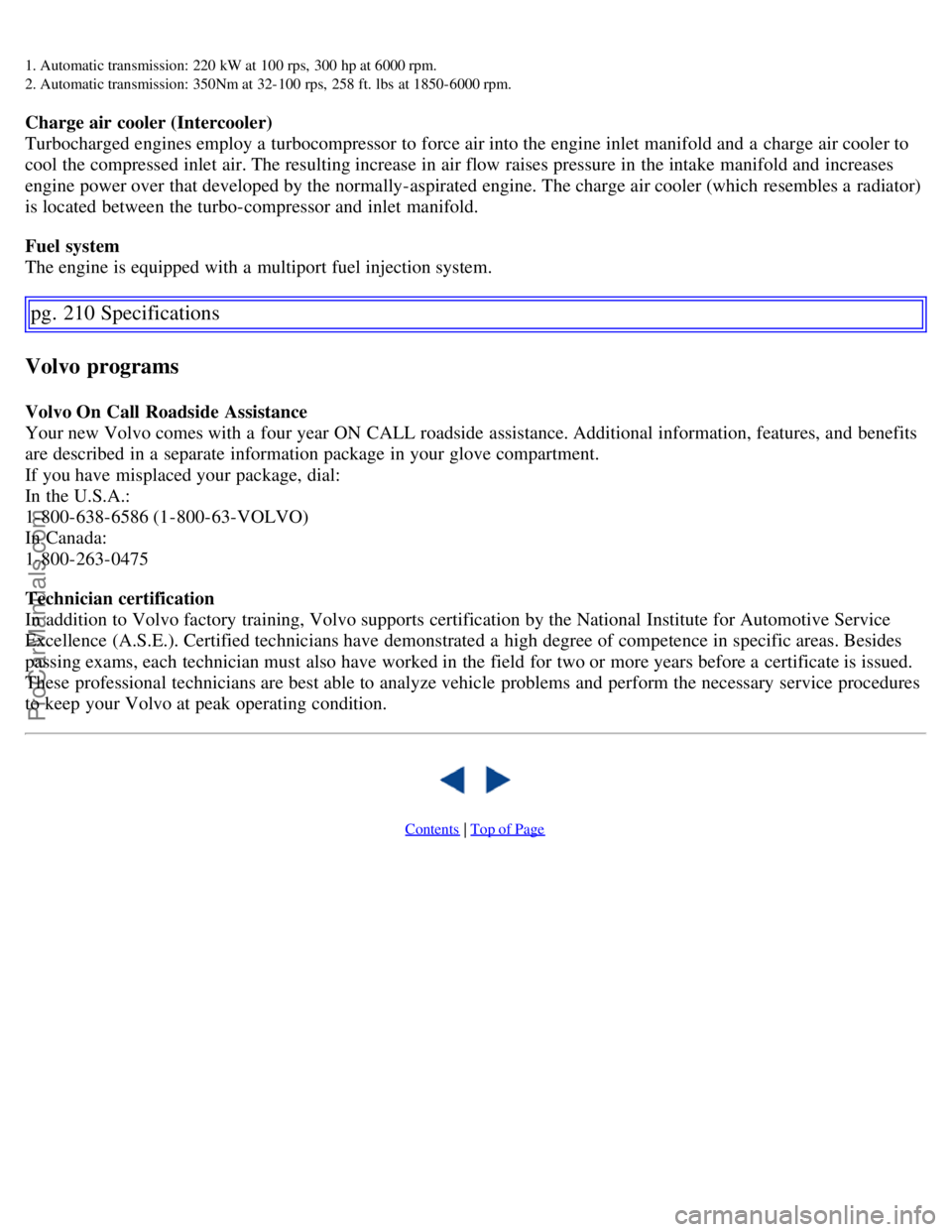
1. Automatic transmission: 220 kW at 100 rps, 300 hp at 6000 rpm.
2. Automatic transmission: 350Nm at 32- 100 rps, 258 ft. lbs at 1850- 6000 rpm.
Charge air cooler (Intercooler)
Turbocharged engines employ a turbocompressor to force air into the engine inlet manifold and a charge air cooler to
cool the compressed inlet air. The resulting increase in air flow raises pressure in the intake manifold and increases
engine power over that developed by the normally-aspirated engine. The charge air cooler (which resembles a radiator)
is located between the turbo-compressor and inlet manifold.
Fuel system
The engine is equipped with a multiport fuel injection system.
pg. 210 Specifications
Volvo programs
Volvo On Call Roadside Assistance
Your new Volvo comes with a four year ON CALL roadside assistance. Additional information, features, and benefits
are described in a separate information package in your glove compartment.
If you have misplaced your package, dial:
In the U.S.A.:
1-800-638-6586 (1-800-63-VOLVO)
In Canada:
1-800-263-0475
Technician certification
In addition to Volvo factory training, Volvo supports certification by the National Institute for Automotive Service
Excellence (A.S.E.). Certified technicians have demonstrated a high degree of competence in specific areas. Besides
passing exams, each technician must also have worked in the field for two or more years before a certificate is issued.
These professional technicians are best able to analyze vehicle problems and perform the necessary service procedures
to keep your Volvo at peak operating condition.
Contents | Top of Page
ProCarManuals.com
Page 195 of 200
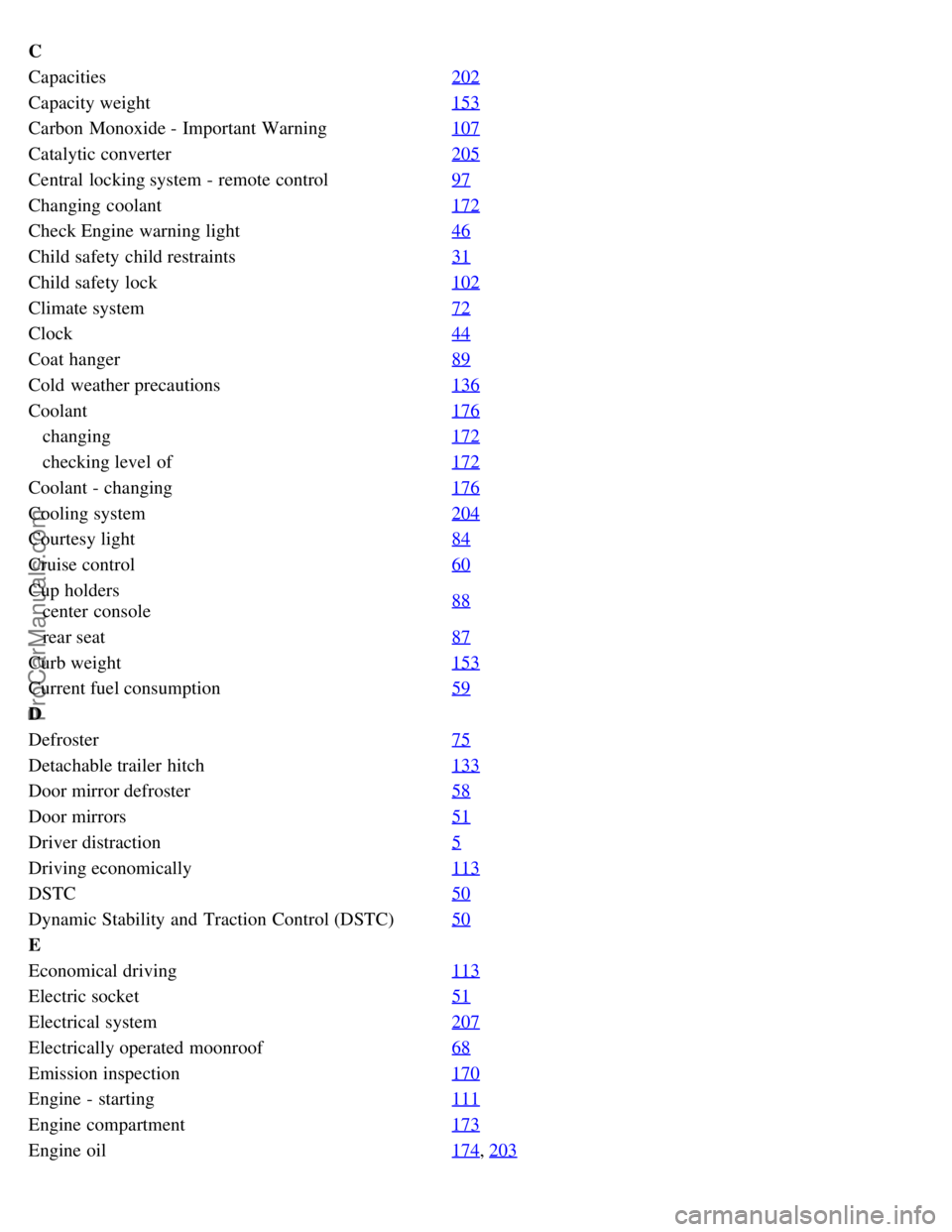
C
Capacities202
Capacity weight153
Carbon Monoxide - Important Warning107
Catalytic converter205
Central locking system - remote control97
Changing coolant172
Check Engine warning light46
Child safety child restraints31
Child safety lock102
Climate system72
Clock44
Coat hanger89
Cold weather precautions136
Coolant176
changing172
checking level of172
Coolant - changing176
Cooling system204
Courtesy light84
Cruise control60
Cup holders
center console88
rear seat
87
Curb weight153
Current fuel consumption59
D
Defroster75
Detachable trailer hitch133
Door mirror defroster58
Door mirrors51
Driver distraction5
Driving economically113
DSTC50
Dynamic Stability and Traction Control (DSTC)50
E
Economical driving113
Electric socket51
Electrical system207
Electrically operated moonroof68
Emission inspection170
Engine - starting111
Engine compartment173
Engine oil174, 203
ProCarManuals.com