seats VOLVO S60 2007 Owners Manual
[x] Cancel search | Manufacturer: VOLVO, Model Year: 2007, Model line: S60, Model: VOLVO S60 2007Pages: 200, PDF Size: 4.03 MB
Page 6 of 200
2 0 0 7
VOLVO S60
Safety
pg. 9 Safety
Occupant safety, Reporting safety defects 10
Seat belts12
Supplemental Restraint System (SRS)15
Front airbags16
Occupant Weight Sensor (OWS)20
Side impact protection (SIPS) airbags24
Volvo Inflatable Curtain (VIC)25
Whiplash Protection System (WHIPS)26
Child safety28
Child restraint systems31
Infant seats33
Convertible seats35
Booster cushions37
ISOFIX lower anchors38
Top tether anchors39
pg. 10 Safety
Occupant safety, Reporting safety defects
Volvo concern for safety
Safety is the Volvo cornerstone. Our concern dates back to 1927 when the first Volvo rolled off the production line.
Three-point seat belts (a Volvo invention), safety cages, and energy-absorbing impact zones were designed into Volvo
vehicles long before it was fashionable or required by government regulation. We will not compromise our
commitment to safety. We continue to seek out new safety features and to refine those already in our vehicles. You
can help. We would appreciate hearing your suggestions about improving automobile safety. We also want to know if
you ever have a safety concern with your vehicle. Call us in the U.S. at: 800-458-1552 or in Canada at: 800-663-8255.
Occupant safety
How safely you drive doesn't depend on how old you are but rather on:
How well you see.
Your ability to concentrate.
How quickly you make decisions under stress to avoid an accident.
The tips listed below are suggestions to help you cope with the ever changing traffic environment.
ProCarManuals.com
Page 9 of 200
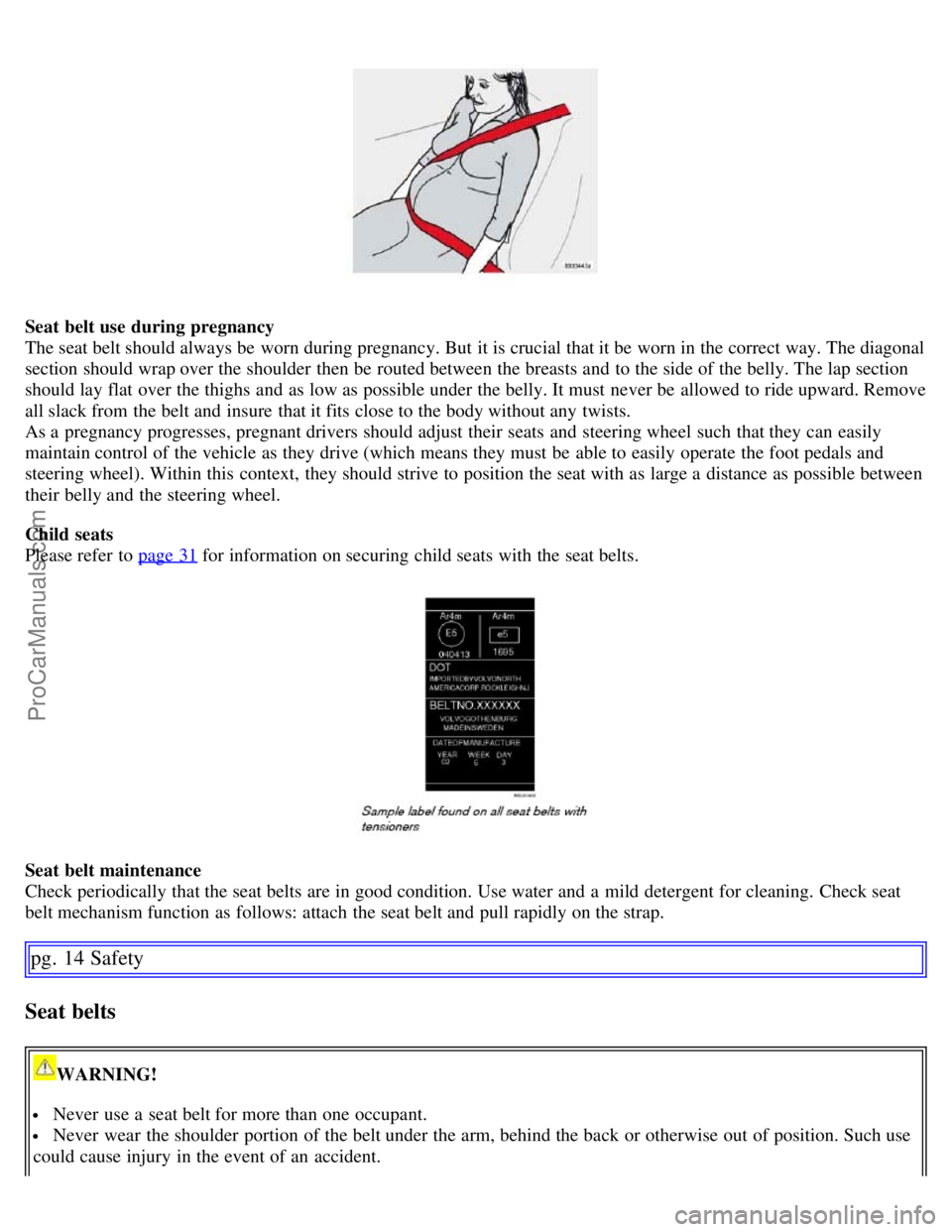
Seat belt use during pregnancy
The seat belt should always be worn during pregnancy. But it is crucial that it be worn in the correct way. The diagonal
section should wrap over the shoulder then be routed between the breasts and to the side of the belly. The lap section
should lay flat over the thighs and as low as possible under the belly. It must never be allowed to ride upward. Remove
all slack from the belt and insure that it fits close to the body without any twists.
As a pregnancy progresses, pregnant drivers should adjust their seats and steering wheel such that they can easily
maintain control of the vehicle as they drive (which means they must be able to easily operate the foot pedals and
steering wheel). Within this context, they should strive to position the seat with as large a distance as possible between
their belly and the steering wheel.
Child seats
Please refer to page 31
for information on securing child seats with the seat belts.
Seat belt maintenance
Check periodically that the seat belts are in good condition. Use water and a mild detergent for cleaning. Check seat
belt mechanism function as follows: attach the seat belt and pull rapidly on the strap.
pg. 14 Safety
Seat belts
WARNING!
Never use a seat belt for more than one occupant.
Never wear the shoulder portion of the belt under the arm, behind the back or otherwise out of position. Such use
could cause injury in the event of an accident.
ProCarManuals.com
Page 10 of 200
Seat belts lose much of their strength when exposed to violent stretching and should be replaced after any
collision, even if they appear to be undamaged.
Never repair the belt yourself; have this work done by an authorized Volvo service technician only.
Any device used to induce slack into the shoulder belt portion of the three-point belt system will have a
detrimental effect on the amount of protection available to you in the event of a collision.
The seat back should not be tilted too far back. The shoulder belt must be taut in order to function properly.
Do not use child safety seats or child booster cushions/backrests in the front passenger's seat. We also recommend
that children who have outgrown these devices sit in the rear seat with the seat belt properly fastened.
pg. 15 Safety
Supplemental Restraint System (SRS)
Supplemental Restraint System
As an enhancement to the three-point seat belts, your Volvo is equipped with a Supplemental Restraint System (SRS).
Volvo's SRS consists of seat belt tensioners, front airbags, side impact airbags, the occupant weight sensor, and
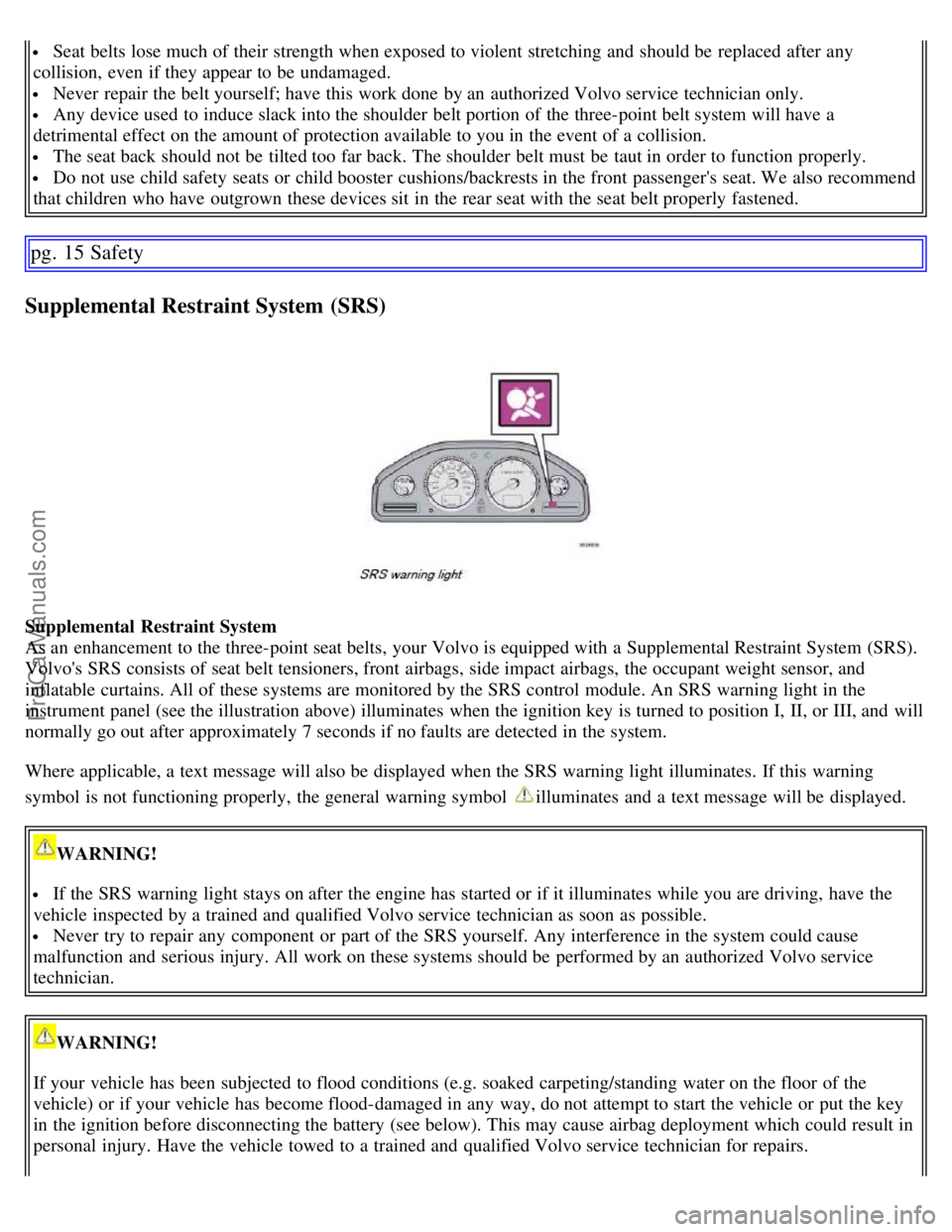
inflatable curtains. All of these systems are monitored by the SRS control module. An SRS warning light in the
instrument panel (see the illustration above) illuminates when the ignition key is turned to position I, II, or III, and will
normally go out after approximately 7 seconds if no faults are detected in the system.
Where applicable, a text message will also be displayed when the SRS warning light illuminates. If this warning
symbol is not functioning properly, the general warning symbol
illuminates and a text message will be displayed.
WARNING!
If the SRS warning light stays on after the engine has started or if it illuminates while you are driving, have the
vehicle inspected by a trained and qualified Volvo service technician as soon as possible.
Never try to repair any component or part of the SRS yourself. Any interference in the system could cause
malfunction and serious injury. All work on these systems should be performed by an authorized Volvo service
technician.
WARNING!
If your vehicle has been subjected to flood conditions (e.g. soaked carpeting/standing water on the floor of the
vehicle) or if your vehicle has become flood-damaged in any way, do not attempt to start the vehicle or put the key
in the ignition before disconnecting the battery (see below). This may cause airbag deployment which could result in
personal injury. Have the vehicle towed to a trained and qualified Volvo service technician for repairs.
ProCarManuals.com
Page 11 of 200
Automatic transmission:
Before attempting to tow the vehicle, use the following procedure to override the shiftlock system to move the gear
selector to the neutral position:
Switch off the ignition for at least 10 minutes and disconnect the battery.
Wait at least one minute.
Insert the key in the ignition and turn it to position II.
Press firmly on the brake pedal.
Move the gear selector from (P)ark to the (N)eutral position.
pg. 16 Safety
Front airbags
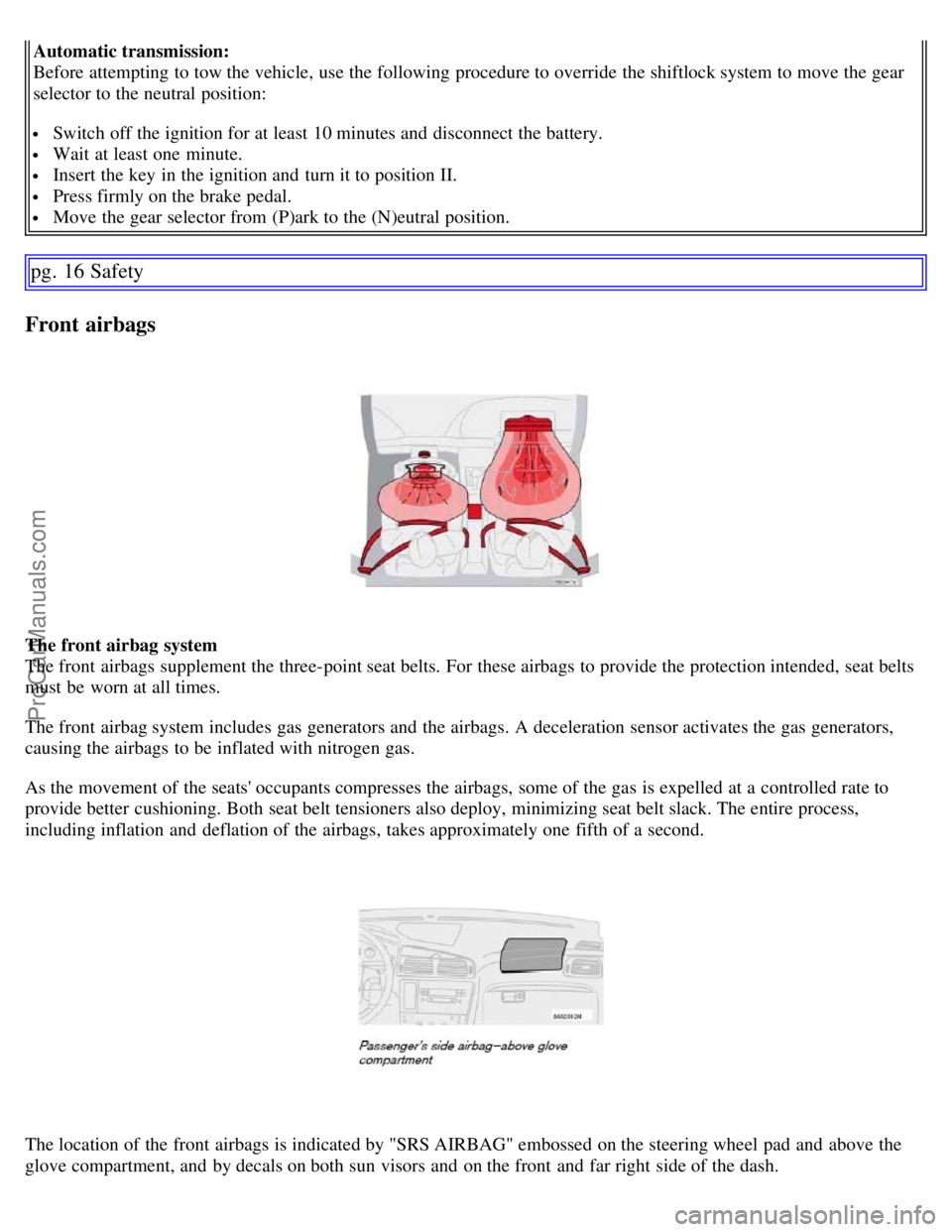
The front airbag system
The front airbags supplement the three-point seat belts. For these airbags to provide the protection intended, seat belts
must be worn at all times.
The front airbag system includes gas generators and the airbags. A deceleration sensor activates the gas generators,
causing the airbags to be inflated with nitrogen gas.
As the movement of the seats' occupants compresses the airbags, some of the gas is expelled at a controlled rate to
provide better cushioning. Both seat belt tensioners also deploy, minimizing seat belt slack. The entire process,
including inflation and deflation of the airbags, takes approximately one fifth of a second.
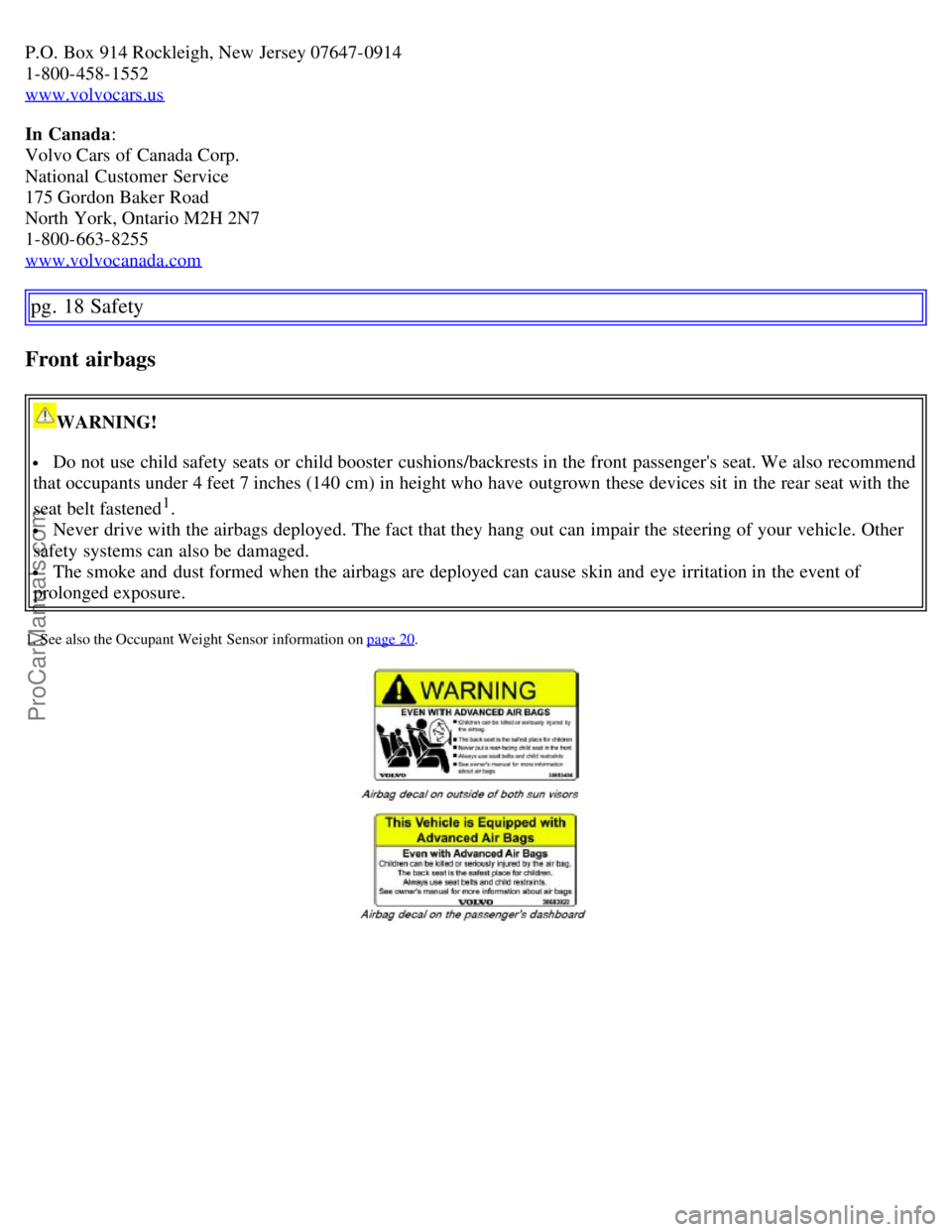
The location of the front airbags is indicated by "SRS AIRBAG" embossed on the steering wheel pad and above the
glove compartment, and by decals on both sun visors and on the front and far right side of the dash.
ProCarManuals.com
Page 13 of 200
P.O. Box 914 Rockleigh, New Jersey 07647-0914
1-800-458-1552
www.volvocars.us
In Canada:
Volvo Cars of Canada Corp.
National Customer Service
175 Gordon Baker Road
North York, Ontario M2H 2N7
1-800-663-8255
www.volvocanada.com
pg. 18 Safety
Front airbags
WARNING!
Do not use child safety seats or child booster cushions/backrests in the front passenger's seat. We also recommend
that occupants under 4 feet 7 inches (140 cm) in height who have outgrown these devices sit in the rear seat with the
seat belt fastened
1.
Never drive with the airbags deployed. The fact that they hang out can impair the steering of your vehicle. Other
safety systems can also be damaged.
The smoke and dust formed when the airbags are deployed can cause skin and eye irritation in the event of
prolonged exposure.
1. See also the Occupant Weight Sensor information on page 20.
ProCarManuals.com
Page 16 of 200

Occupant Weight Sensor (OWS)
WARNING!
If a fault in the system is detected and indicated as explained on the previous page, be aware that the passenger's
side front airbag will not deploy in the event of a collision.
In this case, the safety systems and Occupant Weight Sensor should be inspected by an authorized Volvo retailer as
soon as possible.
WARNING!
Never try to open, remove, or repair any components in the OWS system. This could result in system
malfunction. Maintenance or repairs should only be carried out by an authorized Volvo service technician.
The front passenger's seat should not be modified in any way. This could reduce pressure on the seat cushion,
which might interfere with the OWS system's function.
The OWS is designed to disable (will not inflate) the passenger's side front airbag when a rear facing infant seat, a
forward-facing child restraint, or a booster seat is detected. The PASSENGER AIRBAG OFF indicator lamp will
illuminate and stay on to remind you that the passenger's side front airbag is disabled (see the following table).
The OWS is designed to enable (may inflate) the passenger's side front airbag anytime the system senses that a person
of adult size is sitting properly in the front passenger's seat. The PASSENGER AIRBAG OFF indicator lamp will be
off and remain off.
If a person of adult size is sitting in the front passenger's seat, but the PASSENGER AIRBAG OFF indicator lamp is
on, it is possible that the person isn't sitting properly in the seat. If this happens:
Turn the vehicle off and ask the person to place the seatback in an upright position.
1. Volvo recommends that children always be properly restrained in appropriate child restraints in the rear seats. In rare situations when the seat
belt is not properly fastened, some child restraints may not be detected by the OWS because there is very little weight on the vehicle seat cushion.
In these cases the passenger's side front airbag may be disabled, but the PASSENGER AIRBAG OFF indicator lamp will not be lit. Do not assume
that the passenger's side front airbag is disabled unless the PASSENGER AIRBAG OFF indicator lamp is lit. Make sure the child restraint is
properly installed (turn the vehicle off, remove the child restraint from the vehicle and reinstall the restraint following the child restraint
manufacturer's instructions) and that the PASSENGER AIRBAG OFF indicator lamp is on, or move the child restraint to the rear seat.
ProCarManuals.com
Page 18 of 200
him/herself off the seat cushion using the armrest in the door or the center console, by pressing the feet on the floor,
by sitting on the edge of the seat cushion, or by pressing against the backrest in a way that reduces pressure on the
seat cushion. This could cause OWS to disable the front passenger's side airbag.
Do not place any type of object on the front passenger's seat in such a way that jamming, pressing, or squeezing
occurs between the object and the front seat, other than as a direct result of the correct use of the ALR/ELR seat belt
(see page 30
).
No objects should be placed under the front passenger's seat. This could interfere with the OWS system's
function.
pg. 24 Safety
Side impact (SIPS) airbags
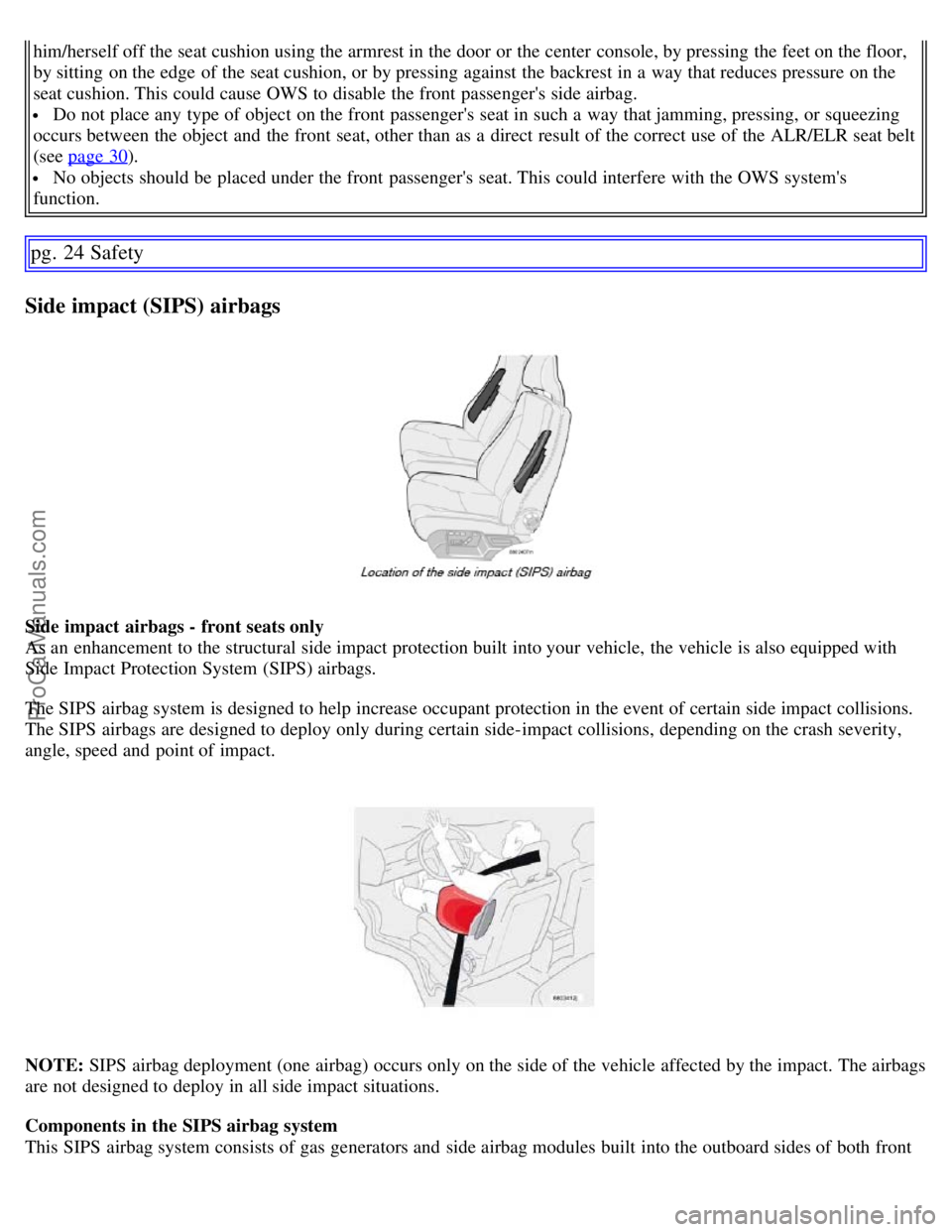
Side impact airbags - front seats only
As an enhancement to the structural side impact protection built into your vehicle, the vehicle is also equipped with
Side Impact Protection System (SIPS) airbags.
The SIPS airbag system is designed to help increase occupant protection in the event of certain side impact collisions.
The SIPS airbags are designed to deploy only during certain side-impact collisions, depending on the crash severity,
angle, speed and point of impact.
NOTE: SIPS airbag deployment (one airbag) occurs only on the side of the vehicle affected by the impact. The airbags
are not designed to deploy in all side impact situations.
Components in the SIPS airbag system
This SIPS airbag system consists of gas generators and side airbag modules built into the outboard sides of both front
ProCarManuals.com
Page 19 of 200
seat backrests.
WARNING!
The SIPS airbag system is a supplement to the structural Side Impact Protection System and the three-point seat
belt system. It is not designed to deploy during collisions from the front or rear of the vehicle or in rollover
situations.
The use of seat covers on the front seats may impede SIPS airbag deployment.
No objects, accessory equipment or stickers may be placed on, attached to or installed near the SIPS airbag
system or in the area affected by SIPS airbag deployment.
Never try to open or repair any components of the SIPS airbag system. This should be done only by a trained and
qualified Volvo service technician.
In order for the SIPS airbag to provide its best protection, both front seat occupants should sit in an upright
position with the seat belt properly fastened.
Failure to follow these instructions can result in injury to the occupants of the vehicle in the event of an accident.
pg. 25 Safety
Volvo Inflatable Curtain (VIC)
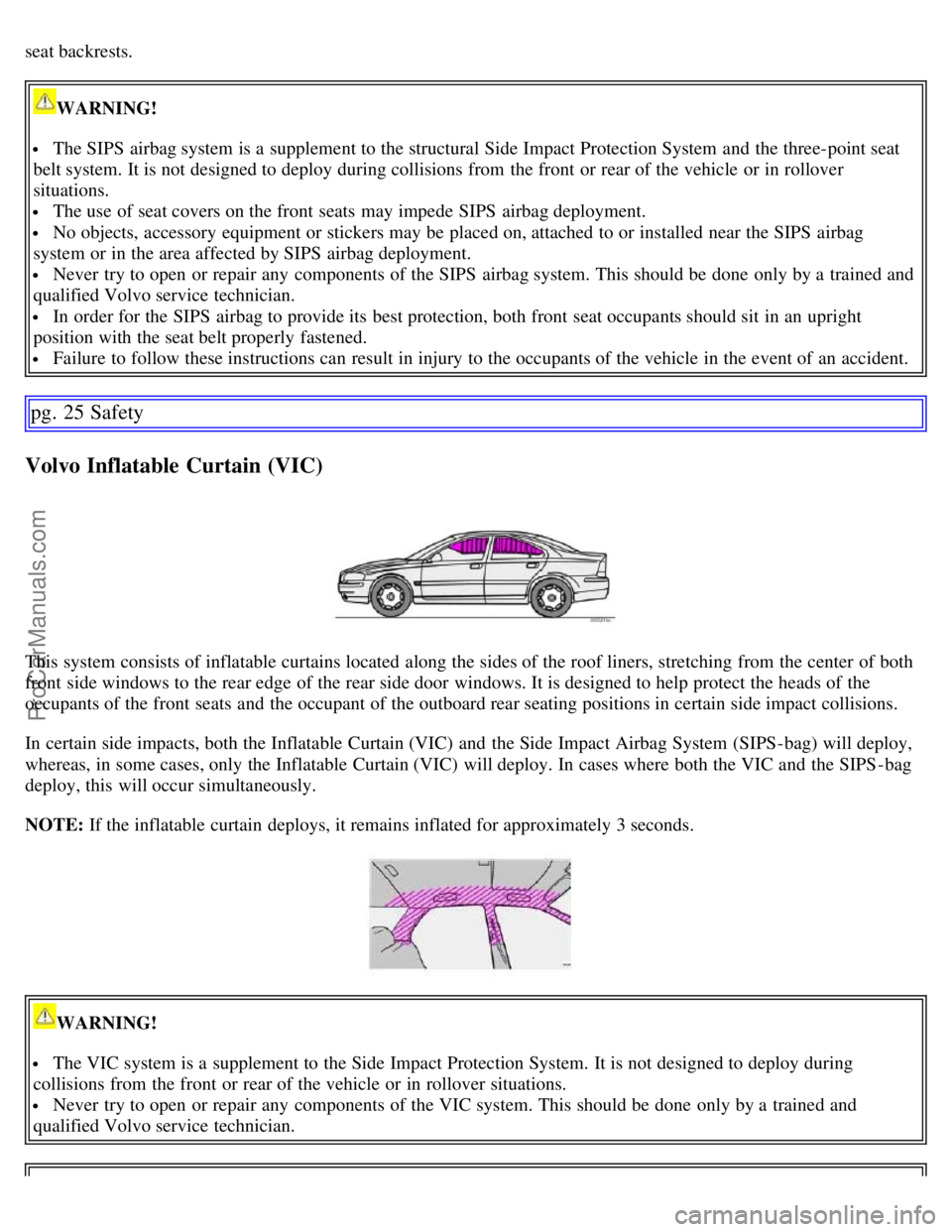
This system consists of inflatable curtains located along the sides of the roof liners, stretching from the center of both
front side windows to the rear edge of the rear side door windows. It is designed to help protect the heads of the
occupants of the front seats and the occupant of the outboard rear seating positions in certain side impact collisions.
In certain side impacts, both the Inflatable Curtain (VIC) and the Side Impact Airbag System (SIPS-bag) will deploy,
whereas, in some cases, only the Inflatable Curtain (VIC) will deploy. In cases where both the VIC and the SIPS -bag
deploy, this will occur simultaneously.
NOTE: If the inflatable curtain deploys, it remains inflated for approximately 3 seconds.
WARNING!
The VIC system is a supplement to the Side Impact Protection System. It is not designed to deploy during
collisions from the front or rear of the vehicle or in rollover situations.
Never try to open or repair any components of the VIC system. This should be done only by a trained and
qualified Volvo service technician.
ProCarManuals.com
Page 20 of 200
WARNING!
In order for the VIC to provide its best protection, both front seat occupants and both outboard rear seat occupants
should sit in an upright position with the seat belt properly fastened; adults using the seat belt and children using the
proper child restraint system. Only adults should sit in the front seats. Children must never be allowed in the front
passenger seat. See page 30
for guidelines. Failure to follow these instructions can result in injury to the vehicle
occupants in an accident.
pg. 26 Safety
Whiplash Protection System (WHIPS)
Whiplash Protection System (WHIPS) - front seats only
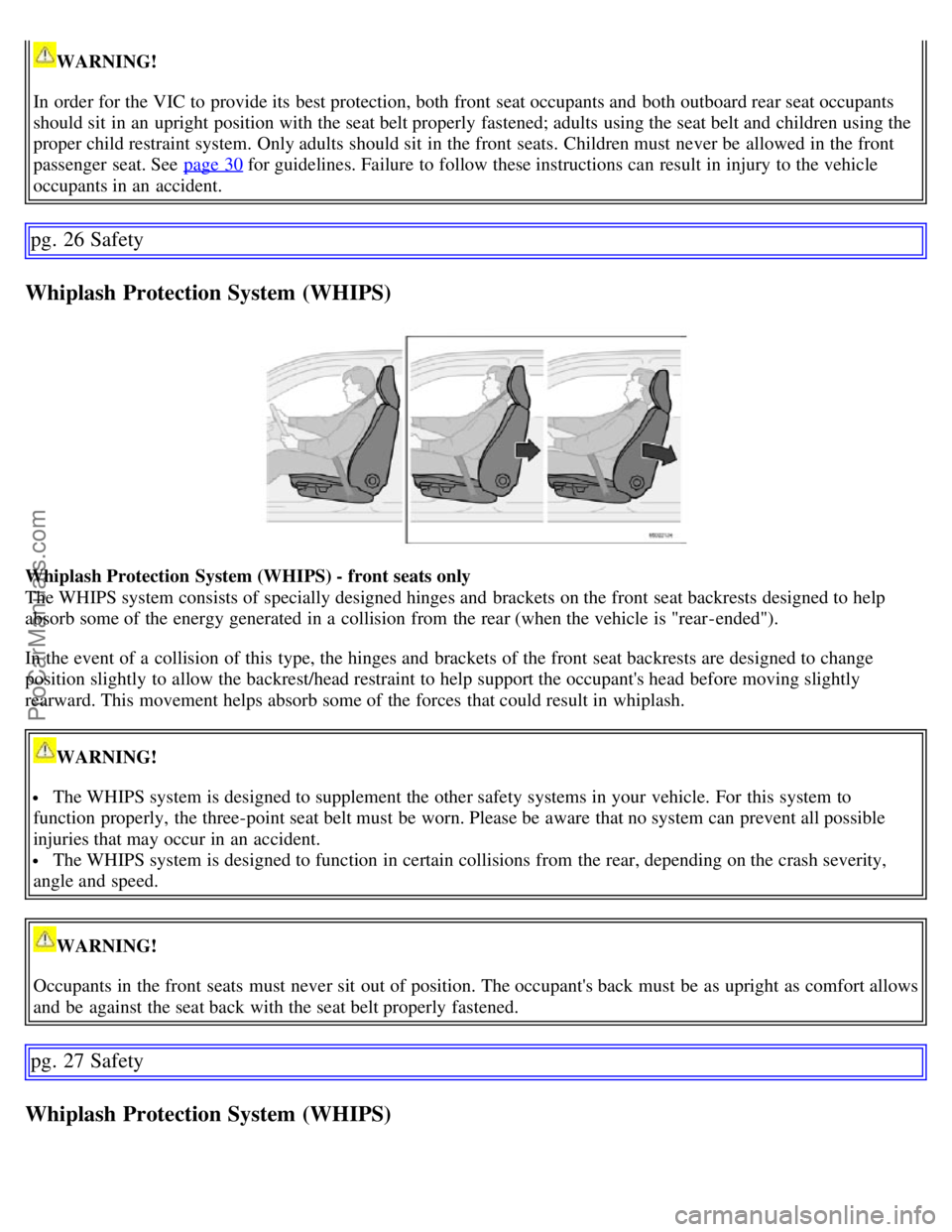
The WHIPS system consists of specially designed hinges and brackets on the front seat backrests designed to help
absorb some of the energy generated in a collision from the rear (when the vehicle is "rear-ended").
In the event of a collision of this type, the hinges and brackets of the front seat backrests are designed to change
position slightly to allow the backrest/head restraint to help support the occupant's head before moving slightly
rearward. This movement helps absorb some of the forces that could result in whiplash.
WARNING!
The WHIPS system is designed to supplement the other safety systems in your vehicle. For this system to
function properly, the three-point seat belt must be worn. Please be aware that no system can prevent all possible
injuries that may occur in an accident.
The WHIPS system is designed to function in certain collisions from the rear, depending on the crash severity,
angle and speed.
WARNING!
Occupants in the front seats must never sit out of position. The occupant's back must be as upright as comfort allows
and be against the seat back with the seat belt properly fastened.
pg. 27 Safety
Whiplash Protection System (WHIPS)
ProCarManuals.com
Page 21 of 200
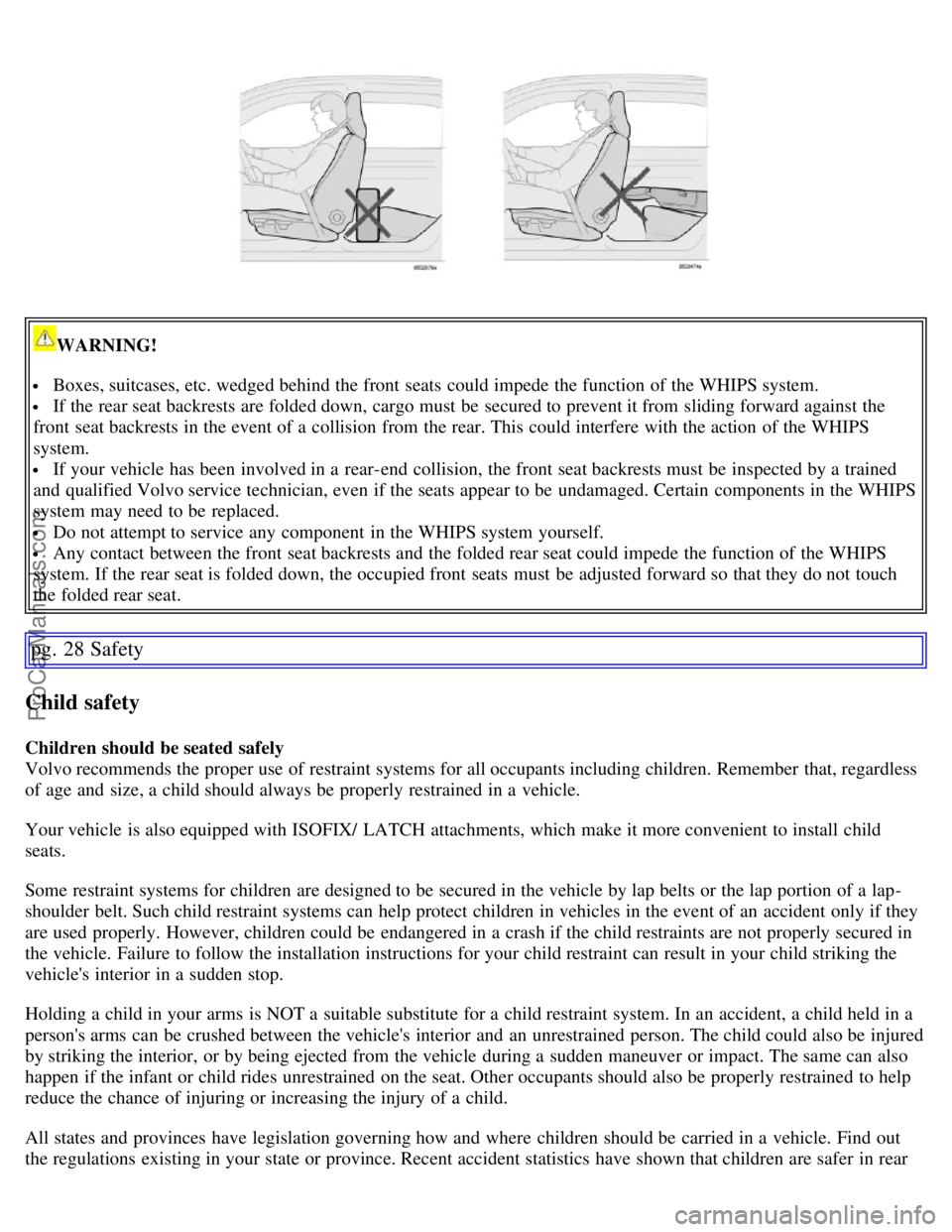
WARNING!
Boxes, suitcases, etc. wedged behind the front seats could impede the function of the WHIPS system.
If the rear seat backrests are folded down, cargo must be secured to prevent it from sliding forward against the
front seat backrests in the event of a collision from the rear. This could interfere with the action of the WHIPS
system.
If your vehicle has been involved in a rear-end collision, the front seat backrests must be inspected by a trained
and qualified Volvo service technician, even if the seats appear to be undamaged. Certain components in the WHIPS
system may need to be replaced.
Do not attempt to service any component in the WHIPS system yourself.
Any contact between the front seat backrests and the folded rear seat could impede the function of the WHIPS
system. If the rear seat is folded down, the occupied front seats must be adjusted forward so that they do not touch
the folded rear seat.
pg. 28 Safety
Child safety
Children should be seated safely
Volvo recommends the proper use of restraint systems for all occupants including children. Remember that, regardless
of age and size, a child should always be properly restrained in a vehicle.
Your vehicle is also equipped with ISOFIX/ LATCH attachments, which make it more convenient to install child
seats.
Some restraint systems for children are designed to be secured in the vehicle by lap belts or the lap portion of a lap-
shoulder belt. Such child restraint systems can help protect children in vehicles in the event of an accident only if they
are used properly. However, children could be endangered in a crash if the child restraints are not properly secured in
the vehicle. Failure to follow the installation instructions for your child restraint can result in your child striking the
vehicle's interior in a sudden stop.
Holding a child in your arms is NOT a suitable substitute for a child restraint system. In an accident, a child held in a
person's arms can be crushed between the vehicle's interior and an unrestrained person. The child could also be injured
by striking the interior, or by being ejected from the vehicle during a sudden maneuver or impact. The same can also
happen if the infant or child rides unrestrained on the seat. Other occupants should also be properly restrained to help
reduce the chance of injuring or increasing the injury of a child.
All states and provinces have legislation governing how and where children should be carried in a vehicle. Find out
the regulations existing in your state or province. Recent accident statistics have shown that children are safer in rear
ProCarManuals.com