sensor VOLVO S60 2008 Owner's Guide
[x] Cancel search | Manufacturer: VOLVO, Model Year: 2008, Model line: S60, Model: VOLVO S60 2008Pages: 230, PDF Size: 5.33 MB
Page 141 of 230
sound sources that use the same ultrasound frequencies as the system. This may include such things as the horns of
other vehicles, wet tires on asphalt, pneumatic brakes, motorcycle exhaust pipes, etc. This does not indicate a fault in
the system.
153 06 Starting and driving
Front/rear park assist (option/accessory)
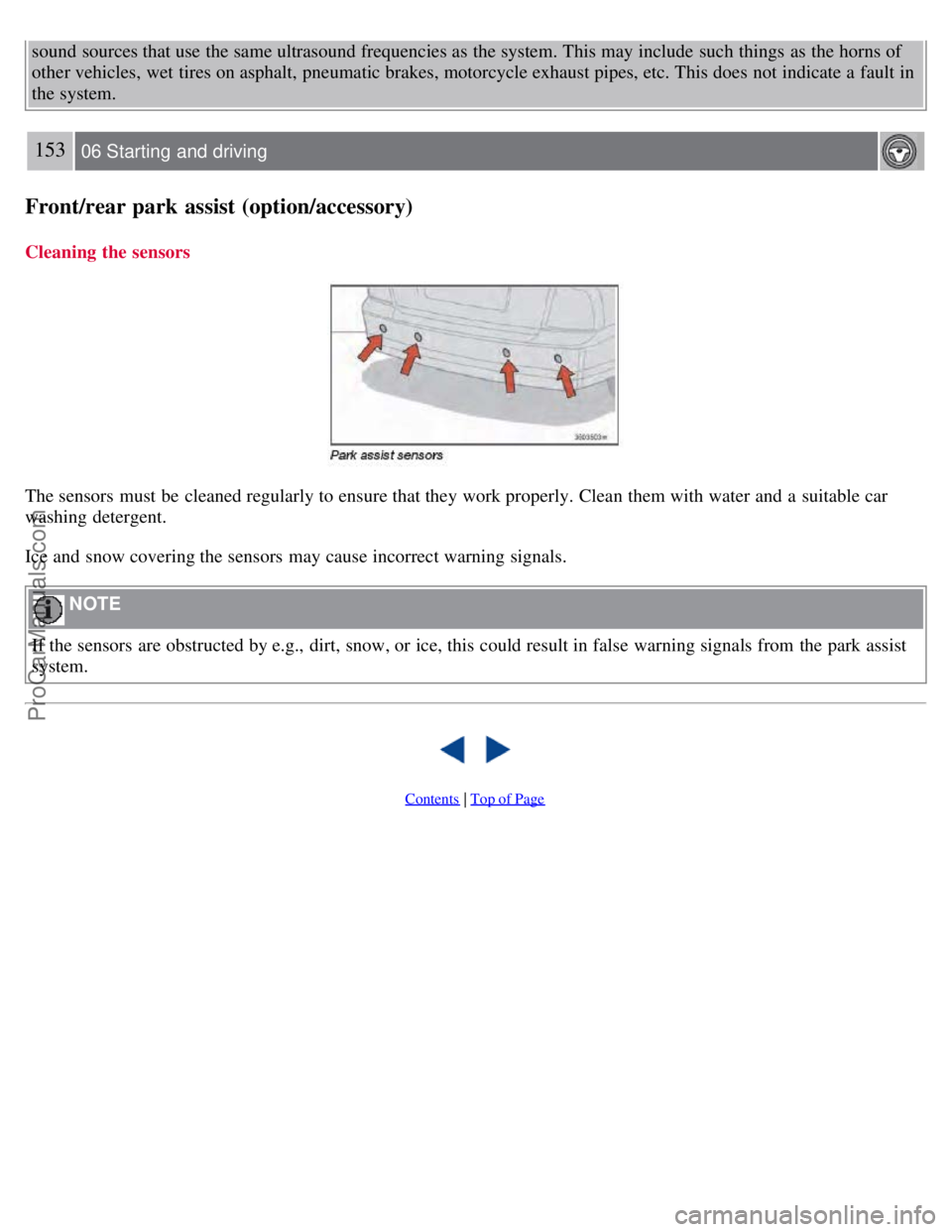
Cleaning the sensors
The sensors must be cleaned regularly to ensure that they work properly. Clean them with water and a suitable car
washing detergent.
Ice and snow covering the sensors may cause incorrect warning signals.
NOTE
If the sensors are obstructed by e.g., dirt, snow, or ice, this could result in false warning signals from the park assist
system.
Contents | Top of Page
ProCarManuals.com
Page 148 of 230
162 07 Wheels and tires
Tire Pressure Monitoring System (TPMS) - U.S. models
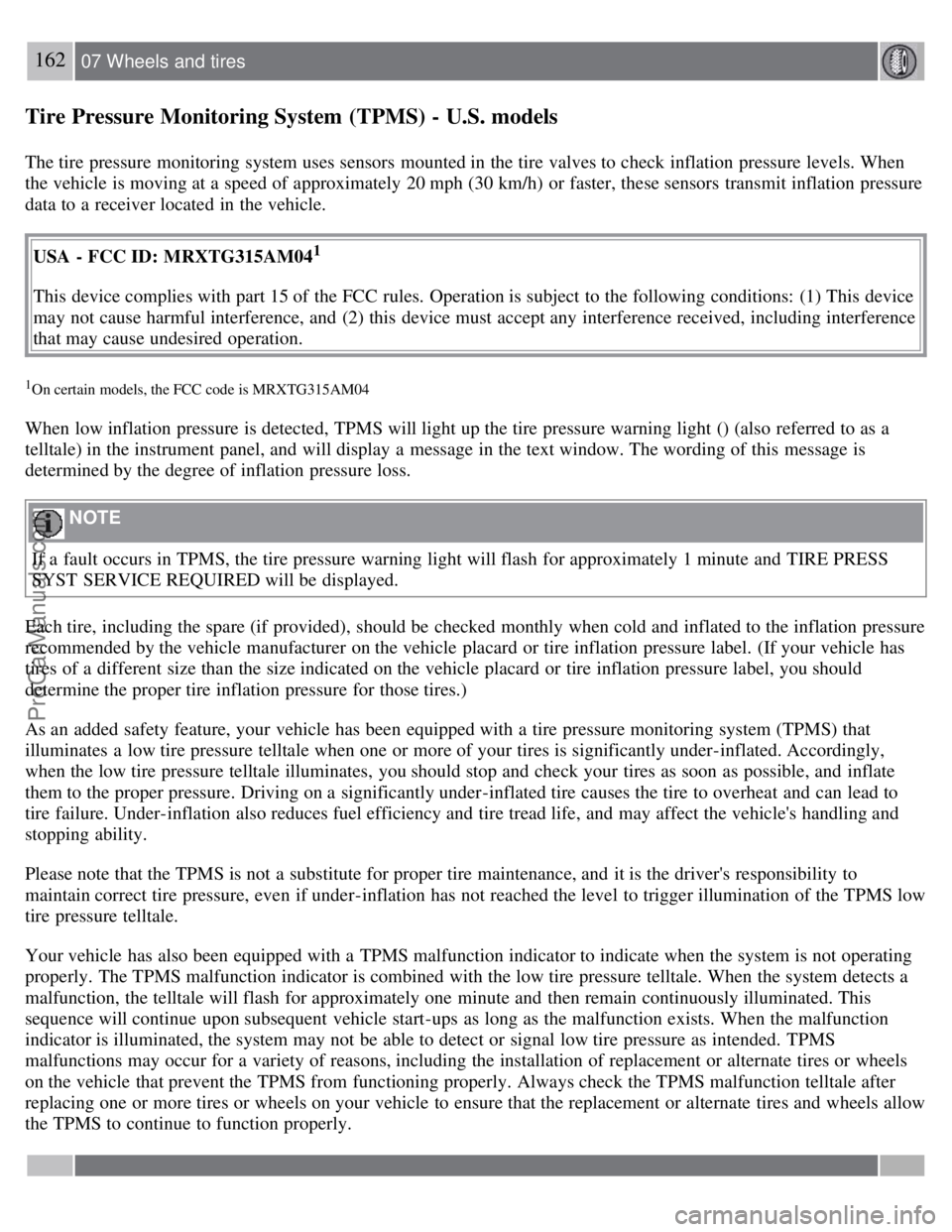
The tire pressure monitoring system uses sensors mounted in the tire valves to check inflation pressure levels. When
the vehicle is moving at a speed of approximately 20 mph (30 km/h) or faster, these sensors transmit inflation pressure
data to a receiver located in the vehicle.USA - FCC ID: MRXTG315AM04
1
This device complies with part 15 of the FCC rules. Operation is subject to the following conditions: (1) This device
may not cause harmful interference, and (2) this device must accept any interference received, including interference
that may cause undesired operation.
1On certain models, the FCC code is MRXTG315AM04
When low inflation pressure is detected, TPMS will light up the tire pressure warning light () (also referred to as a
telltale) in the instrument panel, and will display a message in the text window. The wording of this message is
determined by the degree of inflation pressure loss.
NOTE
If a fault occurs in TPMS, the tire pressure warning light will flash for approximately 1 minute and TIRE PRESS
SYST SERVICE REQUIRED will be displayed.
Each tire, including the spare (if provided), should be checked monthly when cold and inflated to the inflation pressure
recommended by the vehicle manufacturer on the vehicle placard or tire inflation pressure label. (If your vehicle has
tires of a different size than the size indicated on the vehicle placard or tire inflation pressure label, you should
determine the proper tire inflation pressure for those tires.)
As an added safety feature, your vehicle has been equipped with a tire pressure monitoring system (TPMS) that
illuminates a low tire pressure telltale when one or more of your tires is significantly under-inflated. Accordingly,
when the low tire pressure telltale illuminates, you should stop and check your tires as soon as possible, and inflate
them to the proper pressure. Driving on a significantly under-inflated tire causes the tire to overheat and can lead to
tire failure. Under-inflation also reduces fuel efficiency and tire tread life, and may affect the vehicle's handling and
stopping ability.
Please note that the TPMS is not a substitute for proper tire maintenance, and it is the driver's responsibility to
maintain correct tire pressure, even if under-inflation has not reached the level to trigger illumination of the TPMS low
tire pressure telltale.
Your vehicle has also been equipped with a TPMS malfunction indicator to indicate when the system is not operating
properly. The TPMS malfunction indicator is combined with the low tire pressure telltale. When the system detects a
malfunction, the telltale will flash for approximately one minute and then remain continuously illuminated. This
sequence will continue upon subsequent vehicle start-ups as long as the malfunction exists. When the malfunction
indicator is illuminated, the system may not be able to detect or signal low tire pressure as intended. TPMS
malfunctions may occur for a variety of reasons, including the installation of replacement or alternate tires or wheels
on the vehicle that prevent the TPMS from functioning properly. Always check the TPMS malfunction telltale after
replacing one or more tires or wheels on your vehicle to ensure that the replacement or alternate tires and wheels allow
the TPMS to continue to function properly.
ProCarManuals.com
Page 149 of 230
163 07 Wheels and tires
Tire Pressure Monitoring System (TPMS) - U.S. models
NOTE
TPMS indicates low tire pressure but does not replace normal tire maintenance. For information on correct tire
pressure, please refer to the tables on pages 160 and 161
, or consult your Volvo retailer.
Erasing warning messages
When a low tire pressure warning message has been displayed, and the tire pressure warning light has come on:
Use a tire pressure gauge to check the inflation pressure of all four tires.
Re-inflate the tire(s) to the correct pressure (consult the tire pressure placard or the tables on pages 160 and 161).
Drive the vehicle for several minutes at a speed of 20 mph (30 km/h) or faster.
This will erase the warning text and the warning light will go out.
WARNING
Incorrect inflation pressure could lead to tire failure, resulting in a loss of control of the vehicle.
Changing wheels with TPMS
Please note the following when changing or replacing the factory installed TPMS wheels/tires on the vehicle:
Only the factory-mounted wheels are equipped with TPMS sensors in the valves.
If the vehicle is equipped with a temporary spare tire, this tire does not have a TPMS sensor.
If wheels without TPMS sensors are mounted on the vehicle, TIRE PRESS SYST SERVICE REQUIRED will be
displayed each time the vehicle is driven above 25 mph (40 km/h) for 10 minutes or more.
Once TPMS sensors are properly installed, the warning message should not reappear.
Volvo recommends that TPMS sensors be fitted on all wheels used on the vehicle. Volvo does not recommend
moving sensors back and forth between sets of wheels.
CAUTION
When inflating tires with TPMS valves, press the pump's mouthpiece straight onto the valve to help avoid bending or
otherwise damaging the valve.
164 07 Wheels and tires
Tire designations
ProCarManuals.com
Page 173 of 230
The upper section describes the oil's performance level.
The center identifies the oil's viscosity.
The lower section indicates whether the oil has demonstrated energy-conserving properties in a standard test in
comparison to a reference oil.
NOTE
Volvo uses different systems to indicate a low oil level or pressure. Some models have an oil pressure sensor, in which
case a warning symbol (see page 50
) is used to indicate low oil pressure. Other models have an oil level sensor, in
which case the driver is alerted by the warning symbol in the center of the instrument panel and a text in the information
display. Some models use both systems. Contact a trained and qualified Volvo service technician for more information.
Changing engine oil and oil filter
See the previous page for oil specifications and page 246
for oil volumes. Refer to the Warranty and Service Records
Information booklet for information on the oil change intervals.
NOTE
Volvo does not recommend the use of oil additives.
Synthetic oil is not used when the oil is changed at the normal maintenance intervals except at owner request and at
additional charge. Please consult a trained and qualified Volvo service technician.
Checking and adding oil
The oil level should be checked every time the vehicle is refueled. This is especially important during the period up to the
first scheduled maintenance service.
The vehicle should be parked on a level surface when the oil is checked.
If the engine is warm , wait for at least 10- 15 minutes after the engine has been switched off before checking the oil.
Checking the oil
1. Pull out the dipstick and wipe it with a lint-free rag.
2. Reinsert the dipstick, pull it out, and check the oil level.
3. Add oil if necessary. If the level is close to the MIN mark, add approximately 1 US quart (1 liter) of oil.
4. Run the engine until it reaches normal operating temperature.
5. Switch off the engine and wait for at least 10-15 minutes and recheck the oil level. If necessary, add oil until the level
is near the mark.
194 09 Maintenance and servicing
Engine oil
CAUTION
Not checking the oil level regularly can result in serious engine damage if the oil level becomes too low.
Never fill oil above the MAX mark. This could cause an increase in oil consumption.
Not checking the oil level regularly can result in serious engine damage if the oil level becomes too low.
Always add oil of the same type and viscosity as already used.
ProCarManuals.com
Page 223 of 230
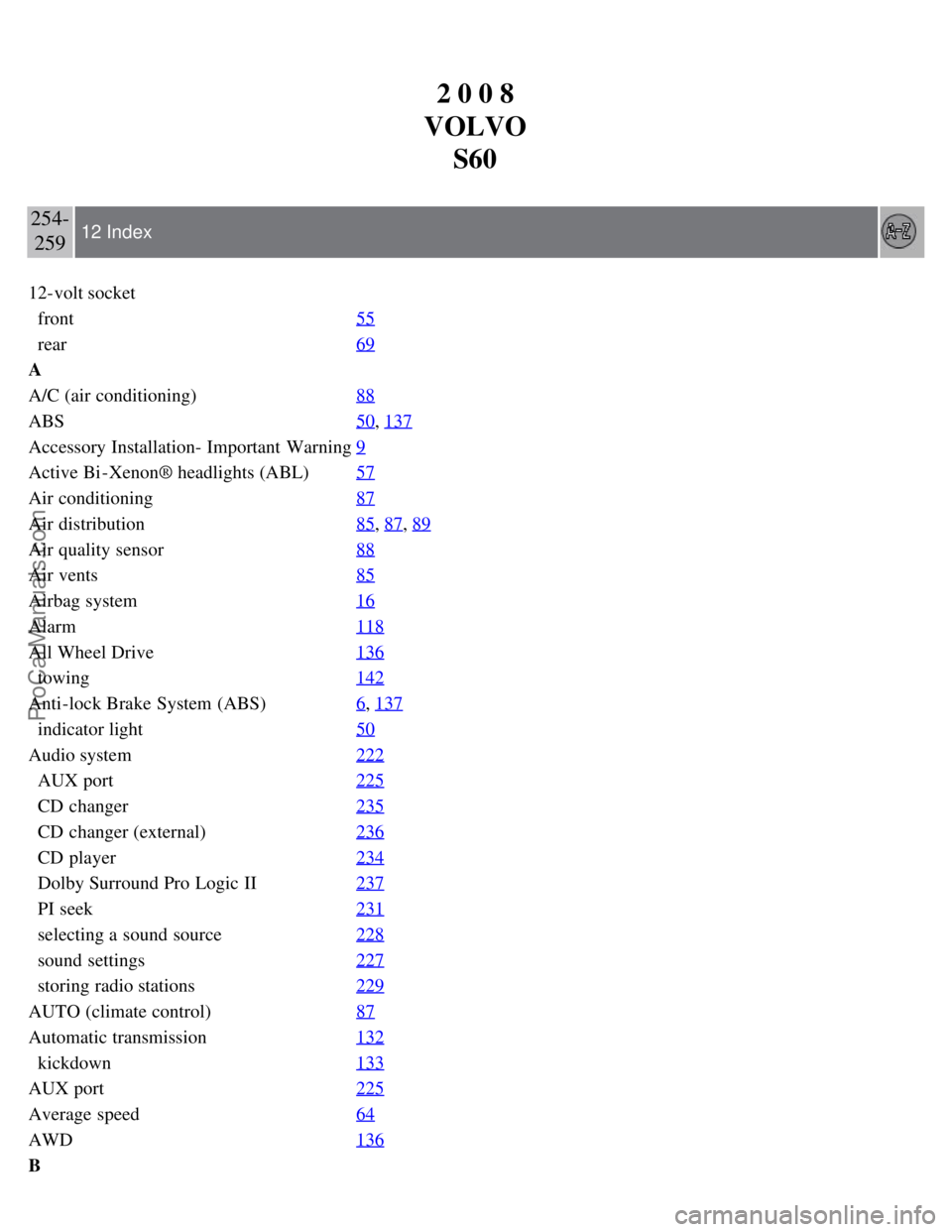
2 0 0 8
VOLVO S60
254-259 12 Index
12-volt socket
front 55
rear69
A
A/C (air conditioning)88
ABS50, 137
Accessory Installation- Important Warning9
Active Bi -Xenon® headlights (ABL)57
Air conditioning87
Air distribution85, 87, 89
Air quality sensor88
Air vents85
Airbag system16
Alarm118
All Wheel Drive136
towing142
Anti-lock Brake System (ABS)6, 137
indicator light50
Audio system222
AUX port225
CD changer235
CD changer (external)236
CD player234
Dolby Surround Pro Logic II237
PI seek231
selecting a sound source228
sound settings227
storing radio stations229
AUTO (climate control)87
Automatic transmission132
kickdown133
AUX port225
Average speed64
AWD136
B
ProCarManuals.com
Page 227 of 230
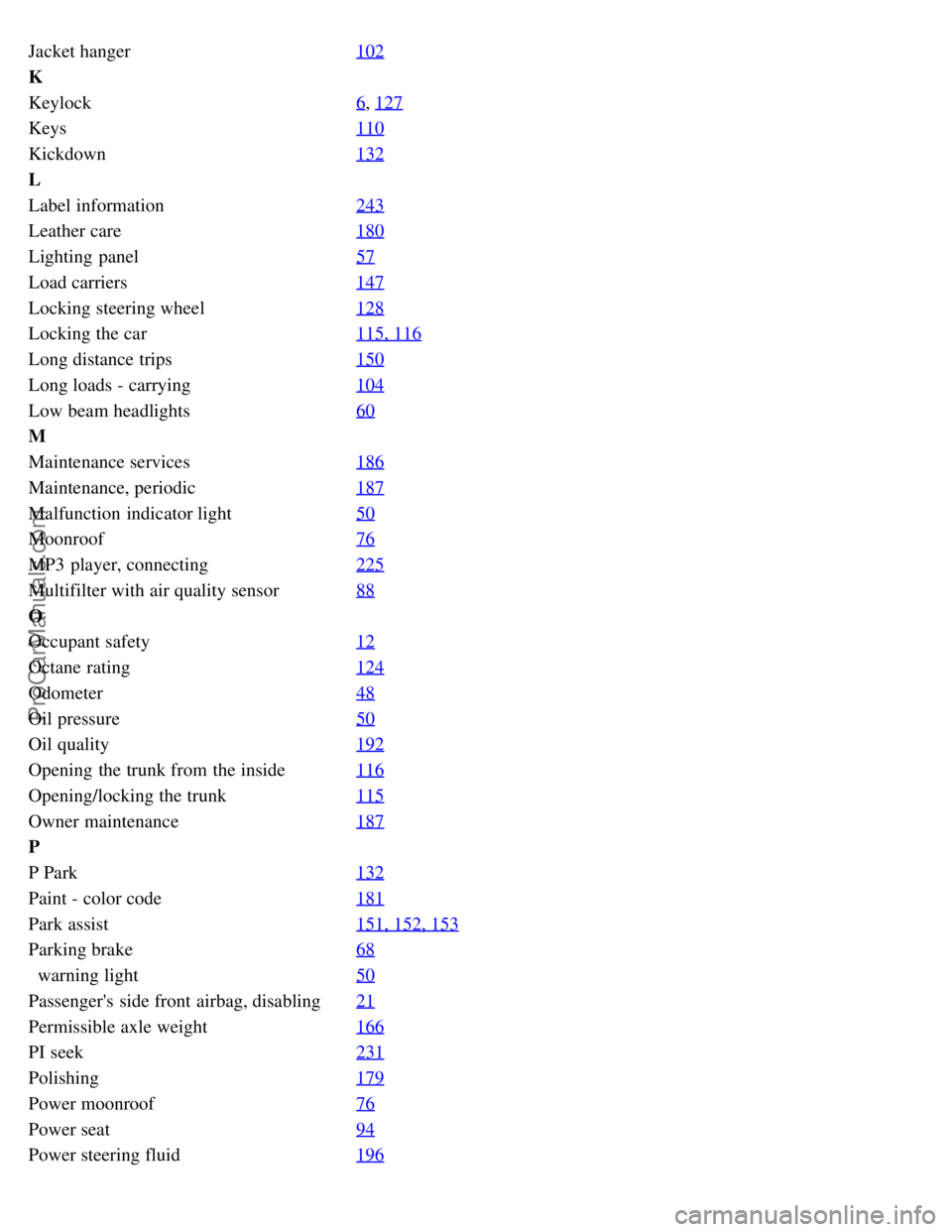
Jacket hanger102
K
Keylock6
, 127
Keys110
Kickdown132
L
Label information243
Leather care180
Lighting panel57
Load carriers147
Locking steering wheel128
Locking the car115, 116
Long distance trips150
Long loads - carrying104
Low beam headlights60
M
Maintenance services186
Maintenance, periodic187
Malfunction indicator light50
Moonroof76
MP3 player, connecting225
Multifilter with air quality sensor88
O
Occupant safety12
Octane rating124
Odometer48
Oil pressure50
Oil quality192
Opening the trunk from the inside116
Opening/locking the trunk115
Owner maintenance187
P
P Park132
Paint - color code181
Park assist151, 152, 153
Parking brake68
warning light50
Passenger's side front airbag, disabling21
Permissible axle weight166
PI seek231
Polishing179
Power moonroof76
Power seat94
Power steering fluid196
ProCarManuals.com
Page 228 of 230
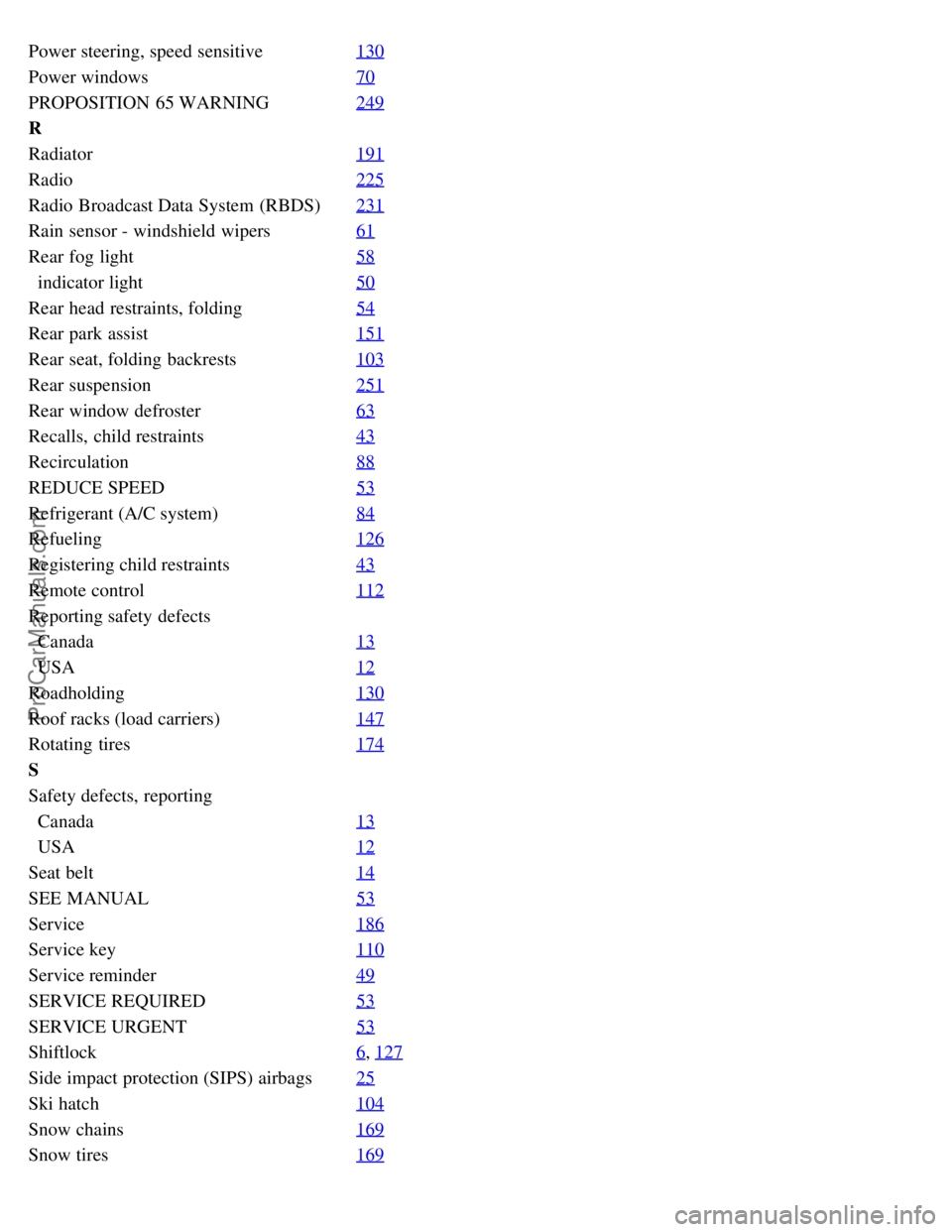
Power steering, speed sensitive130
Power windows70
PROPOSITION 65 WARNING249
R
Radiator191
Radio225
Radio Broadcast Data System (RBDS)231
Rain sensor - windshield wipers61
Rear fog light58
indicator light50
Rear head restraints, folding54
Rear park assist151
Rear seat, folding backrests103
Rear suspension251
Rear window defroster63
Recalls, child restraints43
Recirculation88
REDUCE SPEED53
Refrigerant (A/C system)84
Refueling126
Registering child restraints43
Remote control112
Reporting safety defects
Canada13
USA12
Roadholding130
Roof racks (load carriers)147
Rotating tires174
S
Safety defects, reporting
Canada13
USA12
Seat belt14
SEE MANUAL53
Service186
Service key110
Service reminder49
SERVICE REQUIRED53
SERVICE URGENT53
Shiftlock6, 127
Side impact protection (SIPS) airbags25
Ski hatch104
Snow chains169
Snow tires169
ProCarManuals.com