battery VOLVO S60 2009 Owner´s Manual
[x] Cancel search | Manufacturer: VOLVO, Model Year: 2009, Model line: S60, Model: VOLVO S60 2009Pages: 254, PDF Size: 6.17 MB
Page 148 of 254
06 Starting and drivingCold weather precautions
06148
If you wish to check your vehicle before the
approach of cold weather, the following advice
is worth noting:•
Make sure that the engine coolant contains
50 percent antifreeze. Any other mixture
will reduce freeze protection. This gives
protection against freezing down to -31 °F
(-35 °C). See section "Coolant". The use of
"recycled" antifreeze is not approved by
Volvo. Different types of antifreeze must
not be mixed.
•
Volvo recommends using only genuine
Volvo antifreeze in your vehicle's radiator.
•
Try to keep the fuel tank well filled - this
prevents the formation of condensation in
the tank. In addition, in extremely cold
weather conditions it is worthwhile to add
fuel line de-icer before refueling.
•
The viscosity of the engine oil is important.
Oil with low viscosity (thinner oil) improves
cold-weather starting as well as decreas-
ing fuel consumption while the engine is
warming up. For winter use, 5W-30 oil, par-
ticularly the synthetic type
1, is recom-
mended. Be sure to use good quality oil but
do not use cold-weather oil for hard driving
or in warm weather. See section "Engine
oil" for more information.
•
The load placed on the battery is greater
during the winter since the windshield wip-ers, lighting, etc. are used more often.
Moreover, the capacity of the battery
decreases as the temperature drops. In
very cold weather, a poorly charged bat-
tery can freeze and be damaged. It is there-
fore advisable to check the state of charge
more frequently and spray an antirust oil on
the battery posts.
•
Volvo recommends the use of snow tires
on all four wheels for winter driving - see
section "Wheels and tires."
•
To prevent the washer fluid reservoir
from freezing, add washer solvents con-
taining antifreeze (see page 192 for the
location of the washer fluid reservoir). This
is important since dirt is often splashed on
the windshield during winter driving,
requiring the frequent use of the washers
and wipers. Volvo Washer Solvent should
be diluted as follows:
•
Use Volvo Teflon Lock Spray in the locks.NOTE
Avoid the use of de-icing sprays as they can
cause damage to the locks.
1Synthetic oil is not used when the oil is changed at the normal maintenance service intervals.
Page 149 of 254
06 Starting and driving
Before a long distance trip
06
149
It is always worthwhile to have your vehicle
checked by a trained and qualified Volvo serv-
ice technician before driving long distances.
Your retailer or service technician will also be
able to supply you with bulbs, fuses, spark
plugs and wiper blades for your use in the event
that problems occur.
As a minimum, the following items should be
checked before any long trip:•
Check that engine runs smoothly and that
fuel consumption is normal.
•
Check for fuel, oil, and fluid leakage.
•
Check transmission oil level
1.
•
Check condition of drive belts.
•
Check state of the battery's charge.
•
Examine tires carefully (the spare tire as
well), and replace those that are worn.
Check tire pressures.
•
The brakes, front wheel alignment, and
steering gear should be checked by a
trained and qualified Volvo service techni-
cian only.
•
Check all lights, including high beams.
•
Reflective warning triangles are legal
requirement in some countries.
•
Have a word with your Volvo retailer if you
intend to drive in countries where it may be
difficult to obtain the correct fuel.
•
Consider your destination. If you will be
driving through an area where snow or ice
are likely to occur, consider snow tires.
1To prevent injury from contact with hot surfaces, do not inspect your vehicle's transmission fluid yourself. Have your vehicle's transmission fluid level inspected by a qualified Volvo service technician.
Page 182 of 254
G020922
182
Volvo service......................................................................................... 184
Maintaining your vehicle....................................................................... 185
Emission inspection readiness.............................................................. 186
Working on your vehicle........................................................................ 187
Hood and engine compartment............................................................ 189
Engine oil............................................................................................... 190
Fluids..................................................................................................... 192
Wiper blades......................................................................................... 194
Battery................................................................................................... 195
Replacing bulbs.................................................................................... 198
Fuses..................................................................................................... 206
Page 185 of 254
09 Maintenance and servicing
Maintaining your vehicle
09
185 Owner maintenance
Periodic maintenance requirements and inter-
vals are described in your vehicle's Warranty
and Service Records Information booklet.
The following points can be carried out
between the normally scheduled maintenance
services.Each time the vehicle is refueled:•
Check the engine oil level
•
Clean the windshield, windshield wipers,
headlights, and tail lights
Monthly:•
Check cold tire pressure in all tires. Inspect
the tires for wear.
•
Check that engine coolant and other fluid
levels are between the indicated "min" and
"max" markings.
•
Clean interior glass surfaces with a glass
cleaner and soft paper towels.
•
Wipe driver information displays with a soft
cloth.
•
Visually inspect battery terminals for cor-
rosion. Corrosion may indicate a loose ter-
minal connector, or a battery near the end
of its useful service life. Consult a trained
and qualified Volvo service technician for
additional information.
As needed:•
Wash the vehicle, including the undercar-
riage, to reduce wear that can be caused
by a buildup of dirt, and corrosion that can
be caused by salt residues.
•
Clean leaves and twigs from air intake
vents at the base of the windshield, and
from other places where they may collect.NOTE
Complete service information for qualified
technicians is available online for purchase
or subscription at www.volvotechinfo.com.
Page 186 of 254
09 Maintenance and servicingEmission inspection readiness
09186
What is an Onboard Diagnostic System
(OBD II)?OBD II is part of your vehicle's computerized
engine management system. It stores diagnos-
tic information about your vehicle's emission
controls. It can light the Check Engine light
(MIL) if it detects an emission control "fault." A
"fault" is a component or system that is not
performing within an expected range. A fault
may be permanent or temporary. OBD II will
store a message about any fault.How do states use OBD II for emission
inspections?Many states connect a computer directly to a
vehicle's OBD II system. The inspector can
then read "faults." In some states, this type of
inspection has replaced the tailpipe emission
test.How can my vehicle fail OBD II emission
inspection?Your vehicle can fail OBD II emission inspec-
tion for any of the following reasons.•
If your Check Engine (MIL) light is lit, your
vehicle may fail inspection.
•
If your vehicle's Check Engine light was lit,
but went out without any action on your
part, OBD II will still have a recorded fault.
Your vehicle may pass or fail, depending
on the inspection practices in your area.
•
If you had recent service that required dis-
connecting the battery, OBD II diagnostic
information may be incomplete and "not
ready" for inspection. A vehicle that is not
ready may fail inspection.
How can I prepare for my next OBD II
emission inspection?•
If your Check Engine (MIL) light is lit - or
was lit but went out without service, have
your vehicle diagnosed and, if necessary,
serviced by a qualified Volvo technician.
•
If you recently had service for a lit Check
Engine light, or if you had service that
required disconnecting the battery, a
period of driving is necessary to bring the
OBD II system to "ready" for inspection. A
half-hour trip of mixed stop-and-go/high-
way driving is typically needed to allow
OBD II to reach readiness. Your Volvo
retailer can provide you with more infor-
mation on planning a trip.
•
Maintain your vehicle in accordance with
your vehicle's maintenance schedule.
Page 187 of 254
09 Maintenance and servicing
Working on your vehicle
09``187
G027252
Note the following before you begin working
on your vehicleBattery•
Ensure that the battery cables are correctly
connected and tightened.
•
Never disconnect the battery when the
engine is running (e.g. when replacing the
battery).
•
Never use a fast charger to charge the bat-
tery. The battery cables should be discon-
nected when recharging.
•
The battery contains acid that is both cor-
rosive and poisonous. It is important that
the battery is handled in an environmen-
tally friendly way. Let your Volvo dealer
assist you.
Hoisting the vehicleIf a garage jack is used to lift the vehicle, the
two jack attachments points should be used.
They are specially reinforced to bear the weight
of the vehicle. A garage jack can also be placed
under the front of the engine support frame.
Take care not to damage the splash guard
under the engine. Ensure that the jack is posi-
tioned so that the vehicle cannot slide off it.
Always use axle stands or similar structures.
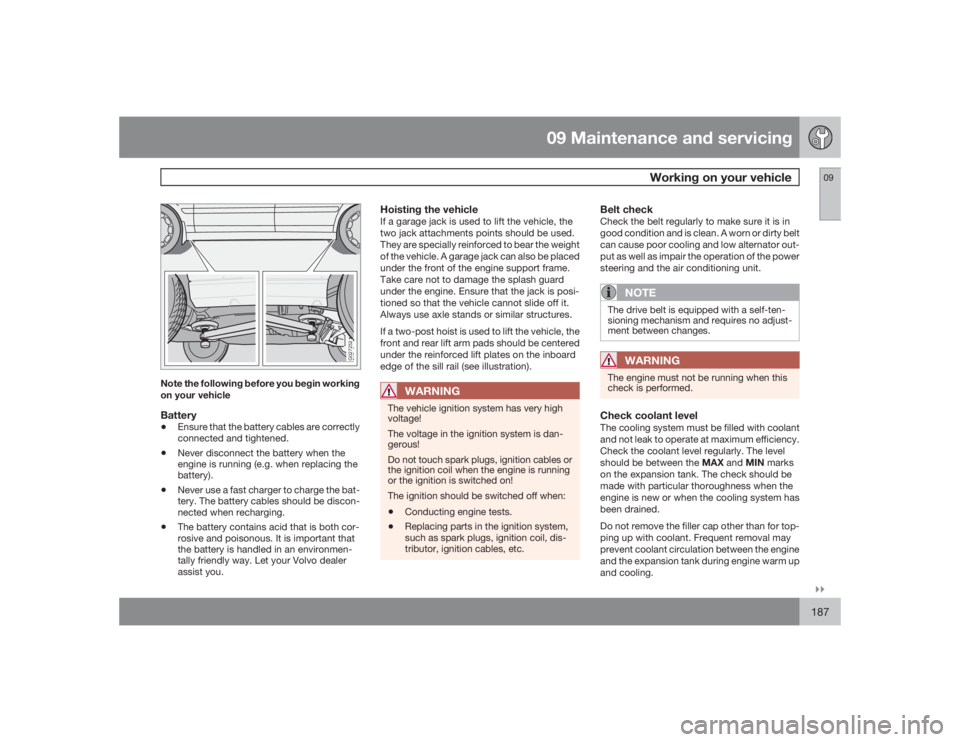
If a two-post hoist is used to lift the vehicle, the
front and rear lift arm pads should be centered
under the reinforced lift plates on the inboard
edge of the sill rail (see illustration).
WARNING
The vehicle ignition system has very high
voltage!
The voltage in the ignition system is dan-
gerous!
Do not touch spark plugs, ignition cables or
the ignition coil when the engine is running
or the ignition is switched on!
The ignition should be switched off when:•
Conducting engine tests.
•
Replacing parts in the ignition system,
such as spark plugs, ignition coil, dis-
tributor, ignition cables, etc.
Belt checkCheck the belt regularly to make sure it is in
good condition and is clean. A worn or dirty belt
can cause poor cooling and low alternator out-
put as well as impair the operation of the power
steering and the air conditioning unit.
NOTE
The drive belt is equipped with a self-ten-
sioning mechanism and requires no adjust-
ment between changes.
WARNING
The engine must not be running when this
check is performed.Check coolant levelThe cooling system must be filled with coolant
and not leak to operate at maximum efficiency.
Check the coolant level regularly. The level
should be between the MAX and MIN marks
on the expansion tank. The check should be
made with particular thoroughness when the
engine is new or when the cooling system has
been drained.
Do not remove the filler cap other than for top-
ping up with coolant. Frequent removal may
prevent coolant circulation between the engine
and the expansion tank during engine warm up
and cooling.
Page 189 of 254
09 Maintenance and servicing
Hood and engine compartment
09
189
G027253
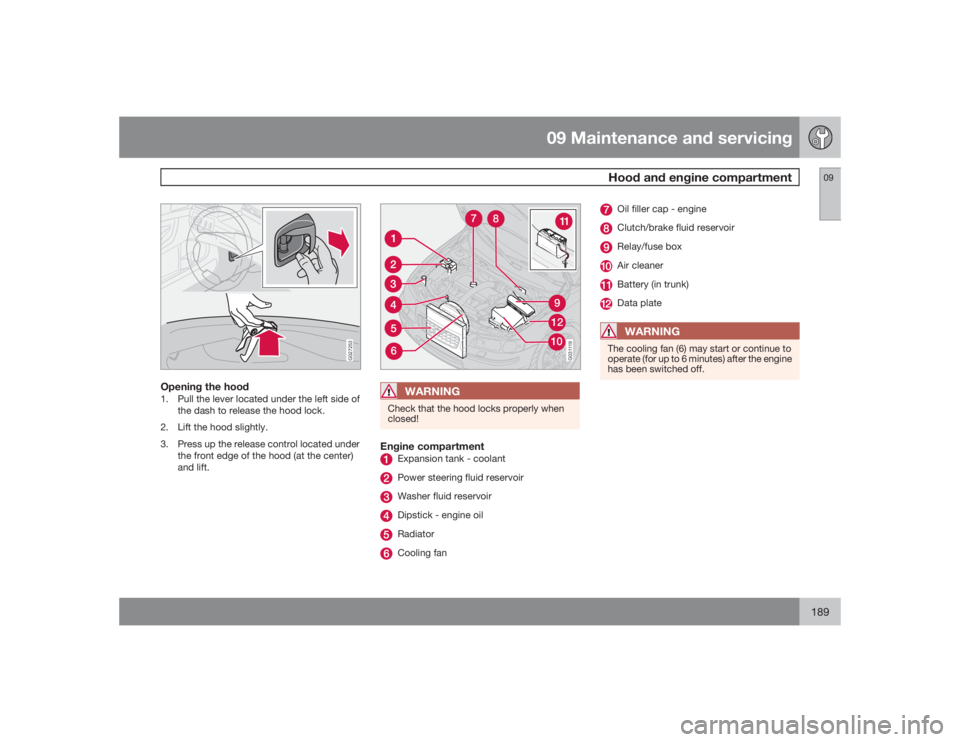
Opening the hood1. Pull the lever located under the left side of
the dash to release the hood lock.
2. Lift the hood slightly.
3. Press up the release control located under
the front edge of the hood (at the center)
and lift.
7
8
9
10
612
G031119
WARNING
Check that the hood locks properly when
closed!Engine compartment
Expansion tank - coolantPower steering fluid reservoirWasher fluid reservoirDipstick - engine oilRadiatorCooling fan
Oil filler cap - engineClutch/brake fluid reservoirRelay/fuse boxAir cleanerBattery (in trunk)Data plateWARNING
The cooling fan (6) may start or continue to
operate (for up to 6 minutes) after the engine
has been switched off.
Page 195 of 254
09 Maintenance and servicing
Battery
09``195 Battery maintenance
The battery in your vehicle is located under the
floor of the trunk.
Driving habits and conditions, climate, the
number of starts, etc. all affect the service life
and function of the battery. In order for your
battery to perform satisfactorily, keep the fol-
lowing in mind:•
Check the fluid level in each cell in the bat-
tery every 24 months or every 15,000
1
miles (24,000 km), whichever is sooner. Do
not overfill.
•
Use a screw driver to open the caps or
cover and a flashlight to inspect the level.
•
If necessary, add distilled water. The level
should never be above the indicator.
•
The fluid level should be checked if the
battery has been recharged.
•
After inspection, be sure the cap over each
battery cell or the cover is securely in
place.
•
Check that the battery cables are correctly
connected and properly tightened. Route
ventilation hose through opening in floor
(see page 195)
•
Never disconnect the battery when the
engine is running, for example when
changing the battery.
•
The battery should be disconnected from
the vehicle when a battery charger is used
directly on the battery.
•
However, if the battery is being charged via
the connecting points in the engine com-
partment (see page 195), the battery must
be connected.WARNING
PROPOSITION 65 WARNING!
Battery posts, terminals, and related acces-
sories contain lead and lead compounds,
chemicals known to the state of California
to cause cancer and reproductive harm.
Wash hands after handling.
WARNING
•
Never expose the battery to open flame
or electric spark.
•
Do not smoke near the battery.
•
Battery fluid contains sulfuric acid. Do
not allow battery fluid to contact eyes,
skin, fabrics or painted surfaces. If con-
tact occurs, flush the affected area
immediately with water. Obtain medical
help immediately if eyes are affected.
NOTE
Used batteries should be properly disposed
of at a recycling station or similar facility, or
taken to your Volvo retailer.Symbols:
Wear protection gogglesSee owner's manual for
detailsKeep away from children
1More frequently in warm climates.
Page 196 of 254
09 Maintenance and servicingBattery
09196
CorrosiveNo smoking, no open flames,
no sparksExplosion
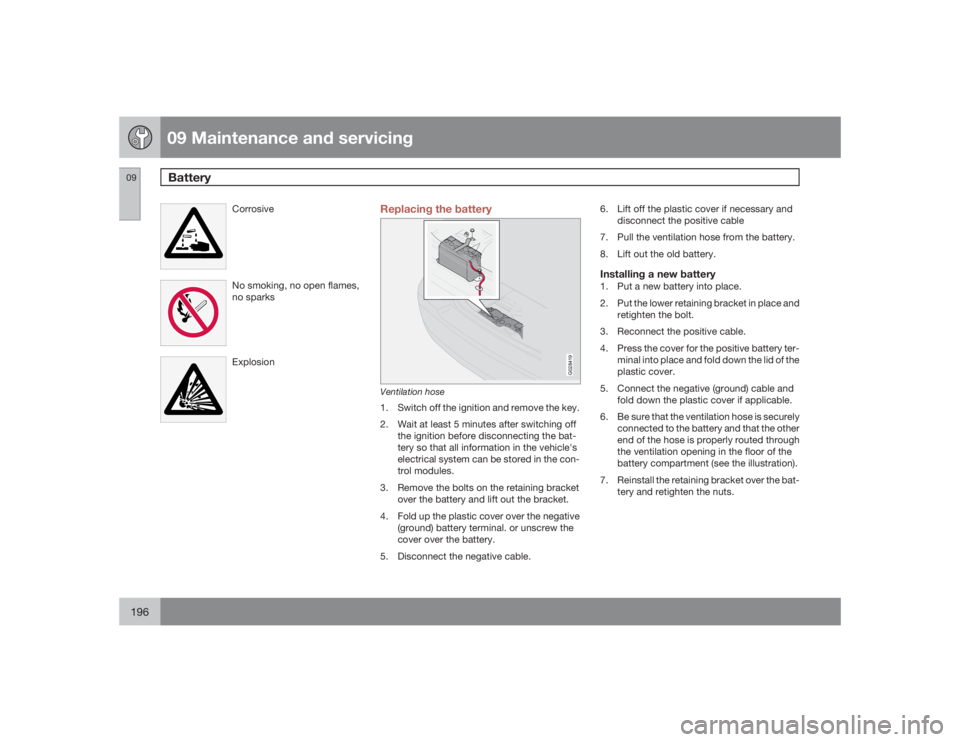
Replacing the battery
G028419
Ventilation hose1. Switch off the ignition and remove the key.
2. Wait at least 5 minutes after switching off
the ignition before disconnecting the bat-
tery so that all information in the vehicle's
electrical system can be stored in the con-
trol modules.
3. Remove the bolts on the retaining bracket
over the battery and lift out the bracket.
4. Fold up the plastic cover over the negative
(ground) battery terminal. or unscrew the
cover over the battery.
5. Disconnect the negative cable.6. Lift off the plastic cover if necessary and
disconnect the positive cable
7. Pull the ventilation hose from the battery.
8. Lift out the old battery.
Installing a new battery1. Put a new battery into place.
2. Put the lower retaining bracket in place and
retighten the bolt.
3. Reconnect the positive cable.
4. Press the cover for the positive battery ter-
minal into place and fold down the lid of the
plastic cover.
5. Connect the negative (ground) cable and
fold down the plastic cover if applicable.
6. Be sure that the ventilation hose is securely
connected to the battery and that the other
end of the hose is properly routed through
the ventilation opening in the floor of the
battery compartment (see the illustration).
7. Reinstall the retaining bracket over the bat-
tery and retighten the nuts.
Page 197 of 254
09 Maintenance and servicing
Battery
09
197
WARNING
Ventilation hose:•
The battery generates hydrogen gas,
which is flammable and explosive. The
battery is fitted with a ventilation hose
which vents hydrogen gas out of the
battery compartment through a ventila-
tion opening in the bottom of this com-
partment. If the battery must be
replaced, it is essential that the ventila-
tion hose is properly connected to the
battery and that it is routed through the
ventilation opening provided (see illus-
tration).
•
Be sure the ventilation hose is free of
debris.
•
Only use replacement batteries equip-
ped with a ventilation hose. Consult a
trained and qualified Volvo service tech-
nician.NOTE
After the battery has been disconnected or
replaced, lock and unlock the vehicle with
the central locking system's remote control
to reactivate such features as the power
windows, moonroof, courtesy lighting, etc.