gas VOLVO S60 2009 Owner´s Manual
[x] Cancel search | Manufacturer: VOLVO, Model Year: 2009, Model line: S60, Model: VOLVO S60 2009Pages: 254, PDF Size: 6.17 MB
Page 127 of 254
06 Starting and driving
Economical driving
06
127 Economical driving conserves natural
resources
Better driving economy may be obtained by
thinking ahead, avoiding rapid starts and stops
and adjusting the speed of your vehicle to
immediate traffic conditions. Observe the fol-
lowing rules:•
Bring the engine to normal operating tem-
perature as soon as possible by driving
with a light foot on the accelerator pedal for
the first few minutes of operation. A cold
engine uses more fuel and is subject to
increased wear.
•
Whenever possible, avoid using the vehicle
for driving short distances. This does not
allow the engine to reach normal operating
temperature.
•
Drive carefully and avoid rapid acceleration
and hard braking.
•
Do not exceed posted speed limits.
•
Avoid carrying unnecessary items (extra
load) in the vehicle.
•
Maintain correct tire pressure. Check tire
pressure regularly (when tires are cold).
•
Remove snow tires when threat of snow or
ice has ended.
•
Note that roof racks, ski racks, etc,
increase air resistance and also fuel con-
sumption.
•
Avoid using automatic transmission kick-
down feature unless necessary.
•
However, at higher driving speeds, fuel
consumption will be lower with the air con-
ditioning on and the windows closed than
with the air conditioning off and the win-
dows open.
•
Using the onboard trip computer's fuel
consumption modes can help you learn
how to drive more economically.
Other factors that decrease gas mileage are:
•
Dirty air cleaner
•
Dirty engine oil and clogged oil filter
•
Dragging brakes
•
Incorrect front end alignment.
Some of the above mentioned items and others
are checked at the standard Maintenance
Service intervals.NOTE
Vehicles equipped with automatic transmis-
sions should use (D)rive as often as possible
and avoid using "kickdown" to help improve
fuel economy.
CAUTION
Drive slowly and carefully if going through
standing water (i.e. flooded roadways, etc.).
Damage to the engine could result if excess
water is drawn in through the air intake sys-
tem. Never drive the vehicle in water deeper
than 1 foot (300 mm).
Page 142 of 254

06 Starting and drivingJump starting
06142
Jump starting
G030860
Follow these instructions to jump start your
vehicle's dead battery or to jump start another
vehicle's dead battery using your vehicle.
Although your vehicle's battery is located
under the floor of the trunk, jumper cables
should be connected in the engine compart-
ment, to the points shown in the illustrations.
If the 12-volt auxiliary battery to be used is in
another vehicle, check that the vehicles are not
touching to prevent premature completion of a
circuit. Be sure to follow jump starting instruc-
tions provided for the other vehicle.
To jump start your vehicle:1. Switch off the ignition.
2. First connect the auxiliary battery positive
(+) terminal (1) to the positive (+) terminal in
your vehicle's engine compartment (2),
located under a small black plastic cover
attached to the fuse box cover, marked
with a "+" sign. Remove the cover on the
main fuse box if necessary to access this
terminal. Then connect the auxiliary bat-
tery's negative (–) terminal (3) to the ground
point in your vehicle's engine compartment
(4).
3. Start the engine in the assisting vehicle,
then start the engine in the vehicle with
dead battery.
4. After the engine has started, first remove
the negative (–) terminal jumper cable.
Then remove the positive (+) terminal
jumper cable.
WARNING
PROPOSITION 65 WARNING!
Battery posts, terminals, and related acces-
sories contain lead and lead compounds,
chemicals known to the state of California
to cause cancer and reproductive harm.
Wash hands after handling.
WARNING
•
Do not connect the jumper cable to any
part of the fuel system or to any moving
parts. Avoid touching hot manifolds.
•
Never expose the battery to open flame
or electric spark.
•
Do not smoke near the battery.
•
Batteries generate hydrogen gas, which
is flammable and explosive.
•
Battery fluid contains sulfuric acid. Do
not allow battery fluid to contact eyes,
skin, fabrics or painted surfaces. If con-
tact occurs, flush the affected area
immediately with water. Obtain medical
help immediately if eyes are affected.
•
Failure to follow the instructions for
jump starting can lead to personal
injury.
Page 154 of 254
07 Wheels and tiresGeneral information
07154
Your vehicle is equipped with tires according
to the vehicle's tire information placard on the
B-pillar (the structural member at the side of
the vehicle, at the rear of the driver's door
opening), or on the inside of the fuel filler door
on Canadian models.
CAUTION
Some Volvo models are equipped with an
Ultra High Performance tire and wheel com-
bination designed to provide maximum dry
pavement performance with consideration
for hydroplaning resistance. As such, they
may be more susceptible to road hazard
damage and, depending on driving condi-
tions, may achieve a tread life of less than
20,000 miles (30,000 km). Even if this vehi-
cle is equipped with Volvo’s advanced AWD
or DSTC system, these tires are not
designed for winter driving, and should be
replaced with winter tires when weather
conditions dictate.The tires have good road holding characteris-
tics and offer good handling on dry and wet
surfaces. It should be noted however that the
tires have been developed to give these fea-
tures on snow/ice-free surfaces.
Certain models are equipped with "all-season"
tires, which provide a somewhat higher degree
of road holding on slippery surfaces than tires
without the "all-season" rating. However, foroptimum road holding on icy or snow-covered
roads, we recommend suitable winter tires on
all four wheels.
When replacing tires, be sure that the new tires
are the same size designation, type (radial) and
preferably from the same manufacturer, on all
four wheels. Otherwise there is a risk of altering
the vehicle's roadholding and handling charac-
teristics.
Storing wheels and tiresWhen storing complete wheels (tires mounted
on rims), they should be suspended off the
floor or placed on their sides on the floor.
Tires not mounted on rims should be stored on
their sides or standing upright, but should not
be suspended.
CAUTION
Tires should preferably be stored in a cool,
dry, dark place, and should never be stored
in close proximity to solvents, gasoline, oils,
etc.
WARNING
The wheel and tire sizes for your Volvo are
specified to meet stringent stability and
handling requirements. Unapproved wheel/
tire size combinations can negatively affect
your vehicle's stability and handling.
Approved tire sizes are shown in the Tire
inflation pressure tables on pages 158 and
159.
Any damage caused by installation of unap-
proved wheel/tire size combinations will not
be covered by your new vehicle warranty.
Volvo assumes no responsibility for death,
injury, or expenses that may result from
such installations.
Page 178 of 254
08 Car careWashing and cleaning the vehicle
08178
designed for this purpose. Consult your Volvo
retailer.Alcantera™ suede-like materialSuede-like upholstery can be cleaned with a
soft cloth and mild soap solution.Leather careVolvo's leather upholstery is manufactured
with a protectant to repel soiling. Over time,
sunlight, grease and dirt can break down the
protection. Staining, cracking, scuffing, and
fading can result.
Volvo offers an easy-to-use, non-greasy
leather care kit formulated to clean and beau-
tify your vehicle's leather, and to renew the
protective qualities of its finish. The cleaner
removes dirt and oil buildup. The light cream
protectant restores a barrier against soil and
sunlight.
Volvo also offers a special leather softener that
should be applied after the cleaner and pro-
tectant. It leaves leather soft and smooth, and
reduces friction between leather and other fin-
ishes in the vehicle.
Volvo recommends cleaning, protecting and
conditioning your vehicle's leather two to four
times a year. Ask your Volvo retailer about
Leather Care Kit 951 0251 and Leather Soft-
ener 943 7429.
Cleaning leather upholstery1. Pour leather cleaner on a damp sponge
and squeeze it until the cleaner foams.
2. Apply the foam to the stain by moving the
sponge with circular movements.
3. Dampen the stain thoroughly with the
sponge. Let the sponge absorb the stain,
do not rub.
4. Dry the stain with soft paper towels or a
towel, and allow the leather to dry com-
pletely.Protecting leather upholstery1. Put a small amount of protectant cream on
a cloth and apply a thin coating of cream
to the upholstery with light circular move-
ments.
2. Allow the leather to dry for 20 minutes.
This will help the leather resist staining and
protect against sunlight's harmful UV rays.
CAUTION
•
Under no circumstances should gaso-
line, naphtha or similar cleaning agents
be used on the plastic or the leather
since these can cause damage.
•
Take extra care when removing stains
such as ink or lipstick since the coloring
can spread.
•
Use solvents sparingly. Too much sol-
vent can damage the seat padding.
•
Start from the outside of the stain and
work toward the center.
•
Sharp objects (e.g. pencils or pens in a
pocket) or velcro fasteners on clothing
may damage the textile upholstery.
•
Clothing that is not colorfast, such as
new jeans or suede garments, may stain
the upholstery.
Chromed wheels: Clean chrome-plated
wheels using the same detergents used for
the body of the vehicle. Aggressive wheel-
cleaning agents can permanently stain
chrome-plated wheels.
Cleaning the seat beltsClean only with lukewarm water and a mild
soap solution.
Page 197 of 254
09 Maintenance and servicing
Battery
09
197
WARNING
Ventilation hose:•
The battery generates hydrogen gas,
which is flammable and explosive. The
battery is fitted with a ventilation hose
which vents hydrogen gas out of the
battery compartment through a ventila-
tion opening in the bottom of this com-
partment. If the battery must be
replaced, it is essential that the ventila-
tion hose is properly connected to the
battery and that it is routed through the
ventilation opening provided (see illus-
tration).
•
Be sure the ventilation hose is free of
debris.
•
Only use replacement batteries equip-
ped with a ventilation hose. Consult a
trained and qualified Volvo service tech-
nician.NOTE
After the battery has been disconnected or
replaced, lock and unlock the vehicle with
the central locking system's remote control
to reactivate such features as the power
windows, moonroof, courtesy lighting, etc.
Page 228 of 254

10 AudioExternal CD changer (option)
10228
G027181
The optional 10-CD changer is mounted in the
cargo compartment.
Please refer to the illustrations on pages 217
and 218 for the location of the buttons referred
to on this page.
Turn the SOURCE knob to select the external
CD changer.To load discs into the changer:1. Slide the cover on the CD change open.
2. Press the eject button on the CD changer.
3. Pull the magazine out of the changer and
insert the disc(s).
4. Press the magazine back into the changer
and slide the cover back into place.If there are discs in the player when CD mode
is selected, the changer will resume playing the
disc and track that were most recently played.
Selecting a disc position (number)Use the station setting buttons 1 – 6 to select
the disc to be played. Continue to press button
6 to select discs 7 – 10.
The number of the disc and the track being
played are shown in the display.Changing tracksBriefly press the
or
keys (or the
corresponding keys on the steering wheel key-
pad) to skip to the previous or next track. The
track number is shown in the display.
Fast forward/backPress and hold down the
or
keys
to search within a track or the entire disc. The
search continues for as long as the buttons are
held in.
The corresponding keys on the steering wheel
keypad cannot be used for fast forward/back.
Random playThis function plays the tracks on a CD in ran-
dom order (shuffle).
1.
SelectCD mode and press the RND but-
ton.
RND
is shown in the display as longas the function is activated. Random tracks
from randomly selected discs will be
played.
2.
PressRND again to stop random play.
ScanThis function plays the first 10 seconds of each
track on the CD.
1.
PressSCAN to start the function.
2.
PressSCAN or EXIT to stop the scan func-
tion and listen to an entire track.
Scan only works on the selected disc.
Page 249 of 254
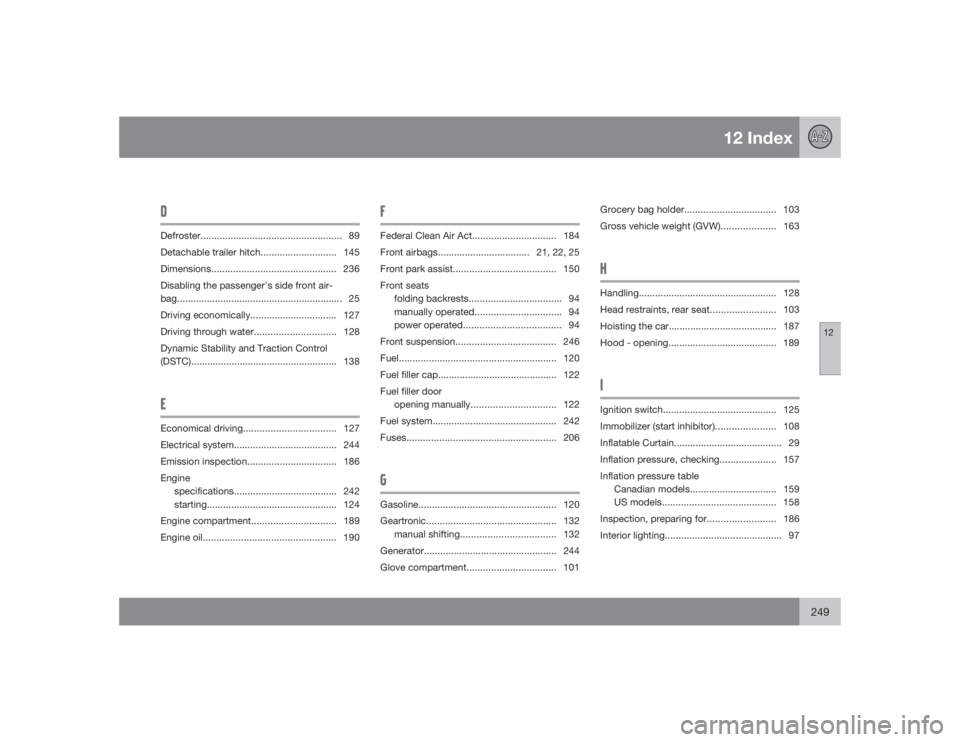
12 Index
12
249
DDefroster.................................................... 89
Detachable trailer hitch............................ 145
Dimensions.............................................. 236
Disabling the passenger's side front air-
bag............................................................. 25
Driving economically................................ 127
Driving through water..............................128
Dynamic Stability and Traction Control
(DSTC)...................................................... 138EEconomical driving..................................127
Electrical system...................................... 244
Emission inspection................................. 186
Engine
specifications...................................... 242
starting................................................ 124
Engine compartment............................... 189
Engine oil................................................. 190
FFederal Clean Air Act............................... 184
Front airbags.................................. 21, 22, 25
Front park assist...................................... 150
Front seats
folding backrests.................................. 94
manually operated................................ 94
power operated.................................... 94
Front suspension..................................... 246
Fuel.......................................................... 120
Fuel filler cap............................................ 122
Fuel filler door
opening manually...............................122
Fuel system.............................................. 242
Fuses.......................................................206GGasoline................................................... 120
Geartronic................................................ 132
manual shifting...................................132
Generator................................................. 244
Glove compartment................................. 101Grocery bag holder.................................. 103
Gross vehicle weight (GVW).................... 163
HHandling................................................... 128
Head restraints, rear seat........................103
Hoisting the car........................................ 187
Hood - opening........................................ 189IIgnition switch.......................................... 125
Immobilizer (start inhibitor)...................... 108
Inflatable Curtain........................................ 29
Inflation pressure, checking..................... 157
Inflation pressure table
Canadian models................................ 159
US models.......................................... 158
Inspection, preparing for......................... 186
Interior lighting........................................... 97