weight VOLVO S60 2009 Owner´s Manual
[x] Cancel search | Manufacturer: VOLVO, Model Year: 2009, Model line: S60, Model: VOLVO S60 2009Pages: 254, PDF Size: 6.17 MB
Page 32 of 254
01 SafetyChild safety
0132
Children should be seated safelyVolvo recommends the proper use of restraint
systems for all occupants including children.
Remember that, regardless of age and size, a
child should always be properly restrained in a
vehicle.
Your vehicle is also equipped with ISOFIX/
LATCH attachments, which make it more con-
venient to install child seats.
Some restraint systems for children are
designed to be secured in the vehicle by lap
belts or the lap portion of a lap-shoulder belt.
Such child restraint systems can help protect
children in vehicles in the event of an accident
only if they are used properly. However, chil-
dren could be endangered in a crash if the child
restraints are not properly secured in the vehi-
cle. Failure to follow the installation instructions
for your child restraint can result in your child
striking the vehicle's interior in a sudden stop.
Holding a child in your arms is NOT a suitable
substitute for a child restraint system. In an
accident, a child held in a person's arms can
be crushed between the vehicle's interior and
an unrestrained person. The child could also be
injured by striking the interior, or by being ejec-
ted from the vehicle during a sudden maneuver
or impact. The same can also happen if the
infant or child rides unrestrained on the seat.
Other occupants should also be properlyrestrained to help reduce the chance of injuring
or increasing the injury of a child.
All states and provinces have legislation gov-
erning how and where children should be car-
ried in a vehicle. Find out the regulations
existing in your state or province. Recent acci-
dent statistics have shown that children are
safer in rear seating positions than front seating
positions when properly restrained. A child
restraint system can help protect a child in a
vehicle. Here's what to look for when selecting
a child restraint system:
•
It should have a label certifying that it
meets applicable Federal Motor Vehicle
Safety Standards (FMVSS 213) – or in Can-
ada, CMVSS 213.
•
Make sure the child restraint system is
approved for the child's height, weight and
development – the label required by the
standard or regulation, or instructions for
infant restraints, typically provide this infor-
mation.
•
In using any child restraint system, we urge
you to carefully look over the instructions
that are provided with the restraint. Be sure
you understand them and can use the
device properly and safely in this vehicle.
A misused child restraint system can result
in increased injuries for both the infant or
child and other occupants in the vehicle.When a child has outgrown the child safety
seat, you should use the rear seat with the
standard seat belt fastened. The best way to
help protect the child here is to place the child
on a cushion so that the seat belt is properly
located on the hips, see page 34. Legislation
in your state or province may mandate the use
of a child seat or cushion in combination with
the seat belt, depending on the child's age and/
or size. Please check local regulations.
A specially designed and tested booster cush-
ion (not available in Canada) can be obtained
from your Volvo retailer for children weighing
33 – 80 lb. (15 – 36 kg) and 38 – 54 inches
(97 – 137 cm) in height.
Page 34 of 254
01 SafetyChild restraint systems
0134
Child restraints
G026491
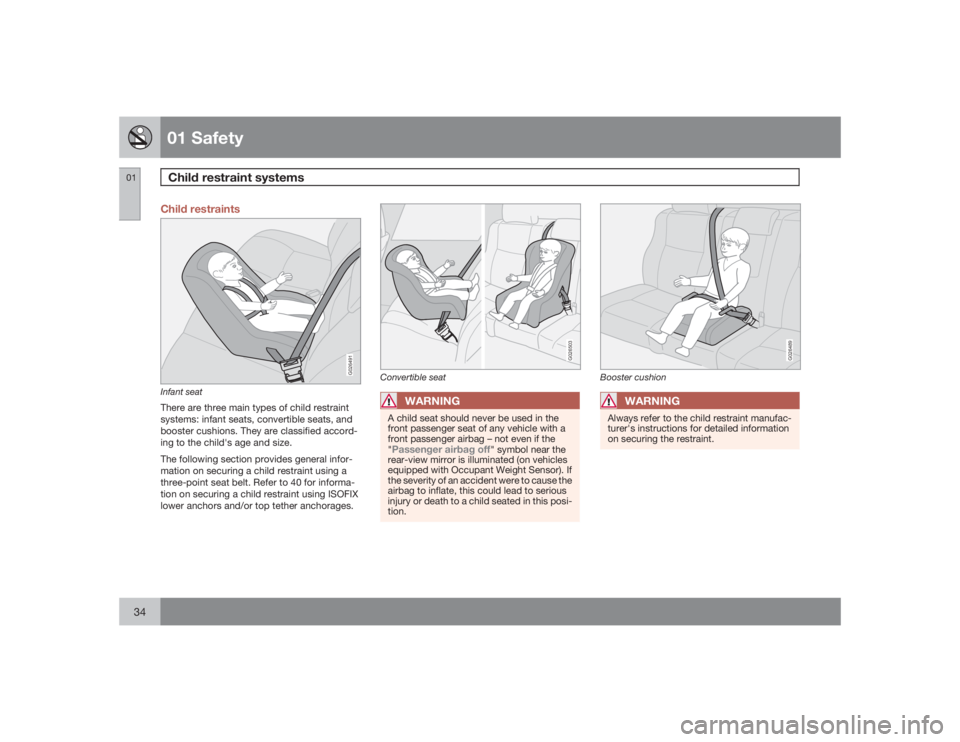
Infant seatThere are three main types of child restraint
systems: infant seats, convertible seats, and
booster cushions. They are classified accord-
ing to the child's age and size.
The following section provides general infor-
mation on securing a child restraint using a
three-point seat belt. Refer to 40 for informa-
tion on securing a child restraint using ISOFIX
lower anchors and/or top tether anchorages.
G026503
Convertible seat
WARNING
A child seat should never be used in the
front passenger seat of any vehicle with a
front passenger airbag – not even if the
"Passenger airbag off
" symbol near the
rear-view mirror is illuminated (on vehicles
equipped with Occupant Weight Sensor). If
the severity of an accident were to cause the
airbag to inflate, this could lead to serious
injury or death to a child seated in this posi-
tion.
G026489
Booster cushion
WARNING
Always refer to the child restraint manufac-
turer's instructions for detailed information
on securing the restraint.
Page 35 of 254
01 Safety
Child restraint systems
0135
WARNING
•
When not in use, keep the child restraint
system secured or remove it from the
passenger compartment to help pre-
vent it from injuring passengers in the
event of a sudden stop or collision.
•
A small child's head represents a con-
siderable part of its total weight and its
neck is still very weak. Volvo recom-
mends that children up to age 4 travel,
properly restrained, facing rearward. In
addition, Volvo recommends that chil-
dren should ride rearward facing, prop-
erly restrained, as long as possible.
Page 36 of 254
01 SafetyInfant seats
0136
Securing an infant seat with a seat belt
G026417
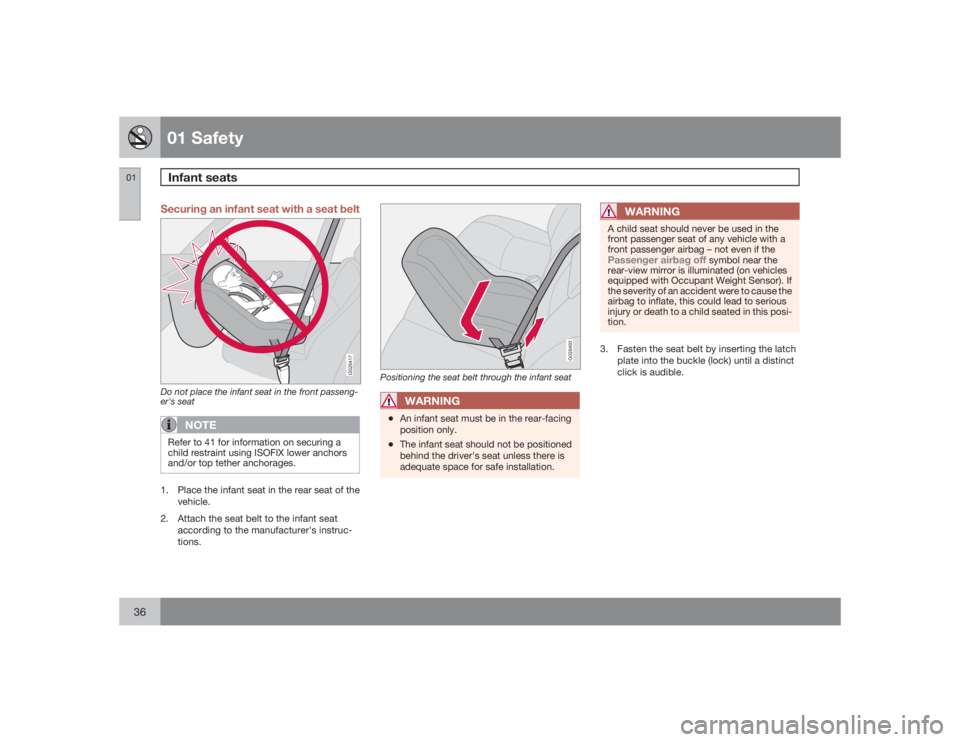
Do not place the infant seat in the front passeng-
er's seat
NOTE
Refer to 41 for information on securing a
child restraint using ISOFIX lower anchors
and/or top tether anchorages.1. Place the infant seat in the rear seat of the
vehicle.
2. Attach the seat belt to the infant seat
according to the manufacturer's instruc-
tions.
G026493
Positioning the seat belt through the infant seat
WARNING
•An infant seat must be in the rear-facing
position only.•The infant seat should not be positioned
behind the driver's seat unless there is
adequate space for safe installation.
WARNING
A child seat should never be used in the
front passenger seat of any vehicle with a
front passenger airbag – not even if thePassenger airbag off
symbol near the
rear-view mirror is illuminated (on vehicles
equipped with Occupant Weight Sensor). If
the severity of an accident were to cause the
airbag to inflate, this could lead to serious
injury or death to a child seated in this posi-
tion.
3. Fasten the seat belt by inserting the latch
plate into the buckle (lock) until a distinct
click is audible.
Page 38 of 254
01 SafetyConvertible seats
0138
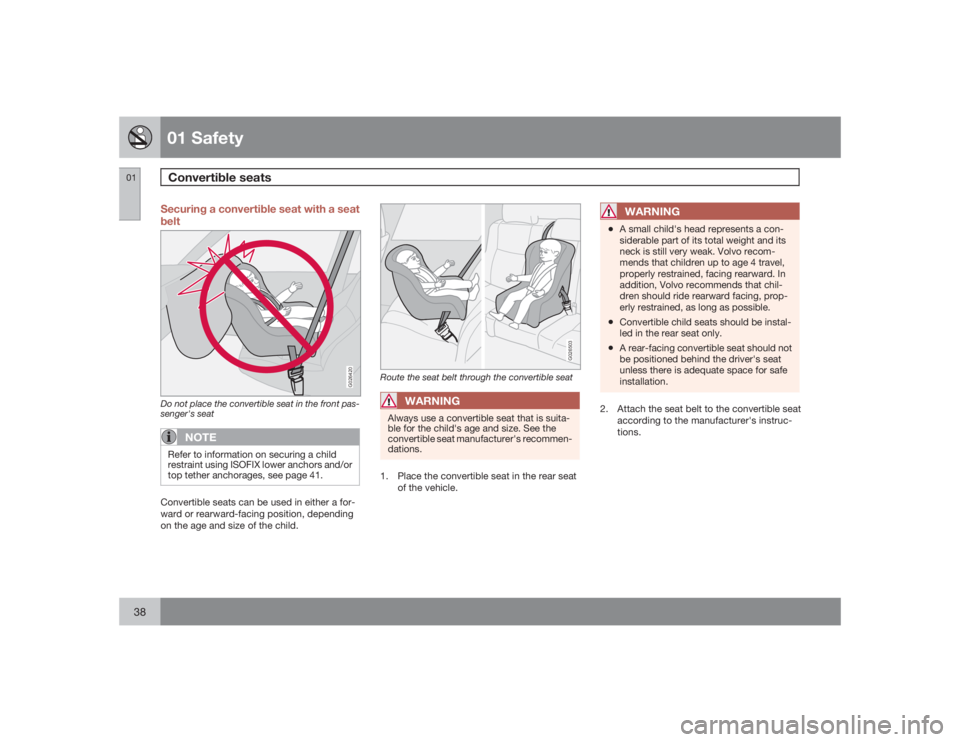
Securing a convertible seat with a seat
belt
G026420
Do not place the convertible seat in the front pas-
senger's seat
NOTE
Refer to information on securing a child
restraint using ISOFIX lower anchors and/or
top tether anchorages, see page 41.Convertible seats can be used in either a for-
ward or rearward-facing position, depending
on the age and size of the child.
G026503
Route the seat belt through the convertible seat
WARNING
Always use a convertible seat that is suita-
ble for the child's age and size. See the
convertible seat manufacturer's recommen-
dations.1. Place the convertible seat in the rear seat
of the vehicle.
WARNING
•A small child's head represents a con-
siderable part of its total weight and its
neck is still very weak. Volvo recom-
mends that children up to age 4 travel,
properly restrained, facing rearward. In
addition, Volvo recommends that chil-
dren should ride rearward facing, prop-
erly restrained, as long as possible.•Convertible child seats should be instal-
led in the rear seat only.•A rear-facing convertible seat should not
be positioned behind the driver's seat
unless there is adequate space for safe
installation.
2. Attach the seat belt to the convertible seat
according to the manufacturer's instruc-
tions.
Page 39 of 254
01 Safety
Convertible seats
0139
G026500
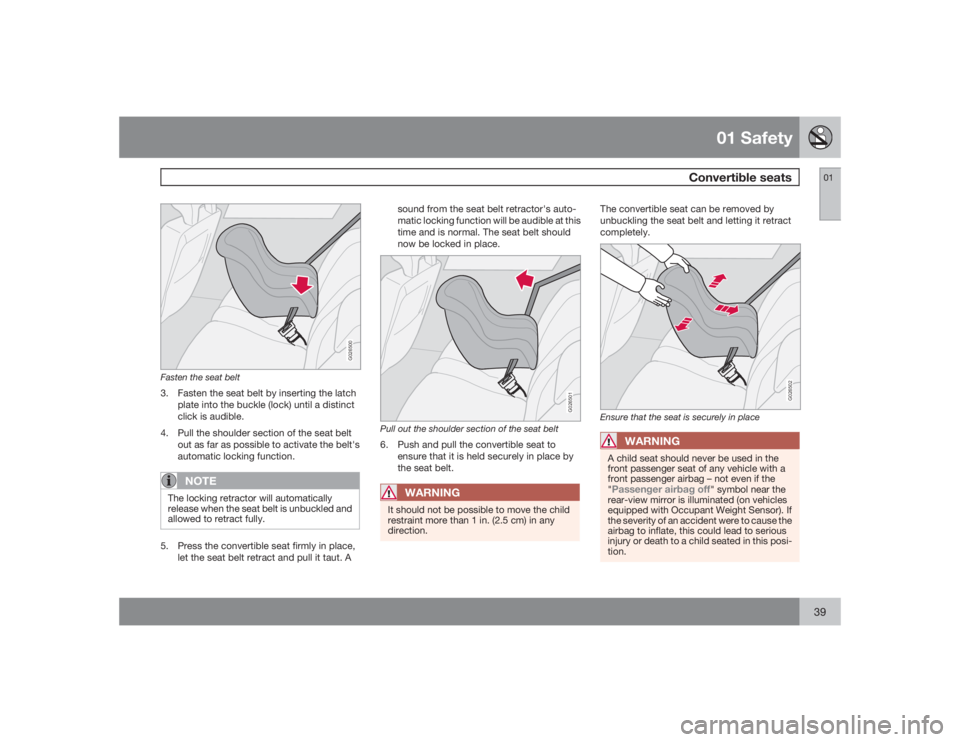
Fasten the seat belt3. Fasten the seat belt by inserting the latch
plate into the buckle (lock) until a distinct
click is audible.
4. Pull the shoulder section of the seat belt
out as far as possible to activate the belt's
automatic locking function.
NOTE
The locking retractor will automatically
release when the seat belt is unbuckled and
allowed to retract fully.5. Press the convertible seat firmly in place,
let the seat belt retract and pull it taut. Asound from the seat belt retractor's auto-
matic locking function will be audible at this
time and is normal. The seat belt should
now be locked in place.
G026501
Pull out the shoulder section of the seat belt6. Push and pull the convertible seat to
ensure that it is held securely in place by
the seat belt.
WARNING
It should not be possible to move the child
restraint more than 1 in. (2.5 cm) in any
direction.
The convertible seat can be removed by
unbuckling the seat belt and letting it retract
completely.
G026502
Ensure that the seat is securely in place
WARNING
A child seat should never be used in the
front passenger seat of any vehicle with a
front passenger airbag – not even if the
"Passenger airbag off
" symbol near the
rear-view mirror is illuminated (on vehicles
equipped with Occupant Weight Sensor). If
the severity of an accident were to cause the
airbag to inflate, this could lead to serious
injury or death to a child seated in this posi-
tion.
Page 128 of 254
06 Starting and drivingHandling and road holding
06128
Weight distribution affects handlingAt the specified curb weight your vehicle has a
tendency to understeer, which means that the
steering wheel has to be turned more than
might seem appropriate for the curvature of a
bend.
This ensures good stability and reduces the
risk of rear wheel skid. Remember that these
properties can alter with the vehicle load.
The heavier the load in the trunk (max. 220 lbs,
100 kg), the less the tendency to understeer.Handling, roadholdingVehicle load, tire design and inflation pressure
all affect vehicle handling. Therefore, check
that the tires are inflated to the recommended
pressure according to the vehicle load. See
"Tire pressure" section.
Loads should be distributed so that capacity
weight or maximum permissible axle loads are
not exceeded.
Speed-sensitive power steering
(Option on certain models)With this feature, the steering is most respon-
sive at lower speeds to make parking, driving
in city traffic, etc., easier. The effect of the
power steering diminishes as you accelerate
for greater stability at highway speeds.Driving through waterThe vehicle can be driven through water up to
a depth of approximately 9 in. (25 cm), at a
maximum speed of 6 mph (10 km/h).
Take particular care when driving through flow-
ing water.
Clean the electrical connections for trailer wir-
ing after driving in mud or water.
When driving through water, maintain low
speed and do not stop in the water.
WARNING
After driving through water, press lightly on
the brake pedal to ensure that the brakes
are functioning normally. Water or mud can
make the brake linings slippery, resulting in
delayed braking effect.
CAUTION
•
Engine damage will occur if water is
drawn into the air cleaner.
•
If the vehicle is driven through water
deeper than 9 in (25 cm), water may
enter the differential and the transmis-
sion. This reduces the oil's lubricating
capacity and may shorten the service
life of these components.
•
Do not allow the vehicle to stand in
water up to the door sills longer than
absolutely necessary. This could result
in electrical malfunctions.
•
If the engine has been stopped while the
car is in water, do not attempt to restart
the engine. Have the car towed out of
the water.
Page 143 of 254
06 Starting and driving
Towing a trailer
06``143
Volvo recommends the use of Volvo trailer
hitches that are specially designed for the vehi-
cle.•
Maximum trailer weight recommended by
Volvo is: Trailers without brakes: 1650 lbs
(750 kg) Trailers with brakes: 2" (50 mm)
ball - 3300 lbs* (1500 kg), 1 7/8 " (47 mm)
ball - 2000 lbs (900 kg). Observe the legal
requirements of the state/province in
which the vehicles are
•
All Volvo models are equipped with
energy-absorbing shock-mounted bump-
ers. Trailer hitch installation should not
interfere with the proper operation of this
bumper system.
Trailer towing does not normally present any
particular problems, but take into considera-
tion:
•
Increase tire pressure to recommended
full. See section "Wheels and tires."
•
When your vehicle is new, avoid towing
heavy trailers during the first 620 miles
(1000 km).
•
Recommended hitch tongue load is: Trailer
weightsbelow 2,650 lbs (1,200 kg) -
110 lbs (50 kg) Trailer weights above
2,650 lbs (1,200 kg) - 165 lbs (75 kg)
•
Maximum speed when towing a trailer:
50 mph (80 km/h).
•
Engine and transmission are subject to
increased loads. Therefore, engine coolant
temperature should be closely watched
when driving in hot climates or hilly terrain.
Use a lower gear and turn off the air con-
ditioner if the temperature gauge needle
enters the red range.
•
If the automatic transmission begins to
overheat, a message will be displayed in
the text window.
•
Avoid overload and other abusive opera-
tion.
•
Hauling a trailer affects handling, durabil-
ity, and economy.
•
It is necessary to balance trailer brakes
with the towing vehicle brakes to provide a
safe stop (check and observe state/local
regulations).
•
Do not connect the trailer's brake system
directly to the vehicle's brake system.
•
More frequent vehicle maintenance is
required.
•
Remove the ball and drawbar assembly
when the hitch is not being used.
•
Volvo recommends the use of synthetic
engine oil when towing a trailer over long
distances or in mountainous areas.
WARNING
•
Bumper-attached trailer hitches must
not be used on Volvos, nor should
safety chains be attached to the
bumper.
•
Trailer hitches attaching to the vehicle
rear axle must not be used.
•
Never connect a trailer's hydraulic
brake system directly to the vehicle
brake system, nor a trailer's lighting
system directly to the vehicle lighting
system. Consult your nearest trained
and qualified Volvo service technician
for correct installation.
•
When towing a trailer, the trailer's safety
wire must be correctly fastened to the
hole or hook provided in the trailer hitch
on the vehicle. The safety wire should
never be fastened to or wound around
the drawbar ball.NOTE
When parking the vehicle with a trailer on a
hill, apply the parking brake before putting
the gear selector in P (first/reverse gear on
manual transmissions). Always follow the
trailer manufacturer's recommendations for
wheel chocking.
Page 144 of 254
06 Starting and drivingTowing a trailer
06144
•
When starting on a hill, put the gear selec-
tor in D before releasing the parking brake.
•
If you use the manual (Geartronic) shift
positions while towing a trailer, make sure
the gear you select does not put too much
strain on the engine (using too high a gear).
•
The drawbar assembly/trailer hitch may be
rated for trailers heavier than the vehicle is
designed to tow. Please adhere to Volvo's
recommended trailer weights.
LevelingIf your vehicle is equipped with automatic lev-
eling, the rear suspension always retains the
correct ride height regardless of the load.
When the vehicle is stationary, the rear sus-
pension lowers, which is normal.
Page 146 of 254
06 Starting and drivingLoad carriers (accessory)
06146
G027340
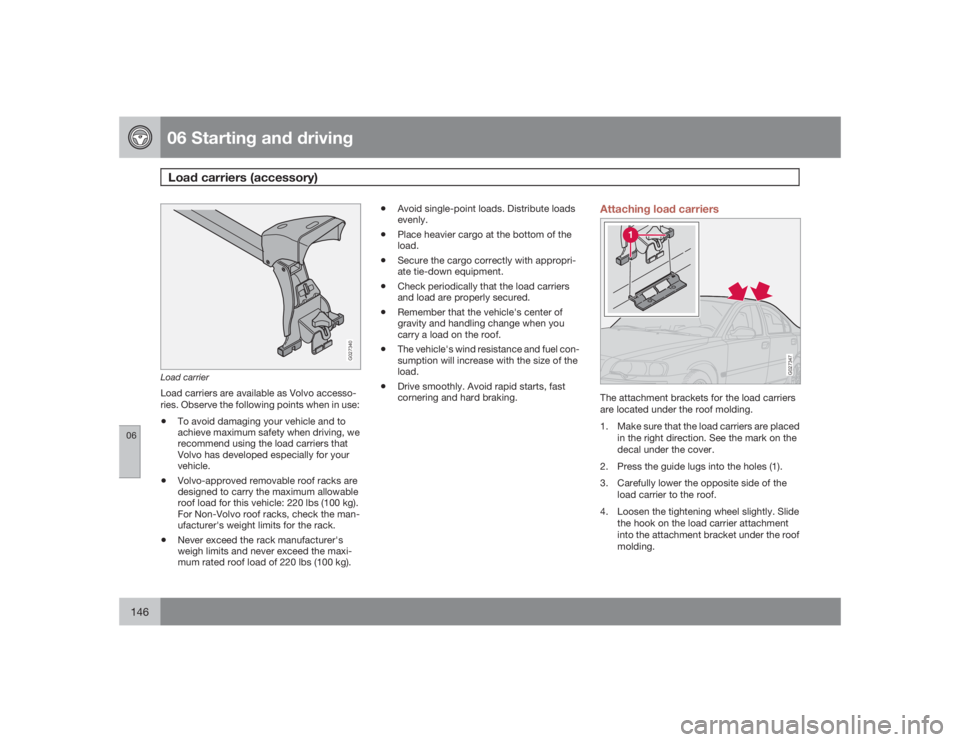
Load carrierLoad carriers are available as Volvo accesso-
ries. Observe the following points when in use:•
To avoid damaging your vehicle and to
achieve maximum safety when driving, we
recommend using the load carriers that
Volvo has developed especially for your
vehicle.
•
Volvo-approved removable roof racks are
designed to carry the maximum allowable
roof load for this vehicle: 220 lbs (100 kg).
For Non-Volvo roof racks, check the man-
ufacturer's weight limits for the rack.
•
Never exceed the rack manufacturer's
weigh limits and never exceed the maxi-
mum rated roof load of 220 lbs (100 kg).
•
Avoid single-point loads. Distribute loads
evenly.
•
Place heavier cargo at the bottom of the
load.
•
Secure the cargo correctly with appropri-
ate tie-down equipment.
•
Check periodically that the load carriers
and load are properly secured.
•
Remember that the vehicle's center of
gravity and handling change when you
carry a load on the roof.
•
The vehicle's wind resistance and fuel con-
sumption will increase with the size of the
load.
•
Drive smoothly. Avoid rapid starts, fast
cornering and hard braking.
Attaching load carriers
G027347
The attachment brackets for the load carriers
are located under the roof molding.
1. Make sure that the load carriers are placed
in the right direction. See the mark on the
decal under the cover.
2. Press the guide lugs into the holes (1).
3. Carefully lower the opposite side of the
load carrier to the roof.
4. Loosen the tightening wheel slightly. Slide
the hook on the load carrier attachment
into the attachment bracket under the roof
molding.