steering VOLVO S60 2009 Owner´s Manual
[x] Cancel search | Manufacturer: VOLVO, Model Year: 2009, Model line: S60, Model: VOLVO S60 2009Pages: 254, PDF Size: 6.17 MB
Page 126 of 254
06 Starting and drivingStarting the vehicle
06126
WARNING
Never switch off the ignition (turn the ignition
key to position 0) or remove the key from the
ignition switch while the vehicle is in motion.
This could cause the steering wheel to lock,
which would make the vehicle impossible to
steer.
Page 128 of 254
06 Starting and drivingHandling and road holding
06128
Weight distribution affects handlingAt the specified curb weight your vehicle has a
tendency to understeer, which means that the
steering wheel has to be turned more than
might seem appropriate for the curvature of a
bend.
This ensures good stability and reduces the
risk of rear wheel skid. Remember that these
properties can alter with the vehicle load.
The heavier the load in the trunk (max. 220 lbs,
100 kg), the less the tendency to understeer.Handling, roadholdingVehicle load, tire design and inflation pressure
all affect vehicle handling. Therefore, check
that the tires are inflated to the recommended
pressure according to the vehicle load. See
"Tire pressure" section.
Loads should be distributed so that capacity
weight or maximum permissible axle loads are
not exceeded.
Speed-sensitive power steering
(Option on certain models)With this feature, the steering is most respon-
sive at lower speeds to make parking, driving
in city traffic, etc., easier. The effect of the
power steering diminishes as you accelerate
for greater stability at highway speeds.Driving through waterThe vehicle can be driven through water up to
a depth of approximately 9 in. (25 cm), at a
maximum speed of 6 mph (10 km/h).
Take particular care when driving through flow-
ing water.
Clean the electrical connections for trailer wir-
ing after driving in mud or water.
When driving through water, maintain low
speed and do not stop in the water.
WARNING
After driving through water, press lightly on
the brake pedal to ensure that the brakes
are functioning normally. Water or mud can
make the brake linings slippery, resulting in
delayed braking effect.
CAUTION
•
Engine damage will occur if water is
drawn into the air cleaner.
•
If the vehicle is driven through water
deeper than 9 in (25 cm), water may
enter the differential and the transmis-
sion. This reduces the oil's lubricating
capacity and may shorten the service
life of these components.
•
Do not allow the vehicle to stand in
water up to the door sills longer than
absolutely necessary. This could result
in electrical malfunctions.
•
If the engine has been stopped while the
car is in water, do not attempt to restart
the engine. Have the car towed out of
the water.
Page 136 of 254
06 Starting and drivingBrake system
06136
Anti-lock brakes (ABS)
If the warning lamp lights up there
is a malfunction of the ABS system
(the standard braking system will
however function) and the vehicle
should be driven cautiously to a
trained and qualified Volvo service technician
for inspection. The Anti-lock Braking System
(ABS) helps to improve vehicle control (stop-
ping and steering) during severe braking con-
ditions by limiting brake lockup. When the
system "senses" impending lockup, braking
pressure is automatically modulated in order to
help prevent lockup, which could lead to a skid.
The system performs a self-diagnostic test
when the engine is started and when the
vehicle first reaches a speed of approxi-
mately 12 mph (20 km/h). The brake pedal will
pulsate several times and a sound may be
audible from the ABS control module. This is
normal.
To obtain optimal effect from the ABS system,
constant pressure should be kept on the brake
pedal. Do not pump the brake pedal.
The switching of the ABS modulator will be
audible and the brake pedal will pulsate during
braking. Please be aware that ABS does not
increase the absolute braking potential of the
vehicle. While control will be enhanced, ABSwill not shorten stopping distances on slippery
surfaces.
ABS with EBD (Electronic Brake Force
Distribution)EBD is an integrated part of the ABS system.
EBD regulates the hydraulic pressure to the
rear brakes to help provide optimal braking
capacity. The brake pedal will pulsate during
braking, which is normal.
If the BRAKEandABS warning lights come on
at the same time, this could indicate a fault in
the brake system.
1. Stop the vehicle in a suitable place and
switch off the engine.
2. Restart the engine.
3. If both warning lights go off, no further
action is required.
WARNING
If the fluid level is below the MIN mark in the
reservoir or if a "
Brake failure - Service
urgent
" message is displayed in the text
window:DO NOT DRIVE
. Have the vehicle
towed to a trained and qualified Volvo serv-
ice technician and have the brake system
inspected.
4. If both lights are still on after the engine has
been restarted, switch off the engine again
and check the brake fluid level (see
page 193 for the location of the brake fluid
reservoir).
5.
If the brake fluid level is above the MIN
mark, drive carefully to a trained and quali-
fied Volvo service technician and have the
brake system inspected.Emergency Brake Assistance (EBA)The EBA function is designed to provide full
brake effect immediately in the event of sud-
den, hard braking. The system is activated by
the speed with which you depress the brake
pedal.
Page 138 of 254
06 Starting and drivingStability system
06138
Dynamic Stability Traction Control
(DSTC)The stability system consists of a number of
functions designed help reduce wheel spin,
counteract skidding, and to generally help
improve directional stability.
NOTE
A pulsating sound will be audible when the
system is actively operating and is normal.Traction control (TC)This function is designed to help reduce wheel
spin by transferring power from a drive wheel
that begins to lose traction to the wheel on the
opposite side of the vehicle (on the same axle).
TC is most active at low speeds.
This is one of the DSTC's permanent functions
and cannot be switched off.Spin control (SC)The spin control function is designed to help
prevent the drive wheels from spinning while
the vehicle is accelerating.
Under certain circumstances, such as when
driving with snow chains, or driving in deep
snow or loose sand, it may be advisable to
temporarily switch off this function for maxi-
mum tractive force.
Temporarily switching off Spin control1. Turn the thumb wheel (2) on the left-side
steering wheel lever until the DSTC menu
is displayed.
2.
Hold down the RESET button (1) to toggle
between
DSTC SPIN CONTROL ON
or
OFF
.
Active Yaw Control (AYC)This function helps maintain directional stabil-
ity, for example when cornering, by braking
one or more of the wheels if the vehicle shows
a tendency to skid or slide laterally.)
WARNING
The car's handling and stability characteris-
tics will be altered if the DSTC system func-
tions have been disabled.
G031005
Controls on the left-side steering wheel lever
NOTE
•
The message
DSTC SPIN CONTROL
OFF
indicates that the stability sys-
tem's spin control function has tempo-
rarily been switched off.
•
The stability control indicator light will
illuminate and remain on until spin con-
trol has been reactivated.
•
DSTC ON
indicates that all system
functions are active.
•
The spin control function is automati-
cally enabled each time the engine is
started.
Page 140 of 254
06 Starting and drivingTowing
06140
Emergency towing
ABC
G028091
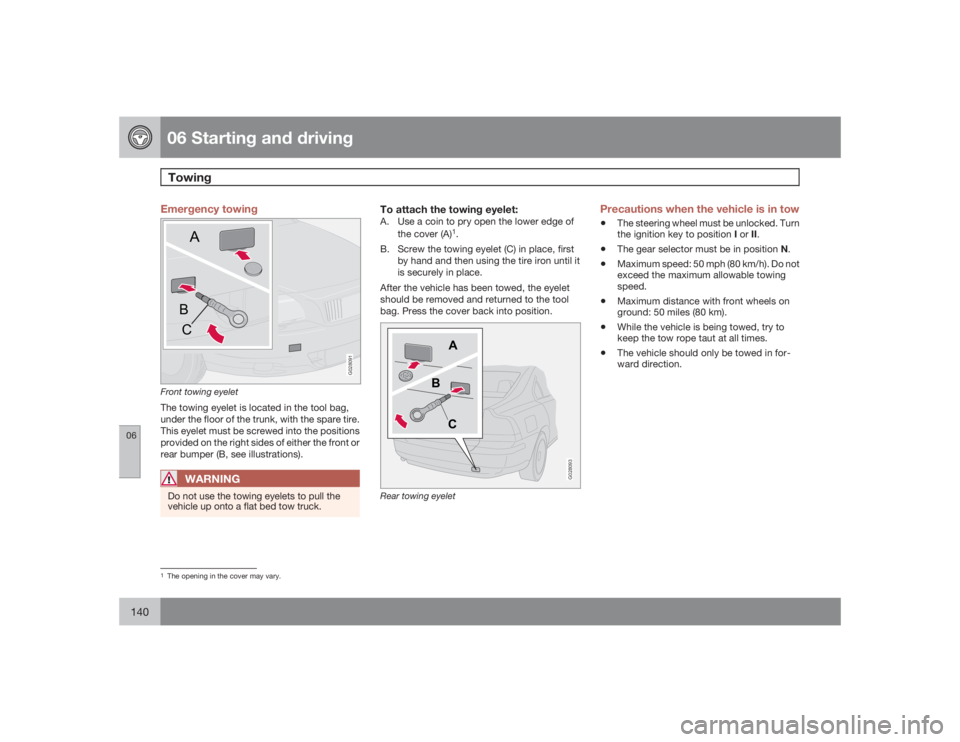
Front towing eyeletThe towing eyelet is located in the tool bag,
under the floor of the trunk, with the spare tire.
This eyelet must be screwed into the positions
provided on the right sides of either the front or
rear bumper (B, see illustrations).
WARNING
Do not use the towing eyelets to pull the
vehicle up onto a flat bed tow truck.
To attach the towing eyelet:A. Use a coin to pry open the lower edge of
the cover (A)
1.
B. Screw the towing eyelet (C) in place, first
by hand and then using the tire iron until it
is securely in place.
After the vehicle has been towed, the eyelet
should be removed and returned to the tool
bag. Press the cover back into position.A
B
C
G028093
Rear towing eyelet
Precautions when the vehicle is in tow•
The steering wheel must be unlocked. Turn
the ignition key to position I or II.
•
The gear selector must be in position N.
•
Maximum speed: 50 mph (80 km/h). Do not
exceed the maximum allowable towing
speed.
•
Maximum distance with front wheels on
ground: 50 miles (80 km).
•
While the vehicle is being towed, try to
keep the tow rope taut at all times.
•
The vehicle should only be towed in for-
ward direction.
1The opening in the cover may vary.
Page 141 of 254

06 Starting and driving
Towing
06
141
CAUTION
•
Please check with state and local
authorities before attempting this type
of towing, as vehicles being towed are
subject to regulations regarding maxi-
mum towing speed, length and type of
towing device, lighting, etc.
•
If the vehicle's battery is dead, do not
attempt to start the vehicle by pushing
or pulling it as this will damage the
three-way catalytic converter(s). The
engine must be jump started using an
auxiliary battery (see page 142).
•
If the vehicle is being towed on a flat bed
truck, the towing eyelets must not be
used to secure the vehicle on the flat
bed. Consult the tow truck operator.
WARNING
•
Remember that the power brakes and
power steering will not function when
engine is not running. The braking and
steering systems will function but the
brake pedal pressure required is
3 – 4 times above normal and greater
steering effort must be exerted.
•
The towing eyelets must not be used for
pulling another vehicle out of a ditch or
for any similar purpose involving severe
strain.
•
Do not use the towing eyelets to pull the
vehicle up onto a flat bed tow truck.
Towing vehicles with front wheel drive/
All Wheel DriveVolvo recommends the use of flat bed equip-
ment.
If wheel lift equipment must be used, please
use extreme caution to help avoid damage to
the vehicle. In this case, the vehicle should
be towed with the rear wheels on the ground
if at all possible.
If it is absolutely necessary to tow the vehicle
with the front wheels on the ground, please
refer to the towing information on the previous
page.
CAUTION
•
Sling-type equipment applied at the
front will damage radiator and air con-
ditioning lines.
•
It is equally important not to use sling-
type equipment at the rear or apply lift-
ing equipment inside the rear wheels;
serious damage to the rear axle may
result.
•
If the vehicle is being towed on a flat bed
truck, the towing eyelets must not be
used to secure the vehicle on the flat
bed. Consult the tow truck operator.WARNING
Do not use the towing eyelets to pull the
vehicle up onto a flat bed tow truck.
Page 149 of 254
06 Starting and driving
Before a long distance trip
06
149
It is always worthwhile to have your vehicle
checked by a trained and qualified Volvo serv-
ice technician before driving long distances.
Your retailer or service technician will also be
able to supply you with bulbs, fuses, spark
plugs and wiper blades for your use in the event
that problems occur.
As a minimum, the following items should be
checked before any long trip:•
Check that engine runs smoothly and that
fuel consumption is normal.
•
Check for fuel, oil, and fluid leakage.
•
Check transmission oil level
1.
•
Check condition of drive belts.
•
Check state of the battery's charge.
•
Examine tires carefully (the spare tire as
well), and replace those that are worn.
Check tire pressures.
•
The brakes, front wheel alignment, and
steering gear should be checked by a
trained and qualified Volvo service techni-
cian only.
•
Check all lights, including high beams.
•
Reflective warning triangles are legal
requirement in some countries.
•
Have a word with your Volvo retailer if you
intend to drive in countries where it may be
difficult to obtain the correct fuel.
•
Consider your destination. If you will be
driving through an area where snow or ice
are likely to occur, consider snow tires.
1To prevent injury from contact with hot surfaces, do not inspect your vehicle's transmission fluid yourself. Have your vehicle's transmission fluid level inspected by a qualified Volvo service technician.
Page 168 of 254
07 Wheels and tiresTire rotation
07168
G031112
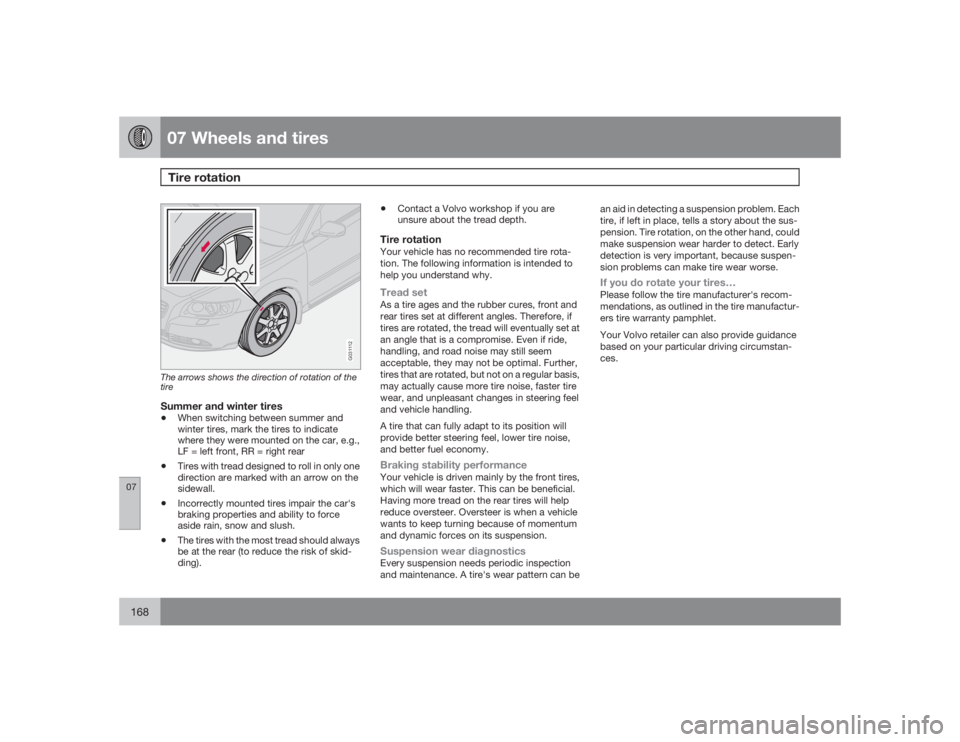
The arrows shows the direction of rotation of the
tireSummer and winter tires•
When switching between summer and
winter tires, mark the tires to indicate
where they were mounted on the car, e.g.,
LF = left front, RR = right rear
•
Tires with tread designed to roll in only one
direction are marked with an arrow on the
sidewall.
•
Incorrectly mounted tires impair the car's
braking properties and ability to force
aside rain, snow and slush.
•
The tires with the most tread should always
be at the rear (to reduce the risk of skid-
ding).
•
Contact a Volvo workshop if you are
unsure about the tread depth.
Tire rotationYour vehicle has no recommended tire rota-
tion. The following information is intended to
help you understand why.Tread setAs a tire ages and the rubber cures, front and
rear tires set at different angles. Therefore, if
tires are rotated, the tread will eventually set at
an angle that is a compromise. Even if ride,
handling, and road noise may still seem
acceptable, they may not be optimal. Further,
tires that are rotated, but not on a regular basis,
may actually cause more tire noise, faster tire
wear, and unpleasant changes in steering feel
and vehicle handling.
A tire that can fully adapt to its position will
provide better steering feel, lower tire noise,
and better fuel economy.Braking stability performanceYour vehicle is driven mainly by the front tires,
which will wear faster. This can be beneficial.
Having more tread on the rear tires will help
reduce oversteer. Oversteer is when a vehicle
wants to keep turning because of momentum
and dynamic forces on its suspension.Suspension wear diagnosticsEvery suspension needs periodic inspection
and maintenance. A tire's wear pattern can bean aid in detecting a suspension problem. Each
tire, if left in place, tells a story about the sus-
pension. Tire rotation, on the other hand, could
make suspension wear harder to detect. Early
detection is very important, because suspen-
sion problems can make tire wear worse.
If you do rotate your tires…Please follow the tire manufacturer's recom-
mendations, as outlined in the tire manufactur-
ers tire warranty pamphlet.
Your Volvo retailer can also provide guidance
based on your particular driving circumstan-
ces.
Page 187 of 254
09 Maintenance and servicing
Working on your vehicle
09``187
G027252
Note the following before you begin working
on your vehicleBattery•
Ensure that the battery cables are correctly
connected and tightened.
•
Never disconnect the battery when the
engine is running (e.g. when replacing the
battery).
•
Never use a fast charger to charge the bat-
tery. The battery cables should be discon-
nected when recharging.
•
The battery contains acid that is both cor-
rosive and poisonous. It is important that
the battery is handled in an environmen-
tally friendly way. Let your Volvo dealer
assist you.
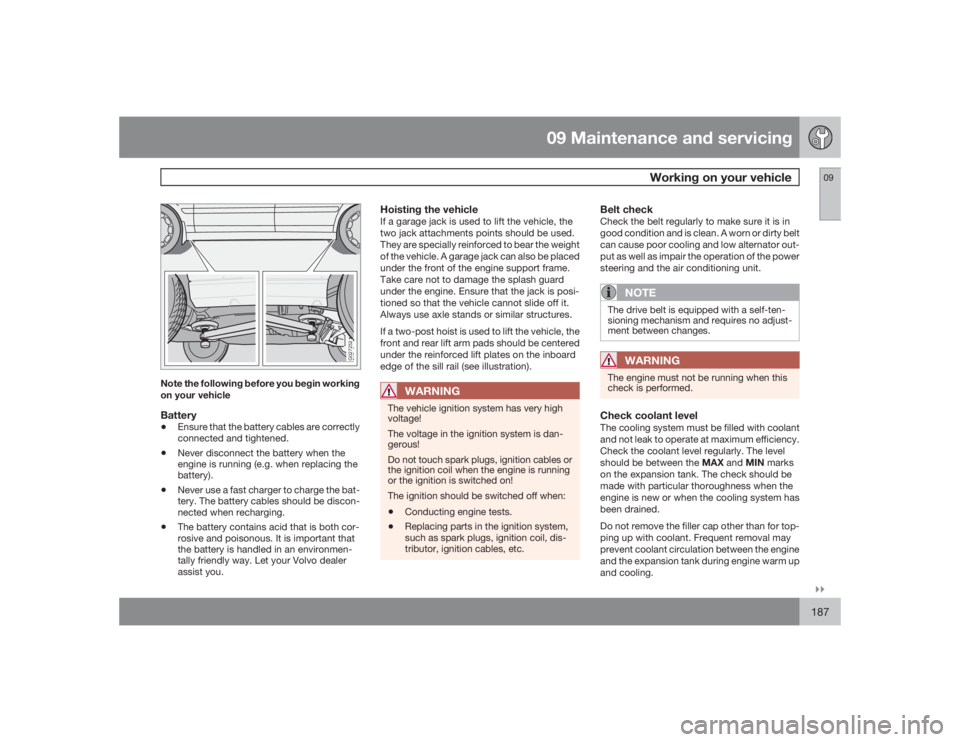
Hoisting the vehicleIf a garage jack is used to lift the vehicle, the
two jack attachments points should be used.
They are specially reinforced to bear the weight
of the vehicle. A garage jack can also be placed
under the front of the engine support frame.
Take care not to damage the splash guard
under the engine. Ensure that the jack is posi-
tioned so that the vehicle cannot slide off it.
Always use axle stands or similar structures.
If a two-post hoist is used to lift the vehicle, the
front and rear lift arm pads should be centered
under the reinforced lift plates on the inboard
edge of the sill rail (see illustration).
WARNING
The vehicle ignition system has very high
voltage!
The voltage in the ignition system is dan-
gerous!
Do not touch spark plugs, ignition cables or
the ignition coil when the engine is running
or the ignition is switched on!
The ignition should be switched off when:•
Conducting engine tests.
•
Replacing parts in the ignition system,
such as spark plugs, ignition coil, dis-
tributor, ignition cables, etc.
Belt checkCheck the belt regularly to make sure it is in
good condition and is clean. A worn or dirty belt
can cause poor cooling and low alternator out-
put as well as impair the operation of the power
steering and the air conditioning unit.
NOTE
The drive belt is equipped with a self-ten-
sioning mechanism and requires no adjust-
ment between changes.
WARNING
The engine must not be running when this
check is performed.Check coolant levelThe cooling system must be filled with coolant
and not leak to operate at maximum efficiency.
Check the coolant level regularly. The level
should be between the MAX and MIN marks
on the expansion tank. The check should be
made with particular thoroughness when the
engine is new or when the cooling system has
been drained.
Do not remove the filler cap other than for top-
ping up with coolant. Frequent removal may
prevent coolant circulation between the engine
and the expansion tank during engine warm up
and cooling.
Page 189 of 254
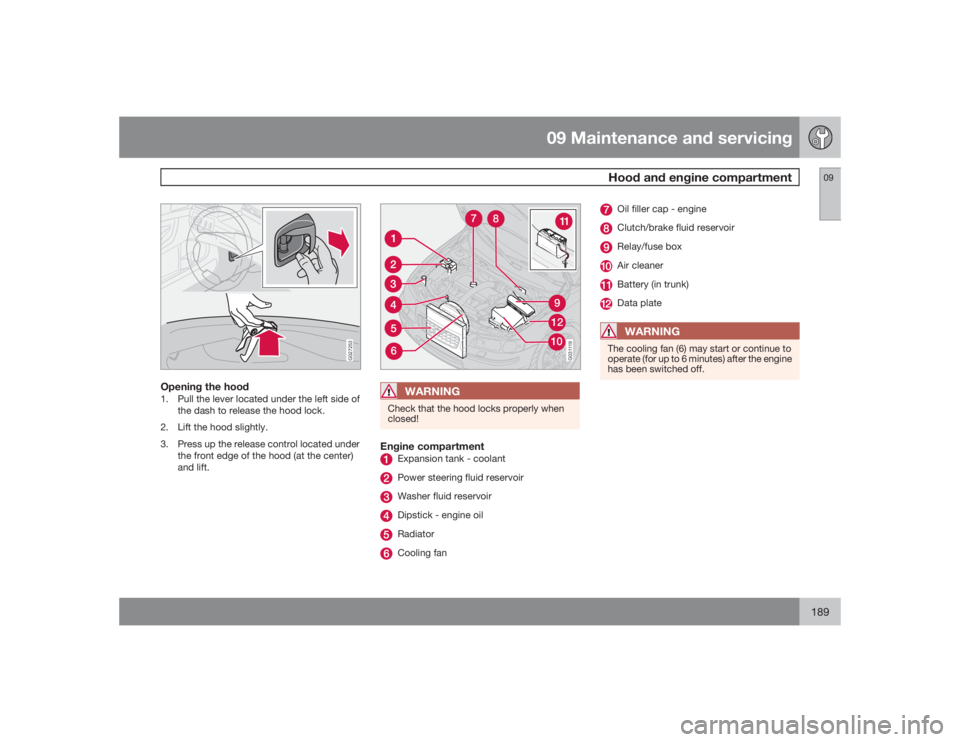
09 Maintenance and servicing
Hood and engine compartment
09
189
G027253
Opening the hood1. Pull the lever located under the left side of
the dash to release the hood lock.
2. Lift the hood slightly.
3. Press up the release control located under
the front edge of the hood (at the center)
and lift.
7
8
9
10
612
G031119
WARNING
Check that the hood locks properly when
closed!Engine compartment
Expansion tank - coolantPower steering fluid reservoirWasher fluid reservoirDipstick - engine oilRadiatorCooling fan
Oil filler cap - engineClutch/brake fluid reservoirRelay/fuse boxAir cleanerBattery (in trunk)Data plateWARNING
The cooling fan (6) may start or continue to
operate (for up to 6 minutes) after the engine
has been switched off.