warning light VOLVO S60 2009 Owner´s Manual
[x] Cancel search | Manufacturer: VOLVO, Model Year: 2009, Model line: S60, Model: VOLVO S60 2009Pages: 254, PDF Size: 6.17 MB
Page 110 of 254

05 Locks and alarmRemote control
05110
•
FCC ID:LQNP2T-APU This device
complies with part 15 of the FCC rules.
Operation is subject to the following
conditions: (1) This device may not
cause harmful interference, and (2) this
device must accept any interference
received, including interference that
may cause undesired operation.
•
Canadian 2306104388 Model 504 2927
by Donnelly Operation is subject to the
following conditions: (1) this device may
not cause interference, and (2) this
device must accept any interference,
including interference that may cause
undesired operation of the device.
•
Canadian 2306104388A Model 509
977 by Connaught Electronics Opera-
tion is subject to the following condi-
tions: (1) this device may not cause
interference, and (2) this device must
accept any interference, including inter-
ference that may cause undesired oper-
ation of the device.
NOTE
•
If an airbag deploys, your vehicle's SRS
control module will attempt to automat-
ically unlock all doors.
•
The keys may also be used to lock and
unlock the doors, and to activate and
deactivate the alarm system.
•
To avoid leaving your keys in the vehi-
cle, make a habit of always locking the
vehicle with the remote control.
•
If the key blade section of the remote is
not fully folded out when starting the
vehicle, the immobilizer function may
make it impossible to start the engine.
•
The vehicle can be locked even if a door
is open. When the door(s) are closed,
they will be locked. Please be aware
that the keys could be locked in the car
when this is done.
Automatic re-lockingIf the doors are unlocked, the locks will auto-
matically reengage (re-lock) and the alarm will
rearm after 2 minutes unless a door or the trunk
has been opened. This helps prevent the car
from inadvertently being left unlocked.
WARNING
Never use the transmitter to lock the doors
from inside the vehicle.
Doing so would ACTIVATE:•
the break-in alarm, which would sound
if one of the doors were opened
•
the optional interior motion and inclina-
tion alarm sensors.
Doing so would DEACTIVATE:
•
the moonroof and interior courtesy light
controls.
•
the central locking buttons on the front
door armrests, although the interior
door handles would still function to
allow occupants to leave the vehicle.
Disabled features would remain disabled
until the remote is used again to unlock the
vehicle.
In addition, locking an occupied vehicle
would hinder rapid access to the occupants
in an accident or emergency.
Page 122 of 254
06 Starting and drivingRefueling
06122
WARNING
Never carry a cell phone that is switched
on while refueling your vehicle. If the phone
rings, this may cause a spark that could
ignite gasoline fumes, resulting in fire and
injury.
WARNING
Carbon monoxide is a poisonous, colorless,
and odorless gas. It is present in all exhaust
gases. If you ever smell exhaust fumes
inside the vehicle, make sure the passenger
compartment is ventilated, and immediately
return the vehicle to a trained and qualified
Volvo service technician for correction.
WARNING
Driving with the trunk open: Driving with
the trunk open could lead to poisonous
exhaust gases entering the passenger com-
partment.
If the trunk must be kept open for any rea-
son, proceed as follows:•
Close the windows
•
Set the ventilation system control to air
flow to floor, windshield and side win-
dows and blower control to its highest
setting.
Fuel filler door
G025967
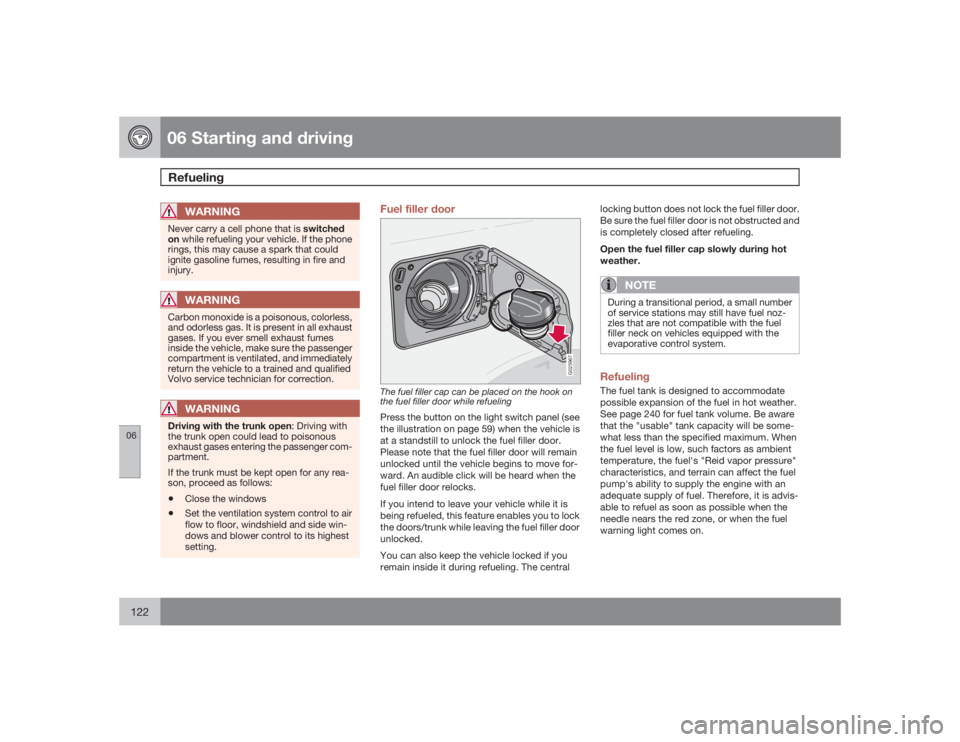
The fuel filler cap can be placed on the hook on
the fuel filler door while refuelingPress the button on the light switch panel (see
the illustration on page 59) when the vehicle is
at a standstill to unlock the fuel filler door.
Please note that the fuel filler door will remain
unlocked until the vehicle begins to move for-
ward. An audible click will be heard when the
fuel filler door relocks.
If you intend to leave your vehicle while it is
being refueled, this feature enables you to lock
the doors/trunk while leaving the fuel filler door
unlocked.
You can also keep the vehicle locked if you
remain inside it during refueling. The centrallocking button does not lock the fuel filler door.
Be sure the fuel filler door is not obstructed and
is completely closed after refueling.
Open the fuel filler cap slowly during hot
weather.
NOTE
During a transitional period, a small number
of service stations may still have fuel noz-
zles that are not compatible with the fuel
filler neck on vehicles equipped with the
evaporative control system.RefuelingThe fuel tank is designed to accommodate
possible expansion of the fuel in hot weather.
See page 240 for fuel tank volume. Be aware
that the "usable" tank capacity will be some-
what less than the specified maximum. When
the fuel level is low, such factors as ambient
temperature, the fuel's "Reid vapor pressure"
characteristics, and terrain can affect the fuel
pump's ability to supply the engine with an
adequate supply of fuel. Therefore, it is advis-
able to refuel as soon as possible when the
needle nears the red zone, or when the fuel
warning light comes on.
Page 124 of 254

06 Starting and drivingStarting the vehicle
06124
Starting the engine
WARNING
Before starting, check that the seat, steering
wheel and mirrors are adjusted properly.
Make sure the brake pedal can be
depressed completely. Adjust the seat if
necessary. See pages 94 and 94.1. Fasten the seat belt.
2. Apply the parking brake (hand brake) if not
already set. The gear selector (automatic
transmission) is locked in the (P)ark posi-
tion (SHIFTLOCK).
Manual transmission: the clutch must be
fully depressed.
3. Without touching the accelerator pedal,
turn the ignition key
1to the starting posi-
tion. Allow the starter to operate for up to
10 seconds. Release the key as soon as
the engine starts. If the engine fails to start,
repeat this step.
NOTE
•
If the key blade section of the remote is
not fully folded out when starting the
vehicle, the immobilizer function may
make it impossible to start the engine.
•
After a cold start, idle speed may be
noticeably higher than normal for a
short period. This is done to help bring
components in the emission control
system to their normal operating tem-
perature as quickly as possible, which
enables them to control emissions and
help reduce the vehicle's impact on the
environment.
•
To release the gear selector from the P
position, the engine must be running (or
the ignition key must be in position II)
and the brake pedal must be
depressed.
•
Select the desired gear. The gear
engages after a very slight delay which
is especially noticeable when selecting
R.
NOTE
Your vehicle is equipped with a KEYLOCK
system (automatic transmission). When the
engine is switched off, the gear selector
must be in the P position before the key can
be removed from the ignition switch.
When starting in cold weather, the trans-
mission may shift up at slightly higher
engine speeds than normal until the auto-
matic transmission fluid reaches normal
operating temperature.
WARNING
An extra mat on the driver's floor can cause
the accelerator pedal to catch. Check that
the movement of the accelerator pedal is
not impeded. No more than one protective
floor covering may be used at one time.
1If two of the keys to your vehicle are close together, e.g. on the same key ring, when you try to start the vehicle, this could cause interference in the immobilizer system and result in the vehicle not
starting. If this should occur, remove one of the keys from the key ring before trying to start the vehicle again.
Page 125 of 254
06 Starting and driving
Starting the vehicle
06``125
WARNING
Always place the gear selector in Park or in
reverse on models with a manual transmis-
sion, and apply the parking brake before
leaving the vehicle. Never leave the vehicle
unattended with the engine running.
Always open garage doors fully before star-
ting the engine inside a garage to ensure
adequate ventilation. The exhaust gases
contain carbon monoxide, which is invisible
and odorless but very poisonous
CAUTION
Automatic transmission
The engine should be idling when you move
the gear selector. Never accelerate until
after you feel the transmission engage!
Accelerating immediately after selecting a
gear will cause harsh engagement and pre-
mature transmission wear.
SelectingP or N when idling at a standstill
for prolonged periods of time will help pre-
vent overheating of the automatic transmis-
sion fluid.Do not race a cold engine immediately after
starting.
Ignition switch and steering wheel lock
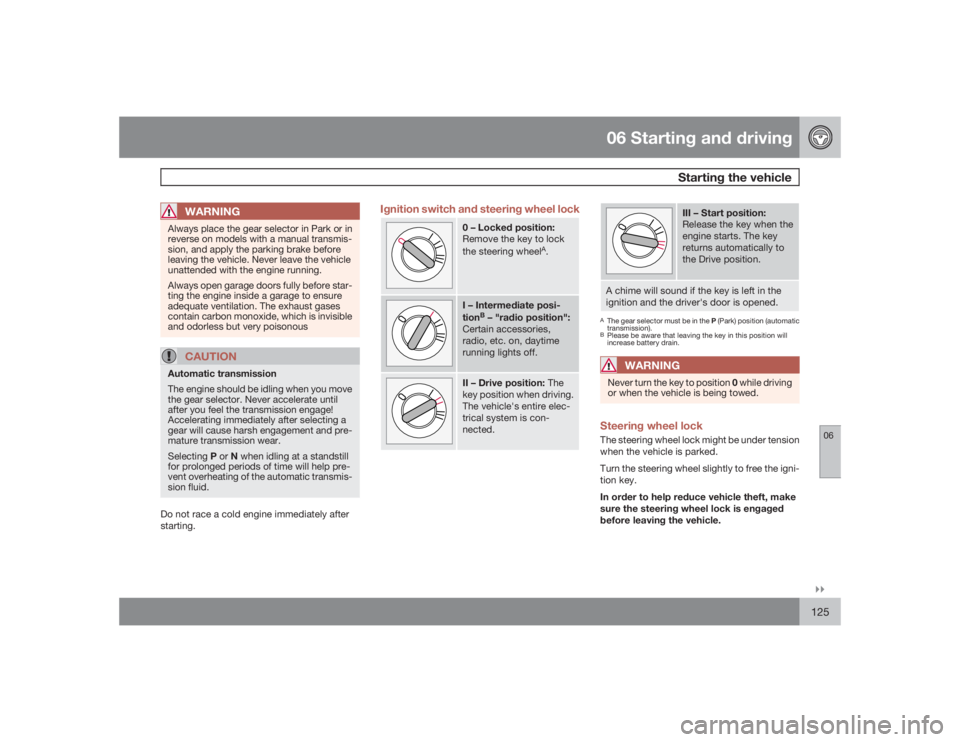
0 – Locked position:
Remove the key to lock
the steering wheel
A.
I – Intermediate posi-
tion
B – "radio position":
Certain accessories,
radio, etc. on, daytime
running lights off.
II – Drive position: The
key position when driving.
The vehicle's entire elec-
trical system is con-
nected.
III – Start position:
Release the key when the
engine starts. The key
returns automatically to
the Drive position.
A chime will sound if the key is left in the
ignition and the driver's door is opened.AThe gear selector must be in the P (Park) position (automatic
transmission).BPlease be aware that leaving the key in this position will
increase battery drain.
WARNING
Never turn the key to position 0 while driving
or when the vehicle is being towed.Steering wheel lockThe steering wheel lock might be under tension
when the vehicle is parked.
Turn the steering wheel slightly to free the igni-
tion key.
In order to help reduce vehicle theft, make
sure the steering wheel lock is engaged
before leaving the vehicle.
Page 128 of 254
06 Starting and drivingHandling and road holding
06128
Weight distribution affects handlingAt the specified curb weight your vehicle has a
tendency to understeer, which means that the
steering wheel has to be turned more than
might seem appropriate for the curvature of a
bend.
This ensures good stability and reduces the
risk of rear wheel skid. Remember that these
properties can alter with the vehicle load.
The heavier the load in the trunk (max. 220 lbs,
100 kg), the less the tendency to understeer.Handling, roadholdingVehicle load, tire design and inflation pressure
all affect vehicle handling. Therefore, check
that the tires are inflated to the recommended
pressure according to the vehicle load. See
"Tire pressure" section.
Loads should be distributed so that capacity
weight or maximum permissible axle loads are
not exceeded.
Speed-sensitive power steering
(Option on certain models)With this feature, the steering is most respon-
sive at lower speeds to make parking, driving
in city traffic, etc., easier. The effect of the
power steering diminishes as you accelerate
for greater stability at highway speeds.Driving through waterThe vehicle can be driven through water up to
a depth of approximately 9 in. (25 cm), at a
maximum speed of 6 mph (10 km/h).
Take particular care when driving through flow-
ing water.
Clean the electrical connections for trailer wir-
ing after driving in mud or water.
When driving through water, maintain low
speed and do not stop in the water.
WARNING
After driving through water, press lightly on
the brake pedal to ensure that the brakes
are functioning normally. Water or mud can
make the brake linings slippery, resulting in
delayed braking effect.
CAUTION
•
Engine damage will occur if water is
drawn into the air cleaner.
•
If the vehicle is driven through water
deeper than 9 in (25 cm), water may
enter the differential and the transmis-
sion. This reduces the oil's lubricating
capacity and may shorten the service
life of these components.
•
Do not allow the vehicle to stand in
water up to the door sills longer than
absolutely necessary. This could result
in electrical malfunctions.
•
If the engine has been stopped while the
car is in water, do not attempt to restart
the engine. Have the car towed out of
the water.
Page 135 of 254
06 Starting and driving
Brake system
06``135 BRAKE Brake circuit malfunction
The brake system is a hydraulic system con-
sisting of two master cylinders and two sepa-
rate brake circuits. If a problem should occur in
one of these circuits, it is still possible to stop
the vehicle with the other brake circuit.
If the brake pedal must be depressed farther
than normal and requires greater foot pressure,
the stopping distance will be longer.
A warning light in the instrument panel will light
up to warn the driver that a fault has occurred.
If this light comes on while driving or braking,
stop immediately and check the brake fluid
level in the reservoir.
NOTE
Press the brake pedal hard and maintain
pressure on the pedal – do not pump the
brakes.
WARNING
If the fluid level is below the MIN mark in the
reservoir or if a
Brake failure – Service
urgent
message is displayed in the text
window:DO NOT DRIVE
. Have the vehicle
towed to a trained and qualified Volvo serv-
ice technician and have the brake system
inspected.
NOTE
When the vehicle is at a standstill and the
engine is idling, e.g. at a traffic light and the
brake pedal is depressed, the pedal may go
down slightly. This is a normal function of
the power-assisted brake system.Power brakes function only when the
engine is runningThe power brakes utilize vacuum pressure
which is only created when the engine is run-
ning. Never let the vehicle roll to a stop with the
engine switched off.
If the power brakes are not working, the brake
pedal must be pressed approximately four
times harder than usual to make up for the lack
of power assistance. This can happen for
example when towing your vehicle or if the
engine is switched off when the vehicle is roll-
ing. The brake pedal feels harder than usual.
Water on brake discs and brake pads
affects brakingDriving in rain and slush or passing through an
automatic car wash can cause water to collect
on the brake discs and pads. This will cause a
delay in braking effect when the pedal is
depressed. To avoid such a delay when the
brakes are needed, depress the pedal occa-
sionally when driving through rain, slush etc.
This will remove the water from the brakes.
Check that brake application feels normal. This
should also be done after washing or starting
in very damp or cold weather.Severe strain on the brake systemThe brakes will be subject to severe strain
when driving in mountains or hilly areas or tow-
ing. Vehicle speed is usually slower, which
means that the cooling of the brakes is less
efficient than when driving on level roads. To
reduce the strain on the brakes, shift into a
lower gear and let the engine help with the
braking. Do not forget that, if you are towing a
trailer, the brakes will be subjected to a greater
than normal load.
Page 136 of 254
06 Starting and drivingBrake system
06136
Anti-lock brakes (ABS)
If the warning lamp lights up there
is a malfunction of the ABS system
(the standard braking system will
however function) and the vehicle
should be driven cautiously to a
trained and qualified Volvo service technician
for inspection. The Anti-lock Braking System
(ABS) helps to improve vehicle control (stop-
ping and steering) during severe braking con-
ditions by limiting brake lockup. When the
system "senses" impending lockup, braking
pressure is automatically modulated in order to
help prevent lockup, which could lead to a skid.
The system performs a self-diagnostic test
when the engine is started and when the
vehicle first reaches a speed of approxi-
mately 12 mph (20 km/h). The brake pedal will
pulsate several times and a sound may be
audible from the ABS control module. This is
normal.
To obtain optimal effect from the ABS system,
constant pressure should be kept on the brake
pedal. Do not pump the brake pedal.
The switching of the ABS modulator will be
audible and the brake pedal will pulsate during
braking. Please be aware that ABS does not
increase the absolute braking potential of the
vehicle. While control will be enhanced, ABSwill not shorten stopping distances on slippery
surfaces.
ABS with EBD (Electronic Brake Force
Distribution)EBD is an integrated part of the ABS system.
EBD regulates the hydraulic pressure to the
rear brakes to help provide optimal braking
capacity. The brake pedal will pulsate during
braking, which is normal.
If the BRAKEandABS warning lights come on
at the same time, this could indicate a fault in
the brake system.
1. Stop the vehicle in a suitable place and
switch off the engine.
2. Restart the engine.
3. If both warning lights go off, no further
action is required.
WARNING
If the fluid level is below the MIN mark in the
reservoir or if a "
Brake failure - Service
urgent
" message is displayed in the text
window:DO NOT DRIVE
. Have the vehicle
towed to a trained and qualified Volvo serv-
ice technician and have the brake system
inspected.
4. If both lights are still on after the engine has
been restarted, switch off the engine again
and check the brake fluid level (see
page 193 for the location of the brake fluid
reservoir).
5.
If the brake fluid level is above the MIN
mark, drive carefully to a trained and quali-
fied Volvo service technician and have the
brake system inspected.Emergency Brake Assistance (EBA)The EBA function is designed to provide full
brake effect immediately in the event of sud-
den, hard braking. The system is activated by
the speed with which you depress the brake
pedal.
Page 138 of 254
06 Starting and drivingStability system
06138
Dynamic Stability Traction Control
(DSTC)The stability system consists of a number of
functions designed help reduce wheel spin,
counteract skidding, and to generally help
improve directional stability.
NOTE
A pulsating sound will be audible when the
system is actively operating and is normal.Traction control (TC)This function is designed to help reduce wheel
spin by transferring power from a drive wheel
that begins to lose traction to the wheel on the
opposite side of the vehicle (on the same axle).
TC is most active at low speeds.
This is one of the DSTC's permanent functions
and cannot be switched off.Spin control (SC)The spin control function is designed to help
prevent the drive wheels from spinning while
the vehicle is accelerating.
Under certain circumstances, such as when
driving with snow chains, or driving in deep
snow or loose sand, it may be advisable to
temporarily switch off this function for maxi-
mum tractive force.
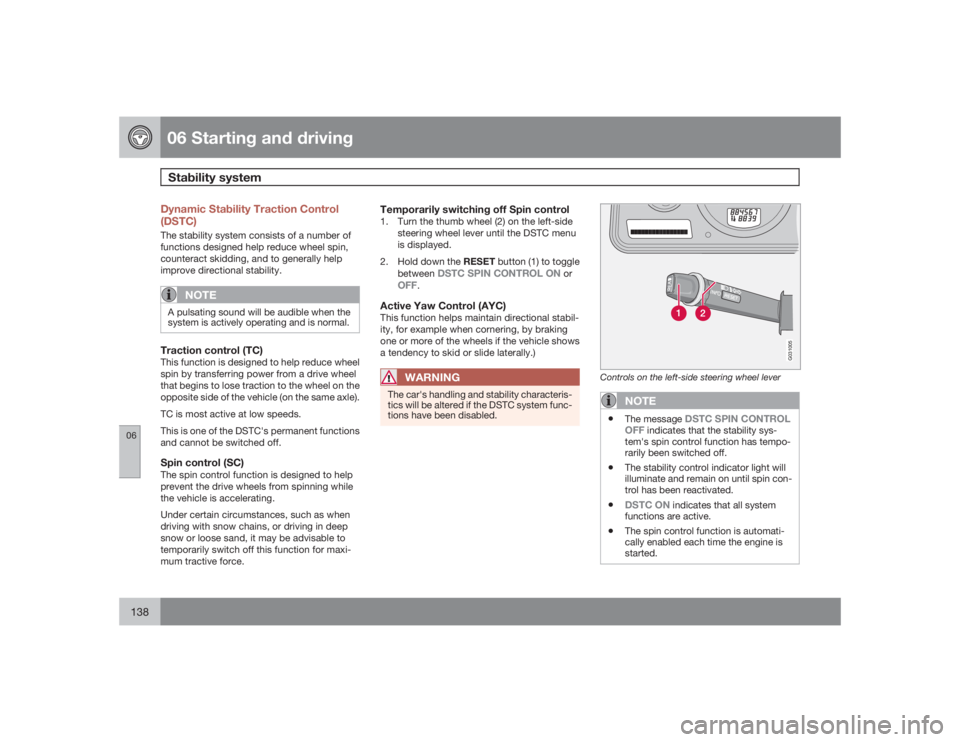
Temporarily switching off Spin control1. Turn the thumb wheel (2) on the left-side
steering wheel lever until the DSTC menu
is displayed.
2.
Hold down the RESET button (1) to toggle
between
DSTC SPIN CONTROL ON
or
OFF
.
Active Yaw Control (AYC)This function helps maintain directional stabil-
ity, for example when cornering, by braking
one or more of the wheels if the vehicle shows
a tendency to skid or slide laterally.)
WARNING
The car's handling and stability characteris-
tics will be altered if the DSTC system func-
tions have been disabled.
G031005
Controls on the left-side steering wheel lever
NOTE
•
The message
DSTC SPIN CONTROL
OFF
indicates that the stability sys-
tem's spin control function has tempo-
rarily been switched off.
•
The stability control indicator light will
illuminate and remain on until spin con-
trol has been reactivated.
•
DSTC ON
indicates that all system
functions are active.
•
The spin control function is automati-
cally enabled each time the engine is
started.
Page 139 of 254

06 Starting and driving
Stability system
06
139
DSTC-related messages in the text
window•
"TRACTION CONTROL TEMPORARILY
OFF
" - The system has been temporarily
switched off due to high brake temperature
and will automatically switch on again
when the brakes have cooled.
•
"ANTI SKID SERVICE REQUIRED
" - the
system has been automatically disen-
gaged due to a fault. A trained and qualified
Volvo service technician should check the
system.
Symbols in the instrument panelThe Stability Control indicator light
This light indicates different condi-
tions, depending on how it illumi-
nates.
The Stability Control indicator light
illuminates for approximately 2 secondsThis indicates that the system is performing a
self-diagnostic test when the ignition is
switched on.The Stability Control indicator light
flashesThis indicates that the stability system is
actively functioning to help counteract wheel
spin and/or a skid.
The Stability Control indicator light
glows steadily"ANTI SKID SERVICE REQUIRED
" will be
displayed in the text window at the same time.
A fault is indicated in the stability system.
1. Stop the vehicle in a safe place and switch
off the engine.
2. Restart the engine.
3. If the indicator light goes out, the fault was
temporary and no further action is
required.
4. If the indicator light remains on, drive to an
authorized Volvo workshop as soon as
possible to have the system checked.
The Stability Control indicator light
glows steadilyIf "
DSTC SPIN CONTROL OFF
" is displayed
in the text window at the same time, this is a
reminder that spin control has been disabled
by the driver.
The warning symbol
The warning symbol glows
steadily yellow
The system has been temporarily switched off
due to high brake temperature. "
TRACTION
CONTROL TEMPORARILY OFF" will be dis-
played. The system will automatically switch
on again when the brakes have cooled.
WARNING
The stability system is intended to help
improve driving safety. It supplements, but
can never replace, the driver's judgement
and responsibility when operating the vehi-
cle. Speed and driving style should always
be adapted to traffic and road conditions.
Page 141 of 254

06 Starting and driving
Towing
06
141
CAUTION
•
Please check with state and local
authorities before attempting this type
of towing, as vehicles being towed are
subject to regulations regarding maxi-
mum towing speed, length and type of
towing device, lighting, etc.
•
If the vehicle's battery is dead, do not
attempt to start the vehicle by pushing
or pulling it as this will damage the
three-way catalytic converter(s). The
engine must be jump started using an
auxiliary battery (see page 142).
•
If the vehicle is being towed on a flat bed
truck, the towing eyelets must not be
used to secure the vehicle on the flat
bed. Consult the tow truck operator.
WARNING
•
Remember that the power brakes and
power steering will not function when
engine is not running. The braking and
steering systems will function but the
brake pedal pressure required is
3 – 4 times above normal and greater
steering effort must be exerted.
•
The towing eyelets must not be used for
pulling another vehicle out of a ditch or
for any similar purpose involving severe
strain.
•
Do not use the towing eyelets to pull the
vehicle up onto a flat bed tow truck.
Towing vehicles with front wheel drive/
All Wheel DriveVolvo recommends the use of flat bed equip-
ment.
If wheel lift equipment must be used, please
use extreme caution to help avoid damage to
the vehicle. In this case, the vehicle should
be towed with the rear wheels on the ground
if at all possible.
If it is absolutely necessary to tow the vehicle
with the front wheels on the ground, please
refer to the towing information on the previous
page.
CAUTION
•
Sling-type equipment applied at the
front will damage radiator and air con-
ditioning lines.
•
It is equally important not to use sling-
type equipment at the rear or apply lift-
ing equipment inside the rear wheels;
serious damage to the rear axle may
result.
•
If the vehicle is being towed on a flat bed
truck, the towing eyelets must not be
used to secure the vehicle on the flat
bed. Consult the tow truck operator.WARNING
Do not use the towing eyelets to pull the
vehicle up onto a flat bed tow truck.